
Pakistan’s Prime Minister Imran Khan has been ousted from power after losing a no-confidence vote in his leadership.

The vote was held past midnight after opposition parties brought a motion against him, following days of drama.

The motion was first brought last week, but the former cricket star blocked it by dissolving parliament.

Sunday’s vote took place after the country’s Supreme Court ruled in favour of opposition parties and said that Mr Khan had acted unconstitutionally.

Opposition leader Shehbaz Sharif said Pakistan and its parliament were “finally freed from a serious crisis”, adding in a tweet: “Congratulations to the Pakistani nation on a new dawn.”

Mr Khan is the first Pakistani prime minister to be ousted by a no-confidence motion, with opposition parties securing 174 votes in the 342-member house in support of the no-confidence motion.

His replacement, who will be voted in by parliament on Monday, will be able to hold power until October 2023, when the next election is due to be held.

‘International conspiracy’

However, Mr Khan had said he would not recognise an opposition government, claiming – without evidence – that there was a US-led conspiracy to remove him because of his refusal to stand with Washington on issues against Russia and China.

He has repeatedly said that Pakistan’s opposition parties are working with foreign powers. Members of his party (PTI) left the building just ahead of the vote, also insisting he was the victim of an international conspiracy.

The US has said there is “no truth” in these allegations, and Mr Khan has never provided any evidence.

Police officers in Islamabad, Pakistan, detain supporters of former Pakistani Prime Minister Imran Khan during a protest

When Imran Khan was elected prime minister in 2018, he seemed to have almost everything in his favour.

A national hero from his cricketing days, he had transformed into a charismatic politician and, after years of struggle, managed to supplant the two rival established political dynasties that had dominated Pakistan for decades.

He emerged as a fresh force, with vibrant rallies full of catchy songs which, along with his huge social media presence, amplified his staunch anti-corruption message. Mr Khan promised to bring “change” to the country, creating a “new Pakistan”.

No prime minister has ever completed a full five-year parliamentary tenure in Pakistan, and Imran Khan looked as though he could well be the first.

The reason his position appeared so secure, however, also helps explain his downfall. Both sides deny it, but it’s widely acknowledged he came to power with the help of Pakistan’s powerful army and intelligence services – and now he has fallen out with them.

The vote was initially due to take place in parliament last Sunday, but deputy speaker Qasim Suri – a member of Mr Khan’s political party – swiftly blocked the motion, saying it showed “foreign interference”. Mr Suri also said that it went against the constitution, which calls for loyalty to the state.

Mr Khan’s government went on to dissolve parliament and called for a snap election to be held. This angered several opposition members, with some accusing the prime minister of treason for blocking the vote.

Opposition figures submitted a petition to the Supreme Court to assess the situation.

On Thursday, Pakistan’s top court ruled that Mr Khan’s decision to stop the vote from going ahead was unconstitutional. It ordered that the no-confidence vote should go ahead again.

However an impasse over the vote continued well into Saturday evening, prompting the speaker of the lower house of parliament – Asad Qaiser, an ally of Mr Khan – to resign.

Five things to know about Imran Khan (from 2018)

Pakistan: The basics

Who is the ruling party in Pakistan? Pakistan’s current ruling party is Pakistan Tehreek-e-Insaf (PTI), which is one of the three major political parties of Pakistan. It is now headed by former cricketer-turned-politician and PTI head Imran Khan, who took power as Prime Minister in 2018 after PTI emerged as the dominant party in government following the 2013 general elections.

Who are the opposition? The opposition is headed by the Pakistan Muslim League-N (PML-N) and the Pakistan Peoples Party (PPP) — two usually feuding dynastic groups that dominated national politics for decades until prime minister Imran Khan forged a coalition against them.

How long does the prime minister serve for? The prime minister of Pakistan serves for a five-year term. However no elected or appointed prime ministers have served the entirety of their term to date.


Council elections 2022: Plaid Cymru councillors “make a difference” to people’s everyday lives, party leader Adam Price has said, as he launched its local election campaign.

Mr Price cited Plaid councils’ policy of aiming to extend free school meals to all their secondary school pupils as a clear example.

Plaid Cymru currently leads four councils in Wales – Carmarthenshire, Ceredigion, Anglesey and Gwynedd.

The party made modest gains overall at the previous local elections, in 2017.

Increasing its majority in Gwynedd and becoming the largest party in Anglesey, it raised its tally of councillors across Wales by 33 to 202 five years ago.

There were also significant gains in councils that included Rhondda Cynon Taf, Carmarthenshire and Neath Port Talbot.

Joined by council candidates at an event in Deganwy, Conwy county, Mr Price listed three key priorities to put before voters on polling day on 5 May – free school meals, housing and safeguarding jobs and incomes.

Free meals are already being extended to all children in primary education under Plaid’s co-operation agreement with Labour ministers in the Senedd, starting this September with some of the youngest pupils.

Mr Price announced that Plaid Cymru-led councils would aim to extend the offer to all secondary school pupils in his party’s conference speech last month.

d the campaign with party activists just under a month from polling day

“This is the Plaid Cymru family at its best, because I feel we are a family, we are community,” he said on Friday.

“We’re the party of fairness and social justice, and not just social but economic and climate justice as well.

“We are the party that does right by future generations by making a difference today, because we can’t afford to wait when people are facing not just a cost of living crisis but a cost of living emergency.”

Speaking later to BBC Wales, Mr Price agreed that it would be hard for Plaid Cymru-led councils, under increasing local government cost pressures, to fund free meals for all secondary school pupils.

“It’s going to be difficult, but we are going to set the goal of moving on from primary school universal free school meals to secondary in the hope that, by providing that local leadership, we will be able to get the policy adopted at a national level,” he said.

“That’s what we really need, isn’t it? If we’re going to actually have it delivered to every child in Wales then that’s the way that we can ensure that.”

Is there an election in my area?

Enter your postcode, or the name of your English, Scottish or Welsh council area or Northern Ireland constituency to find out. Eg ‘B1 1RS’ or ‘Birmingham’

1px transparent line

In his speech, Mr Price highlighted the party’s policy to “tackle Wales’ housing crisis by building more energy-efficient, genuinely affordable housing, and take radical action on second homes and ending homelessness”.

He also promised to strengthen local supply chains and support local businesses – to safeguard jobs and incomes in the midst of what he called a “cost of living emergency”.

But he said the struggle to make ends meet that people are currently facing is “no accident” but a “direct consequence of Tory choices” by UK government ministers.

“Rocketing energy prices and gaping holes in vital safety nets such as universal credit are a manifestation of Conservative values, or I should say their model vacuum,” he said.

“Our local authorities are still suffering the side effects of those Tory cuts, at a time when they are in desperate need of extra funds to secure a real post-Covid recovery.”

Mr Price accused Sir Keir Starmer’s UK Labour Party of being “too weak and too racked by division to offer real leadership” in a crisis.

Providing free school meals to all secondary pupils would be hard for councils, said Mr Price

The Plaid Cymru leader also launched the party’s local election manifesto entitled “Making a Difference“.

Mr Price said the document “identifies problems, offers solutions, and most importantly, proves how having Plaid Cymru councillors are making a difference in communities all throughout Wales”.

Wales will be electing councillors in each of its 22 local authorities next month.

There are also elections taking place in parts of England, in Scotland and Northern Ireland.

Analysis by BBC Wales political reporter Emilia Belli

After a performance in the 2021 Senedd election that leader Adam Price acknowledged was “disappointing” Plaid Cymru is aiming for a positive set of results to send the message the party is back on track.

But a co-operation agreement with Labour in the Senedd and a deal with the greens at council level in Cardiff means differentiating Plaid on the doorstep might be a challenge.

While Adam Price had criticism for the UK Conservative and Labour parties in his launch speech, he conspicuously avoided any mention of First Minister Mark Drakeford, whose personal profile was seen as key to Labour’s successful campaign last May and his partner in that Cardiff Bay deal.

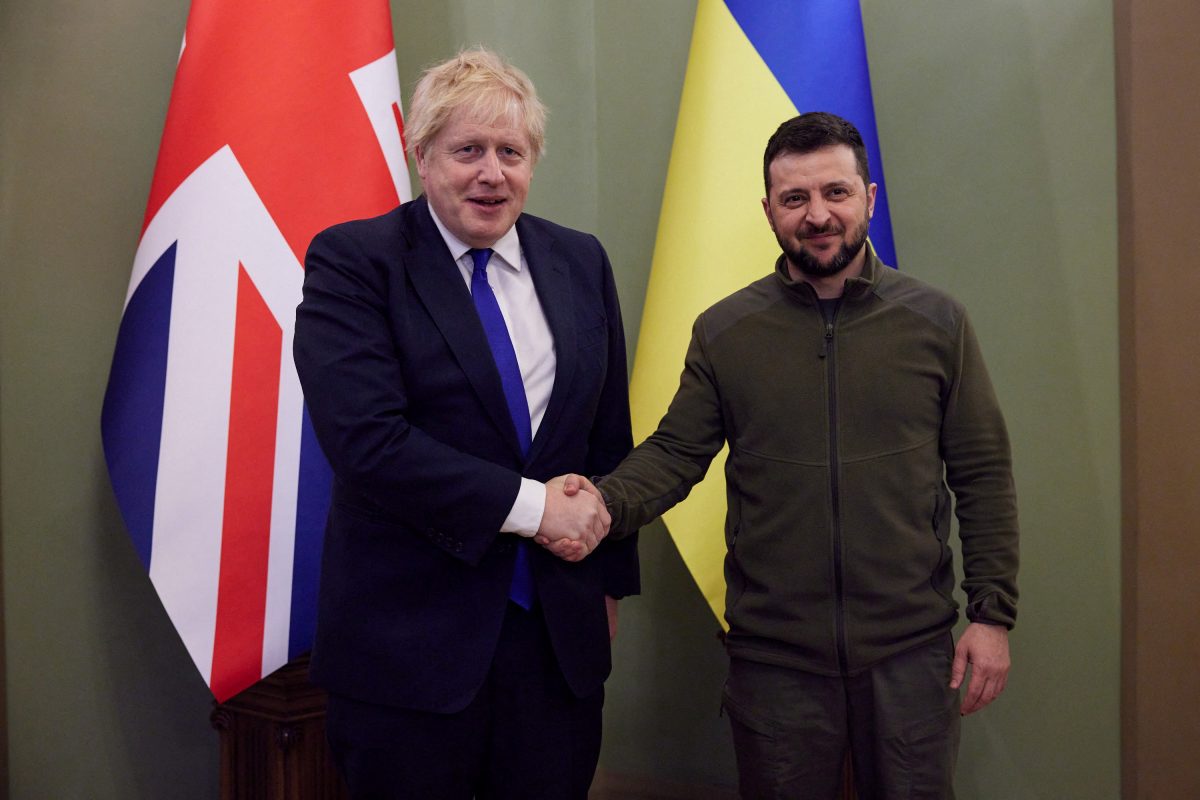
In show of support, British PM meets Ukraine’s Zelenskiy in Kyiv

President Volodymyr Zelenskiy met Prime Minister Boris Johnson, one of his staunchest backers, in Kyiv on Saturday, with the British leader using the visit to set out a new financial and military aid package for Ukraine.

Johnson is the latest foreign leader to visit Kyiv after Russian forces pulled back from the outskirts of the capital last week. The move caps weeks of lobbying by the British prime minister to meet Zelenskiy to underline their close ties.

Andriy Sybiha, deputy head of the Ukrainian president’s office, said on Facebook that Johnson’s visit had begun with a one-on-one meeting with Zelenskiy.

Zelenskiy’s office published pictures showing the two men chatting across a table.

Johnson met Zelenskiy “in a show of solidarity with the Ukrainian people”, a Downing Street spokesperson said.

“They will discuss the UK’s long-term support to Ukraine and the PM will set out a new package of financial and military aid,” the spokesperson added. Read full story

On Zelenskiy’s Telegram channel, Johnson was described as “one of the most principled opponents of the Russian invasion, a leader in putting sanctions on Russia and providing defensive support to Ukraine”.

Johnson’s visit to the Ukrainian capital was not announced in advance, and comes as Russia is amassing troops in the east of the country. Read full story

“The UK will send more defensive weapons to Ukraine and will work with G7 partners to target every pillar of the Russian economy to ensure Putin fails,” Johnson tweeted earlier on Saturday.

Indian media celebrates PM Imran Khan’s statement on its ‘sovereignty’

Prime Minister Imran Khan on Friday praised the Indian government for following an “independent” foreign policy, saying that none of the superpowers has the audacity to speak against New Delhi.

The premier highlighted the practices followed in India during his televised address to the nation and mentioned that India attained its independence from Britain at the same time as Pakistan but still, “none of the superpowers has the audacity to speak against India.”

As soon as the PM Imran Khan’s address ended, Indian media and journalists were quick to take notice of the comment and provided wide coverage to the Pakistani premier’s statement.

The Hindustan Times highlighted that the Pakistani premier called India a “‘khuddar qaum“.

India Times ran the story with the headline that “Pakistan should learn self-pride from India, no superpower can dictate terms to Delhi: Imran Khan”.

WIO News noted in its headline that the Pakistani premier had praised Indian foreign policy and commended New Delhi’s independent stand.

Meanwhile, NDTV’s headline read: “No superpower can dictate terms to India: Pak PM Imran Khan”.

Times Now wrote: “No superpower has guts to dictate India’s foreign policy, says Pakistan PM Imran Khan in his address to the nation”.

While Zee News reported that PM Imran Khan got emotional during the address praising Indian foreign policy and saying — “honest country”.

It is worth mentioning that this is not the first time the premier has praised Indian foreign policy, he has been acknowledging New Delhi’s stance for a while now.

Last time, during his public rally in the Dargai tehsil of the Malakand district PM Imran Khan praised the Indian government for following an “independent” foreign policy, saying that New Delhi’s policy was for the betterment of its people.

The premier had said that India is a member of the quad alliance, with the United States as one of its members, but it still calls itself “neutral”. He had stated that India is still importing oil from Russia, regardless of the sanctions the country is facing due to the Ukrainian war.

“This is because India’s foreign policy is for its people,” he had said.

‘Threat letter:’ US ‘bluntly’ calls PM Imran Khan’s allegations untrue

The US government Saturday once again categorically turned down Prime Minister Imran Khan’s allegations regarding its involvement in toppling his government through a no-trust motion, Geo News reported.

Prime Minister Imran Khan Friday addressed the nation and reiterated the stance that he would not tolerate the installation of a “foreign government” in Pakistan and that he would turn to the public for support if such a thing happens.

The PM stated that he would never accept an “imported government” and would look up to the public for their decision.

PM Khan maintained that even before the no-confidence motion was filed against him, the US official had warned the Pakistani ambassador that if Imran Khan manages to save himself from the motion, Pakistan would have to face “severe consequences.”

Criticizing the US official for his arrogance, he said that the official told the ambassador that if Imran Khan is ousted, Pakistan will be spared no matter who takes the charge.

In response to the Prime Minister’s continued allegations against the US government, the state department once again responded to his accusation and ‘bluntly’ rejected the claim of any involvement in changing the regime in Pakistan.

Since PM Khan leveled allegations against the US government to oust him from power, this is the fourth time the US government refuted his accusations.

On March 27, at a Jalsa, the PM accused the US of interfering in Pakistan’s politics and plotting to oust his regime through a no-trust motion in the National Assembly.

As proof, the PM also carried a ‘threat letter’ at the public gathering, saying that a foreign country has warned of dire consequences if he remains in power.

Following the PM’s addressed on April 8 to the nation, during a press briefing the Deputy State Department spokeswoman Jalina Porter rejected the allegations.

“Let me just say very bluntly there is absolutely no truth to these allegations,” she said.

Jalina Porter went on to say that the US government supports the constitutional process and rule of law in Pakistan.

“Of course, we continue to follow these developments, and we respect and support Pakistan’s constitutional process and rule of law. But again, these allegations are not true,” she concluded.

What is the ‘threat letter’?

On March 27, the premier, during what PTI labelled as one of its “biggest” rallies in its history at the Parade Ground in Islamabad, flashed a letter before the public, saying that he has “written evidence” that “money has been pouring in from abroad,” while “some of our people are being used to topple the government.”

Following the Opposition’s ruckus on the ‘threat letter’, the PM had called the National Security Committee (NSC) and presented the letter. To this, the NSC expressed concern and a demarche was issued to the US envoy in Pakistan.

Subsequently, based on this ‘threat letter’, the deputy speaker rejected the no-trust motion against the PM and President Arif Alvi dissolved the NA on the PM’s advice. However, this act turned into a deep constitutional crisis.

Supreme Court reinstates National Assembly

On Thursday, in landmark judgement, the Supreme Court of Pakistan restored the National Assembly after it declared the government’s decision to dissolve the assembly and NA Deputy Speaker Qasim Suri’s ruling against the Constitution.

The top court has ordered National Assembly Speaker Asad Qasier to summon the session on Saturday (April 9) no later than 10:30am to allow the vote on the no-confidence motion against the premier.

Following Supreme Court’s order, the National Assembly’s session for voting on the no-confidence motion against Prime Minister Imran Khan will take place at 10:30am today.

In the National Assembly’s (NA) agenda issued Friday, voting on the no-confidence motion is at the fourth position in the six-point agenda.

US-led coalition in Iraq downs drone targeting base

The US-led coalition fighting the Islamic State group in Iraq said it shot down Friday an armed drone that targeted an air base, reporting no casualties or damage.

“US air defence systems shot down an armed unmanned aerial system entering Al Asad Air Base” early Friday morning, the coalition said in a statement.

“There are no reported injuries or damage and all coalition personnel are accounted for,” it said, adding that the incident was “under investigation”.

The base, which is controlled by Iraq, is located in the desert in the western Anbar province.

The attack comes after four US troops were hurt Thursday when rockets were fired at a base housing American forces in neighbouring Syria’s Deir Ezzor province.

Dozens of rocket and armed drone attacks have targeted US troops and interests in Iraq in recent months.

Western officials have blamed hard-line pro-Iran factions for the attacks, which have never been claimed.

In early January, coalition forces in Iraq said they shot down two armed drones targeting the Ain Al-Asad base.

The US-led coalition ended its combat mission in Iraq in December, four years after the Baghdad government declared victory over the jihadists.

But roughly 2,500 American soldiers and 1,000 coalition soldiers remain deployed in three Iraqi-controlled bases across the country, including Ain Al-Asad, to offer training, advice and assistance to national forces.

Strike on train station kills 50 in Ukraine

KRAMATORSK: In one of the deadliest strikes of the six-week-old Ukrainian war, at least 50 people were killed and hundreds injured on Friday when a rocket hit a train station in the eastern city of Kramatorsk, drawing strong reactions from European Union and several other countries including Japan that decided to expel eight Russian diplomats and trade representatives.

However, the Russian defence ministry was quoted by RIA news agency as saying the missiles said to have struck the station were used only by Ukraine’s military and that Russia’s armed forces had no targets assigned in Kramatorsk on Friday.

The bombing came at a time when European Commission President Ursula von der Leyen and EU foreign policy chief Josep Borrell were in Kyiv for talks with President Volodymyr Zelensky and to visit the scene of civilian deaths in Bucha. Zelensky said no Ukrainian troops were at the station, calling it ‘a deliberate attack on civilians’ with 50 deaths and 300 reportedly injured. “Russian forces (fired) on an ordinary train station, on ordinary people,” he told Finland’s parliament in a video address.

Regional governor Pavlo Kyrylenko said the station was hit by a Tochka U short-range ballistic missile containing cluster munitions. However, Russia’s defence ministry said suggestions it had carried out the attack were “absolutely untrue”.

Reuters was unable to verify what happened in Kramatorsk.

Officials have begged civilians to flee, while the intensity of fighting is impeding evacuations. However, officials continued to press civilians to leave. “There is no secret — the battle for Donbas will be decisive. What we have already experienced — all this horror — it can multiply,” warned Lugansk regional governor Sergiy Gaiday. “Leave! The next few days are the last chances. Buses will be waiting for you in the morning,” he added.

Moscow has denied targeting civilians but growing evidence of atrocities has galvanised Ukraine’s allies to pile on more pressure.

The EU earlier approved an embargo on Russian coal and the closure of its ports to Russian vessels as part of a “very substantial” new round of sanctions that also includes an export ban and new measures against Russian banks. In addition, it backed a proposal to boost its funding of arms supplies to Ukraine by 500 million euros ($544 million), taking it to a total of 1.5 billion euros. So far, the bloc had frozen 30 billion euros in assets from blacklisted Russian and Belarusian individuals and companies under sanctions, it said Friday.

En route to Kyiv, Borrell told journalists the EU would supply 7.5 million euros to train Ukrainian prosecutors to investigate war crimes.

At the United Nations, 93 of the General Assembly’s 193 members voted on Thursday to suspend Russia from the body’s human rights council over its actions in Ukraine.

In his video address to the Finnish parliament, President Zelensky called for a “cocktail” of sanctions, scolding “those who are making us wait, wait for the things that we need badly, wait for the means of protecting our lives”.

His appeal echoed a call from his foreign minister, Dmytro Kuleba, who earlier asked Nato for heavy weaponry, including air defence systems, artillery, armoured vehicles and jets. “Either you help us now – and I’m speaking about days, not weeks – or your help will come too late and many people will die, many civilians will lose their homes, many villages will be destroyed,” FM Kuleba said after meeting Nato foreign ministers in Brussels.

Finland, Japan expel diplomats

Finland said it would expel two Russian diplomats over the war in Ukraine, following a wave of similar moves across Europe. “The measure is in line with those taken by other EU member states,” the PM Office stated.

“In addition the visa extension of one Russian embassy staff member has been cancelled.” This week EU countries expelled almost 200 Russian diplomats over two days for alleged spying or “national security reasons” amid increasing outrage over apparent evidence of widespread killing of Ukrainian civilians by Russian troops.

Also in a rare move for Japan, its foreign ministry announced it was expelling eight diplomats and trade representatives as part of a comprehensive judgment that included condemnation of Russia’s killing of civilians.

Tokyo also announced it would ban coal imports from Russia. Trade minister Koichi Hagiuda said it would reduce imports gradually while looking for alternative suppliers in the wake of sanctions against Russia after its invasion of Ukraine. However, he said, “We would need to find alternative suppliers or we would face difficulties securing domestic coal which could lead to power outages and such. We need to avoid such a situation.

“We will cooperate with Russian sanctions without inflicting a burden on domestic industry”.

US, EU condemn attack

The White House decried the “horrific and devastating images” of the attack which EU foreign policy chief Josep Borrell, in Kyiv with the head of the EU executive Ursula von der Leyen, condemned on Twitter as “yet another attempt to close escape routes for those fleeing this unjustified war.”

Ukrainian officials say Russia’s military is regrouping after withdrawing eastwards from the zone around Kyiv, where a forensics team on Friday began exhuming a mass grave in the town of Bucha. The grave’s discovery last week galvanised the West into toughening sanctions against Russia and speeding up arms deliveries to Ukraine.

Turkey pushes for talks

However, Turkey is pushing to revive talks between Russia and Ukraine stalled after atrocities were uncovered in Bucha and other regions near Kyiv, saying both countries are still ready to meet on its soil. Ankara assures that the two warring sides are still “willing to hold talks” in Turkey in a bid to move towards a solution to the six-week war.

“Both Russia and Ukraine are willing to hold the talks in Turkey but they are far away from agreeing on a common text,” a high-ranking Turkish official told journalists on Friday. There are “some issues pending”, including the status of the Donbas and Crimea regions as well as security guarantees, according to the official, who said no date had been fixed for the next round of talks.

Russia has called allegations that its forces executed civilians in Bucha a “monstrous forgery” aimed at denigrating its army.

The Kremlin said on Friday the “special operation” could end in the “foreseeable future” with its aims being achieved with work by the Russian military and peace negotiators.

Russian forces have however failed to take any major cities so far, confronted by unexpectedly strong Ukrainian resistance and dogged by what Western intelligence officials say have been logistical, supply and morale problems.

Britain would send Ukraine a further 100 million pounds ($130 million) of military support, Prime Minister Boris Johnson said on Friday, and defence sources in Prague said the Czech Republic had delivered tanks, rocket launchers, howitzers and infantry fighting vehicles and would ship more.

Ukraine’s military general staff said on Friday that Russian troops were focused on capturing the besieged southeastern port of Mariupol, fighting near the eastern city of Izyum and breakthroughs by Ukrainian forces near Donetsk.

The West has imposed more sanctions on Russia since the images surfaced, with Washington sanctioning top Russian lenders and President Vladimir Putin’s daughters, a move echoed by Britain on Friday, while the EU banned nearly 20 billion euros worth of trade, including Russian coal.

Zelensky has urged Brussels to also ban Russian oil and gas. Borrell said a potential oil ban would be discussed on Monday in Brussels, but called oil sanctions “a big elephant in the room” given concerns over its impact on Europe’s economy and its consumers.

One Palestinian killed in Israel army raid on refugee camp: officials

The Israeli army told AFP a military operation was ongoing in the Jenin camp, a stronghold of Palestinian armed factions in the north of the occupied West Bank.

The Palestinian health ministry said five others were wounded in Jenin by Israeli gunfire.

Saturday’s raid comes a day after Israel said it had killed Raad Hazem, 28, the alleged gunman who went on a shooting spree on Thursday in a popular nightlife district of Tel Aviv, killing three Israelis and wounding more than a dozen others.

After the attack in Tel Aviv, Israeli Prime Minister Naftali Bennett said he had given security agencies “full freedom” to curb a surge in violence since March 22.

“There are not and will not be limits for this war,” Bennett said on Friday, speaking hours after a gunman opened fire on a street of crowded bars and restaurants.

“We are granting full freedom of action to the army, the Shin Bet (the domestic security agency) and all security forces in order to defeat the terror,” he said.

A total of 14 people have been killed in attacks in Israel since March 22, including some carried out by assailants linked to or inspired by the militant Islamic State group.

Over the same period, at least 10 Palestinians have been killed.

Palestinian movement Hamas, which controls the Gaza Strip, and the Islamic Jihad group praised the Tel Aviv attack — drawing criticism from the UN — but did not claim responsibility.

Thursday’s deadly attack came amid heightened tensions during the holy month of Ramazan.

Last year during Ramazan, clashes that flared between Israeli forces and Palestinians visiting Al Aqsa mosque in annexed east Jerusalem led to 11 days of devastating conflict between Israel and Hamas.


Jenin has been a flashpoint through the long-running Israeli-Palestinian conflict.

Earlier this month, Israeli security forces killed three Islamic Jihad members when they came under fire during an operation to arrest them in Jenin.

The raid, in which four Israeli soldiers were wounded, followed another deadly attack on March 29 in Bnei Brak, an Orthodox Jewish city near Tel Aviv.

In that attack, two Israeli civilians, two Ukrainian nationals and an Arab-Israeli policeman were reportedly killed.

France prepares for first round of tight Macron re-election bid

France on Saturday prepared for the first round of presidential elections projected to produce a run-off rematch between President Emmanuel Macron and far-right leader Marine Le Pen that will be far tighter than their duel five years ago.

All further political activity by candidates was banned on the final day before polls open in mainland France at 0600 GMT on Sunday, after a campaign overshadowed by Russia’s invasion of Ukraine.

French overseas territories will begin voting earlier to take account of the time difference, starting with Saint Pierre and Miquelon off the coast of Canada at 1000 GMT Saturday.

Territories in the Caribbean, the Pacific and finally the Indian Ocean will follow before polling stations open in mainland France.

Polls predict that Macron will lead Le Pen by a handful of percentage points in round one, with the top two going through to a second round on April 24.

But analysts warn that the outcome remains highly volatile with uncertainty remaining over turnout and some observers fearing a quarter of the electorate may stay away in a possible record boycott of the vote.

Far-left candidate Jean-Luc Melenchon is snapping at their heels in third and still fancies his chances of reaching the second round at the expense of Le Pen or even — in an extraordinary upset — Macron himself.

Although her opponents accuse her of being an extremist bent on dividing society, Le Pen has with some success during the campaign sought to show a more moderate image and concern with voters’ daily worries such as rising prices.

Macron by contrast has campaigned relatively little, by his own admission entering the election campaign later than he would have wished due to the war in Ukraine.

STRANGE CAMPAIGN

If Macron and Le Pen as forecast reach the second round, analysts predict that their clash will be far tighter than in 2017 when the current president thrashed his rival with 66 percent of the vote.

“There is an uncertainty ahead of the first round,” said French political scientist Pascal Perrineau, pointing to unprecedently high numbers of voters who were still undecided or who had changed their minds during the campaign as well as absentee voters.

Analysts fear that the 2002 record of the numbers of French voters boycotting a first round of 28.4 percent risks being beaten, with the 2017 absentee rate of 22.2 percent almost sure to be exceeded.

“We have experienced a strange campaign that was at odds with what we experienced in the past presidential elections,” Frederic Dabi, director of the Ifop polling institute, told AFP.

The stakes of the election are high for Macron, who came to power aged 39 as France‘s youngest president with a pledge to shake up the country.

He would be the first French president since Jacques Chirac in 2002 to win a second term and thus cement a place in the country’s history.

If he wins he would have a five-year mandate to impose his vision of reform which would include a crack at reducing the pension age in defiance of union anger.

He would also seek to consolidate his position as the undisputed number one in Europe after the departure of German chancellor Angela Merkel.

A Le Pen victory would however be seen as a victory for right-wing populism and send shockwaves across Europe and markets.

REPUBLICAN FRONT ILLUSION

The candidates of France‘s traditional parties, the right-wing Republicans and the Socialists on the left, are facing a debacle on election night, continuing a shake-up of French politics that began when Macron took power.

Greens candidate Yannick Jadot, the Republicans’ Valerie Pecresse and the flagging Socialist nominee Anne Hidalgo appear certain to be ejected in the first round.

Far-right former TV pundit Eric Zemmour made a stunning entry into the campaign last year but lost ground, and analysts say he has aided Le Pen by making her appear more moderate.

Even with the outcome of the first round still the subject of some uncertainty, attention is already turning to the second round and who the defeated first-round hopefuls will back.

Analysts question whether Macron would enjoy the same support from a broad anti-far right “Republican front” coalition that helped him win in 2017 and allowed Jacques Chirac to demolish Marine Le Pen’s father Jean-Marie in 2002.

“The Republican front hasn’t been what it used to be for a while,” the director of the Jean-Jaures Foundation, Gilles Finchelstein, told AFP, adding it could be source of votes for Macron in a round two but it would be an “illusion” to think it were enough.

Ex-US general among 24 sanctioned by Iran

Tehran on Saturday said it sanctioned a retired US general and 23 other American nationals involved in what the Islamic republic described as terrorism and human rights violations.

The announcement came days after Washington imposed new sanctions on Iran, and amid crucial talks in Vienna to salvage the 2015 Iran nuclear deal.

Retired US General Joseph Votel, who headed US Central Command which covers the Middle East, is among the 24 sanctioned Americans. Other US former treasury and military officials, ambassadors and company managers are also on the list.

They are targeted for “their involvement in terrorist acts, glorification and supporting terrorism and gross violations of human rights,” a statement by Iran‘s foreign ministry said.

The nuclear deal between Tehran and world powers, known as the Joint Comprehensive Plan of Action (JCPOA), gave Iran sanctions relief in exchange for curbs on its nuclear programme.

It aimed to prevent Tehran from developing a nuclear weapon, something it has always denied wanting to do.

The US unilaterally withdrew from the accord in 2018 and reimposed biting economic sanctions, prompting Iran to begin rolling back on its own commitments the following year.

US sanctions “including by deprivation of access to medicine and medical equipment and services, especially, in the situation caused by the Covid-19 pandemic… has endangered lives of millions of Iranians,” the foreign ministry statement said.

“Such unlawful measures constitute flagrant violations of the fundamental principles of international law and fundamental human rights and are a clear example of crime against humanity.”

The Vienna negotiations that started about a year ago involve Iran as well as France, Germany, Britain, Russia and China directly, and the United States indirectly.

Talks had progressed most of the way toward reviving the deal. They were halted on March 11 after Russia demanded guarantees that Western sanctions imposed following its invasion of Ukraine would not damage its trade with Iran.

Days later, Moscow said it had received the necessary guarantees, but the impasse continued as Tehran and Washington traded accusations over causes of the delay.

In late March, the US Treasury announced sanctions targeting several entities it accused of involvement in procuring supplies for Iran‘s ballistic missile programme.

A day later, Iran‘s foreign ministry spokesman said Washington’s latest sanctions showed its “ill will” towards the country.