
The UK’s economic growth slowed in February following a sharp fall in the production of cars and computer goods.

The Office for National Statistics (ONS) said the economy expanded by 0.1% compared with 0.8% in January.

The fall in manufacturing was off-set by growth in the services sector including areas such as tourism and travel.

The ONS also said that the UK economy is 1.5% above its pre-coronavirus pandemic level in February 2020.

Economists had been expecting gross domestic product (GDP) – which measures activity in services, construction and industrial production – to grow by 0.3% in February following the lifting of most Covid restrictions in England at the end of January.

“The pace of the recovery was already going to slow once the post-Omicron bounce faded and the squeeze on household real incomes intensified,” said Ruth Gregory, senior UK economist at Capital Economics.

“But we hadn’t expected it to slow so much so soon.”

Alpesh Paleja, lead economist at the CBI, a business lobby group, said: “Near-term challenges to the outlook have ramped up since, with a growing cost-of-living crunch set to weigh on growth,” he said. “Businesses are also grappling with headwinds from the Ukraine conflict, which is exacerbating cost pressures and supply chain disruption.”

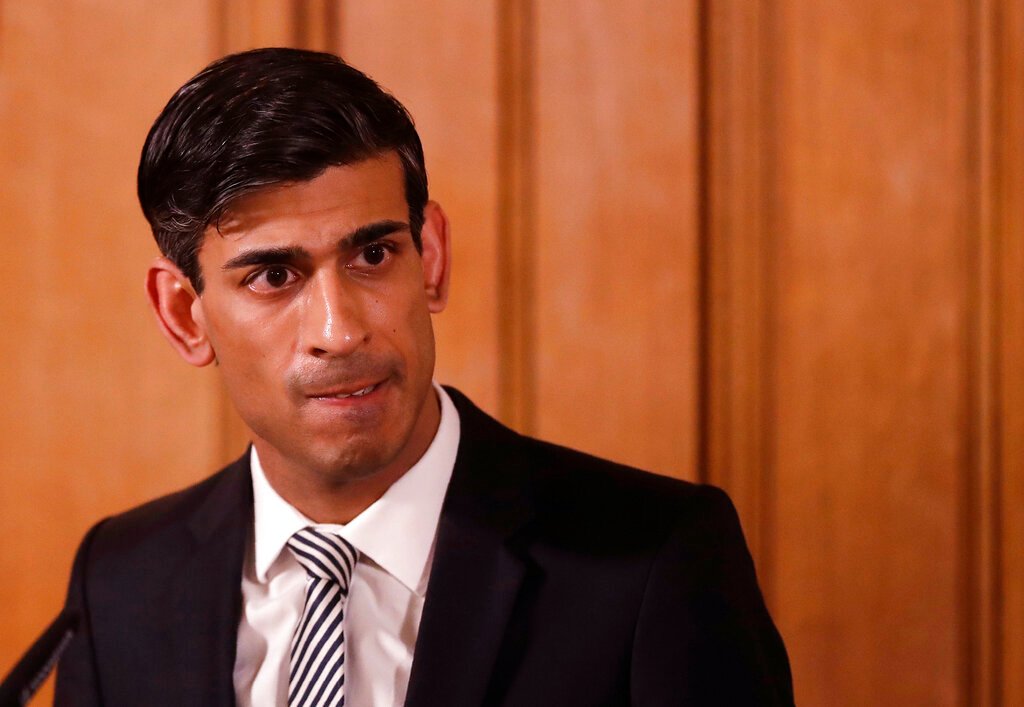
Chancellor Rishi Sunak said he “welcomed” February’s growth figures. He said: “Russia’s invasion of Ukraine is creating additional economic uncertainty here in the UK, but it is right that we are responding robustly against Putin’s unprovoked invasion.”

Semiconductor shortage

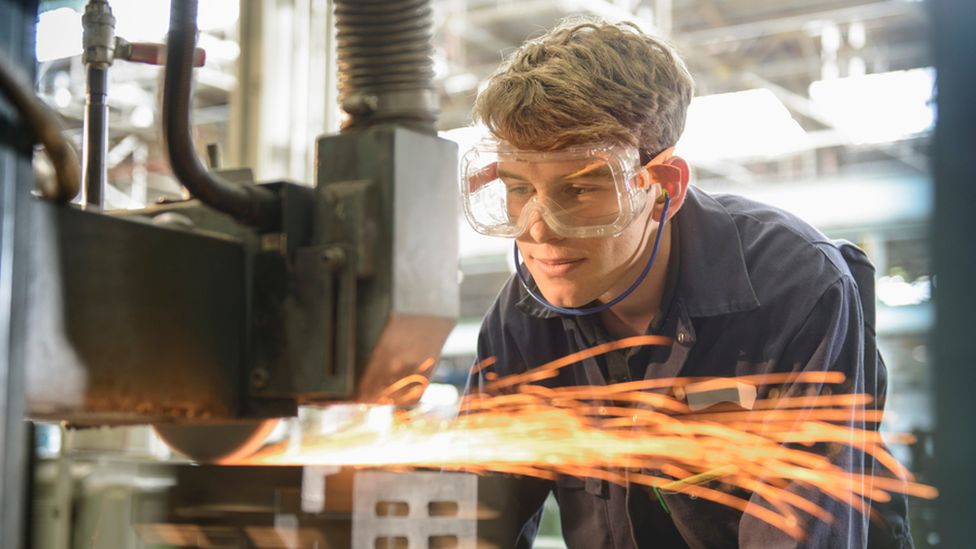
The ONS said the fall in industrial production was due to a 5.4% drop in the manufacture of transport equipment “driven entirely by the fall in manufacture of cars”.

It added that production of computer and electronic products had fallen in February.

Barret Kupelian, senior economist at the accountancy firm PwC UK, said: “This is an area other European economies have also been struggling with, because of the semiconductor shortage.

“Manufacturing is also likely to face headwinds due to high energy prices as it consumes above average energy per unit of GDP and we will see this reflected in future data releases.”

The construction sector also contracted but at a slower rate than production industries. Capital Economics said the fall was, in part, “driven by Storm Eunice, Dudley and Franklin resulting in construction projects being delayed”.

The services sector provided the only bright spot in the data as post-Omicron spending on leisure continued, with growth in accommodation as well as travel agencies and tour operators.

Mr Kupelian said growth momentum “shifted towards the sectors of the economy which were hardest hit during the pandemic, including accommodation and food services, activities and arts, entertainment, and recreation”.

He said: “We expect that there is still more growth to come from these sectors.”

New PM of Pakistan to be elected tomorrow

ISLAMABAD: After Imran Khan was dismissed as the prime minister of Pakistan as a result of a successful no-trust motion by the joint Opposition, the National Assembly will elect a new leader of the House tomorrow (Monday).

The NA is all set to hold the election of the new prime minister at 2pm. This session was earlier supposed to start at 11 am on Monday.

NA Secretariat said in a statement issued in this regard said that the aspirant candidates can file their nomination papers for the top slot till 2pm today (Sunday), which will be scrutinised till 3pm today.

Imran Khan loses vote of no-confidence

In a historic first for Pakistan, Imran Khan was ousted as the prime minister of Pakistan from office through a no-confidence motion after the NA debated on the matter for more than 12 hours and the political situation in the country took a critical turn Saturday night.

The session was chaired by Ayaz Sadiq — a member of the panel of chairs — after speaker Asad Qasier resigned from his post.

“174 members have recorded their votes in favour of the resolution, consequently the resolution for the vote on no-confidence against Mr Imran Khan, the prime minister of Pakistan, has been passed by a majority,” Ayaz Sadiq announced after the process of voting was completed.

Once the voting was concluded and the result was announced, Opposition leaders delivered their victory speeches. Earlier, the session had been adjourned till 11am on Monday, April 11.

Speaking on the occasion, PML-N President Shahbaz Sharif said the country was witnessing a new day and thanked all the joint Opposition leaders for their efforts in uniting the parties against the government.

“We cannot thank Allah enough for allowing us to see this new day,” said Shahbaz. “We thank everyone for their sacrifices, and now, once again, a Pakistan based on Constitution and law is about to come into existence,” the PML-N president said, hoping that the alliance would move the country towards progress.

Shahbaz said this might be the first time in Pakistan that the country’s daughters and sisters were sent to prison, but maintained that he wanted to forget the past and move forward.

“When the time comes, we will speak in detail, but we want to heal the wounds of the nation; we will not send innocent people to jails, and we will not take revenge,” Shabaz said, noting that the law will take its course without interference.

“Neither I, nor Bilawal, nor will Maulana Fazlur Rehman interfere. Law will be upheld and we will respect the judiciary,” Shahbaz said, thanking Sadiq for chairing the historic session.

“Jab apna qafla azm o yakeen se niklay ga, jahan se chahen ge rasta wohi se niklay ga, watan ki mitti airian ragrne day, mujhe yaqeen hai chashman yaheen se niklayga,” Shahbaz concluded.

ISPR rejects BBC report on events at PM House, calls it ‘totally baseless and a pack of lies’

In a statement, the military’s media affairs wing branded the story “typical propaganda” lacking “any credible, authentic and relevant source” and claiming that it “violates basic journalistic ethos”.

“There is no truth in the fake story whatsoever and clearly seems part of an organised disinformation campaign. The matter is being taken up with BBC authorities,” the statement concluded.

The story in question supposedly recounts the events leading up to the ouster of Imran Khan as prime minister.

According to the article, Parliament House was abuzz with activity during the day as the National Assembly was in session. However, it claimed that this activity shifted to the PM House once the session was adjourned for Iftar.

The report said that Imran had convened an emergency meeting of his cabinet — summoning his legal and political advisers, the NA speaker and deputy speaker and several bureaucrats — where it was decided that the “threat letter” would be shown to a select few officials.

The story alleged that “two uninvited guests” reached PM House, with an extraordinary security detail, via helicopter and held a 45-minute private meeting with Imran.

The biggest claim in the story — made by quoting government sources — said that the meeting was less than pleasant. “Just an hour ago, former prime minister Imran Khan had given orders to remove one of the senior officials present for the meeting,” the story alleged, without taking any names.

It went on to say that the sudden arrival of the guests was “unexpected” for the former premier, adding that Imran was instead expecting the arrival of his “newly appointed officials”.

The story alleged that the necessary notifications for the removal and the new appointment were not issued by the Ministry of Defence. “Even if the removal was carried out on the prime minister’s orders, preparations had been made to declare it null and void,” the BBC report said.

The story also talked about how the doors of the Islamabad High Court (IHC) were open late at night to take up a petition asking the court to restrain Imran from possibly de-notifying Chief of Army Staff (COAS) Gen Qamar Bajwa.

The urgent petition — which was filed but never fixed for hearing — said that Imran, for political and personal purposes, had misused his powers and recommended the removal of the Chief of Army Staff, urging the court to quash the order in public interest, the report said.

“It is important to mention that while the petition was prepared, the space for the number of the notification regarding the army chief’s dismissal was left blank. The reason for this was that despite the prime minister’s request, the notification could not be issued and there was no need for a hearing,” the report concluded.

Petition filed in IHC

Late last night, a petition was filed in the IHC, asking the court to restrain Prime Minister Imran Khan from de-notifying General Qamar Jawed Bajwa as the chief of army staff. The petition was filed but never fixed for hearing as government ministers vehemently denied having any such plans in place.

The petition, a copy of which is available with Dawn.com, was filed by Advocate Adnan Iqbal under Article 199 of the Constitution and mentioned the Federation of Pakistan, Government of Pakistan, Prime Minister Imran Khan, President Dr Arif Alvi, Ministry of Law and the secretary of the Ministry of Defence as respondents.

Iqbal said he was filing the petition to “uphold the enforcement and mandatory constitutional provision with regard to identification of term” of the COAS.

The petition was a pre-emptive measure to restrain the premier from “using his arbitrary power” to recommend the army chief’s approval before the expiry of his term for “personal and political motive”.

No such notification was issued by the prime minister.

The petition raised a number of questions: whether the approval of the cabinet was obtained for the issuance of any such supposed notification; whether the prime minister had “unfettered powers” to remove the COAS when he had recommended his appointment and in the “absence of any cogent reason for altering the earlier recommendation”; and lastly whether the premier could remove the army chief for “furtherance of political interests”.

It also drew the attention of the court towards the observations of the Supreme Court during suo motu hearings of the National Assembly’s dissolution and its verdict on Thursday whereby it said that any order passed by the prime minister or president would be subject to the order of the apex court.

Meanwhile, federal Information Minister Fawad Chaudhry had denied that the government had taken any step to remove the army chief, terming such reports “baseless”.

“The government fully understands the importance of the army chief and Pakistan Army as an institution. Reports that anyone is even thinking of changing the leadership of Pakistan Army are baseless rumours and lies. This is being done under an agenda. The government condemns these rumours and completely denies them,” the minister wrote on Twitter.

The development followed a lengthy impasse over a no-confidence motion to oust the premier as the National Assembly was adjourned four times before the vote was finally held around midnight.

US warns of ‘arbitrary’ Covid measures in China

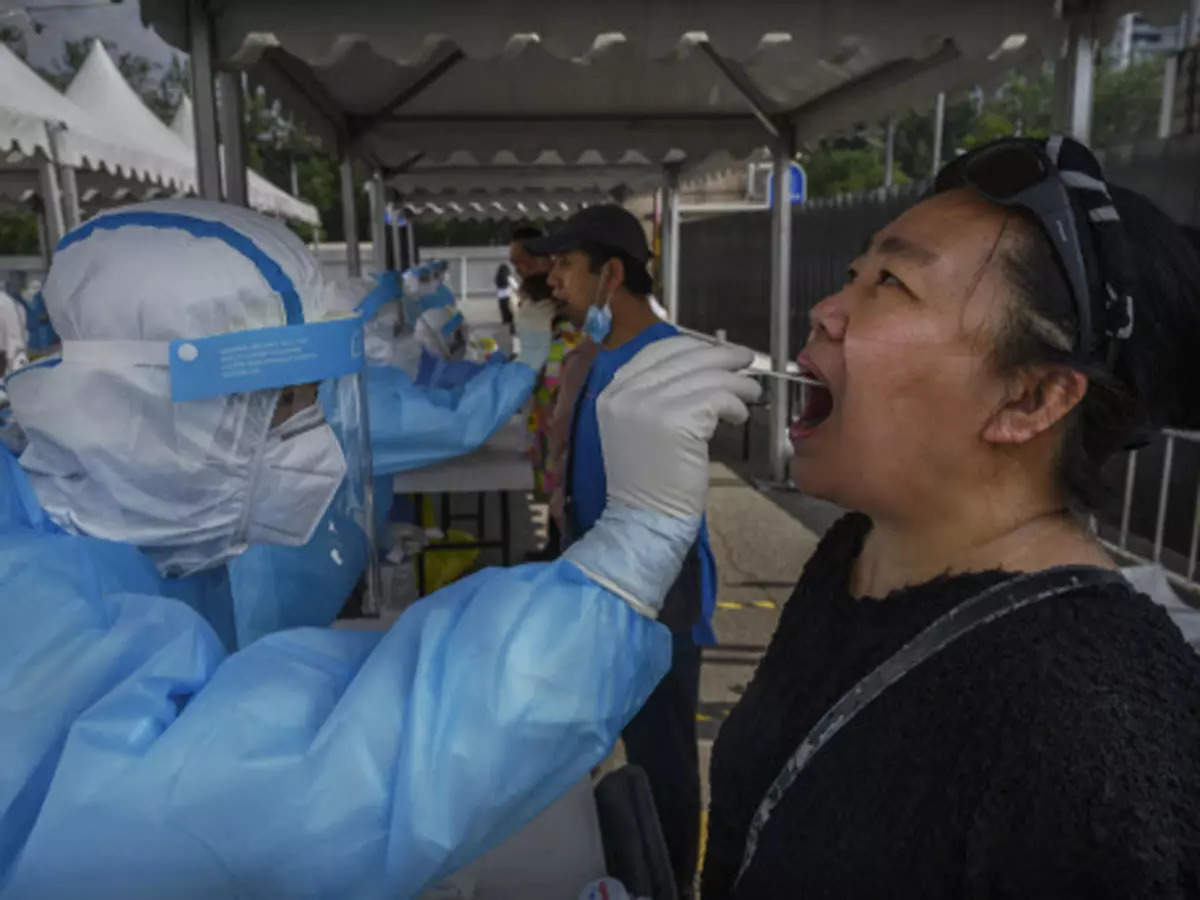
Until March, China had kept cases low with snap lockdowns, mass testing and travel restrictions, but more than 100,000 cases have been reported in Shanghai since March in a test of the country’s strict zero-Covid policy.

The city’s roughly 25 million inhabitants were locked down in phases last week, prompting complaints of food shortages and viral videos of disgruntled residents scuffling with officials.

The US State Department will now allow non-essential employees to leave its consulate in Shanghai “due to a surge in Covid-19 cases and the impact of restrictions related to the response”, a US embassy spokesperson said in a statement.

The statement warned citizens to reconsider travelling to China, “due to arbitrary enforcement of local laws and Covid-19-related restrictions”, adding that the embassy in Beijing had raised its concerns over the measures with the Chinese government.

Shanghai reported more than 23,000 new infections on Saturday — mostly asymptomatic, accounting for more than 90 percent of new domestic infections in the country.

City authorities have prepared thousands of new beds in more than 100 makeshift hospitals, Shanghai’s vice mayor Zong Ming said during a press conference on Saturday.

The largest of these, a 50,000-bed hospital in the landmark National Exhibition and Convention Center, opened on Saturday according to state news agency Xinhua.

As part of China’s zero-Covid policy, authorities are insisting on isolating every person who tests positive in hospital wards — which have left existing facilities overrun with patients, even if they show no severe symptoms.

Meanwhile locals have begun to chafe at lockdown restrictions, with many taking to social media to complain of food shortages and express outrage over the recent killing of a pet corgi by health workers, for fear of being infected.

An unpopular policy of separating infected children from their virus-free parents was softened this week after triggering public anger.

But Beijing is sticking to its zero-tolerance approach and is determined to squash the Shanghai outbreak, sending medical workers from around the country in as reinforcements.

COLOMBO: Tens of thousands marched on beleaguered Sri Lankan President Gotabaya Rajapaksa’s office on Saturday, in the biggest protest to date over the country’s dire economic and political crisis

Sri Lanka’s 22 million people have seen weeks of power blackouts and severe shortages of food, fuel and other essentials in the country’s worst downturn since independence in 1948.

Saturday’s social-media organised protest drew the largest numbers since the crisis blew up last month according reporters.

And pressure on Rajapaksa intensified further as the country’s powerful business community also began withdrawing support for the president.

Men and women poured onto Colombo’s seafront promenade and laid siege to the colonial-era Presidential Secretariat, chanting “Go home Gota” and waving the national lion flag.

UK minister under new attack despite wife’s tax U-turn

Sunak was also criticised for a lack of transparency, after he admitted to holding a “Green Card” for US permanent residents until last year.

Sunak’s wealthy wife Akshata Murty said she would start paying UK tax on “all worldwide income”, in a bid to defuse a controversy that has further imperilled his waning political fortunes.

But Labour frontbench MP Louise Haigh told BBC radio that Sunak had “come out on a number of occasions to try and muddy the waters” around his family’s tax affairs.

She conceded that the “non-domicile” status enjoyed by Murty — shielding the overseas income from her family’s company Infosys against UK taxes — was legal.

But Haigh queried “whether it was right that the chancellor of the exchequer, whilst piling on 15 separate tax rises to the British public, was benefiting from a tax scheme that allowed his household to pay significantly less to the tune of potentially tens of millions of pounds.”

The Independent newspaper reported that Sunak was listed as the beneficiary of trusts set up in the British Virgin Islands and Cayman Islands to help manage his wife’s tax and business affairs.

Sunak was listed in 2020, after he became chancellor and after a prior stint as chief secretary to the Treasury, the newspaper said.

“No-one in Akshata’s family is aware of this alleged trust,” a spokeswoman close to the Sunak family said in response.

As chancellor, Sunak oversaw a huge programme of government spending during the coronavirus pandemic, but is now tightening the belt just as Britons face the worst cost-of-living crisis in generations.

Once a leading contender to succeed Prime Minister Boris Johnson, Sunak has seen his popularity plummet in recent weeks as a result, and has accused critics of mounting a “smear” campaign against his wife.

Allies of the finance minister have told newspapers that Johnson’s office is waging a political hit job.

They said the prime minister believed Sunak had not backed him strongly enough during an ongoing scandal into Downing Street lockdown parties.

Johnson denied knowledge of any briefing operation against Sunak, and told reporters that his chancellor was doing an “absolutely outstanding job”.

The White House meanwhile declined to comment about Sunak’s Green Card, which the minister said he only gave up ahead of his first visit to the United States as chancellor in October last year.

Under US law, possession of the card meant that Sunak intended to live in America and pay US taxes, despite serving as Britain’s second-most powerful politician.

Sunak and Murty met as students in the United States and they married in 2009. She is the daughter of Indian billionaire N. R. Narayana Murthy, co-founder of the IT giant Infosys.

Robbers, posing as govt officials, use gas cutters and earthmoving machinery to break down abandoned bridge in India.

BHUBANESWAR: Police in India are seeking to arrest members of a gang who dismantled a 60-feet-long iron bridge and likely sold it off in parts as scrap metal, officials said on Sunday.

The robbers, posing as government officials attached with the irrigation department in the eastern state of Bihar, used gas cutters and earthmoving machinery to break down an abandoned bridge in Amiyawar village, about 150 kilometres (93 miles) south from Patna, the state capital.

Selling metal scrap can be a lucrative business in India, where cases of theft of metal parts from public property to sell in large, unorganised scrapyards for quick cash are common.

A police officer said Amiyawar residents assumed that the government officials had decided to dismantle the old bridge, built over a water canal some three decades ago, as it was not in use. Villagers had previously submitted an application to the irrigation department to dismantle the bridge, one resident said.

“People came with heavy machinery, gas cutters and worked for two days during the day time to dismantle the bridge,” said Gandhi Chaudhary, 29, a villager. Locals asked those working about their identity and were told they had been hired by the irrigation department to dismantle the bridge.

Earlier in the week the scrap metal was loaded into a vehicle and the site was vacated.

“We have identified some members of the gang and some are yet to be tracked down. They destroyed public property and stole a bridge.” said Subash Kumar, a police official probing the case.

A “real embargo” on Russian energy by Western countries could stop war in Ukraine, President Putin’s former chief economic adviser has suggested.

Dr Andrei Illarionov said Russia “did not take seriously” other countries’ threats to reduce their energy usage.

Despite trying to reduce its reliance on Russian sources, Europe is continuing to buy oil and gas.

Last year, soaring prices meant oil and gas revenues accounted for 36% of Russia’s government spending.

Much of that income comes from the European Union, which imports about 40% of its gas and 27% of its oil from Russia.

This week, its top diplomat Josep Borrell said “a billion [euros] is what we pay Putin every day for the energy he supplies us”.

Dr Illarionov said if Western countries “would try to implement a real embargo on oil and gas exports from Russia… I would bet that probably within a month or two, Russian military operations in Ukraine, probably will be ceased, will be stopped”.

“It’s one of the very effective instruments still in the possession of the Western countries,” he added.

While the oil and gas trade has continued during the conflict, widespread sanctions mean that a lot of other economic activity has stopped, many foreign companies have pulled out and exports have been disrupted.

One recent survey by Russia’s own central bank even forecasts the economy will shrink by 8% this year, while the International Institute of Finance says it could fall by as much as 15%.

Dr Illarionov suggested that President Putin was prepared to endure a hit to the economy that shows where his priorities lie.

“His territorial ambitions, his imperial ambitions, are much more important than anything else, including the livelihood of the Russian population and of the financial situation in the country… even the financial state of the his government,” he said.

Prices are rising for many food items in Russia as the country feels the impact of international sanctions.

Jobs under threat

Last week, amid tensions with Europe over how gas would be paid for, President Putin said that “key indicators” of the health of the Russian economy include the “creation of jobs, the reduction of poverty and inequality, the improvement of the quality of life of people, the availability of goods and services”.

World Bank figures suggest that almost 20 million Russians live in poverty.

President Putin has, in recent years, pledged to halve that number.

Now Dr Illarionov said “we’ll see probably doubling the number of those people, maybe even tripling” as the economy struggles.

The Moscow-based think tank, the Centre for Strategic Research, estimated two million jobs could be lost this year as the unemployment rate rises from a record low.

Those concerns are shared by Vladimir Milov, who is a former Russian deputy energy minister, but is now part of Alexei Navalny’s Russia of the Future opposition party.

“Many people are concerned about losing their jobs, I think it’s just that the majority does not really realise the severity of the economic situation,” he said.

Inflation, which has already risen to 15.7% because of the war, means people might stop spending money on things such as gyms and meals in restaurants and “that’s bad news for a lot of small businesses”, said Mr Milov.

Some basic food items such as sugar, onions and cabbages have risen in price by more than 40% since the start of this year.

Mr Milov said any noticeable falls in living standards would help his party’s cause as an opposition.

“We have been explaining to people all along [that] Putin’s policy would lead Russia into a catastrophe, including a complete social and economic catastrophe, including [a] deterioration of living standards that we haven’t seen in decades,” he said.

“I have to say that comes at an extremely high price. We would prefer not to see what is happening today.”


However Mr Milov, who fled to Lithuania last year, thinks it will take time for falling living standards to translate to political change.

“Russia is a country with big inertia in society, and a lot of fear instigated by the authorities. Specifically people really are very much afraid of protesting because right now they can end up in jail for a long, long time for doing that”.

He added: “But I would say [that within a] few months [of] real deep economic trouble, that we haven’t seen in 30 years, it will change the mood of the society. More people will start to speak out loudly.”

Dr Andrei Illarionov is seen here watching President Putin give a speech in 2004.

President Putin’s former adviser Dr Andrei Illarionov, who now lives in the United States, said a change of government is inevitable “sooner or later”.

He said “it is absolutely impossible to have any positive future for Russia, with the current political regime”.

Under President Putin, he suggested, “there is no way that country might be integrated back into the international relations, in the world economy”.

You can watch Dr Andrei Illarionov and Vladimir Milov’s interviews on Talking Business with Aaron Heslehurst this weekend.

French voters are casting their ballots in the opening round of a presidential race that could become a cliffhanger.

Emmanuel Macron has a fight on his hands from far-right challenger Marine Le Pen, who has been galvanised by a slick election campaign.

Forty-nine million people are eligible to decide which two of 12 candidates should take part in the run-off vote.

The president spent little time on the race, focusing instead on Europe’s reaction to Russia’s war in Ukraine.

One issue more than any other has predominated this election: the spiralling cost of living in energy bills and shopping baskets.

When he came to power with a new party in 2017, Emmanuel Macron swept away the old allegiances, and the two big parties are still nursing their wounds.

Socialist candidate Anne Hidalgo has struggled to be heard, while on the right Valérie Pécresse has failed to excite the Republicans.

Now, the main challenge to Mr Macron, 44, is coming from Ms Le Pen on the far right and Jean-Luc Mélenchon on the far left.

Some are even predicting the president could lose.

1px transparent line

‘I still don’t know who to vote for’

Voting began at 08:00 (06:00 GMT) in mainland France and ends in the big cities of Paris, Lyon and Marseille at 20:00 local time. What adds to the uncertainty is that days before the vote, one Ipsos opinion poll suggested 37% of people were still undecided.

First the Covid-19 pandemic and then Russia’s invasion overshadowed this election.

“The campaign’s been going on for two months and there hasn’t been much debate,” complains Ourdia, a café owner in north-west Paris. “I still don’t know who to vote for.”

Voters can choose from 12 candidates

The old tribal tradition of voting either for the left or right has gone. One market trader in Paris said he was yet to decide whether to vote for Marine Le Pen, 53, or 70-year-old Jean-Luc Mélenchon.

Philippe Bridou, a former Socialist voter in south-western city of Perpignan, told the BBC he had switched to the far right because “security is important, immigration is important too because it’s a subject now – and the left wing doesn’t discuss it”.

For many voters, the old stigma of voting for the far right has gone. After she was trounced by Mr Macron in 2017, Ms Le Pen rebranded her National Front as National Rally, even if many of her policies have hardly changed. She has also come across as more moderate than far-right rival candidate Eric Zemmour.

All up in the air

“The election race isn’t over at all,” said Brice Teinturier of polling institute Ipsos.

Turnout is key because the pollsters suggest as many as 28% of voters may not show – a level not seen for 20 years – and the least likely to bother are 25-34 year-olds. Then there are the so-called votes blancs – the ballots left blank as a protest.

Tactical voting may also play a part, if voters decide to back one of the favourites because they have more of a chance of winning than, for example, Greens candidate Yannick Jadot.

Cost of living crunch

The French economy is in decent shape and unemployment has fallen to 7.4%, but voters are not feeling the benefit.

That’s because prices are going up across the board, at the shops, the market, the petrol pump and in domestic energy bills. The phrase you hear everywhere is pouvoir d’achat – which translates as spending power but is better known in English as the cost of living.

Thierry, who lives outside Paris and runs a shoe stall, says prices have gone through the roof. “The cost of shoes has gone up by 20% to 30% and all the taxes have gone up too,” he points out.

That is why many of the candidates are promising to boost the minimum wage, in some cases by hundreds of euros. It’s due to go up at the start of May to about €1,300 (£1,100; $1,430) a month after tax.

For Marine Le Pen, the spending crunch is also a big opportunity. She has spent less time talking about nationalism and focused more on low wages, saying she’ll waive income tax for under-30s.

But she still wants a referendum on restricting immigration, she wants to ban the Islamic hijab in public areas and wants radical change to the European Union.

She has distanced herself from Russia’s Vladimir Putin, even though she went to see him in 2017, used to admire him and her party is still paying back a Russian loan.

By contrast, voters have been unimpressed with revelations that the Macron government has spent increasing amounts of taxpayers’ money on consultants such as US firm McKinsey. “People are a bit disgusted who gets the money,” said Thierry.

Mr Macron entered the campaign late, with a rousing rally eight days before the vote. While his adversaries were criss-crossing France, he was focusing on diplomacy in Russia’s war in Ukraine.

He only got going on his main adversary shortly before campaigning ended, condemning her policies as racist and “very brutal”.

The first round will only decide the top two candidates, but already the race is tight.

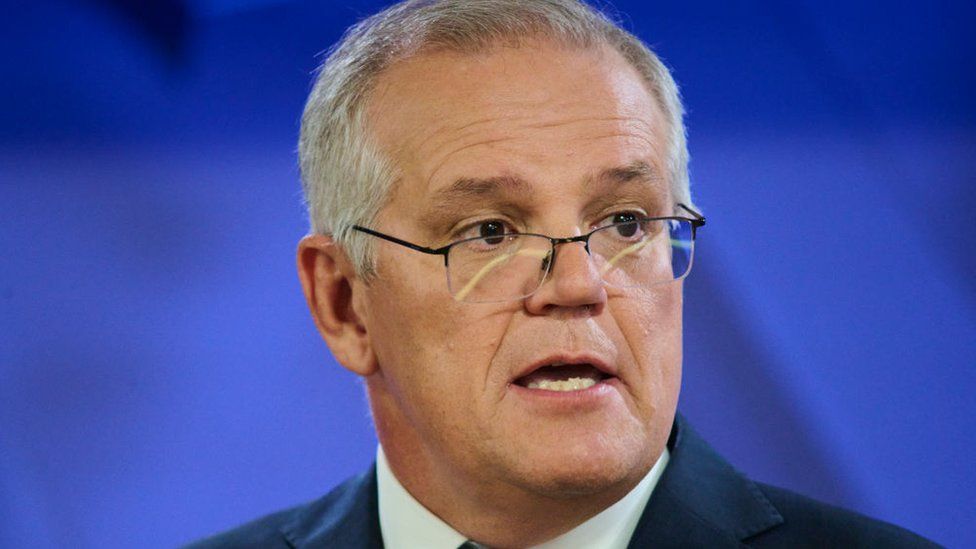
Australian Prime Minister Scott Morrison has called a federal election for 21 May.

Mr Morrison’s ruling coalition holds 76 seats in the House of Representatives – the minimum needed to retain power.

Polls suggest there will be a change of government, with the opposition Labor Party, led by Anthony Albanese, tipped to take office.

However, in the last election, the centre-right Mr Morrison won despite most polls predicting otherwise.

Mr Morrison announced the date after talks with the Governor General in the capital, Canberra.

“It’s a choice between a strong future and an uncertain one. It’s a choice between a government you know and a Labor opposition that you don’t,” the prime minister said on Sunday.

But Mr Albanese – pointing out Mr Morrison’s own deputy prime minister called him “a hypocrite and a liar” – argued that “we can and must do better”.

“The pandemic has given us the opportunity to imagine a better future and Labor has the policies and plans to shape that future,” he said on Sunday.

Mr Morrison is the first leader to serve a full term in office since John Howard, who won four elections before losing to Labor’s Kevin Rudd in 2007.

Since then, what observers call the “coup culture” of Australian politics has led to a series of short-lived premierships.

Mr Morrison’s Liberal-led coalition is defending a one-seat majority. Even though it has won seven of the past nine federal elections, it may be hard-pressed to do so again, say political analysts.

In recent weeks, the prime minister has faced accusations of being a bully and once sabotaging a rival’s career by suggesting the man’s Lebanese heritage made him less electable. Mr Morrison has denied the allegations.

But despite the most recent polling putting Labor ahead, Mr Albanese has called his opponents the “favourites”, noting his party has only won government from opposition three times since World War Two.

Analysis

by Phil Mercer in Sydney

A “complete blank page” or “a bully with no moral compass”? On 21 May, Australians will choose between an opposition leader accused by opponents of being clueless and inexperienced, or an incumbent prime minister who’s fending off allegations of racism and an intimidatory style of leadership.

Scott Morrison’s centre-right government is under pressure, but it’s led by a former marketing executive who’s become a political survivor and defied the polls to win the so-called “miracle” election in 2019.

Remarkably, Mr Morrison is the first Australian prime minister to serve a full term since John Howard. His Labor challenger, Anthony Albanese, presents himself as a measured, gently progressive alternative.

The handling of the pandemic and natural disasters, as well as national security and the environment, will sway voters, but as the cost of living rises, the 21 May poll will ultimately be decided by one dominant issue – the economy.