
PTI, PML-N supporters face off in London

LONDON: Supporters of the Pakistan Muslim League-Nawaz and the Pakistan Tehreek-i-Insaf faced off outside the residence of PML-N supremo Nawaz Sharif in London on Sunday, as one group celebrated and the other protested the ouster of PTI chairman Imran Khan from the premiership.

A heavy police contingent stood in a chain between the two groups as they chanted slogans against each other’s leaders.

The morning started with a few PML-N supporters gathering outside Mr Sharif’s Avenfield House residence to celebrate. Two men were hired to play the dhol (drum), while party supporters broke into a dance and chanted slogans in favour of Nawaz Sharif.

“Chant your slogans loudly so Mian Sb can hear you inside!” said one supporter to the others, as they yelled “sher sher” (tiger). Mr Sharif’s bodyguards stood outside the main entrance of the apartment block. Members of the family were not seen at the gathering.

A stone’s throw away in the green expanses of Hyde Park, hundreds of PTI supporters demonstrated against Mr Khan’s ouster.

Imran Khan’s UK spokesperson Sahibzada Jahangir had in a video message called on the party’s supporters to gather at the park and then march to the US embassy to register their protest against alleged “foreign interference by America in Pakistan”.

A message circulating in PTI Whatsapp groups said the purpose of the demonstration was to raise their voice against “regime change” and the Supreme Court’s decision; and to demand free and fair elections through electronic voting as well as the right of overseas Pakistanis to vote.

At the PTI protest, both speakers and members of the crowd condemned the alleged US role in Imran Khan’s removal, with many saying they believed the letter and conspiracy Mr Khan spoke of was a reality. Several of Mr Khan’s supporters were also critical of the military establishment, and blamed it for his exit.

Emotions ran high and some supporters were teary-eyed as they spoke about their anger over his ouster.

“This new imported government is unacceptable,” chanted Mr Khan’s supporters.

“The sense of pride that we feel as Pakistanis has been instilled in us by Imran Khan alone.”

Some chanted: “No Imran, no remittances.”

The sizeable crowd was made up of PTI supporters from all over London, with many families turning up on the sunny day along with their children. Many wore shirts emblazoned with a photo of Mr Khan, and carried posters in which they condemned the heads of the Pakistan Democratic Move­ment’s component parties.

Although the plan for the PTI crowd was to march to the US embassy at 2pm, hundreds of people instead turned towards Park Lane and decided to take their protest to Avenfield House. Police raced ahead of the PTI demonstrators to create a divide between PML-N workers who were already outside Mr Sharif’s residence.

As the two groups confronted each other, both sides chanted slogans in praise of their leader and denounced the other.

Slogans raised by PTI supporters included “boot polish, boot polish” as well as anti-US chants, while PML-N workers did the bhangra to the drum beats and clapped.

Sahibzada Jahangir, the PTI spokesperson, said Imran Khan’s supporters were ready to give the “last drop of their blood” for him. “Khan will bounce back from the setback.”

Ukraine says 1,200 bodies found near Kyiv as east braces for onslaught

Ukraine said Sunday it had found more than 1,200 bodies in the Kyiv region, the scene of atrocities allegedly committed by Russian troops, as residents in the country’s east braced — or fled — ahead of an expected massive offensive.

Heavy bombardments hammered Ukraine through the weekend, adding to mounting casualties six weeks into Russia’s invasion of its neighbour.

Shelling claimed two lives in northeast Kharkiv on Sunday morning, regional governor Oleg Synegubov said, the day after 10 civilians, including a child, died in bombings southeast of the city.

“The Russian army continues to wage war on civilians due to a lack of victories at the front,” Synegubov said on Telegram.

In Dnipro, an industrial city of around a million inhabitants, a rain of Russian missiles nearly destroyed the local airport, causing an uncertain number of casualties, local authorities said.

An AFP reporter saw black smoke in the sky above the facility, but a plane also took off later on Sunday, suggesting its runway was still functioning.

President Volodymyr Zelensky again condemned atrocities against civilians, and, after speaking with German Chancellor Olaf Scholz, said they had agreed “that all perpetrators of war crimes must be identified and punished”.

Ukraine’s Prosecutor General Iryna Venediktova said the country was examining the alleged culpability of 500 leading Russian officials, including President Vladimir Putin, for thousands of war crimes.

And White House National Security Advisor Jake Sullivan pledged the US would “work with the international community to make sure there’s accountability” for what he called “mass atrocities”.

At the Vatican, Pope Francis called for an Easter ceasefire to pave the way for peace, denouncing a war where “defenceless civilians” suffered “heinous massacres and atrocious cruelty”.

‘We will respond’

In his nightly address, Zelensky said Russian troops were about to launch “even larger operations” in the east of Ukraine.

“We are preparing for their actions. We will respond,” he said.

Residents have been fleeing in their thousands, but Lugansk governor Sergiy Gaiday said many were afraid to leave after a missile strike on a railway station in the city of Kramatorsk on Friday killed 57 people, according to a revised tally issued by local authorities.

“We evacuated “2,700-2,500 people per day, but now there are fewer and fewer,” Gaiday said, adding he was “sure that 20-25 percent” of the region’s population was still there.

“Sometimes we just beg (them) to come out of hiding because we know what comes next,” he said, adding Russian forces would “destroy everything in their path”.

Almost 50 wounded and elderly patients were transported from the east in a hospital train by medical charity Doctors Without Borders (MSF) over the weekend, the first such evacuation since the attack on the Kramatorsk station.

Electrician Evhen Perepelytsia was one of those evacuated after he lost his leg, and almost his life, to shelling in his hometown of Hirske in Lugansk.

“We hope that the worst is over — that after what I’ve been through, it will be better,” said 30-year-old after the train arrived in the western city of Lviv.

Russia’s defence ministry has denied carrying out the Kramatorsk attack.

It said Kyiv and its western allies were continuing to stage “monstrous and merciless” provocations and murdering civilians in the self-proclaimed Lugansk People’s Republic, one of two pro-Russian separatist statelets in Ukraine’s eastern Donbas.

‘Inciting hatred’

Ukraine on Sunday hit out at the Kremlin and Russian media for laying the groundwork for war “for many years”.

“Russian political elites and propaganda have been inciting hatred, dehumanising Ukrainians, nurturing Russian superiority and laying ground for these atrocities,” Foreign Minister Dmytro Kuleba tweeted on Sunday.

But in an interview with NBC’s “Meet the Press”, Kuleba said he remained open to negotiating with the Russians.

“If sitting down with the Russians will help me to prevent at least one massacre like in Bucha, or at least another attack like in Kramatorsk, I have to take that opportunity,” he said.

Bucha — where authorities say hundreds were killed, some with their hands bound — has become a byword for the brutality allegedly inflicted under Russian occupation.

Ukraine’s prosecutor Venediktova said 1,222 bodies had been found there and in the broader region around Kyiv so far.

At least two corpses were found inside a manhole at a petrol station on a motorway outside Kyiv on Sunday, an AFP reporter saw.

The bodies appeared to be wearing a mix of civilian and military clothing.

A distraught woman peered into the manhole before breaking down, clawing at the earth and wailing, “My son, my son”.

The United Nations said on Sunday that 4,232 civilian casualties had been recorded in Ukraine to date, with 1,793 killed and 2,439 injured.

Nehammer to Moscow

Austrian Chancellor Karl Nehammer said he would meet Putin on Monday, which would make him the first European leader to visit the Kremlin since the invasion began on February 24.

Nehammer met the Ukrainian leader in Kyiv over the weekend, and his spokesman said he had informed Berlin, Brussels and Zelensky of the trip to Moscow.

Austria is a member of the European Union, but not of NATO.

EU foreign ministers will also meet Monday to discuss a sixth round of sanctions, even as divisions over a ban on Russia gas and oil imports threaten to blunt their impact.

In a bid to shore up international resolve against Moscow, US President Joe Biden is to hold virtual talks on Monday with Indian Prime Minister Narendra Modi, just weeks after saying India had been “shaky” in its response to the invasion.

A US spokeswoman said the two leaders would consult on ways to offset the “destabilizing impact (of the war) on global food supply and commodity markets”.

The World Bank on Sunday issued a dire forecast, saying Ukraine’s economy would collapse by 45.1 percent this year — a much bleaker outlook than it predicted even a month ago — while Russia would see an 11.2 percent decline in GDP.

Why are Sri Lankans protesting in the streets?

The island nation is facing its worst economic crisis since gaining independence from Britain in 1948 and is facing food shortages, soaring prices and power cuts.

Many say the government is to blame.

Why is there an economic crisis in Sri Lanka?

Sri Lanka’s problems come down to the fact that its foreign currency reserves have virtually run dry.

It means it cannot afford to pay for imports of staple foods and fuel, leading to acute shortages and very high prices.

The government blames the pandemic, which all but killed off Sri Lanka’s tourist trade – one of the island’s biggest foreign currency earners.

It also says tourists were frightened off by a series of deadly bomb attacks on churches three years ago.

However, many experts say economic mismanagement is to blame.

There are many reasons for this, but one main factor is that at the end of its 30-year civil war in 2009, Sri Lanka chose to focus more on its domestic markets instead of exporting to foreign ones. So income from exports remained low, while the bill for imports kept growing.

The government also racked up huge amounts of debt to fund what critics have called unnecessary infrastructure projects.

At the end of 2019, Sri Lanka had $7.6bn (£5.8bn) in foreign currency reserves, but by March 2020 it had only $2.3bn (£1.75bn).

How did the government respond?

When he came to power in 2019, President Rajapaksa decided to cut taxes. This meant the government had less money to buy foreign currency on the international markets to increase its reserves.

When Sri Lanka’s currency shortages became a really big problem in early 2021, the government tried to stop the outflow of foreign currency by banning all imports of chemical fertiliser, telling farmers to use organic fertilisers instead.

This led to widespread crop failures.

Sri Lanka had to supplement its food stocks from abroad, which made its foreign currency shortage even worse.

The switch from chemical to organic fertiliser resulted in widespread crop failure, exacerbating foreign currency shortages

Since then, the government has banned the import of a wide range of “non-essential” items – from cars to certain types of food and even shoes.

One way that countries can boost their exports is to cut the value of the currency, but the government refused to let the Sri Lankan rupee fall against other currencies.

It finally did so in March 2022, and the rupee fell more than 30% against the dollar.

How much foreign debt must Sri Lanka repay?

Sri Lanka’s government has to raise $7bn in foreign currency this year to pay down its debt. It will have to make similar payments for years to come.

The government would like to make new finance deals to settle its debts, but its credit rating has fallen so low that very few institutions will lend it money. As a result, it has been running down its foreign reserves simply to pay the interest on the current loans.


What is the political situation?

Mass protests flared up in early April with people calling for President Rajapaksa to resign, which he has refused to do.

People are furious because the cost of living has become unaffordable. They are paying up to 30% more for food compared with a year earlier, which has led to some people having to cut down not only on what food they buy, but also the number of meals they eat every day.

Shortages of fuel have seen long lines at petrol stations, while the crisis has also hit public transport services.

“Earlier I used to get a bus in 15 minutes, now I have to wait one to two hours. Sometimes the bus stops midway with no fuel,”

President Gotabaya Rajapaksa (middle) has so far refused to step down despite widespread protests and mass resignations from lawmakers

As demonstrations grew, the president imposed a curfew, a draconian emergency law and a ban on social media. However, when these failed to keep protesters off the streets, he withdrew the measures.

President Rajapaksa then sacked everyone in his cabinet apart from the prime minister, Mahinda Rajapaksa, who is his brother. He also sacked the governor of the central bank.

The new finance minister he appointed resigned less than 24 hours after taking the job.

The president asked opposition MPs to help form a new government, but they have refused. Instead, more than 40 MPs aligned to the ruling coalition in parliament have left it.

What help can Sri Lanka get from abroad?

In March, Sri Lanka’s government asked the International Monetary Fund (IMF) for a bailout.

The new central bank governor, P Nandalal Weerasinghe, will lead the negotiations between the government and the IMF. However, the talks have had to be postponed until a new finance minister is found.

Meanwhile, Sri Lanka is being helped by friendly neighbours such as India. It has begun supplying fuel to Sri Lanka on a $500m credit line.

China has agreed to bolster Sri Lanka’s foreign currency reserves by swapping the Lankan rupee for its currency, the renminbi.

It has also taken loans from countries like Japan and Bangladesh.

Tens of thousands of Imran Khan supporters took to the streets on Sunday night after the former Pakistani prime minister called for peaceful protests following his removal from office. The tumultuous political drama looks set to continue – but who do his followers blame for his downfall?

“I think Imran Khan is the only honest guy left,” one woman told the BBC. “He’s the only one we can trust and we do not want to be ruled by these traitors.”

Mr Khan has alleged the opposition’s move to hold a vote of no confidence against him was part of a US-led conspiracy, targeting him because of his foreign policy decisions including a recent trip to Moscow that angered Western officials.

Opposition politicians have reacted angrily, accusing Mr Khan of cynically manipulating the public in order to try and remain in power, despite having lost the support of parliament.

Most analysts believe Mr Khan is deliberately exaggerating the contents of a diplomatic cable, sent by the Pakistani ambassador in Washington, reportedly passing on a warning that there would be “consequences” if Mr Khan remained in power.

However, the narrative is resonating with Mr Khan’s supporters, many of whom chanted, “whoever is a friend of America, is a traitor”, at the protests.

At a rally in a park in the capital Islamabad, whole families had turned out to express support for Mr Khan, along with large numbers of young men and women.

“We’ve decided we won’t live a life of slaves,” said one protester. “These people are all thieves and hopefully they’ll all go to jail,” he added, referring to Mr Khan’s opponents.

There was also anger, amongst some, directed at Pakistan’s powerful military.

It’s a sudden U-turn for Imran Khan’s supporters, who until now have frequently praised the role of the army, which it’s widely believed helped him into power in 2018. Videos on social media showed slogans being chanted against the army chief, Gen Bajwa, a rare move in the country.

It’s believed a rift between the army and Imran Khan emerged last year, leading to the military withdrawing its support for his slender ruling coalition.

The really in support of the ousted PM on 10 April attracted large crowds

Defecting members of Imran Khan’s party have described the army’s role as “neutral” – it seems clear, however, that even if not actively involved in his downfall, the military is content to see Imran Khan out of office.

Shahbaz Gill, a close aide to Imran Khan, told the BBC the party respected and loved the Pakistani army.

Many critics of Imran Khan, who have often faced harassment from the intelligence services for criticising the army’s support for his government, noted the sudden change in approach by his followers.

Some remarked on the hypocrisy, given their earlier praise for the army, whilst others welcomed the apparent newfound belief in civilian supremacy.

In one photo, widely shared online, a man holds up a sign reading “How many Vigos can you bring?” referring to a pick-up truck notorious for its use by members of the intelligence services to detain activists.

1px transparent line

The image was shared by the former Human Rights Minister Shireen Mazari, who many accuse of not taking action against earlier assaults on critics of her government.

“These Vigos,” one prominent academic wrote, “brought your leader and the likes of you to power.”

Indian Prime Minister Narendra Modi and US President Joe Biden will hold virtual talks on Monday ahead of the meeting between their foreign and defence ministers in Washington.

The ministers’ annual meeting – known as the 2+2 Dialogue – was launched in 2018 to deepen co-operation between the two countries.

The forum has focused on improving bilateral relations and co-operation in Asia. It is also seen as part of Washington’s strategy to help India become a counterweight to China in the region.

The two nations have largely been on the same page – at least in their public statements – on most issues of mutual concern.

But it’s not business as usual this time because of Russia’s invasion of Ukraine.

Delhi’s press release ahead of the talks included the usual line about strengthening the “comprehensive global strategic partnership” between the two countries.

But Washington’s statement mentioned “mitigating the destabilising impacts of Russia’s war against Ukraine”, suggesting that the US will again nudge India – perhaps not too hard – to take a stronger position on Moscow.

Indian defence minister Rajnath Singh, left, and foreign minister S Jaishankar are in Washington to hold talks

India and the US have had differing views over Ukraine since the war began in February.

While Delhi has used strong words to comment on the invasion, it hasn’t directly criticised Moscow. It has also abstained from all UN votes against Russia.

India has also been trying to find ways to circumvent banking sanctions on Moscow to take advantage of discounted oil prices offered by Russian firms.

India’s stand of non-alignment also stems from its own geopolitical needs. Moscow is Delhi’s time-tested ally and also its largest supplier of defence equipment – accounting for more than 50% of its imports.

Confusion over India’s stand

A former Indian diplomat said Delhi’s stand has put Washington in a Catch-22 situation.

The US wants India to be part of its wider strategy of isolating Russia but at the same time, it can’t afford to weaken India against China – both diplomatically and militarily.

Experts say this has created confusion in the White House about the best way to deal with India.

Washington has not directly criticised India but has issued statements that experts call “mild warnings”.

India and the US have had differing views over Ukraine since the war began

After Mr Modi refrained from criticising Russia during a recent meeting of the Quad – which also includes Australia, the US and Japan – on Ukraine, Mr Biden said India’s stand on the war was “somewhat shaky”.

His top economic adviser Brian Deese later said India had been informed that the consequences of a “more explicit strategic alignment” with Moscow would be “significant and long-term”.

But this didn’t deter India as it once against abstained from the vote that suspended Russia from the UN Human Rights Council.

Other US officials, including US Deputy National Security Adviser for International Economics Daleep Singh, have appeared to be more understanding of India’s stand.

What’s at stake?

While Mr Biden and Mr Modi are likely to focus on bilateral ties, Ukraine still looms large over the meeting.

It will also be on the agenda when Indian Foreign Minister S Jaishankar and Defence Minister Rajnath Singh meet their US counterparts Antony Blinken and Lloyd Austin on Monday.

Both sides have been clear about their differing stands on Ukraine but there is too much at stake to risk their bilateral relationship.


Washington sees India as an ally to challenge China’s dominance in the Asia-Pacific region.

Both countries also believe that there is massive untapped potential in bilateral trade.

They have the ambitious target of taking bilateral trade – which was at $113bn in 2021 – to $500bn in the future.

India also needs the US to help diversify its defence portfolio and reduce its reliance on Russian arms.

Moscow continues to be India’s largest arms supplier even though its share has dropped to 49% from 70%. The US was India’s second-largest supplier between 2011 and 2015 after Russia, but fell behind France and Israel in the period between 2016 and 2021.

Russia has sold its S-400 anti-aircraft system, seen here in Crimea, to India

Both Washington and Delhi would want to improve on these statistics.

The S-400 deal

But the elephant in the room will continue to be India’s purchase of the S-400 missile defence system from Russia – a deal which gives India strategic deterrence against both China and Pakistan.

The agreement has come under the Countering America’s Adversaries Through Sanctions Act (Caatsa), which was introduced in 2017 to target Russia, Iran and North Korea with economic and political sanctions. It also prohibits any country from signing defence deals with these nations.

The US had sanctioned China for buying the same system in 2018.

But so far, it has been evasive about doing the same for India. It had refrained from sanctioning India even after the country started receiving the first deliveries of the S-400 in December last year.

But the Ukraine war will now further complicate the situation.

Some US officials have said in the past that there was no guarantee that India would get a waiver.

Now, in the fast-changing geopolitical scenario, both Washington and Delhi would not want to publicly take stands against each other.

But when the defence ministers meet, the S-400 and the issue of sanctions will definitely come up.

How the two countries deal with this and their other differences will determine the future course of Washington-Delhi ties.

Mexico’s President Andrés Manuel López Obrador has won a referendum on whether he should step down or complete his six-year term.

More than 90% of those who cast their votes said they wanted the president to stay in office, a quick count suggests.

But turnout was low at less than 19%, according to preliminary figures.

The president had called the unprecedented referendum, which critics said was a tactic to distract from his government’s failures.

In Mexico, presidents are limited to a single six-year term in office.

But since before he was sworn in as president in 2018, Andrés Manuel López Obrador has promised to give voters a chance to remove him from office half-way through his term.

He argued that the referendum was vital to validating his democratic mandate.

With approval ratings around 60%, Mr López Obrador knew that he had every chance of winning the vote.

Moreover, the vote carried little risk for the president. In order to be binding, at least 40% of voters would have had to cast their ballots, an unlikely turnout in this first recall referendum to be held in Mexico.

Opponents of the divisive president labelled it as a waste of money and urged Mexicans to boycott it -and those who did turn out overwhelmingly backed the president.

President López Obrador celebrated the result, saying in a video address that “more than 15 million Mexicans are happy and want me to continue until September 2024” when his term comes to an end.

Some critics of the president feared that he may try to use an overwhelming victory in the recall referendum to pave the way for lifting Mexico’s one-time presidential term limit.

But late on Sunday, Mr López Obrador stressed he had no intention of staying in power beyond the end of his term in 2024.

“I will continue to serve until the last day of my term, I will not go further than that because I am a democrat and I am not in favour of re-election,” he said.

BBC Mexico Correspondent Will Grant says that the president will point to his wide margin of victory as evidence that his policies are popular among Mexicans, while his opponents will try to use the low turnout against him.

Emmanuel Macron has won the first round of the French election and far-right rival Marine Le Pen will fight him for the presidency for a second time.

“Make no mistake, nothing is decided,” he told cheering supporters.

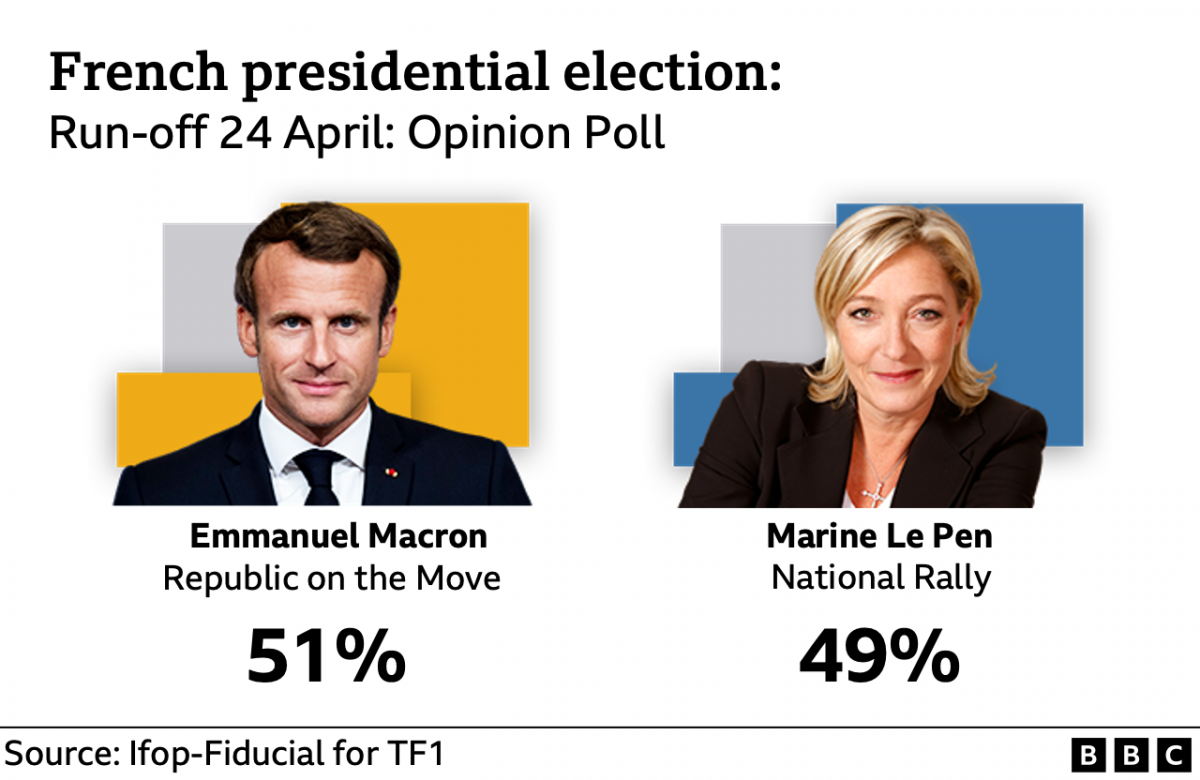
In the end, he won a convincing first-round victory, but opinion polls suggest the run-off could be much closer.

Ms Le Pen called on every non-Macron voter to join her and “put France back in order”.

With 97% of results counted, Emmanuel Macron had 27.6% of the vote, Marine Le Pen 23.41% and Jean-Luc Mélenchon 21.95%.


Kingmaker on far left

Veteran far-left candidate Jean-Luc Mélenchon polled even better than five years ago and now has the unlikely role of kingmaker.

“You must not give a single vote to Marine Le Pen,” he warned his supporters, but unlike other candidates, he pointedly did not back the president instead. Later in the evening, Mélenchon activists gathered outside his campaign HQ thinking he might even come second, but it was not to be.

Making up more than a fifth of the vote, Mélenchon voters could decide the final round of this election, yet many of them may just sit the second round out and abstain.

1px transparent line

Twelve candidates were in the running, but these were the only three who polled more than 10%. Many voters appeared to embrace the idea of tactical or “useful” voting, deciding that the other nine candidates had no hope of making the run-off.

Several of the nine had little chance anyway, but the 2022 presidential election will be partly remembered for the disaster that befell the two old parties that used to run France, the Republicans and Socialists. They sank almost without trace, with Socialist Anne Hidalgo falling below 2%.

It was only a few months ago that Valérie Pécresse was still in the race for the right-wing Republicans. She performed so badly, her party could not even scrape the 5% needed to claim its election costs.

This is potentially terrible news for a party already tearing itself apart. Parties that fail to reach 5% only get €800,000 (£670,000) of their campaign funding covered by the state, and the Republicans will have paid out far more than that.

Run-off campaign starts now

A renewed battle for votes is under way. Marine Le Pen can count on supporters of Eric Zemmour, whose more hardline nationalism won him fourth place and 7%. Nationalist Nicolas Dupont-Aignan has also backed her. She can already count on an impressive 33% of the entire vote.

Mr Macron’s team is planning a series of big rallies and major TV appearances. Most of the other candidates on the left have backed him, as has Valérie Pécresse, but one-time Socialist candidate Ségolène Royal said the president now had to “earn” victory.

Ifop pollster François Dabi said his company’s 51%-49% estimate for the run-off was the closest they had ever predicted. An Elabe poll put the gap at 52%-48% and an Ipsos poll suggested it was wider still.

Addressing his supporters, Mr Macron looked a relieved man and he promised to work harder than in the first part of the campaign. He had only started campaigning eight days before the vote, his mind more focused on Russia’s war in Ukraine.

“When the extreme right in all its forms represents so much of our country,” he said, “we cannot feel that things are going well.”

He addressed Le Pen voters too: “I want to convince them in the next few days that our project answers solidly to their fears and challenges of our time.”

Ms Le Pen said it was time for a “great changeover”, with a fundamental choice on 24 April of two opposite views: “Either division and disorder, or a union of the French people around guaranteed social justice.”

She has built her campaign around the cost-of-living crunch facing much of Europe, promising to cut taxes and waive income tax for under-30s. There has been less emphasis on nationalism, but she wants a referendum on restricting immigration, radical change to the EU and a ban on the Islamic hijab in public areas.

The campaign only sparked into life in the final fortnight, first because of the Covid pandemic and then the Russian war. But in the end, the spring sunshine meant turnout was not as low as feared, at almost 75%.

One in four young voters backed the president, although more than one in three 18-24 year-olds opted for Jean-Luc Mélenchon, according to Elabe pollsters.

Marine Le Pen performed best among 35-64 year-olds, while the president was favoured by over-65s.

It was already clear from Mr Macron’s speech that he planned to target Ms Le Pen’s close links with the Kremlin. Although she has condemned Vladimir Putin’s war, she visited him before the previous election in 2017 and her party took out a Russian loan.

He wanted a France that made alliances with great democracies to defend itself, he said, not a state that would leave Europe and have only populists and xenophobes for allies.

Pakistan’s parliament will select a new prime minister on Monday, after Imran Khan was ousted in a no-confidence vote in the early hours of Sunday.

Shahbaz Sharif – the leader of an opposition coalition who worked to depose Mr Khan – is widely expected to win a majority of the votes.

The parliament is due to vote around 14:00 local time (09:00GMT).

Mr Khan, 69, was voted out after days of political drama and Supreme Court intervention.

He had attempted to block a previous attempt to bring a no-confidence motion against him by dissolving parliament and calling for a snap election.

However, the country’s Supreme Court upheld an opposition petition that his actions were unconstitutional and ordered the no-confidence vote to go ahead.

What do we know about Shahbaz Sharif?

Mr Sharif, 70, served as chief minister of Punjab, Pakistan’s most populous province, prior to Imran Khan coming to power in 2018. Mr Sharif, who leads the Pakistan Muslim League Nawaz (PMLN), had a reputation for efficiency and being hardworking, and is credited with making significant infrastructure improvements.

Many ruefully contrasted him with his successor, Usman Buzdar, who was widely ridiculed as under-qualified and incompetent. Anger at Imran Khan’s refusal to replace Mr Buzdar is one reason cited by numerous analysts for the emergence of a rift between Mr Khan and his previously close ally, the Pakistani military.

Shahbaz Sharif has always been in the shadow of his older brother, Nawaz Sharif, who served as PM on three occasions. Whereas Nawaz openly criticised the army following his removal from power, however, Shahbaz has favoured a reconciliation with the “establishment”.

Like his brother, Shahbaz has also faced corruption allegations and has spent periods of time in jail during Mr Khan’s tenure. He has not been convicted of an offence and maintains the allegations are politically motivated. Shahbaz Sharif’s son, Hamza, is hoping to follow in his father’s footsteps and become the next chief minister of Punjab.

Imran Khan’s supporters regard the Sharif clan as part of the dynastic, “old Pakistan” that they want to relegate to history.

Shahbaz Sharif submitted his candidacy for the top post on Sunday and is widely tipped to have the numbers to ensure victory.


Other opposition leaders – like Bilawal Bhutto Zardari of the Pakistan People’s Party (PPP) – have already indicated their support for him.

On Sunday, Mr Sharif heralded “a new dawn” for Pakistan following the vote.

However, Imran Khan, whose supporters protested across major cities after he was dismissed, is still blaming a “foreign conspiracy” for his removal as prime minister.

He has claimed, without evidence, that his rivals had colluded with the US to remove him because of his foreign policy stance on Afghanistan, Russia and China. Washington has strongly denied this. But the former international cricketer’s claims fed on anti-American sentiment held by many of his supporters.

He tweeted that the crowds seen were some of the largest in Pakistan’s history – a claim that has not been not independently verified.

How was Imran Khan ousted?

Mr Khan’s opponents saw an opportunity to strike after months of discontent over his management of the economy, and a breakdown in his relations with Pakistan’s powerful military.

Mr Sharif banded together with other opposition lawmakers to muster the numbers to vote Mr Khan out.

On 3 April, they challenged Mr Khan outright in parliament – launching a motion for a vote of no confidence in his leadership.

But the deputy speaker of the parliament – a political ally of Mr Khan’s – blocked the motion, claiming it was influenced by foreign powers. His government then swiftly dissolved parliament and called for a snap election.

The furious opposition immediately challenged the legality of government actions in the Supreme Court. After a four-day hearing, it ruled that Mr Khan’s government had acted illegally, in breach of the constitution.

Even then, Mr Khan and his party tried to prevent the vote in parliament for hours – with officials quitting, lawmakers filibustering and other disruptions.

But eventually, in the early hours of Sunday, his opponents secured his removal, with 174 lawmakers voting against him in the 342-member house.

Rishi Sunak has referred himself to Boris Johnson’s ethics watchdog as he continues to face questions about his family’s financial affairs.

The chancellor wants Lord Geidt – the PM’s adviser on ministers’ interests – to check if he followed the rules.

Mr Sunak’s wife, Akshata Murty, last week announced she would start paying UK tax on her overseas earnings.

But Labour says he still has questions to answer about transparency and whether he has used tax havens.

Mr Sunak said he was “confident” a review by Lord Geidt, who investigated allegations about Mr Johnson’s refurbishment of his Downing Street flat, would find he had appropriately declared all his interests.

Ms Murty owns £700m in shares of the Indian IT giant Infosys – founded by her father – from which she received £11.6m in dividend income last year.


The BBC estimates she would have avoided £2.1m a year in UK tax through her non-domicile (non dom) status.

She will now pay tax on her overseas earnings, but her domicile remains India, where she has said she intends to eventually return.

Mr Sunak said he had made the Cabinet Office aware of his wife’s non-dom status when he first became a government minister in 2018.

He has ordered a leak inquiry into how that information came to be reported in the media.

Downing Street has rejected newspaper reports that its staff leaked damaging stories about Mr Sunak to the media.

Rishi Sunak’s reputation has gone from golden to tinfoil. His personal ratings have plummeted and his leader-in-waiting status has been dented, if not destroyed.

But his job as chancellor looks safe for now.

He has the backing of the prime minister so won’t get fired.

The number of Conservative backbenchers grumbling about his handling of this appears to be outweighed by the number of colleagues who think he’s a good operator so they won’t get rid of him. And the review into his declarations of interests isn’t likely to cause him too many problems either.

But all of that could change under pressure from the opposition, the media and any further revelations, or if he becomes a threat to the reputation of the government.

What will be fascinating to see is whether this changes the approach Rishi Sunak takes to the rising cost of living.

Will the chancellor accused of being too rich feel he has to do more to help people who are getting poorer?

It feels like Rishi Sunak has gained a lifetime’s-worth of baggage in a fortnight.

Most politicians have it – what matters is how much it weighs them down.

Labour’s shadow home secretary Yvette Coopers said questions faced by Mr Sunak include whether he had declared his wife’s tax status when taking “policy decisions” affecting non-dom households.

“The lack of transparency does raise questions about conflict of interest,” she told BBC.

“The fact that they have changed their tax arrangements now shows that they do recognise it’s a problem – but they wouldn’t have done that if this hadn’t been public.”

It has also been revealed that Mr Sunak held a US green card until last year, entitling him to permanent residence, a path to citizenship, in that country.

It also means he filed US tax returns, prompting opposition questions about whether he gained a financial advantage from this.

Labour also says the public need to know if Mr Sunak has ever benefitted from tax havens.

It follows a report in the Independent which said Ms Murty had received income from companies based in tax havens.

What is a non-dom?

A non-dom is a UK resident who declares their permanent home, or domicile, outside of the UK.

A domicile is usually the country his or her father considered his permanent home when they were born, or it may be the place overseas where somebody has moved to with no intention of returning.

For proof to the tax authority, non-doms have to provide evidence about their background, lifestyle and future intentions, such as where they own property or intend to be buried.

Those who have the status must still pay UK tax on UK earnings but do not need to pay UK tax on foreign income. They can give up their non-dom status at any time.

Ms Murty has chosen to be domiciled in India via her father, the billionaire Narayana Murty.

Passengers on P&O Ferries from Scotland to Northern Ireland have been told some services have now resumed.

The company suggested over the weekend that “tourist travel” would return on Thursday, 14 April.

But on Monday it tweeted some sailings have resumed, with departures from Cairnryan at 04:00 BST, 12:00 and 20:00 and Larne at 08:00, 16:00 and 23:59.

The European Causeway boat used on the service was detained in Larne last month over safety concerns.

That followed the company sacking 800 staff without notice and replacing them with cheaper agency workers.

There was confusion over the weekend when P&O initially tweeted that passengers could come on board from Sunday, but that changed to Wednesday before Thursday was suggested as a likely start date.

The operator’s Dover-Calais service is expected to resume on that date. P&O said on Monday sailings “remain cancelled”.

On Saturday the European Causeway sailed, with limited services, on a return journey between Larne and Cairnryan.

It was the first time the vessel had been allowed to sail since it was detained in Larne a fortnight ago, but only freight was transported on the vessel. It is now understood foot passengers are allowed to travel again.

The RMT union has said it would attempt to blockade ports, including Cairnryan, in protest when the ferry operator started running what the union labelled its “ships of shame” again.

Regional organiser Gordon Martin branded the company “capitalist bandits” for the way in which it sacked staff with no notice via video call.

“We will be after you, we will be coming to Cairnryan, Larne, and elsewhere and we will be targeting your supply chain,” he told BBC Scotland.

“Anybody dealing with P&O – I’ll send a clear message to them – whether it be fuel providers, food providers, whatever it may be.

“We will find out who you are and you will be part of our efforts to get proper legislation in place to protect workers.”

Almost 200 people joined a protest at Cairnryan last month after P&O’s decision to sack 800 workers

The European Causeway was initially detained in Larne with the Maritime and Coastguard Agency (MCA) concerned about “failures on crew familiarisation, vessel documentation and crew training”.

‘Serious disruption’

Stena Line have put on extra ferries from Cairnryan to Belfast to compensate for the postponement of P&O services.

The operator increased its daily sailings on the route from 12 to 18 and said its staff had been working hard to meet demand.

The Scottish government condemned the “serious disruption” P&O’s actions had caused to the supply chain between Scotland and Northern Ireland.

A spokesman said: “The employment practices P&O have needlessly pursued have no place in a modern working practices.

“The Scottish government has been absolutely clear that we will stand by the workers who have been let down in the most appalling manner imaginable by P&O.”

He added ministers were seeking urgent meetings with the UK government to discuss the matter.

A spokesman for the UK Department for Business, Energy and Industrial Strategy said: “The Insolvency Service has confirmed it has commenced formal criminal and civil investigations into the circumstances surrounding the recent appalling behaviour of P&O Ferries, following the Business Secretary asking they undertake a thorough review.

“We will not provide further comment while investigations are ongoing.”

P&O has been approached for comment.