
US monitoring rise in rights abuses in India, Blinken says

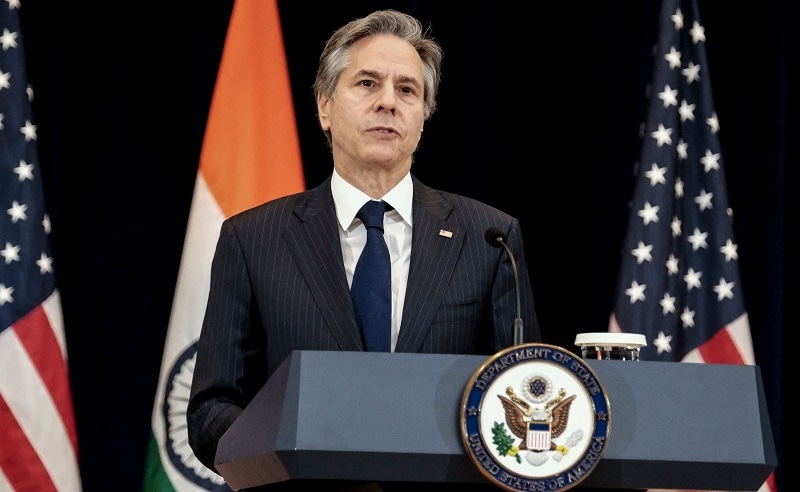
WASHINGTON: US Secretary of State Antony Blinken said the United States was monitoring what he described as a rise in human rights abuses in India by some officials, in a rare direct rebuke by Washington of the Asian nation’s rights record.

“We regularly engage with our Indian partners on these shared values (of human rights) and to that end, we are monitoring some recent concerning developments in India including a rise in human rights abuses by some government, police and prison officials,” Blinken said on Monday in a joint press briefing with US Defense Secretary Lloyd Austin, Indian Foreign Minister Subrahmanyam Jaishankar and India’s Defense Minister Rajnath Singh.

Blinken did not elaborate. Singh and Jaishankar, who spoke after Blinken at the briefing, did not comment on the human rights issue.

Blinken’s remarks came days after US Representative Ilhan Omar questioned the alleged reluctance of the US government to criticise Indian Prime Minister Narendra Modi’s government on human rights.

“What does Modi need to do to India’s Muslim population before we will stop considering them a partner in peace?” Omar, who belongs to President Joe Biden’s Democratic Party, said last week.

Modi’s critics say his Hindu nationalist ruling party has fostered religious polarisation since coming to power in 2014.

Since Modi came to power, right-wing Hindu groups have launched attacks on minorities claiming they are trying to prevent religious conversions. Several Indian states have passed or are considering anti-conversion laws that challenge the constitutionally protected right to freedom of belief.

In 2019, the government passed a citizenship law that critics said undermined India’s secular constitution by excluding Muslim migrants from neighbouring countries. The law was meant to grant Indian nationality to Buddhists, Christians, Hindus, Jains, Parsis and Sikhs who fled Afghanistan, Bangladesh and Pakistan before 2015.

In the same year, soon after his 2019 re-election win, Modi’s government revoked the special status of Kashmir in a bid to fully integrate the Muslim-majority region with the rest of the country. To keep a lid on protests, the administration detained many Kashmir political leaders and sent many more paramilitary police and soldiers to the Himalayan region also claimed by Pakistan.

Modi’s Bharatiya Janata Party (BJP) recently banned wearing the hijab in classrooms in Karnataka state. Hardline Hindu groups later demanded such restrictions in more Indian states.
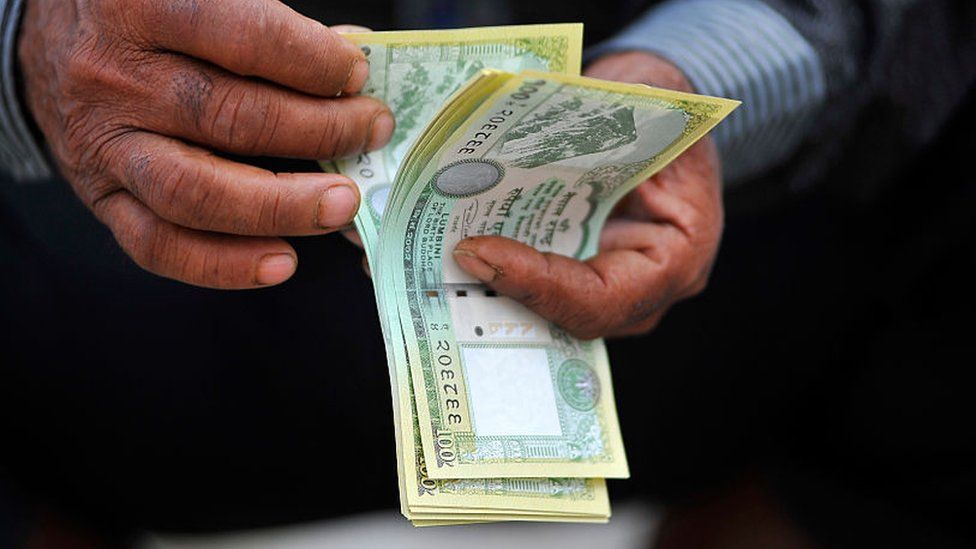
Nepal has restricted imports of non-essential goods – including cars, cosmetics and gold – after its foreign currency reserves dropped.

It comes as a fall in tourism spending and money sent home by Nepalis working abroad helped drive up government debt.

Meanwhile, the governor of the country’s central bank was removed from his role last week.

Nepal’s finance minister said he was “surprised” the issue was being compared with the crisis in Sri Lanka.

According to the country’s central bank, Nepal Rastra Bank, foreign currency reserves fell by more than 16% to 1.17tn Nepali rupees ($9.59bn; £7.36bn) in the seven months to the middle of February.

Over the same period, the amount of money sent to Nepal by people working abroad fell by almost 5%.

Narayan Prasad Pokharel, deputy spokesperson at the central bank, told the Reuters news agency that the institution believed the country’s foreign currency reserves were “under pressure”.

“Something must be done to restrict the import of non-essential goods, without affecting the supply of essential goods,” Mr Pokharel said.

He added that importers were allowed to bring in 50 “luxurious goods” if they paid for them in full.

“This is not banning the imports but discouraging them,” Mr Pokharel said.

Last week, Nepal’s government removed central bank governor Maha Prasad Adhikari from his role, without giving a reason for the decision.

Government debt in Nepal has risen to more than 43% of its gross domestic product, as officials increased spending to help cushion the economic impact of pandemic, Nepal’s finance ministry said on Monday.

The ministry also said indicators of the country’s economic health were “normal”.

“However, due to some pressures in the external sector, some steps have already been taken to manage imports and increase foreign exchange reserve,” it said in a statement.

Earlier in the day, finance minister Janardan Sharma said Nepal’s debt was lower than other countries in the region and elsewhere.

Mr Sharma told reporters: “I am surprised why people are comparing with Sri Lanka”. The island nation is facing its most serious economic crisis since independence from the UK in 1948.

Alex Holmes, an emerging markets economist at research firm Capital Economics also told the BBC that the situation in Nepal appears “much better than in Sri Lanka”.

Nepal’s foreign currency reserves are double what is considered “a comfortable minimum” and government debt “is not particularly high”, Mr Holmes said.

“Of course, things will eventually regress if the current account deficit does not narrow,” he added. “But crisis does not appear imminent”.

Last week, Sri Lanka named a new central bank chief and almost doubled its key interest rate to help tackle soaring prices and shortages of essential goods.

In recent weeks, demonstrators have taken to the streets of the capital Colombo as homes and businesses were hit with long power cuts.

Sri Lankans are faced with shortages and rising inflation after the country steeply devalued its currency last month ahead of talks with the International Monetary Fund over a bailout.

At least 25 people have died so far in landslides and floods in the Philippines after Tropical Storm Megi swept the nation.

On Tuesday, rescue crews were still battling to retrieve people stranded on the eastern and southern coasts.

Megi – known locally as Agaton – hit the archipelago on Sunday with winds of up to 65km (40 miles) per hour.

It was the first such storm of the year – the Philippines typically sees an average of 20 each year.

More than 13,000 people fled to higher-ground shelters as the storm lashed the east coast. Heavy rain and winds knocked out power supply, flooded homes and fields and caused mudslides in villages.

Images shared by authorities and locals online showed rescuers wading through muddy swamps and using rafts on fast-flowing rivers to try and reach isolated areas of submerged homes.

In the town of Abuyog, in Leyte, the floods cut roads off and inundated homes and buildings

One of the worst affected areas was the province of Leyte, where 22 bodies had been retrieved after being buried under a landslide, local authorities in Baybay city said on Monday.

“I was crying because I know the people buried there and I was also scared because there were mountains behind our house,” one Leyte resident told news agency AFP.

The national disaster agency also confirmed that at least three people had died in the Davao region in the south.

The storm’s conditions were due to ease Tuesday.

It comes about four months after Super Typhoon Rai devastated many of the nation’s south-east islands in December – killing at least 375 people and affecting about 500,000 people.

It was the worst storm to hit the Philippines that year and experts said it had grown stronger far quicker than anticipated.

Scientists say human-caused climate change has led to a greater intensity and power in tropical storms. The Philippines has experienced some of its most deadly storms since 2006.

It’s been ranked as one of the nations most vulnerable to climate disasters due to its geography.

Sri Lanka has said it will temporarily default on its foreign debts amid its worst economic crisis in over 70 years.

Officials said the impact of the pandemic and the Ukraine war made it “impossible” to pay its creditors.

The South Asian country has seen mass protests as it suffers food shortages, soaring prices and power cuts.

It is due to start talks with the International Monetary Fund (IMF) next week on a loan programme to get its economy back on track.

Sri Lanka’s finance ministry said it otherwise had an “unblemished record” of paying its dues since independence from the UK in 1948.

“Recent events, however… have eroded Sri Lanka’s fiscal position that continued normal servicing of external public debt obligations has become impossible,” it said in a statement on Monday.

The IMF had assessed Sri Lanka’s debt to be unsustainable last month, the ministry noted.

“Although the government has taken extraordinary steps in an effort to remain current on all of its external indebtedness, it is now clear that this is no longer a tenable policy,” it said.

“A comprehensive restructuring of these obligations will be required.”

Credit rating agencies have not yet classified the move as a default.

S&P Global Ratings said it had “nothing to say at this stage” when approached by the BBC.

In January, the firm lowered Sri Lanka’s rating to a classification where it was “currently vulnerable and dependent on favourable business, financial and economic conditions to meet financial commitments”.

Moody’s and Fitch Ratings did not immediately respond to requests for comment.

Lakshini Fernando of Asia Securities welcomed the move by Sri Lanka’s government, and called it “the better option compared with a hard default”.

“We expect Sri Lanka’s current credit rating to be downgraded to ‘selective default’ or ‘restricted default’ following the announcement,” Ms Fernando said.

She noted that Sri Lanka had $78m (£60m) in international sovereign bond payments due next week.

Sri Lanka’s foreign reserves stood at $1.93bn at the end of March. However, it has around $4bn in foreign debt payments due this year.

The country recently named a new central bank chief and almost doubled its key interest rate to help tackle soaring prices and shortages of essential goods.

In recent weeks, demonstrators have taken to the streets of the capital Colombo as homes and businesses were hit with long power cuts.

Sri Lankans are faced with shortages and rising inflation after the country steeply devalued its currency last month ahead of talks with the IMF over a bailout.

US President Joe Biden’s administration has finalised a set of new regulations targeting untraceable “ghost guns”.

The new rules come as Mr Biden faces increasing political pressure to act against a rise in gun violence.

The rule bans businesses from selling kits that can be used to create a gun at home without serial numbers.

In remarks at the White House on Monday, Mr Biden also nominated a new director of the Bureau of Alcohol, Tobacco, Firearms and Explosives (ATF).

The new regulations – which are nearly a year in the making – are expected to face stiff legal resistance from lobbying groups that oppose new gun control regulations.

At the White House, Mr Biden showed the components of a 9mm semi-automatic pistol that he said had been made using a simple kit purchased online.

Ghost guns can be self-assembled and sometimes 3D printed, which means they do not contain a serial number and cannot be traced. Background checks have not previously been required to purchase the assembly kits.

The new rules require self-assembled “buy build shoot” kits to have serial numbers – legally making them a firearm.

“You buy a couch [that] you have to assemble, it’s still a couch,” said Mr Biden said in his news conference.

“You buy the parts you need to build a functioning firearm, it’s still a gun.”

It also forces federally licensed firearm dealers to add serial numbers to any untraceable guns purchased through them.

Experts say that a fraction of violent crimes are being committed with ghost guns, but law enforcement authorities say they are being recovered more frequently at crime scenes.

In 2021, there were about 20,000 suspected ghost guns recovered by police and reported to the ATF – a tenfold increase from 2016, according to the White House.

Meanwhile, the firearms business has seen record sales since the early days of the pandemic two years ago. In 2020, a record of about 22m guns were legally sold. Almost 19m guns were bought in 2021.

Also on Monday, Mr Biden announced a new nominee for the ATF after his first choice failed to advance through the Senate confirmation process because of Republican opposition.

If confirmed, former US attorney for Ohio Steve Dettlebach will be the first to hold the office since 2013.

A bullseye for Biden or a misfire?

Gun control is an issue Democrats in Washington always talk about but seldom are able to do much about. Part of this is the reality of congressional gridlock, which allows Republicans in the US Senate to block any substantive legislation on the topic. There is also a fear among Democrats that guns are an electoral liability. They worry that firearm-rights activists are more likely to punish them for new legislation than gun-control proponents are to reward them.

And so Democratic-backed changes, at least on the national level, are made on the margins. Such is the case with the administration move to regulate ghost guns, which at the moment play a relatively small part in the rise of US gun violence.

It is an area, however, where the Biden administration can act on its own, without congressional support. The president can tout an accomplishment that may placate supporters concerned that gun control has languished on the back-burner during the first half of his presidency.

Even here, however, the new rules will face almost certain legal challenge. And with the current conservative bent of the US Supreme Court, their fate may ultimately be in doubt.

Mexico claims that half a million guns flow south from the US every year. Can a lawsuit against American gun manufacturers stem the tide?

Just before sunrise on a warm Friday morning in June 2020, gunmen were waiting for Omar Garcia Harfuch, the city’s then 38-year-old security head, in Mexico City’s upscale Lomas de Chapultepec neighbourhood.

What happened next would be captured on CCTV and the mobile phone cameras of terrified onlookers: the rat-a-tat-tat of bullets as dozens of heavily armed gunmen, some dressed as road workers, blocked his path with a truck and opened fire.

“At that moment I knew we had been ambushed,” Mr Harfuch later told Spain’s El País newspaper. “Then I felt the first shot come through the windscreen”.

By the time the ensuing firefight was over, he had been shot three times. Three others – two bodyguards and an innocent woman selling snacks nearby – lay dead.

The location and the prominent target of the ambush were notable anomalies in Mexico’s bloody drug war.

But the weapons recovered afterward were not: Barrett 50-calibre sniper rifles, pistols and military assault weapons.

All are produced and sold by US-based gun manufacturers.

The attack against Mr Harfuch, along with hundreds of other incidents, now form a key part of a lawsuit brought by the Mexican government against US-based gunmakers and wholesalers, including Smith & Wesson, Beretta, Colt, Glock and Ruger.

Omar Garcia Harfuch, then the minister of security for Mexico City, was ambushed in a violent gunfire attack in 2020

The lawsuit, filed in a federal courthouse in Massachusetts – where several of the companies are based – argues that the “flood” of illegal guns in Mexico “is the foreseeable result of the defendants’ deliberate actions and business practices”.

The companies have argued that Mexico cannot prove that the violence detailed in the lawsuit is their fault, and have claimed US law shields them from liability over the misuse of their products.

This week, oral arguments are to be heard in court from both sides for a judge to decide whether the case can continue.

Though experts are doubtful that the lawsuit will achieve its primary aims – $10bn in damages, an end to “inflammatory” marketing practices allegedly appealing to criminals and requirements for “smart” safety technology – it has already been a publicity coup for the Mexican government.

More than a dozen US states – including California and New York – have expressed their support for the Mexican government’s case, as have lawyers representing Antigua and Barbuda and Belize.

The case is shining a light on an issue Mexico says has long been ignored by the manufacturers and most Americans.

“This doesn’t just affect Mexico,” Guillaume Michel, head of legal affairs at Mexico’s embassy in Washington, told the BBC. “It also has consequences for the US.”

A cross-border problem

For those on the frontlines of Mexico’s drug war, the ubiquity of American-made weapons flowing across the border has long been a problem. Mexican police say that criminals and gangs in US border towns have ready access to weapons purchased and smuggled across the border.

“The security measures implemented on the border are almost a joke,” said Ed Calderon, a former police officer in Tijuana, just across from California, and an expert on Mexico’s criminal underworld.

“The border is porous,” he said. “People – it could even be old women and men – walk or drive across the border on a daily basis and can amass a stockpile that would rival any Texas gun show. It’s easy to get a gun or rifle in Mexico.”

Mexico’s National Guard – which is largely responsible for stemming the flow of weapons into Mexico – could not be reached for comment. Mexican officials at various levels of government, however, have repeatedly vowed to clamp down on the flow of weapons coming across the border, referring to the effort as a “national priority”.


These efforts occasionally net large quantities of weapons and lead to arrests. Between 1 January 2019 and January 2021 alone, Mexico’s Milenio Televisión reported that 1,585 people were detained for weapons trafficking, over 90% of whom were US citizens.

In the same time frame, official data compiled by Stop US Arms to Mexico – a project aimed at reducing illegal weapons in the country – shows that 11,613 weapons were seized by the army, a small fraction of what is believed to be on Mexico’s streets.

A single raid in early March this year near the US border saw authorities discover over 150 guns and almost three million rounds of ammunition from a suspected cartel stash house.

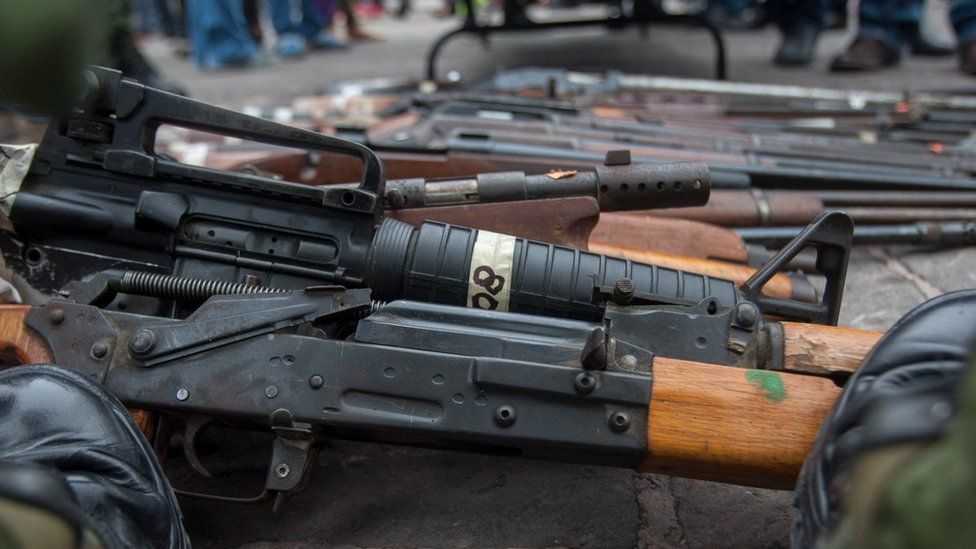
An assortment of weapon from the more than five thousand used in felonies and seized by the Mexican Army from drug traffickers in the states of Tamaulipas and San Luis Potosi, in Monterrey, Mexico, on January 17, 2017.IMAGE SOURCE,AFP
Image caption,

Mexico says illegally trafficked guns are linked to thousands of deaths in the country

Criminal groups’ arsenals, Mr Calderon said, are often comparable to those of the Mexican military and leave the local police forces hopelessly outgunned.

“It’s horrible for morale,” he said. “I’ve met municipal police officers that have more combat experience than any special forces. But there’s a feeling of abandonment, of not having what they need.”

Echoing court documents filed by the Mexican government, Mr Calderon claims that many US weapons are sold with decorations and features made to the tastes of Mexican cartel members, such as gold-plated AK-47s or pistols with engravings depicting well-known ‘Narco Saints’ or Santa Muerte, a Mexican folk saint of death. These decorations are often the work of US-based private sellers who he claims cater specifically to the Mexican criminal underworld, and those who hope to imitate it.

“They’re openly for sale,” he said. “It’s a status symbol within certain elements of cartels – like a badge of honour.”

There is also no law in the US that would make selling weapons with such decorations a crime, leading some experts to cast doubt on this aspect of Mexico’s claim that the manufacturers could be held liable.

Mexican officials say that the vastly different firearms regulations of the two North American neighbours are a root cause of the problem.

Mexico is home to exactly one gun shop, a fortress-like structure in a Mexico City military complex that requires buyers to provide mountains of paperwork and submit to exhaustive background checks that can take months.

Extremely restrictive gun laws require guns to be registered with the federal government and limits their type and calibre.

But north of the border, getting a gun is far easier. Mexican officials believe that a large portion of southern-bound weapons are bought legally by ‘straw buyers’, who then unlawfully pass them to criminals.

The deadly trade killing Mexicans and Americans

In other cases, guns are bought “off paper” from private vendors at gun shows in states such as Texas or Arizona, circumventing background checks.

Mexican officials argue that the steady flow of weapons from these sources is a primary driver of violence in their country, where an estimated 33,000 people were murdered in 2021 alone.

“This is all illicit traffic,” Mr Michel said. “There is no commercial, legal mechanism that would allow such amounts of weapons to be brought into Mexico.”

The Mexican government’s efforts have become yet one more thread to become entangled in the US gun debate, where a politically engaged minority – gun owners and gun rights supporters – have clashed for decades with activists pushing for tighter restrictions on ownership and purchasing rules.

Gun rights activists, backed by a powerful firearms lobby, argue that restrictions violate the Second Amendment of the US Constitution, which gives citizens the right to own and bear guns.

Lawyers for the manufacturers and prominent members of the US gun lobby have explicitly linked Mexico’s lawsuit to Americans’ constitutional rights.

“It is not up to the Mexican government to decide how firearms are lawfully sold in the United States, particularly when American citizens have a fundamental constitutional right,” said Lawrence Keane, the senior vice-president and general counsel of the National Shooting Sports Foundation, a trade group that represents the US firearms industry.

“It is the lawful commerce of firearms that make the exercise of that right for Americans possible,” he added.

Mr Keane rejected Mexico’s claims that the manufacturers can be held responsible for violence in Mexico.

Its government “should be in a Mexican courtroom, seeking justice and trying to bring these cartels to justice”, he said.

“Not filing a frivolous lawsuit in a US federal court, trying to blame law-abiding manufacturers for their failure to protect their citizens.”

Mexican officials insist that they aren’t seeking a review of the Second Amendment or calling into question Americans’ rights to buy and own guns.

The lawsuit is about seeking recourse for “the negligent practices of these companies”, Mr Michel said.

None of the companies named in the lawsuit responded to the BBC’s requests for comment.

A PR win?

Experts admit that the chances of legal success are small – but the lawsuit is important nonetheless for its symbolism.

“It sends a signal that business as usual is over,” Arturo Sarukhan, Mexico’s ambassador in Washington from 2007-13, told the BBC.

Ioan Grillo, a Mexico-based British author of Blood Gun Money: How America Arms Gangs and Cartels, agreed.

Mr Grillo, whose work is cited in court documents, said that he’s seen more publicity about US-trafficked arms in the last several months than he had in the two decades he’s covered Mexico.

“It kind of pushes this on the agenda,” he said, so the issue is “not as simple as winning or losing” in court.

“When there’s a lawsuit like this, it starts to push and change the parameters. Already, the gun companies are going to have to try and defend themselves,” Mr Grillo said. “It starts a back and forth and forces them to start having to look at this stuff. They can’t just ignore it”.

Mr Calderon, the former Tijuana policeman, was not impressed with the perceived public relations victory, however.

“I don’t see it actually doing anything other than political points for either side,” he said. “The government of Mexico has a big responsibility for policing its own border. They’ll militarise the border when a migrant caravan comes through, but they do nothing to stop thousands of rounds of ammunition and thousands of rifles moving north to south. I don’t think anyone actually cares about that.”

And the vast quantity of firearms already in Mexico may mean that little can be done to stem the violence, said Alejandro Hope, a former Mexican intelligence official.

“There are already maybe 15 million small arms in private hands in Mexico,” he said. “Even if tomorrow we completely stopped the flow of arms, there’s already enough guns around to maintain a high level of violence.”

“I’m very sceptical that this can be controlled on the supply side,” Mr Hope said. “I doubt there would be any short-term impact.”

But, at least, he said, “it shows the cost that weapons trafficking has on Mexico”.

The US and Britain say they are looking into reports that chemical weapons have been used by Russian forces attacking the Ukrainian port of Mariupol.

Ukraine’s Azov regiment said three soldiers were injured by “a poisonous substance” in an attack on Monday.

However, no evidence has been presented to confirm the use of chemical weapons.

UK Foreign Secretary Liz Truss said officials were working to “urgently” investigate what she called “a callous escalation” of the war.

The Pentagon called the potential use of the weapons “deeply concerning”.

Western nations have warned that the use of chemical weapons would mark a dangerous escalation of the conflict and have pledged to take firm action if Russia carries out such attacks.

Ukraine’s Deputy Defence Minister Hanna Maliar said the government was investigating the allegations, adding that early assumptions suggested phosphorous ammunition had been used.

On Tuesday, pro-Russian separatist forces in Donetsk denied carrying out the attack.

‘Chemical forces’

The Azov battalion, which has been heavily involved in fighting in Mariupol and has strong ties to the far-right, wrote in a telegram post that Russian forces had dropped “a poisonous substance of unknown origin” during a drone attack at the city’s large Azovstal metals plant.

It said that its fighters had suffered minor injuries, including shortness of breath.

One injured man described a “sweet-tasting” white smoke covering an area of the plant after an explosion. Another said he felt immediately unable to breathe and had collapsed with “cotton legs”.

The reported incident – which the BBC cannot independently verify – came hours after a spokesperson for the Moscow-backed Donetsk People’s Republic urged Russia to bring in “chemical forces” to the besieged south-eastern city.

Eduard Basurin told Russian state TV the remaining Ukrainian forces in Mariupol were entrenched at the Azovstal plant and that Russia should encircle it and “smoke out the moles”.

Speaking on Monday night, President Volodymyr Zelensky said any use of chemical weapons would mark a “new stage of terror against Ukraine” and called on Western nations to arm his forces with the weapons needed to defend his country.

“Unfortunately, we are not getting as much as we need to end this war sooner,” Mr Zelensky said. “I am sure that we will get almost everything we need, but not only time is being lost. The lives of Ukrainians are being lost — lives that can no longer be returned.”

UK Defence Minister James Heappey ruled nothing out in terms of a Western response if a chemical attack was confirmed.

“There are some things that are beyond the pale, and the use of chemical weapons will get a response and all options are on the table for what that response could be,” he said.

Last month US President Joe Biden said Nato “would respond” if Russia used chemical weapons in Ukraine.

“The nature of the response would depend on the nature of the use,” he said.

Stronger reforms to England and Wales’ criminal justice system are needed to tackle the “shocking” collapse in rape prosecutions, a report by MPs says.

Reported rapes are at an all-time high, while prosecutions fell by 70% in the past four years, MPs said.

A government review said the justice system should return to 2016 prosecution levels by 2024.

But the MPs said this would still be a poor performance and there was little confidence it would be achieved.

The Home Affairs Select Committee said the government should go “much further, much faster” in changing how rape and sexual offences were handled by the police, Crown Prosecution Service and the courts.

It said the reforms needed to focus on the experience of victims seeking justice, because lengthy delays in reaching court, “harmful” evidence-gathering processes and poor provision of support were turning people away.

Between July and September last year, 63% of adult rape investigations were closed because the victim no longer wished to continue.

The review does not apply to Scotland and Northern Ireland as both countries have separate legal systems.

Dame Diana Johnson, the Labour chair of the committee, said the collapse in prosecutions was “truly shocking and completely unacceptable” and while there was significant effort being put in to reverse the decline, there was much further to go.

“From now on the focus must be on supporting the victims. Reporting an incident should be the beginning of getting justice but instead has become a source of further pain,” she said.

“The fact that even now nearly two thirds of cases collapse because a victim may not be able to bear going forward is unimaginable.”

Among the recommendations in the MPs’ report were that:

  • The government should make it clear that every police force should have a specialist rape investigation team, as at least 40% of forces in England and Wales currently do not
  • Ministers should consider creating a dedicated commissioner to represent the interests of victims of sexual violence, or expanding the role of an existing commissioner
  • More victims should be given independent legal advocates to support them with requests for personal data, applications to refer to their sexual history in court or applications to access records of their counselling or therapy sessions
  • There should be greater support for long-term counselling and therapy
  • Police must be given the funding to get the equipment and skills to ensure rape victims do not have their phones removed for evidence-gathering for more than 24 hours

Natasha Saunders, who has been through the system, told the Today programme she initially had no intention of telling the police “primarily because I knew then just how low rape convictions were”.

“It took three years to actually get it to court and in those three years I don’t know how many times I said to my now husband… ‘You know if I knew then what I know now I don’t know if I’d do this.'”

Ms Saunders, who is an ambassador for domestic abuse charity Refuge, said during the trial she was cross examined for five and a half hours “for an entire court day”.

“The process in a way has to be very clinical, I understand that” but “I don’t feel the people [prosecutors and police] are being educated enough”, she said.

“Especially from people like myself with actual lived experience of what it’s like to just go through those proceedings.”

Listening to Ms Saunders’ story, Ms Johnson said listening to the lived experiences of survivors had “been really important… and has helped us to shape the recommendations”.

She said the committee heard a number of times from people who had gone through the system that, if they had known how long it would take and what would happen to them, they would not have “brought the case to the police’s attention in the first place”.

The committee said it was “deeply concerned” by reports victims were avoiding accessing mental health support because they feared records of their therapy sessions could be disclosed to the defence and used to undermine their case.

It said new guidance on pre-trial therapy should be published as soon as possible.

The Crown Prosecution Service said it recognised many victims felt let down by the criminal justice process.

“It is paramount victims know they can access therapy at any time and that doing so is entirely their decision,” a spokesman said.

New “fundamental principles” on pre-trial therapy published by the CPS say police must request specific information when requesting therapy notes for an investigation, not make “unfocused requests”.

And they say therapy notes must only be disclosed to the defence when they might be considered to undermine the prosecution case or help the defence.

A government spokesman said it was recruiting more sexual violence advisers, rolling out the use of pre-recorded evidence faster and boosting funding for victim support by £440m over the next three years.

It said the most recent data showed a “modest” increase in the number of charges for rape and “our reforms will drive this progress further”.

Police issue at least 30 more fines for breaches of lockdown regulations in Whitehall and Downing Street.

This comes on top of the 20 fines sent out last month.

The Met Police are not providing details of who will be sent a fine or about the events.

But Downing Street has said it will confirm if Prime Minister Boris Johnson and top civil servant Simon Case are among the recipients.

Those who receive fines can either pay within 28 days or contest the police decision.

If they contest the fine, police will review the case and then either withdraw the penalty or take the matter to court.

In a statement, the police said they were “making every effort to progress this investigation at speed”.


The police are investigating 12 events that may have breached Covid lockdown rules in government buildings, including at least three attended by Mr Johnson.

As part of their inquiry, they have sent out over 100 questionnaires to ask about people’s participation in the events.

Reports of gatherings in Downing Street and Whitehall during the pandemic led to several Conservative MPs called for the prime minister to resign.

Unemployment has fallen in Scotland but wage growth has failed to keep up with the rising cost of living, according to official figures.

The Office for National Statistics said regular pay rose by 4% between December and February, and by more than 5% when bonuses were taken into account.

But that did not keep up with inflation, which is running at 6.2%.

Meanwhile Scotland’s unemployment rate fell to 3.5%, down 0.1 percentage points from the previous quarter.

It has fallen 0.2 percentage points from the same period two years ago, before the onset of the pandemic.

Across the UK, 3.8% of the workforce is unemployed.

However, Scotland’s employment rate also fell during the months when a new wave of coronavirus – the Omicron variant – disrupted the economy.

It dropped 0.3 percentage points from the previous quarter to 74.7%, according to the ONS Labour Force Survey. That is 0.6 percentage points lower than pre-pandemic levels between December 2019 and February 2020.

Early estimates indicate that median monthly pay for payrolled employees in Scotland increased to £2,050 in March 2022 – an increase of 4.4% compared to the same period last year.

This is lower than the annual growth in median monthly pay for the UK over the same period (5.9%).

Tom Arthur, the Scottish government’s public finance minister, said: “This latest time period reflects the emergence of the Omicron variant at the end of last year, when it was necessary to implement strict public health measures to curtail its spread.

“Separate HMRC early estimates show 2.41m payrolled employees in Scotland in March 2022, 21,000 more than in February 2020, prior to the pandemic.

“While we continue to face economic challenges, with the rising cost of living, the negative effects of Brexit and the potential economic impacts of Russia’s illegal invasion of Ukraine, the Scottish government remains committed to doing all we can to help our economy recover.”

Chancellor of the Exchequer Rishi Sunak said: “Today’s stats show the continued strength of our jobs market, with the number of employees on payrolls rising once again in March and unemployment falling further below pre-pandemic levels.

“We are helping to cushion the impacts of global price rises through over £22bn of support for the cost of living this financial year. We’re also helping people to find new jobs, and ensuring work always pays as this is the best way to support households in the longer term.”