
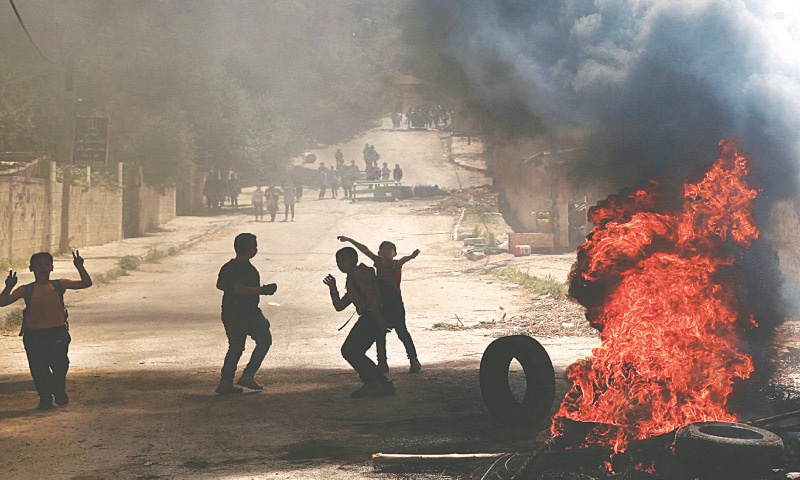
JENIN: Fresh clashes between Israeli soldiers and Palestinian militants rocked the West Bank city of Jenin on Tuesday as a Palestinian stabbed a police officer in Israel before being shot dead.

Israeli troops launched a fourth day of operations around Jenin after an assailant from the flashpoint district shot and killed three people in a Tel Aviv bar last week in the latest of a spate of attacks that have stunned the Jewish state.

Prime Minister Naftali Bennett — who warned in response that there would “not be limits for this war” — overnight visited the Tel Aviv shooting scene and vowed: “We will not let our enemy stop our lives.

“We will continue to live our lives and at the same time we will fight where they are located, in their bases, at their source — and, please God, we will win.” The Palestinian official news agency Wafa said clashes erupted for a fourth day between young Palestinian men and Israeli soldiers who fired live bullets, stun grenades and tear gas at them.

Islamic Jihad hails Palestinian response to Israel’s military incursions in Jenin, other cities

The Israeli army said its soldiers responded with live ammunition toward suspects who hurled explosive devices at them, as well as toward armed suspects in the area.

“Soldiers and other security forces apprehended 20 wanted terror suspects during the night and early morning.”

In Zeita, near the border with Israel, commandos found “weapons and arrested wanted persons suspected of aiding terrorist activities,” the army said. The latest violence to rock Israel came in the Mediterranean port city of Ashkelon, where police said an officer was checking a Palestinian man in his 40s who then “pulled out a knife and attacked the officer”.

The policeman “fired and neutralised the suspect, whose death was declared on site,” police said, adding that the officer was hospitalised with light wounds from the attack using a kitchen knife.

Police said the man hailed from Hebron — a powder keg where around 1,000 Jewish settlers live under heavy military protection among 200,000 Palestinians. Ashkelon said it deployed extra police on motorcycles to patrol schools and commercial areas.

Escalating violence

Palestinian youth have also clashed elsewhere with Israeli security forces, including Ramallah where they threw rocks and were targeted with tear gas on Monday.

The rise in violence comes during the Muslim fasting month of Ramazan and days before the Jewish festival of Passover and Christian Easter.

Last year during Ramazan, tensions in Jerusalem flared into 11 days of war between Israel and the Hamas militant group ruling the Gaza Strip.

Israeli troops and police have stepped up operations over the past three weeks in which four shooting, stabbing and car-ramming attacks have left 14 people dead.

Over the same period, Israeli forces have killed 15 Palestinians, including assailants, according to an AFP tally.

The Palestinian prime minister, Mohammad Shtayyeh, charged that Israeli actions were fuelling the escalation and accused Israel of a “shoot-to-kill policy”, speaking at a government meeting on Monday.

He argued that the lack of a political horizon and double standards from the international community were “a serious warning that the situation is getting worse,” according to Wafa.

Palestinian militant group Islamic Jihad hailed the response to Israel’s military incursions in Jenin and other cities.

“We salute our people who stand like an unyielding barricade in the face of the Zionist enemy’s terrorism, and who frustrate its plans to carry out the assault on the camp and city of Jenin and all the cities of the West Bank.”

UN Secretary General Antonio Guterres followed “with deep concern the escalating violence in the Occupied Palestinian Territory and Israel”, said his spokesman Stephane Dujarric.

“He is appalled by the increasingly high number of casualties, including women and children,” Dujarric added.

FO rejects ‘unwarranted reference’ to Pakistan in India-US joint statement after ministerial talks

The joint statement was issued as a part of the fourth ‘2+2’ dialogue between India and the United States, which ended yesterday in Washington DC. India’s external affairs and defence ministers, S Jaishankar and Rajnath Singh, held meetings with their US counterparts, Secretary of State Anthony Blinken and Secretary of Defense Lloyd Austin.

In the statement, US and India called on Pakistan to take “immediate, sustained, and irreversible action” to ensure that no territory under its control was used for terrorist attacks.

“[India] strongly condemned any use of terrorist proxies and cross-border terrorism in all its forms and called for the perpetrators of the 26/11 Mumbai attack, and Pathankot attack, to be brought to justice,” the statement — issued by the US Embassy and Consulates in India — reads.

According to The Indian Express, the 2+2 dialogue is a format of talks between the foreign and defence ministers of India and its allies on strategic and security issues. India holds dialogues on this format with four of its strategic partners — US, Russia, Australia, and Japan.

In the joint statement issued yesterday after the meeting, both countries called for concerted action against all terrorist groups, including those proscribed by the UNSC 1267 Sanctions Committee, such as al Qaeda, ISIS/Daesh, Lashkar-e-Tayyiba (LeT), Jaish-e-Mohammad (JeM), and Hizb ul Mujahideen.

“The ministers committed to continued exchange of information about sanctions and designations against terror groups and individuals, countering violent radicalism, use of the Internet for terrorist purposes, and cross-border movement of terrorists,” it read.

India also emphasised the importance of upholding international standards on anti-money laundering and combating the financing of terrorism by all countries, consistent with Financial Action Task Force (FATF) recommendations.

“The ministers also reaffirmed their support for the early adoption of a UN Comprehensive Convention on International Terrorism (CCIT) that advances and strengthens the framework for global cooperation and reinforces that no cause or grievance justifies terrorism,” the statement added.

According to Radio Pakistan, the Foreign Office in Islamabad today rejected the statement and called it a “betrayal to the counter-terrorism focus of both countries”.

“It is unfortunate that a bilateral cooperation mechanism is being used to target a third country for political expediency and to mislead public opinion away from the real and emerging terrorism threats. The assertions made against Pakistan in the statement are malicious and lack any credibility.”

The Foreign Office said Pakistan had remained a major, proactive, reliable and willing partner of the international community in the global fight against terrorism over last two decades. “Pakistan’s successes and sacrifices in countering terrorism are unparalleled and widely acknowledged by the international community, including the United States. No country in the region has sacrificed more for peace than Pakistan,” it stated.

The FO expressed that India’s insinuations against Pakistan were a desperate attempt to conceal its state-terrorism and brutal atrocities against the subjugated Kashmiris in Indian Illegally Occupied Jammu and Kashmir.

“Responsible members of the international community must condemn India’s use of terrorism as an instrument of state policy and the impunity that continues to be associated with it,” it urged, adding that India’s terrorism network using the soil of other countries through supporting UN-designated terrorist organisations, was on record.

“Failing to take cognizance of this serious situation is tantamount to abdication of international responsibility,” the FO highlighted.

“Pakistan expects and urges partner countries to adopt an objective view of the issues of peace and security in South Asia and refrain from associating themselves with positions that are one-sided, politically motivated, and divorced from ground realities,” it further stated.

The FO added that its concerns regarding the statement had been conveyed to the US side through diplomatic channels.

A former US researcher at a cryptocurrency group has been sentenced to more than five years in prison for conspiring to help North Korea evade US sanctions using cryptocurrency.

Virgil Griffith had earlier pleaded guilty to conspiring to violate US law.

He formerly worked for the Ethereum Foundation, a non-profit organisation focused on the technology behind the cryptocurrency ether.

The sentence was the minimum amount of prison time sought by prosecutors.

He was also fined $100,000 (£76,864). The 39-year-old had been facing a maximum sentence of 20 years in prison and a $1m fine.

His lawyer said in a statement that while the sentence was disappointing, the judge “acknowledged Virgil’s commitment to moving forward with his life productively, and that he is a talented person who has a lot to contribute”.

US Attorney Damian Williams said in a statement that “justice has been served”.

In September, Griffith pleaded guilty to conspiring to violate the US International Emergency Economic Powers Act by travelling to North Korea’s capital Pyongyang to give a presentation on blockchain technology.


According to prosecutors, Griffith, who has a doctorate from the California Institute of Technology, travelled to North Korea via China in April 2019 to speak at the Pyongyang Blockchain and Cryptocurrency Conference, despite being denied permission by the US Department of State to go.

Prosecutors said Griffith understood the information could be used to evade sanctions that Washington had imposed on North Korea over its development of nuclear weapons.

“The most important feature of blockchains is that they are open. And the DPRK [Democratic People’s Republic of Korea] can’t be kept out no matter what the USA or the UN says,” Griffith said during the presentation, according to prosecutors.

In September, the US Department of Justice said he had “jeopardised the national security of the United States” by undermining sanctions.

The Ethereum Foundation said at the time of Griffith’s arrest that it had not approved or supported his travel to North Korea.

At least 53 people have been killed in landslides and floods after Tropical Storm Megi devastated the Philippines.

Rescue crews were still looking for survivors in flooded villages on Wednesday, digging through mud and wading through chest-high water.

However the death toll from Sunday’s natural disaster is only expected to climb, officials say.

Villages around Baybay city in the central Leyte province are worse hit.

There, hillside avalanches and overflowing rivers wiped out homes and buried many people alive. The city’s mayor Jose Carlos Cari told news outlet CNN that at least 47 people in the area had been killed.

In one village, Pilar, about 80% of the houses had been washed out to sea, a government official told news agency AFP.

Philippines national disaster agency has also reported deaths in the southern Davao region, Mindanao and in the central Negros Orientals province.

More than 100,000 people in southern and eastern Philippines islands have been affected by the storm, authorities say.

Many fled their homes to shelters or higher ground on Sunday when the storm, known locally as Agaton, hit the archipelago with winds of up to 65km/h (40mph).

A man carries a boy on his shoulder as they walk through a flooded road in Capiz province with the aid of rescuers
Another rescue operation in Panitan on Panay Island in the nation’s east

Pictures posted by the Philippines Coast Guard show rescuers carrying the injured on stretchers through chest-high water and ferrying survivors on rafts down flooded streets.

The rescue effort has been hampered by constant rain, although conditions eased on Tuesday.

It was the first such storm of the year – the Philippines typically sees an average of 20 each year.

It comes about four months after Super Typhoon Rai devastated many of the nation’s south-east islands in December – killing at least 375 people and affecting about 500,000 people.

It was the worst storm to hit the Philippines that year and experts said it had grown stronger far quicker than anticipated.

On Tuesday, a national disaster agency spokesman also said the landslide around Baybay city had extended to areas “outside the danger zone”, reported AFP.

Marissa Miguel Cano, a public information officer in Baybay, told the news agency: “It’s supposed to be the dry season but maybe climate change has upended that.”

Scientists say human-caused climate change has led to a greater intensity and power in tropical storms. The Philippines has experienced some of its most deadly storms since 2006.

It’s been ranked as one of the nations most vulnerable to climate disasters due to its geography.

The death toll in the South African province of KwaZulu-Natal has reached more than 250, after devastating floods wreaked havoc in the area.

Local authorities are calling for a state of disaster to be declared, after some areas saw months worth of rain fall in one day.

Officials have called it “one of the worst weather storms in the history of our country”.

President Cyril Ramaphosa has visited the area and pledged to help.

“Even though your hearts are in pain, we’re here for you,” the Reuters news agency quotes him as saying.

Photos from the area’s main city, Durban, show wrecked homes and cars submerged in water.

Months worth of rain fell in a single day in some areas, and mudslides have brought traffic to a standstill. Some motorways are so submerged that only the tops of traffic lights can be seen, according to the AFP news agency.

Many are people are still missing.

Ron Naidoo, a community pastor in the town of Tongaat, told the BBC he had been kept awake through the night by the rising floodwaters and had seen police drag a car out of the river with a body inside.

“It was traumatic because it is the first time that we have seen the river rise so high here,” he continued.


The KwaZulu-Natal provincial government estimates that billions of rand worth of damage has been caused to properties and infrastructure, describing the heavy rains as unleashing “untold havoc” in a statement on Facebook.

Electricity and water treatment plants have been “flooded out”, Durban’s Mayor Mxolisi Kaunda told the BBC.

The KwaZulu-Natal province says it needs more funds to fix the extensive damage

Durban port – the busiest in South Africa – has also been affected. Terminals cannot be accessed because of damage to the roads, and operations at the port have now been suspended, state-owned logistics company Transnet said.

Parts of the crucial N3 highway which connects Durban to the economic heartland of Gauteng province have been blocked.

Communications have also been disrupted with two major networks reporting that more than 900 of their cell phone towers are down.

Declaring the flood-stricken area a disaster zone will “enable the province to apply for emergency funding” from the National Treasury and assist with necessary reconstruction work, authorities say.

There are also reports of looting in Durban, which the local government has condemned: “We will not allow what is a tragic development in our province to be taken advantage of,” it said.

There have been incidents of looting in Durban

The government is calling on people to stay safe by avoiding flooded roads and bridges and to evacuate to higher ground if they live in low-lying areas.

At the start of the year, the region was hit by three cyclones and two tropical storms in six weeks, which primarily affected Madagascar, Mozambique and Malawi and inflicted widescale damage with 230 reported deaths according to the World Weather Attribution (WWA).

New York City police have named “a person of interest” after a morning rush-hour shooting at a subway station that left more than 20 people injured.

Police said they were looking for Frank R James, 62, in connection with the attack as he had rented a U-Haul van that may be linked to the shooting.

The key to the van, rented in Philadelphia, was found at the scene.

“We are looking to determine if he has any connection to the train,” NYPD Chief of Detectives James Essig said.

The New York Police Department (NYPD) asked “anyone with information on his whereabouts” to call a hotline.

Mr James has not been named as a suspect in the attack. Being identified as a person of interest means police believe he may have information concerning the crime.

The New York Times reports that Mr James, who has addresses in Wisconsin and Philadelphia, appears to have posted dozens of videos on social media in recent years, in which he expresses bigoted views. More recently he had also criticised New York City Mayor Eric Adams.

In a briefing late on Tuesday, police gave more details of the incident which saw a male attacker detonate two smoke grenades and open fire at Brooklyn’s 36th Street station.

The attack unfolded shortly before 08:30 local time (12:30 GMT) on Tuesday, and police said the man had a Glock 9 mm semi-automatic handgun.

“He then fired that weapon at least 33 times, striking 10 people,” police chief Mr Essig said. Seven men and three women were shot.

Images from the scene showed bloodied passengers lying on the floor of the smoke-filled station.

Another 13 people “suffered injuries related to smoke inhalation, falling down or a panic attack”, the police chief said.

All of the victims are expected to survive.

“The male then fled the scene, and detectives are actively trying to determine his whereabouts,” Ms Essig said.

Investigators found the Glock handgun, three extended magazines, a hatchet and a range of potential incendiary devices at the scene.

A $50,000 (£38,450) reward is being offered for information leading to the arrest of the suspect.

Police say the gunman was roughly 5ft 5in tall and 170lb (77kg). He was said to be wearing a construction vest, grey hooded sweatshirt, and a gas mask.

The attacker’s motive was not immediately known.

New York City Police Commissioner Keechant Sewell said earlier on Tuesday that the shooting was not initially being treated as an act of terrorism.

Witnesses have described hearing people shouting for medical assistance and fleeing in panic. Brooklyn resident Yayha Ibrahim said he saw people running from the 36th Street station.

“I saw a lady, she was shot right in her leg and she was screaming for help,” he told Reuters news agency. Rescue workers “did a good job of coming quick and fast, and the ambulance came in and they took her”, he added.

WARNING: Graphic image below

“My subway door opened into calamity. It was smoke and blood and people screaming,” eyewitness Sam Carcamo told the Associated Press. He added that a billow of smoke poured out of the train once its doors opened.

Images shared on social media showed injured people inside the smoke-filled station

Initial police investigations into what happened may have been hampered by a failure in the station’s surveillance system.

“At that particular station there appeared to be some form of malfunction with the camera system,” Mayor Adams later said.

Responding to the attack, President Joe Biden expressed gratitude to “all the first responders who jumped into action, including civilians who didn’t hesitate to help their fellow passengers.”

US cities have seen a rise in gun violence over the past two years.

“This insanity that is seizing our city has to stop,” New York Governor Kathy Hochul said after the attack. “We say no more. No more mass shootings. No more disrupting lives.”

The Scottish Tory leader has said Boris Johnson should not be removed from office “at this time” despite his fine for breaking lockdown rules.

Douglas Ross said he shared the fury of the public over the “unacceptable” actions of the prime minister.

But he said it would be wrong to destabilise the UK government while the war in Ukraine was ongoing.

Chancellor Rishi Sunak and the PM’s wife, Carrie Johnson, will also be fined over parties in Downing Street.

Downing Street has confirmed Mr Johnson’s fine was in relation to an event he attended on 19 June 2020 to celebrate his birthday.

His wife and Mr Sunak were also reported to have been at the gathering, with an ITV report saying the prime minister had been presented with a cake while people sang Happy Birthday to him.

The fines are among more than 50 to have been handed out so far by officers from the Met, who have been investigating alleged Covid law-breaking at 12 gatherings in Whitehall and Downing Street during lockdowns in 2020 and 2021.

Mr Johnson is the first serving prime minister of the UK to be sanctioned for breaking the law.

Scotland’s first minister, Nicola Sturgeon, and Labour leader Sir Keir Starmer have both called for Mr Johnson and Mr Sunak to resign.

But Mr Ross said in a statement that removing the prime minister would “destabilise the UK government when we need to be united in the face of Russian aggression and the murdering of innocent Ukrainians.”

He said the public was “rightly furious” at what had happened in Downing Street during lockdown, adding: “I understand why they are angry and share their fury.

“The behaviour was unacceptable. The prime minister now needs to respond to these fines being issued.

“However, as I’ve made very clear, in the middle of war in Europe, when Vladimir Putin is committing war crimes and the UK is Ukraine’s biggest ally, as President Zelensky said at the weekend, it wouldn’t be right to remove the prime minister at this time.”

Awkward doesn’t really cover the spot that Douglas Ross finds himself in. His credibility is in question.

Having concluded the prime minister’s position was “untenable” in January, before the police investigated – he’s now arguing the opposite when Boris Johnson has been fined.

This about turn is not new. He made that the early stages of the Ukraine war, on the basis that the UK should present a united front against Russia.

Partygate has certainly united the opposition in demanding the PM’s resignation, with some arguing the UK cannot afford to be represented by a lawbreaking leader on the world stage.

There’s division within the Conservative party too, with former Scottish leader Ruth Davidson sticking to her view that Mr Johnson has lost the “moral authority” to govern. Awkward indeed.

Mr Johnson has confirmed that he has paid the fine, and he apologised but insisted he would not resign over the matter.

“I accept in all sincerity that people had the right to expect better,” he said in an interview, at his Chequers country retreat.

“[But] now I feel an even greater sense of obligation to deliver on the priorities of the British people.”

Reports that parties had been held in Downing Street during lockdown first emerged in December of last year, with Mr Johnson initially insisting that “the guidelines were followed at all times”.

He later apologised for attending a drinks party in the Downing Street garden, but told Parliament he believed he had been attending a work event.

This admission initially resulted in Mr Ross saying the prime minister’s position was no longer tenable, and he wrote to the 1922 Committee of backbench Tory MPs in January calling for a leadership contest.

But he withdrew the letter in March, arguing that calls for Mr Johnson to quit should be put on hold following the Russian invasion of Ukraine.

Mr Johnson subsequently attended the Scottish Conservative conference in Aberdeen, where he was welcomed onto the stage by Mr Ross.

Mr Sunak was also asked in the Commons in December if he attended Christmas parties said to have taken place in 2020, and replied: “No, I did not attend any parties.”

What has the reaction been?

First Minister Nicola Sturgeon tweeted that Mr Johnson had broken the law and “repeatedly lied to parliament about it”, and must therefore resign.

She added: “The basic values of integrity and decency – essential to the proper working of any parliamentary democracy – demand that he go.

“And he should take his out of touch chancellor with him”.

Labour leader Sir Keir said the fines showed that the Conservatives were “totally unfit to govern”, adding: “Britain deserves better.

“Boris Johnson and Rishi Sunak have broken the law and repeatedly lied to the British public. They must both resign.”

Scottish Green MSP Gillian Mackay said Mr Johnson and Mr Sunak were “a disgrace” and that “if they have a shred of dignity left they will resign immediately.”

And Scottish Liberal Democrat leader Alex Cole-Hamilton said parliament should be recalled for a vote of no confidence in the prime minister.

Campaigners from the Covid-19 Bereaved Families for Justice group also said there was “simply no way either the prime minister or chancellor can continue”.

Scottish Secretary Alister Jack issued a statement in support of the Mr Johnston, saying he remained the “right person to lead this country at such a crucial time.

Former Scottish Conservative leader Ruth Davidson, however, tweeted that he had lost moral authority and he “should go”.

Sue Gray’s record of the gatherings

The government has faced intense pressure over gatherings held in and around Downing Street during Covid lockdowns. Senior civil servant Sue Gray has said that many of them “should not have been allowed to take place or to develop in the way that they did.” Here is what we know about them and the restrictions in place at the time:

Prices are rising at their fastest rate for 30 years, driven by a sharp increase in petrol and diesel costs.

The UK inflation rate rose to 7% in the year to March, the highest rate since 1992 and up from 6.2% in February.

Prices are rising faster than wages and there is pressure on the government to do more to help those struggling.

The cost of living is expected to rise even further after the energy price cap was increased, driving up gas and electricity bills for millions.

Inflation is the rate at which prices rise. If a bottle of milk costs £1 and that rises by 5p, then milk inflation is 5%.


Fuel had amongst the biggest impact on the inflation rate, with average petrol prices rising by 12.6p per litre between February and March, the largest monthly rise since records began in 1990, the Office for National Statistics (ONS) said.

This compares with a rise of 3.5p per litre between the same months of 2021.

Diesel prices also rose by 18.8p per litre this year, compared with a rise of 3.5p per litre a year ago.

The rise in the inflation rate was higher than the 6.7% expected by analysts and was also driven up by furniture, restaurant and food prices.

The figures for March do not yet reflect the average 54% increase in energy bills that took place from 1 April when the energy price cap was raised.

Since late last year, prices have been rising fast as pandemic restrictions have been eased and firms face higher energy and shipping costs which they have passed on to consumers.

Russia’s invasion of Ukraine is now adding to the pain, as the price of oil and other commodities climb higher.

Russia is one of the world’s largest oil exporters and demand for oil from other producers has increased since the invasion, leading to higher prices.

Although the UK imports just 6% of its crude oil from Russia, it is still affected when global prices rise.

Ukraine and Russia are also the world’s main suppliers of sunflower oil and the war has hit prices.

In the UK, the price of oils and fats for food increased by 7.2% in March, according to the ONS.

Andrew Selley, chief executive of BidFood, a wholesaler which supplies 45,000 caterers and food service businesses across the UK, said increasing electricity, fuel and packaging costs were impacting the price of all its products.

But he told the BBC products affected by the war in Ukraine, such as wheat-based foods, sunflower oil, chicken and white fish, were particularly hard hit.

“I’ve been in the business for over 30 years. I’ve never seen a situation where everything seems to be going up [in price],” he said, adding that some of these costs would ultimately be passed on to consumers.

‘I’m paying £120 more a month for petrol’

Sara Gerritsma, a student from Leicestershire with a partner and six year-old child, said she may have to give up her paramedic degree due to the rising cost of fuel.

The 32-year-old only started the three-year course in October but she has a 2.5 hour roundtrip each day to get to university in Northampton, and her petrol costs have shot up by about £120 a month.

“It would be really frustrating giving up my course. It was a big decision changing my career at 32,” Sara told the BBC.

“But recently we have sat down and gone through everything and thought, can I afford to be a full-time student?”

Sara said the family was also using less energy and has reworked its food budget to save money.

The sharp rise in prices is also putting pressure on businesses.

Paul White, who owns the pizzeria 6/CUT in Eccles, Greater Manchester, said the increase in the minimum wage, the end of VAT relief, and rising fuel and food prices have all hit his company. The restaurant is also spending £500 more a week on its energy bills.

“We need to find an extra £1,400 a week to cover the costs of everything that’s come on in the last few weeks,” he told the BBC .

He says he will have to put up prices, and is looking to charge each customer about 50p to £1 extra to cover his rising overheads.

But he is also worried people might start eating out less as their budgets are squeezed.

“Next six months there’ll be a lot of [restaurants] shutting down, they won’t be making enough money to cover the costs of everything,” he said.

This is no longer a cost of living squeeze, but a financial throttling for many people. Price rises are accelerating and their wages, benefits and pensions are failing to keep pace.

So, at home, families will be discussing how best to cope with this situation, which is expected to last a while.

In the words of the ONS, there were “no large offsetting downward contributions” to the inflation rate. In other words, nothing is getting significantly cheaper.

So avoidance of price rises is impossible. Even if you do not have a car and are avoiding surging fuel costs, lots of other necessities are getting more expensive.

Experts say the only option is trying to budget as best we can, across every part of our lives. Most importantly, they also stress the importance of seeking early, and free, help before falling into unmanageable debt.

Jack Leslie, senior economist at the Resolution Foundation think tank, which focuses on those on lower incomes, warned the cost of living crisis would “continue to worsen before it starts to ease at some point next year”.

He said with wages not keeping pace with rising prices, people were facing “the biggest squeeze since the mid-70s.”

Chancellor Rishi Sunak said: “I know this is a worrying time for many families, which is why we are taking action to ease the burdens by providing support worth around £22bn in this financial year, including for the most vulnerable through our Household Support fund.”

But Labour called on the chancellor to “show the leadership the country needs”.

“Labour has a plan to cut energy bills through a one-off windfall tax on oil and gas producer profits. Meanwhile, the chancellor has increased taxes for working people to their highest levels in 70 years,” shadow chief secretary to the Treasury Pat McFadden said.

Liberal Democrats leader Ed Davey called for “unfair tax hikes” to be immediately reversed and said people needed “urgent help” with energy bills.

Boris Johnson and Rishi Sunak have rejected calls to resign, despite being fined by police for breaking lockdown rules in Downing Street in June 2020

The prime minister, the chancellor and the PM’s wife all received fixed penalty notices for attending a birthday gathering for the PM in No 10.

As a result, Mr Johnson became the UK’s first serving prime minister to be sanctioned for breaking the law.

All three apologised, but opposition MPs say the PM and Mr Sunak must quit.

Mr Johnson said he felt “an even greater sense of obligation to deliver”, while the chancellor said he was “focused on delivering for the British people”.

‘Mortified’

But a group representing bereaved families said there was “simply no way” either could continue in their jobs, calling their actions “truly shameless”.

Amanda McEgan, whose daughter Isabel died during the pandemic, said the prime minister’s conduct during the lockdowns made restrictions on the 19-year-old’s funeral “more hurtful”.


Opposition parties accused Mr Johnson and Mr Sunak of lying to the public about their attendance at the Downing Street gathering, with Labour leader Sir Keir Starmer and the first ministers of Scotland and Wales demanding they step down.

The SNP and the Liberal Democrats also led calls for Parliament to return from its Easter break so the PM and chancellor could face questions from MPs.

Nearly all cabinet ministers have publicly backed Mr Johnson and Mr Sunak – including Foreign Secretary Liz Truss, who said they were “delivering for Britain on many fronts”.

Nigel Mills is currently the only Tory MP known to have said publicly that Mr Johnson should go, telling BBC Radio Derby: “I don’t think his position is tenable”.

Others who called for him to resign earlier in the year, including Scottish Tory leader Douglas Ross, have now said they don’t think he should.

Transport Secretary Grant Shapps said Mr Johnson was “mortified” about being fined, but argued he had not “set out with malice to break the law”.

He told BBC Breakfast he understood public anger over the parties, but added: “Everyone is human. People make mistakes”.

‘Right to expect better’

The fines come as part of an investigation by the Metropolitan Police into illegal parties held in Downing Street and across Whitehall during Covid lockdowns in 2020 and 2021.

The force is looking into 12 parties overall, and has already issued more than 50 fines, with more expected to come.

Speaking on Tuesday, the PM said he accepted “in all sincerity that people had the right to expect better” from him.

He claimed the event he was fined for attending – a gathering in the Cabinet Room to mark his birthday – was “brief” and lasted “less than 10 minutes”.

He added: “In all frankness, at that time it did not occur to me that this might have been a breach of the rules.

“But, of course, the police have found otherwise and I fully respect the outcome of their investigation.”

A spokesperson for the prime minister’s wife, Carrie Johnson, said she had accepted the police’s findings and “apologises unreservedly.”

Mr Sunak later released a statement, saying: “I understand that for figures in public office, the rules must be applied stringently in order to maintain public confidence.

“I respect the decision that has been made and have paid the fine.”

But the “full” and “unreserved” apologies did not silence critics of the PM and chancellor.

Labour’s deputy leader, Angela Rayner, tweeted: “You made the rules. You broke your own law. Just go.”

The SNP’s Westminster leader, Ian Blackford, said the two leading Tories had “insulted the millions of people who faithfully followed the rules”.

Liberal Democrat leader Sir Ed Davey said: “This is a government in crisis neglecting a country in crisis.”

Reports of parties being held in Downing Street during lockdowns first emerged in December last year, with Mr Johnson initially insisting that “guidelines were followed at all times”.

Mr Sunak also told the Commons: “I did not attend any parties.”

The PM then ordered an inquiry into the allegations of rule-breaking, led by senior civil servant Sue Gray.

The Met initially said it would not retrospectively investigate the allegations unless “significant evidence” of a regulation breach came forward.

But after Ms Gray passed information to officers, they launched their own inquiry.

Her full report will not be released until the Met have concluded their investigation.

Sue Gray’s record of the gatherings

The government has faced intense pressure over gatherings held in and around Downing Street during Covid lockdowns. Senior civil servant Sue Gray has said that many of them “should not have been allowed to take place or to develop in the way that they did.” Here is what we know about them and the restrictions in place at the time:

A photo from May 2020 showed the prime minister and his staff with bottles of wine and a cheeseboard in the Downing Street garden. When asked about it, Boris Johnson said “those people were at work talking about work”.

The rules:

Legal restrictions at the time said you could not leave your house without a reasonable excuse and government guidance was that you could meet one person outside of your household in an outdoor setting while exercising.

This event is not being investigated by the police.

About 100 people were invited by email to “socially distanced drinks in the No 10 garden this evening”. Witnesses told the BBC the PM and his wife were among about 30 people who attended. Boris Johnson has declined to say whether he was among those there.

This event is being investigated by the police.

A gathering took place in the Cabinet Office to mark the departure of a No 10 private secretary.

This event is being investigated by the police.

On Boris Johnson’s birthday, up to 30 people gathered in the Cabinet Room at No 10 to present the prime minister with a birthday cake and sing Happy Birthday, according to a report by ITV News.

No 10 said staff had “gathered briefly” to “wish the prime minister a happy birthday”, adding that he had been there “for less than 10 minutes”.

The rules:

Restrictions at the time banned most indoor gatherings involving more than two people.

This event is being investigated by the police.

Sources told the BBC that Downing Street staff members attended a gathering with Carrie Johnson in the flat where she and the prime minister live. A spokesman for Mrs Johnson denies the party took place. There was a separate gathering in No 10 Downing Street  on the same day to mark the departure of a special adviser.

The rules:

Eight days earlier Boris Johnson had announced a new lockdown in England. Indoor gatherings with other households were banned, unless they were for work purposes.

These events are being investigated by the police.

A leaving event was held for No 10 aide, Cleo Watson, where people were drinking, and Mr Johnson made a speech, according to sources.

This event is not being investigated by the police.

The Department for Education has confirmed it had an office gathering to thank staff for their work during the pandemic. It says drinks and snacks were brought by those who attended and no outside guests or support staff were invited.

The rules:

Eight days earlier, London had been placed in restrictions which banned two or more people from different households from meeting indoors, unless “reasonably necessary” for work purposes.

This event is not being investigated by the police.

The Conservative Party has admitted that an “unauthorised gathering” took place at its HQ in Westminster. It was held by the team of the party’s London-mayoral candidate, Shaun Bailey, who has since stepped down as chair of the London Assembly police and crime committee. The Metropolitan Police is to speak to two people who attended the party.

This event was not included in Sue Gray’s report.

Multiple sources have told the BBC there was a Christmas quiz for No 10 staff last year. A photo – published by the Sunday Mirror – shows Boris Johnson taking part and sitting between two colleagues in No 10. Mr Johnson has denied any wrongdoing.

This event is not being investigated by the police.

The Department for Transport has apologised after confirming reports of a party in its offices, calling it “inappropriate” and an “error of judgment” by staff.

The rules:

London moved into the highest tier of restrictions and Matt Hancock, who was health secretary at the time, said it was important “everyone is cautious” ahead of the festive period.

This event was not included in Sue Gray’s report.

A leaving party was held at the Cabinet Office for the outgoing head of the civil service Covid taskforce – the team responsible for drawing up coronavirus restrictions.

Kate Josephs, now chief executive of Sheffield City Council, apologised for the event, saying she was “truly sorry that I did this and for the anger that people will feel as a result”.

A second gathering was held in the Cabinet Office to hold an online Christmas quiz for the Cabinet Secretary’s private office.

A third gathering was held in No 10 Downing Street to mark the departure of a No 10 official

These events are being investigated by the police.

Downing Street originally denied a report by the Daily Mirror that a party took place in Downing Street. However, a video obtained by ITV News showed the prime minister’s then-press secretary Allegra Stratton, joking about reports of an event, saying: “This fictional party was a business meeting and it was not socially distanced.”

This event is being investigated by the police.

A gathering was held in No 10 Downing Street to mark the departure of two private secretaries.

This event is being investigated by the police.

Two parties were held by Downing Street staff at No 10, the night before Prince Philip’s funeral.

One of the events was a leaving party for the PM’s then director of communications James Slack, who has apologised for the event and acknowledged it “should not have happened at the time that it did”.

Boris Johnson was not at either party.

The rules

The rules had been eased in England on 12 April, but working from home continued to be recommended and socialising indoors with people from other households was not allowed. Meeting others outdoors was limited to groups of six people or two households.

These events are being investigated by the police.

Democratic Pakistan critical to US interests, White House says after Shehbaz becomes PM

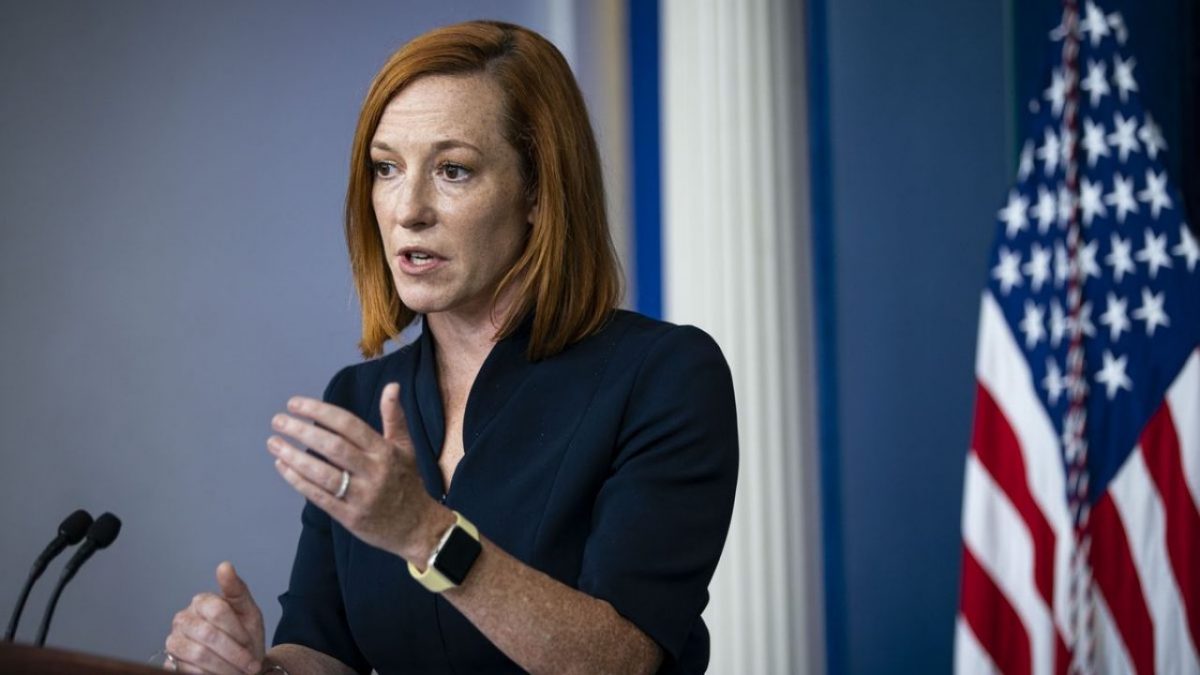
WASHINGTON: A democratic Pakistan is critical to the interests of the United States, White House Press Secretary Jen Psaki said Monday, hours after Shehbaz Sharif was elected as the prime minister.

Ex-prime minister Imran Khan repeatedly blamed the US for backing the no-confidence motion — that lead to his ouster early Sunday — and has refused to accept the newly-elected premier, saying “there can’t be any bigger insult to this country” — but the Joe Biden administration denied any role.

In a press briefing at the White House, Psaki said: “We support the peaceful upholding of constitutional democratic principles, we don’t support one political party over another.”


The White House press secretary said the United States “certainly” supports the principles of rule of law and equal justice under the law.

Will Biden call Shehbaz?

Psaki added that the US values its long-standing cooperation with Pakistan and has always viewed a prosperous and democratic Pakistan as critical to US interests — that remains unchanged regardless of who the leadership is.


In response to a question about whether Biden would call Shehbaz, Psaki said: “In terms of future calls, I don’t have anything to predict at this point and time, obviously, we stay in close touch with them at a range of levels.”

Since Biden assumed the US president’s office in 2021, Imran Khan and Biden did not hold a telephonic conversation.

Messages from India, Turkey

Meanwhile, Indian Prime Minister Narendra Modi and Turkish President Recep Tayyip Erdogan congratulated Shehbaz on becoming the 23rd premier of Pakistan.

In his congratulatory message to Shehbaz on Twitter, PM Modi said: “Congratulations to H. E. Mian Muhammad Shehbaz Sharif on his election as the Prime Minister of Pakistan.”

“India desires peace and stability in a region free of terror so that we can focus on our development challenges and ensure the well-being and prosperity of our people,” he said.

In a telephonic conversation with Shehbaz, Turkish President Erdogan told the newly-elected prime minister that he was “extremely happy” about him being elected as the premier.


“I am sure that under your leadership, Pakistan-Turkey’s brotherly ties will bolster,” said Erdogan, who called Shehbaz hours after the lower house of the Parliament elected him.

In response, Shehbaz said he aspired to bring both the countries closer during his tenure as the prime minister and thanked Erdogan for his congratulatory telephonic call.