People living in Shetland and north east Scotland have reported feeling an earthquake miles away in the Norwegian Sea.

British Geological Survey (BGS) recorded the 4.9 magnitude quake just after 05:30.

It said one report came from Aberdeen – more than 311 miles (500km) from the epicentre.

BGS said the person had described feeling “three waves of vibration in around three seconds”.

The epicentre was about 86 miles (140km) west of Norway, and 112 miles (180km) north east of Shetland.

A Ukrainian MP has accused Russia of trying to starve the besieged port city of Mariupol into surrendering.

Dmytro Gurin was speaking soon after Ukraine rejected a Russian deadline demanding Mariupol’s defenders lay down their arms in exchange for safe passage out of the city.

Mariupol is a key strategic target for the Russian military.

Around 300,000 people are believed to be trapped there with supplies running out and aid blocked from entering.

Residents have endured weeks of Russian bombardment with no power or running water.

Mr Gurin said there was no question of Mariupol surrendering.

“Russians don’t open humanitarian corridors, they don’t let humanitarian convoys enter the city and we clearly see now that the goal of the Russians is to start to [create] hunger [in the city] to enforce their position in the diplomatic process,” he said.

“If the city does not surrender, and the city will not surrender, they won’t let people out. They won’t let humanitarian convoys into the city.”

Under the proposal, which Ukraine had until 05:00 Moscow time (02:00 GMT) to accept, Russian troops would have opened safe corridors out of Mariupol from 10:00 Moscow time, initially for Ukrainian troops and “foreign mercenaries” to disarm and leave the city.

After two hours, Russian forces say they would then have allowed humanitarian convoys with food, medicine and other supplies to enter the city safely, once the de-mining of the roads was complete.

But the deadline came and went.

Should Russia capture Mariupol, it would help it create a land corridor between the eastern regions of Donetsk and Luhansk, controlled by Russian-backed separatists and Crimea, which was annexed by Russia in 2014. So far though, Mariupol’s defenders have stood firm.

There are mounting concerns about the humanitarian situation, with Yaroslav Zhelezniak, a Ukrainian MP from Mariupol, calling it “hell on Earth”.

Residents spend most of their time in shelters and basements as Russia continues its unrelenting attack on the city, from land, air and sea, officials say.

Pictures show a city in ruins, with entire neighbourhoods devastated. The mayor, Vadym Boychenko, estimated that over 80% of residential buildings had either been damaged or destroyed, a third of them beyond repair.

Bodies are being left in the streets as it is too dangerous to get them.

Mr Gurin said teams were still unable to clean the rubble of a theatre which Ukrainian officials say was bombed by Russia last Wednesday. Hundreds of people are believed to remain trapped in the basement, which withstood the attack. Moscow denies targeting the building.

“The services cannot clean this rubble because the shelling never stops and bombing never stops. It’s really dangerous,” he said. He could not give an estimate on how many people had managed to flee the area as “we don’t have connection with Mariupol”.

Since the war began, authorities say at least 2,500 people have been killed in Mariupol although the true figure may be higher.

Previous efforts to evacuate Mariupol’s civilians have been blocked by Russian fire, although local authorities say that thousands have been able to leave in private vehicles.

On Sunday, the Ukrainian deputy prime minister said 3,985 people had fled from Mariupol to Zaporizhzhia, adding that on Monday the government plans on sending about 50 buses to pick up further evacuees from the city.

President Volodomyr Zelensky has said the Russian siege amounts to a “war crime”.

“This is a totally deliberate tactic,” he said. “They [Russian forces] have a clear order to do absolutely everything to make the humanitarian catastrophe in Ukrainian cities an ‘argument’ for Ukrainians to cooperate with the occupiers”.

The lonely funeral of a young soldier in Ukraine

There was no family around Dmytro Kotenko when they put him in the ground. His parents did not hear the gunshots that rang out over his grave. They did not hear the sound of the ribbon tied to the wooden cross above him as it fluttered in the wind. They did not see the rough earth that first landed on his coffin and they did not lay a flower over him when he was completely covered by the earth.

Russian shells hit a chemical plant near the north-eastern Ukrainian city of Sumy, causing an ammonia leak, officials say.

Residents of Novoselytsya, near Sumy, were told to stay indoors but the region’s governor, Dmytro Zhyvytskyy, later said the leak had been contained.

A 50-ton tank of the poison gas was damaged by the attack, local officials said, creating an ammonia cloud.

Ammonia is largely used to make fertiliser and is corrosive.

The Sumykhimprom chemical plant was attended by emergency crews, and the cloud affected an area of about 2.5km (1.5 miles), Dmytro Zhyvytsky said.

He said one injury was reported – a worker at the plant. Residents of Novoselytsya were advised to shelter because of the wind direction.


Ammonia is a common chemical that has several commercial uses, and the Sumykhimprom plant says its production is for making chemical fertiliser. It is a waste product of the human body and usually dealt with by the liver, but is toxic in large amounts.

In the air, it is invisible but has a distinct unpleasant smell, and in high concentrations is both and irritant and corrosive. It can cause pain and burns to the airway and injuries to the eyes. However, it is lighter than air, so does not remain on the ground as long as some other dangerous gases do.

Russia has previously alleged, without any evidence, that Ukraine was planning to use chemical weapons in the ongoing war, pointing to the creation of industrial chemicals such as ammonia.

Earlier this month, Russia’s defence ministry alleged that Ukraine was plotting a “false flag” operation to blame Russia for using chemical weapons.

Yet Ukraine and its Western allies, including the US, have ridiculed such claims, and expressed their own concerns that Russia was setting the stage for its own false flag chemical weapons attack, which it would attempt to pin on Ukraine.

Ammonia is not well-known as a chemical weapon, since the human body has ways of processing it and it disperses, being lighter than air.

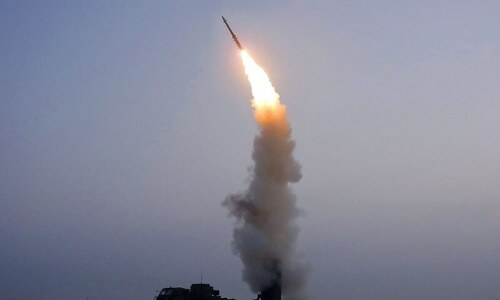
SEOUL: North Korea fired multiple rocket launchers on Sunday, Seoul said, the latest in a series of provocations by the nuclear-armed nation to heighten tensions in the region.

Pyongyang launched a string of banned weaponry this year and tested what it claimed were components of a “reconnaissance satellite” — although Seoul and Washington have described them as a new ICBM (intercontinental ballistic missile) system.

“There were shots suspected to be from North Korea’s multiple rocket launchers this morning,” said the Joint Chiefs of Staff in a text message to reporters.

“Our military is maintaining our defence readiness while closely following related developments,” it added, without further detail.

Four shots were fired into the western waters during a span of an hour from 7:20 am from an unspecified location in South Pyongan province, Yonhap news agency reported citing unnamed officials.

The intention of the firing was being evaluated, the report added.

South Korea’s National Security Council held an emergency meeting and called for a tight readiness posture to “prevent security vacuum during the government transition period”, according to a statement from the presidential Blue House.

President-elect Yoon Suk-yeol will be inaugurated on May 10 after winning the March 9 polls.

Pyongyang has long possessed the ability to devastate Seoul — which is only around 60km from the border — with artillery fire.


A self-proclaimed ‘time traveller’ has predicted a dead musician will return.

A self-proclaimed “time traveller” has predicted that a dead musician will return in September admitting they faked their death, Lad Bible has reported.

He has made a number of claims regarding the future through his TikTok account @realtiktoktimetraveler.

In a recent video, he says: “some people don’t believe I’m a real time-traveller, so here are some pretty big events that will happen in 2022.”

One of his predictions is that the biggest ocean creature will be discovered in the Pacific Ocean on June 17.

Some people do not believe the “time traveller,” and have claimed that his previous predictions had been proven wrong.

One person wrote: “Last time this happened the date came and they deleted the video.”

Apart from this one, there are other such claimants on TikTok, too. One example is Aery Yormany (@aesthetictimewarper) who predicted the same discovery regarding marine creatures.

The claims do seem false, considering there was one made about March 11, which did not come true. The so-called “time traveller” had said that a human and chimpanzee would have a child on March 11.

Taliban to open high schools for girls this week, official says

KABUL: The Taliban will allow girls around Afghanistan to return to class when high schools open next week, an education official said on Thursday, after months of uncertainty over whether the group would allow full access to education for girls and women.

“All schools are going to open to all boys and girls,” Aziz Ahmad Rayan, a spokesman for the Ministry of Education, told Reuters.

“But there are some conditions for girls,” he said, adding that female students would be taught separately from males and only by female teachers.

In some rural areas where there was a shortage of female teachers, he said that older male teachers would be allowed to teach girls.

“There is no school that will close for this year. If there is any school that closes, it is the responsibility of the education ministry to open it,” Rayan added.

Allowing girls and women into schools and colleges has been one of the key demands the international community has made of the Taliban since it toppled the Western-backed government last August.

Most countries have so far refused to formally recognise the group, amid concerns over their treatment of girls and women and allegations of human rights abuses against former soldiers and officials from the ousted administration.

The Taliban have vowed to investigate alleged abuses, and say they are not seeking revenge on their former enemies.

The last time the group ruled Afghanistan, from 1996 to 2001, they banned female education and most employment. Since regaining power, boys and men have returned to education in far greater number than girls and women.

The Taliban is seeking to run the country according to its interpretation of Islamic law while at the same time accessing billions of dollars in development aid that it desperately needs to stave off widespread poverty and hunger.

Sanctions against some leading members of the group have complicated the situation.

The Taliban say they respect women’s rights in accordance with Islamic law and local custom. But many women have reported restrictions on access to public life, including jobs, forcing some to drop out of the workforce.

Heather Barr, associate women’s rights director at Human Rights Watch, urged the international community against complacency after the announcement.

“There has been a huge focus by donors on girls’ secondary schools — multiple donors have told me they see this issue as ‘totemic’,” she said.

Barr added that reopening schools would not necessarily mean that the broader rights of women and girls in society would be protected.

Seventeen-year-old Farzana said she was already washing and ironing her uniform as she anticipated joining her friends in her Kabul classroom. After six months at home, she said she and others had struggled mentally being away from studies.

“I feel very powerful. We can show not only (the Taliban) but also the world (that) we never stop, and Afghanistan won’t return to previous decades,” she said.


Ukraine has rejected a Russian ultimatum offering people in the besieged city of Mariupol safe passage out of the port if they surrender.

Under Russia’s proposal, civilians would be allowed to leave if the city’s defenders laid down arms.

But Ukraine has refused, saying there was no question of it surrendering the strategic port city.

Around 300,000 people are believed to be trapped there with supplies running out and aid blocked from entering.

Residents have endured weeks of Russian bombardment with no power or running water.

Details of the Russian proposal were laid out on Sunday by Gen Mikhail Mizintsev, who said Ukraine had until 05:00 Moscow time (02:00 GMT) on Monday morning to accept its terms.

Under the plans, Russian troops would have opened safe corridors out of Mariupol from 10:00 Moscow time (07:00 GMT), initially for Ukrainian troops and “foreign mercenaries” to disarm and leave the city.

After two hours, Russian forces say they would then have allowed humanitarian convoys with food, medicine and other supplies to enter the city safely, once the de-mining of the roads was complete.

Russian Gen Mizintsev admitted that a terrible humanitarian catastrophe was unfolding there – and said the offer would have allowed civilians to flee safely to either the east or west.

In response to the offer, Ukraine’s Deputy Prime Minister Iryna Vereshchuk said Ukraine would not stop defending Mariupol.

“There can be no question of any surrender, laying down of arms,” she was quoted by Ukrainska Pravda as saying.

Earlier on Sunday, Pyotr Andryushenko, who is an adviser to the mayor of Mariupol, vowed the city’s defenders would fight on.

“We will fight until the last of our soldiers,” he said.

He told the BBC’s Newshour that Moscow’s humanitarian promises could not be trusted, and repeated unconfirmed claims made by Mariupol officials in recent days that Russian forces have been forcibly evacuating some of its residents to Russia.

“When they [Russian forces] say about humanitarian corridors, what do they really do? They really force evacuate our people to Russia,” Andryushenko said.

The BBC has not been able to verify these accusations.

Mariupol is a key strategic target for Russia and has seen some of the invasion’s fiercest fighting, with Russian forces so far failing to take the city from its defenders.

A catastrophe unfolds

By Hugo Bachega, BBC News, Lviv

“Hell on Earth”. That’s how Yaroslav Zhelezniak, a Ukrainian MP from Mariupol, described to me the situation in his native city. And it really is desperate.

Mariupol has been surrounded by Russian forces, which have prevented the creation of corridors to allow the distribution of humanitarian aid.

Around 300,000 residents are trapped inside, with no electricity, running water or heating. And as food and medical supplies run low, the crisis could get worse, with people going hungry and diseases spreading.

Residents spend most of their time in shelters and basements as Russia continues its unrelenting attack on the city, from land, air and sea, officials say.

Pictures show a city in ruins, with entire neighbourhoods devastated. The mayor, Vadym Boychenko, told me last week that over 80% of residential buildings had either been damaged or destroyed, a third of them beyond repair.

Bodies are being left in the streets as it’s too dangerous to get them. When they’re finally collected, some end up buried in mass graves, another symbol of the horror there.

Even a Russian general has acknowledged that a terrible humanitarian catastrophe is unfolding in the city. Unsurprisingly, he didn’t admit that his own forces were responsible for that.

Since the war began, authorities say at least 2,500 people have been killed in Mariupol although the true figure may be higher.

After last week’s destruction of a theatre where more than 1,000 people were sheltering, on Sunday authorities in Mariupol said that an arts school with 400 people inside has also been attacked.

Previous efforts to evacuate Mariupol’s civilians have been blocked by Russian fire, although local authorities say that thousands have been able to leave in private vehicles.

On Sunday, the Ukrainian deputy prime minister said 3,985 people had fled from Mariupol to Zaporizhzhia, adding that on Monday the government plans on sending about 50 buses to pick up further evacuees from the city.

President Volodomyr Zelensky has said the Russian siege amounts to a “war crime”.

“This is a totally deliberate tactic,” he said. “They [Russian forces] have a clear order to do absolutely everything to make the humanitarian catastrophe in Ukrainian cities an ‘argument’ for Ukrainians to cooperate with the occupiers”.

The location of the port city, on the Sea of Azov, makes it a strategic target for Russia, as it would help it create a land corridor between the eastern regions of Donetsk and Luhansk, controlled by Russian-backed separatists and Crimea, which was annexed by Russia in 2014.


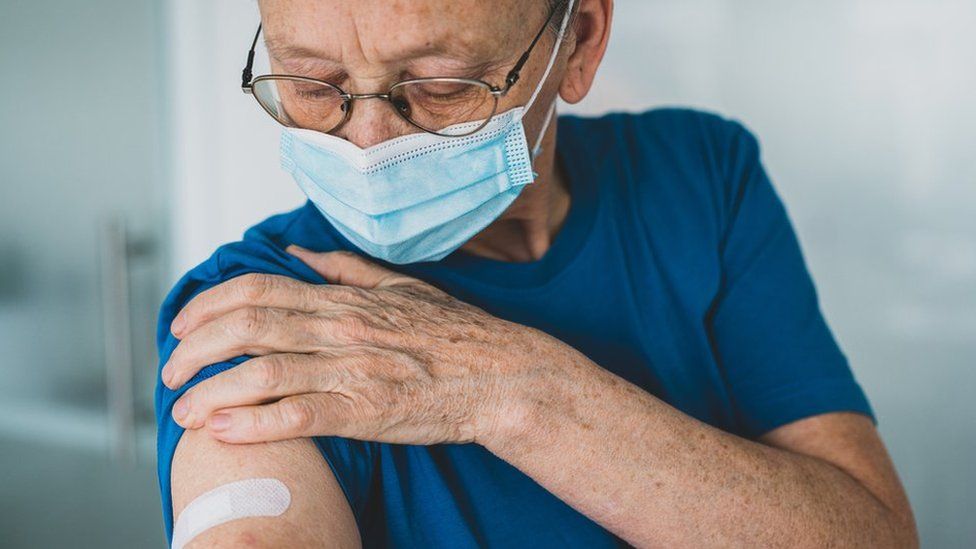
People aged 75 and over, residents in care homes and those with weakened immune systems can now book an extra booster jab against Covid in England.

It comes as official figures show infection rates are rising in all age groups – including the over-70s.

The rollout follows recommendations from the UK’s vaccine advisers who say additional jabs will help boost protection for the most vulnerable.

Spring boosters are already being rolled out in Wales and Scotland.

A wider booster programme – involving more people – is expected this autumn.

While vaccines have been shown to provide good protection against severe disease, protection wanes over time.

And as many of the oldest received their last jab in autumn 2021, their immunity may now be declining, experts say.

Now, a second booster – to be administered six months after the previous dose – will be offered to:


About five million people in the UK will be eligible to book the extra booster jab – with the first 600,000 people to be invited from this week.

Dr Nikki Kanani, GP and deputy lead for the NHS’s vaccination programme, urged everyone eligible to book their boosters as soon as possible.

She said: “With infections rising this is a really important opportunity for people who are eligible to come forward and get booked and get their spring booster.”


The extra jabs will be given around six months after the last dose of vaccine.

Across the UK more than two-thirds of people aged over 12 have had two Covid vaccines plus a single booster jab.


A first booster dose is currently available for everyone aged 16 and over, and at-risk children aged 12 to 15.

But up until now only people with severely weakened immune systems had been eligible for a fourth dose – three doses plus a booster.

The Joint Committee on Vaccination and Immunisation has suggested further boosters will be offered to a wider group of people in autumn.

Experts believe winter is likely to be the season when the threat from Covid is greatest – for individuals, the NHS and care homes.

No-trust vote: PM Imran warns opposition it would ‘lose this match badly’

The premier faces a major threat in the National Assembly as his fate is set to be decided in a no-trust resolution amid a number of own party’s MNAs turning against him and indicating that they would vote against him — something that he and his ministers allege has been due to bribes offered by the opposition alliance.

Speaking at a rally in Malakand, PM Imran said he had been advised to offer like-for-like bribes and bring back dissident MNAs to the party fold. He said he would prefer to lose his government than offer bribes and take the same route as the opposition allegedly has.

“I curse on the government that requires me to bring back defected leaders using public money,” he told the rally.

PM Imran vowed to “forgive” his MNAs who have threatened to defect and vote against him in the upcoming no-trust move, saying “I will forgive you if you come back. We all commit mistakes. I am like a father who forgives his children and I will pardon you as well.”

He asked the “turncoats” to think of their children and their families who he said would not be given respect and honour anywhere if they go through with their plans.

The prime minister criticised Leader of the Opposition in the National Assembly Shehbaz Sharif and other opposition leaders who called him out for saying “absolutely not” to the US request for military bases in Pakistan and elucidated the context of his statement.

“I had said absolutely not to a question when I was asked whether Pakistan will give a base to US in Pakistan for actions in Afghanistan… we cannot afford such an approach,” the premier explained.

He said he had told the America time and again that Pakistan would support it in peace and not in any war.

The premier then fired a broadside at Shehbaz for objecting to his criticism of European Union envoys who had urged Pakistan to condemn Russia in the United Nations. Imran said the EU ambassadors had violated the protocol by asking Pakistan to condemn Russia.

“I rightly asked them whether they will write a similar letter to India… Are we their slaves that they ask us to give a statement against any country,” the PM said in a reiteration of his statement against the EU representatives earlier this month.