
At least six people have been killed after a car drove into a crowd of carnival-goers in southern Belgium.

The incident happened in the small town of Strépy-Bracquegnies, about 30 miles (50km) south of the capital Brussels.

The car drove at high-speed into dozens of people who were preparing to take part in a traditional parade on Sunday morning.

Around 40 people were injured and several are in a serious condition, the town’s mayor said.

“There were about 150-200 people who were following the parade and [the] car arrived from behind and drove into the crowd,” Jacques Gobert said.

“It continued for another 100m (328ft),” he added. “It should be considered a national catastrophe.”

The exact circumstances of the attack are being investigated, but police said a terror attack had been ruled out.

“It is an accident, a tragic one. The car hit the group and tried to carry on but it was quickly stopped by the police,” police spokeswoman Cristina Ianoco told the BBC.

“The driver and the other people in the car have been detained,” she added. They have not been identified.

Police denied earlier reports in some Belgian media that the crash, which happened at around 05:00 local time (04:00 GMT), followed a high-speed police chase.

“A community gathering to celebrate has been hit in the heart,” Prime Minister Alexander De Croo said

“Deepest condolences to the families and friends of those killed and injured in the incident this morning,” Belgian Interior Minister Annelies Verlinden wrote on Twitter.

“What was supposed to be a great party turned into a tragedy,” she added.

Prime Minister Alexander De Croo, who is expected to visit the scene later on Sunday, said it was “horrible news”.

“A community gathering to celebrate has been hit in the heart,” he said.

Belgian towns and villages host traditional street carnivals around the period of Lent. The event in Strépy-Bracquegnies, like many others, features a parade with participants dressed up comical figures.

Russia’s leader Vladimir Putin is trapped in a closed world of his own making, Western spies believe. And that worries them.

For years they have sought to get inside Mr Putin’s mind, to better understand his intentions.

With Russian troops seemingly bogged down in Ukraine, the need to do so has become all the more necessary as they try to work out how he will react under pressure.

Understanding his state of mind will be vital to avoid escalating the crisis into even more dangerous territory.

There has been speculation that Russia’s leader was ill, but many analysts believe he has actually become isolated and closed off to any alternative views.

His isolation has been evident in pictures of his meetings, such as when he met President Emmanuel Macron, the pair at far ends of a long table. It was also evident in Mr Putin’s meeting with his own national security team on the eve of war.

Mr Putin’s initial military plan looked like something devised by a KGB officer, one Western intelligence official explains.

It had been created, they say, by a tight “conspiratorial cabal” with an emphasis on secrecy. But the result was chaos. Russian military commanders were not ready and some soldiers went over the border without knowing what they were doing.

Single decision maker

Western spies, through sources they will not discuss, knew more about those plans than many inside Russia’s leadership. But now they face a new challenge – understanding what Russia’s leader will do next. And that is not easy.

“The challenge of understanding the Kremlin’s moves is that Putin is the single decision-maker in Moscow,” explains John Sipher, who formerly ran the CIA’s Russia operations. And even though his views are often made clear through public statements, knowing how he will act on them is difficult intelligence challenge.

“It is extremely hard in a system as well protected as Russia to have good intelligence on what’s happening inside the head of the leader especially when so many of his own people do not know what is going on,” Sir John Sawers, a former head of Britain’s MI6, told the Media.

Mr Putin, intelligence officials say, is isolated in a bubble of his own making, which very little outside information penetrates, particularly any which might challenge what he thinks.

“He is a victim of his own propaganda in the sense that he only listens to a certain number of people and blocks out everything else. This gives him a strange view of the world,” says Adrian Furnham, a professor of psychology and co-author of a forthcoming book The Psychology of Spies and Spying. The risk is what is called “group think” in which everyone reinforces his view. “If he’s a victim of group think we need to know who the group is,” says Prof Furnham.

The circle of those Mr Putin talks to has never been large but when it came to the decision to invade Ukraine, it had narrowed to just a handful of people, Western intelligence officials believe, all of those “true believers” who share Mr Putin’s mindset and obsessions.

The sense of how small his inner circle has become was emphasised when he publicly dressed down the head of his own Foreign Intelligence Service at the national security meeting just before the invasion – a move which seemed to humiliate the official. His speech hours later also revealed a man angry and obsessed with Ukraine and the West.

Those who have observed him say the Russian leader is driven by a desire to overcome the perceived humiliation of Russia in the 1990s along with a conviction that the West is determined to keep Russia down and drive him from power. One person who met Mr Putin remembers his obsession with watching videos of Libya’s Col Gaddafi being killed after he was driven from power in 2011.

When the director of the CIA, William Burns, was asked to assess Mr Putin’s mental state, he said he had “been stewing in a combustible combination of grievance and ambition for many years” and described his views as having “hardened” and that he was “far more insulated” from other points of view.

Is the Russian president crazy? That is a question many in the West have asked. But few experts consider it helpful. One psychologist with expertise in the area said a mistake was to assume because we cannot understand a decision like invading Ukraine we frame the person who made it as “mad”.

The CIA has a team which carries out “leadership analysis” on foreign decision makers, drawing on a tradition dating back to attempts to understand Hitler. They study background, relationships and health, drawing on secret intelligence.

Another source are read-outs from the those who have had direct contact, such as other leaders. In 2014, Angela Merkel reportedly told President Obama that Mr Putin was living “in another world”. President Macron meanwhile when he sat down with Mr Putin recently, was reported to have found the Russian leader “more rigid, more isolated” compared with previous encounters.

Did something change? Some speculate, without much evidence, about possible ill-health or the impact of medication. Others point to psychological factors such as a sense of his own time running out for him to fulfil what he sees as his destiny in protecting Russia or restoring its greatness. The Russian leader has visibly isolated himself from others during the Covid pandemic and this also may have had a psychological impact.

“Putin is likely not mentally ill, nor he has changed, although he is in more of a hurry, and likely more isolated in recent years,” says Ken Dekleva, a former US government physician and diplomat, and currently a senior fellow at the George HW Bush Foundation for US-China Relations.

But a concern now is that reliable information is still not finding its way into Mr Putin’s closed loop. His intelligence services may have been reluctant before the invasion to tell him anything he did not want to hear, offering rosy estimates of how an invasion would go and how Russian troops would be received before the war. And this week one Western official said Mr Putin may still not have the insight into how badly things are going for his own troops that Western intelligence has. That leads to concern about how he might react when confronted with a worsening situation for Russia.

Madman theory
Mr Putin himself tells the story of chasing a rat when he was a boy. When he had driven it into a corner, the rat reacted by attacking him, forcing a young Vladimir to become the one who fled. The question Western policymakers are asking is what if Mr Putin feels cornered now?

“The question really is whether or not he doubles down with greater brutality and escalates in terms of the weapon systems that he’s prepared to use,” said one western official. There have been concerns he could use chemical weapons or even a tactical nuclear weapon.

“The worry is that he does something unbelievably rash in a vicious press-the button way,” says Adrian Furnham.

Mr Putin himself may play up the sense that he is dangerous or even irrational – this is a well-known tactic (often called the “madman” theory) in which someone with access to nuclear weapons tries to get his adversary to back down by convincing them that he may well be crazy enough to use them despite the potential for everyone to perish.

For Western spies and policymakers understanding Mr Putin’s intentions and mindset today could not be more important. Predicting his response is pivotal in working out how far they can push him without triggering a dangerous reaction.

“Putin’s self concept does not allow for failure or weakness. He despises such things” says Ken Dekleva. “A cornered, weakened Putin is a more dangerous Putin. It’s sometimes better to let the bear run out of the cage and back to the forest.”


P&O Ferries’ sacking of 800 staff without warning last week was “awful” and “wrong”, Chancellor Rishi Sunak has told the Media

The government is examining the legality of the firm’s actions, the chancellor confirmed.

However, the Sunday Times reports that ministers knew of the plan to sack crew beforehand, but failed to challenge it.

The Department for Transport said “full details” were not available at that stage.

A memo sent to ministers by a senior Whitehall official – and seen by the Sunday Times – outlined P&O Ferries’ strategy before the sackings took place, the newspaper said.

According to the Sunday Times, the note said the sackings were designed to ensure P&O remained “a key player in the UK market for years to come through restructuring”.

The memo, as reported in the newspaper, said: “We understand that P&O Ferries have an intention to try and re-employ many staff on new terms and conditions or use agency staff to restart routes; they estimate disruption to services lasting 10 days.”

It was circulated before Thursday’s announcement, made over Zoom, telling 800 P&O staff that they were losing their jobs with immediate effect.

The news was met with outrage from trades unions representing crew and ministers responded with strong criticism, announcing they would review all government contracts with the firm.

Mr Sunak, speaking to Sophie Raworth on the BBC’s Sunday Morning programme, said P&O’s approach was “appalling in the way that they’ve treated their workers”.


The government does not appear to have voiced concerns directly to P&O before the sackings.

The Department for Transport (DfT) said it was standard practice for officials to outline what they had been told by a private firm in an internal memo.

“This was sent before ministers were advised of the full details and as soon as they were informed, they made clear their outrage at the way in which P&O staff had been dismissed,” a DfT spokesperson said.

The DfT said the memo made clear that the department’s priority was to “work with unions to ensure workers’ rights continue to be protected”.

The transport secretary had urged the company to “sit down with workers and reconsider this action”, the DfT added. Grant Shapps has said he was “deeply concerned” at the move.

Protests have taken place outside the P&O head office near Dover

Louise Haigh MP, Labour’s shadow transport secretary, said: “This bombshell letter proves that the government was not only aware of P&O ferries’ scandalous action – but complicit in it.

“They knew people’s livelihoods were on the line and they knew P&O was attempting to use exploitative fire and rehire practices. But they sat back and did nothing.”

In a statement, P&O Ferries said: “We took this difficult decision as a last resort and only after full consideration of all other options but, ultimately, we concluded that the business wouldn’t survive without fundamentally changed crewing arrangements, which in turn would inevitably result in redundancies.”

Chris Parker, a director at DFDS, one of P&O’s competitors, told the BBC that his company is prepared to hire some of those sacked by P&O Ferries.

“We reduced the capacity of vessels quite sharply during the pandemic because of social distancing. We’re increasing that back up again now and we’re looking for some staff to come in and help us with that,” he said.

P&O Ferries is owned by Dubai logistics giant DP World which is, in turn, controlled by the Dubai sovereign wealth fund.

Last year, DP World’s revenue soared by more than a fifth to over £3.7bn ($4.9bn) as the global economy began to pick up after coronavirus lockdowns. The company received support of around £10m during the pandemic to furlough 1,100 workers.

Late on Saturday night P&O Ferries resumed its service between Liverpool and Dublin. The firm’s other services remain suspended.

The chancellor has pledged to help “where we can make a difference”, as he faces pressure to help households with soaring living costs.

Ahead of next week’s Spring Statement, Rishi Sunak told the BBC he would “stand by” people, but warned sanctions against Russia were not “cost-free”.

He is facing calls from some Tory MPs to cut fuel duty to help ease rising costs at the pumps.

His Labour counterpart Rachel Reeves said her party would back such a move.

But the shadow chancellor said the government should also be taxing oil and gas companies to fund more generous energy discounts for poorer families.

And she repeated Labour’s call for ministers to scrap the 1.25 percentage point hike in National Insurance, which is due to begin in April.

The Spring Statement is not usually an occasion to announce big tax and spending decisions.

However, this year Mr Sunak is facing pressure to act on living standards amid soaring energy costs and rising household bills due to increasing inflation.

Personal finance expert Martin Lewis said the squeeze facing households was worse than during the Covid pandemic or after the 2008 financial crash.

He told the BBC’s Sunday Morning programme he was “virtually out of tools to help people now” – and said more “political intervention” was required.

‘Not easy’

Speaking to the same programme, Mr Sunak said he would not be able to “fully protect” people from the consequences of rising prices.

But asked whether he was prepared to step in and offer support, he added: “Of course I am, and people can judge me by my actions over the past two years.”

He added: “I want to be honest with people that it’s not going to be easy.

“I wish government could solve absolutely every problem and that I could fully protect people against all the challenges that lie ahead.

“I can’t do that, but what I would say is I will stand by them in the same way that I have done in the past couple of years.”

Financial journalist Martin Lewis says fuel and energy price rises are “catastrophic”

Millions of household are facing sharp rises in energy bills from next month, when the government’s price cap is set to rise.

The higher cap means typical households face paying £1,971 a year from April, 54% more than they pay now, with a further rise expected in October.

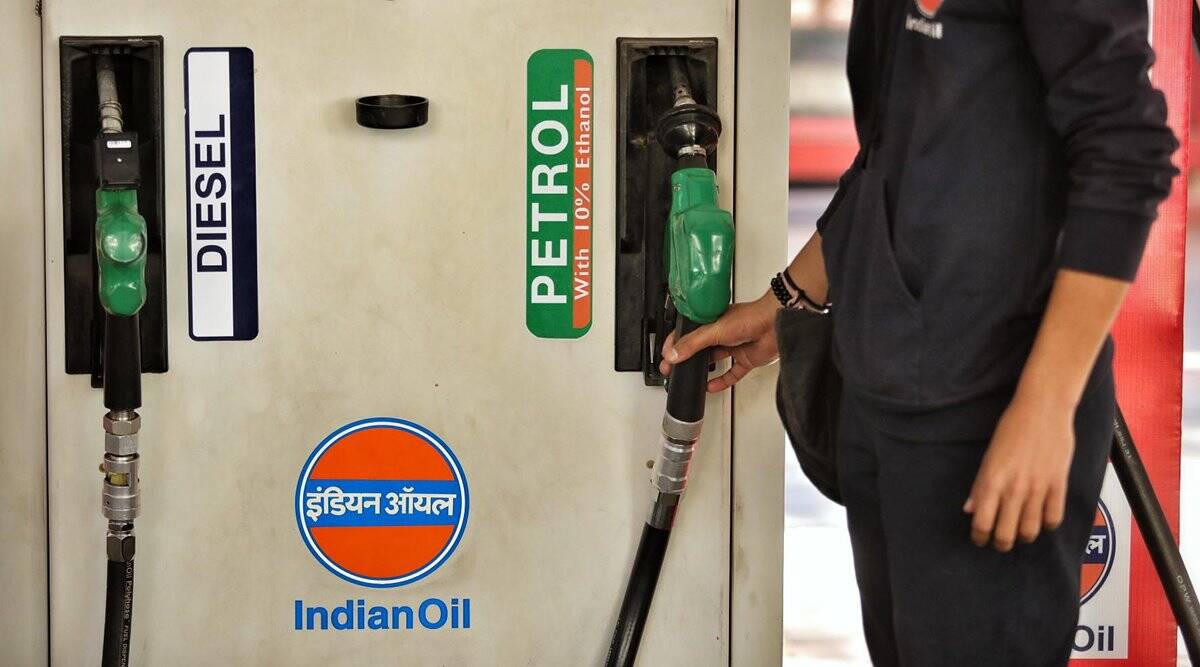
The price of petrol and diesel is also on the rise, worsened by a surge in oil costs due to Russia’s invasion of Ukraine.

Rising inflation, which the Bank of England has warned could hit about 7% this year, is also pushing up costs of food, clothing and transport.

More on the cost of living:

Mr Sunak is facing calls from more than 50 MPs to cut fuel duty, which has been frozen for over a decade, to reduce the price of petrol and diesel.

Others within his party have been calling for the government to scrap VAT on energy bills – while some want green levies removed to reduce costs.

The chancellor said he could not “speculate” on tax decisions, but added that the government was already “taking action” over energy bills.

He pointed to support announced in April – including a £150 rebate on council tax for people living in properties in bands A-D, about 80% of households.

A £200 energy bill discount is also due to apply in October – although Labour has criticised it as a “buy now, pay later scheme” as people will have to pay the discount back over five years from 2023.

Shadow chancellor Ms Reeves said Labour would support a cut to fuel duty – currently 57.95p per litre of petrol or diesel – but told Sky News the move did not “rise to the scale of the challenge we face”.

She told the BBC her “priority” would be reversing next month’s National Insurance rise, and increasing corporation tax on oil and gas firms to fund more generous support for energy bills through the Warm Home Discount scheme.

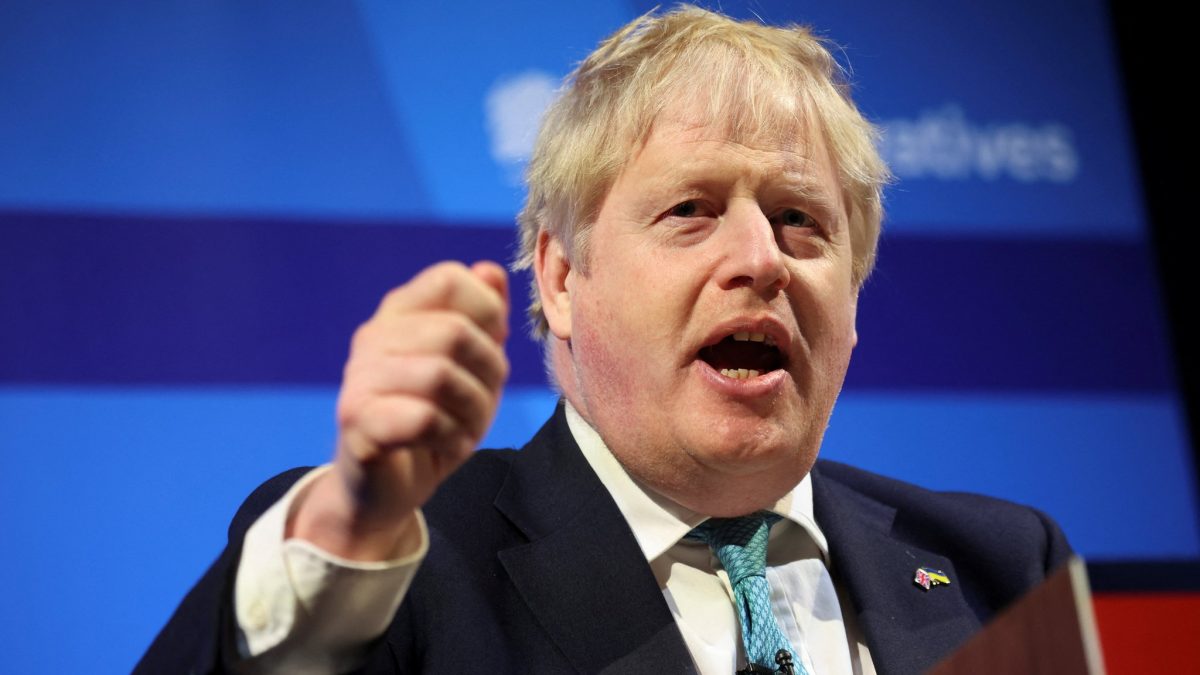
Boris Johnson has been criticised for comparing the struggle of Ukrainians fighting Russia’s invasion to people in Britain voting for Brexit.

In a speech he said Britons, like Ukrainians, had the instinct “to choose freedom” and cited the 2016 vote to leave the EU as a “recent example”.

The comments have caused anger among politicians both in the UK and Europe.

Donald Tusk, the former president of the European Council, called the comments offensive.

Conservative peer Lord Barwell said voting in a referendum was not “in any way comparable with risking your life” in a war, while Liberal Democrat leader Sir Ed Davey said it was an “insult” to Ukrainians.

The row comes as the prime minister strongly urged China to condemn the Russian invasion in an interview with the Sunday Times. He suggested Beijing was having “second thoughts” about its neutral stance.

Mr Johnson likened the Ukrainians’ fight to Brexit in a speech to the Conservative Party’s spring conference in Blackpool on Saturday.

He said: “I know that it’s the instinct of the people of this country, like the people of Ukraine, to choose freedom, every time. I can give you a couple of famous recent examples.

“When the British people voted for Brexit in such large, large numbers, I don’t believe it was because they were remotely hostile to foreigners.

“It’s because they wanted to be free to do things differently and for this country to be able to run itself.

Mr Johnson also cited as an example British people choosing to get vaccinated against coronavirus because they “wanted to get on with their lives” and “were fed up with being told what to do by people like me”.

But his remarks, intended to rally the Tory faithful, attracted criticism from political figures in the UK and Europe.

Mr Tusk tweeted “Boris, your words offend Ukrainians, the British and common sense”, while Guy Verhofstadt, the former Belgian prime minister and the European Parliament’s chief Brexit negotiator, said the comparison was “insane”.

Asked about Mr Johnson linking the plight of Ukraine to Brexit, Chancellor Rishi Sunak told the BBC’s Sunday Morning programme: “I don’t think the prime minister was making a direct comparison between these two things – clearly they’re not directly analogous.”

“He was making some general observations about people’s desire for freedom,” he added.

Mr Sunak said the prime minister had been galvanising global opinion to send a strong message to Vladimir Putin, and “that’s the thing we should be focused on”.

Shadow chancellor Rachel Reeves called for the prime minister to withdraw his comments and apologise.

She told the BBC: “The people of Ukraine, who are fighting for their lives – in any way to draw a parallel to voting to leave the European Union, it is shameless.”

She pointed out that Ukrainian President Volodymyr Zelensky wanted to join the EU – and that “he clearly sees no such parallel”.


Lord Barwell, who served as Theresa May’s chief of staff in No 10, said: “Apart from the bit where voting in a free and fair referendum isn’t in any way comparable with risking your life to defend your country against invasion, and the awkward fact the Ukrainians are fighting for the freedom to join the EU, this comparison is bang on.”

Ukraine applied for fast-track membership of the European Union last month, shortly after the Russian invasion.

Mr Zelensky said on Friday he had spoken to the head of the European Commission Ursula von der Leyen and expected progress to be made on its application in the coming months.

Others who criticised Mr Johnson’s comments included Conservative MP Tobias Ellwood, chair of the defence select committee, who tweeted: “Comparing the Ukrainian people’s fight against Putin’s tyranny to the British people voting for Brexit damages the standard of statecraft we were beginning to exhibit.”

The Liberal Democrat leader Sir Ed called the prime minister a “national embarrassment”, adding: “To compare a referendum to women and children fleeing Putin’s bombs is an insult to every Ukrainian. He is no Churchill: he is Basil Fawlty.”

SNP Westminster leader Ian Blackford said Mr Johnson’s comments were “crass and distasteful”.

Speak out, Johnson tells China

Meanwhile in his interview with the Times, Mr Johnson has urged China to join in the global condemnation of Vladimir Putin’s invasion.

He warned Beijing that supporting Russia was akin to choosing the wrong side in World War Two, describing it as a battle between good and evil.

Mr Johnson told the paper that he believed some in Xi Jinping’s administration were having “second thoughts” about the neutral stance adopted by Beijing.

It comes just a few days after the US warned China that it would face consequences if it helped Russia evade sanctions.

“As time goes on, and as the number of Russian atrocities mounts up, I think it becomes steadily more difficult and politically embarrassing for people either actively or passively to condone Putin’s invasion,” Mr Johnson said.

“There are considerable dilemmas now for people who thought they could sit this one out, who thought they could sit on the fence.”

India’s oil imports from US to rise amid criticism for Russian purchases

NEW DELHI: India’s oil imports from the United States will rise by 11% this year, officials said on Saturday, as the severely energy-deficient country looks to secure supplies from producers around the world, including heavily sanctioned Russia.

The surge in oil prices following Russia’s invasion of Ukraine last month threatens to fan Indian inflation, stretch public finances and hurt growth just when it was emerging from a pandemic-induced slowdown.

New Delhi faces criticism from the West for its long-standing political and security ties with Moscow, with some saying that engaging in business with Russia will help fund its war. India has urged an end to the violence in Ukraine but abstained from voting against Russia.

Japanese Prime Minister Fumio Kishida, meeting his Indian counterpart Narendra Modi during a visit on Saturday, said he will encourage a unified approach to Ukraine.

India buys most of its oil from the Middle East, but the United States has emerged as the fourth-biggest source and this year supplies will rise substantially, a government official briefed on the matter told Reuters.

Iraq supplies 23% of India’s oil, followed by Saudi Arabia at 18% and the United Arab Emirates at 11%. The US share of the Indian market will rise to 8% this year, said the official, who spoke on condition of anonymity in line with government policy.

Russia has been a marginal player in the Indian market, but since its Feb. 24 invasion has been offering discounted oil to soften the blow of sweeping sanctions imposed by the United States and other countries.

Read more: US refuses to comment on Indian violation of Pakistani airspace

Indian Oil Corp, the country’s top refiner, recently ordered 3 million barrels of Russian oil through a tender, while Hindustan Petroleum Corp has booked 2 million barrels for May loading. read more

India welcomes competing offers for oil sales including from Moscow, especially when global prices have jumped, another government official said, defending the decision to buy from Russia.

European countries continue to import Russian oil and gas, and India cannot be stopped from doing so too, the second official said.

Read more: British international kabaddi player Sandeep Singh Sandhu shot dead in India

Western sanctions have carve-outs to avoid any impact on energy imports from Moscow, and Russian banks that process payments for these sales remain on the SWIFT network, this official said.

The official said India’s legitimate energy transactions should not be politicised. “Countries with oil self-sufficiency or those importing themselves from Russia cannot credibly advocate restrictive trading.”

Worshippers stop axe wielding attacker: Canada mosque

One worshipper knocked the axe from the man’s hands, and held him down until police arrived, local media reports.

A 24-year-old man was arrested at the scene in the suburb of Mississauga, and he has since been charged.

Some congregants had minor injures from the bear spray, the mosque’s imam said.

One of the worshippers said the experience was “terrifying” and described hearing a scream before turning around to see a man holding an axe and using bear spray – similar to pepper spray – against three people.

“By the time he was spraying, the people in the first row realized something was going on and one of the young men turned around and knocked away the axe before he had a chance to use it,” Noorani Sairally told Canadian newspaper The Globe and Mail.

The young man then held the alleged assailant down until police arrived, the witness said.

“Before he could inflict harm on any worshippers, several congregants bravely were able to stop him in his tracks,” imam Ibrahim Hindy said in a statement, describing the moment the attacker entered the site.

“Our community will never be broken and we refuse to be intimated,” he added.

Police have named the man they arrested as Mohammad Moiz Omar, and charged him with six offences including assault with a weapon and administering a noxious substance with intent to endanger life or cause bodily harm.

Following initial uncertainty over a possible motive, investigators now say they believe the attack was a “hate-motivated incident.”

Prime Minister Justin Trudeau was one of a number of high-profile Canadian public figures to condemn the attack, which he described as “incredibly disturbing” and applauded the courage of the worshippers at the mosque.

Canada’s Muslim community has been targeted in a number of deadly attacks, including in 2017 when a shooting at a Quebec City mosque killed six people and left another eight wounded.

And last year, four members of the same Muslim family were killed after a vehicle hit them in London, Ontario, which was described by police as a deliberate Islamophobic attack.

SHANGHAI: Mainland China reported its first Covid-19 deaths in more than a year on Saturday, according to a post on the National Health Commission’s website that said two people died in the northeastern region of Jilin.

China reported only two Covid deaths for all of 2021, the last on January 25.

The country is maintaining a “dynamic clearance” approach, which aims to cut transmission as soon as possible, using stringent measures such as short and targeted shutdowns and quick testing schemes where cases are found.

Jilin, bordering North Korea and Russia, accounts for more than two-thirds of domestic infections in this wave. One of the dead was an elderly person of unspecified age, the other over 60, said Jiao Yahui, a senior official with the National Health Commission. The direct cause of death was their underlying diseases, Jiao told reporters in Beijing, while their Covid symptoms were mild.

More than 95 per cent of the nearly 30,000 people hospitalised with Covid had mild or no symptoms, Jiao said.

The latest deaths raised the toll to 4,638. China reported 2,228 new confirmed coronavirus cases for Friday, down from 2,416 a day earlier.

Of the new cases, 2,157 were locally transmitted, compared with 2,388 a day earlier, with 78pc appearing in Jilin and others found in the southeastern province of Fujian and the southern province of Guangdong, among others.

The number of new asymptomatic cases, which China does not classify as confirmed cases, stood at 1,823, compared with 1,904 a day earlier. As of Friday, mainland China had confirmed 128,462 cases of confirmed cases.

The first deaths in more than a year quickly caught the social media spotlight. “Two new COVID deaths in Jilin” was a top trending topic on China’s Twitter-like Weibo platform, with many expressing a desire for more information on the two victims.

Scores of Ukrainian soldiers are feared to have been killed after an attack on a military barracks on Friday.

About 200 soldiers were sleeping in the barracks when three Russian missiles hit the base on the northern edge of Mykolaiv, a source told the BBC. Some 57 injured people were being treated in hospitals, another source said.

There are no official casualty figures.

Rescue workers crawling over giant piles of rubble found a survivor on Saturday – 30 hours after the attack.

The man was carried down the steep mountain of rubble in a stretcher and taken away by ambulance towards the city centre.

However, the temperature in Mykolaiv last night was minus 6C and it’s feared there may not be many more survivors.

Vitaly Kim, head of the regional administration, blamed Russians for hitting “sleeping soldiers with a rocket in a cowardly manner”.

“At least 50 bodies have been recovered, but we do not know how many others are in the rubble,” a soldier named Maxim was quoted as saying by AFP news agency.

And the rescue work at the site is being carried out amid fears of new Russian attacks.

With a crane pulling away chunks of concrete and twisted metal, suddenly soldiers guarding the base shouted at journalists to run for cover, as the sound of a plane, or possibly a missile, could be heard overhead.

Seconds later a dull explosion could be heard somewhere to the north-east.

Near the army base is the site of an attack which killed nine civilians queueing outside a shop. There we meet Yulia, who is in tears as she tells the BBC what happened.

“I can’t tell you how scared we are,” she says. “We all live in the cellar now. When the bombs hit the army base – everything shook.”

Two blocks away, Andre Ansimov is trying to clear up from another Russian strike. The crater is so big, a car and a house fell into it.

Only by chance were Andre and his family away when the bomb hit.

“This isn’t a war between armies,” he said. “The Russians are trying to destroy us all.”

Mykolaiv has been blocking Russia’s advance west along the Black Sea coast for weeks. Overnight there was more heavy shelling in the south of the city.

There are also reports that Russian reconnaissance teams, sent in to locate military targets for attack, have been found there.


A private jet has been grounded while “possible Russian links” are probed, the transport secretary has said.

Grant Shapps said ministers were taking decisive action against Vladimir Putin and his “illegal war” in Ukraine.

All aircraft owned, operated or chartered by Russians are banned from flying or landing in the UK.

The jet has been held at London Biggin Hill airport while officials investigate if it falls foul of UK sanctions.

The official notice grounding the flight on Saturday morning relates to a Cessna plane owned by a company named as Brooker Holdings.

The Department for Transport said it would not comment on any links to individuals while it investigated the issue further.

The latest plane seizure comes 10 days after it emerged that the UK had impounded a private jet linked to a billionaire Russian oligarch.

The Luxembourg-registered aircraft had flown from the US into Farnborough airport, Hampshire, on 3 March. UK officials believe the oil tycoon Eugene Shvidler was on board when it arrived.

The plane had been due to fly from the UK to Dubai, but UK authorities prevented this while they investigated whether it was permanently leased to Mr Shvidler and fell under UK sanctions.


Mr Shvidler himself has not been personally sanctioned by the UK at any stage.

The UK and other western nations opposed to the Russian president’s invasion of Ukraine have introduced a raft of sanctions designed to cripple Russia’s economy and hurt its wealthiest citizens.

The UK has made it a criminal offence for planes owned, operated or chartered by Russians – including private jets – to fly or land in the UK.

New trade sanctions have also been introduced banning UK exports of aviation or space-related technology to Russia.

Other measures introduced by the UK include:

  • Excluding major Russian banks from the UK financial system and freezing the assets of all Russian banks
  • Putting a 35% tax on certain imports from Russia, including vodka
  • Imposing sanctions – including travel bans and asset freezes – against oligarchs considered close to the Kremlin