
Boris Johnson gets details of vital government business sent to him via WhatsApp, court papers have revealed.

The material, from the PM’s ministerial “red box”, is sent to his phone for “administrative ease”, officials say, and does not break the rules.

But campaigners challenging “government by WhatsApp” in the High Court say it is a security risk.

They claim the use of insecure apps and message deletion by ministers and officials is “rampant”.

Campaigning law groups the Good Law Project and Foxglove are challenging the government’s use of such services in the High Court, saying that it breaks the law on keeping public records.

The government says it has secure channels for exchanging sensitive information, and ministers are obliged to record important decision-making discussions with officials.

‘Private device’

Documents released on the first of a three-day judicial review reveal:

  • From November 2020 onwards, Boris Johnson has been sent a summary of “red box” material, including diary updates, via WhatsApp
  • The PM and other senior ministers downloaded Signal – an app that can instantly delete messages – to their phones. Signal has now been removed from Mr Johnson’s device and the No 10 app store
  • At least one of the six Cabinet Office senior civil servants used Signal on their private device to communicate with colleagues
  • No official record has been made of the WhatsApp messages screenshot by former aide Dominic Cummings, revealing March 2020 discussions about Covid

The screenshot messages, published by Mr Cummings on his blog, include discussions with the PM on the procurement of ventilators, testing in care homes, and Mr Johnson’s description of then health secretary Matt Hancock as “hopeless”.

Image caption,

No official record has been kept of these messages

It also emerged that all messages on Boris Johnson’s phone were wiped in April 2021, after it emerged his number had been freely available on the internet for 15 years.


In a witness statement, the Cabinet Office’s chief operating officer Sarah Harrison said: “In light of a well-publicised security breach, the prime minister implemented security advice relating to a mobile device. The effect was that historic messages were no longer available to search and the phone is not active.”

‘Thin air’

Legal campaigners say records of vital decision-making have been lost to the public record, which could undermine next year’s inquiry into the government’s handling of the pandemic.

Cori Crider, director of Foxglove, said: “Our democracy can only work if the decisions of those who represent us are open to scrutiny.

“That can’t happen if officials govern by secret WhatsApp chats that vanish into thin air.”

Foxglove is bringing the case on behalf of non-profit media group The Citizens.

They say the government is potentially in breach of its own data security guidelines and the Public Records Act of 1958, which requires legal checks to be made on messages in case they need to be kept for the public interest.

The government argues that a record is kept of all substantive discussions and only ephemeral messages are deleted.

In her witness statement, Ms Harrison said: “In my view, it is not realistic to suggest that those working in government should refrain from interacting with one another online in the same way everyone else does, subject always to the compliance with government policy on the use of such tools and in line with information records management policy.

“This is particularly the case where teams are now much more dispersed – between home and the office as well as geographically.”

The Foxglove and Good Law Project law suits started out as separate cases but the High Court decided to hear both of them together.

The government is expected to challenge the standing of the Good Law Project in court, after the High Court found against the organisation in a separate case in February.

Fuel prices have stabilised for the first time this month after Russia’s invasion of Ukraine caused a surge.

Average fuel prices slipped from record highs on Monday, with petrol at nearly £1.67 a litre and diesel at £1.79.

Crude oil surged to $139 per barrel in the first week of March, then slid back the following week.

The RAC said the settling of prices could be an indication that retailers may have “finished” passing on their higher wholesale costs to customers.

However, it is unclear if and when the cost of fuel will go down.

Simon Williams, fuel spokesman for the RAC, said Monday’s prices had “steadied with very slight reductions in both petrol and diesel”.

UK fuel prices have increased at the fastest rate on record in recent weeks, with petrol rising 13p since the start of the month and diesel increasing by nearly 21p.

Fuel prices, which were already rising as global economies recovered from the coronavirus pandemic, surged after the war in Ukraine pushed up oil prices.

Changes in prices at the pump are mainly determined by crude oil prices and the dollar exchange rate, because crude oil is traded in dollars.

Russia is one of the world’s major oil exporters and it is being targeted by economic and trading sanctions.

After Brent crude oil – a global benchmark for prices – hit a near 14-year high of $139 a barrel during the early stages of the conflict, prices fell back to around $100, but have since risen again to $115 on Tuesday.

The most recent increase was driven by the European Union discussing a ban on the purchase of Russian oil, which countries in the bloc rely heavily on.

Some countries, such as the US and Canada, have already banned on Russian oil imports, but the EU has so far stopped short of that action.

Meanwhile, the UK government has vowed to phase out imports of Russian oil by the end of the year.

The UK only imports about 6% of its crude oil from Russia, but is affected by the global shifts in price.

Mr Williams said the wholesale price of petrol for retailers currently stands at £1.30 a litre for petrol and £1.48 for diesel.

“With prices this high before retailer margin and 20% VAT are added it’s clear we are in a tough place when it comes to being able to afford to drive,” he said.

“This is why it’s crucial the chancellor takes decisive and meaningful action in his Spring Statement that helps hard-pressed drivers and businesses.”

‘Supply shock’

More than 50 Conservative MPs have called for a cut in fuel duty, which is currently 57.95p per litre, and has VAT of 20% applied on top.

Several newspapers have also reported that Chancellor Rishi Sunak is considering a temporary cut of as much as 5p per litre, but some opposition MPs have questioned whether this would go far enough.

Following Russia’s invasion of Ukraine, there were warnings of potential global oil supply problems.

The International Energy Agency (IEA) has said high commodity prices and sanctions against Russia were “threatening to create a global oil supply shock”.

It estimated three million barrels per day of Russian oil could be taken out of the global market as a result of international sanctions.

The agency warned only Saudi Arabia and the United Arab Emirates have enough spare production capacity to offset the shortfall in Russian output.

A team of researchers build a profile based on data collected from 500 people.

A team of researchers from the University of Essex has discovered the world’s most boring person, Lad Bible reported.

The researchers were curious about the science of boredom. They studied the qualities that make a person perceived as “boring.” After gathering data from 500 people, they created a profile.

The results of the study showed that the “world’s most boring person is a data entry worker who is religious, lives in a town, and has watching TV as their favourite hobby.”

According to the results of the study, people working in the field of performing arts and science were perceived to be the most interesting whereas jobs like data analysis, banking, accounting, cleaning, or working in insurance or tax topped the list of boring jobs.

Hobbies that were considered boring included religion, watching animals, sleeping, and watching TV.

The study’s goal, however, was to get rid of the stereotypes of what people perceive as boring.

Dr Wijnand Van, who was leading the research, warned that being seen as boring can lead to self-harm, ‘addiction, and mental health issues.

China and Hong Kong are seeing their largest spike in Covid cases in more than two years, despite determinedly pursuing one of the world’s strictest virus elimination policies.

Most countries are now trying to live with coronavirus – so how long can China hold on to its “zero-Covid” goal?

Striking a balance

For the last two years, China’s strict measures to contain Covid, enforced by swift lockdowns and aggressive restrictions, seemed to be largely paying off.

As the rest of the world grappled with surges in cases and deaths in 2020, China’s President Xi Jinping declared the country’s handling of the pandemic through lockdowns and widespread testing a success – and touted its methods as being the most effective in dealing with the virus.

The zero-Covid model was therefore strictly enforced both in mainland China and Hong Kong.

But things soon began to change.

The first signs of strain on the much-vaunted zero-Covid model in China began to appear when authorities were forced to impose increasingly large lockdowns triggered by the more infectious Delta variant in 2021. These started to raise questions about how long China could maintain this policy.

And now Omicron has called it further into question.

In mainland China, thousands of cases are now being reported each day and millions of people in the north-eastern province of Jilin have been placed under lockdown – the first time China had restricted an entire province since the early days of the pandemic in Wuhan.

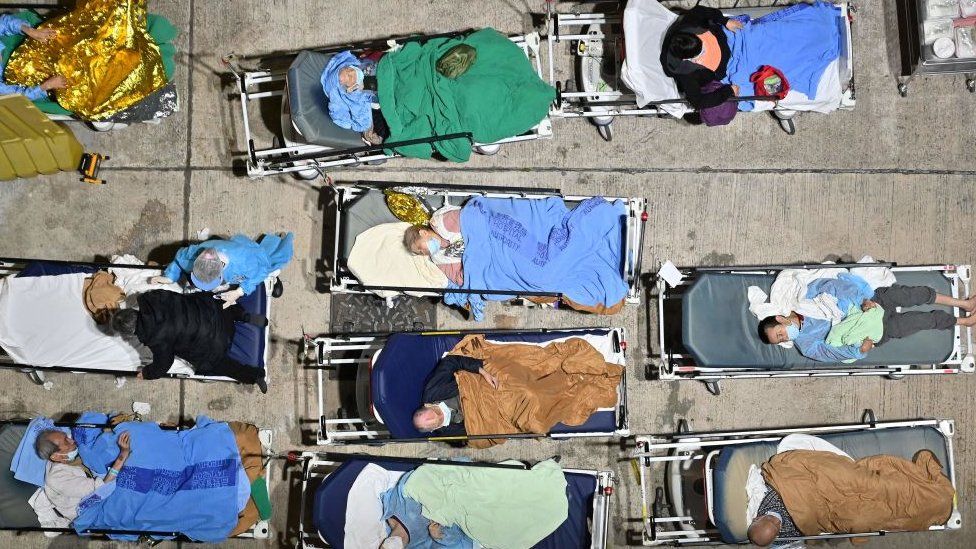
Hong Kong, which was previously almost untouched by the virus, is now seeing 30,000 cases and more than 200 deaths a day. The city’s healthcare system has been overrun, with shocking images of people in need of hospital care receiving rudimentary treatment outside medical facilities.

It’s a situation unlike anything the country has seen for the past two years.

Officially, the Chinese government has not budged from its zero-Covid position. But there have been some signs that it may be softening its stance on how best to deal with the virus.

Earlier this week, China’s National Health Commission said it was changing its rules so that mild cases would be isolated in centralised locations, rather than treated in hospitals. The criteria for a patient to be discharged from quarantine has also been lowered.

“In the past, China would actually admit every patient – whether they were asymptomatic or with just mild symptoms – to the hospital,” Prof Jin Dong-yan of The University of Hong Kong told the BBC.

“The fact they’re now proposing to [locally isolate] them – that’s one step to show they recognise that there’s a large group of people that do not need much help.”

During China’s recent National People’s Congress meeting, Chinese Premier Li Keqiang also said China would continue to make its Covid-19 response more “scientific and targeted”.

“[Premier Li’s speech] hints that the government is ready to be more flexible and loosen restrictions gradually,” said Prof Chen Gang of the National University of Singapore.

“Under [a more] dynamic policy, more emphasis will be placed on striking a balance between disease control and enabling people to live normal lives.”

On the ground as well, there’s also been a noticeable shift in attitudes.

Last year, top Chinese epidemiologist Zhang Wenhong suggested that China would eventually need to “co-exist” with the virus. He was met with a barrage of criticism, with some calling him a traitor, and others saying he was colluding with foreign forces to undermine China’s Covid response.

But just this week, Dr Zhang posted another message on Chinese social media that got a very different reception.

While he said that it was necessary for China to maintain its zero-Covid strategy for now, he added that it should not be afraid to eventually move towards a more “sustainable coping strategy” in the future.

“With this virus, alleviating fear is the first step we must take,” he said. “Omicron has become so mild, in countries that have achieved widespread vaccination and natural infection rates, it may be less deadly than even the flu.”

This time, he was not met with vitriol – and was instead widely praised.

“Thank you Dr Zhang for your scientific and rational [take] on issues,” one comment said.

Others shared their struggles over the past years – a sign of growing frustration after more than two years of lockdowns.

“These past few years, I have suffered a lot. I have lost my freedom – all in the name of the virus,” one said.

According to Professor Huang Yanzhong, a senior fellow for global health at the Council on Foreign Relations, there is a sense that “public support for zero-Covid is in decline”.

“My sense is that especially in bigger cities like Shanghai, some people are saying it’s just too much. While there’s still overall public support for zero-Covid – it’s being undermined by the recent Omicron wave,” he said.

Politics and the pandemic

So how much longer can China hold on?

Experts say we are unlikely to see any big moves this year, especially not now while it is in the throes of its biggest outbreak in years.

Many believe loosening restrictions now could lead to an overwhelmed healthcare system – and a huge spike in the death rate.

All mainland China needs to do is look to Hong Kong to see a city struggling to contain its outbreak, with morgues filled to capacity and hospitals swamped with patients.

Prof Huang says China’s Centre for Disease Control and Prevention (CDC) has been proclaiming the fact that it has avoided a significant number of deaths, and “there is no doubt that opening will lead to a rapid increase in cases”.

“The dilemma is do you want to accept short-term pain – a significant increase of cases, deaths – for long-term stability?”

Analysts believe the answer is unlikely to be yes – especially right now.

“If restrictions are loosened, the number of deaths may shoot up, leading to social panic – something that will not be allowed in the politically sensitive year of the 20th party congress,” said Prof Chen.

This Chinese Communist Party 20th party congress is one of the country’s most important political events of the decade, and on paper, was when President Xi Jinping was supposed to step down, having come to the end of his two term-limit in office.

But this limit was removed and there is growing certainty that Mr Xi will secure another term in power as party chief and come out of the congress “more powerful than ever”, according to Michael Cunningham of research institution the Heritage Foundation.

“The government usually shifts the pendulum toward preserving stability in party congress years, as those in power seek to avoid crises rather than make bold decisions that, if unsuccessful, could negatively impact their career prospects,” said Mr Cunningham in a report.

Mr Xi himself said in a politburo meeting on Thursday that China would stick to its dynamic zero-Covid policy, saying: “Victory comes from perseverance”.

With this clear instruction coming from the top, its more likely that officials will instead put in place smaller and gradual measures, similar to those already being made – but with no “fundamental” change – for now.

“The problem with the zero-Covid policy is that it doesn’t accept risks,” says Prof Huang.

“And unless [the Chinese government] is no longer obsessed with worst-case scenarios, you cannot expect to see a fundamental change to its policy.”

A Ukrainian man who survived the Nazi Holocaust during World War Two has been killed during a Russian attack on the eastern city of Kharkiv.

Boris Romantschenko, 96, died during Russian shelling of his apartment block on Friday, relatives said.

Russian forces have been relentlessly shelling Kharkiv, which lies just 30 miles (50km) from the border, for over three weeks.

At least 500 civilians have now been killed there, Ukrainian officials say.

Police said one of the victims has been identified as a nine-year old boy.

The Buchenwald and Mittelbau-Dora Memorials Foundation said it was “deeply disturbed” by Mr Romantschenko’s death.

The organisation, of which Mr Romantschenko was vice-president, announced the news after being informed by his family and said he had “worked intensely on the memory of of Nazi crimes”.

“We mourn the loss of a close friend. We wish his son and granddaughter, who brought us the sad news, a lot of strength in these difficult times,” the foundation’s statement added.

Mr Romantschenko’s death comes more than three weeks after President Vladimir Putin sought to justify his invasion to the Russian people by telling them his goal is to”de-Nazify Ukraine”.

Western leaders have condemned these claims and pointed out that Ukraine’s president, Volodymyr Zelensky, is Jewish.

Mr Romantschenko was born in the north-eastern city of Bondari on 20 January 1926.

He was rounded up by Nazi troops after the invasion of the Soviet Union and deported to Germany in 1942, where he was forced to do hard labour, the foundation said.

After a failed escape attempt in 1943, he was sent to the Buchenwald concentration camp, where some 56,545 people were murdered before its liberation in 1945 by the allies.

He also spent time in the subcamp of Mittelbau-Dora, as well as the infamous Bergen Belsen and Peenemünde camps.

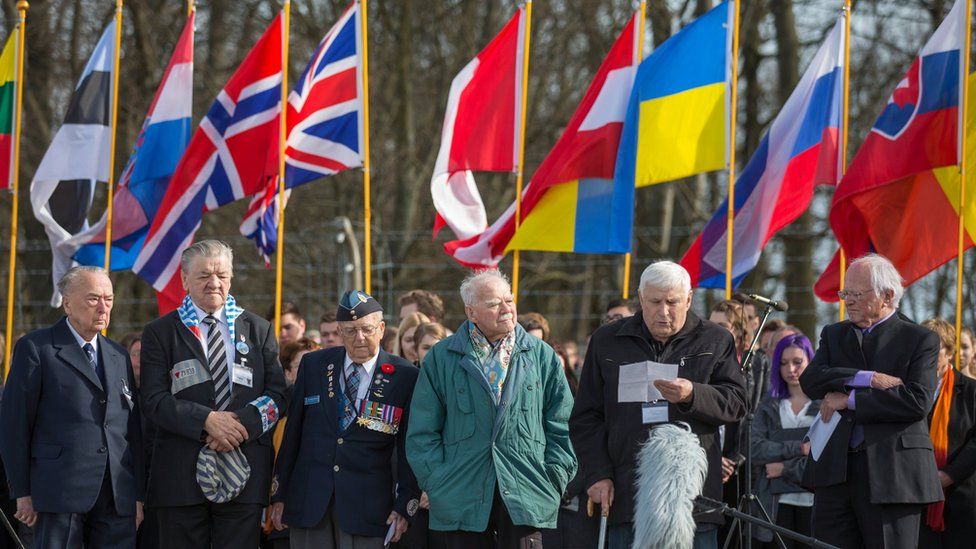
He returned to Buchenwald in 2012 to celebrate the 67th anniversary of the liberation of the camp by US troops, where he recited the pledge made by survivors to create “a new world where peace and freedom reign”.

The Nazi regime murdered over six million Jewish people across occupied Europe between 1941 and 1945.

The family of a British-US national who they expected to be freed by Iran last week as part of a deal with the UK has gone on hunger strike, they say.

Morad Tahbaz, 66, who also has Iranian citizenship, has been confined to a hotel, the Foreign Office has said.

His sister Taraneh told the BBC his family was “absolutely distraught” and feared he would be forgotten about.

The Foreign Office says it is continuing to lobby Iran at the highest levels for Mr Tahbaz to be released.

Hopes had been raised that Mr Tahbaz would be freed when Nazanin Zaghari-Ratcliffe and Anoosheh Ashoori were released and flew back to the UK on Thursday, but he was returned to Evin prison on Friday.

The Foreign Office said it had been informed by the Iranians this move was in order for Mr Tahbaz to have an electronic ankle bracelet fitted. On Sunday, the Foreign Office said he had been moved to a hotel in Tehran.

Appearing alongside Mrs Zaghari-Ratcliffe at a news conference on Monday, Mr Tahbaz’s daughter, Roxanne, said the family had been led to believe her father would be released with the other dual nationals.

“From the outset, we were always assured by the [UK government] that my father would be included in any deal that was made to release all of the hostages.

“So we’re truly devastated, knowing now that this was not the case.”

Roxanne Tahbaz said the family “just want them [the UK government] to do whatever they have to do” to bring her father and mother, who is also subject to a travel ban inside Iran, back home.

Speaking on the Today programme earlier, Taraneh Tahbaz said Mr Tahbaz had gone on hunger strike.

“He continues to be used as a pawn on a chessboard and it’s very distressing,” she said. ” We’re agonised and we’re absolutely distraught and we don’t know what the next moves are.”

Mr Tahbaz was doing conservation work when he was held in Iran in January 2018.

Family photo of Morad Tahbaz, as a younger man, with his family

He and seven other conservationists were accused of collecting classified information about Iran’s strategic areas under the pretext of carrying out environmental and scientific projects.

The conservationists – members of Persian Wildlife Heritage Foundation – had been using cameras to track endangered species including the Asiatic cheetah and Persian leopard, according to Amnesty International.


All eight denied the charges and Amnesty International said there was evidence that they had been subjected to torture in order to extract forced “confessions”.

He was sentenced to 10 years in prison with his colleagues on vague charges of spying for the US and undermining Iran’s security.

Last year, UN human rights experts warned that Mr Tahbaz, who has cancer and has twice had Covid, had been denied access to proper treatment in prison despite his health condition deteriorating.

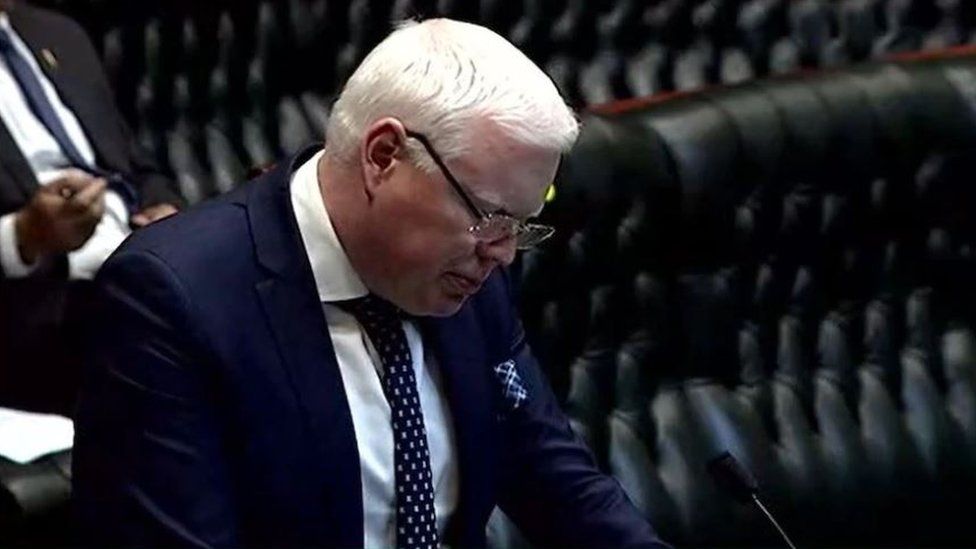
A former minister in Australia’s New South Wales (NSW) state government has been charged with sexually abusing a man and a teenage boy.

Gareth Ward – now an independent MP – is alleged by police to have committed the crimes in 2013 and 2015.

Mr Ward, 40, denies the charges.

“I will be instructing my lawyers to seek to bring this matter before the courts as quickly as possible and I look forward to demonstrating my innocence there,” he said on Tuesday.

Mr Ward has been accused of five charges in total. The most serious – one charge of sexual intercourse without consent – carries a maximum jail term of 14 years.

“Police will allege in court that the man indecently assaulted a 17-year-old boy at [NSW suburb] Meroo Meadow in February 2013, and sexually abused a 27-year-old man in Sydney in September 2015,” NSW Police said in statement, without giving further details.

Mr Ward revealed he was being investigated by police last year, prompting him to resign as minister for families, communities and disability services. He also stopped sitting with the ruling Liberal Party in parliament.

On Tuesday, NSW Premier Dominic Perrottet said he would move a motion to remove Mr Ward from parliament if he did not resign.

Mr Ward should be presumed innocent but it was “not compatible with the seriousness of the charges” for him to remain as an MP, the premier said.

Mr Ward is due to face a court in May.

Two women in their 50s have died after being “subjected to violence” at a secondary school in the southern Swedish city of Malmö, police say.

An 18-year-old man, who is a student at the school, has been arrested on suspicion of murder, officers say.

It was not immediately clear what happened but police said there had been no reports of gunfire.

The two women, who worked at the school, were taken to hospital by ambulance but could not be saved.

Around 50 people, both students and teachers, were at the school when the incident took place, with police receiving reports of a “suspected serious crime” shortly after 17:00 (16:00 GMT) on Monday.

When they arrived, emergency services found two people injured at Malmö Latin School, a large secondary school in Sweden’s third-largest city, police said.

“It is with great sadness that we can state that two people lost their lives in this terrible event and our thoughts go to their relatives and friends,” said Malmö police chief Petra Stenkula.

The alleged attacker was armed with a knife and an axe, according to Swedish media outlets. He is said to have called the emergency number and admitted to having killed two people.

Police evacuated the school and searched its grounds, but found “no indication” of any more perpetrators, police said.

Teachers and pupils told local media police entered the school with their weapons drawn and ordered them to remain locked in their classrooms for several hours.

The school remained cordoned off with police tape several hours later, with numerous police cars and ambulances still at the scene.

“This is absolutely terrible,” headteacher Fredrik Hemmensjö told the Aftonbladet newspaper, saying there had been “deadly violence” at the school.

Officers said they were still trying to work out what was behind the incident.

“Now a great deal of work awaits to be able to understand what happened and the underlying motive for this terrible event,” said Malmö north police chief Åsa Nilsson.

The UK government has publicly blamed Russia for hoax calls about the conflict in Ukraine made to British cabinet ministers.

Defence Secretary Ben Wallace and Home Secretary Priti Patel said they had been contacted by imposters last week.

Downing Street has now revealed an unsuccessful attempt was also made to contact Culture Secretary Nadine Dorries.

A No 10 spokesman added that further hoax calls to ministers are expected.

There is understood to be concern in government that doctored recordings of the calls may be made public to reinforce Russian claims about the war.

‘Standard practice’

On Friday, Mr Wallace blamed “Russian disinformation, distortion and dirty tricks” for a man calling him pretending to be Ukrainian PM Denys Shmyhal.

Home Secretary Priti Patel then revealed shortly afterwards that she had received a similar call earlier in the week.

On Monday, Boris Johnson’s spokesman told reporters that “the Russian state was responsible for the hoax telephone calls made to UK ministers last week”.

The spokesman did not give further details, but added: “This is standard practice for Russian information operations.

“Disinformation is a tactic straight from the Kremlin playbook to try to distract from their illegal activities in Ukraine and the human rights abuses being committed there.

“We are seeing a string of distraction stories and outright lies from the Kremlin, reflecting Putin’s desperation as he seeks to hide the scale of the conflict and Russia’s failings on the battlefield.”

It is understood that Mr Wallace was put through to a Microsoft Teams video call which lasted about 10 minutes.

The video call was set up after an email, purportedly from an aide at the Ukrainian embassy in London, was sent to a government department and then forwarded to the Ministry of Defence.

Mr Wallace was apparently asked about whether the UK would send warships to the Black Sea, and if Ukraine should get nuclear weapons.

The defence secretary was also apparently asked about the prospect of Ukraine dropping its ambition to join Nato and becoming a “neutral” state.

A cross-department government inquiry into how the call happened is ongoing.

Asked whether defences against hoax calls were strong enough, the No 10 spokesman said there was guidance on how such calls should be handled.

The Scottish government has been urged to rethink its opposition to nuclear power in response to the Russian invasion of Ukraine.

UK ministers are targeting a “nuclear renaissance” as part of efforts to cut reliance on oil and gas from overseas.

Nicola Sturgeon says this could take decades to bear fruit, arguing instead for more use of renewable sources.

But UK energy minister Greg Hands said the war in Ukraine underlined the need for greater energy security.

He told BBC Scotland that there would “never be a better time to bring more nuclear power to Scotland”.


Prime Minister Boris Johnson is hosting a meeting of nuclear energy industry leaders on Monday as work continues on a new UK energy strategy.

Downing Street said Mr Johnson was clear that nuclear power was “absolutely crucial to boosting UK energy security and independence as we move away from Russian hydrocarbons and foreign fossil fuels”.

However the Scottish government is opposed to any construction of new nuclear facilities, saying they would be expensive to build and take years to come online.

Key planning powers are held at Holyrood which allow Scottish ministers to block any development of new sites.

The Hunterston B plant in North Ayrshire was shut down in January, while the station at Torness in East Lothian is due to close in 2028, two years earlier than originally planned.

Mr Hands said it was a “great pity” that Scottish ministers were “ideologically opposed” to nuclear power, saying he would like to see new technology being deployed north of the border.

He highlighted new smaller reactors being developed by Rolls Royce, which could be cheaper to build than conventional plants while still powering approximately one million homes each.

He said: “I’m still hoping the Scottish government will change its mind on nuclear. Obviously they will have seen what is happening with the Russian invasion of Ukraine and the need for better energy security.

“What do you do for your energy baseload when the wind isn’t blowing and the sun isn’t shining? That is currently provided by gas – we would like to see it in the future provided by nuclear. And to do that we need more nuclear power stations.

“There are already very good reasons to think again, because nuclear is going to be a big part of our energy future. But the Russian invasion of Ukraine should hopefully have given them a pretext to have a rethink.”

‘Right balance’

Former Prime Minister Gordon Brown has also said nuclear should be part of a “proper mix and balance” of energy sources.

He told BBC Scotland: “In most countries in the world they’re now considering how they can balance oil and gas, renewables – including solar, wind and wave power – with some investment in nuclear power for the future.

“It’s getting the balance right that’s important. But I don’t think you can meet all the needs you have, even if people cut their use of energy, without having some element of nuclear power in the future.”

Scotland has been generating electricity from nuclear for decades but that era appears to be coming to an end.

With the closure of Hunterston B in Ayrshire, Torness in East Lothian is the last operational plant and is due to cease production before the end of this decade.

That will leave Scotland with a nuclear decommissioning industry but without nuclear power – except that which may be drawn from other parts of the UK on the shared electricity grid.

The Scottish government’s opposition to renewing traditional nuclear fission plants leaves them some wriggle room as the technology develops, but a change in position seems unlikely anytime soon.

While strategic decisions on nuclear power are for the UK government, they seem to accept it would be “very difficult” for new plants to open here without planning consent from Scottish ministers.

First Minister Nicola Sturgeon has argued that neither nuclear energy nor continued extraction of oil and gas from the North Sea will provide an immediate solution to Europe’s reliance on Russian energy.

She said the best move was to “accelerate the transition away from fossil fuels”, adding that “we don’t do anybody any favours if we put forward solutions that don’t provide a panacea in the short term”.

And Scottish Energy Secretary Michael Matheson said the UK government was making a “very serious mistake in ramping up dependence on nuclear power”.

He said: “The reason for that is not just because of environmental implications it has, but it’s also the most expensive form of electricity you can produce. It’s more than double the cost of renewable electricity.

“The real danger here is that it could significantly push up consumers’ bills even more as a result of being even more dependent on nuclear.

“We think it’s a bad deal for consumers, and an approach we are not intending to take here in Scotland because of our focus on renewables.”

The SNP’s position may have been reinforced after the party was joined in government by the Scottish Greens, who are firmly opposed to nuclear energy.

Scottish Green MSP Maggie Chapman said there was “nothing secure about nuclear power”, adding: “Especially now, the last thing we need is a backwards step towards the nuclear industry, which would cost hundreds of millions of pounds while leaving a toxic legacy for centuries.”