The government’s forecaster expects the economy to grow by 3.8% this year, well below its previous forecast of 6.0%.
It is “too early to know the full impact of the Ukraine war” on the UK, the Office for Budget Responsibility (OBR) said.
Mr Sunak told MPs that the prospect of lower growth had not damaged the country’s “strong jobs performance”.
In his Spring Statement, Chancellor Rishi Sunak said the OBR’s “initial view, combined with high global inflation and continuing supply chain pressures”, means it is now forecasting growth of 3.8% in 2022, followed by 1.8% in 2023, then 2.1%, 1.8% and 1.75% in the following three years.
The OBR publishes its Economic and Fiscal Outlook twice a year. In October, prior to Russia’s invasion of Ukraine, it forecast growth of 2.1% in 2023, 1.3% in 2024 and 1.6% in 2025.
GDP or Gross Domestic Product is one of the most important ways of showing how well, or badly, an economy is doing.
It is a measure – or an attempt to measure – all the activity of companies, governments and individuals in an economy.
GDP allows businesses to judge when to expand and hire more people, and for government to work out how much to tax and spend.
Living standards hit
In its report, the OBR said Russia’s invasion of Ukraine had “major repercussions for the global economy, whose recovery from the worst of the pandemic was already being buffeted by Omicron, supply bottlenecks, and rising inflation”.
The jump in oil and gas prices brought about by the conflict would “weigh heavily on a UK economy that has only just recovered its pre-pandemic level”, it added.
Petrol prices had already risen by 20% since the OBR’s previous forecast, and household energy bills are set to increase by 54% in April.
The OBR said that if wholesale energy prices remained as high as expected, then energy bills would rise by another 40% in October, pushing inflation to a 40-year high of 8.7% in the final three months of the year.
With inflation at these levels, real incomes and consumption would be eroded the OBR said, hence the dramatically lower GDP forecast.
As a result, “real living standards are set to fall by 2.2% in 2022-23 – their largest financial year fall on record – and not recover their pre-pandemic level until 2024-25”, the OBR said.
While talking about the OIC’s role, he said, “We have failed both the Palestinians and the people of Kashmir. I am sad to say that we have been able to make no impact at all.”
The premier said Western countries did “not take the OIC seriously” because “we are a divided house and those powers know it.
“We (Muslims) are 1.5 billion people and yet our voice to stop this blatant injustice is insignificant.”
PM Imran said international law was on the side of the people of Palestine and Kashmir, adding that the United Nations Security Council’s resolutions backed the right of the Kashmiris to self-determination through a plebiscite. However, the international community never ensured that right was given, he said.
Referring to India’s stripping of occupied Kashmir’s special status in August 2019, he said “nothing happened because they (India) feels no pressure.”
“They feel we can just [pass] a resolution and then [go] back to our usual business.”
He cautioned that unless the OIC was united on core issues, human rights abuses would keep happening such as the “daylight robbery in Palestine”.
“The only hope I have is that for the first time because of social media, there is awareness in Western countries. Much more than the OIC, it is the mobile phone and the spread of information of the injustices being done to the Palestinians … at the moment, that is the best way to protect them, not us.”
He said India was changing the demography in occupied Kashmir by bringing in settlers from outside but “no one has pushed about it because they think we are ineffective.”
Resolution against Islamophobia
The PM began his speech congragulating the Muslim world for the recent adoption of a resolution against Islamophobia by the United Nations General Assembly (UNGA), that proclaims March 15 as International Day to Combat Islamophobia.
He said the world was now realising that Islamophobia was a reality and more needed to be done to combat it.
“Why was Islam equated with terrorism?” Imran questioned, and referred to the Christchurch attack on a mosque as a consequence of this stereotyping.
“Once that happens, how is the man in the street in Western countries, how is he supposed to differentiate between a moderate Muslim and a radical Muslim? Hence, this man walks into a mosque and shoots everyone he could.”
The prime minister said it was unfortunate that the Muslim world was not able to combat this image of Muslims. “What should have been done wasn’t; the heads of Muslim countries should have taken a stand on this. Unfortunately this narrative of Islamic terrorism, Islamic radicalisation, this narrative went on unchecked.”
In response to this wave of Islamophobia, PM Imran said, some Muslim heads of state said they were moderate Muslims. “When you say this, you automatically say there are some extremist Muslims.”
There were moderates, liberals, conservatives and fanatics in every human community, he said. But it was only Muslims who were “branded based on their religion”, he added.
Muslim states had made the “biggest mistake” by not challenging the narrative because of which Muslims residing in Western countries suffered, he said.
“Any time any terrorist incident by Muslims happened, [it] immediately meant that every Muslim [was] branded. How could the whole community be responsible for some fanatical deed by some extremists?” he asked.
“They were able to vilify our religion and yet there was no coherent response from the Muslim world.” Referring to the recently passed UNGA resolution, the premier said he hoped that from now onwards, the Muslim community would be able to put forward its narrative and explain to the West why Islamophobic acts, including “insulting Prophet Muhammad (Peace Be Upon Him) hurts [Muslims] so much.”
He also spoke about the state of Madinah, which he said had laid the foundation of “one of the greatest civilisations in human history”.
He said he was glad that Chinese Foreign Minister Wang Yi was attending the moot because he wanted people to understand what brought about “one of the greatest revolutions of all time”.
“The state of Madinah was ahead of its time and it was the first welfare state in the world. It was a state that took care of its weak, orphans, widows, poor people.”
The premier said he was saddened because some European states “look after their animals better than some of us treat our people”.
Prophet Muhammad (PBUH) had sparked a “revolution for the quest of knowledge”, he said. Comparing the situation to that of today, the prime minister rued, “wherever you go … we imprison our women, they have no rights. And sometimes, it almost seems the US invaded Afghanistan to liberate the women.
“Sadly, cultural issues are equated with our religion … Let’s not confuse Muslim imperialism with the 10 years of the Prophet in Madinah. Because that’s not what the Prophet preached. The whole revolution was about ideas.”
Afghanistan and Ukraine
The premier also spoke about the global situation, expressing his apprehension that the world is “headed in the wrong way”.
A new Cold War had almost started and the world could be divided into blocs, he said, stressing that unless 1.5bn Muslims took a united stand, “we will be nowhere.”
No other people had suffered as much as the people of Afghanistan, he said, adding that for the first time in 40 years, there was “no conflict” in the war-torn country. “The only danger now is through the sanctions [imposed on Afghanistan] and non-recognition”, which could cause a humanitarian crisis, he cautioned.
He said it was “extremely important” to stabilise Afghanistan because it was the “only way we are going to be able to stop international terrorism from Afghan soil”.
“Let’s not be delusional that some other country can come in and fight terrorism through drones. The only way is a stable Afghanistan government that can take care of terrorism.
“Anyone who knows the Afghan character should be cautioned, please do not push the people of Afghanistan where they feel their sovereignty is being threatened.”
The premier called on the OIC to encourage the Afghan people and include them in the international community, saying he believed the “people of Afghanistan are strong enough to evolve and go in the right direction.”
Talking about the ongoing war in Ukraine, PM Imran suggested that the OIC foreign ministers should discuss how the body could “mediate, try to bring about a ceasefire and an end to the conflict”.
If the war continued, it would have “great consequences for the world”, he cautioned. “All countries that are non-partisan are in a special position to be able to influence this conflict.”
He again repeated his suggestion that the foreign ministers discuss the issue, adding that he would also talk about it with Chinese Foreign Minister Wang Yi about how the OIC, along with China, “can influence the events in Ukraine and stop this and have some ceasefire and resolve this conflict”.
Earlier, in his opening speech, Foreign Minister Shah Mahmood Qureshi stressed that the forum is a bridge amongst Muslim nations and the rest of the world, highlighting its role in resolving conflicts in the Muslim world.
Before his opening remarks, Pakistan assumed the chair of the 48th session of the moot with Foreign Minister Shah Mahmood Qureshi chairing the session.
The two-day annual meeting of the 57-member body of Muslim countries is being held under the theme of ‘Building Partnerships for Unity, Justice, and Development’. About 46 member states are being represented at the ministerial level in the meeting. The rest will be represented by senior officials.
Qureshi urges collective response
Qureshi urged the OIC to forge a collective response to meet the challenges faced by the Muslim Ummah, emphasising that the OIC is the collective voice of nearly two billion Muslims.
“It is a bridge amongst the Muslim countries and the international community. Promoting solidarity and cooperation within the Muslim Ummah is one of the central pillars of Pakistan’s foreign policy,” he said, adding that Pakistan’s overarching goal as chair of the 48th session of the OIC meeting shall be to further solidify the cooperation amongst the Muslim countries.
“The Muslim world is faced with conflicts in the Middle East, prolonged foreign occupation, and the denial of the right to self-determination, most notably to the people of Palestine and Kashmir,” Qureshi said.
“The Muslims of Palestine and the Indian Illegally Occupied Jammu and Kashmir (IIOJK) are still reeling under abominable subjugation. For the last seven decades, they have struggled to achieve their inalienable right to self-determination,” the foreign minister noted.
Resentment in Muslims, he pointed out, is increasing due to frequent external interventions in Muslim countries. “More than two-thirds of all refugees worldwide come from just five countries: Syria, Afghanistan, South Sudan, Myanmar, and Somalia.”
Qureshi said Muslim countries are hosting the largest number of refugees [presently].
“While we must work to prevent outside interference in the Muslim World, we alone can find solutions to internal fissures and challenges. The key to ending these conflicts and disputes is comprehensive engagement and cooperation among the Islamic countries,” he suggested.
A similar resolve and unity, the minister urged, is needed in countering what he referred to as the ideologies of hate such as Islamophobia and right-wing racism. “Repeated incidents of desecration of the Holy Quran and reprinting of caricatures have seriously hurt the sentiments of Muslims across the world. They also cause great anguish within the Islamic world.”
Prime Minister Imran Khan attends the 48th session of the Organisation of Islamic Cooperation at the Parliament House in Islamabad. — APP
Saudi Arabian Foreign Minister Prince Faisal bin Farhan Al-Saud, OIC Secretary-General Hissein Brahim Taha, Islamic Development Bank President Dr Muhammad Suleiman Al-Jasser, Chinese State Councilor, and Foreign Minister Wangi Yi also addressed the session. A video message by United Nations Secretary-General Antonio Guterres was shown as well.
‘China stands with Palestinians’
Taking the stage at the OIC moot, Chinese Foreign Minister Wang Yi said that maintaining friendly relations lies at the heart of the traditions of China.
“China can never forget the support of the Islamic world in the United Nations,” he said, assuring unwavering assistance for the Muslims in Palestine.
“China stands with the Palestinian people for a two-state solution.”
Regarding Afghanistan, Yi assured that China stands with the war-torn country for all possible assistance and cooperation for peace, development and reconstruction.
He revealed that China has, so far, donated 1.3bn coronavirus vaccine doses to 50 countries and promised 300 million more doses. “We are also investing $400bn in 600 projects in the Muslim world.”
More than 54 countries, he said, are a part of the One Belt One Road Initiative, which is a global infrastructure development strategy adopted by the Chinese government in 2013.
The Chinese minister stressed that clashes between nations should be avoided via negotiations and dialogue, which is also what China is in favour of.
“China stands ready for cooperation with the Islamic world,” he vowed, adding that the country is ready to work for regional security, stability, and development.
Talking about the Russia-Ukraine conflict, Yi said that China supports negotiations between the two countries.
Meeting’s agenda
During the two-day conference, more than 100 resolutions will be overviewed.
The agenda of the meeting covers a review of the developments affecting the Muslim world since the last CFM held in Niamey in 2020 and efforts undertaken by the secretariat for the implementation of resolutions adopted in previous sessions, especially on Palestine and Al Quds.
The participants would also deliberate on the situation in Afghanistan and India-held Jammu and Kashmir.
Issues pertaining to Africa and Muslims in Europe and developments in Yemen, Libya, Sudan, Somalia, and Syria, will also be taken up at the meeting.
The agenda, moreover, includes Islamophobia and issues related to international terrorism and cooperation in economic, cultural, social, humanitarian, and scientific domains.
On March 23, foreign ministers will visit the venue of the Pakistan Day parade. Later in the day, FM Qureshi along with OIC Secretary General Hissein Brahim Taha will hold a joint press stakeout following the conclusion of the session.
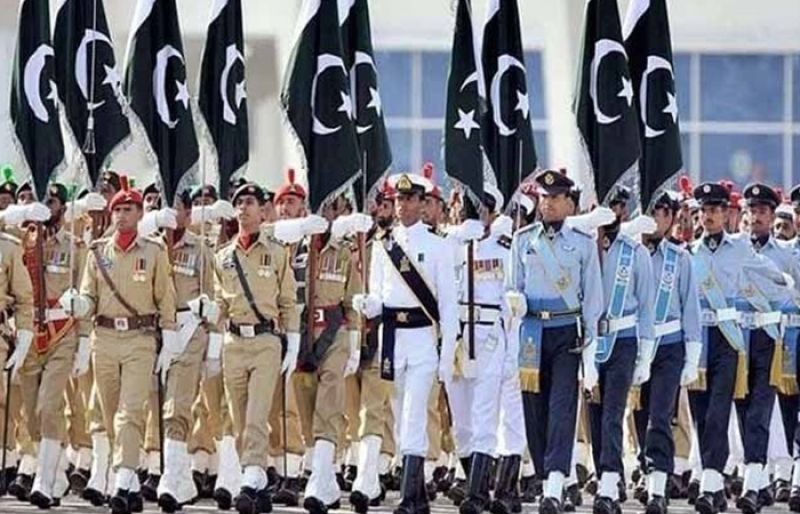
ISLAMABAD: The nation is celebrating the 82nd Pakistan Day with zeal and fervour today (March 23), with the joint armed forces parade held in full swing in the federal capital to exhibit the country’s military prowess and cultural diversities.
Prime Minister Imran Khan, Chief of Army Staff General Qamar Javed Bajwa, Naval Chief Admiral Ajmal Khan Niazi, Chairman Joint Chief of Staff Committee General Nadeem Raza, Defence Minister Pervaiz Khattak attended the arms show.
Other cabinet members, diplomats, senior civil and military officials, and prominent figures who gained accolades for their services to Pakistan were also present on the occasion.
The parade held at Shakarparian Parade Ground included contingents of the tri-services, paramilitary forces and civil armed forces, whereas the troops from Pakistan’s friend countries including Saudi Arabia, Turkey, Uzbekistan, Azerbaijan and Bahrain also participated in the show.
Nation will always keep independence of Pakistan dear: Alvi
President Dr Arif Alvi while addressing the ceremony said that the nation knows the value of the hard-earned sovereignty and independence of Pakistan and said that it will always keep it dear.
“I want to make it clear to the enemy that Pakistan will never compromise on its sovereignty as the nation and armed forces are ready to thwart any hostility. ,” he said, adding that any external aggression would be strongly dealt with.
President Alvi said the expansionist designs of Pakistan’s neighbouring country was a matter of concern for the security and stability of South Asia.
He mentioned India’s illegal occupation in Jammu and Kashmir and urged the international community and the United Nations to stop the ongoing human rights violations.
Referring to the country’s resolve against fighting extremism and terrorism, he said, “Pakistani nation has made immense sacrifices in wars and stood resilient against internal and external conspiracies.”
“We should always keep in view the saying of Quaid-e-Azam Muhammad Ali Jinnah to stand united as a nation and demonstrate faith and discipline within our ranks,” he said.
He lauded the valour and courage of the country’s armed forces and nation for making their homeland strong and prosperous, and paid glowing tribute to the countrymen who laid their lives for the sovereignty of the country and contributed towards its stability.
“Being a strong and united nation, we vow to keep high the integrity and sovereignty of our motherland,” he said.
He expressed confidence that the nation would stand undeterred in the journey towards making the country strong and prosperous.
“This event is the reflection of unity and progress of our nation and also shows the picture of our military strength,” he said.
Key highlights of the event
One of the important highlights of the parade was the fly-past of the newly inducted J-10C fighter jets along with various formations of Pakistan Air Force fighter aircraft, which was led by Chief of the Air Staff Air Chief Marshal Zaheer Ahmed Babar Sidhu as per the tradition.
The J-10C aircrafts, equipped with cutting-edge technology, were inducted into the Pakistan Air Force’s squadron earlier this month.
The marching columns of Armour Corps, Artillery, Rangers, Air Defence, Coast Guards, and the women contingent of Armed Forces Nursing Service passed by the dais.
The commandos of the Special Services Group (SSG) also demonstrated their skills during the parade, while the Sherdils team of seven Karakoram aircraft presented enthralling aerobatics, leaving a colourful trail of smoke in the blue sky.
Later, paratroopers of the three services made freefall jumps from the altitude of 10,000 feet and precisely landed at their designated targets in the ground.
Another colourful attraction of the event was the display of floats of all four provinces, including Azad Jammu & Kashmir and Gilgit-Baltistan, depicting their unique culture through artefacts, folk songs and dances in a show of national harmony. A special float of OIC countries was also showcased for the interest of specially invited delegations.
Meanwhile, the participants of 48th Session of the Organisation of Islamic Cooperation’s (OIC) Council of Foreign Ministers also attended the Pakistan Day parade on special invitation. This year’s theme is “Shad Rahe Pakistan” (May Pakistan Be Happy) and which is adapted from the words “Markaz e Yaqeen Shad Bad” in our national anthem (Blessed be the citadel of faith).
Pakistan Day theme
This year’s Pakistan Resolution Day was celebrated under the theme “Shad Rahe Pakistan”, which is also the title of the latest enthralling national song recently released by the Inter-Services Public. The song is written and sung by lyricist and singer Shuja Haider, with vocalist Yashal Shahid.
Moreover, the ISPR also issued a short public message to pay homage to the nation and the father of the nation.
President’s message
Earlier, President Dr Arif Alvi issued a special statement, on the occasion.
The statement, released on the official Twitter account of President of Pakistan, embodies messages for the nation about independence, national stability, supremacy of law, human and minority rights to mention some.
“Achieving national freedom is considered as half work. The remaining half, being crucial for a state’s security and stability, is equally important. This includes blending of various ethnic and minority groups into a single nation, ensuring the supremacy of law, eliminating terrorism and internal disturbances, achieving economic growth, promoting good relations with the world and above all, protecting human rights of all the citizens of the state,” the statement read.
State media Xinhua said soil at the crash site had absorbed a lot of water, adding “uncertainty” to the rescue.
No survivors have so far been found from China Eastern flight MU5735 which had 132 passengers when it crashed in the hills in southern China.
Investigators don’t know why the plane plummeted out of the sky on Monday.
There has been an outpouring of grief in China, where families of passengers and crew are still waiting for news.
Hundreds of responders have been scouring the steeply forested slopes in Wuzhou where debris from the plane was strewn after it broke apart and set fire to the hillside.
There had been no official word on casualties until China’s Civil Aviation Administration held its news briefing on Tuesday evening, some 36 hours after the disaster.
“Up to now, search and rescue work has not found any survivors,” Zhu Tao, aviation safety office director at the CAA, told reporters. “Given the information currently available, we still do not have a clear assessment of the cause for the crash.”
Air controllers had repeatedly called the aircraft during its descent but had received no response, he added.
Rescuers have so far found parts of the 737’s burnt wreckage. State broadcasters showed images of the charred remains of letters, bags, wallets and identity cards belonging to those on board.
Meanwhile, the families and friends of the 123 passengers and nine crew have gathered at each end of the flight – with relatives visiting China Eastern’s offices in Yunnan province and waiting at Guangzhou International Airport.
The China Eastern Airlines flight from Kunming, the capital of Yunnan, had been due to land in Guangzhou on Monday afternoon.
China Eastern has grounded all its Boeing 737-800s and set up a hotline for people seeking information on those on board.
Authorities have yet to identify passengers and crew members, but some relatives have spoken to local media or shared their grief online.
One woman reported the loss of her newly-wed husband on her WeChat account. Her earlier posts included videos of the couple’s holiday trips.
Other passengers included a group of six people, one of them a teenager, who were on their way to Guangzhou to attend a funeral, a local newspaper reported.
Another woman interviewed said her sister and close friends were part of that group, adding that she had also been booked on the flight, but ended up switching to an earlier plane.
Reuters quoted a man at the airport who said he was the colleague of a passenger named Mr Tan.
After confirming that Mr Tan was on board, he had to break the news to Mr Tan’s family. “They were sobbing. His mother couldn’t believe this had happened,” he told the news agency. “Her boy was only 29 years old.”
He added that arrangements were being made by the airline to bring families to the crash site in Wuzhou.
Pictures show distraught families waiting in a cordoned-off area at Guangzhou airport, being assisted by airline staff.
One unverified clip circulating widely on Chinese social media shows a man slumped in his seat crying and lamenting the loss of his three children who were on the flight.
This accident took place in China and involved a Chinese airline. As such, the investigation will be led by the country’s civil aviation administration.
But under international standards, the US will also be entitled to appoint an accredited representative because the Boeing 737 was designed and built in the US. The National Transportation Safety Board has already appointed a senior air safety investigator to fulfil this role.
Representatives from Boeing itself, the engine maker CFM International and the US aviation regulator, the Federal Aviation Administration, will serve as technical advisers.
The priority now will be to gather evidence from the crash site and search for the “black boxes”, the flight data recorder and cockpit voice recorder.
If they can be found, and the data they contain is readable, then the immediate cause of the crash could become apparent quite quickly. But the investigation as a whole will take time.
Flight MU5735 had been in the air for more than an hour and was nearing its destination when it suddenly plummeted from its cruising height.
Chinese state TV outlets have broadcast footage which appears to show a jet in a near nosedive to the ground. The footage was captured by a car’s dashcam. The BBC has not yet been able to verify the clip.
Flight tracker data showed the Boeing 737-800 jet dropped thousands of metres in under three minutes.
According to FlightRadar24, the plane was cruising at 29,100ft (about 9,000m), but two minutes and 15 seconds later it was recorded at 9,075ft. The last sourced information on the flight showed it ended at 14:22 local time, at an altitude of 3,225ft.
Aviation experts say the Boeing 737-800 model has a strong safety record, with thousands in service around the world. The aircraft that crashed was less than seven years old.
Investigators are expected to look at several possible causes – including deliberate action, pilot error, or technical issues such as a structural failure or mid-air collision.
I wish Ukrainians could say the same. After a month reporting from their country, I have just left a nation under brutal attack and I have no idea when it will end.
It’s not like I didn’t know what Vladimir Putin was capable of. I reported on the annexation of Crimea in 2014 and then the war in eastern Ukraine that was whipped up by Russia’s proxies and propaganda.
I also reported for many years from Russia itself, covering the murder and poisoning of opposition figures, wars in Chechnya and Georgia and horrors like the Beslan school siege, until I was expelled last summer as a “security threat”.
Still, I arrived in the capital Kyiv last month convinced that Russia’s president would not launch all-out war on Ukraine. The very idea seemed ludicrous, irrational, disastrous – and everyone I spoke to in both countries agreed.
When the war began, Nika was so terrified that she sat at her piano and played crashing chords as loud as she could, yelling at the top of her voice. The 15-year-old couldn’t stand the sound of the bombs.
Nika is from Kharkiv, Ukraine’s second city, but we met in a small-town motel filled with families who had fled and were living in the dark, scared of being spotted by Russian fighter jets.
When we arrived, the receptionist rushed us to the canteen urging us to eat quickly as the staff had to get home before curfew. Anyone out after nightfall risked getting shot.
Nika spent the first week of the war mainly in her aunt’s cellar
“Don’t turn on any lights and don’t use too much hot water,” she instructed. When we asked about the nearest bomb shelter, she signalled to somewhere behind the kitchen.
Nika had been there a couple of nights but was hardly sleeping. The teenager said her first thought each morning was: “Thank God I’m alive.”
She spoke in English, and the directness of her language was disarming.
“We were in panic because we had to hide as our life was in danger,” Nika said, describing how she had spent the first week of the war in her aunt’s cellar.
“It was cold and small. We didn’t have lots of food. This was a very traumatising period,” she said. “Now I’m scared of every sound. If someone claps, I think I will cry. I start shaking.”
By torchlight, the teenager scrolled through pictures on her phone of life before the war – smiling poses with friends, in the park, at her home.
“We just want to go back,” she said. “We want to know our families will be alive tomorrow. We want peace.”
Kharkiv is just 40km from the Russian border. Most people there speak Russian as a first language, not Ukrainian, and have friends and relatives on the other side. That’s presumably why Vladimir Putin thought his troops could roll into Kharkiv and take over – or into Mariupol, Sumy or Kherson. But he misjudged the mood.
The war that Russia fomented in eastern Ukraine in 2014 had already transformed the country and forged a far stronger national identity, even among Russian speakers. But now that war has exploded into an open invasion, it has destroyed every shred of “fraternal” relations. It’s killing the very people Vladimir Putin claims he is saving.
So as we crisscrossed a landscape now covered with checkpoints and trenches dug into wheat fields, we also saw dozens of giant billboards telling Russia, or Putin himself, to get lost.
Other messages lining the roads addressed Russian soldiers directly: “Think of your families,” one said.
“Surrender and stay alive.”
For much of the first three weeks of fighting, we were based 200km south of Kharkiv in Dnipro, a city that straddles the giant river which cuts Ukraine into east and west.
Dnipro was a haven of relative safety in the region as Russia attempted to bomb other cities into submission. But on 11 March we woke from a night of long air raid sirens to reports of a strike in the city centre.
We were soon standing beside the smouldering wreckage of a shoe factory where Russian missiles had killed a pensioner working as a security guard.
Sweeping shattered glass from the stairway of her nearby apartment block, Natasha broke down describing the terrified screams of her son. “What are they killing us with?” she cried, her hands covering her face.
A Russian-speaker, she demanded to know why Russia was doing this. “We didn’t ask to be saved.”
It was a statement I heard over and over again.
By that point, people had already begun leaving Dnipro. The exodus began a day after the university in central Kharkiv was shelled. Suddenly noone felt safe, even away from the front lines.
So crowds piled onto evacuation trains. There were women screaming, pets getting squashed and men in tears which they tried to hide from their families. I heard one repeating to himself that everything would be ok as he laid a palm on the window of a train carrying his wife and child away from him, who knew for how long.
Like all men, he had to stay and wait to be called up to fight.
Fleeing Kharkiv itself was harder, as we found out when I got a call about a little girl named Polina.
The three-year-old has cancer and her medicine was running out. The family needed to leave Kharkiv urgently, but the city was under heavy Russian fire and Polina’s parents did not dare to step outside.
The eight ships they worked on, which service routes including Dover-Calais and Larne-Ciarnryan, are all registered in Cyprus, the Bahamas or Bermuda.
Sacked staff had told the BBC about their experience of being “treated like criminals” – but in the letter Mr Hebblethwaite denied “rumours” that security staff who boarded vessels to manage the situation wore balaclavas or were directed to use handcuffs or force.
“The teams accompanying the seafarers off our vessels were totally professional in handling this difficult task,” he said.
The company said its settlement with its workers is believed to be “the largest compensation package in the British marine sector,” and more than 40 staff would get severance packages of more than £100,000 each.
The transport and freight company said 575 seafarers affected were in discussions to progress with the severance offers.
However, the RMT union, which has been organising protests over the redundancies said “the pay in lieu of notice is not compensation”.
“If staff do not sign up and give away their jobs and their legal right to take the company to an employment tribunal they will receive a fraction of the amount put to them,” general secretary Mick Lynch said.
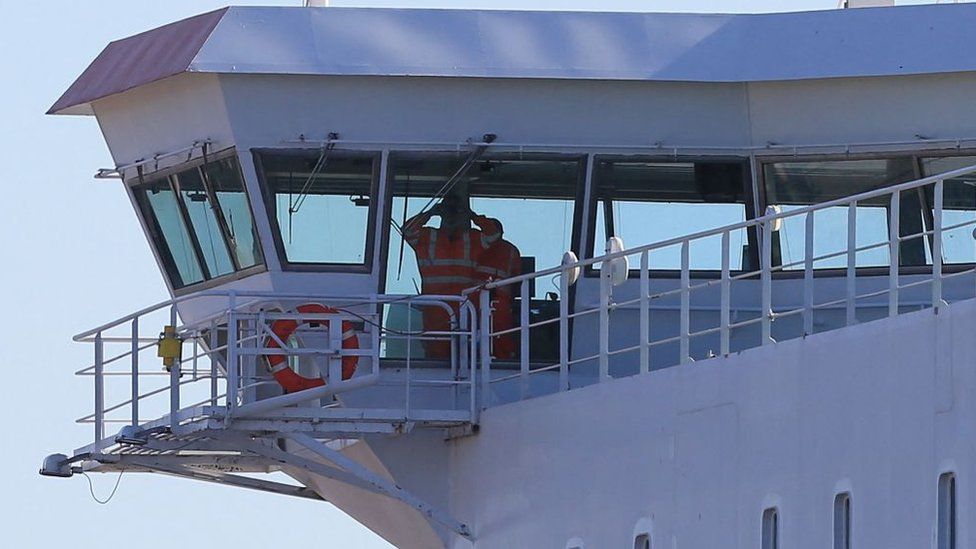
P&O Ferries vessels remain docked in Dover
P&O Ferries had until Tuesday at 17:00 to respond to the letter from Mr Kwarteng – in which he said that P&O Ferries “appears to have failed” to follow the correct process for making large-scale redundancies, by not consulting with unions and notifying the government in time.
Mr Kwarteng pointed out that failure to notify is “a criminal offence and can lead to an unlimited fine”.
Government officials will now review Mr Hebblethwaite’s latest response.
Separately, Business Minister Paul Scully said the government was reviewing all of its contracts with P&O ferries and its owner DP World, including a £25 million subsidy to DP World to help develop London Gateway as a freeport.
Things were calm in her home town, Bila Tserkva, a historic city on a winding river 80km (50 miles) south of Kyiv.
Then the explosions began.
Svetlana and her husband dragged their mattresses into the corridor of their apartment building and huddled there with their three children. The noise of the sirens was constant and they didn’t sleep for days.
Thousands of miles away in Australia, Emma Micallif was frantically messaging. The two women are intimately connected because Svetlana is pregnant with Emma’s second child. As rockets fell on Bila Tserkva Emma felt angry and helpless.
For six months the two mums had chatted back and forth using a translation app. They shared pictures of their children, discussed the things they liked to bake with their kids or moaned about the stress of pandemic home-schooling.
Now they were trying to co-ordinate an evacuation.
“I thought having cancer was stressful or having a baby while having treatment was stressful or having round after round of IVF and it not working was stressful,” Emma says. “But it just does not compare.”
With the help of the surrogacy agency, Emma got in touch with two other parents who had surrogates in Ukraine. They found a bus that would take the three women and their 10 children on an 18-hour trip to the Moldovan border.
When they finally got to the Moldovan capital they were crammed into a small apartment. Emma was horrified when she heard that there weren’t enough beds. “Our lovely, pregnant Svetlana was sleeping on the floor,” she says.
But Svetlana was too devastated to care. She had left her husband behind in Ukraine and her mother had fled to Germany. When her mother calls she just cries down the phone.
“It hurts so much that this war is tearing families apart,” she told me. “I feel safe in Moldova but my heart is in Ukraine.”
More than 2,000 children are born through surrogacy every year in Ukraine, the majority to foreign couples. The country has around 50 reproductive clinics and many agencies and middle-men who match couples – known as “intended parents” – to surrogates.
Ukraine is a popular choice because of the way its laws on surrogacy are written. In many European countries, including the UK, when a surrogate gives birth she is listed as the mother on the birth certificate. If she is married, her husband will be listed as the father. In Ukraine the intended parents are listed as mother and father. That means getting the baby a passport and bringing them home is much simpler.
The agency that Emma and Svetlana are using is small – it is currently managing nine surrogacies – but Ukraine’s biggest agency currently has 500 surrogates at different stages of pregnancy.
Watch: Surrogate babies waiting for parents in a bomb shelter in Kyiv, Ukraine
Forty-one babies in its care are stranded in Kyiv, because their intended parents, from all over the world, have been prevented from collecting them by the war. Many of these children are being cared for in a basement nursery in Kyiv as Russian forces sit outside the city and shell it.
Every day more children are born, but since the invasion only nine sets of parents have risked the journey to Kyiv to pick up their babies. Another five have arranged remote pick-ups. “If nothing changes in the near future, we may have 100 babies under our care,” says Denys Herman, the agency’s legal adviser.
The company has been grappling with whether to move the babies out of Kyiv to a safer location in western Ukraine, but transporting them in a war zone also carries risks.
It’s not just Denys Herman who has a problem with stranded babies.
Nastya was saving up to buy a house in Kharkiv, where she lives with her two young boys, and coming to the end of her second surrogate pregnancy. When the war broke out she was only weeks from her due date and went into labour to give birth to twins a few days later.
A Ukrainian territorial defence soldier examines a burnt-out Russian military vehicle in Kharkiv
“We spent the entire time in the hospital in a bomb shelter,” she says. Kharkiv was under heavy bombardment and the hospital’s basement was packed from wall to wall with mattresses and baby cribs. She camped out in a storage room with her two children, sleeping on sofa cushions on the floor, underneath shelves piled high with files and paperwork.
“But the doctors were wonderful, I am very grateful to them,” she says. She gave birth to two healthy boys.
A week later she left the hospital. Kharkiv was still under attack and the foreign parents couldn’t get there to collect the twins.
So, together with some staff from her agency, Nastya, her two sons and the new-born twins travelled across Ukraine. She cared for the babies while delivering them to their parents at the border. That was more than a week ago, and she hasn’t heard from them since.
When Emma envisages the family she wants, she thinks of the drive from her home in Canberra to her parent’s place in Sydney. She imagines looking into the back seat and seeing a gaggle of children. Instead, she has one. “It just feels like a hole in my life,” she says.
Five years ago while she was pregnant with her son, she was diagnosed with cervical cancer. The tumour was growing at an alarming rate, helped along by the hormones she produced in pregnancy. It was a rare medical event and when her son was born doctors crowded into the delivery room to observe.
“He came out perfect, he didn’t have to go into the neonatal ICU, so I felt very lucky,” she says. When her son was only five weeks old, she started intense radiation and chemotherapy which damaged her reproductive organs.
“I went into early menopause at 29. So that was delightful,” she says wryly.
In the five years since her cancer diagnosis, Emma’s every waking moment has been consumed by thoughts of how to conceive her second child. She and her husband went through 13 cycles of IVF which were traumatic and expensive, but none of the embryos would ultimately take. “Surrogacy is never anyone’s first pick but it comes as a result of a deep loss beforehand,” she says.
Emma and her husband, Alex, struggled to find a surrogate in Australia where only altruistic surrogacy is allowed. When they first heard about the option of Ukraine they were hesitant but they were reassured by other Australians who’d had a good experience.
With their first surrogate, two attempts at pregnancy didn’t take, causing further heartbreak. When they were matched with Svetlana and she got pregnant right away it felt like the battle was finally over.
“It was such a relief that we could stop fighting. We’d been in a state of fight or flight, as husband and wife, for so long.”
Before the war, the whole family had planned to travel to Ukraine. Emma had hoped to spend time with Svetlana so that she could tell her new child about her birth mother. With the baby due in a month that’s unlikely to happen now.
But for some intended parents the war is making the relationship with their surrogates even closer.
Christine (not her real name) woke up on the day of the invasion and felt sick. Her surrogate was in Zaporizhzhia, in the south-east of Ukraine, which would make headlines a few days later when its nuclear power plant, the largest in Europe, was attacked by Russian forces.
Her surrogate, Tatiana (also not her real name) left for Poland that day with her six-year-old son. Christine marvels at her strength.
When she asked Tatiana if she was interested in coming to England Christine wasn’t sure how she would react. But she was delighted. “We can come next week,” she said. She is one of only four or five women applying for a bespoke visa created by the Home Office for surrogate mothers.
“The past few days have been unbearably traumatic in what’s already been a traumatic year,” Christine says.
Last January she and her husband lost a child, a daughter who was born prematurely and died at five weeks old. At one point during the delivery her husband was told he might have to choose between Christine and the baby. She was advised not to try again but she did and miscarried again. “Because I was impatient and grieving and wanting it now, we looked abroad.”
They found out Tatiana was pregnant in January this year. “It was kind of too good to be true,” she says.
On Sunday Christine flew to Poland to meet Tatiana for the first time. Both were nervous, but relaxed when a Polish doctor said the results of the first scan were good.
Now they are working hard to get to know each other, using Google translate. “Yesterday, we had a discussion about our spiritual beliefs, whether we believe in clairvoyance and all those things. It’s not just all about pregnancy,” she says.
The visa will last three years and Christine and her husband have invited Tatiana to stay with them for as long as she wants to, beyond the birth of their child.
Surrogacy is legal in the UK, but under English law the surrogate’s name will be on the birth certificate, along with Christine’s husband’s. Legal parenthood will then have to be transferred from Tatiana to Christine.
If the baby is born in a third country there are even more legal complications. And that’s left Svetlana, Emma and Alex with a dilemma.
Surrogacy is not permitted in Moldova. If the baby is born there, Svetlana will be its legal guardian. She could place it for adoption but then it could be years before Emma and Alex are allowed to take their child home.
So together they have come up with a plan for Svetlana to deliver the baby in a city close to the border.
Svetlana has mixed feelings about going back to Ukraine. “There’s shooting everywhere, homes are being reduced to rubble and the Russians are shelling maternity hospitals, kindergartens and schools,” she says.
On the other hand, she is desperate to see her husband, who can’t leave the country under the terms of Ukraine’s martial law.
A mother waits to give birth in a hospital basement in Mykolaiv
For Emma, the idea of Svetlana returning to a war zone is hard to take. “If you’d asked me a year ago, I’d say ‘No, I wouldn’t do that.’ Because it’s just not what we should be doing. It’s not what should be happening,” she says.
One possible snag is that it could take weeks for the baby’s birth certificate to be issued. If that happens Emma and Alex are not sure what they will do.
The war has left thousands of surrogates and intended parents in equally terrible positions.
Cyrille, who is French, struggled to get in touch with his surrogate in Kharkiv for two weeks after the invasion. When eventually he did, he helped her to come to Paris where he hopes she will stay until she gives birth in August. But she has left her children in western Ukraine with their father, who didn’t want them to leave.
Natasha, a surrogate in Cherkasy is 10 weeks pregnant with the baby of a couple in the US. She is tormented by sirens, shelling and morning sickness. “This is not life, it’s a nightmare,” she says.
Just a few days before the war, I spoke to another surrogate who is pregnant with a baby girl for a couple in Spain. Maryna lived close to Svetlana in the town of Uzyn. When we spoke she was getting ready to move to Kyiv for the last two months of her pregnancy.
“Kyiv is always going to be a safe place because it’s so far from the Donbas,” she said.
Even after Russia invaded she struggled to imagine how bad things could get. “I really hope that a brain will appear in Putin’s head and he will start to withdraw his troops. Because Ukrainian and Russian mothers didn’t give birth to children so that they would fight.”
Just after Svetlana arrived safely in Moldova, Emma felt a moment of bittersweet relief.
“She sent me a photo of her youngest daughter with a soft-serve ice cream from McDonalds and a balloon and the biggest smile on her face. And I just completely broke down,” Emma says.
It reminded her of what every child should be doing, enjoying her life safely, with her family.
Each of the vessels cost more than $500m and are among a number tracked by Lloyd’s List Intelligence. The shipping data experts have been monitoring on-board tracking devices and have shared this information exclusively with the BBC, enabling the journeys of these and other vessels linked to sanctioned Russians to be plotted.
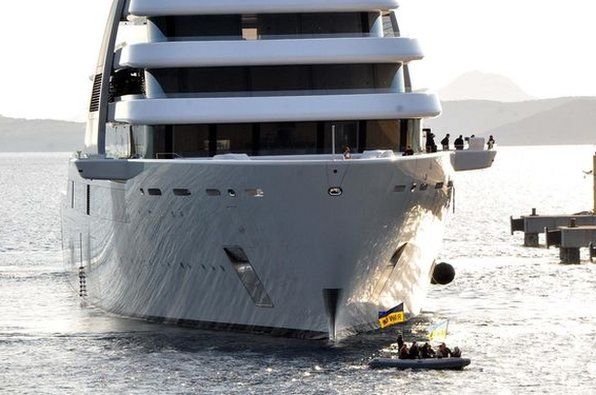
A boatload of young Ukrainians tried to stop the superyacht MY Solaris docking in Bodrum in Turkey. The other Abramovich-linked yacht Eclipse sailed to Marmaris.
The UK, US and EU have said they will target superyachts, and at least eight have been seized so far. More remain at large – some are on the move, others are moored in places that are currently safe from sanctions, including the Maldives.
Many superyachts are linked to Russian billionaires but ownership is shrouded in secrecy – boats are often registered through a series of offshore companies.
The team at Lloyd’s List sifted through registration papers, credit reports and other records to determine who they believe is linked to each superyacht.
MY Solaris, which is estimated to have cost $600m, boasts a pool and a helipad. It has a crew of up to 60 and can accommodate more than 30 guests.
It left Barcelona on 8 March where it was undergoing repairs.
It docked off Tivat in Montenegro days after Mr Abramovich was sanctioned by the UK. Tivat, in the mountain-fringed Bay of Kotor, is a hub for superyachts and boasts a large marina.
MY Solaris left Tivat and was sailing off the Greek west coast when the EU sanctioned Mr Abramovich on 15 March.
After this date, the yacht’s tracking data shows it was steering clear of Greek territorial waters (Greece is in the EU) and sailing in international waters, where it cannot be seized.
On 21 March, it arrived in the Turkish resort of Bodrum, which has a modern marina and can accommodate superyachts up to 140m in length.
But its path was blocked by a small dinghy carrying eight children from a Ukrainian junior sailing team and their coach, waving Ukrainian flags.
Coach Paulo Donstov told the BBC they were there to compete in a sailing championship and were tipped off about the arrival of MY Solaris.
IMAGE SOURCE,YAŞAR ANTER
Image caption,
Protesters from a junior sailing team try to prevent My Solaris docking
“We want the world to know that Ukraine wants freedom and peace,” said Mr Donstov, whose family are still in the Ukrainian port city of Odesa.
Turkey has said it has “no intention” of joining EU sanctions on Russians and, unlike most European countries, it is still allowing direct flights from Russia.
The captain of one vessel linked to a wealthy Russian, who did not want to be identified, told the BBC that Turkish officials had made it clear that Russian ships are “very welcome and will be treated as any other vessel”.
The Eclipse is one of the world’s largest superyachts. It has nine decks, three helipads and a three-person submarine. It is also rumoured to have a missile-defence system and a laser-directed light system to deter photographers from taking pictures of the boat.
It was docked off the Caribbean island of Sint Maarten – a Dutch overseas territory linked to the EU – but left at the beginning of March. It then sailed east through the Mediterranean, north of Algeria.
On 22 March, the data showed it arriving at Marmaris in Turkey. The resort, a former fishing village, is another popular destination for superyachts. There is a marina, an Ottoman castle and more than 50 diving sites nearby.
Andrei Kostin
Sea Rhapsody has also been on the move. It has been linked to Andrei Kostin, president of the Russian state-owned VTB bank, who has been sanctioned by the US, EU and UK authorities.
Other superyachts haven’t moved. One of them is Clio which is linked to Oleg Deripaska, an industrialist with close ties to President Putin, who has been sanctioned by the UK and the US.
It has its own support vessel called Sputnik – complete with its own helipad – and is currently near the Maldives.
Several other superyachts linked to sanctioned Russians are in or near the Maldives, including the Ocean Victory linked to Viktor Rashnikov and Nord linked to Alexei Mordashov.
The Madame Gu – linked to Andrey Skoch who has been sanctioned by the EU and UK – is in Dubai.
The Maldives, the Seychelles and Dubai don’t have an agreement with the US, UK or EU that would allow the authorities to seize property, protecting yachts there from any sanctions.
But they may not be able to stay in safe waters indefinitely. “These things are living, guzzling animals on the water that need maintenance… so you need ports that can cater to that,” says Capucine de Vallée, CEO of Boat Bookings. “All the leading shipyards are in northern Europe.”
She believes manufacturers may stop offering parts and maintenance due to sanctions.
Out of the nine superyachts linked to sanctioned Russians, only one is docked in European waters.
The Tango – linked to Viktor Vekselberg – is docked off the coast of Palma in Spain. Mr Vekselberg is under sanction by the US and the UK, but not the EU.
A superyacht linked to Russian President Vladimir Putin in the past sailed back to Russian waters before the invasion of Ukraine began.
Graceful moved from Germany to the coast of Kaliningrad, Russia, in mid-February.
But Lloyd’s List says the movement data is limited as the vessel turned off its tracking device for several weeks.
Under the UN Safety of Life at Sea (SOLAS) Convention, ships must have their onboard-trackers switched on at all times unless there is a danger to the safety of the crew and vessel.
Several other yachts linked to Russians have also occasionally turned off their tracking data in the last month.
US officials are examining the ownership of a second yacht, the Scheherazade which is currently docked off the Italian town of Marina di Carrara.
Supporters of the Russian opposition leader Alexander Navalny have linked the 140m vessel, estimated to be worth $700m, to President Putin.
Which yachts have been seized?
At this time of year, many superyachts would usually start heading toward popular European destinations, such as Port Hercule in Monaco or Marina Grande on the Italian island of Capri.
“Between December and April it’s Caribbean season, and then yachts are moved to Europe for the Mediterranean season which will normally run from May to September,” says Chris Jefferies of Superyacht World Magazine.
A superyacht linked to Russian President Vladimir Putin in the past sailed back to Russian waters before the invasion of Ukraine began.
Graceful moved from Germany to the coast of Kaliningrad, Russia, in mid-February.
But Lloyd’s List says the movement data is limited as the vessel turned off its tracking device for several weeks.
Under the UN Safety of Life at Sea (SOLAS) Convention, ships must have their onboard-trackers switched on at all times unless there is a danger to the safety of the crew and vessel.
Several other yachts linked to Russians have also occasionally turned off their tracking data in the last month.
US officials are examining the ownership of a second yacht, the Scheherazade which is currently docked off the Italian town of Marina di Carrara.
Supporters of the Russian opposition leader Alexander Navalny have linked the 140m vessel, estimated to be worth $700m, to President Putin.
Which yachts have been seized?
At this time of year, many superyachts would usually start heading toward popular European destinations, such as Port Hercule in Monaco or Marina Grande on the Italian island of Capri.
“Between December and April it’s Caribbean season, and then yachts are moved to Europe for the Mediterranean season which will normally run from May to September,” says Chris Jefferies of Superyacht World Magazine.
Navalny was detained when he returned to Russia last year, after surviving a poisoning he blamed on the Kremlin.
He is already serving three and a half years in jail for breaking bail conditions while in hospital.
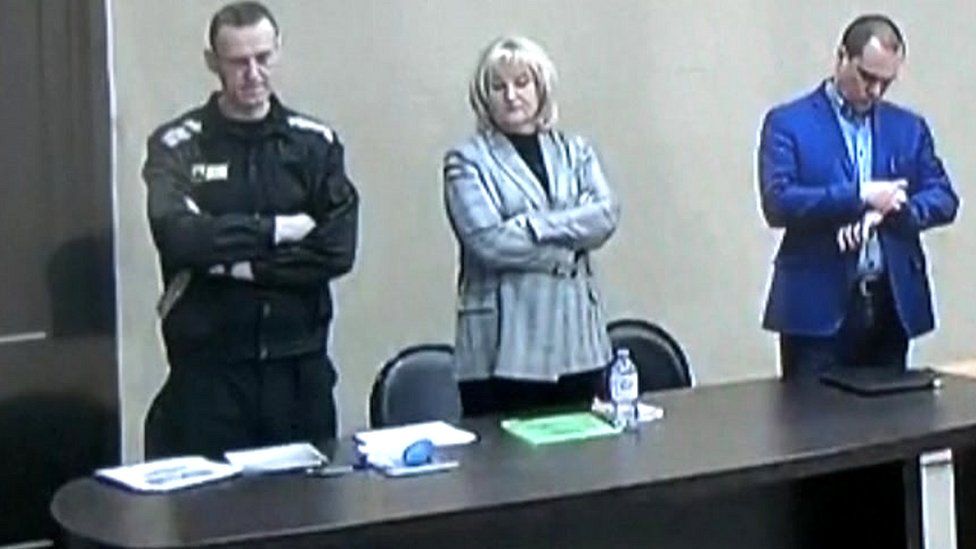
A judge has now found him guilty of fraud and contempt of court.
Prosecutors accused him of stealing $4.7m (£3.5m) of donations given to his now banned organisations, including his anti-corruption foundation.
Delivering her verdict, Judge Margarita Kotova said Navalny had carried out “the theft of property by an organised group”.
The new sentence replaces his earlier jail term, so the opposition leader will now have to serve some seven years in a maximum-security prison, with much stricter conditions and far more remote than the jail in Pokrov east of Moscow where he has spent more than a year.
A visibly gaunt Navalny folded his arms and exchanged comments with his lawyer as the ruling was read out.
Accusing the authorities of jamming his “last word” in court, he tweeted that he and his supporters would continue to fight censorship to “bring the truth to the people of Russia”.
This verdict will not come as a surprise to those who have watched Alexei Navalny’s case.
His FBK anti-corruption foundation was declared extremist, he was poisoned and he was already imprisoned. Now he faces being barred from public life for almost a decade.
Despite being behind bars, he has called for protests against what Russia calls its special military operation in Ukraine. His supporters now fear that as a result, he might be placed in a maximum security prison as well as receiving an increased sentence.
Russia’s crackdown on any platform that contradicts the Kremlin’s line continues.
Meta, the company that owns Instagram and Facebook, has been declared an extremist organisation; more media outlets are regularly blocked and a new law that can lead to up to 15 years in jail for anything the authorities consider to be fake news about the military has led many independent journalists to leave the country.
There is no space for dissent against President Putin in today’s Russia.
The trial was held at the penal colony in Pokrov where Navalny was sent last year after being jailed for failing to observe bail conditions, while he was being given life-saving treatment in Berlin for the August 2020 nerve agent attack.
The Kremlin denies any involvement in poisoning Navalny, who has become President Vladimir Putin’s fiercest domestic critic.
Navalny’s spokeswoman Kira Yarmysh said that while the attention of the world was focused on Ukraine, “another monstrous crime was being committed inside of Russia”. His colleagues alleged that the judge had discussed the trial with the Kremlin in recent weeks.
Ms Yarmysh said it was not just his freedom that was at stake but his life as well, because his accusers had already tried to kill him in Siberia.
The trial has been dismissed as a sham by Amnesty International, while German Chancellor Olaf Scholz has condemned it as incompatible with the rule of law.
Navalny’s top aide, Leonid Volkov, said President Putin had come up with many plans, including the capture of Kyiv in 96 hours, and his plans always ended in failure: “So it will be with these nine years.”
The 555 workers won a landmark civil case against the Post Office in 2019, but saw most of their settlements swallowed up by legal fees.
They will now get the same level of compensation as other sub-postmasters who were wrongly convicted.
The announcement comes as a public inquiry into the scandal continues.
Between 2000 and 2014, hundreds of sub-postmasters and mistresses were wrongly accused of theft, fraud and false accounting due to faults in the Horizon computer software being used at branches across the UK.
In 2019, a group of 555 subpostmasters and mistresses successfully challenged the Post Office over the accusations in the High Court.
That case set a legal precedent and paved the way for a series of cases in which 72 people had criminal convictions overturned.
The Post Office opened a historic shortfall scheme to compensate more than 700 wrongfully convicted former branch managers who had personally covered shortfalls in branch accounts caused by the Horizon software.
But the 555 people who won the High Court case could not participate in the scheme, and despite winning nearly £43m in compensation in 2019, the group’s funds were swallowed up due to a “no win, no fee” agreement with Therium, the company which funded the litigation.
The group only got a “small fraction” of the settlement equating to around £20,000 each, the Treasury said.
Therium has agreed to waive its rights to any claim on the new pot of compensation.
‘Absolutely parallel’
Business minister Paul Scully told the BBC’s Today programme that the compensation paid to the 555 people would be “absolutely parallel” to the other Post Office workers who had been compensated through the historic shortfall scheme.
He said the group were “pioneers” and had “broken open” the scandal.
“I want to make sure they get that full compensation,” he said. “It is a massive scandal and it’s something I am absolutely determined to put right.”
Asked if the families of 32 out of the 555 people who have since died would be able to receive the compensation, Mr Scully said he would look into it.
Speaking in the House of Commons on Thursday, Mr Scully said he envisaged the compensation scheme as running alongside the historic shortfall scheme “on the basis of losses, and looking at ongoing losses as well”.
“I’d love to say I’ve got a blank cheque from the Treasury, but that’s clearly not going to happen from this place – but the Treasury know that we need to sort it out.
“I want to make sure that the scheme has the confidence of [sub-postmasters],” he added.
Following the government’s announcement, the Post Office said it welcomed the move.
“Since it came to light through media reports that around £46m of the compensation provided to group litigation claimants was directed to the funders of their case, we have continually urged the government to address this unfairness,” a statement said.
It’s hard to overstate the importance of the legal precedent set by the victory of 555 subpostmasters two and a half years ago. That was the moment that evidence came into the public domain about the flaws with the Post Office’s Horizon system, and back-end access to the software.
The judge did not hold back in his opinion of the Post Office, saying the system was not remotely robust, but that getting that information out of the Post Office had taken subpostmasters years, and many tens of millions of pounds in costs.
It was the moment where the tables turned against a crown institution which had been wrongly convicting, bankrupting, and sacking its own employees for decades.
Their David v. Goliath legal battle has proved the ammunition needed for 706 branch managers who were convicted or sent to prison have been able to get those convictions quashed. It also forced the Post Office to agree to refund 2,500 others for huge financial losses they suffered as result, although most still haven’t received a penny of that money.
The 555 original legal trail-blazers stood and cheered as their legal victory snowballed, but were left with very little in compensation themselves. This new scheme is promising to set that right. Full details of how to claim have not yet been published, and there’s still a lot of nervousness from those who had to fight the Post Office and the government at every turn, but this is the clearest statement yet that a fairer payment is on the way.
Scandal
The new compensation scheme comes as High Court judge Sir Wyn Williams leads a public inquiry into the Post Office scandal, which has heard testimonies from Post Office staff, some of which were wrongly accused or convicted of crimes they didn’t commit.
A total of 72 have had their names cleared so far.
The inquiry – which is expected to run for the rest of this year – is examining whether the Post Office knew about faults in the IT system, Horizon, which was developed by Japanese company Fujitsu.
It will also ask how and why they were left to shoulder the blame.
The Post Office has previously said it is “sincerely sorry for the impact of the Horizon scandal on the lives of victims and their families and we are in no doubt about the human cost”.
“In addressing the past, our first priority is that full, fair and final compensation is provided and we are making good progress,” it added.
The Department for Business has previously said it is “eager to see all Horizon-related issues resolved fairly and quickly, including for the 555, who played a crucial role in bringing this scandal to light”.