
PM Khan invites public to convey message that nation is standing against “group of bandits”.

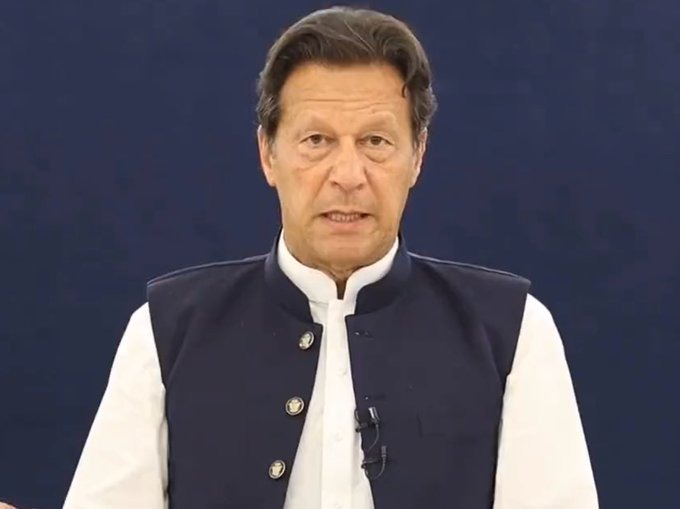
Prime Minister Imran Khan on Thursday invited the nation to join him on March 27 to reinstate the government’s stance against the “dacoits” ruling Pakistan for the last 30 years.

In a special message for the nation broadcast on television, social media and radio, the premier said that the “group of bandits” who have been looting the county for the last 30 years have joined hands in “auctioning the conscience of the elected public representatives.”

“They are practicing this publicly,” he said, adding that the people of Pakistan should join him on March 27 to convey their message that the nation is against evil.

He said that the people should tell the Opposition that the act of horse-trading being done from black money is “unacceptable” so that nobody dares to commit such crimes next time.

The premier asked the people of the country to “stand with the good” and “against evil”, urging them to show support.

Earlier, Senator Faisal Javed Khan had tweeted that the premier would deliver an important message to the people of Pakistan and invite them to attend the ruling party’s power show in Islamabad on March 27.


Following the order of the Supreme Court barring political parties from entering the Red Zone, the PTI had changed the venue of its planned March 27 power show in Islamabad from D-Chowk to Parade Ground.

In a tweet, the PTI said that “the Parade Ground will be more suitable to accommodate the number of people that are expected to participate in the rally.”

PM Imran Khan had tasked party leaders to gather one million people for the rally, with Information Minister Fawad Chaudhry saying that it would be a small “referendum” in the face of the no-confidence motion against the premier.

The premier, addressing a rally in Swat last week, had urged the nation to reach Islamabad on March 27 to tell the world that Pakistanis “stand with the truth and are against corruption”.

The PTI has called their public gathering “Amr-bel-Maroof” in response to the Opposition’s no-trust motion to show support to the prime minister.

One of two black boxes from crashed China Eastern jet found

WUZHOU: Chinese emergency workers found on Wednesday one of two black boxes from a China Eastern Airlines plane that crashed this week in forest-clad mountains with 132 people onboard, the aviation regulator said.

The device is the plane’s cockpit voice recorder, based on an early assessment, a Civil Aviation Administration of China (CAAC) official told a media briefing.

Flight MU5735 was en route from the southwestern city of Kunming to Guangzhou on the coast on Monday when the Boeing 737-800 jet suddenly plunged from cruising altitude at about the time when it should have started its descent before landing.

The cause of the crash has yet to be determined. Most of the jet appears to have disintegrated upon impact, although some debris and human remains have been found.

“An initial inspection showed that the exterior of the recorder has been severely damaged, but the storage units, while also damaged to some extent, are relatively complete,” CAAC official Zhu Tao said.

The black box is being sent to an institute in Beijing for decoding, although how long that takes would depend on the extent of the damage, Zhu said.

Weather along the flight path on Monday did not pose any danger to the aircraft and air controllers had communication with it after take-off and prior to its rapid descent, said Mao Yanfeng, head of aircraft investigation at CAAC.

The authorities have said the plane, which did not respond to repeated calls during its descent, met airworthiness standards before take-off and all three pilots – one more than normally required on a 737 – were in good health.

The captain, hired in January 2018, had 6,709 hours flying experience, while the first and second officers had 31,769 hours and 556 hours, respectively, a China Eastern official said.

“From what we know, the performance of the three pilots had been good and their family life relatively harmonious,” the official said.

One co-pilot was an observer to build up experience, the airline said.

Extra precautions

China Eastern tightened precautions after the crash, requiring two senior captains and a senior co-pilot on a three-person crew on some aircraft types, state-backed The Paper said.

Heavy rain in southern China on Wednesday hampered the search for victims and black boxes, with wet weather forecast to last the rest of the week.

Grief-stricken relatives visited the site, among them a retiree surnamed Zhang from Shenzhen, whose eyes filled with tears as he told Reuters his nephew was onboard. read more

“I hope the country can thoroughly investigate this matter and find out whether it was the manufacturer’s fault or it was a maintenance problem,” Zhang said.

CAAC has launched a two-week inspection of the sector, involving checks on all regional air traffic control centres, airline companies and flight training institutes to ensure “absolute” safety.

FlightRadar24 data showed the aircraft plunged rapidly at a rate of 31,000 feet per minute.

China has improved air safety over the past two decades, and Monday’s disaster was the first major crash in a dozen years.

China Eastern and two subsidiaries have grounded their fleet of more than 200 Boeing 737-800 jets. An airline official said the move was more an emergency reaction to the crash rather than a response to any safety issue.

The disaster comes as Boeing is working to recover from several crises, notably safety concerns over its 737 MAX model following two deadly crashes and the impact on travel from the COVID-19 pandemic.

Powerful earthquake rattles Taiwan

A magnitude 6.7 earthquake that struck off the coast of Taiwan early Wednesday rattled buildings and roused people from their sleep, leaving one injured and causing a half-constructed bridge in the island’s east to collapse.

Taiwan is regularly hit by earthquakes as it lies near the junction of two tectonic plates. It does not issue tsunami warnings unless a quake registers at more than magnitude 7.0.

The US Geological Survey initially estimated the 1:41 am (1741 GMT Tuesday) quake to be magnitude 6.9, but downgraded it to 6.6 before finally assessing it back up to 6.7.

It also revised the depth from an initial 10 kilometers (six miles) to 24 km.

The quake hit off Taiwan‘s east coast — near the island’s scenic tourist city Hualien — but was felt over much of the island.

Government-issued alerts sent people’s cell phones blaring, and social media lit up with people posting their reactions on being woken up.

“The chandelier on my ceiling shook for more than three minutes and didn’t stop,” local reporter Chao Li wrote on Facebook.

“It’s shaking so much, it scares people to death,” he said in an accompanying video.

An AFP reporter also felt their building in Taipei’s Zhongshan district shake a few minutes just after 1:41 am.

Local media on Wednesday ran footage from grocery stores that showed items flying off the shelves when the quake hit.

Taiwan‘s National Fire Agency confirmed on its official Facebook page that a man in the southern county of Taitung was hit by glass and had been sent to hospital.

A bridge under construction in Hualien had also collapsed but there were no injuries as traffic was not allowed around the area, the agency said.

Popular for its beaches and hiking spots, Hualien saw a deadly 6.4-magnitude quake in 2018 which left 17 people dead and 300 injured.

“Please do not panic if there are aftershocks and we urge the residents to be prepared for disaster prevention,” the county government said in a statement on its official Facebook page.

There were about 150 aftershocks, mostly under 3.6 magnitude, following the initial quake, said Chen Kuo-chang, head of Taiwan‘s Central Weather Bureau’s Seismological Center.

Earthquakes of 6.0 or more can prove deadly, although much depends on where it strikes and at what depth.

The last time Taiwan experienced a quake of a similar magnitude was in January, when a 6.2 tremor hit its east coast. There was no widespread damage or injuries.

US President Joe Biden joins fellow Western leaders in Brussels on Thursday for three summits on Russia’s war in Ukraine, a month after the invasion began.

Nato, the G7 and the EU are all holding meetings, in a display of unity rarely seen by the West.

Mr Biden will take part in all three, the first ever visit by a US president to an EU summit in Brussels.

But his visit to Brussels is not just about symbolism.

Russia’s invasion of Ukraine has given the Western defensive alliance Nato a renewed sense of purpose. And as the EU attempts to sever energy ties with Russia, it needs to forge and reinforce other relationships, particularly with the US.

Ukrainian President Volodymyr Zelensky will appear by video link to both Nato and EU leaders.

Nato’s 30 presidents and prime ministers will agree greater support for Ukraine and new troop deployments for Eastern allies. Their aim is to show solidarity to Kyiv, though only up to a point.

Many, but not all, have been willing to supply weapons. The UK said it would use both the G7 and Nato meetings to “substantively increase defensive lethal aid to Ukraine”.

But the alliance has also made clear it won’t become more directly involved and Mr Zelensky’s repeated requests for a no-fly zone over Ukraine have pretty much been ignored.

Nor is it clear how Nato would respond if Russia were to dramatically escalate the conflict in Ukraine – such as an attack on a Western weapons convoy, the use of chemical, or even tactical nuclear weapons. Nato’s red lines have so far been drawn at its borders.

Collective defence

For the past few weeks, 30,000 Nato troops from 25 countries have been training in Norway as part of Exercise Cold Response, a long-planned exercise that has now taken on more significance.

Soldiers from Sweden, which is not part of Nato, joined thousands of troops on exercise in Norway

Like Ukraine, Norway borders Russia. The key difference is that, as a Nato member, Norway is covered by a commitment to “collective defence” – an attack on one is an attack on all.

“I think an exercise like this is pretty good to have, to prove to countries like Russia… that you don’t want to mess with Nato,” a young Norwegian conscript called Peder told the BBC.

Nato leaders are focused on how to boost their own defences. They’ve already sent thousands more troops to the alliance’s eastern flank, along with more air defence batteries, warships and aircraft.


This, says Secretary-General Jens Stoltenberg, is the “new normal” following Russia’s invasion of Ukraine. Russia will get exactly what it didn’t want – more, not less Nato near its border. Nato battlegroups will stretch all the way from the Baltic to the Black Sea for the foreseeable future.

Two EU countries that are not members of Nato – Sweden and Finland – contributed troops to the exercise in Norway. They appear to be edging closer and closer to Nato in the wake of Russia’s invasion.

President Trump once questioned the very existence of Nato and French President Emmanuel Macron once called it “brain dead”. But President Biden’s visit to Brussels is proof that he sees it as being more important than ever to curb a more aggressive Russia.

Dizzying EU unity

Defence strategy will also play a part in an EU summit where leaders will approve plans that aim to pull member states closer together on military planning, intelligence and procurement. One ambition is to have a rapidly deployable force of 5,000 troops.

It’s all part of the theme of “strategic autonomy” championed by Mr Macron.

The argument is that a more sovereign Europe is a safer Europe, whether that’s by securing reliable supplies of energy and semiconductor chips or by boosting military spending.

But the trickiest subject for the European Union’s 27 member states is fast becoming the future of energy supplies, as they try to look beyond Russia.

After an initial, dizzying display of unity on sanctions across all 27 member states there are now obvious ruptures over what to do next.

EU leaders have reacted fast to Russia’s invasion with a series of hard-hitting sanctions

German Chancellor Olaf Scholz has publicly denounced the idea of banning Russian gas and oil imports, arguing it will drag Europe into a recession. “Sanctions must not hit the European states harder than the Russian leadership. That is our principle,” he said on the eve of the summit.

‘Blood money’

Soaring energy prices are also a concern to be discussed by EU leaders on Friday.

But there are nations agitating for action as they voice deep discomfort about handing cash to the Kremlin via energy payments. “It’s blood money,” said one central European diplomat. “I don’t think some countries understand the gravity of the situation.”

President Biden’s ability to offer Europe more US Liquefied Natural Gas (LNG) is a key watch at Thursday’s summit. The US is the world’s largest producer of natural gas.

He is also expected to announce more sanctions on Russian political figures as well as so-called oligarchs.

But the prospect of fresh EU sanctions this week is being played down. Some in Brussels call it “fatigue”, while others insist it’s the right time to take stock.

Two police officers who conducted a strip-search of a black pupil are no longer in public-facing roles, the Met Police told a community meeting.

safeguarding report found the search of the 15-year-old, known as Child Q, was unjustified and racism was “likely” to have been a factor.

Child Q is suing the Met and her Hackney school over the 2020 incident.

Hackney police commander Ch Supt Marcus Barnett, who resisted calls to resign, said the pair were doing desk duties.

It came in response to repeated questions from the public about why the officers had not been sacked.

A member of the public also questioned why the team hosting Wednesday’s meeting was made up of three white male police officers.

Protests have been held in east London during the last week

Det Supt Dan Rutland responded acknowledging that while the panel did not reflect the local community, they were the senior leadership team of Hackney Police.

During the incident, the girl was taken out of an exam to the school’s medical room and strip-searched by two female Met police officers searching for cannabis, while teachers remained outside.

No other adult was present, her parents were not contacted and no drugs were found.

Her intimate body parts were exposed and she was made to take off her sanitary towel, according to the review.

Scotland Yard has admitted the officers’ actions were “regrettable” and it “should never have happened”.

Speaking at Prime Minister’s Questions on Wednesday, Boris Johnson said that reports of the strip-search were “deeply distressing and deeply concerning”.

Earlier, Hackney’s mayor said it was clear that “school leadership has lost the confidence of the school, myself and the community”.

Philip Glanville said removing the head teacher could be “part of a process” to bring about change.

Labour MP Florence Eshalomi: “When my daughter is 15, I hope this issue still isn’t happening but I’m worried it will”

On Monday, policing minister Kit Malthouse said the government was taking this matter “extremely seriously”.

He added the government would wait for the outcome of an Independent Office of Police Conduct (IOPC) investigation before announcing any changes to police training around strip searches.

The IOPC said a report on the incident is being “finalised”.

The incident has sparked days of protest across Hackney, near the site of Child Q’s school.

The school has not responded to repeated requests for comment.

PM Imran underlines CPEC’s significance for economic growth

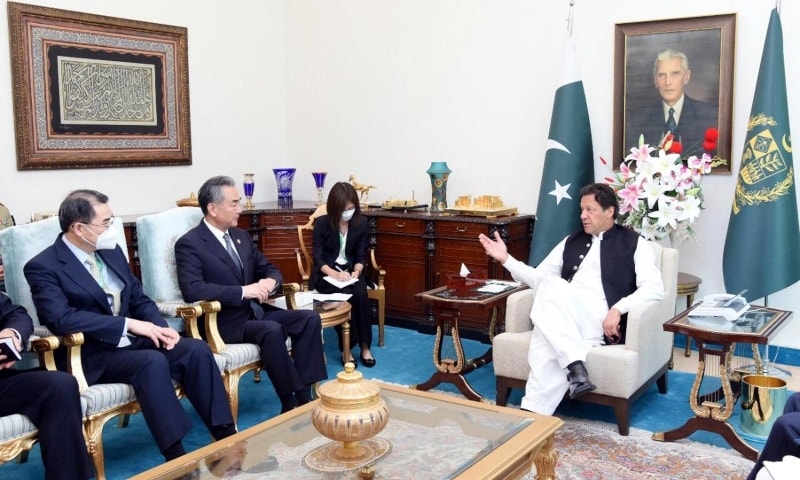
ISLAMABAD: Noting that the ongoing second phase of the China-Pak­is­tan Economic Corridor (CPEC) would reinforce Pakistan’s efforts towards economic development with an enhanced cooperation in diverse areas, Prime Minister Imran Khan invi­ted Chinese investors to benefit from the lucrative investment opportunities in Pakistan.

The PM made these rem­arks during a meeting with Chinese State Coun­cilor and For­eign Minister Wang Yi on the sidelines of the OIC moot here on Tuesday.

PM Khan and Mr Yi discussed the current trajectory of China-Pakistan bilateral ties, and the evolving regional and international scenario. The two sides also discussed the situation in Ukraine and reiterated the need for a solution through sustained dialogue and diplomacy.

Mr Khan briefed the Chinese leader on India’s egregious human rights violations in India-held Kash­m­­ir and its “irresponsible” behaviour that was an impe­d­­­iment to regional peace and security.

He also apprised Mr Yi of the so-called accidental firing of a missile from India into Pakistan.

He also emphasised that Pakistan and China must continue deeper engagement to promote peace and stability in Afghanistan, and avert a humanitarian crisis there.

In his meeting with Palestinian Foreign Minister Dr Riyad al-Maliki, the prime minister maintained that the Palestinian tragedy was at the heart of the turmoil in the Middle East. He reiterated Islam­abad’s unequivocal support for the rights of the Palestinian people and their just struggle.

Later, in a meeting with Iraqi Foreign Minister Fuad Hussein, Mr Khan reiterated Pakistan’s support for the territorial integrity and sovereignty of Iraq.

FM meets envoys

Pakistan announced un­­conditional support for Saudi Arabia’s candidature to host the World Expo 2030 in Riyadh. The assurance came when Foreign Minister Shah Mahmood Qureshi met his Saudi counterpart Prince Faisal bin Farhan Al Saud on the sidelines of the OIC foreign ministers gathering here.

Prince Faisal thanked Pakistan for supporting the kingdom’s bid at the 169th General Assembly of Bureau International des Expo­sit­i­ons, scheduled for December 2023.

Prince Faisal underscored the importance that Saudi Arabia attached to its fraternal and strategic relationship with Pakistan. He conveyed Riyadh’s appreciation for the role Islamabad played in the OIC.

Meanwhile, FM Qureshi also met his counterparts from Gambia Dr Mamadou Tangara, Turkmenistan’s Ra­­­­­shid Meredov and Kaza­khstan’s Mukhtar Tileuberdi.

Army chief meets delegates

Separately, the Saudi foreign minister also called on Army Chief General Qamar Javed Bajwa and appreciated Pakistan’s efforts for hosting the OIC meeting. The APP agency quoted an ISPR news release as stating that the two leaders discussed matters of mutual interest, regional security, the current situation in Afghanistan and bilateral defence ties.

Gen Bajwa said Pakistan valued its historic and brotherly relations with Saudi Arabia. He called the OIC session historic for bringing the international community together for a shared vision and joint strategy to find solutions to the emerging challenges vital for peace and stability.

Prince Faisal appreciated Pakistan’s role in the Afghan crisis, special efforts for border management, its role in regional stability, and pledged to play his part for further improvement in diplomatic cooperation with Pakistan.

Meanwhile, the army chief also met Azerbaijan’s Defence Minister Col Gen Zakir Hasanov and Republic of Kyrgyzstan’s Foreign Minister Ruslan Kazakbaev separately at General Headquarters. During the meetings, both sides reiterated their desire to further enhance bilateral relations, including efforts for peace and security in the region.

Ukrainian troops are counter-attacking Russian forces in some areas of the country, with reports that they have gained ground near the capital, Kyiv.

Local authorities in the town of Makariv, west of Kyiv, said Ukrainian flags were flying there once more.

A US defence spokesman said Ukrainians were also reversing momentum in some parts of the south.

In the small southern town of Voznesensk, Russian forces were pushed back and an armoured convoy destroyed.

And in Kherson, close to the Crimean peninsula and the first city to fall to Russia, Ukrainian forces are also trying to recapture territory.

A UK defence analyst told the BBC the fightback could force Moscow to change its tactics.

However, the latest assessment from the UK Ministry of Defence says Russian troops in Ukraine are moving in from the north and south to “envelop Ukrainian forces in the east of the country”.

The note says “Russian forces are likely reorganising before resuming large-scale offensive operations”.

Russian forces are also continuing to bombard the southern port city of Mariupol, although the port area itself is said to have suffered relatively little damage.

Justin Bronk, from the UK defence and security think tank the Royal United Services Institute (Rusi), said the Ukrainian pushback came as the Russians were trying to compensate for their lack of progress so far.

“The Russians have quite visibly failed to take the whole of Ukraine across multiple positions of advance,” he told the BBC.

“So now they are trying to pull their resources back and consolidate them and concentrate them on one push at a time – in particular around Mariupol and the south.”

He said that if the Russians took Mariupol, which has been besieged for weeks and is low on supplies, then they might look to redistribute troops and ammunition, first to Ukraine’s eastern Donbas region and then perhaps to the north-eastern city of Kharkiv.

But as Ukraine pushes Russian troops back around Irpin, about 20km (12 miles) from Kyiv, and other suburbs along with Makariv, it could hamper Moscow’s plans to capture the capital, he added.

“Essentially, what [Ukrainian forces] are trying to do is cut off an entire side of the attempted encirclement of Kyiv, which would force the Russians to either try to break north and abandon those positions, or for Russia to reroute significant combat power to try to break through and release their own forces there.”

The Pentagon gave more details of the Ukrainian counter-offensive on Tuesday, saying it has seen increasing signs in recent days that Russians are being dislodged from areas they previously held.

Spokesman John Kirby told CNN that he was unable to confirm reports from Ukrainian officials that they had retaken at least one town and expected to take more in coming days.

However, he said it would be “consistent with the kind of fighting and the kinds of capabilities we have seen the Ukrainians use”.

He said Russian forces had “stalled” and were running out of fuel and food.

There were also communication problems between air and ground forces, with some Russian fighters resorting to mobile phones to speak to each other, Mr Kirby said.

“They are slowed,” he said, adding that this was partly due to “their own ineptitude”.

Another Pentagon official, speaking anonymously, told the AFP news agency that some Russian soldiers had been laid low with frostbite, because they did not have the appropriate cold weather clothing for the terrain.

The official said that because of losses and other problems, Russian forces inside Ukraine were now below 90% of their available combat power.

P&O Ferries’ decision to sack 800 workers without notice last week appears to have broken UK employment law, the prime minister has said.

The firm could face fines “running into millions of pounds” if found guilty, Boris Johnson told the House of Commons.

It came as the boss of P&O Ferries apologised for the mass sacking.

Peter Hebblethwaite said the decision was “incredibly difficult” but “the only way to save the business”.

The sackings – along with claims that workers paid as little as £1.81 an hour will replace the fired staff – have sparked outrage.

At Prime Minister’s Questions, Mr Johnson said: “Under section 194 of the trades union and labour relations act of 1992, it looks to me as though the company concerned has broken the law.

“And we will be taking action therefore, and we will be encouraging workers themselves to take action under the 1996 employment rights act.”

He added that the government would take steps to protect mariners working in UK waters and “ensure they all paid the living wage”.

Responding, Labour leader Sir Keir Starmer said it was not illegal for international seafarers to be paid below the national living wage at UK ports and criticised the government for not banning the practice.

He added that the government should immediately cancel a £50m contract awarded to P&O Ferries’ owner, DP World. Ministers have said such contracts are under review.

“DP World must be quaking in their boots. The prime minister says how disappointed he is in them whilst handing them £50m,” Mr Starmer said.

Protestors marched through London on Monday

P&O denies it broke the law and says it is compensating workers fairly. But on Wednesday Mr Hebblethwaite said he understood people’s anger.

“I want to say sorry to the people affected and their families for the impact it’s had on them, and also to the 2,200 people who still work for P&O and will have been asked a lot of difficult questions about this,” he said.

“Over the last week, I’ve been speaking face-to-face to seafarers and their partners. They’ve lost their jobs and there is anger and shock and I completely understand.”

He added that the sackings were necessary to keep the loss-making firm afloat.

“This was an incredibly difficult decision that we wrestled with but once we knew it was the only way to save the business, we had to act,” Mr Hebblethwaite said.

“I wish there was another way and I’m sorry.”

It comes after reports that Indian agency workers paid as little as £1.81 an hour have already replaced sacked P&O workers at the Port of Dover.

Last week P&O said the figure was inaccurate but said it could not comment on how much agencies pay workers on ferries.

Some of P&O’s ferries are registered in Cyprus, meaning they do not have to pay the minimum wage required by UK law.

An 83-year-old Australian-Iranian imprisoned in Iran for more than two years on what his family said were false accusations of fraud has died.

Shokrollah Jebeli died in Evin prison hospital in Tehran on Sunday, his son Peyman said.

Amnesty International said his treatment in jail had in effect been torture. Iran has not commented.

Mr Jebeli’s death comes at a time of heightened focus on the plight of dual nationals imprisoned in Iran.

Conservationist Morad Tahbaz, a British-US national held since 2018 on spying charges, has gone on hunger strike after Iran did not release him when two British-Iranian nationals, Nazanin Zaghari-Ratcliffe and Anoosheh Ashoori, were freed on Thursday.

Iran does not recognise dual nationality and there are no exact figures on the number of such detainees.

Peyman Jebeli tweeted on an account which had campaigned for his father’s release that Shokrollah Jebeli had died.

He said his father’s health had seriously deteriorated in the preceding 24 hours and that his father had been made to sign a statement saying the prison would not be held responsible if anything happened to him.

Mr Jebeli had long been in poor health, had fallen over more than 10 times and had suffered a stroke in prison, according to his family. They said he was given inadequate medical care.

Last week, Amnesty said Iranian authorities were subjecting Mr Jebeli to a form of torture “by deliberately denying him adequate specialised medical care and withholding medication for his multiple serious health conditions”.

The Australian Department of Foreign Affairs and Trade (DFAT) said Iran had refused to accept Mr Jebeli’s Australian citizenship and had denied him “consular access”.

It said the Australian government had “repeatedly sought his release on compassionate and humanitarian grounds, given his age, underlying infirmities and his illness”.

According to Australian media, Mr Jebeli moved to Australia in 1976 and had made his home in Sydney, before returning to Iran in 2007.

Amnesty said two claims relating to financial disputes had been brought against him, resulting in one jail term of four years and six months, while the second case was continuing.

Australia has unveiled a defence agency focused on space, designed to counter Russia and China’s ambitions.

Defence Minister Peter Dutton said the Defence Space Command would secure Australia’s place in the cosmos.

Air Vice-Marshal Cath Roberts, who will lead it, said she was “scared” by Australia’s inability to combat Beijing and Moscow’s activities.

The US, Russia and China are all believed to have tested weapons that could destroy a satellite in space.

The agency’s chief said a Chinese satellite could theoretically “take out” the National Broadband Network for regional Australia.

Her role includes increasing Australians’ “national understanding” of space threats.

Vice-Marshal Roberts said that “we are really tight with the US” and “we can rely on them to an extent, but we need to accelerate the capability so that we can deal with the threats”.

Mr Dutton said the Defence Space Command would initially be modest in scope, but that Australia would eventually need a “Space Force in the future” – a reference to the US Space Force launched in 2019.

He criticised “countries that see space as a territory for their taking, rather than one to be shared”.

Space will take on “greater military significance” in this century, Mr Dutton added, warning against it becoming an arena for conflict between nations.

The new agency’s members will come from Australia’s army, navy and air force, and will include private contractors.

Australia announced plans for the new agency last year. It will fall under the air force.

It follows the creation of the United States’ Space Force three years ago. That agency attracted some mockery on social media over its uniforms – with some asking why they needed to be camouflaged for use in space – and its official logo, which was said to resemble one from cult sci-fi TV series Star Trek.

The UK also launched a space command military centre in 2019.