
National Assembly session of Lower House scheduled to start at 4pm.

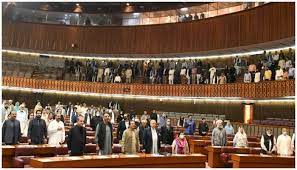
ISLAMABAD: The no-confidence motion against Prime Minister Imran Khan will be discussed in the National Assembly during the Lower House session today (Thursday), scheduled to start at 4pm.

The NA Secretariat issued the order of the day for today on Wednesday night, with discussion on the no-trust move against the premier on the session’s agenda.

Shahbaz tables no-trust motion in NA against PM Imran Khan

Leader of the Opposition in the National Assembly and PML-N President Shahbaz Sharif had tabled the no-confidence motion against PM Imran Khan on Monday — making him the third premier in Pakistan’s history to face the move.

During the session, Deputy NA Speaker Qasim Suri asked the members of Parliament, who are in favour of the motion, to stand up so that their numbers could be counted. As per the Constitution, 20% of the MNAs present in the Assembly must show support for voting.

Following the counting of the members who stood up in favour of the motion, the deputy speaker approved a discussion on the no-confidence motion, adding that it will take place on Thursday, March 31, at 4pm. However, voting on the resolution is expected to take place between April 1-4.

Read more: As expected, crucial NA session on no-trust motion adjourned till Mar 28

“The resolution shall not be voted upon before the expiry of three days, or later than seven days, from the day on which the resolution is moved in the Assembly,” the rules of the NA read.

Opposition submits no-trust motion in NA Secretariat

The Opposition had submitted the requisition along with notice of the no-confidence resolution, in the National Assembly Secretariat on March 8. The notice of no-confidence resolution against PM Imran Khan was signed by 152 opposition members.

“This House is of the view that the Prime Minister of Pakistan, Mr Imran Khan, has lost the confidence of the majority of the members of the National Assembly of Pakistan, therefore, he should cease to hold office,” the resolution bearing signatures of 152 opposition members said.

Rule 37(4) of Rules of Procedure and Conduct of Business in the National Assembly says the leave to move the resolution shall be asked for after Question-Hour, if any, and before any other business entered in the order of the day.

Rule 37(5) says that the Speaker may, after considering the state of business, shall allow a day or two for discussion on the motion. As per Article 95 of the Constitution and Assembly’s rules, a resolution of no-confidence against the Prime Minister shall not be voted before the expiry of three days and not later than seven days from the day, it was moved.

PM Imran calls NSC meeting ahead of NA debate on no-trust motion against him

ISLAMABAD: Prime Minister Imran Khan on Thursday summoned a meeting of the National Security Committee (NSC) today afternoon amid the ongoing controversy regarding the “threat letter” received by the premier.

Federal Minister for Information and Broadcasting Fawad Chaudhry wrote on Twitter that the meeting will be held at PM House today at 2pm.

The NSC meeting has been called just two hours before the start of a crucial NA session, in which debate on the no-trust motion against the premier is set to take place.

On Wednesday, Fawad had revealed that the premier met the military leadership of the country twice, adding that the Pakistan Army is responsible for the national security of the country.

Six Pakistani officers, soldiers embrace martyrdom in copter crash in Congo

Six Pakistani officers and soldiers, part of a UN peacekeeping mission, embraced martyrdom Tuesday when the helicopter carrying them crashed in Congo, said a statement issued by Inter Services Public Relations.

According to the statement, Pakistan Aviation Unit is deployed in UN Mission Congo on peacekeeping duties since 2011.

“On Mar 29, 2022, while undertaking a reconnaissance mission in Congo, a PUMA Helicopter crashed. The exact cause of the crash is yet to be ascertained. Eight UN peacekeepers on board including six Pakistanis Officers/ soldiers have embraced martyrdom.”

Those who embraced martyrdom include: Lt Col Asif Ali Awan, Pilot, Maj Saad Nomani, Co Pilot, Maj Faizan Ali, N/Sub Sami Ullah Khan, Flight Engineer, Havaldar Muhammad Ismail, Crew Chief and L/Hav Muhamad Jamil, Gunner.

“Pakistan has always played a pivotal role as responsible member of the international community to help realise ideals of global peace and security through active participation in various UN Peacekeeping missions. Our Peacekeepers have always distinguished themselves in executing challenging peacekeeping tasks in conflict prone areas through devotion and, if necessary, rendering supreme sacrifices,” the ISPR statement concluded.

Seven Pakistanis die in rockslide incident in Muscat

In the tragic incident of rockslide in Ibri, Muscat, seven Pakistani colliers were crushed to death while four others were still missing, reported 24NewsHD TV channel.

The Pakistan Embassy in Muscat on Wednesday said that seven Pakistani miners died in a sad incident of rockslide that occurred in Ibri, Dhahirah Governorate on Sunday.

The Civil Defence and Ambulance Authority of Oman so far was able to pull out eight bodies from under the rubble, of which seven were Pakistanis.

The Pakistani mission said that the incident occurred when a rock fell on a marble mine in Ibri. It said that the mission was in contact with the authorities conducting search and rescue operation.

The government of Oman has sought heavy machinery for the rescue operation. Sophisticated cameras have been installed and sniffer dogs are searching for the trapped miners. Technical help is also being sought from the coalmining experts.

The Pakistan mission officers met the affected families and miners in Muscat.

The embassy assured full cooperation and dispatch of the dead bodies to Pakistan after completion of all necessary formalities.

Like other South Asian countries, more than 140 Pakistanis are also working in the marble mine in the gulf country.

The mine company has stopped work on the site. The company has also offered food and residence to its workers.

The Pakistan embassy has given Whatsapp number for further information in this connection: 00923105555598 and 00923014242451.

Pervaiz Elahi blames Maryam Nawaz for PML-Q’s fall out with Opposition

ISLAMABAD: PML-Q’s Pervaiz Elahi has held Maryam Nawaz responsible for his party’s support of PM Imran Khan against the no-trust motion, saying there were differences among the PML-N over Punjab’s chief ministership.

Speaking to Hamid Mir on Geo News programme Capital Talk on Tuesday, Punjab Assembly Speaker Pervaiz Elahi said that he joined hands with Imran Khan when he learnt that Maryam Nawaz group and Shehbaz Sharif are not on the same page.

The PML-Q leader said it was because of the Maryam group’s stance that why a party with 10 members should be getting everything. Elahi said that the group is considered the voice of Nawaz Sharif, and Shehbaz, despite his stature, cannot overturn Nawaz’s veto.

Elahi said they always move cautiously in their affairs with the PML-N.

“We also learnt that PML-Q will get chief minister slot only for three or four months,” he added.

Elahi said, “Then came PTI’s Asad Umar and Pervaiz Khattak, but we told them we don’t trust them. I said let’s see when they offered coming up with the chief minister’s office offer tomorrow.”

He said Aslam Bhootani was with PML-Q, but Tariq Bashir Cheema steered him towards the Opposition.

“He [Tariq Bashir Cheema] says he stayed with the PTI because of us (Chaudhry brothers), but now he is adamant about voting against the PM.”

He said Shahbaz’s son Suleman called him, but he told him to read a newspaper report (about Maryam group stance).

Elahi said that in his meeting with the PM today (Tuesday), he has advised him to give MQM-P governorship and the maritime affairs ministry, assuring him that MQM-P is onboard.

The PML-Q leader also claimed to have reached an understanding with the Jahangir Tareen Group.

He said he has spoken to Jahangir Tareen and the issues of his group stand settled, adding meetings with his members are on.

PML-N responds

Meanwhile, PML-N Punjab President Rana Sanaullah said Pervaiz Elahi should have contacted the PML-N if he had doubts about the length of his tenure as the chief minister.

Rana said Elahi had assured them of support once they filed the no-trust resolution against Usman Buzdar. He said Elahi’s act is unbecoming and he should look for better excuses for going back on his commitment.

Tareen group on ELahi’s nomination

However, Tareen group leader Aun Chaudhry, said his group had yet to reach a conclusion.

Speaking on Aaj Shahzeb Khanzada Kay Saath, he said their minus-Buzdar demand has been met.

Confirming contact with Pervaiz Elahi, he said Tareen would be making the final decision.

He said Aleem Khan had already expressed his willingness to join Tareen group. Aleem would be included in the consultations, adding he couldn’t say if Aleem had his own line of action.

Speaking on the same group, Tareen group’s Raja Riaz said his group has difference with Imran Khan who had victimised them. It would be hard for his group to vote for Pervaiz Elahi if Imran Khan nominates him for the CM office.

UN nuclear watchdog head visits Ukraine to discuss safety

VIENNA: The head of the UN atomic watchdog, Rafael Grossi, is in Ukraine to discuss “the safety and security” of nuclear sites there, the agency said on Tuesday.

This is Grossi’s first visit to Ukraine since Russia seized several nuclear facilities, including Chernobyl, as part of its war in Ukraine.

Grossi is holding talks with senior government officials and will travel to one of Ukraine’s nuclear power plants, the International Atomic Energy Agency (IAEA) said in a statement. It did not specify which plant.

“Just crossed the border into Ukraine to start IAEA’s mission,” Grossi tweeted. “We must act now to help prevent the danger of a nuclear accident.”

Since the start of the Russian invasion on February 24, the IAEA director-general has repeatedly warned of the dangers of the conflict. The war is the first to occur in a country with a vast nuclear estate comprising 15 reactors in addition to Chernobyl, the site in 1986 of the world’s worst nuclear disaster.

During the visit, Grossi will discuss IAEA plans to ship “vital safety and security supplies” to Ukraine, including monitoring and emergency equipment, and dispatch experts to several of its nuclear sites, the IAEA said.

“The military conflict is putting Ukraine’s nuclear power plants and other facilities with radioactive material in unprecedented danger,” Grossi said in the statement.

“Ukraine has requested our assistance for safety and security. We will now start delivering it,” he said.

Russian forces took control of the site of the defunct Chernobyl plant — where radioactive waste is still stored — on February 24.

On March 4, they also captured the Zaporizhzhia nuclear plant, Europe’s largest, sparking alarm when shelling caused a fire at a training facility at the complex.

Grossi met Ukrainian and Russian foreign ministers in Turkey earlier this month to discuss nuclear safety but no agreement has been reached as yet.

About 100 Ukrainian technicians continued to run daily operations at Chernobyl.

After Russian forces seized the radioactive site, staff were forced to work for nearly four weeks without rotation.

“There have already been several close calls. We can’t afford to lose any more time,” Grossi said.

Ukraine has four active nuclear power plants, providing about half the country’s electricity, as well as stores of nuclear waste such as the one at Chernobyl.

Taliban bars government employees without beards from work

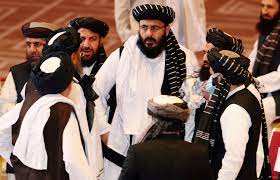
KABUL: Afghanistan’s Taliban has instructed all government employees to wear a beard and adhere to a dress code or risk being fired, three sources told Reuters, the latest of several new restrictions imposed by the hardline Islamist administration.

The sources said representatives from the Ministry for the Propagation of Virtue and Prevention of Vice were patrolling the entrances to government offices on Monday to check that employees were in compliance with the new rules.

Employees were being instructed not to shave their beards and to wear local clothing consisting of a long, loose top and trousers, and a hat or turban. They were also told to ensure they prayed at the correct times, two of the sources said.

Workers were told they would from now on be unable to enter offices and would eventually be fired if they did not meet the dress codes, the sources said.

A spokesman for the public morality ministry did not respond to a request for comment.

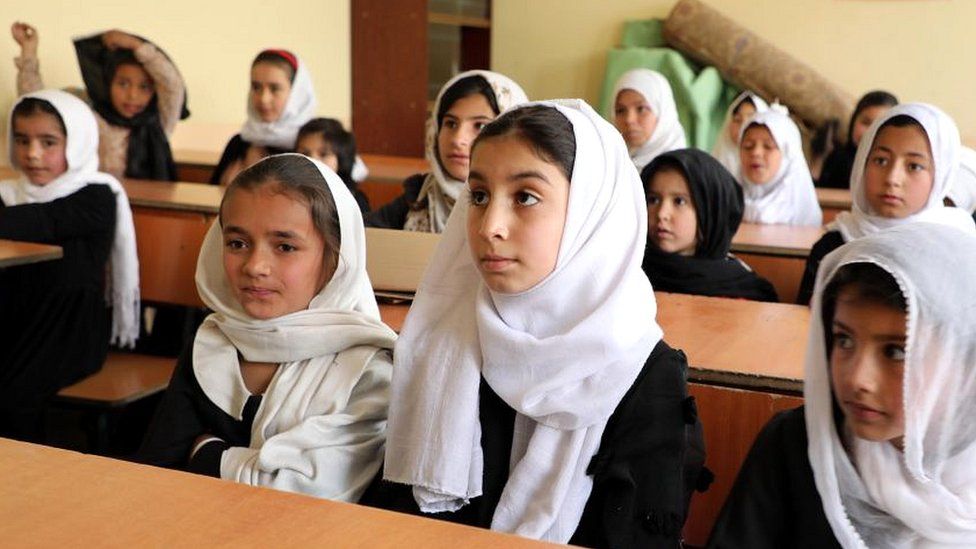
Last week, the Taliban banned women from taking flights without a male chaperone and failed to open girls’ schools as promised.

On Sunday it ordered parks to be segregated by sex, with women allowed to enter three days a week, and men the other four days, including the weekend, meaning even married couples and families cannot visit together.

The Taliban administration has drawn criticism at home and from Western governments for forcing its strict interpretation of Islamic law onto all Afghans.

The Taliban say they will respect everyone’s rights in line with Islamic law and Afghan customs and that they have changed since their 1996-2001 rule when they barred women from leaving the house without a male relative and forced men to grow beards.

Wednesday’s u-turn on girls’ schools led to protests from the international community, including the United States, which pulled out of planned meetings with Taliban officials in Qatar to discuss key economic issues.

The Taliban needs Western countries to lift sanctions that are crippling the Afghan economy.

Russia has announced it will “drastically reduce” military combat operations in two key areas of Ukraine “to boost mutual trust” in peace talks.

The decision to scale back operations around the capital, Kyiv, and the northern city of Chernihiv is the first sign of tangible progress from talks.

But it is unclear how extensive any reduction in military activity might be, and Ukraine remains sceptical.

The US and UK also said the pledge should be treated with caution.

On Tuesday, Russia’s deputy defence minister, Alexander Fomin, said the country would “radically, by several times reduce the military activity” around Kyiv and Chernihiv.

He added that there had been progress on”the neutrality and non-nuclear status” of Ukraine, which are two key concerns for Moscow.

But Russia’s pledge to scale back its forces was met with scepticism. “Ukrainians are not naive people,” President Volodymyr Zelensky said in an overnight video address.

“We can say that the signals… are positive, but those signals do not drown out the explosions or Russian shells,” he added.

“We’ve only seen a small number begin to move away from Kyiv,” Pentagon spokesman John Kirby said, adding that people should be “prepared to watch for a major offensive against other areas of Ukraine”.

The UK Defence Ministry also warned that Russia will likely “seek to divert combat power from the north to their offensive in the Donetsk and Luhansk regions in the east”.

Russia has already refocused its campaign on Ukraine’s eastern regions. It has suffered a series of setbacks to the north of the capital, Kyiv, and is also seeking to capture a land corridor which stretches along the south coast to the Russian border.

The discussions lasted around three hours. Very little was leaked, and nearly all media were kept away in a packed area on a pavement outside.

The key points became clear as members of the Ukrainian delegation came out onto the street an hour before the expected finish.

The negotiators said they had proposed to Russia that Ukraine adopt a neutral status in exchange for security guarantees – an international mechanism where guarantor countries would act to protect Ukraine in future.

In return Kyiv would not join Nato, a key Russian demand. This was not a new pledge, but it was spelt out in the clearest detail yet.

Many are sceptical about what Russia’s announcement about reducing military operations actually means; whether it’s a pledge to pull back or merely an acceptance it has already failed in those areas and will instead turn its full force further east.

Western countries, therefore, are saying they will judge Russia by its actions and not its words.

line

During the ceasefire talks on Tuesday, Ukraine proposed to become a neutral state in exchange for security guarantees. A key aim of Russia’s invasion was to stop Ukraine joining the Nato alliance and Russian officials said the talks had moved to a practical stage.

Ukrainian negotiator Oleksandr Chaly told reporters that its offer of neutrality – which means it would not ally itself militarily with others – was a chance to “restore the territorial integrity and security of Ukraine through diplomatic and political means”.

Russian forces have encircled Chernihiv, where officials say up to 400 people have been killed and some 130,000 residents are without heating, electricity or water supplies.

Russia’s chief negotiator, Vladimir Medinsky, said talks had been “meaningful” and Ukraine’s proposals on neutrality would be put to President Vladimir Putin. However, he made clear that before a presidential summit could happen a treaty would have to be drafted and approved by negotiators, and then signed by foreign ministers.

“This is not a ceasefire but this is our aspiration, gradually to reach a de-escalation of the conflict at least on these fronts,” Mr Medinsky told Russian state news agency Tass.

World Bank freezes projects over girls’ school ban: Afghanistan

The projects’ aims included improving education, health and agriculture.

They also had a “strong focus on ensuring that girls and women participate and benefit from the support,” the bank had said earlier.

Last week, the Taliban reversed a decision to allow the schools to open following months of restrictions.

The Taliban said schools would only reopen after a decision over uniforms for female students had been made in accordance with “Sharia law and Afghan tradition”.

The move has drawn international condemnation, while on Saturday protestors gathered close to the Ministry of Education in the country’s capital Kabul to demand that the schools be reopened.

The World Bank projects were targeted at giving women and girls as much access to services in Afghanistan, as men.

They are financed by the Afghanistan Reconstruction Trust Fund (ARTF), which was frozen last year after the Taliban took control of the country.

At the start of this month, the executive board of the World Bank approved a plan to use more than $1bn from the fund to support “urgent needs” including those in education, agriculture and health.

Under the plan, the money would not be handed to Taliban authorities, and was instead to be distributed through United Nations agencies and aid groups.

“As a first step, the ARTF donors will decide on four projects of approximately $600m to support urgent needs in the education, health, and agriculture sectors, as well as community livelihoods,” the bank said in a statement on 1 March.

“This $600m will be supplemented with additional allocations from the ARTF during 2022 as conditions allow,” it added.

“This phased approach is designed to be flexible and adaptive, recognising that the situation on the ground remains fluid.”

The BBC understands that the projects will be restarted only when the bank is confident that its goals can be met.

On Friday, a joint statement by officials from 10 countries, including the US and UK, described the Taliban’s actions as “profoundly disturbing”.

The US State Department has also cancelled meetings with the Taliban, which were scheduled to take place in Qatar.

US President Joe Biden has signed legislation that designates lynching as a federal hate crime.

The law follows more than 100 years and 200 failed attempts by US lawmakers to pass anti-lynching legislation.

The Emmett Till Antilynching Act is named for the black teenager whose brutal murder in Mississippi in 1955 helped spark the civil rights movement.

Perpetrators of a lynching – death or injury resulting from a hate crime – will face up to 30 years in jail.

Mr Biden said: “Thank you for never giving up, never ever giving up.

“Lynching was pure terror to enforce the lie that not everyone, not everyone, belongs in America, not everyone is created equal.”

He added: “Racial hate isn’t an old problem – it’s a persistent problem. Hate never goes away. It only hides.”

The bill was passed unanimously in the Senate earlier this month. The House had voted overwhelmingly in support of the legislation last month. Three Republicans voted no: Thomas Massie of Kentucky, Chip Roy of Texas and Andrew Clyde of Georgia. They argued that it was already a hate crime to lynch people in the US.

Lynching is murder by a mob with no due process or rule of law. Across the US, thousands of people, mainly African Americans, were lynched by white mobs, often by hanging or torture, in the 19th and 20th Centuries.

Some 4,400 African Americans were lynched between 1877 and 1950, according to the Equal Justice Initiative. Those who participated in lynchings were often celebrated and acted with impunity.

Her ancestors enslaved mine. Now we’re friends

“Lynching is a longstanding and uniquely American weapon of racial terror that has for decades been used to maintain the white hierarchy,” the bill’s sponsor, Illinois Congressman Bobby Rush, said ahead of its passage.

In 2020, following the murder of George Floyd by a police officer in Minneapolis, the House passed an earlier iteration of the bill, but it was blocked in the Senate.

Many racial justice advocates have described the death of Floyd, as well as the murder of Ahmaud Arbery – who was hunted down and shot by three white men in Georgia in 2020 – as modern-day lynchings.

What took so long?

By Chelsea Bailey, BBC News

One would be forgiven for thinking that lynching was already a hate crime in the United States. After all, it’s been decades since Billie Holiday’s haunting ballad, Strange Fruit, told of “black bodies swingin’ in the Southern breeze”, and mobs of white Americans no longer line up to take commemorative photos beneath hanging trees.

But that’s exactly why the Emmett Till Antilynching Act is so significant. Lynchings may not look the same way they did in the past, but that doesn’t mean they don’t happen.

Many regard the murders of black Americans James Byrd Jr, Ahmaud Arbery and George Floyd as modern-day lynchings.

The bill signed into law on Tuesday bears the name of a black teenager whose mother held an open-casket funeral to force the world to see the gruesome effect of racial violence in the US.

For many, the fact that it took Congress more than 65 years to pass the legislation would seem to speak volumes about America’s tacit stance on the subject.

The first anti-lynching bill was introduced in 1900, by George Henry White, the only black man then serving in Congress. The bill failed and continued to fail for more than 120 years.

Lynching is not unique to America, but its use for racial terror and suppression is. According to the Equal Justice Initiative, more than 4,300 black Americans were lynched between the post-Civil War Reconstruction period and 1950. And those are just the murders that were documented.

Confronting America’s gruesome past continues to be a subject of contention. Sometimes, it can take more than a century.