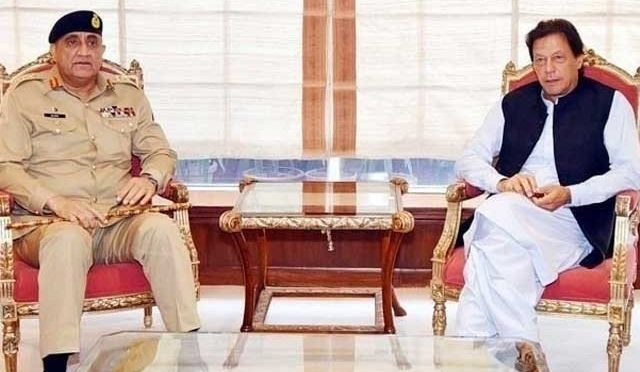
General Qamar Javed Bajwa, ISI DG call on PM Imran Khan

ISLAMABAD: Chief of Army Staff (COAS) General Qamar Javed Bajwa and Director-General of Inter-Services Intelligence LieutenantGeneral Nadeem Ahmed Anjum on Wednesday called on Prime Minister Imran Khan at the PM House.

The high-level meeting discussed matters related to internal security and the political situation. No statement on the meeting was issued by the Prime Minister’s Office.

Iraq MPs fail for third time to elect new president

Iraqi lawmakers Wednesday failed for a third time to elect a new national president for lack of a quorum, officials said, deepening the war-scarred country’s political crisis.

The continued failure by parliament to select a president after last year’s elections reflects a deep schism between Shiite political groupings.

“The assembly adjourned its session until further notice,” the parliament’s press service said without giving a new date.

Iraq‘s federal court has given lawmakers until April 6 to choose a new president. If that deadline is missed, said political scientist Hamza Haddad, “we could reach a point where new elections are decided to break the deadlock”.

A parliamentary source told AFP that only 178 out of 329 lawmakers were present in parliament Wednesday, far short of the two-thirds quorum required for the vote.

As in the previous two aborted votes, last Saturday and February 7, Wednesday’s session was boycotted by a major Shiite coalition bloc in parliament.

Half a year after October 2021 legislative elections, Iraq still does not have a new president or prime minister, keeping the country in a state of political paralysis.

Parliamentarians must first elect the head of state, by convention a member of the Kurdish minority, with a two-thirds majority. The president then appoints the head of government, a post now held by Mustafa al-Kadhemi.

Among the 40 candidates for the presidency, two are considered the frontrunners: incumbent Barham Saleh, of the Patriotic Union of Kurdistan (PUK), and Rebar Ahmed of the rival Kurdistan Democratic Party (KDP).

On February 13, Iraq‘s supreme court ruled out a presidential bid by KDP-backed veteran politician Hoshyar Zebari, after a complaint filed against him over years-old, untried corruption charges.

Iraqi politics were thrown into turmoil following October’s election, which was marred by record low turnout, post-vote threats and violence, and a months-long delay before the final results were confirmed.

The largest political bloc, led by firebrand Shiite cleric Moqtada Sadr, had backed Zebari for the presidency before moving its support to Ahmed.

The failed votes in parliament have underscored the gulf in Iraqi politics between Sadr, the general election’s big winner, and the powerful Coordination Framework, which called the boycotts.

The Coordination Framework includes former premier Nuri al-Maliki’s party and the pro-Iran Fatah Alliance — the political arm of the Shiite-led former paramilitary group Hashed al-Shaabi.

Alongside backing Ahmed for the presidency, Sadr intends to entrust the post of prime minister to his cousin and brother-in-law Jaafar Sadr, Iraq‘s ambassador to Britain.

That prospect is unpalatable for the Coordination Framework.

US sanctions suppliers to Iran’s ballistic missile program

The United States on Wednesday announced sanctions targeting several entities it says are involved in procuring supplies for Tehran’s nuclear program.

The move “reinforces” Washington’s commitment to prevent Iran from developing ballistic missiles, said the Treasury’s under secretary for terrorism Brian Nelson in a statement.

He said that while the United States continues to seek “Iran’s full return” to the 2015 nuclear deal, it “will not hesitate to target those who support Iran‘s ballistic missile program.”

“We will also work with other partners in the region to hold Iran accountable for its actions, including gross violations of the sovereignty of its neighbors,” he said.

The sanctions target Iranian national Mohammad Ali Hosseini and his “network of companies” as suppliers of the program, according to the statement.

They follow “Iran’s missile attack on Arbil, Iraq on March 13 and the Iranian enabled Houthi missile attack against a Saudi Aramco facility on March 25 as well as other missile attacks by Iranian proxies against Saudi Arabia and the United Arab Emirates,” it said.

Iran had claimed responsibility for the March 13 missile strikes, saying they targeted an Israeli “strategic centre” and warning of more attacks.

The sanctions come at a time when the United States seems close to an agreement with Tehran on returning to the nuclear deal, which former president Donald Trump unilaterally exited from in 2018.

Powerful quake strikes French territory of New Caledonia

A 6.8-magnitude earthquake struck east of the French territory of New Caledonia on Thursday, the US Geological Survey said.

The USGS said the tremor struck at 4.44 pm local time (0544 GMT) at a depth of 10 kilometres (6.2 miles), 279.0 km (173.0 mi) southeast of Tadine, New Caledonia.

The US National Weather Service issued a warning that “hazardous tsunami waves are possible for coasts located within 300 km of the earthquake epicenter”, including along the coasts of the Pacific island nation of Vanuatu.

“Persons located in threatened coastal areas should stay alert for information and follow instructions from national and local authorities,” it added.

Sixteen and 17-year-olds in Scotland will not be placed in young offenders institutions, under new plans.

The Scottish government said it wanted to end the placement of under 18s in custody “without delay”.

Instead, ministers said they would fund “care-based alternatives” and shift the approach from “one of punishment to one of love and support”.

The document also outlines plans to give a £200 annual grant to young people aged 16-25 with experience of the care system.

And it says a recommended national allowance for foster and kinship carers will be introduced.

Other changes include redesigns of the Children’s Hearings system and the governance of the care system.

It follows the publication of The Promise by the Independent Care Review in 2020, which said many young people experienced a “fractured, bureaucratic and unfeeling” system.

The review said the care system should have love and nurture at its heart.

Clare Haughey, the minister for children and young people, said the government was committed to fulfilling The Promise by 2030.

“These ambitious actions will help families to thrive so they can safely stay together,” she said. “They will also support carers and families engaged with the care system, as well as care leavers and care experienced people in education and employment.

“Alongside The Promise Scotland, the care community, local government, and many others, we are building on work that is already under way to bring forward change as quickly as possible.”

Earlier this month, Scotland’s chief inspector of prisons led calls for no-one under the age of 18 to be sent to jail.

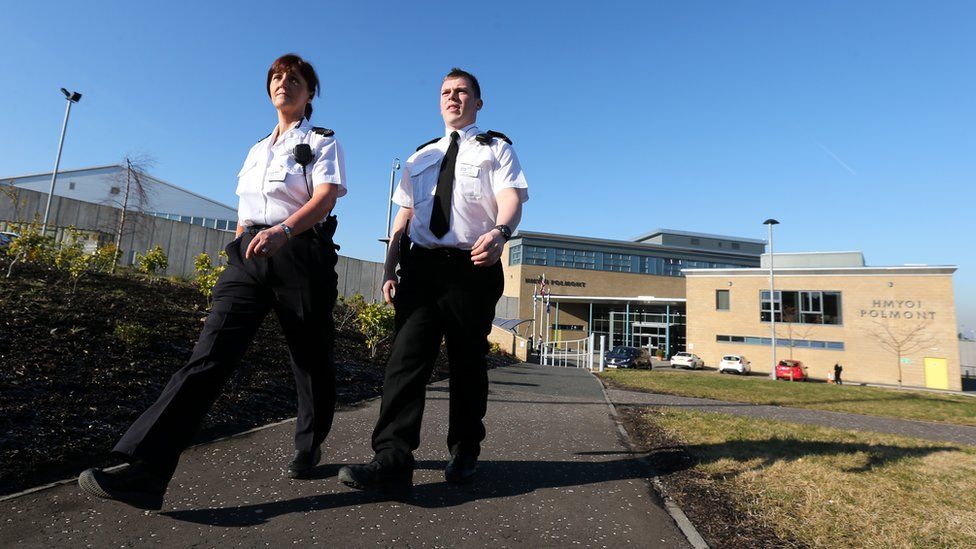
Wendy Sinclair-Gieben said sending 16 and 17-year-olds to Polmont young offenders institution – especially those who had not yet been convicted – was a breach of their human rights.

A consultation on legislation – the Children’s Care and Justice Bill – to stop this practice was launched on Wednesday.

Specialist services

The Scottish government says that if a child needs to be deprived of their liberty, it should be in a “child friendly and rights respecting” environment.

They should have access to staff with expertise in dealing with trauma.

It says there are currently 84 secure care placements across Scotland – but they need to consider how many they need and what they should look like in the future.

“The future offer will be designed in the best interests of each child and will include specialist services and bespoke packages in order to meet the often complex needs of children and young people,” the document says.

“It will consider the wider care and justice systems rather than secure care in isolation.”

Lack of progress

Conservative MSP Meghan Gallacher said her party supported the implementation plan, but noted that some in the care sector felt there had been a lack of progress during the pandemic.

Fiona McFarlane, head of oversight at The Promise Scotland, has previously described the lack of progress as “heartbreaking and shameful”.

Ms Gallacher said: “While MSPs across this chamber understand that Covid has impacted delivery across some areas, it is concerning to note that the overall progress has been criticised by organisations, charities, and those who have experienced the care system.”

Scottish Labour’s Martin Whitfield said meaningful targets were needed to measure the outcomes for young people in care.

He said: “The outcomes are currently, quite frankly, dreadful and things must change.

“And Scottish Labour believe that these targets across the board will help us identify where areas are falling behind, outcomes that need to be critically looked at.”

Scotland’s mandatory face covering rules will now remain in force until 18 April, Nicola Sturgeon has announced.

The legal requirement to wear masks in shops and on public transport had been expected to be lifted next week.

But the first minister told MSPs that the changes would now not take effect until 18 April.

She said this was due to there still being a very high level of infection in Scotland, and because masks provide extra protection.

However, the requirement to wear a face covering in places of worship and while attending marriage and funeral services will end on 4 April.

Ms Sturgeon said this phased approach struck a “sensible balance between our desire to remove this one remaining legal measure and the common sense need for continued caution”.

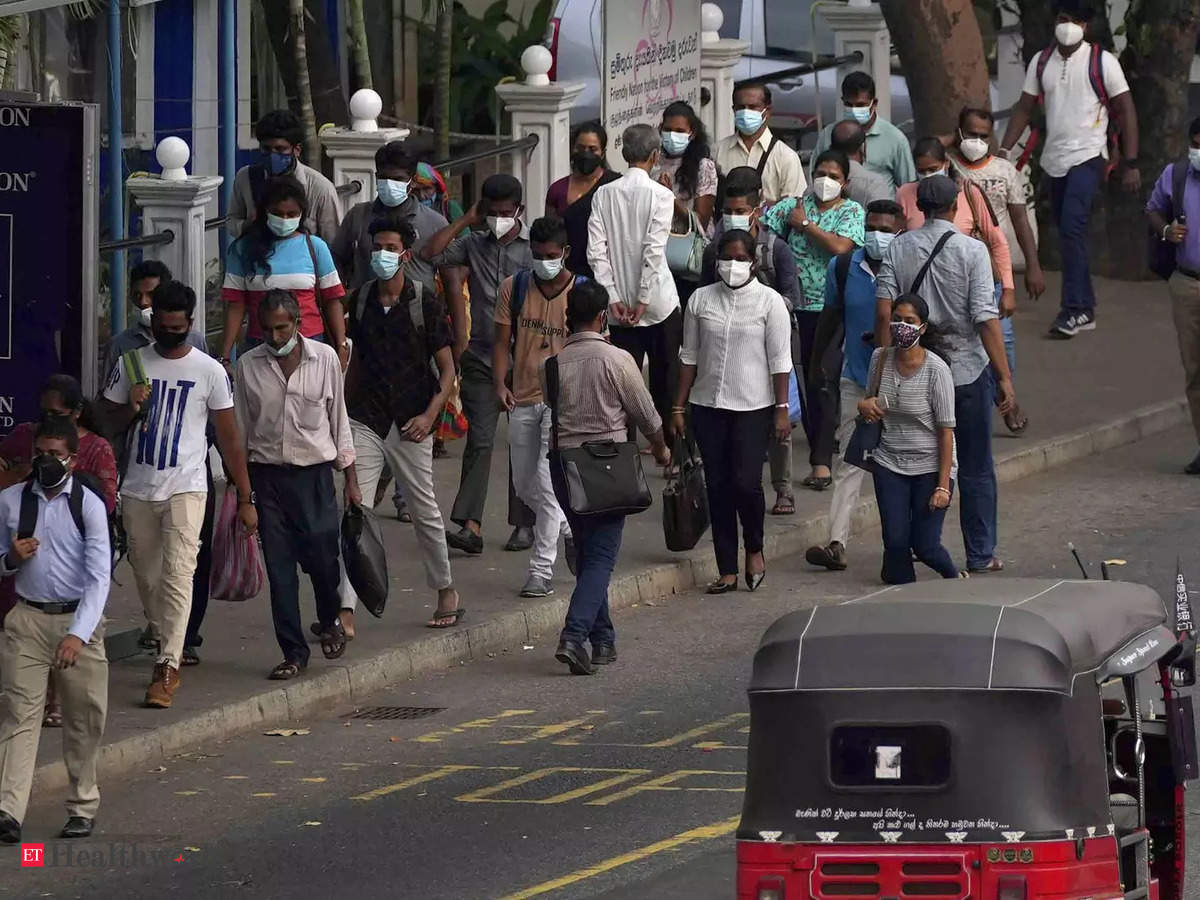
Case numbers have hit record levels in Scotland in recent weeks, with one in 11 people estimated to have had the virus in the week to 20 March.

Both Deputy First Minister John Swinney and Justice Secretary Keith Brown tested positive on Wednesday morning, just hours before Ms Sturgeon made her announcement.

Ms Sturgeon said the daily figures remained high but were “perhaps stabilising”, with a 15% fall from about 12,000 cases to 10,200 over the past week.

She said there was therefore “grounds for optimism that this latest wave of infection may now have peaked”.

However she said the high levels of infection and the pressure it was placing on the NHS meant the planned lifting of the law on face coverings would be delayed until 18 April.

She told MSPs that this would be a “proportionate precautionary measure while we pass the peak of this latest wave”.

This is the second time the first minister has delayed lifting the face mask laws, which had originally been due to be removed on 21 March.

All of Scotland’s other legal restrictions have already been phased out.

Ms Sturgeon said a delay was needed until Scotland passed the peak of the latest wave

Dr Christine Tait-Burkard, a leading infections expert at University of Edinburgh, told BBC Radio’s Good Morning Scotland that cotton masks offered “much less protection” from the BA.2 subvariant because far fewer virus particles needed to be inhaled to catch it.

She said: “The surgical and cotton masks just allow for a little more of the virus to get through. They are still very good for people who are lower risk – they stop them shedding a lot of virus into the environment.

“For people who are more vulnerable it is probably the moment to increase to an FFP2 mask just until the pressure in the environment from so many people infected actually decreases.”

Dr Tait-Burkard said she did not believe legal enforcement of face masks was needed any more, and that recommending people wear them in high risk environments was the right thing to do.

‘Bitterly disappointing’

The mask laws will now be phased out, with the requirement to wear them in places of worship and at services to be dropped on 4 April.

Ms Sturgeon was pictured without a mask at a memorial service for Prince Philip on Tuesday, but insisted that she wore one on the train and “abided by the rules” while in England.

The Scottish Licensed Trade Association said it would have set a better example for the first minister to wear a face covering, adding that it was “bitterly disappointing” the changes had been delayed in Scotland.

Managing director Colin Wilkinson said the pause would ultimately make little difference as “the lack of use of face coverings is already clearly evident in many settings”.

And the Scottish Chambers of Commerce said the “prolonging of Covid-19 rules” might make Scotland a less attractive tourist destination.

Scottish Conservative leader Douglas Ross said Scotland’s case rate being higher than other parts of the UK showed that the first minister’s “strategy is clearly failing”.

He said: “She is keeping restrictions in place here in Scotland weeks after they have been removed elsewhere.

“We believe that anyone who wants to keep wearing a face mask should do so, but it should be down to individual choice as it is in other parts of the UK.

“We should leave it up to people and businesses to decide what is best for them based on public health advice – Nicola Sturgeon has to start trusting the people of Scotland.”

Ms Sturgeon accused the Tory leader of being “seriously out of step with the vast majority of people”.

She said: “Particularly in public places where people don’t always have a choice about being, people have to go to shops and therefore if we all wear face coverings in shops right now we help protect each other.

“For a couple of weeks more while we see this wave of infection peak and start to fall I think that is a sensible thing to do.”

The testing system is also being wound down in Scotland, with the population-wide contact tracing system to be shut down by the end of April.

Scottish Labour’s deputy leader Jackie Baillie said infection levels were concerning, calling for more details about future support and testing for vulnerable people.

She said: “While life is returning to near normality for many, that is not the case for those who are immunocompromised and the 180,000 who were on the shielding list.”

Ms Sturgeon said vulnerable people were being offered extra booster jabs, and that testing would continue to be used in a targeted way to support them.

China should not become “too closely aligned” with Russia following the invasion of Ukraine, the head of UK cyber-intelligence GCHQ has warned.

Sir Jeremy Fleming said China’s long-term interests are not served by an alliance with Moscow.

In a rare public address during a visit to Australia, Sir Jeremy also said Russia had “massively misjudged” the situation in Ukraine.

He said Vladimir Putin’s advisers are “afraid to tell him the truth”.


Sir Jeremy said China’s aspirations to become a leading player on the global stage were “not well served by close alliance with a regime that wilfully and illegally ignores” international rules.

The speech at the Australian National University in Canberra comes after Downing Street said Boris Johnson had a “frank and candid” discussion with China’s President Xi Jinping last week.

Sir Jeremy said that Russian President Vladimir Putin has made a clear “strategic choice” to align with China as it grows more powerful in opposition to the United States.

He said the Kremlin regards China in the current crisis as a supplier of weapons, technology, and a potential market for its oil and gas.

GCHQ Director Jeremy Fleming was speaking in Australia

But Sir Jeremy suggested President Xi has a “more nuanced” view of the relationship.

“Russia understands that, long term, China will become increasingly strong militarily and economically. Some of their interests conflict; Russia could be squeezed out of the equation.”

Meanwhile, echoing comments from US and Ukrainian officials, the GCHQ boss said Mr Putin “underestimated the strength of the coalition his actions would galvanise.

“He under-played the economic consequences of the sanctions regime. He over-estimated the abilities of his military to secure a rapid victory.”

However, Sir Jeremy said “the extent of these misjudgments must be crystal clear to the regime”.

Former US President Donald Trump calls on Russian president Vladimir Putin to share incriminating information on Biden family.

Former US President Donald Trump has asked Russian President Vladimir Putin to disclose any compromising information he might have on US President Joe Biden’s family, Just The News reported.

In his interview with Just The News, Trump claimed that the wife of the mayor of Moscow gave $3.5 million to Joe Biden’s son, Hunter.

Trump has been accusing, without providing any evidence, that Hunter received funds from Elena Baturina, wife of the late Moscow mayor.

During his election campaign in 2016, Trump publicly asked Moscow to find missing emails from his Democratic rival, Hillary Clinton.

“Russia, if you’re listening, I hope you’re able to find the 30,000 emails that are missing, I think you will probably be rewarded mightily by our press,” Trump had said in a July 2016 news conference.

On February 24, Putin launched a full-blown invasion of Ukraine impacting the entire world with the step.

President Biden has been leading the Western response to Putin’s attack with sanctions, weapons, and aid to Kyiv.

Biden even called Putin a war criminal and stated that he “cannot remain in power” after his actions in Ukraine.

Coronavirus cases in Asia surpass 100 million

Coronavirus infections in Asia passed 100 million on Wednesday, according to a Reuters tally, as the region records a resurgence in cases, dominated by the BA.2 Omicron sub-variant.

The region is reporting over 1 million new COVID-19 cases about every two days, according to a Reuters analysis. With more than half of the world’s population, Asia contributes 21% of all reported COVID-19 cases.

The highly contagious but less deadly BA.2 sub-variant of Omicron has pushed the figures to greater highs in recent weeks in countries such as South Korea, China and Vietnam. BA.2 now represents nearly 86% of all sequenced cases, according to the World Health Organization.

South Korea leads the world in the daily average number of new cases reported, accounting for one in every four infections reported globally each day, as per Reuters analysis.

While the number of cases has levelled off since earlier in March, the country is still reporting over 300 deaths on average each day, with authorities ordering crematoriums nationwide to operate longer. read more

China is trying to tame its worst outbreak since the pandemic began. The rise in COVID cases in Shanghai, fuelled by the BA.2 substrain, has prompted the financial hub to go into lockdown. The city moved into a two-staged lockdown of its 26 million residents on Monday, restricting movement through bridges and highways to contain the spread. read more

China has reported over 45,000 new cases since the start of this year, a figure higher than it reported in all of 2021. Even though China has inoculated 90% of its population, not enough elderly people have received booster doses, making them susceptible to reinfections. read more

Though China is sticking to its plan for crushing the outbreak, experts overseas remain sceptical about the efficacy of lockdowns in the face of the highly infectious Omicron variant.

“It is clear from Australia and elsewhere in the world that lockdowns are simply not effective against Omicron – so expect a big wave coming,” said Adrian Esterman, an expert in biostatistics at the University of South Australia. read more

India alone accounts for 43 million COVID cases, more than the total in the next three worst-hit Asian countries of Japan, South Korea and Vietnam.

India has reported fewer than 2,000 cases per day for the past 11 days versus its peak this year in January of over 300,000 cases on average per day.

Earlier in March, Asia passed 1 million COVID-related deaths. There have now been 1,027,586 million COVID-related deaths across the continent.

Vaccines are considered less effective against the BA.2 subvariant compared to its predecessors. Studies have shown Omicron can reinfect people previously diagnosed with different coronavirus variants. read more

Polling under way in KP for second phase of local bodies election

Polling for the second phase of the local government elections in the remaining 18 districts of Khyber Pakhtunkhwa is underway, amid tight security to avoid any untoward incident today (Thursday).

The first phase of local government elections in KP were held in December, where the ruling PTI had suffered a major setback as the opposition parties, particularly JUI-F, won a clean victory.

In a surprise move, JUI-F had emerged as a leading party with 23 seats of tehsil chairpersons and three mayoral seats. However, KP’s ruling party PTI had stood second with only one mayoral seat and 18 seats of tehsil chairpersons.

For the second phase, polling started at 8am and will continue till 5pm without any interruption.

A total of 28,020 candidates are in the run for different categories in the polls being held in Abbottabad, Mansehra, Battagram, Torghar, Upper and Lower Kohistan, Kolai-Palas, Swat, Malakand, Shangla, Lower and Upper Dir, Upper and Lower Chitral, Kurram, Orakzai, and North and South Waziristan districts.

The LG elections are being held for the first time in the erstwhile tribal districts of Kurram, Orakzai, North and South Waziristan.

More security has been provided to the polling stations that have been declared sensitive and most sensitive, The News reported.

Over 8m voters expected to exercise right to vote

According to the ECP, polling is being carried out in 65 tehsils of 18 districts, where a total of 80, 57,474 registered voters will exercise their right to vote, out of whom 44,89,771 voters are male while 35,67,703 are female.

The Election Commission of Pakistan (ECP) has declared 1,646 polling stations “most sensitive”, 2,326 “sensitive” and 2,069 normal out of the 6,176 polling stations. Adequate security arrangements have been made for the sensitive and most sensitive polling stations across the province

The ECP data showed that 39,554 candidates were vying for 12,875 seats.

A total of 651 candidates will contest for city mayor and tehsil chairman seats, 12,980 for general and neighbourhood councils, 2,668 for women seats, 6,451 for labour, 5,213 candidates for Kisan and youth seats and 57 have submitted nomination papers for religious minorities’ seats.

The election body has informed that a total of 1,318 candidates have been elected unopposed in 65 tehsils.

Some 351 candidates have been elected unopposed on general seats, 533 on women seats, 151 on labour and Kisan seats, 233 on youth seats and 50 on minority seats in Village and Neighborhood Councils.

Arrangements finalised

All arrangements have been finalized as the Chief Election Commissioner, ECP secretary and special secretary are personally supervising the election process.

All polling material, including ballot papers, polling bags and polling staff were dispatched to all polling stations under strict security.

Special Assistant to the CM on Information Barrister Muhammad Ali Saif in a press conference said Wednesday that the government had completed all arrangements for the election day and foolproof security would be provided to 8.057 million people, who are exercising their right to vote in a peaceful environment.

He said compared to the first phase of the election, extra security has been provided to women candidates, adding that Pakistan army personnel would also be deployed if needed.

The ECP had expressed concern over the law and order at different polling stations during the first phase last year in December, after which the security was further upgraded.

The district administrations have also announced holiday for the schools in districts where the local government election would take place on Thursday.

Districts administration imposes section 144

Section 144 has been imposed on the recommendation of the Khyber Pakhtunkhwa police department in 18 districts of the province where polling is being continued.

According to the different notifications issued by the local administration, under section 144 display of arms, public rallies and gatherings, display of provocative banners, posters, entry of male agents in female polling stations and use of mobile in polling stations would be banned during the elections.

The public is requested in the polling districts to cooperate with police, district administrations and polling staff for the peaceful conduct of the second phase of local government polls.

Control room established to ensure peace in local body election

The government of Khyber Pakhtunkhwa has also established an emergency control room in Chief Minister’s Secretariat to ensure the peaceful holding of local body elections.

According to a notification issued on Wednesday, Muhsin Iqbal, Deputy Secretary CM Secretariat has been nominated as the focal person for the control room.

The emergency control room would coordinate with stakeholders relating to information and emergencies and inform CM besides taking steps to prevent any untoward incident during the polls.