Biden receives second Covid booster shot: W.House

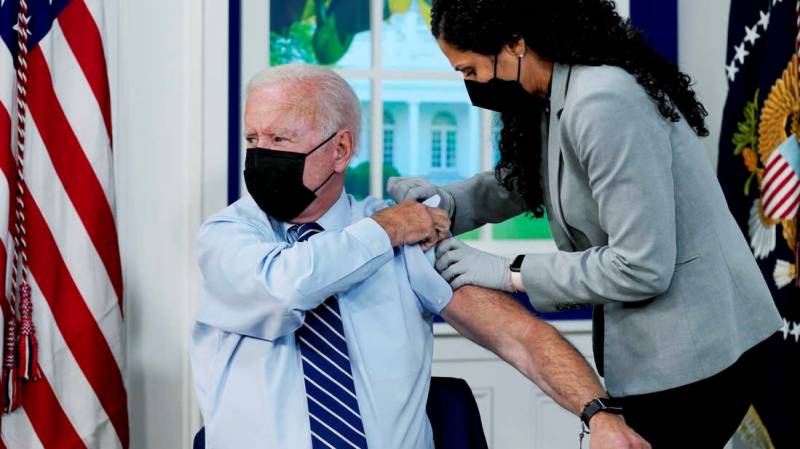
President Joe Biden received a second Covid-19 vaccine booster shot on Wednesday, the White House said.

Biden, 79, got the injection after he addressed the public on a new government website, COVID.gov, aimed at assisting efforts to expand the pandemic response, including information about testing and vaccinations.

“The shot will be administered by a member of the White House Medical Unit,” a spokesman said.

Biden will be getting the shot a day after the United States authorized a fourth dose of either the Pfizer-BioNTech or Moderna Covid-19 vaccines for people 50 and older, as authorities warn of a possible new wave driven by the BA.2 variant.

The Food and Drug Administration said it based its decision on emerging evidence that an additional booster, given four months after the last, improved protection against severe Covid and wasn’t associated with new safety concerns.

Two of Biden‘s spokeswomen have recently tested positive for Covid: Jen Psaki, who canceled her planned travel to Europe with the president as a result, and Psaki’s deputy Karine Jean-Pierre, who tested positive right after the high-profile trip.

The White House stressed in both cases that the president, since he is vaccinated and boosted, was not in danger.

The twin announcements were the latest in a string of Covid cases among people who have spent time with Biden or people in his circle.

Earlier this month, Biden attended a dinner in Washington where he met with Ireland’s prime minister, Micheal Martin, who abruptly left the gala after being informed of a positive Covid test.

The White House said Biden had not spent enough time with Martin to be at risk.

Shortly before Martin’s case, the husband of Vice President Kamala Harris, who regularly sees Biden, also tested positive for Covid-19.

Donors pledge $2.44 bln towards UN appeal for Afghan aid

GENEVA: Donor countries pledged $2.44 billion towards the United Nations’ $4.4 billion appeal for humanitarian aid in Afghanistan, a senior UN official said on Thursday after a high-level pledging conference.

Earlier, UN Secretary-General Antonio Guterres appealed for donors to provide “unconditional” funding saying that 9 million Afghans faced famine and that families were selling children and organs to survive.

Joyce Msuya, UN deputy emergency relief coordinator, announced that $2.44 billion was promised at the talks during which Western donors including the United States, the European Union and Britain strongly criticised the Taliban’s decision to deny girls secondary education.

Pakistan’s Imran Khan is fighting for his political life

The country’s lawmakers have convened on Thursday to begin debating the motion as Mr Khan’s future appears to be hanging by a thread. A vote is due by Monday.

In recent days there has been a flurry of activity – and what some argue were tactics straight out of Machiavelli’s playbook – which resulted in several Khan allies deserting his Pakistan Tehreek-e-Insaf (PTI) party, tilting the scales firmly in the opposition’s favour.

A simple majority of 172 in the 342-seat National Assembly against the former cricket legend would cut short his tenure as PM. On Wednesday, the magic number was breached when his main coalition ally, the MQM, joined the opposition. It means on paper the opposition now commands 175 votes to the government’s 164.

Imran Khan, elected in July 2018 vowing to tackle corruption and fix the economy, isn’t going quietly. He hosted a massive rally last Sunday in Islamabad to show he remains wildly popular with his supporters.

There have been protests around the country against rising prices and inflation

Thundering against his arch-rivals – three-time premier Nawaz Sharif and Asif Zardari, husband of the murdered PM Benazir Bhutto – Mr Khan also waved a letter at the adoring crowd, alleging it contained evidence of a “foreign conspiracy” in cahoots with “corrupt thieves” aiming to topple his government.

In an address to the nation on Thursday, he alleged the conspiracy was being directed by the US, which he said was angry at his foreign policies and was working with his opponents to unseat him.

Analysts viewed the claim sceptically and the US State Department said it was not true.

Rift with the military?

Imran Khan’s government does not need to look far to find its troubles. It has lost public support over rocketing inflation and ballooning foreign debt.

“For instance, from January 2020 to March 2022, India’s food inflation has been about 7% whereas Pakistan’s has been around 23%,” explains Uzair Younus, director of the Pakistan Initiative at the Washington-based Atlantic Council.

Mr Khan was seen as the military’s preferred candidate but they are reported to have fallen out

But an increasingly fractious relationship with the military – considered by many the architect of his political success, although both sides deny this – is why some analysts believe the writing is on the wall for him.

To many observers, the genesis of the current crisis can be traced back to October when Mr Khan refused to sign off on the appointment of a new chief of Pakistan’s powerful ISI intelligence agency.

Analyst Arifa Noor believes that while in Pakistan conflict is “inherent” in the relationship between civilians and the military – which has directly ruled the country for almost half of its existence – the issue of replacing intelligence chief General Faiz Hameed caused a rift.

Singapore-based researcher Abdul Basit agrees, adding that the standoff was due to Mr Khan’s “ego” and “rigidity” which brought an issue into the public domain which was always discussed behind closed doors.

“Imran Khan crossed the military’s red line, and while he eventually accepted the appointment of the person the military wanted, it was downhill for him from then on,” he says.

The military and Mr Khan deny there’s been any falling out.

Third time unlucky?

There have been only two previous instances in Pakistan’s political history when sitting prime ministers faced a vote of no confidence, and both times Benazir Bhutto, in 1989, and Shaukat Aziz, in 2006, emerged unscathed.

But the current parliamentary calculus clearly points towards a heavy defeat for Mr Khan, even if his own party dissidents take no part.

The government is seeking a Supreme Court ruling that would not only bar dissident PTI members from voting under an anti-defection law, but also disqualify them from parliament for life.

Meanwhile, the PM and his cabinet members are putting on a brave face, meeting allies and saying they’re confident of victory.

Uzair Younus believes Imran Khan may have missed his chance to offer concessions to his allies, and even if he “miraculously manages to ride out the storm”, he will be in a very precarious position.

Opposition leaders have seized their chance to try to unseat the PM

“I think he must call early elections. If somehow, he survives, the longer he stays in power, the more pressure there will be on him to fix the economy,” he says.

For Abdul Basit, too, the chances of Mr Khan surviving are nearly non-existent, and his prospects poor, if by a miracle he does somehow scrape through.

“Life will be terribly difficult and under current circumstances, legislation will be a nightmare, which is why I foresee elections in the next six months or so,” he says.

Do the opposition have a plan?

As his rivals jostle to get rid of him, Mr Khan may feel he deserves more credit for what he’s done in office.

Despite the challenges of the pandemic, the PTI did a reasonable job in providing aid to the poor, observers believe.

Pakistan’s Covid statistics also bear scrutiny – a country of 220 million people recorded just 1.5 million cases and 30,000 deaths, a staggeringly low number compared with the devastation in neighbouring India last year.

For analyst Arifa Noor, however, the government’s signature universal healthcare programme – launched in Khyber Pakhtunkhwa and Punjab provinces – was its biggest success.

“In terms of attracting the electorate for the upcoming polls, this could be their big slogan. Some people may not have experienced Covid-related tragedy but a programme like a health card could have big ramifications for present and future,” she says.

What, then, could the opposition offer, if they do manage to topple the government in a country where no prime minister has ever completed a full five-year term?

Could this hastily cobbled-together coalition provide solutions to Pakistan’s deep structural, economic and societal issues?

“The opposition seems opportunistic,” says Arifa Noor. “Unfortunately, in our country, because our rules of transitions are not set, every time somebody is in power, those outside think it is fair to destabilise them.”

Abdul Basit believes the only plan the opposition has is to topple the government but they have not done any homework about what might happen next – nor do they appear concerned about that. “Pakistan is heading towards a prolonged period of political instability, for at least a year and a half,” he says.

Uzair Younus also thinks the opposition has no plan beyond removing Imran Khan.

“They will be forced to take unpopular decisions and for which they will suffer a political cost, which will be a challenge for them,” he says.

“However, no matter who wins, ultimately, the losers will be Pakistani citizens. The entire next election cycle will continue to be volatile, deeply polarising and we won’t have any level of stability until after the elections.”

Protest at president Rajapaksa’s home turns violent: Sri Lankan

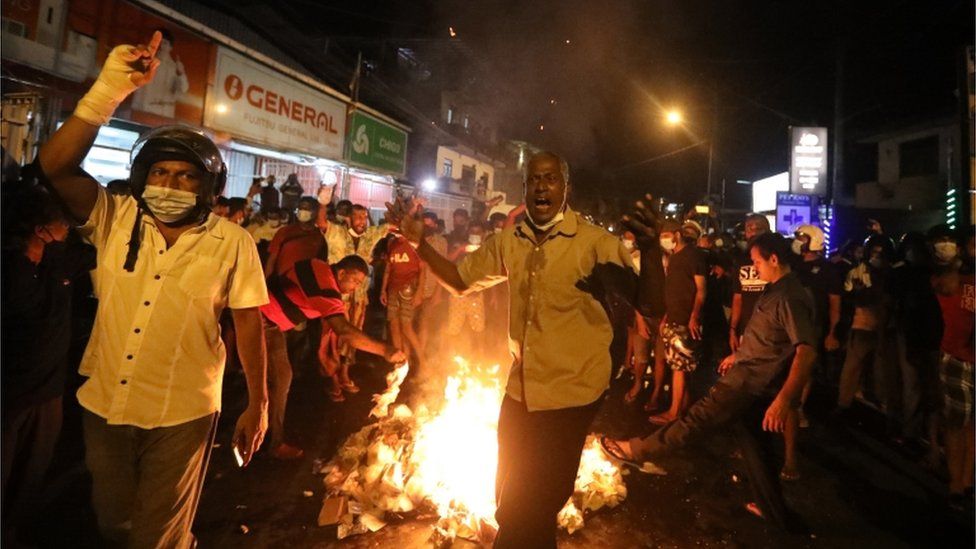
Agitated protesters stormed through barricades, and were accused of setting fire to a bus on Thursday night.

President Gotabhaya Rajapaksa blamed the events on “extremist elements”.

Sri Lanka is in the midst of a foreign exchange crisis that has crippled its economy.

Faced with 13-hour power cuts, a lack of fuel, essential food items and medicines, public anger has reached a new high.

The protest outside the President’s house began peacefully, but participants say things turned violent after police fired tear gas, water cannons and also beat people present.

Protesters retaliated against the police by pelting them with stones.

On Friday morning, police arrested 45 people although no charges have been made against them yet.

The demonstrations mark a massive turnaround in popularity for Mr Rajapaksa who swept into power with a majority win in 2019, promising stability and a “strong hand” to rule the country.

Critics have been pointing to rank corruption and nepotism – his brothers and nephews occupy several key ministerial portfolios – as one of the main reasons for the situation the country has found itself in.

Protesters chanted slogans and burned signs on the roads at Thursday’s demonstration

News reports that the president and his ministers are exempt from the power cuts, along with opulent displays of wealth by family members, have only increased anger.

The government has been blaming the crisis on the pandemic’s impact on tourism – one of the island nation’s main sources of foreign revenue – along with a series of attacks on churches on Easter Sunday 2019 which led to a marked drop in tourists.

But experts say that this crisis has been a long time in the making.

“This is an implosion, an accumulated outcome of what has been building up for a couple of decades and as usual there is no one to take responsibility for it. Of course, the present government is directly responsible for its wilful mismanagement of the crisis since they came into power in 2019 by sheer incompetency, arrogance and of course corruption,” Jayadeva Uyangoda, a political scientist and commentator, told the BBC.

Sri Lanka’s former deputy central bank governor WA Wijewardena told the BBC that Sri Lanka made a fundamental mistake in not integrating with the global economy after the end of a civil war in 2009 which saw its economy grow at rates of almost 9%.

“Exports which accounted for 33% of Gross Domestic Product (GDP) in 2000 have now fallen to 12% and remain at that level,” he said.


In the more immediate term, a government refusal to let the Sri Lankan rupee depreciate also took a massive toll on its foreign reserves.

Accordingly, foreign reserves which stood at $7.6bn (£5.8bn) at the end of 2019 have now fallen to a level of $2.3 bn; of those reserves, usable reserves have fallen to some $300mn.

Mr Wijewardena feels things will get a lot worse before they get better, as there is no sustainable flow of foreign exchange for the heavily import-reliant country.

Sri Lanka no longer has enough dollars to buy essential items like fuel to power vehicles or even generate power.

As a result, the country’s electricity board has been imposing power cuts that have grown longer and longer in duration. On Thursday, power was switched off for 13 hours, with 16-hour cuts expected in the coming days.

Protesters hurled rocks at police after they shot tear gas into the crowd

This has disrupted businesses, education and day to day life for millions.

Long lines have been reported outside fuel stations, while people have also had to queue up for hours in the heat to buy items like cooking gas cylinders with sometimes tragic results.

Five elderly people have died after collapsing in queues over the last few weeks.

Shortages in food items and essential medicines are also being reported from across the country.

The head of French military intelligence, Gen Eric Vidaud, is losing his job after failing to predict Russia’s war in Ukraine, reports say.

Seven months after he took on the role, one report said he was blamed for “inadequate briefings” and a “lack of mastery of subjects”.

The US correctly assessed that Russia was planning a large-scale invasion, while France concluded it was unlikely.

Gen Vidaud was blamed for that by France’s military chief, a source said.

However, the military source told AFP news agency that his job was to provide “military intelligence on operations, not on premeditation”. As Gen Vidaud’s service concluded that Russia had the means to invade Ukraine, the source said that “what happened proves him right”.

When contacted by the BBC, a military spokesman said French armed forces chief Gen Thierry Burkhard had no comment to make.

However, in early March Gen Burkhard acknowledged that French intelligence had not been up to the level of US or UK briefings, which were publicised to pile pressure on Russia’s Vladimir Putin. “The Americans said that the Russians were going to attack, they were right,” he told Le Monde newspaper.

“Our services thought instead that the cost of conquering Ukraine would have been monstrous and the Russians had other options” to bring down the government of Ukraine’s Volodymyr Zelensky, he added.

France’s misreading of President Putin was all the more embarrassing because President Emmanuel Macron had spoken to him regularly in the days leading up to the invasion on 24 February.

Intelligence specialist Prof Alexandre Papaemmanuel told AFP it was too easy to blame military intelligence for the failure, which lay with France’s entire intelligence community.

But Gen Vidaud, France’s former special forces commander, appears to have been squeezed out for other reasons too.

Weeks after he took charge of military intelligence, his service came in for criticism when Australia scrapped a multi-billion dollar submarine contract with France in favour of a security pact with the US and UK. The Aukus pact came out of the blue in France and prompted a diplomatic spat.

Russian troops occupying the former nuclear power plant at Chernobyl have left, the plant’s staff say.

According to Ukraine’s state nuclear company Energoatom, staff at the plant said there are currently no “outsiders” at the site.

Earlier, it said some Russian forces had set off towards the Belarusian border, leaving a small group behind.

The announcement appears to confirm reports by senior US defence officials on Wednesday of a withdrawal.

Russian troops seized Chernobyl at the beginning of their invasion of Ukraine on 24 February.

“This morning, the invaders announced their intentions to leave the Chernobyl nuclear power plant,” Energoatom said in a statement on Thursday.

The company later accused the Russian military of abducting members of the Ukrainian National Guard held captive since the start of the war. Energoatom sourced its information to workers at the plant and did not give numbers.

It also confirmed reports that Russian troops had dug trenches in the most contaminated part of the Chernobyl exclusion zone, receiving “significant doses” of radiation. There are unconfirmed reports that some are being treated in Belarus.

Reuters news agency quoted workers at the plant as saying some of the soldiers had no idea they were in a radiation zone.

The Russian military, however, said that after capturing the plant radiation levels at the plant itself had stayed within a normal range.

The International Atomic Energy Agency (IAEA) said in a statement that it was unable to confirm the reports.

The head of Ukraine’s agency in charge of the exclusion zone, Yevhen Kramarenko, said that radiation levels appeared to be normal and there was no indication of significant damage. However, as the sensors for detecting radiation levels were not working, staff needed to check the facilities, he added.

The head of the IAEA said it was in close consultations with Ukrainian authorities on sending a mission to the Chernobyl plant in the next few days.

While “Chernobyl” is a word that evokes apocalypse, nuclear experts stressed throughout this saga that there was no risk of “another Chernobyl”.

There is no working nuclear reactor on the site. As Prof Claire Corkhill from Sheffield University told me at the time, even if buildings containing contaminated material were pierced “we wouldn’t be talking about plumes of radioactive smoke”.

She was much more concerned when Russian forces attacked a building at the working Zaporizhzhia nuclear facility on 4 March. That incident caused the director general of the International Atomic Energy Agency (IAEA) to plan a trip to Ukraine – essentially to ask Russian forces to keep nuclear facilities out of the line of fire.

“What is a concern in Chernobyl now,” Prof Corkhill told me, “is that we haven’t had regular communication between the site and the IAEA, which basically keeps a [safety log] of where any potentially hazardous material is. We now need to go in and establish that none of that material is missing.”

Other scientists are concerned about the damage that may have been caused to a place that has become a wildlife refuge and a site of international research collaboration.

Prof Nick Beresford, who studies the exclusion zone’s landscape, says his Ukrainian colleagues now don’t know if they will have labs to return to. “The zone itself, over the last nearly 40 years, has become a site for wildlife,” he added.

“Lots of rare species moved in when people moved out. We just don’t know how this will have affected the wildlife.”

2px presentational grey line

In recent days Russia has said it will scale down its operations in northern Ukraine around the capital Kyiv and focus its forces on the eastern Donbas region. Chernobyl is located north of Kyiv.

But on Thursday Nato Secretary General Jens Stoltenberg said Moscow was repositioning rather than withdrawing in order to regroup, resupply and reinforce its offensive in Donbas.

“At the same time, Russia maintains pressure on Kyiv and other cities. So we can expect additional offensive actions, bringing even more suffering,” he said.

There was no change in Russia’s objective to pursue a military outcome, he added.

The occupation of the Chernobyl site since 24 February, the day of the invasion, has been dogged with concerns about power outages and problems for the staff, many of whom were trapped there for weeks and could not get home.

Although no longer a working power station, Chernobyl was never fully abandoned and still requires constant management.

It is the site of what is considered to be the world’s worst nuclear accident in 1986.

The Russian withdrawal follows an announcement several days ago by the mayor of Slavutych, a nearby town housing workers at the plant, that Russian troops had left the town.

ScotRail is back in public ownership for the first time in 25 years.

The train operator will now be run by a company owned by the Scottish government.

The previous operator, Abellio, had its franchise ended early amid criticism of the quality of the service.

The UK’s rail network was privatised in the 90s by John Major’s Conservative government. Before Abellio, ScotRail was run by National Express and First Group.


Passengers should not see any significant changes in services right away, but the Scottish government said it was a new beginning for the railways.

All ScotRail staff will transfer to the new Scottish government-owned entity, and the move has been welcomed by trade unions.

However, critics say Scotland’s railways have just seen the biggest fare rise in a decade – and that some services now run less frequently than before the pandemic.

‘Historic moment’

On Thursday, First Minister Nicola Sturgeon insisted bringing ScotRail into public ownership was a “historic moment”.

She said ScotRail services, which cover all rail services which start and end within Scotland, would continue as normal.

But she said the change in ownership “provides an opportunity to modernise” and would help to “deliver passenger services which are efficient, sustainable, safe, fit for the future”.

To help with that, she pledged staff and travellers would be able to take part in a “national conversation” which would “contribute to the future vision” for the service.

‘CalMac on wheels’

At First Minister’s Questions, Conservative transport spokesman Graham Simpson said issues with lifeline ferry services in Scotland showed that “the SNP is no good at running things”.

With ferry operator CalMac still waiting for two new vessels, which are years late and overbudget, he said rail passengers should be worried that ScotRail would “turn out to be CalMac on wheels”.

The SNP leader, however, insisted her party had already delivered significant improvements, citing several towns which have gained new rail links, with more to follow.

She went on: “Bringing ScotRail into publish ownership and control is an historic moment, and I am delighted it is happening under this government.”

Dutch firm Abellio has been running the franchise since 2015, but had its contract ended early amid criticism over cancellations and performance levels.

The arrangement was made under powers which allow the Scottish government to take over the rail franchise without a bidding process.

Scotland’s railways were temporarily nationalised in March 2020 to help the service cope with the impact of coronavirus.

Transport Minister Jenny Gilruth said Scotland’s railways should be in the hands of the people of Scotland.

She said it was an “exciting opportunity to deliver a better railway service that best meets the needs of our passengers”.

Kevin Lindsay, of the union Aslef, said it was a cause for celebration.

He said rail franchising was a “failed experiment”, adding: “The railway should be for the people, by the people.

“We now have an opportunity moving forward to deliver a railway which delivers for the whole of Scotland.”

There is a certain symmetry to ScotRail’s return to the public sector, on the 25th anniversary of the privatisation of the service.

The irony is not lost on unions and others who opposed the principle of rail privatisation.

The question is whether the return of ScotRail to the public sector will lead to eventual improvements to services.

Fundamental changes – for instance reopening or upgrading lines – are not the responsibility of the train operating company. These decisions are for the Scottish government and a separate company, Network Rail, which is responsible for the track.

For instance, the reopening of the Borders rail line – arguably the single most important change to services in 50 years – was driven principally by the Scottish government.

But some are hopeful that with all the main parties involved in running the railways now in the public sector, achieving change will be easier.

Some passengers though may have more immediate concerns.

Passenger numbers are still well below pre-pandemic levels which means there’s currently less concern about overcrowding.

But some may wonder, for instance, when there will be trains every 15 minutes between Glasgow and Edinburgh again or be hopeful that fare rises in the future will be lower.

Meanwhile, politicians may find themselves drawn into rows on pay or rostering which were previously the responsibility of a private company.

A man has died in a gas explosion which destroyed part of a house.

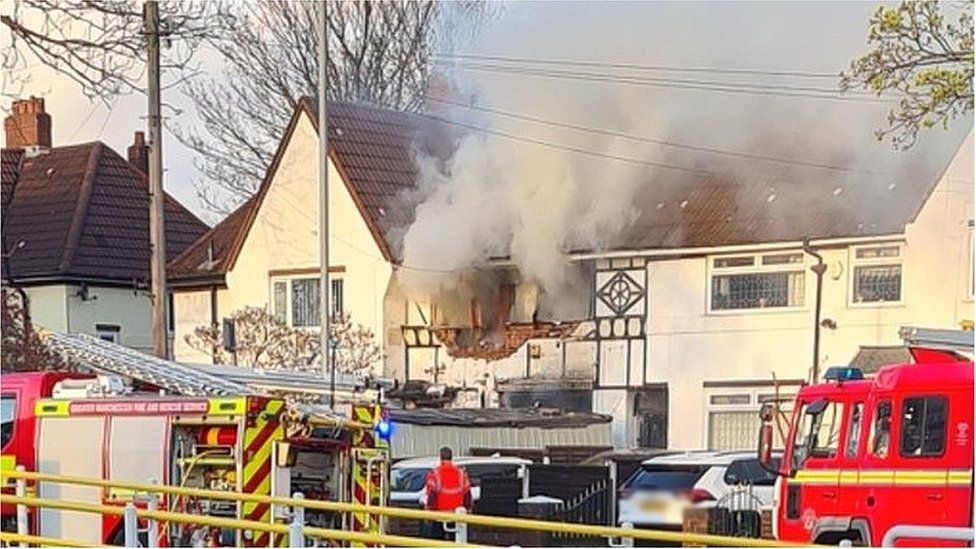
A “massive bang” was reported in Brownley Road, Wythenshawe, Manchester shortly after 18:30 BST on Thursday.

Plumes of smoke could be seen rising from the property, and nearby homes were evacuated while firefighters made the scene safe.

Greater Manchester Police (GMP) said investigations were ongoing into the circumstances that had led to the explosion.

It is understood that the victim was an elderly man who lived at the property.

GMP added that several properties were without power and road closures were in place while emergency services remained at the scene.

Greater Manchester Fire and Rescue Service said it was “saddened that someone has lost their life”.

Matt Muncaster, who lives nearby, said he was getting off a Metrolink tram at Crossacres when he heard the blast.

The windows were blown out, he said, followed by a “huge amount of smoke” billowing out of the house.

The 27-year-old said he “instinctively” ran over to the property alongside another man, and both attempted to kick down the front in case anyone was inside.

When they were unable to get inside they ran to the nearby Wythenshawe fire station to raise the alarm, he said.

As they approached an engine was on its way to the scene, he said.

Millions of people will now feel the impact of an unprecedented £700-a-year rise in energy costs – at the same time as a host of bill hikes take effect.

The 54% rise in the energy price cap means a household using a typical amount of gas and electricity will now pay £1,971 per year.

A further rise pushing the annual bill up to £2,600 should be expected in October, one analyst has told the BBC.

Council tax, water bills and car tax are also going up for some on 1 April.

Minimum wage rates are rising which, along with some financial support from the government, is partially softening the blow.


The £693 a year rise in a typical energy bill will affect 18 million households, with 4.5 million customers on prepayment meters facing an even bigger increase of £708 a year.

Among them is Winston Carrington, a grandfather in his 70s, who said he was growing vegetables in the garden of his Manchester home to help ease the impact of the rising cost of living.

“I’m going to grow, and I’m going to fill my freezer this year with my own produce. I’m going to have to,” said Mr Carrington, who uses a prepayment meter.

“I can’t go away this year again, not because of Covid or anything. I just can’t afford to go away. The state pension that we’re getting at the moment does not cover what I need.”

Prices in general are rising at their fastest rate for 30 years, but the sudden increase in the cost of energy is the most significant for individuals. A number of suppliers’ websites have struggled to cope as customers provided meter readings to ensure they paid no more than was absolutely required.

Dame Clare Moriarty, chief executive of Citizens Advice, said: “The energy price cap rise will be potentially ruinous for millions of people across the country. It comes just as another new, bleak record is set for people needing crisis support from us.”

The governor of the Bank of England, Andrew Bailey, said the country is facing the biggest single shock from energy prices since the 1970s. It is the largest increase, by far, in the energy regulator Ofgem’s price cap, since it was introduced.

The cap, set every six months for England. Wales and Scotland, is designed to protect domestic customers from the volatility of wholesale energy prices.

However, official forecasters and analysts have warned people to be braced for another huge rise in energy bills when the next cap takes effect in October. Wholesale prices have been affected by the war in Ukraine and ongoing pressure on suppliers.

This could add another £629 to a typical bill in October, according to the most up-to-date prediction, provided to the BBC from leading energy consultancy firm Cornwall Insight.

If this proved to be accurate, then the average bill next winter would be double that of the winter just gone. A typical bill is expected to fall back to the current level in summer 2023, although longer-term forecasts are tricky.

Bill Bullen, the boss of Utilita, warned that elderly people and children were at serious risk over the next winter because of a lack of heating.

“We are going to see an extra £500 or £600 added to bills in October, and frankly the chancellor’s going to have to fund that entirely for low-income households,” he told the BBC’s Today programme.

“He won’t be able to afford to take this problem away for everybody… but for customers who can’t respond to that price [increase], that’s where the help needs to be targeted.”

Chris O’Shea, chief executive of Centrica, which owns the UK’s largest supplier British Gas, said his businesses was supporting struggling customers and was giving grants to those most in need.

“We would love to do more. The reality is that for a retail energy company, the market has gone through quite a change, and profits have reduced quite substantially,” he told us

However, he accepted that profits had risen sharply for the heavily taxed exploration arm of the business.

Mysterious Bill Gates photo highlights Imran Khan’s army crisis

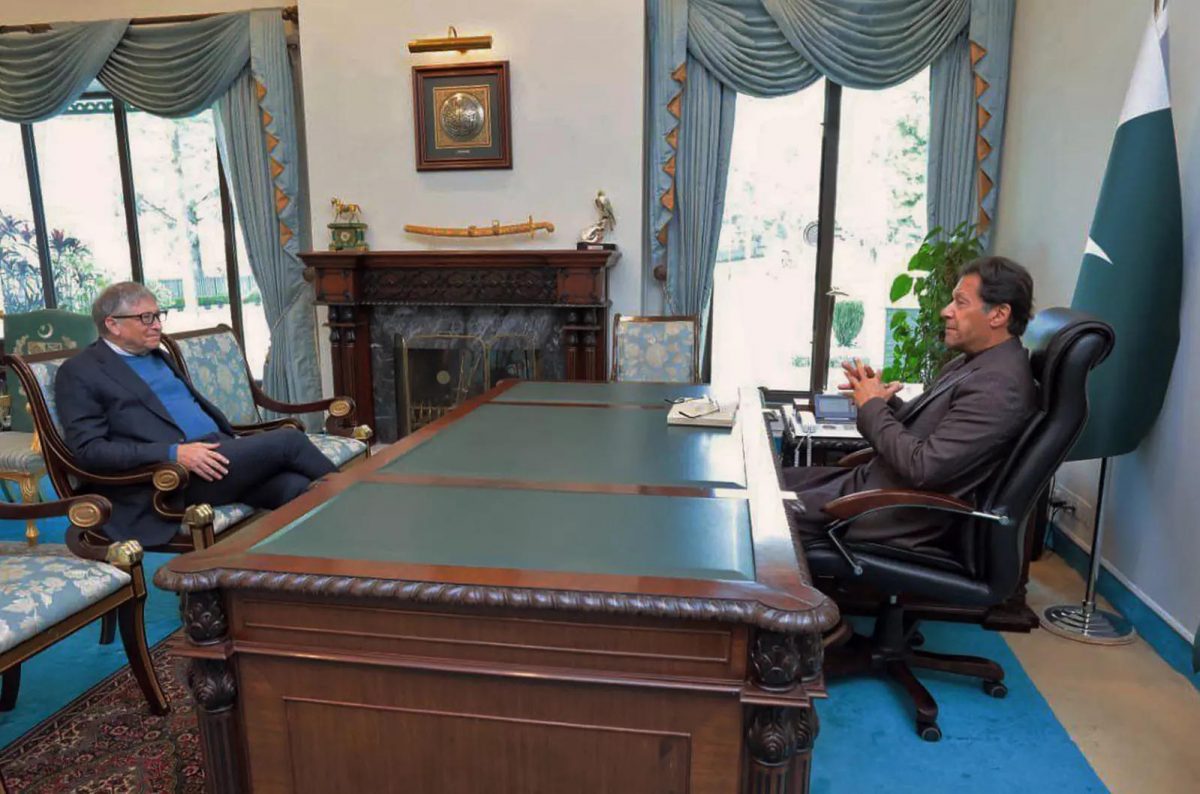
ISLAMABAD: When Pakistan Prime Minister Imran Khan released a photo of a luncheon with Bill Gates last month, social media users noticed something odd: The round table had 13 seats, but only a dozen men.
The vacant space contained a ghost-like figure who appeared to be conversing with others around him, raising questions about whether the image had been doctored. Shortly afterward, local news outlets reported that the country’s new spy chief, Lieutenant General Nadeem Anjum, had been erased out of the shot.
The drama began four months earlier, when army chief Qamar Javed Bajwa appointed Anjum to lead the Inter-Services Intelligence, or ISI, which oversees Pakistan’s internal security. Khan then delayed the appointment and publicly voiced support for General Faiz Hameed, widely seen as his ally, to stay in the role. After a standoff lasting several weeks, the army chief got his way.
Pakistan’s civilian leaders have long clashed with the military, which has ruled the country for about half of its history. Yet if anything, Khan has been criticized for being too close to the army since he promised to oversee a “New Pakistan” rid of corruption and favoritism following his 2018 election win.
His relationship with Hameed drew particular scrutiny. While the law says the premier appoints the ISI chief on the recommendation of the military, the opposition questioned Khan’s motives: Nawaz Sharif, a three-time prime minister, accused Hameed of orchestrating his ouster on corruption charges in 2017 and swinging the election a year later.
Khan’s own actions didn’t help. Besides seeking to keep Hameed at the ISI, the prime minister broke taboos by mentioning a private discussion with the army chief at a public rally, countering the military’s own claims that it doesn’t interfere in politics.
“Naming the army publicly on political forums is the biggest mistake this government has committed,” said Shaista Tabassum, former head of the international relations department at the University of Karachi. Khan and his ministers, she said, “have been publicly dragging the army into politics, saying things like the army is very much behind us or that we enjoy the support of the army chief.”
That served as the backdrop for last month’s luncheon with Gates, who was in Pakistan to promote a campaign to eradicate polio. Unlike his predecessor, Anjum ordered the media to avoid any pictures or videos of him — leading to the strange altered image of the luncheon with the Microsoft Corp founder.

Microsoft co-founder and billionaire philanthropist Bill Gates, left, listens to Pakistan’s Prime Minister Imran Khan during their meeting in Islamabad, Pakistan.

The unusual episode provides a glimpse into Khan’s behind-the-scenes tussle over military promotions that has underpinned a raft of troubles facing the 69-year-old former cricket star. A unified opposition is vying to oust him in a confidence vote in the next few days, as Asia’s second-fastest inflation jeopardizes his chances to become the first prime minister in Pakistan’s 75-year history to complete a full term in office.
Even if Khan stays on, his high-stakes showdown with top generals risks leading to months of instability that could determine whether the world’s fifth-most populous nation shifts even further toward China and Russia or leans back to the US and Europe.
The Gates photograph provided a vivid example of how the military was now acting “neutral” toward Khan, signaling to Pakistan’s political parties that he no longer had establishment support. Last year, the army’s tacit backing helped Khan survive a similar challenge when he was forced to test his majority in parliament.
In one example of how that works on the ground, intelligence officers would often call up certain politicians that criticized Khan on television talk shows and warn them to stay quiet. Now that’s no longer the case, according to a person familiar with the matter who asked not to be identified given the sensitivity of the issue.
Khan’s office and Pakistan’s Foreign Ministry didn’t reply to requests for comments. Pakistan security sources called allegations that the army or its affiliated institutions affected the outcome of the 2018 election “baseless and unfounded.” They reiterated that the army has “nothing to do with politics” and blasted claims to the contrary as “disinformation.” The Bill & Melinda Gates Foundation referred queries to Khan’s office.
For the military, referred to locally as “the establishment,” Khan once represented stability — especially as the economy recovered from a pandemic-induced contraction. Top generals had a say in every element of the premier’s administration, from foreign policy and security matters to economic decisions. Bajwa and other generals regularly held private meetings with top business people and policy makers.
But the relationship began to deteriorate, both over Khan’s involvement in military promotions and souring relations with the US Reports said Pakistan’s military, once a top recipient of American arms, has sought a more balanced foreign policy after becoming increasingly reliant on China for weapons.
Ties got off to a bad start just days after Joe Biden’s inauguration, when a Pakistan court ordered the release of four men who had earlier been convicted of decapitating Wall Street Journal bureau chief Daniel Pearl in 2002. The case drew outrage from the White House, where a decade earlier Biden sat next to Barack Obama watching Navy SEALs secretly enter Pakistan and kill Osama bin Laden.
Biden didn’t invite Khan to his climate summit last April and wouldn’t speak to him on the phone. Relations got worse as the Taliban took power in Afghanistan, with Khan saying the militant group had “broken the shackles of slavery.”
Biden appeared to offer an olive branch last year when he invited Khan to join his democracy summit in December. But the Pakistan leader snubbed the request in a move welcomed by China, which has funded projects in the nation valued at more than $25 billion. Khan has since boosted ties with Russia, holding the first top-level meeting in more than two decades with Vladimir Putin just hours after the Russian leader invaded Ukraine.
Shehbaz Sharif, who leads the main opposition party and is poised to take power if Khan is ousted, has vowed to improve ties with the US and European Union if he wins. He has said the army has been staying neutral ahead of the confidence vote, a notable claim given his older brother was ousted in a 1999 coup. Nawaz Sharif is currently self-exiled in London after being convicted in a corruption case he calls politically motivated.
The 342-member National Assembly will start a debate on the opposition’s no-confidence motion on Thursday, with a vote expected over the weekend. This week Khan lost his slim majority in the chamber after two coalition allies withdrew support for his government.
Ahead of the vote, Khan has vowed to stay on. He rallied thousands of supporters in Islamabad last Sunday and claimed “foreign forces” were out to remove him.
Still, a Gallup poll last month showed Khan’s approval rating has dropped to 36% from 40% in 2018, while Nawaz Sharif’s had more than doubled to 55% in that time. In December, Khan lost a local election in a stronghold it had ruled for eight years, while lawmakers from his party have sought to leave ahead of the vote.
A big reason is the economy. Khan has grappled with some of Asia’s fastest price increases for a few years now while managing a $6 billion program with the International Monetary Fund that calls for tax increases set to further boost the cost of living. Khan this month unexpectedly cut fuel and electricity prices to pacify public anger, disregarding the IMF agreement.
A win for Khan would help him silence critics who say he can only win with the support of the army. A loss, on the other hand, could help him deflect blame for the economic slowdown ahead of national elections that must be held by August 2023.
“Nobody will be going to say in future he is selected or he came to power with their support,” Zafar Nawaz Jaspal, a professor at the Quaid-i-Azam University in Islamabad. “This would in a way become political mileage for Khan in the next elections.”
Even so, there’s one more big question mark if Khan stays as prime minister: Will he allow Bajwa, the general he sparred with, to extend his time as army chief when his term expires in November? Reports indicate Khan wants to instead install Hameed, the former ISI chief, as a powerful friend.
Such a move “will trigger a new controversy in Pakistani politics and within the military,” said Hasan Askari Rizvi, a Lahore-based analyst who has written several books on the nation’s army. Even so, he said, Khan only has himself to blame for his current troubles with the military.
“Khan can’t maintain human relations — he creates unnecessary rifts,” Rizvi said. “The military is at distance and will maintain it.”