
Pakistan, China, Afghanistan vow action against terrorist outfits including TTP

Pakistan, China and Afghanistan have resolved that no terrorist organisation, group or individual will be allowed to use their territories to threaten the security and interests of the region.

Pakistan, China and Afghanistan have resolved that no terrorist organisation, group or individual will be allowed to use their territories to threaten the security and interests of the region.

The pledge came after Foreign Minister Bilawal Bhutto-Zardari, Chinese Foreign Minister Qin Gang and Afghan Acting Foreign Minister Mawlawi Amir Khan Muttaqi held the 5th China-Afghanistan-Pakistan Foreign Ministers’ Dialogue in Islamabad on May 6, 2023, the Foreign Office said in a statement on Monday.

The three sides stressed the need of not allowing any individual, group or party, including the Tehreek-e-Taliban Pakistan (TTP), the Eastern Turkistan Islamic Movement (ETIM) etc, to use their territories to harm and threaten regional security and interests, or conduct terrorist actions and activities, it added.

The communique also said all three sides underscored the need to refrain from intervening in internal affairs of Afghanistan, and to promote Afghan peace, stability and reconstruction.

“Stressing that a peaceful, stable and prosperous Afghanistan serves the common interest of the region, the Foreign Ministers underscored the critical importance of trilateral cooperation in promoting this objective. The three sides resolved to further deepen and expand their cooperation in the security, development and political domains based on the principles of mutual respect, equal-footed consultation and mutual benefit,” read the FO statement.

They also underscored the need to tackle security challenges posing a serious threat to regional and global security, and directly impacting the stability and economic prosperity of the entire region.

“The three sides agreed to coordinate and cooperate on security, organised crimes, drugs smuggling etc. and called on the international community to strengthen bilateral and multilateral cooperation, and provide necessary supplies, equipment and technical assistance in this regard to the relevant countries.”

‘CPEC to be extended to Afghanistan’

Underscoring the imperative to generate economic activity within Afghanistan, the ministers stressed the importance of exploring realistic pathways towards the revival of the Afghan economy. To this end, they agreed to consider further supporting the reconstruction of Afghanistan and exploring trilateral investment possibilities aimed at industrialisation and job creation.

Expressing solidarity with the people of Afghanistan, the three sides stressed the importance of sustained and urgent humanitarian support to the people of Afghanistan including the imperative to bridge funding gaps for humanitarian operations and underlined that humanitarian support to the people of Afghanistan must remain delinked from any political considerations.

The three sides reaffirmed their resolve to fully harness Afghanistan’s potential as a hub for regional connectivity. “Reaffirming their commitment to further the trilateral cooperation under the Belt and Road Initiative (BRI), and to jointly extend the China-Pakistan Economic Corridor to Afghanistan.”

The FO the three sides stressed that the importance of existing projects including CASA-1000, TAPI, Trans-Afghan Railways etc. would enhance regional connectivity as well as ensure economic uplift and prosperity for the peoples of this region.

“Hard and soft connectivity”

The foreign office further said the three top diplomats emphasised pushing forward the “hard connectivity” in infrastructure and “soft connectivity” in norms and standards, further exploring the facilitating measures for the movement of people and trade activities between the three countries. The three sides agreed to enhance transit trade through Gwadar Port.

Expressing satisfaction at the existing trilateral cooperation, the three sides agreed to carry out exchange and training programs and to strengthen people-to-people exchanges by conducting the trilateral programs in line with the List of China-Afghanistan-Pakistan Trilateral Practical Cooperation Projects, adopted by Foreign Ministers in this dialogue.

The three sides reaffirmed continued cooperation in areas of mutual interest like economic development, capacity building, and improving livelihoods. The ministers agreed to strengthen cooperation in the fields such as agriculture, trade, energy, capacity building, border management etc.

World community urged to engage with Afghanistan

The foreign ministers called upon the international community to engage constructively with the Afghan side. In this regard, they acknowledged the efforts made under the aegis of various mechanisms and formats, including in particular, the Neighbouring Countries of Afghanistan, to promote dialogue and constructive engagement with the Interim Afghan Government. The three sides also urged the international community to assist Afghanistan in countering narcotics effectively and develop alternative crops to enhance its capacity for independent and sustainable development.

The three sides urged the relevant countries to lift their unilateral sanctions against Afghanistan and return the assets overseas for the benefit of the Afghan people, and create opportunities for economic development and prosperity in Afghanistan.

Taking note of the Afghan interim government’s repeated assurances to respect and protect women’s rights and interests, the three sides called on the international community to support the reconstruction and development of Afghanistan, and help Afghanistan to improve governance and strengthen the capacity building, so as to effectively protect the basic rights and interests of all segments of the Afghan society, including women and children.

The ministers expressed appreciation to the neighbouring countries, in particular, Pakistan, for the generous hospitality in hosting millions of Afghan refugees, and called on the international community to provide necessary support and assistance to these countries and Afghanistan for the dignified return and reintegration of refugees into the Afghan society.

The three sides resolved to continue with the trilateral cooperation mechanism, including the Director-General Level Practical Cooperation Dialogue, and forge closer-good neighbourly relations and partnerships.

China and Afghanistan thanked Pakistan for the successful organisation of the 5th China-Afghanistan-Pakistan Foreign Ministers’ Dialogue and its warm hospitality.

Army assails Imran Khan over ‘malicious allegations against senior military officer’

RAWALPINDI: The army came down hard on Pakistan Tehreek-e-Insaf (PTI) Chairman Imran Khan Monday for his “irresponsible and baseless allegations” against a senior military officer, who is currently serving in the armed forces.

“[The] chairman PTI has levelled highly irresponsible and baseless allegations against a serving senior military officer without any evidence,” Inter-Services Public Relations (ISPR) Director-General Major General Ahmed Sharif Chaudhry said in a statement, as Khan continues his tirade against the establishment.


The PTI chief has claimed that the senior military officer, Prime Minister Shehbaz Sharif, and Interior Minister Rana Sanaullah were behind the assassination attempt on him on November 3, 2022, but provided no evidence to authorities so far, while all the people accused have rejected the allegations.

“These fabricated and malicious allegations are extremely unfortunate, deplorable and unacceptable,” the top military spokesperson said.

Senior analyst Shahzeb Khanzada said although what happened with the deposed prime minister in November was a tragedy, his track record forces one to believe that he might be targeting people to bolster his political support, with anchorperson Muneeb Farooq backing his analysis.

Khan has also blamed former army chief General (retd) Qamar Javed Bajwa for his government’s ouster in April last year, but has still not been able to prove it.

The army’s spokesperson, in the statement, also said that a pattern has been witnessed over the last year, wherein, the army personnel are targetted for one’s political motives.

“This has been a consistent pattern for [the] last one year wherein military and intelligence agencies officials are targeted with insinuations and sensational propaganda for the furtherance of political objectives.”

The ISPR DG added that politicos should refrain from making baseless allegations and warned that if such a trend were to continue, the army had the right to take legal action.

“We ask the political leader concerned to make recourse to legal avenues and stop making false allegations. The institution reserves the right to take legal course of action against patently false and malafide statements and propaganda.”

Earlier, in response to Khan’s allegations right a day after he was shot, the army had said that his “baseless and irresponsible allegations” against the institution and particularly a senior army officer are “absolutely unacceptable and uncalled for”.

‘Are military officers above the law?’

Before the army’s statement, Prime Minister Shehbaz Sharif had condemned the PTI chief’s tirade against the senior military officer. At this, Khan slammed the premier, asking whether “[military] officers were above the law?”

“As someone who has suffered 2 assassination attempts on his life in last few months, can I dare to ask SS the following Qs: Have I, a citizen, the right to nominate those I feel were responsible for assassination attacks on me? Why was I denied my legal & Constitutional right to register an FIR?”

“Does SS tweet mean mly officers are above the law or that they cannot commit a crime?” he wondered. The PTI chief further asked that if a person is being blamed for a crime, how can it be perceived that an entire institution is being maligned?

“Who was so powerful as to sabotage Wazirabad JIT while PTI govt was in power in Punjab?”

Khan, without naming anyone, said that when PM Shehbaz can truthfully answer all his questions, it would point to one powerful man and his accomplices “all being above the law”.

“Then it is time for us to officially declare that in Pakistan there is only law of the jungle where Might is Right.”

US voices opposition to Syria’s readmission to Arab League

The United States has voiced opposition to the Arab League’s readmission of Syria to its fold, as a statement released by White House said that it would not normalise ties with the regime of Bashar al-Assad, a foreign news agency reported.

The international forum readmitted Syria after over a decade of suspension, consolidating a regional push to normalise its strained relations ties with Assad, in a move highly criticised by Washington.

“We continue to believe that we will not normalise our relations with the Assad regime and we don’t support our allies and partners doing so either,” State Department spokesman Vedant Patel told the reporters.

He said that the Syrian president didn’t deserve the normalisation of ties after a waging a brutal war.

“We do not believe that Syria merits readmission to the Arab League at this time.”

Reaffirming its stance on Assad-led Syria, Washington announced that the US sanctions on the middle eastern nation remain in full effect.

The United States has consistently withstood reconciliation with Syria but the Arab League voted on Sunday to welcome back Syria, effectively concluding that Assad had won the war that has killed half a million people and displaced half the pre-war population since 2011.

The league had closed its doors to Damascus in 2011 for brutally crushing the peaceful protests that erupted earlier that year and escalated into a full-scale military conflict that has so far claimed the lives of 500,000 people, uprooted millions and left the country’s industry and infrastructure in shambles.

The decision, which means Syria can resume its participation in Arab League meetings immediately, also calls for a resolution of the crisis resulting from the country’s civil war, including the flight of refugees to neighbouring countries and drug smuggling across the region.

Russia to ‘develop’ its military facilities in Kyrgyzstan

“The heads of state emphasised the importance of strengthening the Kyrgyz Republic’s armed forces and developing Russian military facilities on its territory,” the Kremlin said in a statement.

Kyrgyzstan, a majority-Muslim country of nearly seven million people, hosts a Russian military base made up of an airfield, a naval installation on Lake Issyk-Kul and several other sites.

President Sadyr Japarov met Russian leader Vladimir Putin in Moscow on Monday, on the eve of Victory Day, a Soviet war anniversary to be marked by an army parade through Red Square.

Japarov will be one of several foreign leaders to attend the parade this year.

Russia and Kyrgyzstan, an ex-Soviet republic, are linked through a Moscow-led military alliance, the Collective Security Treaty Organisation (CSTO).

According to the statement released by the Kremlin, the two countries also expect to “deepen military and technical cooperation” as well as their economic and cultural relations in order to “reach a new level of integration”.

At least 12 Palestinians, including three commanders of the militant group Islamic Jihad, have been killed in Israeli air strikes on the Gaza Strip.

Palestinian health officials said three women and three children were among the dead. Another 20 people were injured.

Israel said it had launched an operation targeting militants who posed an imminent threat to its citizens.

Islamic Jihad has vowed revenge and Gaza-based militants are expected to respond with rocket fire into Israel.

Correspondents say one significant factor will be the extent to which Hamas, which controls the Strip, joins in.

Israel officials are said to be preparing for days of fighting.

Forty Israeli warplanes and helicopters attacked in several waves of pre-dawn air strikes across Gaza, hitting homes and causing panic among residents.

Pictures showed at least two apartments with their fronts ripped away and others damaged.

The Israeli military said that in addition to targeting the three militants its aircraft struck 10 sites used to manufacture weapons and six Islamic Jihad military facilities.

Islamic Jihad’s military wing, the al-Quds Brigades, confirmed that three commanders were among those killed.

It identified them as Jihad Shaker al-Ghannam, secretary of the al-Quds Brigades’ Military Council; Khalil Salah al-Bahtini, the commander of its Northern Region, and Tariq Muhammad Ezzedine, a leader of its military activities in the occupied West Bank.

“As we mourn our martyr leaders, along with their mujahideen wives and a number of their children, we affirm that the blood of the martyrs will increase our resolve,” the al-Quds Brigades said.

“We will not leave our positions, and the resistance will continue, God willing.”

Israel’s Defence Minister, Yoav Gallant, said: “Any terrorist who harms Israeli citizens will be made to regret it.”

Islamic Jihad was behind recent rounds of rocket fire into Israel, some of which was sparked by the death in an Israeli prison of a Palestinian hunger striker.

Tens of thousands of Serbs have joined protests against gun violence in the capital Belgrade and another city after two mass shootings last week.

Seventeen people died in the shootings on Wednesday and Thursday, including eight children in a primary school.

The protesters are demanding that top government officials resign, and want newspapers and TV stations that they say promote violence to be shut down.

Serbia’s President, Aleksandar Vucic, condemned the protests.

He accused the opposition of capitalising on a national tragedy to promote their own interests. He said he was ready to test his party’s popularity at a snap vote.

“I will continue to work and I will never back down before the street and the mob… Whether it will be a reshuffle of the government or an election, we shall see,” he said on TV.

The next parliamentary elections are set to take place in 2026.

Police were stationed near all of Belgrade’s schools as they restarted classes on Monday. The government is planning to recruit more officers to be stationed at schools.

Crowds marched through the centre of the city behind a banner that read “Serbia against violence”.

“We are here because we can’t wait any longer. We’ve waited too long, we’ve been silent too long, we’ve turned our heads too long,” Marina Vidojevic, a schoolteacher, told the crowd, as quoted by AFP news agency.

“We want safe schools, streets, villages and cities for all children.”

Thousands also turned out across the northern city of Novi Sad, where protests threw flowers into the Danube river which flows to the capital.

The protesters called for the resignation of the interior minister and the head of Serbia’s intelligence agency.

Serbia’s Education Minister, Branko Ruzic, stepped down on Sunday, citing the “cataclysmic tragedy” of the recent school massacre in his resignation letter.

In Novi Sad, protesters threw flowers into the Danube river

Serbia has the highest rates of gun ownership in Europe. A 2018 survey suggests there are 39 guns for every hundred people in Serbia – the vast majority unlicensed.

Mr Vucic has started a one-month amnesty for surrendering illegal weapons, with people able to drop of their guns to police with no questions asked.

The amnesty will last 30 days.

On the first day of the amnesty around 1,500 guns were surrendered, according to Serbian police.

Labour leader Sir Keir Starmer will tell his senior shadow ministers there is “more work to be done” after last week’s strong local election results.

He will say the “hardest part lies ahead” and Labour must show it can form a “big reforming government”.

Labour gained more than 500 councillors in last week’s elections, while the Conservatives lost more than 1,000.

Prime Minister Rishi Sunak will also meet with his Cabinet on Tuesday for the first time since the results.

Sir Keir is due to meet with leaders of all 22 councils which were won by Labour.

They have been tasked with drawing up “emergency cost of living plans” within their first 100 days, as well as reviewing local housing and development policies.

Labour took control of councils in some areas which voted heavily for Brexit, such as Dover and Stoke on Trent, and Sir Keir will tell the shadow cabinet that “people who turned away from us during the Corbyn years and the Brexit years are coming back”.

“But there is understandably a lot of scepticism about politics out there and now we need to go from reassurance to hope,” he will say.

“We need to show that we will be a big reforming government bringing hope of a better life for working people.”


He will say that Labour will put a “plan to rebuild the NHS at the heart of our offer to the British people”, with further announcements on the party’s plans expected in the coming weeks.

The Shadow Levelling Up Secretary Lisa Nandy also confirmed reports in the Financial Times that the party was considering raising stamp duty for overseas buyers and stopping them from buying more than 50% of any new development.

Mr Sunak has described the loss of more than 1,000 councillors as “disappointing” but insisted he would “strain every sinew” to fulfil his pledges on the economy, NHS waiting lists and small boats.

He has responded to his party’s losses by doubling down on his five key pledges on the economy, NHS waiting lists and small boats.

Asked if he would apologise to councillors who had lost their seats, Mr Sunak said it was “always disappointing to lose hardworking councillors” but said his job was “to deliver for the country”

“We want to halve inflation, grow the economy, reduce the debt, cut waiting lists and stop the boats,” he added.

“Those are the country’s priorities and me and the government are going to keep working incredibly hard to deliver on those.”

With Coronation celebrations over, the PM – pictured here with US first lady Jill Biden – is set to meet his Cabinet

Some Conservative MPs have privately suggested Mr Sunak is likely to need to go beyond reiterating his promise to deliver those pledges in order to improve the Conservatives’ position before a general election.

The Liberal Democrat leader Sir Ed Davey, whose party gained more than 400 seats, said he would table a vote of no confidence in the government when Parliament returns later

Sir Ed said: “The local elections showed that the public clearly has no confidence in Sunak or the Conservatives, so it’s time for a general election now.

“There’s only one reason Rishi Sunak would deny British people a say at the ballot box: because he is running scared and knows he’d lose.”

The Liberal Democrats are not able to force a debate on the motion though so it is likely to end up being largely symbolic.

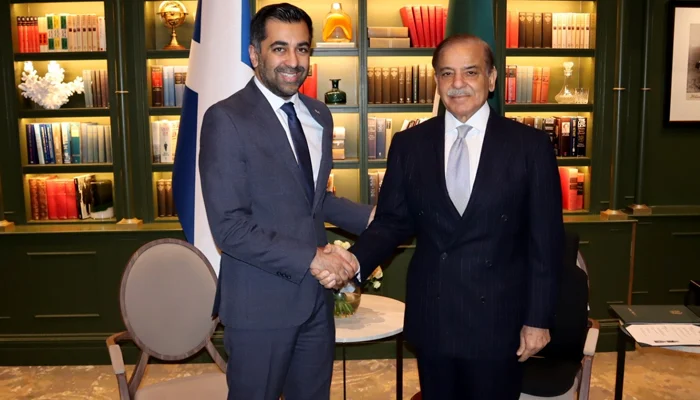
‘Will definitely visit Pakistan’, Scotland’s first minister tells PM Shehbaz in London meeting

LONDON: Humza Yousaf, Pakistan-origin first minister of Scotland, has said that he will “definitely” undertake a visit to Pakistan after he held a meeting with Prime Minister Shehbaz Sharif in London.

“Very positive. I am grateful to Prime Minister Shehbaz Sharif,” he said while responding to a question about his interaction with the premier.

The premier arrived in United Kingdom’s capital London on Wednesday for representing Pakistan at the coronation ceremony of King Charles III.


According to Foreign Office, PM Shehbaz was also scheduled to meet Humza Yousaf, who was recently elected by the Scottish Parliament to head the devolved Scottish government, is the first Muslim and first British Pakistani to do so.

“I am proud of being the first Scottish Pakistani to become the first minister of Scotland,” he remarked in his interaction with Pakistani reporters on Sunday.

The first minister also said he discussed ways to enhance cooperation between Pakistan and Scotland in various areas including trade, investment education and climate change.

“Pakistan and Scotland have a long history and long tradition. I will definitely be there [Pakistan]. His excellency prime minister extended a personal invitation to me to come to Pakistan,” he added.

Scotland’s first minister added that he promised PM Shehbaz that “I will come but we have not nailed down a date yet”.

Speaking to the media in London after meeting with the first minister of Scotland, PM Shehbaz said that an investment conference will be convened to enhance cooperation between the two nations in diverse fields, including trade, investment, education, water management, wind, and solar technology.

The PM said he held a productive conversation with Hamza Yousaf, who is a “young and energetic person”.

He said they have agreed to enhance cooperation between Pakistan and Scotland, which is a constituent component of the United Kingdom.

Around 80,000 Pakistani diasporas are significantly contributing to the development and progress of Scotland, the premier added.

The Scottish leader said strengthening ties with Pakistan is not only the duty of his government but he also considered it a personal commitment.

He said there had been a 150 per cent increase in the number of students coming to Scotland. “We want to see an increase in this further.”

Responding to a question related to the ongoing political crisis in Pakistan, the first minister said he did not discuss the political issues of Pakistan with PM Shehbaz and only matters related to government-to-government came under discussion.

Responding to Pakistanis’ messages of felicitations on his election as the First Minister of Scotland, he said: “I would like to thank all of them [as] I got messages from my father’s hometown in Mian Chinnu and my mother’s home city in Faisalabad and across the country

“It really warmed my heart because I see myself as Scottish and Pakistani too [and] I can’t wait to come to Pakistan as the first minister,” he added.

Yousaf also said that he never shied away from the fact that he is both British and Pakistani.

Moreover, the first minister said he is proud of his Muslim faith.

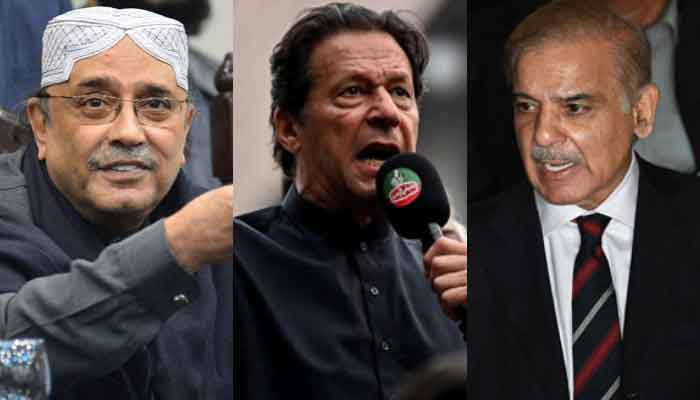
PM Shehbaz, Asif Zardari slam Imran Khan for levelling allegations against army

ISLAMABAD/LAHORE: Prime Minister Shehbaz Sharif, Pakistan Peoples Party (PPP) co-chairperson Asif Ali Zardari and Punjab caretaker Chief Minister Mohsin Naqvi have slammed Pakistan Tehreek-e-Insaf Chairman Imran Khan’s serious allegations against the army.

Berating the PTI chief, the PM said that Imran Niazi’s act of routinely maligning and threatening the Pakistan Army and an intelligence agency for the sake of petty political gains is highly condemnable.

“His levelling of allegations without any proof against Gen Faisal Naseer and officers of our Intelligence Agency cannot be allowed and will not be tolerated.”

On the other hand, former president Asif Ali Zardari said the PTI chief has crossed all limits to defame institutions, which will not be tolerated anymore.

“The attempt to discredit institutions has exposed the true face of the man and now enough is enough, after listening to the foreign agent’s speech, no patriot can even think of following him,” said Zardari in a statement without naming the PTI chief.

Zardari said the allegations against the brave and distinguished officers of the Pakistan Army was an attack on the institution with which the whole of Pakistan stands.

“A person is fooling his innocent workers with lies and deceit, I am seeing the downfall of this person,” he said. The former president said this is the country where we all have to be buried, we will not allow one person to play with our values and our country.

“A person is bent on destroying our ancestors, our children and our country, which we will not allow,” said Zardari.

Meanwhile, Punjab Caretaker CM asserted that the interim government will not allow anyone to humiliate or threaten institutions and intelligence agencies in the province.

Taking to Twitter, the Punjab CM said: “We will not allow anyone to humiliate or threaten our institutions and intelligence agencies in Punjab. It is our foremost responsibility as responsible Pakistani citizens to condemn these elements who are actually benefiting enemies of Pakistan.”

CM Naqvi assured that the provincial government will implement the law and that culprits will be held accountable.

Reacting to the PM’s tweet, PTI leader Asad Umar questioned the premier why he was quite when his brother, Nawaz Sharif, attacked the then army chief and director general Inter Services Intelligence.

“Did you utter a single word when your brother and niece were attacking the then Army chief and DGI by name in jalsas and blaming them for destroying Pakistan? Don’t try to hide behind the army to attack Imran Khan because you cannot compete with him politically,” said Umar.

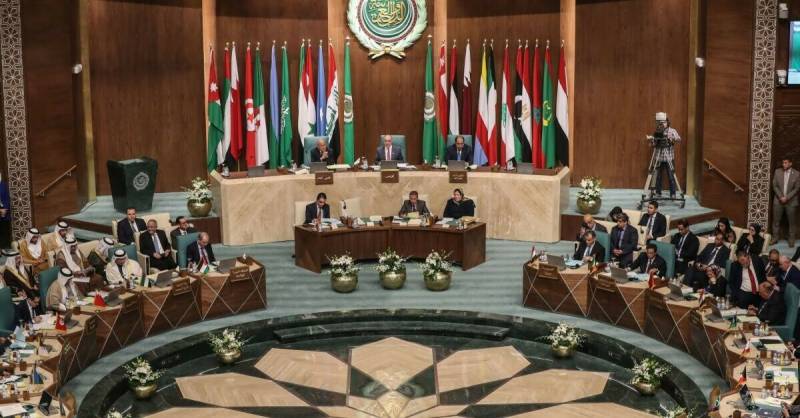
Arab League re-admits Syria after 11-year absence

The Arab League on Sunday welcomed back Syria’s government, ending a more than decade-long suspension and securing President Bashar al-Assad’s return to the Arab fold after years of isolation.

In November 2011, the body suspended Damascus over its crackdown on peaceful protests which began earlier that year and which spiralled into a conflict that has killed more than 500,000 people, displaced millions and battered the country’s infrastructure and industry.

While the front lines have mostly quietened, large parts of the country’s north remain outside government control, and no political solution has yet been reached to the 12-year-old conflict.

“Government delegations from the Syrian Arab Republic will resume their participation in Arab League meetings” starting Sunday, said a unanimous decision by the group’s foreign ministers.

Assad has been politically isolated since the war began, but recent weeks have seen a flurry of diplomatic activity ahead of an Arab League summit in Saudi Arabia on May 19.

The ministers in a statement emphasised their “keenness to launch a leading Arab role in efforts to resolve” the Syria crisis.

They agreed to form a ministerial committee to continue “direct dialogue with the Syrian government in order to reach a comprehensive solution”.

Ahmed Aboul Gheit, head of the 22-member Arab League, said the decision “brings the Arab side into communication with the Syrian government for the first time in years, in order to look into all aspects of the problem”.

Syria’s return to the body is “the beginning… not the end of the issue”, he added, noting it was up to individual countries to decide whether to resume ties with Damascus.

– ‘Diplomatic victory’ –

Following the announcement, Syria’s foreign ministry stressed the importance of “Arab cooperation”, in a statement carried by state news agency SANA.

“The next stage requires an effective and constructive Arab approach… based on dialogue, mutual respect and common Arab interests”, it added.

Several Arab countries cut ties with Syria early in the conflict, betting on Assad’s demise, while some including Qatar and Saudi Arabia provided support to the Syrian opposition.

The last Arab League summit Assad attended was in 2010, while the opposition attended the pan-Arab group’s summit in Doha in 2013, sparking a furious reaction from Damascus.

Aboul Gheit told a press conference Assad was welcome to attend the summit later this month once invited by host Saudi Arabia.

Regional capitals have gradually been warming to Assad as he has stubbornly held onto power and clawed back territory lost earlier in the conflict with crucial support from Iran and Russia.

The United Arab Emirates, which re-established ties in late 2018, has been leading the recent charge to reintegrate Damascus into the Arab fold.

A February 6 earthquake that wreaked devastation in Turkey and Syria sparked Arab outreach to Assad’s government, while intensified regional diplomatic activity has been underway since a March decision by rivals Saudi Arabia and Iran to resume ties in a China-brokered agreement.

“Syria’s regional isolation is officially broken,” analyst Fabrice Balanche said, calling Sunday’s decision a “diplomatic victory” for Assad.

“The earthquake is the best opportunity to get closer without losing face,” he told AFP, adding that “Saudi Arabia’s concern for Syria is part of the context of reconciliation with Iran.”

– ‘Pushed out of our homes’ –

In April, Saudi Foreign Minister Prince Faisal bin Farhan made the first visit to Damascus by a official from the kingdom since the start of the war, days after Syrian Foreign Minister Faisal Mekdad visited Saudi Arabia, also on the first such trip.

Mekdad has visited a string of Arab countries in recent weeks in a diplomatic push.

On Monday, he attended talks in Amman with foreign ministers from Jordan, Saudi Arabia, Iraq and Egypt to discuss the long-running conflict.

Nine Arab countries including Gulf states met in Saudi Arabia last month to discuss ending Syria’s possible return to the Arab League.

Assad is hoping normalisation with wealthy Gulf nations could bring economic relief and money for reconstruction, while analysts say sanctions will likely continue to deter investment.

But with foreign forces including from Turkey and the United States still present on Syrian territory, the war is far from over and Assad remains internationally isolated.

In northwest Syria’s rebel-held Idlib region, displaced Syrians expressed frustration at the Arab League’s decision.

“We were pushed out of our homes,” said Ghassan Yussef, 54.