
The US has announced measures against Kosovo for ignoring its advice to avoid raising tensions in majority-Serb northern areas.

It has criticised Kosovo’s decision to install ethnic Albanian mayors in northern Kosovo “by forcible means”.

Kosovo has been expelled from participating in an ongoing American-led military exercise in Europe.

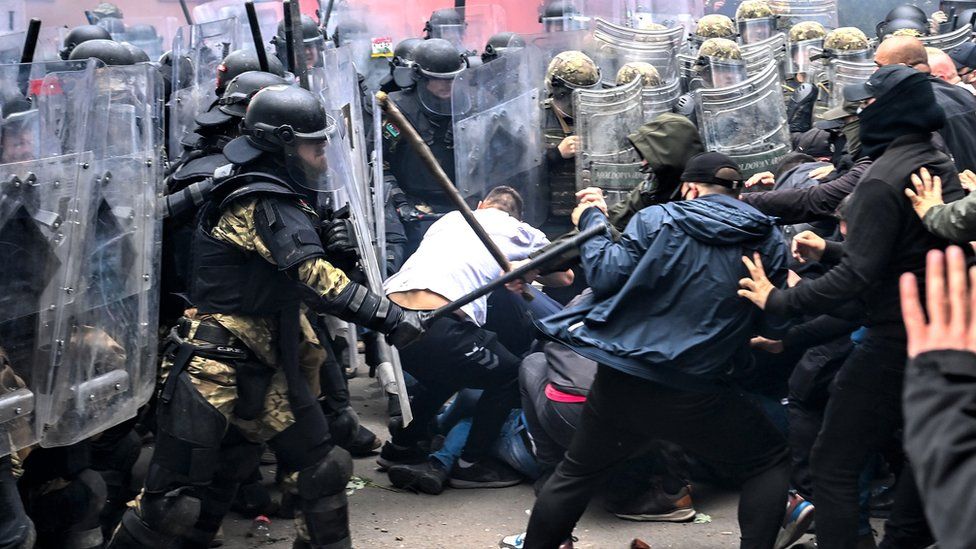
Police and Nato troops clashed with Serb protesters in Zvecan, north Kosovo, on Monday.

Protesters had tried to invade a government building amid unrest over the installation of ethnic Albanian mayors in areas where Serbs make up the majority of the population.

Nato is to deploy an additional 700 troops to Kosovo after saying 30 of its peacekeepers and 52 protesters were hurt in the clashes in Zvecan.

The crisis dates back to April, when ethnic Serbs boycotted local elections in north Kosovo – allowing ethnic Albanians to take control of local councils with a turnout of less than 4%.

Like the US, the European Union has accused the Kosovan authorities of destabilising the situation in north Kosovo, and warned against any actions that could inflame ethnic tensions there.

Kosovo declared independence from Serbia in February 2008, after years of strained relations between its Serb and mainly Albanian inhabitants.

It has been recognised by the US and major EU countries. But Serbia, backed by its powerful ally Russia, refuses to do so – as do most ethnic Serbs inside Kosovo.

While ethnic Albanians make up more than 90% of the population in Kosovo as a whole, Serbs form the majority of the population in the northern region.


The American ambassador in Pristina, Jeffrey Hovenier, said that the US “foresaw the consequences” of the decision to forcibly install ethnic-Albanian mayors in four majority-Serb municipalities.

The US – a strong ally of Kosovo – said it had “strongly advised” Prime Minister Albin Kurti to change his course of action, but the advice was ignored.

As a result, Kosovo’s participation in a Nato exercise, Defender Europe 23, has been cancelled.

Mr Hovenier said the US was considering other measures and currently “has no enthusiasm” to assist Kosovo in its efforts to gain wider international recognition or progress towards membership of the EU and Nato.

Serbia and Kosovo’s leaders have traded accusations over the violent scenes.

Serbian President Aleksandar Vucic said Kosovan PM Albin Kurti “alone is responsible” for the disturbances.

In return, Mr Kurti claimed the protesters in Zvecan were “a bunch of extremists under the direction of official Belgrade”.

The alliance’s chief Jens Stoltenberg said the violence “must stop”.

He strongly condemned “the unprovoked attacks against Kfor troops” – referring to Nato’s peacekeeping force in Kosovo.

But ethnic Serbs in north Kosovo have criticised Kfor for failing to prevent armed Kosovo police from forcing their way into municipal buildings and removing Serbian flags.

Tuesday’s announcement from Nato provides a significant boost to Kfor’s numbers. The 700 additional troops will join the 3,800 who are already on duty in Kosovo.

An additional reserve battalion has been placed on standby and will be ready to deploy within seven days, if required.

Kfor’s mission is to guarantee the safety and freedom of movement of everyone in Kosovo, regardless of their ethnicity.

So the new troops will face considerable expectations from both sides after this week’s disturbances.

Former Nato chief Lord Robertson has accused Serbia of stoking tension in Kosovo.

“The idea that we would withdraw completely from Kosovo can’t happen until Serbia begins to acknowledge reality,” he told BBC Radio 4’s World Tonight programme after returning from a visit to Kosovo.

Noting the “salutary warning” from the Americans to the Kosovan authorities, he said a “degree of common sense and a degree of cool diplomacy should’ve been the order of the day”.

“I think the Kosovan authorities should’ve handled it much better,” he said. “The fact that their close friends, like the Americans, are giving them very pointed warnings should make them rethink what they are doing.”

He chided both Kosovo and Serbia, saying both had to “sit down carefully and think through what future they want for the people of both countries”.


North Korea has said an accident happened as it planned to send up its first space satellite, causing it to crash into the sea.

Pyongyang announced earlier it planned to launch a satellite by 11 June to monitor US military activities.

It now says it will attempt a second launch as soon as possible.

The launch sparked a false alarm in the South Korean capital Seoul, while in Japan a warning was issued to residents of Okinawa, in the south.

There was chaos and confusion in Seoul as people awoke to the sound of an air raid siren and an emergency message telling them to prepare for an evacuation – only to be told 20 minutes later it had been sent in error.

The stakes are high on the Korean Peninsula, where tensions have existed between the two countries for 70 years, and this false alarm could seriously damage people’s trust in the alert system.

North Korea poses a threat to South Korea, and if there is an alert in the future one question being asked is whether it will be taken seriously, or brushed off as another mistake.

Kim, a 33-year-old mother living in Seoul, told the BBC she was “very scared” when she received the emergency alert and started packing her bags to evacuate.

“I didn’t believe there would be a war, but after the war in Ukraine it made me think that North Korea or China might invade [South] Korea,” she said, adding she thought Pyongyang had “lost its mind” and launched an invasion.

In a press conference, Seoul mayor Oh Se-hoon acknowledged the emergency text “may have been an overreaction” but said “there can be no compromise on safety”.

He said the city would improve its warning system to avoid confusion, AFP news agency reports.

South Korea’s military said the rocket might have broken up in mid-air or crashed after it vanished from radar early. It released pictures of wreckage found in the sea.

Japanese Prime Minister Fumio Kishida said North Korea appeared to have fired a ballistic missile and that the government was analysing the details.

He added that there were currently no reports of damage following the launch. Japan said previously it was ready to shoot down anything that threatened its territory.

On Tuesday, Ri Pyong Chol, vice-chairman of North Korea’s ruling party’s central military commission, announced the launch plan, saying it was in response to “reckless military acts” by the US and South Korea.

He accused the countries of “openly revealing their reckless ambition for aggression”.

The United States joined South Korea and Japan in condemning the launch, calling it a “brazen violation” of multiple UN Security Council resolutions.

“The door has not closed on diplomacy but Pyongyang must immediately cease its provocative actions and instead choose engagement,” said Adam Hodge, National Security spokesman.

He added that the US will take “all necessary measures” to protect itself and its allies.

UN secretary general Antonio Guterres also condemned the move, saying any launch by Pyongyang using ballistic missile technology was “contrary” to the relevant security council resolutions.

North Korean leader Kim Jong-un has identified the development of military satellites as a key component of his country’s defence.

Leif-Eric Easley, a professor at Ewha University in Seoul, said the North Korean government “likely sees itself in a space race”, and that whether or not its current satellite mission is a success it “can be expected to issue political propaganda about its space capabilities”.

Households with prepayment meters are being urged to make sure they have cashed in all their energy vouchers before the end of June.

The government says that while more than four in five vouchers have been used, £130m is still available.

The voucher scheme provides support of £400 per household.

Customers are being told to contact their electricity supplier over the next few weeks if they have any issues with their vouchers.

The Energy Bills Support Scheme was announced by the government last year, and provided £400 to each household in Britain to help with the cost of soaring gas and electricity bills.

The government, charities, consumer groups and energy suppliers are issuing a combined call for those eligible to claim the help they are entitled to, before the vouchers expire on 30 June.

Amanda Solloway, the minister for energy consumers and affordability, said the government was “redoubling our efforts to reach anyone who still hasn’t claimed this help”.

Most of the homes in England, Scotland and Wales pay their energy bill by direct debit and, from October, saw about £66 a month knocked off their bills for six months or credited to their account automatically.

However, the system has not been so straightforward for the two million households that have a traditional prepayment meter for their gas or electricity. They have received the support through six vouchers, each worth £66 or £67, in the post or via email.

The vouchers then need to be taken to a local PayPoint store or a Post Office to be credited onto a meter.


Charities have been urging people to cash in their vouchers, as many households with traditional pre-payment meters are considered among the most vulnerable.

Matthew Cole, head of the Fuel Bank Foundation, said the charity was “really concerned” that hundreds of thousands of people could “miss out on this vital financial support”.

It found that some of the reasons why have not been redeemed included people not receiving them, due to incorrect address details, or vouchers having been lost or deleted.

Emily Seymour, Which? energy editor, said “any lost, missing or expired vouchers can be reissued, as long as they are redeemed by 30 June 2023”.

“If you are on a traditional prepayment meter and haven’t received your vouchers, are unsure of how to redeem them, or need a voucher to be reissued, you should get in touch with your supplier for more information,” she added.

PML-N to file review plea against Nawaz’s disqualification: Sanaullah

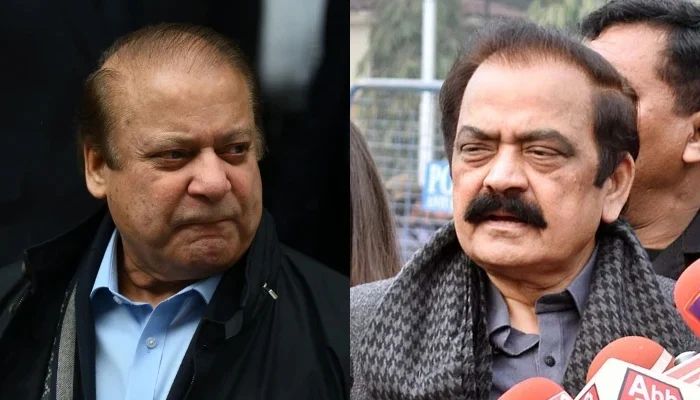
The Pakistan Muslim League Nawaz (PML-N) will file a petition in the Supreme Court to revisit the decision of party supremo Nawaz Sharif’s disqualification to hold public office and the post of party president, Interior Minister Rana Sanaullah confirmed on Monday.

The apex court had disqualified Nawaz in the Panama Papers case on July 28, 2017, barring him to hold any public office for life for hiding unpaid salary from his son in the Panama case.

A year after, the court ruled on petitions challenging the Elections Act 2017, that a person disqualified under Articles 62 and 63 cannot serve as the head of a political party.

The interior minister, while speaking in an interview, said that the PML-N would request Chief Justice of Pakistan (CJP) Umar Ata Bandial not to be a part of the bench that hears the review plea — as the top judge is considered “biased” against the ruling party.

Meanwhile, he said that Nawaz’s return was subject to his health and polls. When asked, the minister reiterated that the general elections will be held in October.

The Supreme Court Review of Judgements and Orders Bill, 2023, came into force Friday after President Arif Alvi’s assent. The law states that for reviewing a suo motu judgement, a bigger bench — than the one that issued the order — will hear the case.

“In case of judgements and orders of the SC in exercise of its original jurisdiction under Article 184 of the Constitution, the scope of review on both facts and law, shall be the same as an appeal under Article 185 of the Constitution,” the law reads.

However, Law Minister Azam Nazeer Tarar is of the view said that the former premier and Pakistan Tehreek-e-Insaf’s (PTI) estranged leader Jahangir Khan Tareen cannot benefit from the new law regarding the review of judgements.

Speaking to Geo News on Monday, Tarar said that the Supreme Court (Review of Judgements and Orders) Bill 2023 will not benefit Nawaz and Tareen as they both have exercised their right of review against their sentences.

The law minister also said that the court’s verdict was considered the final one under Article 184(3), stating that “there is no room for revision or curative review in our law”.

“Under the new law, common people would be given relief under Article 184(3),” he added.

Legal expert’s opinion

While speaking on Geo News programme ‘Geo Pakistan’, senior analyst and law expert Muneeb Farooq said that the option of filing a review petition was already there but its scope was limited.

However, after the law came into effect, a review/appeal can be filed on not only the question of fact but also the question of law as well, he added.

Explaining the matter further, Farooq said that earlier, the judges who had given the original decision would hear the review but the number of judges had now been increased under the new law.

From now, review pleas can be filed in all the cases in which the option had not been availed, within the 60 days of the law coming into effect, he said, adding that a new bigger bench will be formed to adjudicate the cases under review pleas.

However, he supported Tarar’s perspective, saying that a review plea had already been filed in the disqualification case of Nawaz.

Nawaz does not have the option to file a review as he has already exhausted the right and it was turned down. Similarly, he said that Tareen was also not in a position to benefit from the new law.

However, there could be an exception as no review had been filed in the SC’s “Samiullah Baloch vs Abdul Karim Nousherwani” case, which held that electoral disqualification was for life.

In 2018, the top court imposed a lifetime ban, holding that the Islamic principles of ‘tauba’ (repentance) and ‘maghfirat’ (forgiveness) shall not be applicable “because higher standards are expected from persons aspiring to be members of parliament”.

Farooq said that the subject matter in the case was that the court had determined under Article 62(1) f that the disqualification of anyone under the said article would be for life.

He said that a review hadn’t been filed in this case and if it is filed and the larger bench overturns the original decision, the situation could be different for Nawaz and Tareen

It is interesting to note that in the Samiullah Baloch case, the judgment authored by Justice Bandial, held that the incapacity created for failing to meet the qualifications under Article 62(1) (f) of the Constitution imposes a permanent bar which remains in effect so long as the declaratory judgement supporting the conclusion of one of the delinquent kinds of conduct under Article 62(1) (f) of the Constitution remains in effect.

British army chief arrives in Pakistan on 5-day ‘Defence Engagement’ visit

ISLAMABAD: The British Army’s Chief of the General Staff (CGS), General Sir Patrick Sanders, arrived on Monday in Pakistan for a five-day Defence Engagement visit as part of the longstanding defence cooperation agreement between the two countries.

During his visit, General Sanders would meet with Chief of Army Staff (COAS) General Asim Munir, alongside other Defence Engagement activities and discussions on bilateral military cooperation in response to climate change-related crises would be a key focus of the visit, a news release said.

The depth and warmth of the UK-Pakistan military relationship and friendship, underpinned by a shared history and ‘living bridge’ diaspora links, are highly valued by the UK.

The existing defence relationship includes Pakistani officers undertaking training at the UK’s Royal Military Academy Sandhurst, the Advance Command and Staff Course and the Royal College of Defence Studies.

General Sanders’ visit comes almost one year after Pakistan’s devastating floods which left nearly one-third of the country submerged and affected an estimated 33 million people.

The UK’s Ministry of Defence was directly involved in providing assistance for flood relief operations, airlifting in eight boats and ten portable generators at the request of Pakistan’s army chief.

Earlier this year, COAS Muir paid an official visit to the UK from February 5 to 10 in connection with the 5th Pakistan-UK Stabilisation Conference.

The Inter-Services Public Relations (ISPR) had said that the conference was a bi-annual event for military-to-military cooperation between the two countries, in which senior Pakistani military leadership has been participating since 2016.

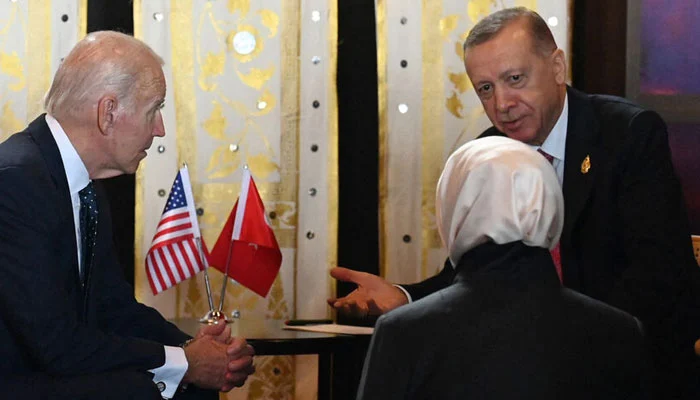
Biden calls up Erdogan, raises F-16s, Sweden in conversation

In a phone call between US President Joe Biden and Turkish President Tayyip Erdogan, the two leaders discussed various issues, including the potential purchase of F-16 fighter jets by Turkey from the United States.

President Biden expressed his willingness to work out a deal on the F-16s, but also emphasised the importance of Turkey dropping its objection to Sweden’s NATO accession.

During the call, President Biden congratulated Erdogan on his victory in the recent presidential election. Biden later spoke to reporters, stating that he had discussed the F-16s with Erdogan and informed him of the United States’ interest in resolving the matter with Sweden. He mentioned that they would continue the conversation in the following week.

The Turkish presidency’s statement on the call was brief, mentioning that the leaders agreed to enhance cooperation on all aspects of their bilateral ties, particularly in the face of regional and global challenges.

Turkey has been seeking to purchase $20 billion worth of F-16s from the United States, but the sale has faced obstacles in the US Congress. Despite the Biden administration expressing support for the deal, it has not progressed swiftly.

Meanwhile, Sweden and Finland, both formerly non-aligned nations, have applied for NATO membership after Russia’s invasion of Ukraine. However, all NATO member states must approve their bids. Turkey has ratified Finland’s NATO accession but continues to object to Sweden’s due to its alleged harboring of individuals Turkey considers terrorists. Hungary has also not yet approved Sweden’s bid.

Washington is prioritizing Sweden’s NATO membership before the upcoming leaders summit in Lithuania in mid-July.

President Biden’s communication with President Erdogan involved congratulating him on his re-election and expressing a plan to discuss Erdogan’s opposition to Sweden’s NATO membership at a later time. Sweden and Finland’s applications to join NATO were prompted by Russia’s invasion of Ukraine, and Erdogan’s objection to Sweden’s bid may be linked to various factors, including tensions with the Kurdish diaspora in Sweden and the desire to secure F-16 fighter jets after Turkey’s removal from the F-35 program.

The relationship between Biden and Erdogan has been strained, with Biden’s predecessor, Donald Trump, taking a more favorable stance toward Erdogan and other autocratic leaders. Nonetheless, Biden offered his belated congratulations to Erdogan, highlighting the complex dynamics in US-Turkish relations.

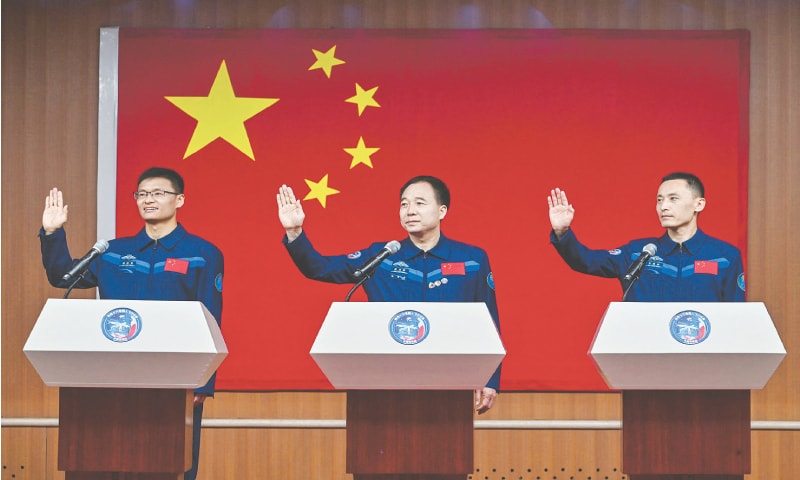
China prepares to send first civilian into space

The world’s second-largest economy has invested billions of dollars in its military-run space programme, trying to catch up with the United States and Russia after years of belatedly matching their milestones.

Until now, all Chinese astronauts sent into space have been part of the People’s Liberation Army.

Gui Haichao is a professor at Beijing’s Beihang University, and will manage scientific experiments on the station during the mission, China Manned Space Agency (CMSA) spokesperson Lin Xiqiang told reporters on Monday.

His mission will “carry out large-scale, in-orbit experiments… in the study of novel quantum phenomena, high-precision space time-frequency systems, the verification of general relativity, and the origin of life,” Lin said.

“I’ve always had this dream,” Gui told a press conference on Monday.

His university said he hailed from an “ordinary family” in the southwest province of Yunnan.

He had “first felt the attraction of aerospace” listening to the news of China’s first man in space, Yang Liwei, on campus radio in 2003, the institution said in a post on social media.

Gui’s addition is “particularly significant”, independent analyst Chen Lan said, given previous missions only carried astronauts trained as pilots responsible for more technical tasks and not specialist scientists.

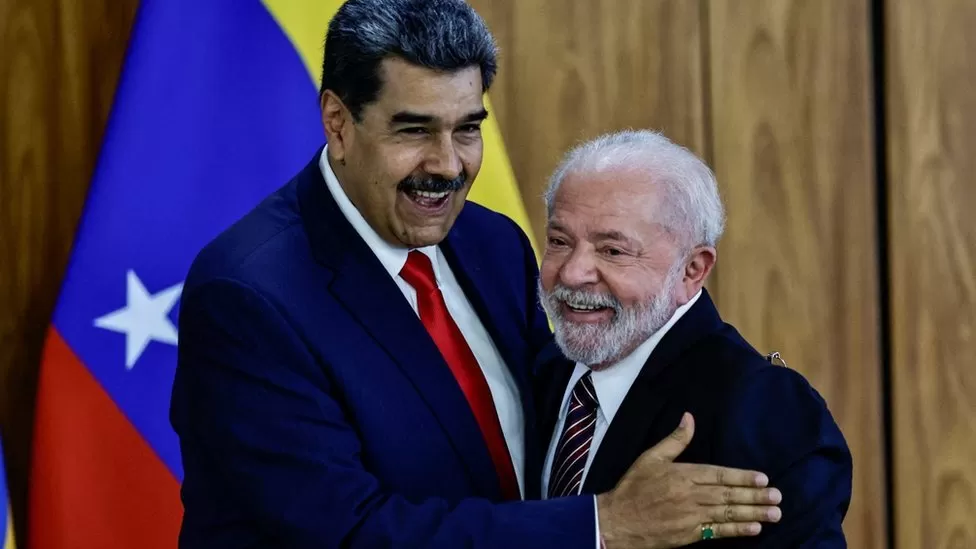
Venezuela’s President Nicolás Maduro has visited Brazil for the first time since he was banned by former far-right President Jair Bolsonaro in 2019.

Mr Maduro was received by the new president, fellow leftist Luiz Inacio Lula da Silva, ahead of a summit of Latin American leaders in Brasilia.

“What’s important about Maduro coming here is that it’s the beginning of Maduro’s return,” Lula said.

Mr Maduro talked of a “new era” in bilateral relations.

Lula said the region should tackle poverty.

A number of countries question the legitimacy of Mr Maduro, who is described by opponents as a dictator.

Greeting his guest in the Brazilian capital on Monday, Lula said his own return had come five months earlier, referring to the time when he again assumed power after beating Mr Bolsonaro in tight presidential elections.

Mr Maduro said Venezuela was open for Brazilian investors, stressing that the two countries “must be united, from now on and always”.

Lula used the visit to criticise US sanctions on Venezuela saying a “constructed narrative of authoritarianism” was in place about Venezuela and that sanctions were unjustified.

President Maduro last visited Brazil in 2015. Jair Bolsonaro was ideologically opposed to the leftist Venezuelan leader and unlikely to extend an invitation.

However, in the past, Lula enjoyed warm ties with both Nicolás Maduro and his political mentor, the late Hugo Chávez.

In a sign that the relationship looks set to remain solid, Lula spoke of what he called “extremely exaggerated” US sanctions on Venezuela and said it was inexplicable that the US would “impose 900 sanctions because they don’t get on”.

He urged his South American ally to build a new “narrative” about authoritarianism, saying an unfair and “constructed” one had been established around the state of democracy in Venezuela.

Lula’s comments have been seized upon by his critics who say he turns a blind eye to the Maduro administration’s alleged human rights violations and lack of free and fair elections.

For Mr Maduro, the visit was an opportunity to repeat his call for the US sanctions to be lifted, saying he would call upon the other nations in South America to oppose them as a regional bloc.

Several South American countries are now led by left-wing leaders and might lend their support to such a position, including Argentina, Bolivia and Colombia as well as Brazil.

However, it is unclear if such a demand would make any real difference to the Biden administration’s policies towards Venezuela.

Since Mr Maduro was elected in 2013, he has grown increasingly authoritarian.

His crackdown on opposition activists ultimately led to the US imposing sanctions on his government and recognising opposition leader Juan Guaidó as interim president in 2019 after a contested election.

Last December, Venezuela’s opposition National Assembly voted to dissolve its parallel government and remove Mr Guaidó.

He was recognised by many Western countries, including the US, but failed to oust the left-wing president.

The vote showed how many opposition politicians in Venezuela had lost faith in Mr Guaidó.


The assembly also voted to appoint a commission to govern the country’s foreign assets, as they sought a united front ahead of elections scheduled for 2024.

Venezuela’s long-running political and humanitarian crisis has seen some seven million people flee the country since 2015.

Venezuela has been caught in a downward spiral for years with growing political discontent further fuelled by skyrocketing hyperinflation, power cuts and shortages of food and medicine.

The rate of price rises at UK supermarkets hit a new high in the year to May due to coffee, chocolate and non-food goods.

While prices for fresh food have fallen marginally, the cost of commodities such as coffee and cocoa has jumped.

The government is in talks about asking supermarkets to cap prices on food items to help with the cost of living.

An agreement, which would be voluntary, would limit the cost of basic foods such as bread and milk.

But the BRC has dismissed caps, stating the government should focus on cutting red tape so resources could be “directed to keeping prices as low as possible”, as opposed to “recreating 1970s-style price controls”.

The BRC and NielsenIQ figures, covering the week between 1 and 6 May, show that overall food inflation ticked lower from 15.7% in the year to April to 15.4%.

Despite the fall, the figure is the second highest rate of food inflation on record.

A decline in the rate of price rises does not mean food costs have fallen, it simply means they are going up at a slower pace.


Meanwhile, the pace of price rises for non-food goods grew from 5.5% in the year to April to 5.8% in May.

This is despite supermarkets making “heavy discounts” on goods such as footwear, books and home entertainment, according to Helen Dickinson, chief executive of the BRC.

Fresh produce showed a slowdown in price rises, from 17.8% to 17.2% in May.

In April, supermarkets cut the price of milk by 5p, taking cost of a pint to 90p. However, that is still almost double pre-Covid prices in March 2020.

Price growth for ambient foods – which are goods that can be stored at room temperature – rose in the year to May from 12.9% to 13.1%. It is the fastest increase on ambient foods prices on record, said the BRC and NielsenIQ.

Ms Dickinson said: “The price of chocolate and coffee rose off the back of the ongoing high global costs for these commodities.”

Last week, official figures showed that the overall headline rate of inflation had fallen sharply to 8.7% in April – the first time it fell under 10% since August.

However, the drop was less than economists and investors had expected after grocery price rises remained close to the highest rate in 45 years.

It is also still more than four times the Bank of England’s 2% target rate of inflation. The Bank has lifted interest rates 12 times in a row to 4.5% in an attempt to calm price rises.

But following the higher-than-expected figure for April, some analysts speculated that interest rates could reach 5.5% by the end of the year.

Food production costs have risen due to a number of factors including the cost of energy which rose following the end of Covid lockdowns, which pushed up demand, as well as Russia’s attack on Ukraine.

Russia, which is a major oil and gas producer, was hit with sanctions.

Ukraine – known as the breadbasket of Europe – is one of the biggest exporters of grain in the world and has seen shipments severely disrupted because of the war.

Adverse weather conditions in some parts of Europe and Africa also impacted some fresh vegetables earlier this year, leading to supermarkets introducing customer limits on sales of peppers, tomatoes and cucumber.

Wholesale gas prices have started to drop but retailers claim that falling production costs take time to filter through to supermarket shelves due to the long-term contracts they typically sign with food producers.

Mike Watkins, head of retailer and business insight at NielsenIQ, said: “Food retailing in particular is competitive, so hopefully the recent price cuts in fresh foods is a sign that inflation has now peaked, albeit ambient inflation may take a little while longer to slow.”

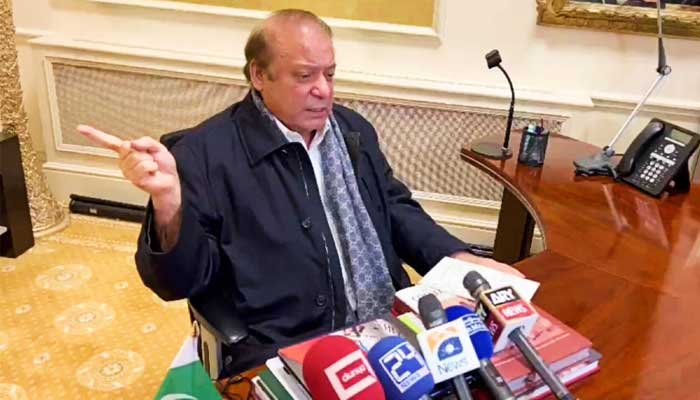
Pakistanis will always hate May 9 mayhem, love May 28 nuclear tests: Nawaz Sharif

Pakistan Muslim League-Nawaz (PML-N) supremo Nawaz Sharif has said that people of the country will always hate May 9 mayhem and love May 28 — a reference to the events when violent protests broke out following Pakistan Tehreek-e-Insaf (PTI) Chairman Imran Khan’s arrest and Pakistan became the nuclear-armed country, respectively.

“The people of Pakistan will continue to hate May 9 and love May 28 as there is a stark distinction between these two events,” the three-time prime minister said in an audio message played at the PML-N’s public gathering organised to celebrate the Youm-e-Takbeer, which marks the historic day when Pakistan conducted successful nuclear tests in the hills of Chaghai 25 years ago.

PML-N Senior Vice President Maryam Nawaz and other party leaders also addressed the gathering.


Nawaz, who has been living in London since November 2019 on medical grounds, said despite the pressure of international powers he went ahead with his decision of conducting nuclear tests in 1998 as prime minister of the country.

“We don’t have any aggressive intentions against anyone but we cannot allow anyone to have ill intentions against Pakistan,” he added

He also slammed his ouster from power in 2017 saying that all those elements who conspired against him had been exposed.

Addressing the gathering, Maryam took a jibe at Imran Khan, saying: “If a coward was leading Pakistan on May 28 1998, he would have hidden with a bucket over his head”.

Calling the PTI chief “jackal”, she said he was begging the US for help during “tough times” after accusing it of toppling his government through conspiracy.

“Brave nations are led by brave leaders,” she added.

Maryam, the scion of the Sharif family’s political dynasty, said the PTI chief while “sitting in a bunker in Zaman Park inciting his supporters to violence”. Khan has been using his Lahore’s Zaman Park residence since he was injured in an assassination attempt in Wazirabad on November 3 2022.

The PML-N stalwart also hailed her father Nawaz for rejecting a $5 billion offer to compromise on nuclear tests saying: “This is called absolutely not”.

Earlier today, in a Youm-e-Takbeer message, Prime Minister Shehbaz Sharif, who is also PML-N president, reaffirmed that the national defence and sovereignty are impregnable.

He said that Youm-e-Takbeer was a clear declaration of “no compromise over country’s sovereignty, and defence”, and a reminder that the nation would not budge from any sacrifice to safeguard.