
Snap Sri Lankan election poses test for new leader

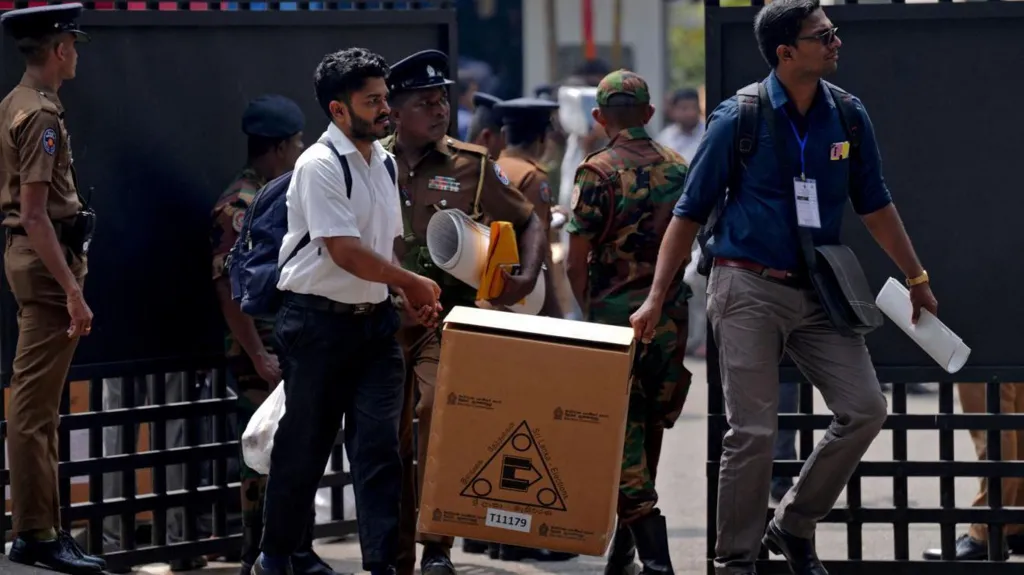
Sri Lanka’s 17.1 million voters head to the polls again on Thursday to vote in snap parliamentary elections, barely seven weeks after choosing a new president.

More than 8,800 candidates are in the fray in an election marked by a low-key campaign.

Voting begins at 07:00 local time (01:30 GMT) and ends until 16:00 (10.30 GMT). Counting will start in the evening and results are expected on Friday.

Out of 225 seats in the parliament, 196 MPs will be directly elected. The rest would be nominated by political parties based on the percentage of votes they get in what is known as proportional representation.

Sri Lankans are returning to the polls barely seven weeks after choosing a new president

“Over 8,800 candidates belonging to 49 political parties and 284 independent groups are contesting the elections but only around 1,000 candidates have actively campaigned,” Rohana Hettiarachchi, executive director of poll monitoring group People’s Action for Free and Fair Elections, told the BBC.

High inflation, food and fuel shortages precipitated a political crisis in 2022 which led to the ousting of President Gotabaya Rajapaksa. His successor Ranil Wickremesinghe managed to negotiate a bailout package worth $3bn with the International Monetary Fund – but many Sri Lankans continue to feel economic hardship.

“We are still stuck with the problems we faced before. We still don’t have financial help even to fulfil our daily needs,” 26-year-old garment factory worker Manjula Devi, who works in the Katunayake Free Trade Zone near Colombo, told the BBC.

The number of people living below the poverty line in Sri Lanka has risen to 25.9% in the past four years. The World Bank expects the economy to grow by only 2.2% in 2024.

“Sri Lanka has still not recovered from the 2022 economic crisis, even with the IMF bailout,” Raisa Wickrematunge, deputy editor of Himal Southasian magazine, told the BBC.

“I am typing this from the Sri Jayawardenapura general hospital, a public hospital which is switching off its lights and fans to try to bring down skyrocketing electricity costs.”

In 2022, the country defaulted on its foreign debt for the first time, forcing it to seek debt restructuring deals.

Observers expect a multi-cornered contest in the general election, which may ultimately dent the chances of President Anura Kumara Dissanayake’s party, Janatha Vimukthi Peramuna, enacting ambitious reforms.

“Analysts predict he may struggle to get two-thirds and may have to rely on coalitions. This would make his task much more difficult,” says Raisa Wickrematunge.

The election campaign has been largely peaceful with no reports of poll-related deaths or large scale misuse of government resources.

“Violence is negligible compared to previous elections. It will be peaceful elections,” hopes Rohana Hettiarachchie.
Trump, Biden shake hands in White House, vow smooth transfer

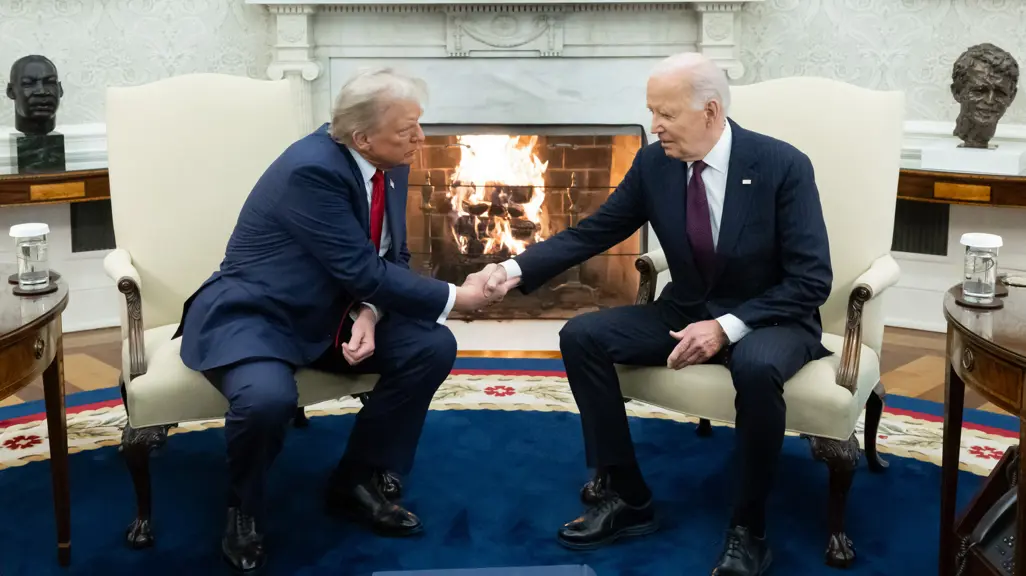
US President-elect Donald Trump thanked President Joe Biden for pledging a smooth transfer of power as the victorious Republican made a historic return visit to the White House on Wednesday.

“Politics is tough, and in many cases it’s not a very nice world. It is a nice world today and I appreciate it very much,” Trump said after the two men shook hands in the Oval Office.

Trump, 78, added that the transition would be “smooth as you can get.”

Biden greeted Trump in front of a roaring fire, offering him congratulations and saying: “Welcome back.”

The 81-year-old Biden invited his sworn rival to the White House — despite the fact that Trump, who refused to admit his 2020 election loss, never afforded Biden the same courtesy.

Biden, who dropped out of the election in July but saw his successor Kamala Harris lose to Trump last week, said he was “looking forward to having a smooth transition.”

“We’ll do everything we can to make sure you’re accommodated, (have) what you need,” he told Trump.

Their talks after the public handshake may have been a bitter pill to swallow for Biden, who branded Trump a threat to democracy.

Biden was expected to push during the meeting for Trump to continue US support for Ukraine’s fight against Russia, which the Republican has called into question.

Ahead of the White House visit, Trump addressed Republicans from the House of Representatives at a Washington hotel near the Capitol, which a mob of his supporters stormed in 2021 to try to reverse his election loss.

An ebullient Trump suggested that he could even be open to a third term in office — which would violate the US constitution.

“I suspect I won’t be running again unless you say, ‘He’s good, we got to figure something else,'” he said, drawing some laughter.

Trump’s party looks set to take both chambers of Congress and consolidate his extraordinary comeback.

He was accompanied at the meeting with Republicans by the world’s richest man Elon Musk, whom he named on Tuesday as head of a new group aimed at slashing government spending.

Trump has launched a flurry of nominations as he moves swiftly to name his administration.

Biden’s Oval Office invitation restored a presidential transition tradition that Trump tore up when he lost the 2020 election, refusing to sit down with Biden or even attend the inauguration.

Then-president Barack Obama had welcomed Trump to the White House when the tycoon won the 2016 election.

But by the time Trump took his last Marine One flight from the White House lawn on January 20, 2021, he had also been repudiated by many in his own party for having stoked the assault on the Capitol.

That period of disgrace soon evaporated, however, as Republicans returned to Trump’s side, recognizing his unique electoral power at the head of his right-wing movement.

Trump enters his second term with a near total grip on his party and the Democrats in disarray.

He has spent the week since the election at his Mar-a-Lago resort in Florida assembling his top team, as the world watches to see how closely he sticks to his pledges of isolationism, mass deportations and sweeping tariffs.

Trump named Space X, Tesla and X boss Musk, and businessman Vivek Ramaswamy, to lead a “Department of Government Efficiency (‘DOGE’)” — a tongue-in-cheek reference to an internet meme and cryptocurrency.

Trump is moving quickly to fill out his administration, picking a host of ultra-loyalists.

Trump nominated Fox News host and army veteran Pete Hegseth as his incoming defense secretary. An outspoken opponent of so-called “woke” ideology in the armed forces, Hegseth has little experience similar to managing the mammoth US military budget and bureaucracy.

Trump named South Dakota Governor Kristi Noem — an ally who famously wrote about shooting her dog because it did not respond to training — as head of the Department of Homeland Security.

UN nuclear chief in Iran to ‘reach diplomatic solutions’

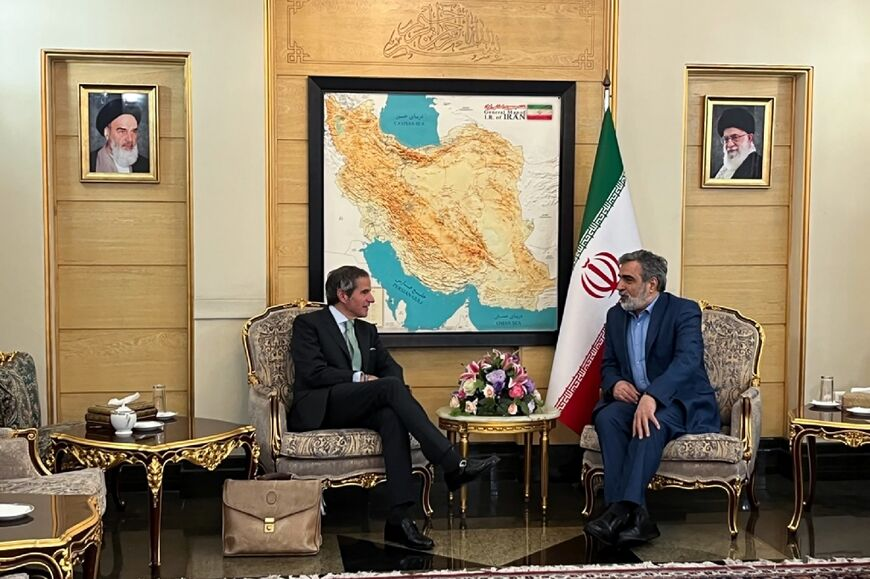
International Atomic Energy Agency chief Rafael Grossi was to hold talks with top Iranian officials Thursday on Tehran’s nuclear programme, a week after Donald Trump’s re-election as US president.

During his first term in the White House from 2017 to 2021, Trump was the architect of a policy called “maximum pressure” which levied against Tehran biting sanctions that had been lifted through a landmark nuclear agreement in 2015.

Grossi, who is the director general of the UN agency, arrived at Tehran airport on Wednesday evening and was greeted by Behrouz Kamalvandi, the spokesman for the Atomic Energy Organization of Iran (AEOI).

Grossi is set to meet Thursday in Tehran with AEOI chief Mohammad Eslami as well as Foreign Minister Abbas Araghchi, who was chief negotiator in the nuclear talks between Tehran and the major powers that resulted in the 2015 deal formally called the Joint Comprehensive Plan of Action or JCPOA.

The deal, reached after 21 months of negotiations between Iran and world powers, gave Tehran sanctions relief in exchange for curbs on its nuclear programme to guarantee that it could not develop a nuclear weapon — something it has always denied wanting to do.

Three years later, then-president Trump unilaterally withdrew the United States from the agreement and reimposed heavy sanctions against Iran.

– Search for solutions –

A year later, Iran started to gradually roll back its commitments to the nuclear deal, which only allowed Tehran to enrich uranium to 3.65 percent purity.

The IAEA says Iran has considerably increased its reserves of enriched uranium to 60 percent, close to the 90 percent needed to develop an atomic bomb.

The head of the IAEA “will do what he can to prevent the situation going from bad to worse” given the significant differences between Tehran and Western capitals, analyst Ali Vaez, an Iran expert for the Crisis Group, a US-based think tank, told AFP.

“The one who left the agreement was not Iran, it was America,” Iran’s government spokeswoman Fatemeh Mohajerani said on Wednesday.

“Mr. Trump once tried the path of maximum pressure and saw that this path did not work.”

Grossi’s visit comes only two days after the defence minister of Iran’s arch enemy Israel warned that the Islamic republic was “more exposed than ever to strikes on its nuclear facilities”.

The two countries have exchanged missile fire in recent months in a context of high tensions in the Middle East due to the war waged by Israel in the Gaza Strip against Hamas and in Lebanon against Hezbollah, two militant groups allied with Iran.

Trump’s return to the White House in January also raises fears of rising tensions between Iran and his country.

“The margins for manoeuvre are beginning to shrink,” Grossi warned in an interview with AFP on Tuesday, adding that “it is imperative to find ways to reach diplomatic solutions”.

– Religious decree –

Grossi has said that while Iran does not have any nuclear weapons at this this moment in time, it does have plenty of nuclear materials that could be used eventually to make a weapon.

Iranian President Masoud Pezeshkian, who came to office in July with hopes of improving ties with the West and having sanctions lifted, favours a revival of the nuclear deal.

But all efforts to get the nuclear agreement off life support have so far failed.

The IAEA chief has repeatedly called for more cooperation from Iran.

In recent years, Tehran has decreased its interaction with the UN agency by deactivating surveillance devices needed to monitor the nuclear programme and effectively barring its inspectors.

The foundations of Iran’s nuclear programme date back to the late 1950s, when the United States signed a civil cooperation agreement with Iran’s then Shah Mohammad Reza Pahlavi.

In 1970, Iran ratified the Non-Proliferation Treaty (NPT), which requires signatory states to declare and place their nuclear materials under the IAEA control.

But with Iran threatening to hit back at Israel for its latest missile strikes, some lawmakers in the Islamic republic have called on the government to revise its nuclear doctrine to pursue nuclear weapons.

The parliamentarians called on supreme leader Ayatollah Ali Khamenei, who wields ultimate authority in Iran, to reconsider his long-standing religious edict or fatwa banning nuclear weapons.

The Islamic republic has maintained its policy against acquiring nuclear weapons, insisting its nuclear activities are entirely peaceful.

SNP yet to make decision on two-job MPs – Swinney

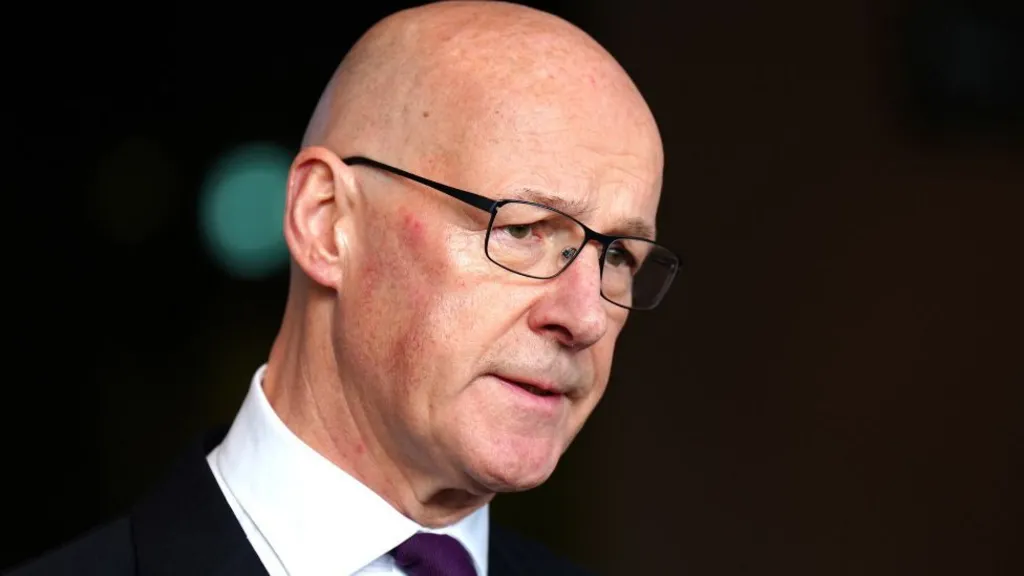
First Minister John Swinney has said the SNP is yet to make a decision on whether its politicians can hold seats at both the Scottish and UK parliaments.

It comes after the party’s Westminster leader, Stephen Flynn, announced his ambition to stand in the 2026 Holyrood election.

Another sitting MP, Stephen Gethins, has submitted an application to be selected as a candidate – though he has not stated an intention to hold two seats at once.

Swinney also said former health secretary Michael Matheson should be allowed to “get on with the rest of his life” after it was reported he had put his name forward.

Dave Doogan, MP for Angus and Perthshire Glens, told BBC News he is considering running for Holyrood and would remain an MP at Westminster if elected.

Applications to stand as an SNP candidate in 2026 closed on Monday, though the formal selection process will not start until next year.

Flynn drew criticism from colleagues after announcing he hoped to win the SNP nomination for the Aberdeen South and North Kincardine seat, currently held by Audrey Nicoll.

The SNP, including Flynn, was highly critical of former Scottish Conservative leader Douglas Ross for holding what is known as a dual mandate.

Swinney, who held seats at both Westminster and Holyrood between 1999 and 2001, told BBC Scotland News: “We’ve had times in the past when we’ve had dual mandates – I had a dual mandate myself for two years in the early days of devolution.

“The party has got to come to its conclusions about these particular issues and it will do in the fullness of time.”

Former SNP minister George Adam said it was “wrong” for SNP MPs to try to also sit at Holyrood, adding he was “disappointed” with how Flynn had handled his decision to challenge Nicoll.

The Paisley MSP noted his party had spent years “attacking others” for having dual mandates.

He told Politics Scotland SNP politicians were “all meant to be very loyal”, adding “let’s just remember that when we go forward”.

Meanwhile, Deputy First Minister Kate Forbes said Flynn would be a “brilliant asset” to the Scottish Parliament.

Last year she criticised Ross, who was an MP, MSP and professional football referee at the time, branding him “three jobs”.

Responding to Flynn’s announcement, she added: “The beauty of democracy is that it ultimately will be a decision for the local electorate as to who represents them, both within the party and within the public.

“Now, most recently, that was put to the test with Douglas Ross, he wasn’t returned as the MP, and therefore it proves the point that democracy works.”

Gethins, who represents Arbroath and Broughty Ferry, told the Courier newspaper he had submitted an application to keep his vetting papers “up to date” and noted there were no local vacancies for SNP candidates.

The MP told the Courier he would like to return at “some point” to Holyrood, where he formerly worked as a government adviser. However, he said his priority was representing his constituents at the UK parliament.

Dave Doogan confirmed that he has submitted for SNP vetting in advance of the 2026 election. He did not confirm that he would stand, saying it was “not a statement of intent” but would mean running remained a possibility.

Doogan said that if he did stand for Holyrood, and was elected, then it would be “reasonable” for him to serve as both an MP and an MSP consecutively.

The SNP MP told Politics Scotland “it is possible to do both jobs” if the “bulk” of constituents being represented were the same in both parliaments.

BBC Scotland News understands that SNP Westminster colleagues Pete Wishart Brendan O’Hara, Kirsty Blackman, Chris Law and Graham Leadbitter have not put their names forward for selection.

Michael Matheson has put his name forward for selection at the next Holyrood election

Swinney described Matheson – who resigned from the cabinet after he admitted misleading parliament about how an £11,000 data roaming bill was racked up on his work iPad – as a “faithful servant” to his constituents.

The Times and Herald reported the Falkirk West MSP had submitted an application to stand again in the constituency.

Swinney said Matheson had made a “mistake” and that he had accepted his punishment – a record ban from parliament.

He added: “I think it’s important that we accept those errors, accept the remedies that were put in place, and allow Michael to get on with the rest of his life”.

Matheson has been asked to comment.

Former first ministers Nicola Sturgeon and Humza Yousaf are among the other SNP politicians understood to have submitted candidacy applications – though both are yet to decide on whether to stand for re-election.

Ahead of the 2021 election, the SNP changed internal rules to require MPs to resign their seat at Westminster to fight for selection to Holyrood.

Flynn told the Press and Journal he understood that rule to be “election specific”.

He told BBC Scotland News he took “no pleasure” from potentially competing with Nicoll for selection but that it was for members to decide an outcome.

Nicoll said the selection process was still at an early stage and that Flynn was within his rights to stand for selection.

SNP MSP Emma Roddick called for the party’s Westminster leader to rethink his ambition to hold two seats seats.

The Highlands and Islands representative said she could not imagine “being a good MSP” while spending “half” her time in London.

One former SNP MP told BBC Scotland News: “I’m not sure being seen to do Audrey Nicoll out of her job so that he can have two jobs is a smart pitch.”

Another senior party figure described Flynn’s move as “naked ambition”.

Nawaz hopeful of ‘good’ Pakistan-US ties after Trump’s victory

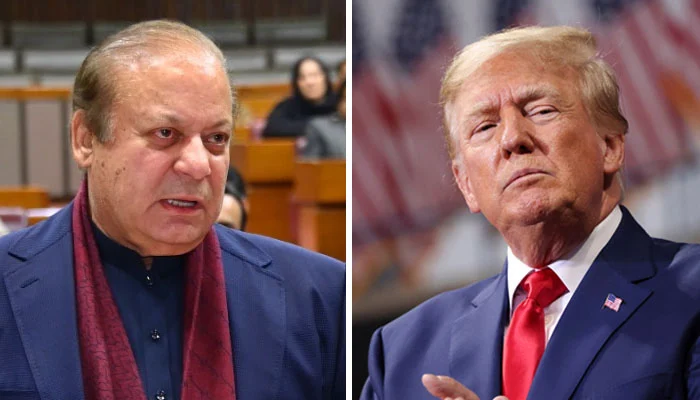
LONDON: Pakistan Muslim League-Nawaz (PML-N) President Nawaz Sharif has expressed optimism that Pakistan’s relations with the United States will remain stable and improve further after President-elect Donald Trump’s emphatic victory in the recently-held US elections.

The three-time former prime minister made these remarks while talking to journalists along with his daughter and Punjab Chief Minister Maryam Nawaz after reaching London from Geneva’s trip.

Responding to a question regarding Trump’s victory, Nawaz noted that the relations between the US and Pakistan have been good, expressing hope that the ties would “remain good and improve further.”

He also stressed the need for having “good relations” with the neighbouring countries too.

In response to another question, the PML-N president said that Indian cricket team should visit Pakistan for the upcoming Champions Trophy 2025 that he said could improve relations.

“Relations with India can be improved and there seems to be no hindrance in it. That time will come when the neighbouring team will visit too,” he added.

Speaking about the smog pollution in Punjab, Nawaz responded with criticising the Pakistan Tehreek-e-Insaf (PTI), asking “where is the billion-tree tsunami [project]?”

“Where are the billion trees, where are the 5 million jobs and where are the dams. I cannot see anything. PTI should point out the project that it started when it ruled in the federal. Is there any other project the former ruling party can name.”

He further said that the PTI started the culture of misbehaviour and hooliganism. “This is extremely unfortunate. They promoted the culture of hooliganism in their government and did the same while in the opposition. To establish such a culture is unfortunate,” he added.

“They run after cars like zombies with eggs and tomatoes. So, if agitation is written in your fate, then do it appropriately. Youth have been taught to chase cars and chant dirty slogans. Our religion and culture don’t teach this,” he regretted.

A journalist asked him that it’s believed that PTI founder Imran Khan will stay inside the jail for as long as he [PML-N president] wants, Nawaz replied: “Ask those who believe so.”

Meanwhile, Nawaz praised his brother and Prime Minister Shehbaz Sharif for “going out of way” to help Pakistan’s economy. He said that the economic indicators are getting better and the premier has stabilised a falling economy.

“Reserves are going up. Stock exchange is rising every day. Interest rates are coming down, so is inflation. Maryam brought down the flour prices soon after coming to power. Punjab government gave Rs55 billion for the electricity relief,” he pointed out.

For her part, Punjab CM Maryam said that it’s after the previous Nawaz’s government, that now the country was getting good news.

“The issue of smog has been there for several years and we cannot fix it overnight but we are doing our utmost to resolve it. We are taking every step to resolve this. No steps were taken previously to deal with this issue,” she said.

To a question regarding the provincial airline, the chief minister said: “We’re exploring and considering the idea of starting Punjab Airline.”

“I’m undergoing treatment, but I’m doing well!” she said when asked about her health.

The former premier took flight from London last week to Geneva while the Punjab chief minister left for Switzerland city on a special Pakistan Air Force plane from Lahore.

CM Maryam was accompanied by Senior Punjab Minister Marriyum Aurangzeb and personal staff.

‘No real resilience sans climate justice’, PM tells COP29 Climate Action Summit

Prime Minister Shehbaz Sharif has said that nations cannot put up real resilience without climate justice, stressing the need to boost climate funding for developing nations.

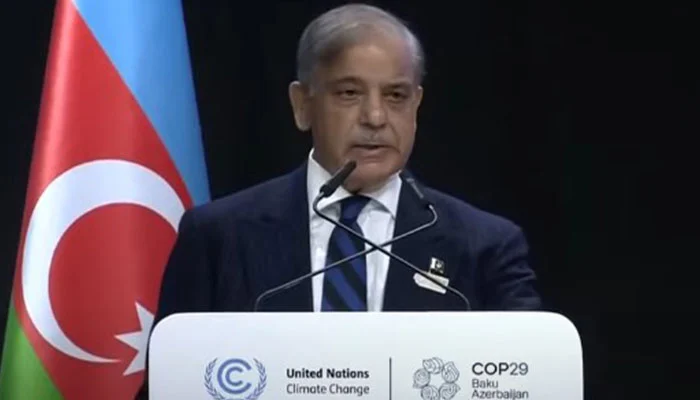
“As the minus-one emitters, we should not brave the impact of immissions realised by others without even the tools to finance resilience. Without climate justice, there can be no real resilience,” the premier told the COP29 Climate Action Summit, taking place in Baku, Azerbaijan on Wednesday.

Nearly 200 nations are negotiating global action on climate change at the summit aimed at climate fundraising to help transition to clean energy and adaptation to a warmer world.

The summit seeks to reach a deal that ensures up to trillions of dollars in financing for climate projects worldwide.

“I would not want other countries to face the plight Pakistan faced back in 2022. Pakistan is a resilient, hard-working, and responsible nation. We are fully committed to being part of the global climate solutions,” PM Shehbaz said.

He added that the incumbent government in the country has taken concrete actions to deliver on its commitment to producing 60% of all energy from clean sources and shifting 30% of our vehicles to electric vehicles (EVs) by the end of this decade.


At the same time, Pakistan is going to go through a renewable energy revolution, he added.

The premier told the summit that last year, Pakistan presented a comprehensive national adaptation plan and developed its carbon market framework by 2024.

He, however, underscored that the country cannot reach the goal on its own and needs international support to deliver on its climate ambitions.

PM Shehbaz said that the developing countries will need an estimated $6.8 trillion by 2030 to implement less than half of their current NDCs. The same goes for adaptation and loss and damage.

“In COP27, Pakistan led this phenomenon. I strongly feel that climate finance must be grant-based and not add to the debt burden of developing countries. Finally, two years ago, I warned at the top of my voice that the future would never forgive our inaction, today, I echo the same,” he added.

In 2009, wealthy countries pledged to contribute $100 billion a year to help developing nations cope with the costs of a transition to clean energy and adapting to the conditions of a warming world.

Those payments began in 2020 but were only fully met in 2022. The $100 billion pledge expires this year.

Countries are negotiating a higher target for payments starting next year, but some have been reluctant to confirm its size until it is clear which countries will contribute.

Instead, they are circling around the idea of a multi-layered target, with a core amount from wealthy countries’ government coffers, and a larger sum that includes financing from other sources such as multilateral lending institutions or private investors.

In the past, public money made up the bulk of contributions to the $100 billion goal.

“COP29 should make this understanding loud and clear that we will have to fulfil those financial pledges committed in COP27, COP28,” the premier stressed.

Climate change remains a point of concern and contention for countries around the world who are now fighting over climate finance regarding the phenomenon affecting people all around the world.

The phenomenon has accelerated globally, as human activities — mainly, burning fossil fuels — have heated up the planet’s long-term average temperature by around 1.3°C, turbocharging disastrous floods, hurricanes and extreme heatwaves.

The countries’ plans for emissions cuts are not enough to slow climate change, and would instead lead to far worse warming.

Next year’s UN deadline for countries to update their national climate plans is the last opportunity to avert disaster, scientists say.

Negotiators have said a failure at COP29 to produce a major funding deal could result in countries offering weak climate plans on the grounds that they cannot afford to implement more ambitious ones.

Most of the world’s climate-friendly spending so far has been skewed towards major economies such as China and the US. Africa’s 54 countries received just 2% of global renewable energy investments over the last two decades.

Mauritius gets new PM after opposition sweeps election

One of Africa’s most stable and prosperous democracies, the Indian Ocean island chain has been dominated by a handful of political dynasties since independence from Britain in 1968.

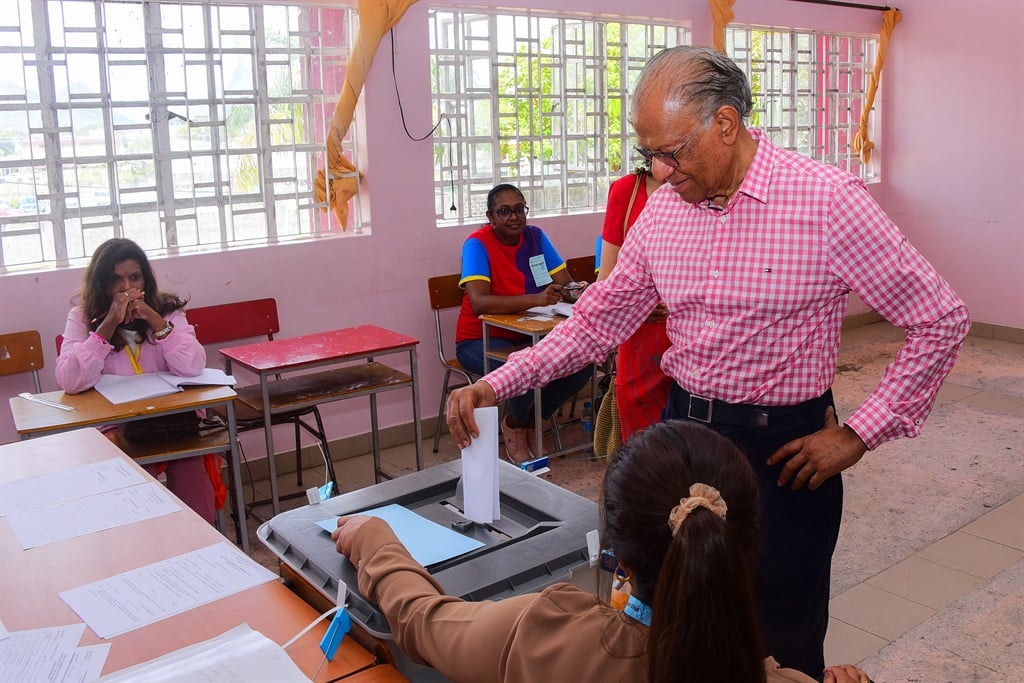
Ramgoolam was confirmed as the new prime minister, a post he has held twice before, by the president’s office.

“The court of the people has delivered its verdict and a new Mauritius awakes,” the 77-year-old said to boisterous cheers and blaring horns.

The outgoing premier Pravind Jugnauth resigned. He had been in office since 2017, having inherited the job from his father.

The election commission said Ramgoolam’s alliance had won 62.6pc of the vote while Jugnauth’s Lepep Alliance took 27.8pc.

Thanks to its winner-takes-all system, it is the third time Mauritius has seen a 60-0 result for parliamentary seats, though four additional seats were given to so-called “best losers”.

Jugnauth, 62, was just last month celebrating a historic deal that saw Britain cede sovereignty over the Chagos Islands to Mauritius after a long-running dispute.

But the vote was overshadowed by an explosive wire-tapping scandal, when secretly recorded phone calls of politicians, diplomats, members of civil society and journalists were leaked online.

The government responded by banning social media until a huge outcry forced the ban to be scrapped within 24 hours. Analysts had recently warned of worsening governance, corruption and the need to diversify the economy.

35 killed as car rams into crowd in China

The toll was a dramatic increase from the initial incident report the day before, when police only said that people had been injured, with videos apparently scrubbed from social media.

A 62-year-old man surnamed Fan drove his small SUV through the gate and “forced his way into the city’s sports centre, ramming people who were exercising on the internal roads”, police said.

Preliminary investigations suggested Fan’s attack had been “triggered by (his) dissatisfaction with the division of property following his divorce”, their statement said.

Footage from Monday night geolocated showed people lying motionless on the ground, while others were seen frantically attempting to resuscitate the unconscious.

Attacker found in his car cutting himself with a knife, and is currently in coma after self-inflicted injuries

An eyewitness surnamed Chen told Chinese news magazine Caixin it was common for groups to take daily walks on the dedicated track around the stadium.

He had just completed his third lap on Monday when a car suddenly sped at them and knocked down “many people”, but he was able to jump aside. Another eyewitness surnamed Liu said that the car “drove in a loop”.

“People were hurt in all areas of the running track — east, south, west, and north,” he said. Fan was “controlled on the spot” as he attempted to drive away, police said.

He was found in his car cutting himself with a knife, and is currently in a coma after self-inflicted injuries to his neck and other parts of his body, unable to undergo interrogation, they added.

The 43 people wounded are not currently in life-threatening condition, police said.

Chinese President Xi Jinping has urged “all-out efforts” to treat the injured and has “demanded punishing the perpetrator in accordance with the law”, according to state news agency Xinhua.

China’s largest airshow showcasing Beijing’s civil and military aerospace sector is being held in Zhuhai at the moment.

One delivery driver said he had already brought 10 orders there that night.

Security was also high in front of the emergency room of a nearby hospital, where a huge group of doctors and nurses were milling about.

After the announcement of the death toll, the news shot to the top of the trending topics on Chinese social media, with tens of millions of views.

The graphic videos that circulated on social media on Monday night showing the aftermath of the incident had mostly disappeared though. On Chinese social media platform Xiaohongshu, users expressed their shock at the sudden rise in fatalities.

“Last night after work, when I watched the news, there weren’t this many people reported,” one user commented on a photo of the police statement released.

“Tonight, suddenly seeing this number — so many families affected.”

Videos on the social media platform showed Zhuhai residents queuing up at blood donation centres and hospitals.

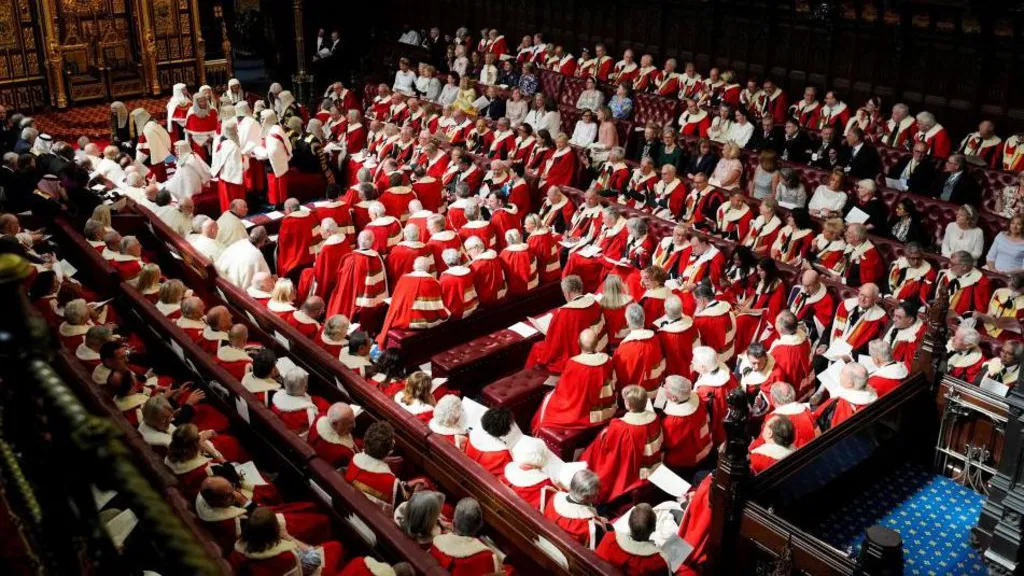
MPs back end of House of Lords hereditary peers

MPs have backed plans to get rid of all hereditary peers from the House of Lords.

A bill making its way through Parliament would abolish the 92 seats reserved for peers who inherit their titles through their families.

MPs voted for the government proposals by 435 votes to 73. The bill will now go to the Lords, where it is expected to face tough opposition.

The Conservatives opposed the plans, with shadow Cabinet Office minister Alex Burghart claiming the government was “seeking to remove established scrutineers in order to replace them with Labour appointees”.

But during a debate in the Commons, some MPs also called for the government to go further.

Conservative Sir Gavin Williamson put forward proposals for Church of England bishops to be removed from the Lords but these were rejected by MPs.

He argued it was “fundamentally unfair” for a block of clerics to “have a right and a say over our legislation”.

“For me, as someone who is an Anglican, I cannot see why I have a greater right for greater representation than my children who are Catholics,” he said.

He added that the 26 bishops in the Lords only come from England and are “probably not reflective of today’s world”.

SNP MP Pete Wishart said the unelected House of Lords should be abolished completely, adding that “if you represent the people, you should be voted by the people”.

He told the Commons the government’s proposals were “pathetic” and “should have been done centuries ago”.

As well as promising to bring about “immediate modernisation” to the Lords by abolishing hereditary peers, Labour’s general election manifesto pledged to introduce a mandatory retirement age of 80 for members of the upper house.

It also said the party was committed to replacing the House of Lords with “an alternative second chamber that is more representative of the regions and nations”.

But these changes are not included in the bill and the government has not set out a timeline for when they will be delivered.

Defending the government’s approach, Cabinet Office minister Ellie Reeves said previous attempts to reform the Lords “all in one go” had failed and the government wanted to see “immediate reform”.

She added that the government would then consult on how to deliver its other manifesto commitments on the House of Lords.

Reeves said the government “values the good work done by hereditary peers” but the bill was “a matter of principle”.

“In the 21st Century it cannot be right for there to be places in our legislature reserved for those born into certain families,” she told the Commons.

Meanwhile, peers were also taking part in their own debate on the issue of Lords reform.

Conservative peer Lord True was among those to criticise the government’s plans.

The shadow leader of the House of Lords argued the aim of the bill was “partisan” removing “88 peers who do not align themselves with Labour and four who do”.

He also said the move would cause “great hurt”.

“The execution will have to be done at close quarters, brushing shoulders in the lobbies as we go to vote for the removal of much-respected colleagues.”

Fellow Conservative peer and former cabinet minister Lord Forsyth of Drumlean accused Labour of “a disgraceful piece of political gerrymandering” aimed at “weakening the scrutiny” of the government.

“If the party opposite continues with this act of constitutional vandalism they ain’t seen nothing yet,” he warned.

The job of the House of Lords is to scrutinise the work of government and recommend changes to proposed legislation.

Most peers are appointed by the monarch on the prime minister’s advice.

The majority of hereditary peers were abolished in 1999 under the last Labour government, leaving only 92 in a compromise deal with the Conservatives.

PM Shehbaz leaves for Baku to attend Climate Action Summit

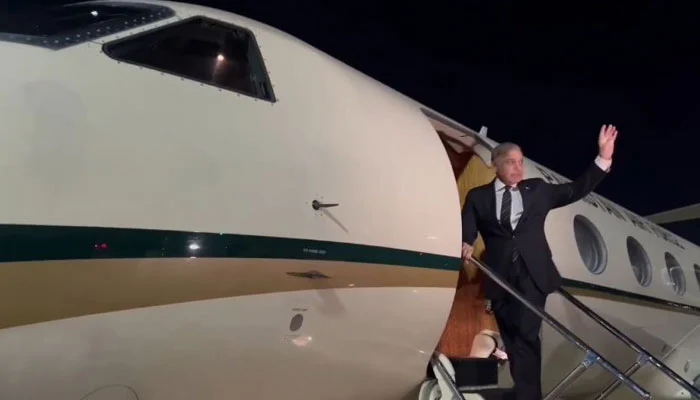
ISLAMABAD: Prime Minister Shehbaz Sharif has left for Baku, Azerbaijan to participate in the “World Leaders’ Climate Action Summit” of the 29th Conference of the Parties to the United Nations Framework Convention on Climate Change (COP29).

Taking to the microblogging website on Tuesday, the premier announced his landing in Baku, saying, “Just landed in Baku.”

The premier addressed the Arab-Islamic Summit over the Middle East crisis in Riyadh earlier in the day. The summit was a follow-up to the Joint Arab Islamic Extraordinary Summit held on November 11, last year.

Later, Saudi Ambassador to Pakistan Nawaf bin Saeed Ahmad Al-Malkiy, Pakistani Ambassador to Saudi Arabia Ahmed Farooq and other diplomatic staff saw off the prime minister at the International Royal Terminal.

The prime minister is being accompanied by Deputy Prime Minister/Foreign Minister Senator Ishaq Dar and other senior officials, the Foreign Office spokesperson said in a press release on Monday.

The prime minister will address the World Leaders Climate Action Summit on November 13 and attend several high-level events on the sidelines of the summit. Besides, he will hold bilateral meetings with world leaders during his three-day official visit.

Several high-level events and roundtable discussions hosted by Pakistan will also take place at the Pakistan Pavilion during COP29.

PM Shehbaz will also attend the high-level event “Glaciers 2025: Actions for Glaciers” to be organised by the President of Tajikistan, Emomali Rahmon, focusing on glacier preservation.

He will participate in the high-level event “Delivering Early Warning for All and Addressing Extreme Heat,” organised by UN Secretary-General Antonio Guterres to discuss the rising temperatures.

Furthermore, the premier will attend a dinner hosted by the President of Azerbaijan in honour of global leaders attending the Summit.

The Prime Minister will also hold bilateral meetings with various world leaders attending COP29, where discussions will focus on enhancing bilateral relations and addressing the climate challenges that Pakistan faces.

“At the COP29, Pakistan will call for balanced and ambitious progress on all issues such as loss and damage, adaptation, mitigation and means of implementation,” the FO statement said.

“It will seek predictable financing to address developing countries’ climate goals.”

COP29 is taking place at a time when millions around the world, including in Pakistan, are facing the adverse impacts of climate change.

As an important stakeholder, Pakistan will continue to make positive contributions to the global climate debate, negotiations, and collective action.