It brings the former prime minister’s declared income since leaving office last September to almost £4.8m.
He has previously recorded nearly £1.8m in speaking fees since his departure.
Mr Johnson has also registered a further £13,500 in accommodation from JCB boss Lord Bamford and his wife Carole for January and February.
It brings the total value of accommodation he has registered from the couple for him and his family since leaving Downing Street to £74,000.
The nearly £2.5m advance in his latest declaration is from the New York-based Harry Walker speaking agency, for an unspecified number of speeches.
It comes on top of almost £1.8m he has registered since leaving office for nine speeches delivered in the US, India, Portugal, the UK and Singapore.
As well as a £510,000 advance for his political memoirs from publisher HarperCollins, he has also declared £1,943 since leaving No 10 in royalty payments for previously written books.
Under ministerial rules, former ministers are not allowed to take jobs that involve influencing government for two years after leaving their post.
But Mr Johnson’s latest declarations are the latest demonstration of how much former leaders can earn shortly after leaving office through book deals and on the lucrative speaking circuit.
The £4.8m in earnings that Mr Johnson has declared since leaving No 10 just over five months ago is more than 50 times his yearly £84,144 MP salary.
A company set up to support his activities as a former PM has also received £1m from crypto currency investor Christopher Harborne.
Mr Harborne has previously donated more than £15m to the Conservatives, the Brexit Party, and Reform UK.
Mr Johnson was forced to resign by his ministers last July after a series of controversies prompted a mass walk-out among his ministers.
He attempted a comeback after his successor, Liz Truss, quit within weeks of taking office last September.
But despite obtaining enough support from Tory MPs to run in the contest to replace her, he ultimately stood aside, clearing the way for Rishi Sunak to become prime minister in October.
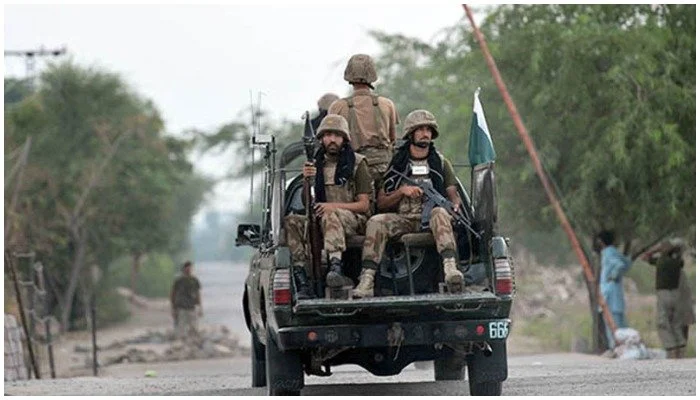
RAWALPINDI/PESHAWAR: At least 12 terrorists of the outlawed Tehreek-e-Taliban Pakistan (TTP) were gunned down Tuesday night in a “very successful intelligence-based operation” (IBO) carried out by the security forces in the Lakki Marwat area of Khyber Pakhtunkhwa, confirmed the military’s media wing on Wednesday.
The Inter-Services Public Relations (ISPR), in a statement, said that the movement and activities of the terrorists were being monitored by the “intelligence tentacles” for the last one week.
“Terrorists were lured in by providing a vehicle for escape that was intercepted and neutralised,” said the ISPR and added, that weapons, ammunition and Afghan currency were also recovered from the terrorists.
Later, a clearance operation was carried out in the area.
The ISPR statement came hours after the police shared the news of the same operation.
While giving details, the police said the terrorists were headed to Tank to carry out an attack. The law enforcement agency had shared that they martyred six policemen in a December 2022 attack.
The country is facing rising insurgency, especially in Balochistan and KP, after the outlawed TTP ended its ceasefire with Islamabad in November.
Since the start of the war on terror, Pakistan has had over 87,000 casualties. Those martyred included innocent civilians, armed forces and police and other civil armed forces personnel.
The security forces are conducting back-to-back operations to eliminate militants, however, terrorist attacks have seen a rise in the last five months, which have also taken the lives of scores of citizens.
The TTP, according to reports, regrouped in Afghanistan after the Taliban’s takeover, with Pakistan repeatedly asking the government in the neighbouring country to ensure that its soil isn’t used for terrorism. But the Taliban-led government has not been able to live up to the expectations.
The activities of militants have been mainly focused in Balochistan and KP, with the former accounting for 31% of the attacks during the last year and the latter 67%, according to Interior Minister Rana Sanaullah.
ISLAMABAD: Prime Minister Shehbaz Sharif has constituted a cabinet committee to review the bill that is aimed to amend the Pakistan Penal Code (PPC) and the Code of Criminal Procedure (CrPC) after it created a sharp division in the federal cabinet
The controversial bill — Criminal Laws Amendment Bill, 2023 — provides for curbs on criticism of certain state institutions including the judiciary and the army through arrest without warrant and imprisonment of five years along with fines of up to Rs1 million.
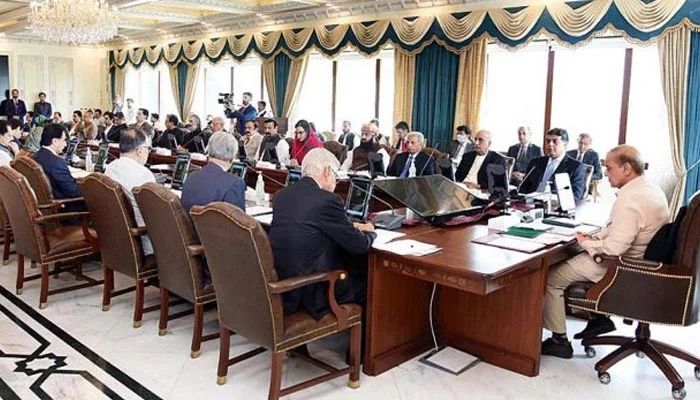
PM Shehbaz, who was chairing the cabinet meeting, formed a committee of ministers to review the legislation to make it acceptable.
Interior Minister Rana Sanaullah, Law Minister Azam Nazeer Tarar, Economic Affairs Minister Sardar Ayaz Sadiq and two others from the allied parties have been included in the committee.
Federal ministers belonging to Pakistan Muslim League-Nawaz (PML-N) Khawaja Saad Rafique, Mian Javed Latif, Ahsan Iqbal and Dr Musadik Malik and Pakistan Peoples Party’s (PPP) Sherry Rehman, Syed Naveed Qamar and Hina Rabbani Khar were among the cabinet members who opposed the bill in its present shape.
Well-placed cabinet sources told The News that Rafique opposed the bill contending that such legislation had proved counterproductive in the past. The bill provides up to five-year imprisonment to whoever ridicules the Pakistan Army and judiciary through any medium.
The cabinet summary states that recently the country has witnessed a spate of scandalous, derogatory and vicious attacks on certain institutions of the state, including the judiciary and armed forces. It is well-known that a deliberate cyber campaign has been launched by certain wings for self-serving motives with the objective of inciting and nurturing hatred against important state institutions and their officials. Such attacks are focused on undermining the integrity, stability and independence of the country’s state institutions.
The summary explained that judicial and army officials do not have the opportunity to step forward and negate scandalous, derogatory remarks while appearing in the media.
The document suggests that given the long-tested legal principle noted in Section 196 of the CrPC, prior approval of the federal government before taking cognisance of the case or registration of a first information report (FIR) against any person has been made mandatory to avoid misuse of the mooted PPC section.
ISTANBUL: President Tayyip Erdogan declared on Tuesday a three-month state of emergency covering Turkey’s 10 southern provinces hit by devastating earthquakes, and called it a disaster zone in a move meant to bolster rescue efforts.
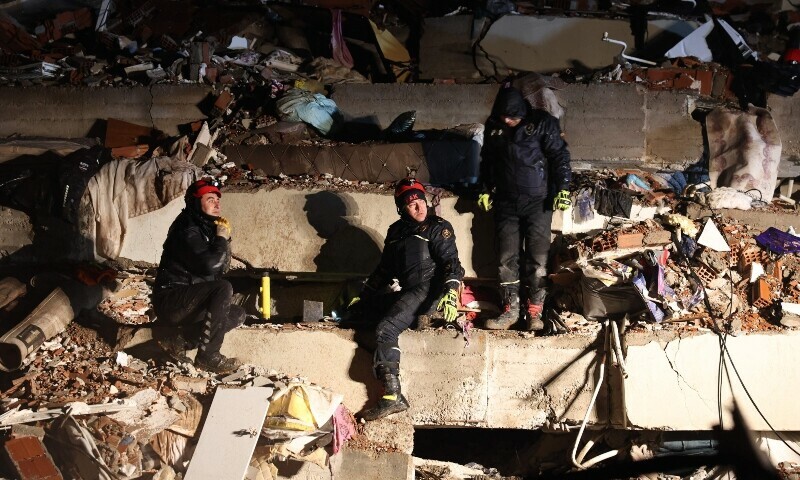
The move came as the death toll from Monday’s two major earthquakes, which hit a wide area of Turkey and Syria, exceeded 5,000 and as rescuers raced against time to dig people out of the rubble of collapsed buildings.
Declaring a state of emergency permits the president and cabinet to bypass parliament in enacting new laws and to limit or suspend rights and freedoms as they deem necessary.
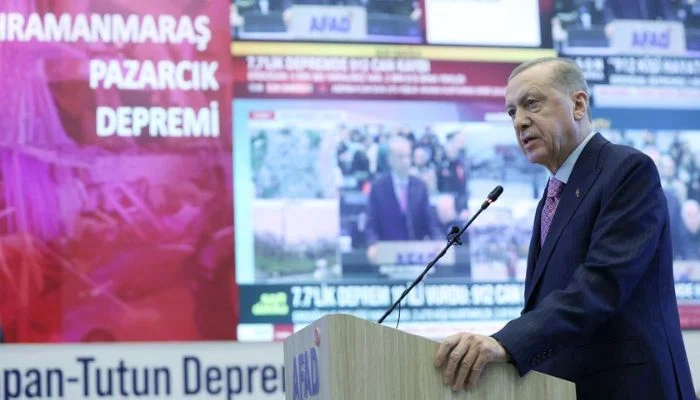
“We have decided to declare a state of emergency to ensure that operations are carried out rapidly,” Erdogan said in his second speech since the first quake hit early on Monday.
He said the state of emergency would last three months – meaning it would end shortly before presidential and parliamentary elections are scheduled on May 14. It could also be extended.
Erdogan previously declared a nationwide state of emergency in July 2016 in the wake of a failed military coup.
Erdogan also said that 70 countries had offered help in search and rescue operations and that Turkey planned to open up hotels in the tourism hub of Antalya, to the west, to temporarily house people impacted by the quakes.
He said the death toll in Turkey had risen to 3,549 people.
ANTAKYA: Turkish President Tayyip Erdogan on Tuesday declared a state of emergency in 10 provinces devastated by two earthquakes that killed more than 7,800 people and left a trail of destruction across a wide area of southern Turkey and neighbouring Syria.
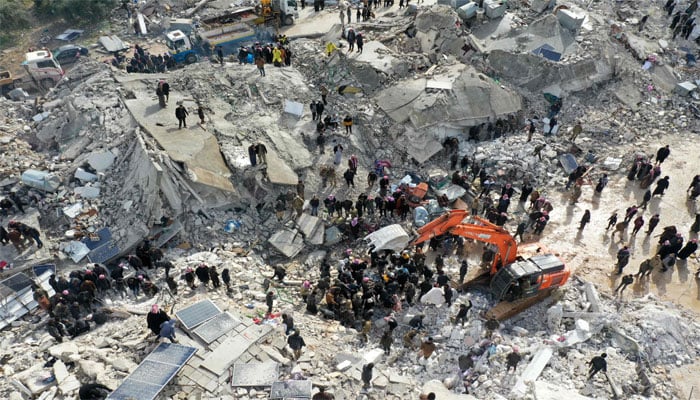
A day after the quakes hit, rescuers working in harsh conditions struggled to dig people out of the rubble of collapsed buildings.
As the scale of the disaster became ever more apparent, the death toll looked likely to rise considerably. One United Nations official said it was feared thousands of children may have been killed.
And residents in several damaged Turkish cities voiced anger and despair at what they said was a slow and inadequate response from the authorities to the deadliest earthquake to hit Turkey since 1999.
“There is not even a single person here. We are under the snow, without a home, without anything,” said Murat Alinak, whose home in Malatya had collapsed and whose relatives are missing. “What shall I do, where can I go?”
Monday’s magnitude 7.8 quake, followed hours later by a second one almost as powerful, toppled thousands of buildings including hospitals, schools and apartment blocks.
Tens of thousands of people were injured or left homeless in cities in Turkey and northern Syria.
Winter weather has hampered rescue and relief efforts and made the plight of the homeless even more miserable. Some areas were without fuel and electricity.
Aid officials voiced particular concern about the situation in Syria, already afflicted by a humanitarian crisis after nearly 12 years of civil war.
Erdogan on Tuesday declared the 10 Turkish provinces affected as a disaster zone and imposed a state of emergency there for three months. This will permit the government to bypass parliament in enacting new laws and to limit or suspend rights and freedoms.
The government will open up hotels in the tourism hub of Antalya to temporarily house people impacted by the quakes, said Erdogan, who faces a national election in three months’ time.
The death toll in Turkey rose to 5,894, Vice President Fuat Oktay said. More than 34,000 were injured. In Syria, the toll was at least 1,932, according to the government and a rescue service in the insurgent-held northwest.
‘Every minute, every hour’
Turkish authorities say some 13.5 million people were affected in an area spanning roughly 450 km (280 miles) from Adana in the west to Diyarbakir in the east, and 300 km from Malatya in the north to Hatay in the south.
Syrian authorities have reported deaths as far south as Hama, some 250 km (155 miles) from the epicentre.
“It’s now a race against time,” World Health Organization Director General Tedros Adhanom Ghebreyesus said in Geneva. “Every minute, every hour that passes, the chances of finding survivors alive diminishes.”
Across the region, rescuers toiled night and day as people waited in anguish by mounds of rubble clinging to the hope that friends, relatives and neighbours might be found alive
In Antakya, capital of Hatay province bordering Syria, rescue teams were thin on the ground and residents picked through debris themselves. People pleaded for helmets, hammers, iron rods and rope.
One woman, aged 54 and named Gulumser, was pulled alive from an eight-storey building 32 hours after the quake.
Another woman then shouted at the rescue workers: “My father was just behind that room she was in. Please save him.”
The workers explained they could not reach the room from the front and needed an excavator to remove the wall first.
Turkish authorities say more than 12,000 search and rescue personnel are working in the affected areas, along with 9,000 troops. Some 70 countries and sending personnel, equipment and aid.
But the sheer scale of the disaster is daunting.
“The area is enormous. I haven’t seen anything like this before,” said Johannes Gust, from Germany’s fire and rescue service, as he loaded equipment onto a truck at Turkey’s Adana airport.
Turkey’s Disaster and Emergency Management Authority (AFAD) said 5,775 buildings had been destroyed in the quake and that 20,426 people had been injured.
In Geneva, UNICEF spokesperson James Elder said: “The earthquakes…may have killed thousands of children.”
Syrian refugees in northwest Syria and in Turkey were among the most vulnerable people affected, Elder said.
In the Syrian city of Hama, Abdallah al Dahan said funerals for several families were taking place on Tuesday.
“It’s a terrifying scene in every sense,” said Dahan, contacted by phone. “In my whole life I haven’t seen anything like this, despite everything that has happened to us.”
Mosques opened their doors to families whose homes were damaged.
Syrian state news agency SANA said at least 812 people were killed and 1,449 people injured in the government-held provinces of Aleppo, Latakia, Hama, Idlib and Tartous.
At least 900 people were killed in Syria’s opposition-held northwest and 2,300 injured with the toll expected to “rise dramatically”, the White Helmets rescue team said.
“There are lot of efforts by our teams, but they are unable to respond to the catastrophe and the large number of collapsed buildings,” group head Raed al-Saleh said.
Time was running out to save hundreds of families trapped under the rubble of buildings and urgent help is needed from international groups, he said.
A UN humanitarian official in Syria said fuel shortages and the harsh weather were creating obstacles.
“The infrastructure is damaged, the roads that we used to use for humanitarian work are damaged,” UN resident coordinator El-Mostafa Benlamlih told Reuters from Damascus.
At Turkey’s Iskenderun port, hundreds of shipping containers were ablaze, shutting down operations and forcing freight liners to divert vessels to other ports. The maritime authority said the fire was a result of earthquake damage.
In Turkey’s Malatya, where snow lay thick on the ground, people expressed their frustration at what they said was the lack of help as they searched for the missing.
With no specialist equipment or even gloves, they tried to pick through the wreckage of homes crumpled by the force of the earthquake.
“My in-laws’ grandchildren are there. We have been here for two days. We are devastated,” said Sabiha Alinak.
“Where is the state? We are begging them. Let us do it, we can rescue them. We can do it with our means.
The Democrat stressed the importance of bipartisanship to a divided Congress where the lower chamber now has a Republican majority.
He also vowed to defend US sovereignty in the wake of an incursion by an alleged Chinese spy balloon.
The speech was seen as a roadmap for a widely expected 2024 re-election bid.
Mr Biden’s 73-minute address came as his public approval rating hovers near the lowest level of his presidency.
The opposition party delivers a response to the president’s State of the Union every year. On Tuesday night, the Republican rebuttal was given by Arkansas’ governor, who accused Mr Biden’s government of being more preoccupied by “woke fantasies” than “the hard reality Americans face every day”.
Mr Biden delivered the address to a packed chamber and high-profile guests – including U2’s Bono – as well as Supreme Court justices.
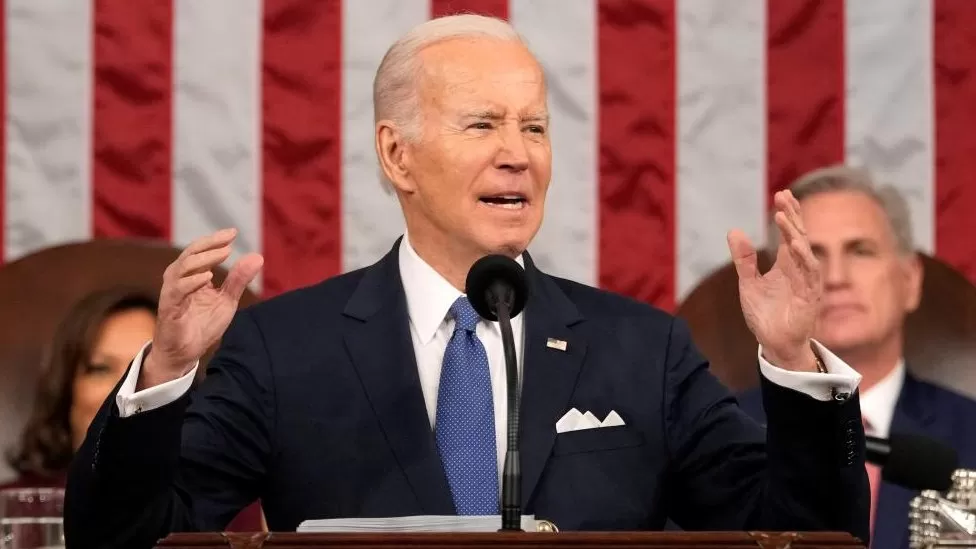
Over the president’s shoulder at the rostrum in the House of Representatives was one of his most vocal critics, the Republican Speaker Kevin McCarthy.
The president was flanked by Vice-President Kamala Harris, and Kevin McCarthy, the Republican Speaker of the House of Representatives
Mr Biden extended an olive branch to the opposition party, which took over the lower chamber of Congress last month with vows to investigate the president’s family and Cabinet.
“To my Republican friends, if we could work together in the last Congress, there is no reason we can’t work together in this new Congress,” said the president, who has previously been accused by his opponents of divisive rhetoric.
“We’ve been sent here to finish the job!” he added.
Mr Biden also said that two years after supporters of his predecessor Donald Trump rioted at the US Capitol, America’s democracy was “unbowed and unbroken”.
As sometimes happens in State of the Union speeches, the president was at points heckled by opposition lawmakers.
Watch: Three testy moments during the State of the Union
Mr Biden made minimal reference in the 7,200-word speech to the foreign policy imbroglio that has gripped the nation in recent days: a suspected Chinese surveillance balloon that crossed US territory before the American military shot it down off the coast of South Carolina last weekend.
The president said he was committed to working constructively with China, but cautioned: “Make no mistake: as we made clear last week, if China threatens our sovereignty, we will act to protect our country. And we did.”
Republicans have been demanding to know why Mr Biden waited a week to act. The president’s administration has said it wanted to avoid risk to civilians from falling debris.
Mr Biden’s speech was light on foreign policy in general, with Ukraine – the main topic of his 2022 State of the Union in the wake of Russia’s invasion – getting a mention towards the end of this year’s remarks. Mr Biden reiterated that the US would stand with Kyiv “as long as it takes”.
The president focused on domestic issues, hailing the resilience and strength of the US economy. Unemployment dropped to a half-century low in January, and there are signs that the worst inflation in four decades is cooling. But the president acknowledged American families need more “breathing room”.
Mr Biden aired his political wish-list, calling for an assault weapons ban, a minimum tax for billionaires, and access to pre-school for three and four-year-olds – though many of the proposals are likely to go nowhere in Congress.
He also condemned “outrageous” profits by oil companies, but drew scorn from Republicans in the chamber when he said: “We’re going to need oil for at least another decade.”
Following the death of Tyre Nichols in Memphis last month, Mr Biden also challenged lawmakers to pass long-stalled reforms to policing, saying: “Do something.” Mr Nichols’ mother and stepfather were in the audience as guests of First Lady Jill Biden.
Rodney Wells and RowVaughn Wells (front left), the parents of Tyre Nichols, attended the speech as guests – alongside Brandon Tsay, hero of the California dance hall shooting, shooting, and U2 singer Bono
The president also emphasised that “most cops are good, decent people”, drawing a rare standing ovation by lawmakers on both sides of the aisle.
The 80-year-old president is facing questions over his ability to serve a second presidential term, which would end when he is 86.
Arkansas Governor Sarah Huckabee Sanders – who at 40 is the country’s youngest governor, and best known for her tenure as press secretary to former President Trump – delivered the Republican response to his speech.
The rebuttal is often delivered by young rising stars in the opposition party and frequently from outside Washington.
Mrs Sanders said: “Most Americans simply want to live their lives in freedom and peace, but we are under attack in a left-wing culture war we didn’t start and never wanted to fight.”
The government had proposed giving police powers to stop protesters using tactics such as blocking roads and slow marching before disruption takes place.
Critics had described proposals as an attack on the right to protest.
Peers removed the plans from the Public Order Bill on Tuesday. Ministers cannot re-add the policy when the bill returns to the House of Commons.
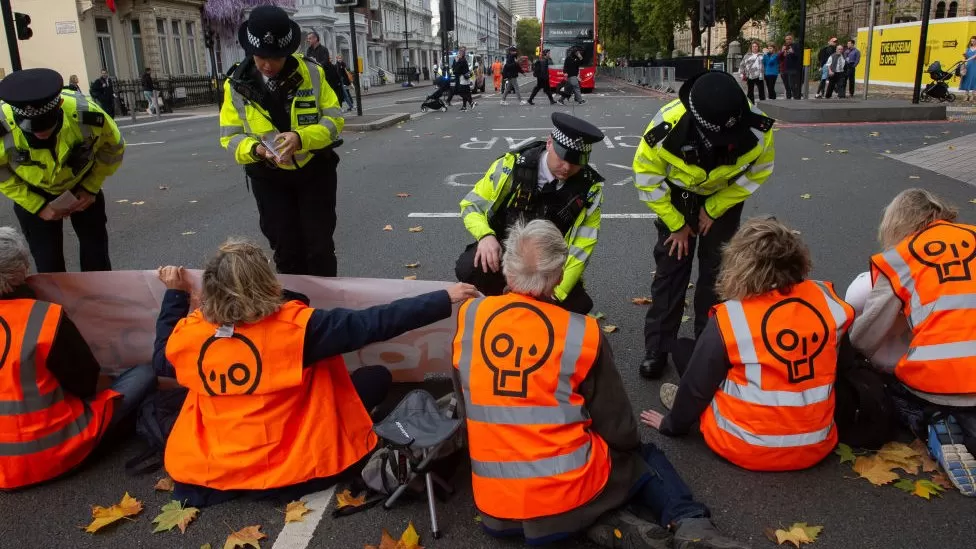
The bill was introduced to crack down on disruptive protests by groups such as environmental activists Just Stop Oil, Insulate Britain and Extinction Rebellion, which have used tactics including blocking roads.
It covers England and Wales and is currently being scrutinised by the House of Lords. Any changes at this stage could be blocked by peers before they become law.
No 10 wants to introduce measures that would mean police would not have to wait for disruption to take place to shut down a protest.
It says forces should also be able to consider the “total impact” of a series of protests by the same group, rather than seeing them as standalone incidents.
Under this existing legislation, if the police want to restrict a protest, they generally have to show it may result in “serious public disorder, serious damage to property or serious disruption to the life of the community”.
But peers rejected the plans by 254 votes to 240. The proposals were only introduced to the Bill in the Lords and so cannot return during parliamentary ping-pong as it was not in the original legislation that went before the Commons.
The House of Lords also voted down a government proposal that would allow police officers to search people without suspicion in a designated area to look for items that could be used in offences such as “locking on”. Peers rejected the measure by 284 votes to 209
A frontbench bid to prevent protesting “an issue of current debate” being used as a lawful excuse for blocking a road was also voted down by 248 votes to 239. Ministers cannot re-add this policy either when the bill returns to the Commons.
Peers went on to defy the government again in backing safeguards for journalists in the Bill by 283 votes to 192, majority 91.
Martha Spurrier, director of human rights group Liberty, previously described the proposals as “a desperate attempt to shut down any route for ordinary people to make their voices heard”.
She said allowing the police to shut down protests before any disruption had taken place “sets a dangerous precedent”.
The Bill builds on the controversial Police, Crime, Sentencing and Courts Act, which passed last year and was criticised by some groups for introducing curbs on the right to protest.
Samantha Markle is suing Meghan for “defamation and injurious falsehoods” following the couple’s interview with Oprah Winfrey in 2021.
She alleges she was defamed when Meghan “falsely and maliciously” said she was “an only child”.
A motion brought by Meghan to stop depositions in the civil case from taking place was dismissed by a judge.
A deposition is a formal statement of evidence in the US, required to be taken of a witness or party to litigation by a court.
In the much-anticipated interview with Winfrey, the couple discussed their families, royal life and mental health.
The duchess’ half-sister claimed, in a filing submitted in March, that Meghan made “demonstrably false and malicious statements” to a worldwide audience.
Documents obtained by PA News agency show the original motion.
They show Samantha Markle, who has MS and uses a wheelchair, brought the action, saying around 50m people in 17 countries had watched the Winfrey interview.
The motion says that it “disseminated false and malicious lies” and had subjected Samantha Markle to “humiliation, shame and hatred on a worldwide scale”.
It adds that Meghan had used “the powerful resources of the Royal Family’s public relations operation” to spread “lies worldwide” about Samantha Markle and their father Thomas Markle and describes it as a “premediated campaign to destroy their reputation and credibility”.
It was done, the motion says, “to preserve and promote the false ‘rags to royalty’ narrative”.
A motion brought by Meghan to stop depositions in the case from taking place was dismissed on Tuesday by Florida judge Charlene Edwards Honeywell.
The defamation case comes after the publication of Prince Harry’s memoir Spare in January and the couple’s Netflix series last year.
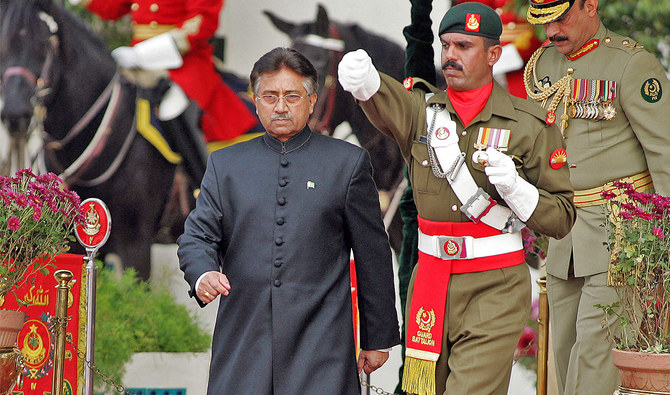
KARACHI: The funeral prayers of former president General (retd) Pervez Musharraf will be held today in Malir Cantonment’s Polo Ground at 1:45pm.
The mortal remains of the former army chief were brought to Karachi on Monday night in a special plane from the UAE — after several delays in the flight.
Earlier in the day, the body was given Ghusl (ritual washing and shrouding of the deceased ahead of burial) in Sonapur, Dubai, where he breathed his last at the age of 79.
Along with the body of the deceased, the widow of the ex-army chief and their children were also flown in.
Upon arrival, the plane was parked near the old terminal at the airport. The body and the aggrieved family were then taken to their destination from the old terminal under tight security.
The bereaved family formally approached Pakistan’s consulate in Dubai on Sunday, seeking permission to shift the body.
It is pertinent to mention here that the former president’s mother was buried in Dubai while his father was laid to rest in Karachi.
It should be noted that Gen (retd) Musharraf passed away on Sunday, where he had been under treatment for amyloidosis at the American Hospital in Dubai for a long time.
Prime Minister Shehbaz Sharif, Pakistan Muslim League-Nawaz supremo Nawaz Sharif, and other politicians had prayed for the ex-president’s forgiveness — who did not return to the country since 2016.
An official 51-member Pakistani rescue team was also set to touchdown in Istanbul today, federal minister Saad Rafiq said on Twitter.
The confirmed death toll across the two countries has soared above 4,300 after a swarm of strong tremors near the Turkiye-Syria border — the largest of which measured at a massive 7.8-magnitude.
Turkish and Syrian disaster response teams report more than 5,600 buildings have been flattened across several cities, including many multi-storey apartment blocks that were filled with sleeping residents when the first quake struck.
In the city of Kahramanmaras in southeastern Turkiye, eyewitnesses struggled to comprehend the scale of the disaster.
“We thought it was the apocalypse,” said Melisa Salman, a 23-year-old reporter. “That was the first time we have ever experienced anything like that.”
Turkiye’s relief agency AFAD on Tuesday said there were now 2,921 deaths in that country alone, bringing the confirmed tally to 4,365.
There are fears that toll will rise inexorably, with World Health Organization officials estimating up to 20,000 may have died.
In Gaziantep, a Turkish city home to countless refugees from Syria’s decade-old civil war, rescuers picking through the rubble screamed, cried and clamoured for safety as another building collapsed nearby without warning.
The initial earthquake was so large it was felt as far away as Greenland, and the impact is big enough to have sparked a global response.
Dozens of nations from Ukraine to New Zealand have vowed to send help, although freezing rain and sub-zero temperatures have slowed the response.
In the southeastern Turkish city of Sanliurfa, rescuers were working into the night to try and pull survivors from the wreckage of a seven-storey building that had collapsed.
“There is a family I know under the rubble,” said 20-year-old Syrian student Omer El Cuneyd.
“Until 11:00 am or noon, my friend was still answering the phone. But she no longer answers. She is down there.”
Despite freezing temperatures outside, terrified residents spent the night on the streets, huddling around fires for warmth.
Mustafa Koyuncu packed his wife and their five children into their car, too scared to move.
“We can’t go home,” the 55-year-old told AFP. “Everyone is afraid.”
Some of the heaviest devastation occurred near the quake’s epicentre between Kahramanmaras and Gaziantep, where entire city blocks lay in ruins under gathering snow.
‘Apocalypse’
Monday’s first earthquake struck at 4:17am (0117 GMT) at a depth of about 18 kilometres (11 miles) near the Turkish city of Gaziantep, which is home to around two million people, the US Geological Survey said.
More than 14,000 people have so far been reported injured in Turkiye, the disaster management agency said, while Syria said at least 3,411 people were injured.
Officials said three major airports have been rendered inoperable, complicating deliveries of vital aid.
A winter blizzard has covered major roads into the area in ice and snow.
Much of the quake-hit area of northern Syria has already been decimated by years of war and aerial bombardment by Syrian and Russia forces that destroyed homes, hospitals and clinics.
The conflict is already shaping the emergency response, with Syria’s envoy to the United Nations Bassam Sabbagh seemingly ruling out reopening border crossings that would allow aid to reach areas controlled by rebel groups.
The Syrian health ministry reported damage across the provinces of Aleppo, Latakia, Hama and Tartus, where Russia is leasing a naval facility.
Even before the tragedy, buildings in Aleppo — Syria’s pre-war commercial hub — often collapsed due to the dilapidated infrastructure, which has suffered from a lack of wartime oversight.
Officials cut off natural gas and power supplies across the region as a precaution, also closing schools for two weeks.
The UN cultural agency UNESCO expressed fears over heavy damage in two cities on its heritage list — Aleppo in Syria and Diyarbakir in Turkiye.
At a jail holding mostly Islamic State group members in northwestern Syria, prisoners mutinied after the quakes, with at least 20 escaping, a source at the facility told AFP.
The United States, the European Union and Russia all immediately sent condolences and offers of help.
President Joe Biden promised his Turkish counterpart Recep Tayyip Erdogan that the United States will send “any and all” aid needed to help recover from a devastating earthquake.
Ukrainian President Volodymyr Zelensky also offered to provide “the necessary assistance” to Turkiye, whose combat drones are helping Kyiv fight the Russian invasion.
Turkiye is in one of the world’s most active earthquake zones.
The country’s last 7.8-magnitude tremor was in 1939, when 33,000 died in the eastern Erzincan province.
The Turkish region of Duzce suffered a 7.4-magnitude earthquake in 1999, when more than 17,000 people died.
Experts have long warned a large quake could devastate Istanbul, a megalopolis of 16 million people filled with rickety homes.
PM Shehbaz to leave for Turkiye on Feb 9
Meanwhile, Information Minister Marriyum Aurangzeb has said that Prime Minister Shehbaz Sharif will depart for Turkiye on Feb 9, Wednesday.
She tweeted that the premier will meet Turkish President Recep Tayyip Erdoğan and express condolences with the lives lost in the earthquake.
Separately, Prime Minister Shehbaz Sharif said in a tweet that the destruction in Turkiye and Syria was mind numbing.
“24 hours after the devastating earthquake hit Turkiye & Syria, scenes of death and destruction are mind numbing. It breaks the heart to witness sheer scale of unfolding human tragedy,” he said.
The premier added that solidarity with Turkiye and Syria should translate into “tangible and timely material support for suffering humanity”.
Pakistan dispatches relief items
On Tuesday morning, Pakistan dispatched two contingents; urban search and rescue team — comprising rescue experts, sniffer dogs, search equipment and a Medical team comprising army doctors, nursing staff and technicians along with 30 bedded mobile hospital, tentage, blankets — and other relief items for Turkiye.
“The aid contingents have flown to Adana via a special Pakistan Air Force aircraft on the night of February 6-7, 2023, to undertake relief efforts for the Turkish people while working in close coordination with the Turkish government, AFs and their Embassy in Islamabad,” a statement issued by the Inter-Services Public Relations (ISPR) said.
It stated that the contingents would stay in Turkiye until the completion of the relief and rescue operation.
“People and AFs of Pakistan stand with our Turk brethren and offer all available support in this hour of need,” the statement added.
Additionally, Minister for Railways Khawaja Saad Rafique said that a Pakistan International Airline (PIA) airplane will take a 51-member rescue team to Istanbul today.
“PK-707 will depart from Lahore for Istanbul with the Pakistani rescue team and their special equipment,” he tweeted, adding that measures for the delivery of relief items had also been completed.
Rafique further said that the delivery of relief goods has been made cost-free on all PIA flights to Istanbul and Damascus. The items can be delivered to PIA’s cargo terminal through the National Disaster Management Authority (NDMA).