

Australian MPs support Sikhs’ rights after attacks by pro-India lobby

MELBOURNE: After The Australian newspaper attacked the pro-Khalistan activism of Sikhs in Australia and linked it with acts of terrorism, several Australian parliamentarians have come out to express solidarity with the local Sikh community which is gearing up for Khalistan Referendum voting in Melbourne on January 29, 2023.

Ever since the Australian Phase of Khalistan Referendum was announced, a series of articles linking the pro-Khalistan activism with terrorism has been published in The Australian and were spiked up after massive ‘Genocide To Referendum’ car rally was carried out in Melbourne last week in which the 1984 Anti-Sikh Riots were highlighted with pictures of 13-days-old babies, who were killed by Hindu mobs in the wake of Indira Gandhi’s assassination on October 31, 1984.

The Australian Sikh community pushed back against the undue and unsubstantiated criticism of their political activism as an attempt to muzzle their freedom of expression, resulting in parliamentarians from across party lines coming out to express support for the Sikh community, giving full backing to the right of Sikhs to peacefully express their political opinion through voting in Khalistan Referendum, organised by pro-Khalistan group Sikhs For Justice (SFJ), in Melbourne next month.

Rob Mitchell MP, the federal member of McEwen, said in a letter that he was disappointed by recent articles in The Australian regarding the Sikh community in Melbourne.

“Be assured that these articles are in no way reflective of our view of the Sikh community. Australia values diversity and inclusion respects the right of individuals to engage in peaceful protest and supports the non-violent expression of views and beliefs. Freedom of expression is fundamental in open and democratic societies,” he said.

David Shoebridge, senator for New South Wales, and Senator Jordon Alexander Steele-John said The Australian newspaper on December 6, 2022, published an article which inappropriately allowed an anonymous representative of the foreign Indian government to attack the Sikh community in Australia.

“These attacks are not based on any material evidence. Our officers have heard from the Sikh community who understandably are offended and disturbed by the content of this article.

“The Sikh community has a proud history of positive peaceful community support, community outreach and proactive contributions to our multiracial community,” he said.

The senators said they will “continue to stand beside the Sikh community” to ensure that their rights are respected.

Federal Member for Leichhardt Warren Entsch said the comments published against Sikhs in the paper had “caused serious damage to the reputations of Sikh communities across Australia. The reporting of warnings raised by the Indian government doesn’t accurately reflect the reality of the situation here in Australia. The Sikh community in Australia is a peaceful and law-abiding group of people who have contributed a great deal to our local communities”.

The lawmaker said that Sikhs have long been persecuted by the Indian government and their security forces have deployed brutal and deplorable tactics, particularly in the 80s when tens of thousands of men and boys were murdered in the Sikh genocide.

“Recognition of this atrocity is still disputed by those responsible, and this trauma is still felt and carried by Sikhs. Despite the range of challenges Sikhs faced abroad and here at home in Australia, they have diligently contributed and volunteered for our communities – far more than most,” he added.

The lawmaker called on The Australian to apologise to the Sikh community for linking them to terrorism.

Several Sikh organisations across Australia have also criticised recent coverage by the said paper.

Published in the December 6 edition of the News Limited publication, the article carried the headline ‘India warns Anthony Albanese over Sikh separatists and terror links’.

The coverage referenced events that took place at the Nagar Kirtan [Harmony Walk] organised by the Victorian Sikh Gurdwara Council (VSGC) on November 19 in Melbourne when thousands of Sikhs gathered to raise demands for Khalistan and expressed support for the upcoming Khalistan Referendum event.

The Australian coverage also stated that the “emerging” Khalistani activities in Melbourne are making many in the Indian-Australian community “highly concerned”.

It provided statements from an anonymous Indian government official who said that the Modi government wanted to convey to its Australian counterparts that the Khalistan movement has ties to “prescribed terrorist organisations with a history of violent terrorism and lots of violence in the past”.

Sikh organisations including the Sikh Gurdwara Perth (Inc.), Australian Sikh Association Sydney, Victorian Sikh Gurdwara Council and Turbans 4 Australia have objected to the contents of the article. They have been joined by the parliamentarians who have expressed support for Sikhs and their demand for a free homeland.
Over 190 nations approve historic Chinese-brokered nature accord

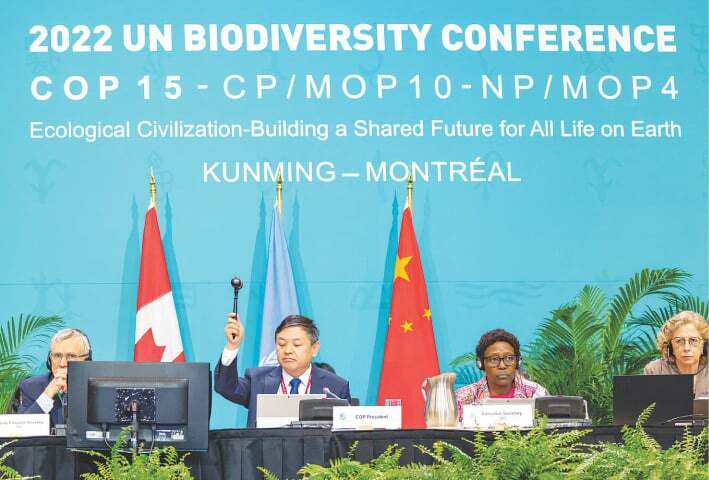
MONTREAL: More than 190 countries approved a historic deal to reverse decades of environmental destruction threatening the world’s species and ecosystems at a marathon UN biodiversity summit early Monday.

The chair of the COP15 nature summit, Chinese Environment Minister Huang Runqiu, declared the deal adopted at a plenary session in Montreal that ran into the wee hours and banged his gavel, sparking loud applause from assembled delegates.

After four years of fraught negotiations, states rallied behind the Chinese-brokered accord aimed at saving Earth’s lands, oceans and species from pollution, degradation and the climate crisis. “We have in our hands a package that I think can guide us all to work together to hold and reverse biodiversity loss, to put biodiversity on the path of recovery for the benefit of all people in the world,” Huang told the assembly.

His Canadian counterpart and host Steven Guilbeault called it a “historic step”.

Congo refuses to back deal, seeking greater funding for developing world

President of the European Commission Ursula von der Leyen welcomed the “historic” international deal on saving the world’s biodiversity, calling it “a roadmap to protect and restore nature”. “This agreement provides a good foundation for global action on biodiversity, complementing the Paris Agree­ment for Climate,” she said.

However, the move overruled an objection from the Democratic Republic of Con­go that had refused to back the text, demanding greater funding for developing countries as part of the accord.

Biggest conservation deal

The deal pledges to secure 30 per cent of the planet as a protected zone by 2030, stump up $30 billion in yearly conservation aid for the developing world and halt human-caused extinctions of threatened species.

Environmentalists have compared it to the landmark plan to limit global warming to 1.5C under the Paris agreement, though some warned that it did not go far enough.

Brian O’Donnell of the Campaign for Nature called it “the largest land and ocean conservation commitment in history.” “The international community has come together for a landmark global biodiversity agreement that provides some hope that the crisis facing nature is starting to get the attention it deserves,” he said.

“Moose, sea turtles, parrots, rhinos, rare ferns and ancient trees, butterflies, rays, and dolphins are among the million species that will see a significantly improved outlook for their survival and abundance if this agreement is implemented effectively.” The CEO of campaign group Avaaz, Bert Wander, cautioned: “It’s a significant step forward in the fight to protect life on Earth, but on its own it won’t be enough. Governments should listen to what science is saying and rapidly scale up ambition to protect half the Earth by 2030.”

Indigenous rights

The text pledges to safeguard the rights of Indigenous people as stewards of their lands, a key demand of campaigners. But observers noted it pulled punches in other areas — for example, only encouraging businesses to report their biodiversity impacts rather than mandating them to do so.

The 23 targets in the accord also include saving hundreds of billions of dollars by cutting environmentally destructive farming subsidies, reducing the risk from pesticides and tackling invasive species.

Funding fight

At times, the talks looked at risk of collapsing as countries squabbled over money. How much the rich countries will send to the developing world, home to most of the planet’s biodiversity, was the biggest sticking point.

Developing countries had been seeking the creation of a new, bigger fund for aid from the Global North. But the draft text instead suggested a compromise: creating a fund under the existing Global Environment Facility (GEF).

That concern was echoed by the Democratic Republic of Congo.

Current financial flows for nature to the developing world are estimated at around $10 billion per year. A DRC delegate spoke up in the plenary to demand annual funding rise to $100 billion.

The US is not a signatory to the biodiversity convention due to resistance from Republican senators.

Netherlands PM apologises for 250 years of slavery

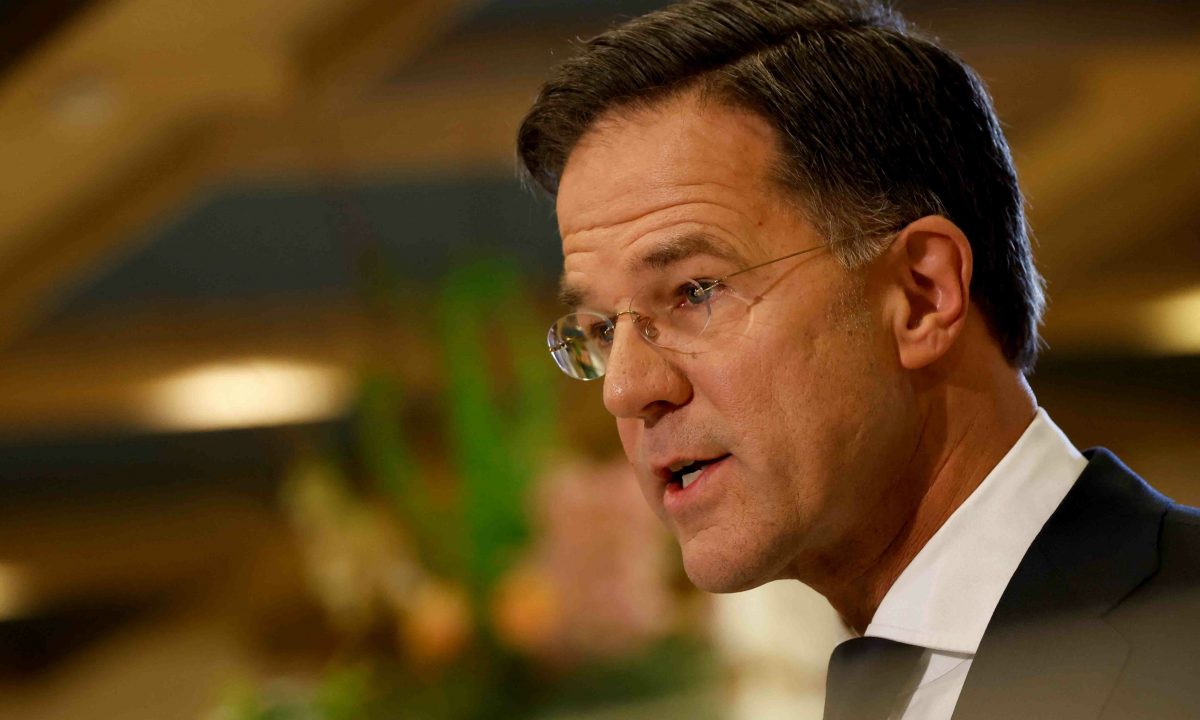
The apology comes almost 150 years after the end of slavery in the European country’s overseas colonies, which included Suriname and islands like Curacao and Aruba in the Caribbean and Indonesia in the East.

“Today on behalf of the Dutch government, I apologise for the past actions of the Dutch state,” Rutte said in a speech in The Hague.

“We, living in the here and now, can only recognise and condemn slavery in the clearest terms as a crime against humanity,” he said. Dutch ministers have travelled to seven former colonies in South America and the Caribbean for the event.

Sigrid Kaag, the Dutch finance minister and deputy prime minister, said on an official visit to Suriname last week that a “process” would begin leading up to “another incredibly important moment on July 1 next year”.

Descendants of Dutch slavery will then celebrate 150 years of liberation from slavery in an annual celebration called “Keti Koti” (Breaking the Chains) in Surinamese.

But the plan has caused controversy, with groups and some of the affected countries criticising the move as rushed, and saying the lack of consultation by the Netherlands smacked of a colonial attitude. But Rutte in his speech on Monday said that choosing the right moment was a “complicated matter”.

“There is not one right time for everyone, not one right word for everyone, not one right place for everyone,” he said.

The Dutch funded their “Golden Age” of empire and culture in the 16th and 17th centuries by shipping around 600,000 Africans as part of the slave trade, mostly to South America and the Caribbean.

At the height of its colonial empire, the United Provinces known today as the Netherlands possessed colonies like Suriname, the Caribbean island of Curacao, South Africa and Indonesia, where the Dutch East India Company was based in the 17th century.

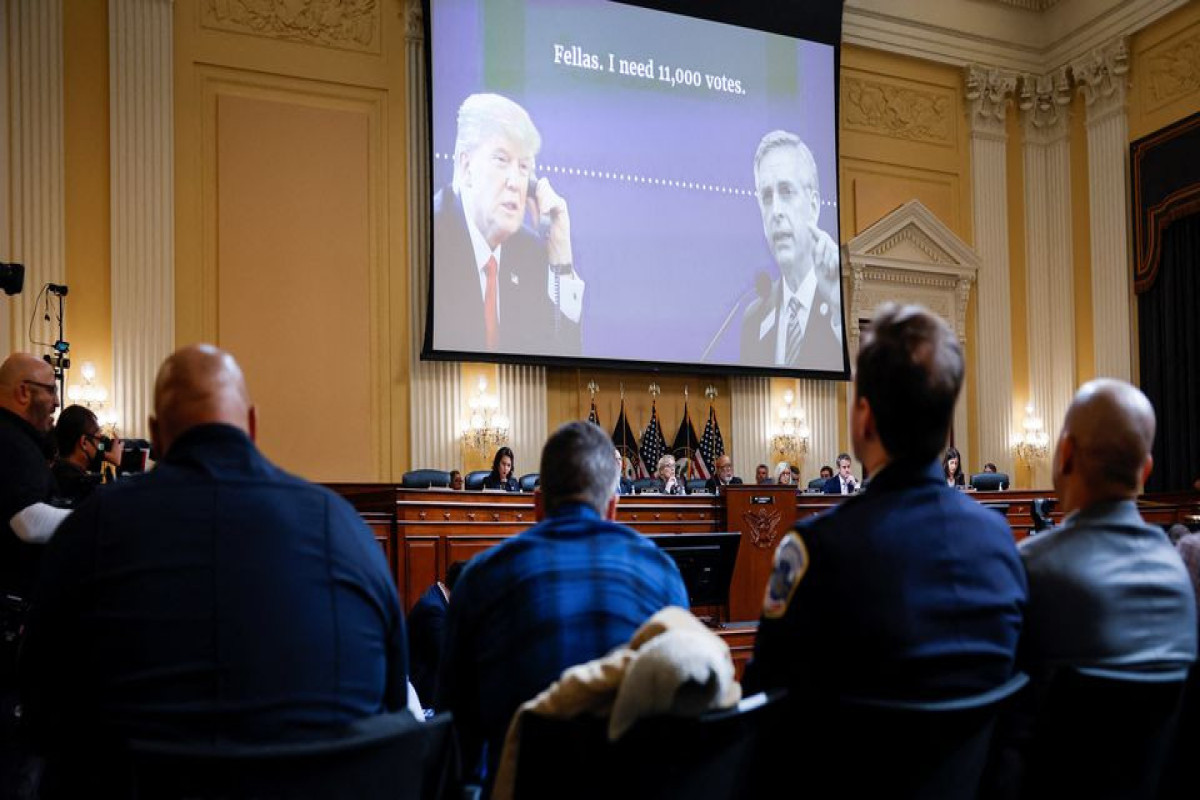
A US congressional inquiry into last year’s Capitol riot says ex-President Donald Trump should face criminal charges, including insurrection.

The Democratic-led committee voted unanimously for the justice department to prosecute Mr Trump.

The panel also aired a new clip of former Trump aide Hope Hicks on her warning to him about his legacy.

Trump supporters stormed Congress on 6 January 2021, interrupting Joe Biden’s certification as president.

Mr Trump, who denies any wrongdoing, released a statement slamming the panel as a “kangaroo court”.

After spending around 18 months investigating the riot, the House of Representatives select committee recommended at their final meeting on Monday that Mr Trump face four charges:

  • Inciting, assisting, aiding or comforting an insurrection
  • Obstruction of an official proceeding
  • Conspiracy to defraud the United States
  • Conspiracy to make a false statement

The justice department – whose prosecutors are already considering whether to charge Mr Trump – does not have to follow a congressional committee’s referral.

While the panel’s actions are mostly symbolic, the chairman described the proposed charges as a “roadmap to justice”.

A justice department spokesman declined to comment on Monday about the referral.

“An insurrection is a rebellion against the authority of the United States,” said congressman Jamie Raskin, a Maryland Democrat who serves on the committee.

“It is a grave federal offence, anchored in the Constitution itself.”

The panel’s seven Democrats and two Republicans released their preliminary 161-page executive summary on Monday.

It accused Mr Trump of a “multi-part conspiracy” to thwart the will of voters in the run-up to the Capitol riot and during the riot itself.

The House committee has argued Mr Trump spread claims that he knew were false about the 2020 presidential election being stolen, before pressuring state officials, the justice department and his own vice-president to help overturn his defeat. The panel accuses him of inciting the riot at Congress in a last-ditch bid to block the peaceful transfer of power to Mr Biden.

The full report, spanning hundreds of pages, is due to be released on Wednesday.

WATCH: Capitol riot committee announces Trump referral

On Monday, the panel also released a new video from their deposition with longtime Trump aide Hope Hicks, who said she had warned Mr Trump that by continuing to make false claims about the election, he and his team were “damaging his legacy”.

Mr Trump had shrugged off her concern, she said.

The then-Republican president, she testified, “said something along the lines of, ‘Nobody will care about my legacy if I lose, so that won’t matter.

“‘The only thing that matters is winning.'”

The committee also criticised the president’s eldest daughter Ivanka Trump, a former White House aide, for not being “forthcoming” with investigators.

Ms Trump and White House press secretary Kayleigh McEnany “displayed a lack of full recollection of certain issues, or were not otherwise as frank or direct” as other aides to Mr Trump, the report said.

Mr Trump’s presidential campaign, which he launched last month, released a statement accusing the committee of holding “show trials by Never Trump partisans who are a stain on this country’s history”.

“This Kangaroo court has been nothing more than a vanity project that insults Americans’ intelligence and makes a mockery of our democracy.”

A Trump bust being held up during the day of the riot at the US Capitol

The committee also said it would refer four Republican members of Congress to the House ethics committee, including Republican leader Kevin McCarthy, for failing to comply with the committee.

“If we are to survive as a nation of laws and democracy, this can never happen again,” said committee chairman Bennie Thompson, a Mississippi Democrat.

“If the faith is broken, so is our democracy. Donald Trump broke that faith,” he added.

More than 900 people have been charged in relation to the Capitol riot.

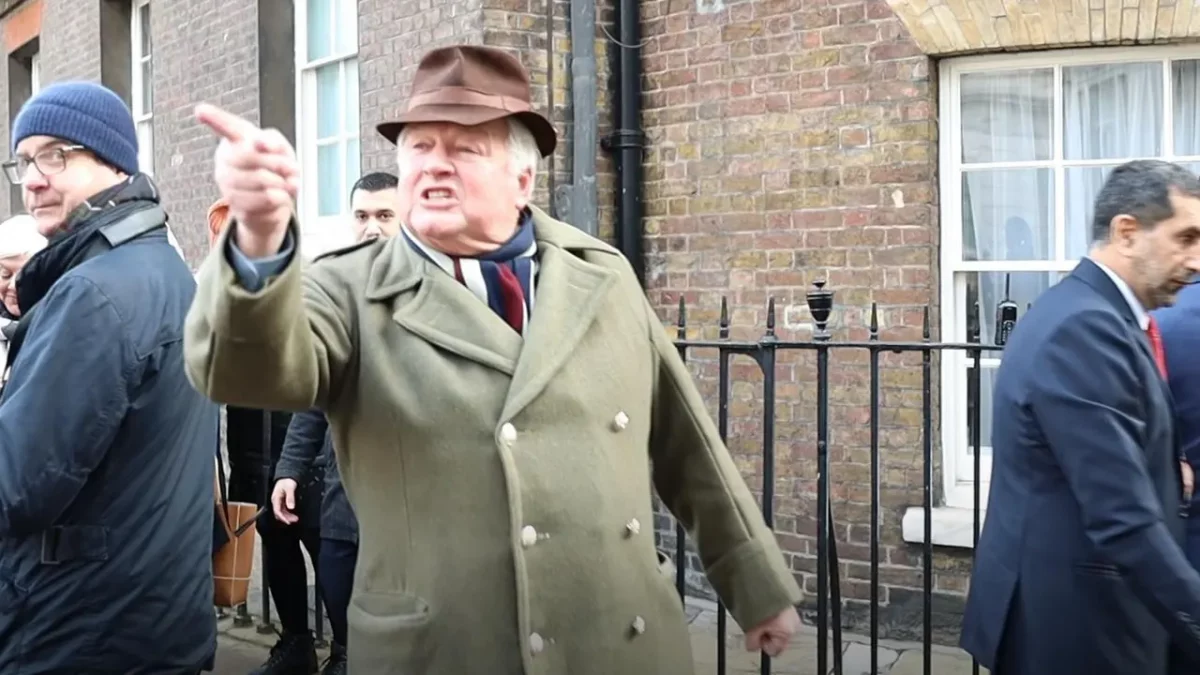
A human rights activist has complained to the Conservative Party after a Tory MP told him to “go back to Bahrain”.

Sayed Ahmed Alwadaei confronted MP Bob Stewart outside an event hosted by the Bahraini embassy in London.

The campaigner repeatedly pressed him on his links to the country, asking “did you sell yourself to the Bahraini regime?”

Mr Stewart has apologised for his remarks but said he was “taunted” and had not taken money from Bahrain.

Mr Alwadaei, who is director of advocacy at the Bahrain Institute for Rights and Democracy, challenged Mr Stewart outside an event to mark the National Day of Bahrain last Wednesday.

In a video, provided to the BBC by Mr Alwadaei, Mr Stewart said in response to his questioning: “Get stuffed. Bahrain’s a great place. End of.”

He later added: “Go away, I hate you. You make a lot of fuss. Go back to Bahrain.”

After being asked again if he had accepted any money from the Bahraini regime, Mr Stewart said: “You’re taking money off my country, go away!”

The event was also attended by former prime minister Theresa May and Conservative Party chairman Nadhim Zahawi.

Mr Alwadaei, who in 2020 was awarded a prize by the Index On Censorship group for his campaigning, fled Bahrain in 2011 after being arrested for taking part in anti-government protests.

He came to the UK in 2012, where he was granted political asylum and continued to campaign on human rights abuses in Bahrain.

Mr Alwadaei said: “I still have the scars from where the authorities kicked me in the head, and if I went back to Bahrain I would face further torture and imprisonment. My family members are still suffering from reprisals.”

He added: “I don’t believe I would have been told to ‘go back’ to the country that violently tortured me if it weren’t for the colour of my skin. No-one should be subjected to racial abuse.”

Mr Alwadaei said he had also complained to the parliamentary commissioner for standards, Kathryn Stone, and reported the incident to the police. The Metropolitan Police have been approached for comment.

Mr Stewart, a former Army officer who was stationed in Bahrain in the 1960s, said he regretted his remarks.

“The protesters persistently taunted me by saying I had taken money from Bahrain. That deeply offended me. I certainly have not and told them so repeatedly,” he said.

“I admit I fell for the taunts and should not have responded which I regret. My comments were meant to tell them they could protest safely in Bahrain… Bahrain gets a very unfair press and I feel that strongly.

“I am sorry if anyone thought I was being racist in any way. Honestly I was not. I wish now I had not been drawn by the taunts (a mistake) but I was and I repeat, I apologise for that. The last thing I meant to be was racist as I have so many good Bahraini friends.”

A Conservative Party spokesman said: “We have an established Code of Conduct and formal processes where complaints can be made in confidence. This process is rightly confidential.”

Mr Stewart has previously defended Bahrain, telling a Commons debate in January that the country “does not have political prisoners” and “they are all prisoners who are there because they have committed a crime”.

The Tory MP has been on two visits to the country paid for by the Bahrain government since last year, according to parliamentary records.

Charities including Amnesty International have accused Bahrain of serious human rights violations, including torture and suppression of freedom of expression.

Protesters took to the streets in 2011 to demand greater rights but the government, backed by Saudi tanks, moved in to crush dissent.

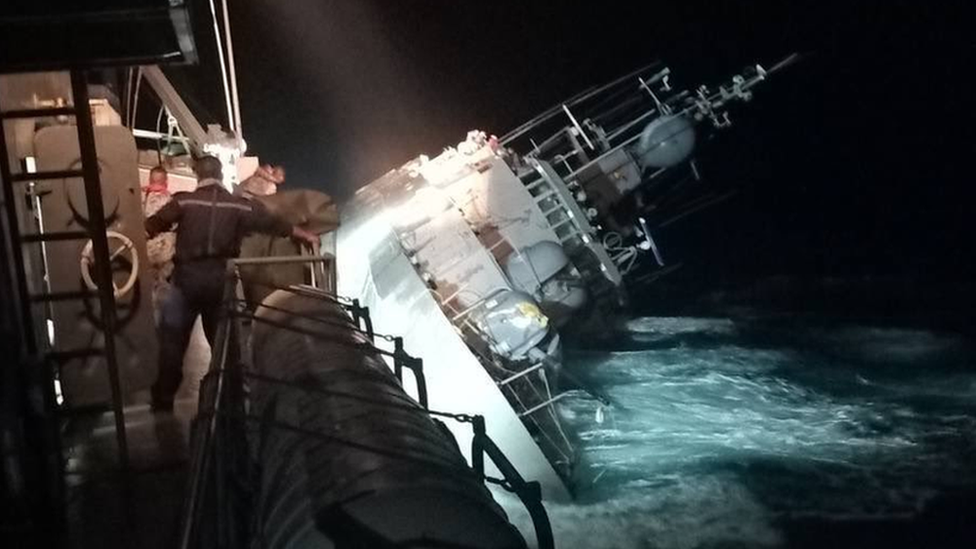
The Thai navy says 31 sailors are missing after a warship carrying over 100 crew capsized and sank during a storm in the Gulf of Thailand.

The HTMS Sukhothai sank after water flooded its power controls on Sunday night.

On Monday, authorities said they had rescued 75 crew, but 31 were still missing in rough seas.

“It’s been more than 12 hours, but we will keep looking,” a navy spokesman told the BBC.

Search crews worked through the night to find survivors, with the operation continuing on Monday with air force assistance.

The navy also announced an investigation into the cause of the disaster.

“This has almost never happened in our force’s history, especially to a ship that is still in active use,” spokesman Admiral Pogkrong Monthardpalin told the BBC.

Officials said the ship went down after it took on water, which flooded its hull and short-circuited its power room.

With the power lost, the crew battled to retain control of the ship which listed on to its side before sinking around 23:30 local time Sunday (16:30 GMT).

The ship had been on a patrol 32km (20 miles) east of Bang Saphan, in the Prachuap Khiri Khan province, when it got caught in the storm on Sunday.

Dramatic pictures posted on the Thai Navy’s Twitter account show the vessel listing onto its starboard side, and back-up rescue ships trying to find survivors in choppy waters.

Three naval ships and helicopters were sent to assist, but only the HTMS Kraburi reached the vessel before it sank.

The frigate picked up most of the Sukhothai’s crew, the navy said. Sailors wearing life jackets were found in the water and in life rafts. The navy has disclosed scant detail on their condition. Local media published pictures showing medical personnel at the dock taking crew members off in stretchers.

Prime Minister Prayut Chan-o-Cha released a statement on Monday confirming officials were investigating the disaster.

“I am following the news closely – about five people are seriously injured,” he said.

The HTMS Sukhothai was built for the Thai navy in the US in the mid-1980s.

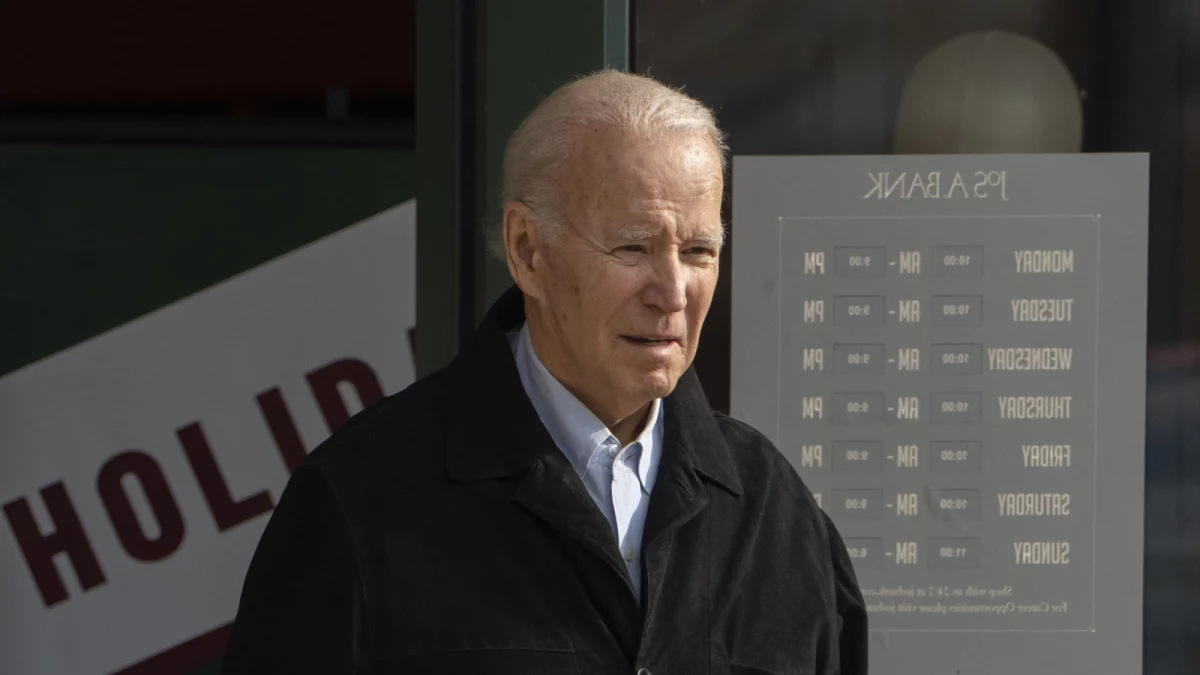
Biden under pressure over asylum rules

US border cities are bracing for an influx of asylum seekers after a US judge in November moved to strike down a policy enacted by the Trump administration in 2020 that has allowed migration authorities to rapidly send asylum seekers back to Mexico and other countries.

The policy, known as Title 42, is due to end on December 21, and thousands of asylum seekers have been lining up at the US-Mexico border ahead of the easing of restrictions.

On Saturday, the west Texas border city of El Paso declared a state of emergency, citing hundreds of migrants sleeping on the streets in cold temperatures and the thousands being apprehended every day.

“It’s a very dire situation,” US Representative Tony Gonzales of Texas, a Republican, told CBS’s Face the Nation.

Gonzales called on Biden to revive past policies that tried to speed up asylum review and expedite deportations.

US Representative Henry Cuellar, a Democrat who also represents Texas, urged Biden to enact a policy requiring people to only request asylum at official border crossing points.

Most Japanese oppose tax to fund military expansion

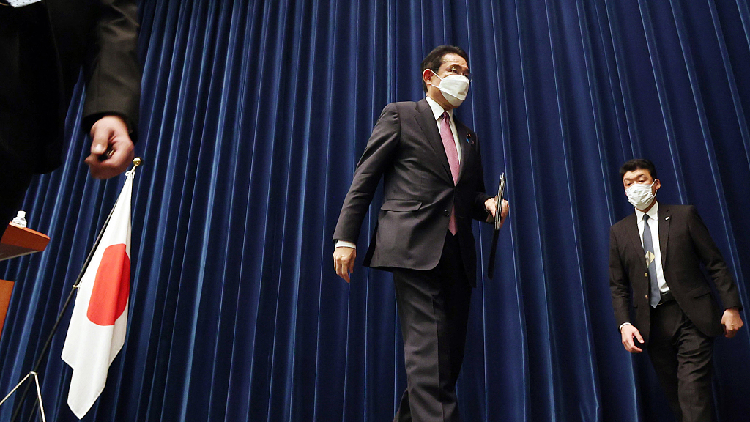
Japan on Friday announced a $320 billion military spending plan to buy missiles capable of striking China and to ready the country for any sustained conflict, as missile tests by nearby North Korea, China’s claim over Taiwan and the invasion of Ukraine by Japan’s western neighbour Russia stoke fear of war.

Prime Minister Fumio Kishida this month said his government would not hike taxes for the next fiscal year beginning April 1 but would raise them in stages toward fiscal 2027 to secure funding to boost the defence budget.

He said Japan was at a “turning point in history” and that military expansion through cost-cutting and tax hikes was “my answer to the various security challenges that we face”.

Almost 65pc of respondents in Kyodo’s survey opposed raising taxes for military spending, while 87pc said Kishida’s explanation of the need to raise tax was insufficient.

The survey also showed support for Kishida’s administration was unchanged from a month earlier at 33.1pc, the worst since it was launched in October last year.

The government’s five-year tax plan, once unthinkable in pacifist Japan, would make the country the world’s third-biggest military spender after the Unit-ed States and China, based on current budgets.

Argentina awaits to welcome home Messi and World Cup winners

In the capital Buenos Aires and throughout the country, millions took to the streets to celebrate Sunday’s remarkable penalty shoot-out victory over France in the World Cup final in Qatar.


Messi finally crowned his record-breaking career with the one trophy that was missing as he produced a performance that will go down in World Cup history, scoring a first-half penalty and netting again in extra time.

France had fought back from 2-0 down in the last 10 minutes as Kylian Mbappe scored twice to equalise and force extra time in a pulsating match watched by an 89,000 crowd in Lusail Stadium.

Messi seemed to have decided the match in extra time with his second goal of the game before his Paris Saint-Germain teammate Mbappe completed only the second World Cup final hat-trick to bring the score to 3-3 and force penalties.

Gonzalo Montiel swept home the decisive spot kick to win the shootout 4-2 for Argentina — but this was Messi’s moment.

And while the players were able to celebrate with an estimated 40,000 fans inside the stadium on Sunday night, there are 45 million back home eager to welcome their heroes on Monday evening.

“Of course, it’s what we’re all waiting for,” teacher Veronica Silva, 44, told AFP from the Plaza de Mayo square in central Buenos Aires where celebrations went on into Sunday night.

“This will continue for a couple of days. It started now and it won’t end tomorrow because they arrive tomorrow: it will go on for longer.”

“Of course we can’t wait to see the players, all of them,” added cleaner Rosa Rodriguez, 63.

“It’s a good team who did us proud. The biggest celebration will be when they arrive.”

‘I can’t ask for more’

Messi had tasted bitter defeat in the 2014 final against Germany but in his fifth and final World Cup, the 35-year-old finally emulated Argentina idol Diego Maradona by leading his nation to World Cup glory for the first time since 1986.


Tens of thousands of blue and white-shirted Argentina fans rose to salute Messi as he told them “We’re champions of the world!” on the stadium microphone.

Later he told Argentine television: “Obviously I wanted to finish my career with this. I can’t ask for any more.

“My career is coming to end because these are my final years. What more could there be after this?” But he said he would continue with the Argentina squad. “I want to keep experiencing a few more matches as world champion,” he added.

FIFA will be delighted with a pulsating final that capped one of the most controversial World Cups in history, with the Qatari organisers having to face persistent questions about the country’s treatment of migrant workers and its laws on homosexuality.

Neutrals will be happy that Messi has finally won a World Cup. However, with his hat-trick — and the Golden Boot for top scorer at the tournament with eight goals — Mbappe surely showed he is ready to inherit the mantle of the world’s best player.

Enthralling game

Argentina, now three-time world champions, dominated the first half of the final as Messi scored a 23rd minute penalty after Ousmane Dembele tripped Angel Di Maria.

The mercurial Messi was then part of a superb move that led to Di Maria sweeping home Argentina’s second goal after 36 minutes.

The defending champions finally got back into the game in the second half as Randal Kolo Muani was dragged down by Nicolas Otamendi in the penalty area and Mbappe converted from the spot with only 10 minutes left.

A minute later, Mbappe scored a superb volley to bring France level.


In extra time, Messi knocked in the rebound when Hugo Lloris parried Martinez’s saved shot in the 108th minute to give Argentina the lead once again.

But when Mbappe’s shot hit Montiel’s outstretched arm, the referee pointed to the penalty spot and the French forward stroked it home to become the first player to score a World Cup hat-trick since England’s Geoff Hurst in 1966.

His heroics were not enough despite also knocking in France’s first shoot-out spot-kick, as Montiel gave Argentina a 4-2 victory after Argentina goalkeeper Emiliano Martinez saved Kingsley Coman’s attempt.

“All that I have dreamed of has been achieved. I have no words for it,” said Martinez, adding that victory was “destiny.”

France coach Didier Deschamps rued the failure to become the first team in 60 years to retain the trophy.

“I don’t want to take any merit away from Argentina but there were lots and lots of emotions and it was cruel at the end because we were so close,” he said.

Operation underway after terror attack on Bannu CTD compound

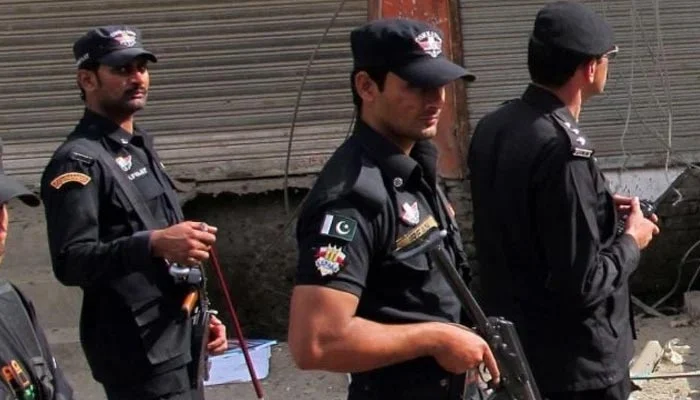
BANNU: Security forces have launched an operation to clear the area after militants took over a compound of the Counter Terrorism Department (CTD) in Bannu and held the officials hostage in the center, sources said Monday.

According to the sources, security is on high alert in the vicinity due to the operation during which a policeman embraced martyrdom while three others sustained injuries.

The internet services have been suspended in Bannu and the roads leading to and from the Bannu Cantonment have been blocked.

Miranshah Road and Jumma Khan Road are closed for all sorts of movements. The sources have claimed that the terrorists are demanding a safe air route to Afghanistan.

Four police personnel martyred

A day earlier, four police personnel were martyred and as many others wounded in an overnight terrorist attack on the Bargai Police Station of Lakki Marwat area.

Terrorists launched an armed assault on the police station from two sides. A fierce exchange of fire took place between the police and the outlaws that left four policemen dead and as many injured.

The attackers escaped after the assault. Police have launched a search operation in the area for the saboteurs.

Constables Ibrahim, Imran, Khairur Rahman and Sabz Ali are among the deceased.

Law and order situtaion in KP

The law and order situation in KP has gone south over the last few weeks as an increase has been noticed in threats and attacks on security forces as well as high-profile political personalities.

According to a The News report, the police are on high alert across the province after the recent spike in attacks in areas including Peshawar, southern districts, and the Mardan region.

The publication, citing a source, said: “Apart from the police, senior politicians have complained of receiving threats. The houses of some of them have also come under grenade attack.”

Provincial spokesperson of the Awami National Party (ANP) Samar Bilour has also shared that their provincial president Aimal Wali Khan had received a call about a plan of attack on his life.

Samar said that their leadership’s protection is the state’s responsibility, adding that they will be left with no other option but to take the protection of their leaders into their own hands if the state does not act.

“Apart from Aimal Wali Khan, Sardar Hussain Babak and others have received threats as well while the house of MPA Faisal Zeb was attacked twice in the last few weeks,” Samar Haroon Bilour had said last week.

Apart from the attack on the house of ANP MPA Faisal Zeb in Shangla, a grenade was hurled at the house of party Senator Hidayatullah in Peshawar in recent months.

Terror incidents

The wave of terrorist attacks has risen across the province in the last few months, the report said. At least 118 terrorist incidents were reported in KP from mid-August till the last week of November, according to official numbers.

At least 26 policemen, 12 personnel of other law enforcement agencies and 17 civilians were killed in terror incidents across the KP. Moreover, 18 policemen, 10 civilians, and 37 law enforcement agencies personnel suffered injuries in these attacks.

A dozen districts, including Peshawar, Mardan, Bajaur, Mohmand, Dera Ismail Khan, Tank, Kohat, Bannu, and Nowshera came under attack in November.