
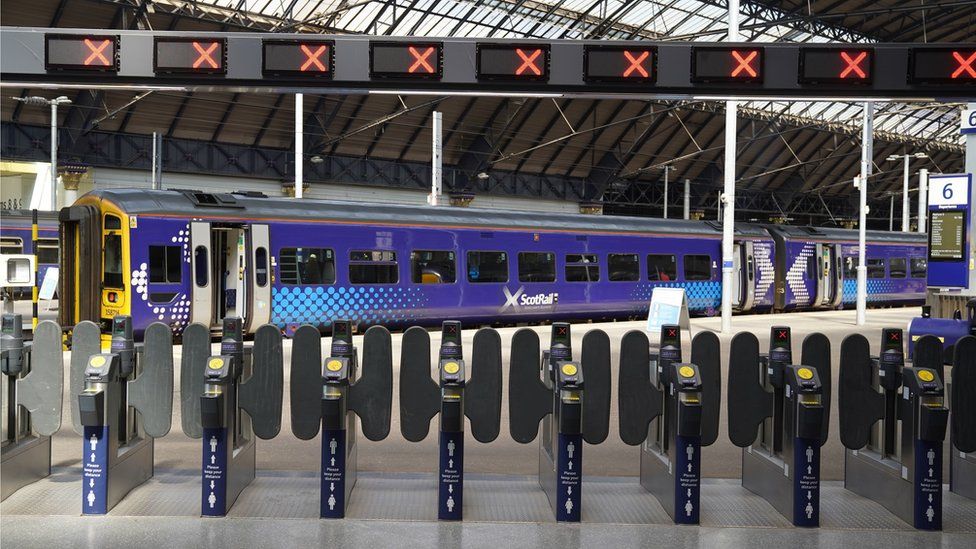
Rail passengers have been warned to expect serious disruption as the first of three 24-hour rail strikes hits services in Scotland.

ScotRail has cancelled 90% of its services while cross-border services are also likely to be badly affected.

About 40,000 Network Rail staff were expected to walk out on at midnight on Tuesday in a dispute over pay, working conditions and redundancies.

Last ditch talks between the RMT union and Network Rail failed on Monday.

Mick Lynch, the union’s general secretary, blamed the “dead hand” of government, saying ministers did not allow employers to negotiate freely.

UK Transport Secretary Grant Shapps said “outdated unions” were “opposing progress”.


Further strikes are scheduled to take place on Thursday and Saturday but services are likely to be disrupted even on non-strike days.

People have been advised to plan ahead and only travel by rail if it is necessary.

Which trains are running?

ScotRail said it would run very limited services on five routes in the central belt only, with no replacement buses or taxis throughout the period of industrial action.

The routes are:

  • Edinburgh – Glasgow via Falkirk High: two trains per hour
  • Edinburgh – Bathgate: two trains per hour
  • Glasgow – Hamilton/Larkhall: two trains per hour
  • Glasgow – Lanark: two trains per hour
  • Edinburgh – Glasgow via Shotts: one train per hour

Trains will only run from 07:30 on those routes, with the last trains departing well before 18:30.

Anyone who has bought a ticket they are unable to use will be able to claim a full refund.

Trains in England and Wales will also be badly affected, including services between London and Scotland on both the East and West Coast mainlines.


Dispute over pay, conditions and safety fears

This dispute between the RMT union and the companies which run Britain’s railway centres on pay, job losses and changes to workers’ terms and conditions.

Staff working for ScotRail are not involved in this industrial action but the train operator, which was nationalised on 1 April, relies on Network Rail workers to operate signal boxes and maintain the track across the UK.

Network Rail staff operate signal boxes and maintain other key railway infrastructure

The RMT said Network Rail’s plans to cut 2,500 jobs would put safety at risk and has warned that strikes could continue over the next six months.

Speaking to BBC Scotland, Network Rail Scotland spokesman Nick King said: “Today’s strike is going to be very disruptive to the public. We are going to see a very, very limited service running in Scotland – principally only a few routes in the central belt.

“We are still keen to reach a resolution with the union, postpone further strike action if we can, but any deal that is done has to be fair on both our workers and on the taxpayer, who ultimately funds Network Rail’s operations.”

On Monday, UK Transport Secretary Gran Shapps told the House of Commons that rail workers were endangering their livelihoods by taking industrial action.

He said the UK government had plans for rail reform and a more “agile, flexible workforce – not one that strikes every time someone suggests a change to the railways”.

RMT organiser Gordon Martin said safety in railway stations and on trains was at risk

Gordon Martin, RMT organiser, told BBC Scotland they had been “forced” to take strike action.

“This is of the UK government’s making,” he said. “We have been forced into this as a defensive measure. Our members’ jobs and livelihoods are at risk here.

“More importantly, the safety of the rail infrastructure is at risk and safety in railway stations and on trains is at risk.”

‘Body blow’ to hospitality

Meanwhile, businesses in Scotland are bracing for an impact on their takings.

Alan Henderson, who owns 10 hospitality outlets across Aberdeen, told BBC Radio Scotland’s Lunchtime Live that the strike was a body blow.

“The impact is quite straightforward, hotel rooms will be cancelled B&Bs will be cancelled, less visitors will come to the north east and the north of Scotland, given that there is absolutely no trains heading north from the central belt,” he said.

“It’s a real body blow to the industry which is just recovering from Covid.”

One of Scotland’s main bus operators said it was prepared for increased demand on strike days.

Duncan Cameron, managing director of First Bus Scotland, said they were planning to increase capacity

First Bus managing director Duncan Cameron told BBC Scotland that despite still not being back to pre-pandemic levels, bus travel “massively overweighs rail use across the country”, carrying passengers on about 74% of public transport journeys.

He said: “It will be difficult for rail users over the coming days with no rail running, but given those margins we believe we can accommodate those who want to move to bus, and where possible we will introduce additional vehicle capacity to do that.”

National Express said coaches were also in high demand but warned it was not possible for the firm to match the demand of the rail network.

“We do expect and are prepared to be busy but also recommend that customers allow plenty of time when planning their journey,” a spokesman said.

The Network Rail industrial action is not related to a separate dispute between ScotRail and train drivers’ union Aslef which led to a temporary timetable with 700 fewer services introduced last month.

The union struck a 5% pay deal and improved terms and conditions with ScotRail earlier this month, with its members now being asked whether they want to accept it and end the dispute. RMT officials rejected a similar offer.
Boris Johnson had a “minor routine operation related to his sinuses” under general anaesthetic at a London hospital, No 10 has said.

The prime minister had the operation at 06:00 BST on Monday and was back in Downing Street at 10:00.

A Downing Street spokesman said Deputy Prime Minister Dominic Raab would make any urgent decisions in his place.

And he said Mr Johnson was feeling well, and was due to take meetings on Monday afternoon.

It is understood Mr Raab remains on hand to assist with any major decisions, but Mr Johnson is expected to chair a meeting of his senior ministers on Tuesday morning and travel to a gathering of Commonwealth leaders later this week.


When questioned on how long the prime minister had experienced problems with his sinuses, his spokesperson said he wouldn’t comment on Mr Johnson’s medical history.

Asked if the prime minister had skipped waiting lists to get his operation, the spokesman said he was “not getting into” that.

The operation – which was carried out on the NHS and had been “scheduled for a while” – was a success and not related to his previous bout of coronavirus.

In April 2020, Mr Johnson spent three nights in intensive care receiving treatment for the virus. He later said it “could have gone either way”.

During his hospitalisation and subsequent recovery, Mr Raab – the then foreign secretary – was in charge of running the government.

Labour has called a vote which would give MPs the power to hold ministers to account if Boris Johnson’s former ethics chief is not replaced.

Lord Geidt resigned on Wednesday after he said he was put in an “impossible and odious” position by the PM.

But Mr Johnson has yet to commit to appointing a successor.

Labour’s proposals, if passed, would enable a committee to appoint an independent ethics adviser if the role is unfulfilled for two months.

The motion will be put to the Commons on Tuesday, with Labour’s deputy leader Angela Rayner saying the role needed to be “urgently reformed”.


Lord Geidt’s role was to advise the PM on the ministerial code – a set of rules governing standards of behaviour.

In announcing his resignation, he said he had been asked for advice on an issue he believed would amount to a deliberate breach of the code.

“This request has placed me in an impossible and odious position,” wrote Lord Geidt in his resignation letter.

The former ethics chief also said he had come close to quitting over the Covid-law breaking in Downing Street.

Downing Street accepted that Lord Geidt fulfilled a “vitally important” role, but said the prime minister was reviewing the position and could abolish it.

Labour’s proposals would give powers to the Commons Public Administration and Constitutional Affairs Select Committee to appoint an independent adviser on possible breaches of the code and initiate its own investigations.

The new “adviser on ministers’ interests” would advise the committee on any potential violations and on the effectiveness of the ministerial code.

They would need to consider any possible breaches referred to them and could also conduct their own investigations, the Labour party said.

Ms Rayner said it was time for Conservative MPs to back the proposals to “clean up politics”.

“Labour will put No 10 in special measures to prevent this prime minister running roughshod over the rules, dodging accountability and degrading standards in public life,” she said.

Lord Geidt was the second ethics adviser to quit under Mr Johnson, after Sir Alex Allan left in 2020.

Post-poll, France’s new parliament sees slight drop in women MPs

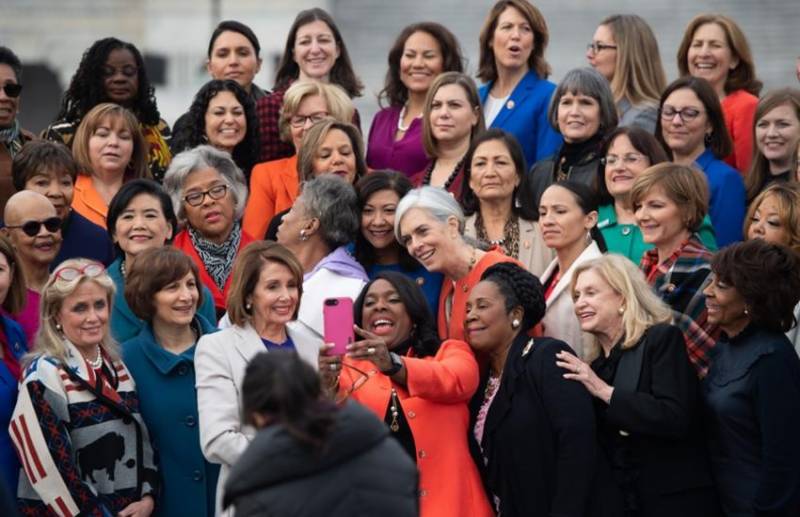
France’s new parliament will see a slight decrease in women MPs after the weekend’s poll, a setback from the previous cycle when women filled nearly 40 percent of seats.

France has lagged in gender parity in politics, coming 33rd out of 185 spots on the Inter-Parliamentary Union’s monthly ranking of women in national parliaments.

But in 2017, voters threw their support behind a parliament composed of 39 percent women MPs — 12 points more than in 2012 and more than triple 2002’s roster of 12 percent.

After Sunday’s poll, France’s parliament will have 215 women MPs — 37.26 percent — while men will take 362 seats, according to an AFP count.

As in 2017, the right-wing Republicans party (LR) has the lowest parity at 29.5 percent, with 18 women MPs making up their 61 elected.

Conversely, the newly formed left-wing alliance NUPES — headed by 70-year-old hard-left figurehead Jean-Luc Melenchon — now has 43.6 percent of women in their ranks.

French President Emmanuel Macron’s “Together” coalition has 40.4 percent, while the National Rally party — led by far-right leader Marine Le Pen — has 37.1 percent.

To promote gender parity in government, France levies financial penalties on political parties with less than 50 percent women.

The Republicans have been the most penalised from 2017 to 2022. In 2021, they were fined 1.78 million euros ($1.9 million) for not meeting the threshold.

Prime Minister Elisabeth Borne — who narrowly won the seat for the sixth constituency of Calvados in Normandy — is the second woman premier of France, after Edith Cresson.

Inflation, subsidy reform hit stomachs in isolated Iran

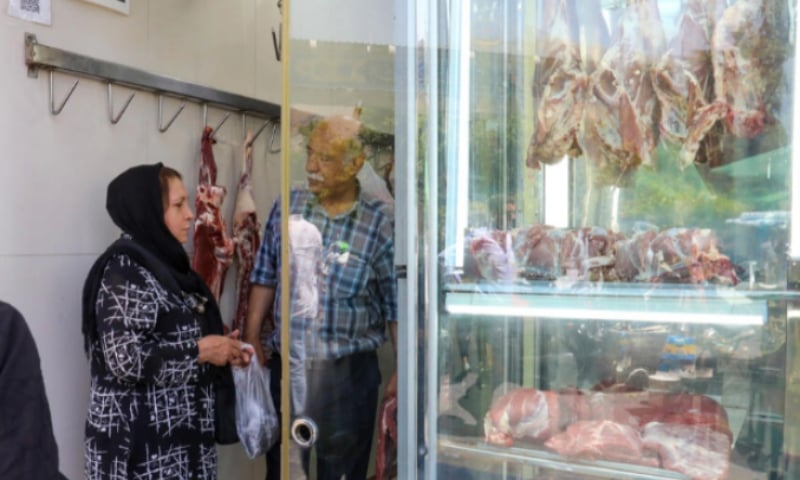
“My sales have fallen significantly — almost by half,” Ali, 50, said. “What can I say? I am a butcher and you may not believe me, but sometimes I don’t eat meat for a week,” he added. “Everything has gone up in price.”

Inflation is making an unwelcome comeback globally — stoked by high energy and food prices, driven largely by Russia’s invasion of Ukraine, a major wheat producer, and by related sanctions on Moscow.

But Iran has been wrestling with rampant price growth for years, exceeding 30 percent annually every year since 2018, according to the International Monetary Fund.

That was the year US president Donald Trump yanked Washington out of a nuclear deal between Iran and world powers and began reimposing biting sanctions, sending the currency into a tailspin even before he unilaterally banned Iran’s oil exports.

Negotiations over the last year or so have sought to bring the US — under Trump’s successor Joe Biden — back inside the deal and convince Tehran to re-adhere to nuclear commitments it has progressively walked away from.

But those ever-delicate efforts have been deadlocked since March, and an escalating spat between Iran and the UN’s nuclear watchdog could reduce chances of reviving the agreement.

Subsidy cuts compound misery

After dividing the cuts of meat, Ali hands Asghar, a retired government employee, a plastic bag containing enough for him and his wife. “The price of everything has gone up, including meat,” lamented Asghar, 63.

“We used to buy more. Now everyone is buying less — everyone is under pressure.” Economic analyst Saeed Laylaz believes price growth in Iran has exceeded 40 percent annually since 2018 — higher than that calculated by the IMF.

It has lately been fuelled further, he says, by “the sharp increase in global inflation” driven by fallout from the war in Ukraine and by Iran’s cash-strapped government in mid-May enacting the “radical reform” of slashing subsidies.

The expert, who has in the past advised Iranian presidents, said the main policy shift by the government of President Ebrahim Raisi was to abolish a subsidised exchange rate for imports of household essentials — wheat, cooking oil and medicine.

Introduced in mid-2018, this “preferential” rate was fixed at 42,000 rials to the dollar, cushioning citizens from the savage black market depreciation of the local currency that stemmed from the US withdrawing from the nuclear deal.

But with the exchange rate on the black market exceeding 300,000 rials to the greenback and global food prices soaring, the arrangement became unaffordable.

“It is estimated that if Iran wanted to continue reckless spending of hard currencies this year like the previous years, the country would have needed $22 billion dollars at the preferential rate,” he said.

“Even in the event of reviving the nuclear agreement… the government had no choice but to cancel the preferential rate,” he added.

Red meat prices have risen 50 percent, chicken and milk prices have doubled, spaghetti has tripled and cooking oil prices have quadrupled since early May, according to figures published by Iranian media.

Protests over prices

Hundreds of Iranians have taken to the streets of several cities to protest against the spiralling prices, on top of months-long demonstrations by professionals and pensioners demanding wages and pensions be adjusted for inflation.

On Tuesday, Labour Minister Hojjatollah Abdolmaleki stepped down in the hope of “strengthening cooperation within the government and improving the provision of services to the people,” according to government spokesman Ali Bahadori-Jahromi.

But reformist newspaper Etemad linked his resignation to “heavy criticism” from the protesting pensioners. In Tehran’s marketplaces, attention is focused on the consequences and effects of inflation, rather than its causes.

President Raisi, an ultra-conservative who took office last August, pledged from the outset that the painful subsidy reform would not affect bread, fuel and medicine prices. Demand for bread is therefore increasing.

“The queues at the bakeries have become longer because the price of rice has risen, and people are resorting to bread,” Shadi, a housewife said. Inside, the baker Mujtaba agrees.

“People… are no longer able to buy rice, cooking oil, spaghetti and tomato paste,” said the 29-year-old, his face drenched in sweat as he took a break from preparing dough.

The subsidy reform has so far done little to steady the black market exchange rate, which slipped to an all-time low of more than 330,000 to the dollar on June 12, and hopes for a restoration of the nuclear deal have receded.

New Delhi-bound plane lands safely after engine fire

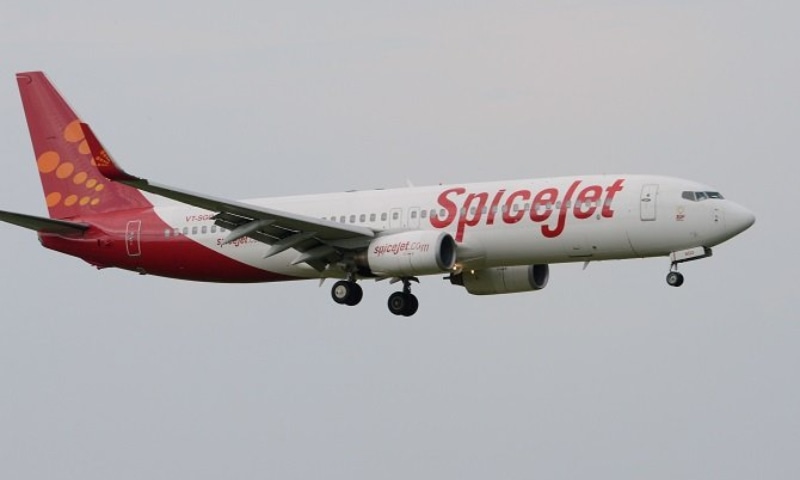
The passengers aboard the domestic flight, operated by commercial carrier SpiceJet, were evacuated safely once the pilot returned to Patna airport shortly after take-off.

“The flight returned to Patna airport after locals (on the ground) noticed a fire on the left wing of the aircraft and informed airport officials,” district magistrate Chandrashekhar Singh told reporters.

“All 185 passengers were safely deboarded. Reason for the fire is a technical glitch. The engineering team is analysing,” Singh added.

A passenger told reporters that there was a lot of noise heard on board the plane in the first 15 minutes after take-off. “The pilot ann­ounced there was some problem and that we would be going back to Patna…. it was quite scary,” said Pacifica, who gave only one name.

A bird hitting the engine may have sparked the fire, local news broadcaster NDTV quoted aviation sources as saying.

The no-frills SpiceJet airline has been in the news in recent weeks, with aviation authorities imposing a fine of one million Indian rupees for training its Boeing 737 MAX pilots on a faulty simulator.

Pakistan seeks US help with IMF talks

Earlier, media reports had claimed that Islamabad was “seeking Washington’s support” for renewing its Extended Fund Facility (EFF) with the IMF.

As the largest shareholder, the US has considerable influence over the IMF’s decision-making.

Pakistan signed a 39-month, $6bn EFF in July 2019, but the Fund stopped the disbursement of about $3bn when the previous government reneged on its commitments.

Currently, Islamabad wants the IMF to not only resume disbursements, but to also expand the size and duration of the programme.

On Saturday, Pakistan’s Ambassador to the United States Masood Khan met Assistant US Trade Representative (USTR) for South and Central Asia Christopher Wilson to discuss expanding trade relations between the two countries and encouraging US investments in Pakistan, a statement said.

The office of the USTR is responsible for developing and coordinating US international trade, commodity, and for directing investment policy. It also oversees trade negotiations with other countries.

On Saturday, Ambassador Khan also met a delegation of the Wabtec company, which is the world’s leading rail company.

A statement issued after the meeting said that the Wabtec showed “keen interest in furthering its existing partnership with Pakistan and in assisting the Pakistan Railways in meeting its locomotive requirements.”

Wabtec is a global provider of equipment, systems, digital solutions, and value-added services for the freight and transit rail sectors.

“While we greatly appreciate the existing level of cooperation between Wabtec and Pakistan Railways, particularly in engineering and rail services, we look forward to benefiting from the company’s expertise in the modernisation of railway networks and indigenisation of locomotive manufacturing in Pakistan,” Ambassador Khan said.

Tens of thousands of job seekers have called for a shutdown in India to protest against a new army hire plan which has sparked violence.

Some states have shut down the internet and suspended train and bus services on Monday.

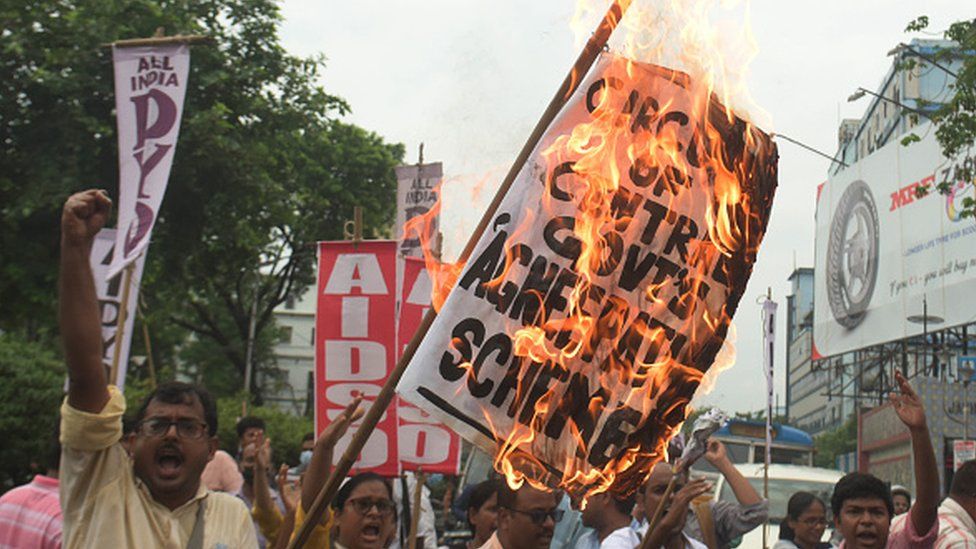
Protesters are demanding the rollback of the plan to hire soldiers on a fixed four-year term, saying it would shatter their dreams of a secure job.

They have taken to the streets, blocking roads and torching trains.

Several opposition political parties have given their support to the protests. But the government has refused to cancel the plan, though it has been trying to allay the fears of protesters.

Demonstrations against the plan began in the northern states of Uttar Pradesh and Bihar last week after Prime Minister Narendra Modi’s government announced changes to how it would recruit soldiers for the armed forces.

But they have now spread to several other states, with thousands of young men attacking train coaches, burning tyres and clashing with security forces.


At least one person died, and several others were injured in the southern state of Telangana where protesters clashed with the police on Friday.

Ahead of the shutdown on Monday, several states announced precautionary restrictions – banning large gatherings, shutting schools and even suspending internet services in some districts. In the state of Jharkhand, school exams have been postponed. And in Bihar, authorities have cancelled 350 trains in the wake of violence.

Protesters set a train on fire during a demonstration against India’s new Agnipath scheme

Fears for future

Protesters say the government’s plan to hire temporary soldiers will reduce their chances of getting coveted permanent military jobs, which guarantee fixed salaries and pensions.

They are demanding that the government scrap the new plan and maintain the policy that would offer them a career that usually lasts two decades and offers a pension at the end of it.

Young people in India’s smaller towns and villages prepare for years to become soldiers in the armed forces as the job brings prestige, a regular income and for some, a way out of poverty.

The new Agnipath scheme is aimed at people aged between 17.5 and 21 years. It says that successful candidates will join the armed services for four years, after which only 25% of them will be retained.

The soldiers will go through training for six months and then will be deployed for three and a half years. During this period, they will get a monthly starting salary of 30,000 rupees ($384; £316), along with additional benefits which will go up to 40,000 rupees by the end of the four-year service.

The reform is aimed at cutting the army’s expenditure on ballooning salaries and pensions – which consume more than half of its budget – and freeing up funds to modernise the forces. The government said this would also “enhance the youthful profile of the armed forces”

In a bid to pacify protesters, the federal government announced late on Thursday night that candidates aged up to 23 years could apply under the scheme in the first year.

The protests have spread to multiple states since last week

On Sunday, the home ministry also said it would reserve 10% of vacancies in the paramilitary forces and the Assam Rifles, a unit in the Indian army, for those who finish the four-year term.

The government has also shared posts on social media, explaining the various opportunities it said would be available to short-term soldiers after they finish their stint. It said that police forces will be asked to accommodate those who successfully finish their four-year terms in the armed forces.

Critics of the plan say that it will weaken the armed forces and also increase unemployment rates in the country.

“It’s a foolish move, one that could affect the efficiency of the security forces,” said retired Major General Sheonan Singh.

“Saving money is good but it should not be done at the cost of defence forces. If you go to war with an experienced soldier, will a person with four years of training be able to replace him on his death? These things don’t work like this.”

But those who support the move say that such a plan was needed to make the forces more efficient.

Retired Maj Gen SB Asthana said the step would benefit the army as it would help modernise India’s forces.

“It is difficult to train old people in modern technology. But this generation is more capable. This plan will give freedom to the army to keep the best 25% of the soldiers and let the rest go.”

Less than two months after he was re-elected president, Emmanuel Macron has lost control of the French National Assembly following a strong performance by a left alliance and the far right.

He had called on voters to deliver a solid majority.

But his centrist coalition lost dozens of seats in an election that has left French politics fragmented.

The prime minister he had only recently appointed, Elisabeth Borne, said the situation was unprecedented.

A storm hit Paris as she returned to her Matignon residence from a long meeting at the presidential Élysée palace to say that modern France had never seen a National Assembly like this one.

“This situation represents a risk for our country, given the risks we’re facing nationally and internationally,” she said. “We will work as of tomorrow to build a working majority.”

That seems a stretch when the two other biggest groups in the Assembly are not remotely interested in collaboration. Economy Minister Bruno Le Maire was adamant that France was not ungovernable, but said it was going to require a lot of imagination.The French prime minister said her government would draw the consequences from the result

Far-left leader Jean-Luc Mélenchon was enjoying his success in bringing together mainstream parties from the left with Communists and Greens into an alliance called Nupes.

He told supporters that the presidential party had suffered a total rout and every possibility was now in their hands.


Meanwhile, Marine Le Pen and her far-right National Rally party were also in jubilant mood after turning eight seats into 89. The people had spoken, she said: Emmanuel’s Macron’s adventure was over and he had been consigned to a minority government.

1px transparent line

If the prime minister was looking to the right-wing Republicans to help build a working majority, their message was not immediately encouraging. Party chairman Christian Jacob said the result was a “stinging failure” for a president now paying for cynically weaponising France’s extremes.

He’s not Jupiter any more, said Dominique Rousseau, professor of constitutional law, referring to an earlier nickname ridiculing Mr Macron’s supposed desire for power.

“For Mr Macron these five years will be all about negotiations and parliamentary compromise,” he told AFP.

It was all so different in April, when he defeated Marine Le Pen convincingly and won a second term as president. He had more than 300 seats, but to maintain his outright majority he needed 289 – and fell well short with 245.

More than half of voters abstained, with a turnout of 46.23%.

Among the ministers to lose their seats was Health Minister Brigitte Bourguignon, who lost to her far-right opponent by just 56 votes. Green Transition Minister Amélie de Montchalin was also defeated, but another key figure, Europe Minister Clément Beaune, survived despite losing in the first round.

One of Mr Macron’s closest allies, the president of the Assembly Richard Ferrand, conceded victory to his Nupes rival Mélanie Thomin. Another casualty came on the Caribbean island of Guadeloupe, where a secretary of state, Justine Benin, lost her seat.

Watch: Jean-Luc Mélenchon says Macron faces “total defeat” as he and Marine Le Pen celebrate projected gains

In a rousing speech to his supporters, Mr Mélenchon said the result marked the moral failure of “Macronie”, accusing the ruling party of enabling the far right by refusing to give clear guidance in seats where the left was running head to head with Marine Le Pen’s party.

In a tacit admission that he was unlikely to achieve his ambition of prime minister, the far-left leader said he was now changing his role in battle: “My commitment is and will remain at the front of your ranks until my final breath if you want.”

But as he was not running for a seat, he will not feature in the National Assembly.

Five years ago, Emmanuel Macron harnessed a wave of optimism, bringing in a fresh cohort of MPs from civil society. The new faces this time have emerged from Nupes and the National Rally.

Among the MPs elected for Nupes, which stands for New Ecological and Social Popular Union, is a hotel chambermaid who led her colleagues in a fight for better pay and conditions. Rachel Keke had vowed to dance in the Assembly if she succeeded in defeating a former sports minister.

1px transparent line

Which reforms are at risk?

President Macron has promised to tackle the cost of living crisis, but his rivals have very different ideas on how to go about it. His big-ticket proposals were reforming benefits, cutting taxes and raising the retirement age gradually from 62 to 65.

His pension age reform will be particularly hard to get through, although he will attract support from the Republicans.

Then there are proposals to move towards carbon neutrality and full employment. And he recently offered a “new method” of governing with greater involvement from civil society, proposing a National Council for Refoundation made up of local people to make France more democratic.

Travellers are facing reduced train services across England, Scotland and Wales ahead of the biggest rail strike in 30 years.

A temporary timetable is due to be introduced later, but last minute talks between unions and rail bosses will continue this morning.

Disruption is expected across the week, with walkouts on almost all major lines on Tuesday, Thursday and Saturday.

Passengers should only travel by train if necessary, Network Rail says.

A strike will also take place across the London Underground on Tuesday, with Transport for London advising passengers to walk and cycle instead.

While two sets of talks are expected first thing this morning, the Rail Maritime and Transport Workers (RMT) union has said it will “intensify” its strike campaign if members don’t get an agreeable deal.

The union’s general secretary, Mick Lynch, said they would “run this campaign for as long as it takes to get a settlement”, potentially for six months or more.

He called on the government to “loosen the shackles” of employers to allow a deal to be struck, but Transport Secretary Grant Shapps said negotiations should be between unions and employers.

Network Rail says the last trains between many major cities are expected to depart over the course of the afternoon, before more than 40,000 rail workers walk out over job cuts, pay and conditions on Tuesday.

The reduced timetable will be in place until Sunday, with just 20% of usual services running on strike days.

Trains that do run will start later and finish much earlier than usual – between 07:30 and 18:30.

Knock on disruption is expected on the roads, with motorists being warned to expected a surge in traffic.

Motoring group the AA says drivers in Scotland and Wales should expect to face long queues as most railway lines will be closed.

The M74, M8 and A9 in Scotland and the M4, A55, A5, and A483 in Wales could see severe traffic, it says.

The RAC says major city routes and those serving the home counties are likely to see some of the biggest increases in traffic volumes.

The strikes will affect a number of events including school exams and the first Glastonbury festival for three years.

Rail strike advic

Can I get a refund? Yes, if you can’t get your train due to strike action. Season-ticket holders can apply for a refund for the days affected. Find more info here.

Do I have to go to work or school? This is up to your individual employer or school, check with them.

The RMT is unhappy about stagnating pay and proposed job losses, and so far tales between the union and Network Rail – which maintains tracks and runs bigger stations – have failed to find a resolution.

Mr Shapps has dismissed a call from the RMT for ministerial intervention as a “stunt” – and claimed union bosses were “gunning for” industrial action.

Leaders at 13 trade unions and the Trade Unions Congress (TUC) have jointly written to Mr Shapps urging him to “help deliver a fair resolution”. The Labour Party has also called on the government to step in.

TUC general secretary Frances O’Grady said nobody takes strike action lightly but argued rail staff had been left with “no other option”.

“Many rail staff who will be hit hardest – such as caterers and cleaners – are on low and average earnings. It’s insulting to ask them to take yet another real-terms pay cut when rail companies took £500 million in profits during the pandemic,” she said.

However, Rail Delivery Group chair Steve Montgomery said rail bosses were trying to work with unions “on how to carry out modernisation and reform of the industry” amid falling passenger numbers.

“Ultimately we do want to give our people a pay increase… but we have to get on with reform, and that helps us deliver the next phase of giving people a pay rise.”

Rail strike basics

  • When? There will be rail strikes on Tuesday, Thursday and Saturday and a London Underground Strike on Tuesday
  • Where? Many lines will face disruption including: Avanti West Coast; C2C; Chiltern Railways; Cross Country Trains; Croydon Tramlink; Greater Anglia; LNER; East Midlands Railway; Elizabeth Line; Great Western Railway; Hull Trains; London Underground; Northern Trains; South Eastern Railway; South Western Railway; TransPennine Express; West Midlands Trains.
  • Who? The RMT union’s members include everyone from guards and catering staff to signallers and track maintenance workers. Train driver members of the Aslef union will be striking on Thursday and 2 July on Greater Anglia and 28, 29 June and 13, 14 July on Croydon Tramlink.