
There is no reason why Scotland cannot have a legal independence referendum, the constitution secretary has said.

Angus Robertson told the BBC that the SNP would continue to push for a vote based on a section 30 order – as agreed by the Scottish and UK governments.

His comments came as The Sunday Times reported that ministers were preparing a consultative referendum next year.

It said this could “attempt to bypass the UK government” by phrasing the independence question in another way.

The SNP plans to hold a second referendum in October 2023. However, the UK government said now was not the time for another vote.

Speaking on BBC Scotland’s The Sunday Show, Mr Robertson said: “We will continue to press for the gold standard – which the 2014 referendum showed itself to be.

“With a section 30 a legal referendum could go ahead and be recognised by the UK government and other countries.”

“Given we have precedent, and it worked and wasn’t complicated, and with mutual respect, it was something we could all agree on.

“If it was possible then, there is no reason why it is not possible now.”

Nicola Sturgeon unveiled her case for Scottish independence on Tuesday

The Sunday Times suggested the First Minister could take a different route to an independence vote, avoiding a section 30 order.

It reports that Nicola Sturgeon could avoid a possible legal challenge with a reworded question.

Instead of repeating the 2014 referendum question, “Should Scotland be an independent country?”, it said a “softer” approach asking if Scotland should open independence negotiations with London could stand a better chance in court.

Mr Robertson declined to comment on any alternative plans.

He said any constitutional plans had to be announced in the Scottish Parliament and Ms Sturgeon would be give an update before summer recess.

What is a section 30 order?

Ms Sturgeon was one of the signatories to the previous “section 30” agreement, in 2012

A section 30 order refers to the section of the Scotland Act that allows Holyrood to pass laws normally reserved to Westminster.

These have been used 16 times since the Scottish Parliament was created in 1999, and have allowed MSPs to legislate in areas from the construction of railways to reducing the voting age in Scottish elections.

A section 30 order was granted by the UK government ahead of the 2014 independence referendum, after Prime Minister David Cameron and First Minister Alex Salmond signed the “Edinburgh Agreement”.

Scottish Labour leader Anas Sarwar, also appearing on The Sunday Show, dismissed the idea of a second referendum.

He said: “The next electoral contest is not a referendum, it is going to be a general election and that is going to be a campaign to put out Boris Johnson.

“The anger we feel sitting in Glasgow, is felt in Edinburgh, it is felt in Cardiff, Birmingham, Manchester and London. Let’s unite across this country, put out Boris Johnson.

“I honestly believe the majority of people still don’t want independence.”

‘Threadbare case’

On Saturday, the first minister accused opposition parties of “running scared” of the debate on Scotland’s future.

The Scottish government published a paper comparing the UK with other nations which Ms Sturgeon claimed are “wealthier, fairer and happier” than the UK.

“The Tories and Labour have completely failed to engage with that point because they know it is true and because they can see how threadbare the case for continued Westminster rule over Scotland has become,” she said.

A UK government spokesman said: “Now is not the time to be talking about another referendum.

“People across Scotland rightly want and expect to see both of their governments working together with a relentless focus on the issues that matter to them, their families and communities.

“That means tackling the cost of living, protecting our long-term energy security, leading the international response against Russia’s invasion of Ukraine and growing our economy so that everyone has access to the opportunities, skills and jobs for the future.”

‘Inflation protest’: Imran Khan to announce PTI’s future strategy today

ISLAMABAD: PTI is all set to stage a nationwide “peaceful demonstration” tonight against rising inflation on the call of their leader, Imran Khan.

A day earlier, PTI Chairman Imran Khan had announced he would share his future course of action in his party’s countrywide protest — slated for today (Sunday) — against inflation.

Chairing a meeting of his party spokespersons, the former prime minister said that the future course of action will be decided along with the nation in today’s (June 19) protest.

“Oppression and force cannot stop the people from raising their voices,” he added.

During the meeting, the PTI chairman congratulated the members, especially ex-energy minister Hammad Azhar, on Pakistan’s removal from the Financial Action Task Force’s (FATF) grey list.

Talking about the rising prices in the country, Khan said that the PTI shielded the nation from global inflation.

“The current government does not care about the people or the future of the country,” he said, adding that the “situation will be out of control if the economy was destabilised.”

Imran Khan further claimed that the “coalition government is putting the future of the nation at stake just to save themselves” and alleged that the government is destroying the institutions to keep itself in power.

Former information minister Fawad Chaudhry called the people belonging to big cities, including Multan, Faisalabad, Rawalpindi, Islamabad, Lahore, Karachi and Peshawar to protest against “high inflation and lawlessness”.

Taking to Twitter, Fawad asked people to protest at Shah Abbas Chowk in Multan, Ghanta Ghar Chowk in Faisalabad, Commercial Market in Rawalpindi, F-9 Park in Islamabad, Liberty Chowk in Lahore, Shahrae Qaideen in Karachi.

4 killed in assault on Kabul gurdwara

Ministry spokesman Abdul Nafi Takor said the attackers lobbed at least one grenade when they entered the temple, setting off a blaze in the complex.

Minutes later, a car bomb was detonated in the area but caused no casualties, he added.

“One of our Sikh brothers has been killed and seven others (were) wounded in the attack,” Takor said in a statement.

Two attackers were killed in an operation to secure the temple following the raid, he said, with one Taliban fighter also killed.

Two attackers killed, several buildings also damaged; Pakistan, India condemn gun-and-bomb attack

“I heard gunshots and blasts,” Gurnam Singh, a Sikh community leader, told AFP from close to the scene of Saturday’s attack soon after the raid began.

“Generally at that time in the morning we have several Sikh devotees who come to offer prayers at the gurdwara (temple complex).”

Footage posted on social media after the attack showed shattered pillars and walls in the temple’s main prayer hall, with debris scattered across the floor. A section of a building near the temple also caught fire.

The windows of several residential buildings were broken from the impact of the car bomb. Nearby streets were littered with shattered glass.

Taliban forces cordoned off the neighbourhood, preventing journalists from speaking to residents and witnesses.

A Taliban fighter deployed in the area said some Sikhs in the temple at the time of the attack managed to flee from a back door.

Some of Kabul’s other Sikh temples were closed for security reasons as reports of the attack spread.

No group claimed responsibility for the raid till late in night.

The attack came days after an Indian delegation visited Kabul to discuss the distribution of humanitarian aid from India to Afghanistan.

Indian Foreign Minister S. Jaishankar in a tweet condemned the “cowardly attack” on the temple.

The community has faced repeated attacks over the years. At least 25 people were killed in March 2020 when gunmen stormed another Sikh temple in Kabul. The self-styled militant Islamic State group claimed responsibility for that attack.

Pakistan condemns attack

Pakistan strongly condemned the terrorist attack on the gurdwara.

In a statement released by APP in Islamabad, the Foreign Office spokesperson said: “Pakistan is seriously concerned at the recent spate of terrorist attacks on places of worship in Afghanistan. Yesterday, terrorists targeted the Imam Sahib Mosque in Kunduz, killing and injuring many worshippers. These acts of terrorism targeting religious places are utterly repugnant”.

“Pakistan reiterates its condemnation of terrorism in all forms and manifestations. We express strong solidarity with the people of Afghanistan and support all efforts of the Afghan authorities in fighting the menace of terrorism and ensuring the protection of all their citizens,” he added.

Zelensky visits war-damaged city in rare trip outside Kyiv

He also visited troops on the southern frontline of the war with Russia. Zelensky’s office published a video of him looking at a badly damaged high-rise residential building in the city and holding a meeting with local officials.

His visit comes a day after a Russian strike killed two people and injured 20 in the city.

Mykolaiv has been targeted by Russian forces since the start of their invasion on February 24.

In the video Zelensky was shown damage to a residential building by local governor Vitaliy Kim. The tall building had a gaping hole, with the inside of apartments visible.

A blue and yellow Ukrainian trident was seen in one of the shattered windows. He later also visited troops on the southern frontline in both the Mykolaiv and the neighbouring Odessa region, his office said.

“It is important that you are alive. As long as you live there is a strong Ukrainian wall that protects our country,” Zelensky told soldiers in the Odessa region.

Fires at a large chemical plant in the Chinese city of Shanghai have killed at least one person.

They broke out around 04:00 on Saturday (20:00 GMT Friday) at one of the country’s largest refining and petrochemical plants.

Flames could be seen engulfing parts of the sprawling complex and spewing thick columns of black smoke into the sky.

Shanghai is China’s economic hub and only recently emerged from a strict pandemic lockdown lasting two months.

The cause of the fires, which affected an ethylene glycol facility, is still unclear.

Sinopec – the state-owned company that operates the plant in the suburb of Jinshan – said the driver of a transport vehicle had been killed and a company employee had been injured.

Residents living up to 6km (four miles) away reported hearing an explosion, local media report.

Shanghai’s fire department dispatched more than 500 personnel to the scene.

State media say the fires are now under control but protective burning is being carried out.

Drone footage shared on social media showed the sky above Shanghai, China’s most populous city, turning black from smoke.

Sinopec said it was monitoring for environmental impact and no damage to the surrounding water environment had been recorded.

The ministry of emergency management has dispatched an expert group to the scene.

Shanghai had been under a strict lockdown imposed by officials to curb a coronavirus outbreak driven by the spread of the Omicron variant.

For two months residents in the global trading hub were forbidden from leaving their homes – shutting down factories with far-reaching consequences for both the local economy and global supply chains.

The government is pursuing a “zero Covid” policy requiring everyone who catches the virus to quarantine.

New rules have now been introduced with residents required to show a green health code on their smartphone to leave their residential compounds and to enter most places.

It’s not even two months since Emmanuel Macron was convincingly re-elected as president but he is already in a crunch election that could prevent him pushing through his reforms.

French voters go to the polls on Sunday to decide who will control their National Assembly.

Mr Macron beat the far right in April, but this time the challenge is harder.

Far-left Jean-Luc Mélenchon leads a left-green alliance that finished neck and neck with Macron only a week ago.

They call themselves Nupes, which stands for New Ecological and Social Popular Union, and the polls suggest they could stop the president winning the 289 seats he needs for an outright majority. The centrist Macron alliance, Ensemble, portrays them as a “marriage of convenience” of Communists, Socialists, far-left Mélenchonists and Greens.

But Nupes have galvanised voters with a promise to fight spiralling prices, bring down the retirement age and tackle climate change. Green leaders and many green voters back them, accusing President Macron of doing little in the past five years.

I wouldn’t normally vote for the left but I want a government that has green policies

Sunday’s second round is almost entirely made up of run-off duels between two candidates, and almost half involve the two big alliances. Several ministers in the Macron government are battling to keep their seats and hold on to their jobs, and two of the toughest fights involve Europe Minister Clément Beaune and Green Transition Minister Amélie de Montchalin.

Without an outright majority of 289 seats, Mr Macron will need the support of other parties to push through his big-ticket reforms, such as raising the retirement age, cutting taxes and reforming benefits. Pollsters suggest Ensemble will win 255-305 seats and Nupes 140-200.

As the sun went down on the campaign on Friday night, Nupes spokesman Ian Brossat told supporters in Longjumeau south of Paris: “They didn’t think the left and Greens could get together – it would be chaos and catastrophe; but the chaos today is economic, with food prices going up. We’ve got 10 million people in poverty.”

Ian Brossat (C) said some had tried to paint Nupes as extremist, but there was nothing extreme about their policies

While fighting for the presidency, Mr Macron rallied voters across the spectrum by presenting his main rival Marine Le Pen as an extremist and contrary to the republic’s values

With mainstream parties joining the Mélenchon alliance it has become harder to do that with this rival. President Macron has appealed to voters to give him a solid majority in the “superior interest of the nation”, while Russia’s war rages at the gates of Europe.

Former Marxist Jean-Luc Mélenchon has long wanted France to leave Nato but says that is now not a priority. However, he remains controversial, tweeting that “the police kill” and promising to naturalise Wikileaks founder Julian Assange as French if he wins the election.

Mr Macron’s recently appointed prime minister, Elisabeth Borne, has painted Mr Mélenchon’s policies as dangerous because he is “ambiguous on republican values”.

In Longjumeau, first-time voter Clara said she had backed Mr Macron against the far right in April, but this time preferred the left-green alliance.

The local candidate is only a few points behind the ruling party rival. But in the next-door constituency Amélie de Montchalin trailed in the first round and defeat would mean losing her job as minister.

Economy Minister Bruno Le Maire joined the campaign trail to help Amélie de Montchalin ahead of the vote

The same is true for Clément Beaune, whose opponent in one of the Paris seats is Caroline Mécary, an experienced LGBT rights lawyer.

Both candidates visited the Aligre market near the Gare de Lyon several times in the run-up to Sunday’s vote, says market vendor Ichem. “People can’t afford much now; they buy less than before,” he observes.


Visiting the market, Grégoire said he backed the president because he did not want to return to the days of “cohabitation”, when president and government came from different parties: “Yes it used to work before but they weren’t good years.” Jean-Baptiste agreed the president needed a strong mandate: “Without a majority he won’t be able to do anything he needs to do.”

But Christine believed handing the president an absolute majority was bad for democracy. She backed Emmanuel Macron to keep the far right from the Élysée Palace, but felt having another party in government was good for debate.

Christine wants to see active debate in the National Assembly rather an absolute majority

What are they offering?

President Macron has promised a “new method” of governing with greater involvement from civil society. He’s proposing:

  • A National Council for Refoundation made up of local people to make France more democratic
  • Reforms to tackle the high cost of living and action towards full employment and carbon neutrality
  • Pension reforms and gradually raising the retirement age to 65

The left-green alliance wants:

  • Retirement lowered from 62 to 60
  • Minimum wages (known as Smic) to go up by about 15% to €1,500 a month
  • A freeze on the prices of basic essentials and the creation of a million jobs.

Thousands of protesters have taken to the streets of London to demand action from the government on the cost of living crisis.

Workers marched to Parliament to call for better pay and conditions as part of the event organised by the Trades Union Congress (TUC).

The union has called for a “decent pay rise for public sector workers” and a £15 minimum wage.

A Treasury spokesman said it had “stepped in to ease the burden”.

The spokesman added that the government was “helping eight million of the most vulnerable British families through at least £1,200 of direct payments this year – and giving every household £400 to help pay their energy bills”.

Protesters set off from Portland Place and headed towards Parliament Square at about 12:00 BST as part of the We Demand Better march.

‘Growing disparity’

The TUC said its research suggested workers have lost almost £20,000 since 2008 because pay has not kept pace with inflation.

General secretary Frances O’Grady told BBC News that ordinary working people were saying “enough is enough” after over 10 years of stagnant pay.

“We want government to listen – workers are not the cause of inflation, they are suffering the impact of inflation,” she said.

Ben Robinson, 25, who works for a housing charity in Brixton, south London, was at the protest.

He said some residents faced a choice “between feeding their own kids, not themselves, their own kids, and paying rent and heating, and that is just not a choice that anyone should have to face”.

Teachers joined the Trade Union Congress protest to call for better pay

Members of NASUWT, the Teachers’ Union, were among those who attended the march and called for the profession to receive a “pay uplift and an urgent rebalancing of workload”.

The union said that with living expenses surging ahead of wages, the value of teachers’ pay had fallen by 19% over the last 12 years.

Teacher Stephen Brown said he was attending the march because many of those in his profession were now leaving – piling on the pressure for those who stay in classrooms.

“We’ve had a pay freeze for the past few years… teachers are leaving the profession because they are struggling so much, they just think it’s not worth it,” he said.

The Department for Education (DfE) said it was “incredibly grateful for the continued efforts of teachers and school leaders in supporting pupils” and work was ongoing to “deliver pay increases and pay awards for new and experienced teachers”.

A Treasury spokesman added: “As part of our £37bn support package we’re also saving the typical employee over £330 a year through the imminent National Insurance tax cut, are allowing universal credit claimants to keep £1,000 more of what they earn and have made the biggest cut to all fuel duty rates ever.”

A series of strikes set to hit the rail network next week will “punish millions of innocent people”, Transport Secretary Grant Shapps has said.

He said commuters and pupils taking exams would be among those affected.

But the Rail, Maritime and Transport union (RMT) said politicians had prevented progress in talks.

Strikes will take place on almost all major lines across Britain on Tuesday, Thursday and Saturday, as well as on the London Underground on Tuesday.

There will also be knock-on effects on services on non-strike days, including Monday.


Speaking to BBC Radio 4’s Broadcasting House programme, the RMT’s Mick Lynch claimed rail operators were refusing to sit down for discussions, while Network Rail was being influenced by government ministers.

“It’s Shapps, [Boris] Johnson and Rishi Sunak who are stopping a deal being done in this dispute,” he said.

But Network Rail, which maintains the tracks and runs larger train stations, said the RMT were dismissing talks before they had finished.

And Mr Shapps urged the union to back down to help those who rely on the rail network.

He said: “Many people who do not get paid if they can’t get to work face losing money at a time they simply can’t afford to.

“Children sitting exams will face the extra distraction of changing their travel plans.

“And vulnerable people trying to attend long-awaited hospital appointments may have no choice but to cancel.

“By carrying out this action the RMT is punishing millions of innocent people, instead of calmly discussing the sensible and necessary reforms we need to make in order to protect our rail network.”

Rail strikes in numbers

  • 4,500 – the number of services due to run on each strike day
  • 20,000 – the number of services that usually run each day
  • £16bn – the amount of taxpayer Covid support given to the rail industry, according to government
  • 2,500 – proposed job cuts planned at Network Rail, according to the RMT – Network Rail says it would never consider any changes that make the railway less safe

The RMT – which has 40,000 members across the rail network – has said its members are unhappy about stagnated pay and proposed job losses.

Mr Lynch denied the union was demanding a pay hike in line with the current RPI inflation rate – which was 11.1% in April – but said any proposed rise must reflect the higher cost of living.

He said the union had rejected a Network Rail offer of a 2% rise with a further 1% increase linked to job cuts. The RMT recently won an 8.4% pay rise on the London Underground, it said.

“We’ve got a working class, working full-time hours, having to go to food banks and take state benefits,” Mr Lynch added, saying the union did not want to see rail workers in a similar position.

On Saturday, thousands of people marched in central London to demand action from the government on the cost of living crisis.

Meanwhile, Labour leader Sir Keir Starmer is set to use a speech at a Labour event in Warwick to suggest Mr Shapps and Prime Minister Boris Johnson want the strikes to go ahead.

“They want the country to grind to a halt so they can feed off the division,” he will say.

“Instead of spending their time this week around the negotiating table, they are designing attack ads.”

But Mr Shapps accused Sir Keir of dishonesty over his public statements about the upcoming strikes.

The transport secretary shared an article in the Mail on Sunday which claimed Sir Keir was supportive of the strikes at a Labour Party meeting.

Liberal Democrat transport spokesperson Sarah Olney claimed Mr Shapps “hasn’t even met with the union bosses for well over a month”.

“Not bothering to avert a crisis is a sackable offence in any other work place,” she said.

A Department for Transport spokesperson said: “The government committed £16 billion – or £600 per household – to keep our railways running throughout the pandemic while ensuring not a single worker lost their job.

“The railway is still on life support, with passenger numbers 25% down and anything that drives away even more of them risks killing services and jobs.

“Train travel for millions more people is now a choice, not a necessity. Strikes stop our customers choosing rail, and they might never return.”

‘No change in policy’: FO clarifies FM Bilawal remarks on ties with India

Speaking at the Institute of Strategic Studies Islamabad, a government-funded think tank, in his first major foreign policy speech since taking office at the end of April, Bilawal had identified India and the United States as countries with which Pakistan’s relations were problematic.

The foreign minister had put greater emphasis on engaging India, saying it was time for pivoting to economic diplomacy and focusing on engagement. His argument was that despite a “long history of war and conflict” and the Indian government’s actions in occupied Kashmir and its anti-Muslim agenda, it was not in Pakistan’s interest to remain disengaged.

In its statement today, the FO said these comments by the foreign minister were “being interpreted out of context and portrayed incorrectly”. “The foreign minister’s remarks are better understood in the overall context of his key message of conflict resolution that he emphasised in his address at the think tank event,” the FO added.

It said Pakistan had “always desired” cooperative relations with all its neighbours, including India, and had “consistently advocated” constructive engagement and result-oriented dialogue to resolve all outstanding issues, including the Kashmir dispute.

“However, India’s unabated hostility and retrogressive steps have vitiated the environment and impeded the prospects of peace and cooperation. The onus, therefore, remains on India to take the necessary steps to create an enabling environment conducive for meaningful and result-oriented dialogue.”

The FO statement said that Bilawal had “clearly articulated” the above perspective in his speech.

FM Bilawal’s comments had attracted strong criticism from former FM Shah Mahmood Qureshi.

“Giving statements on the need to build bonds with India, all while the fascist Indian state persecutes our brothers and sisters in [occupied] Kashmir is irresponsible.

“I urge our imported FM to please stop treating the Foreign Office like his first professional internship,” Qureshi had lashed out.

Former federal minister and PTI leader Shireen Mazari had also taken exception to FM Bilawal’s comments, saying that “it seemed the foreign minister is trying to get close to [Indian Prime Minister Narendra] Modi at a time when Muslims in India are being harassed and targeted and the occupying Indian forces are exceeding all limits of oppression and exploitation in IoK.”

US seeks close ties on human rights, Afghan refugees

At a State Department news briefing on Thursday afternoon, spokesperson Ned Price expanded the horizon of this partnership, adding that Washington was looking to “advance that partnership in a manner that serves our interest and our mutual interests as well”.

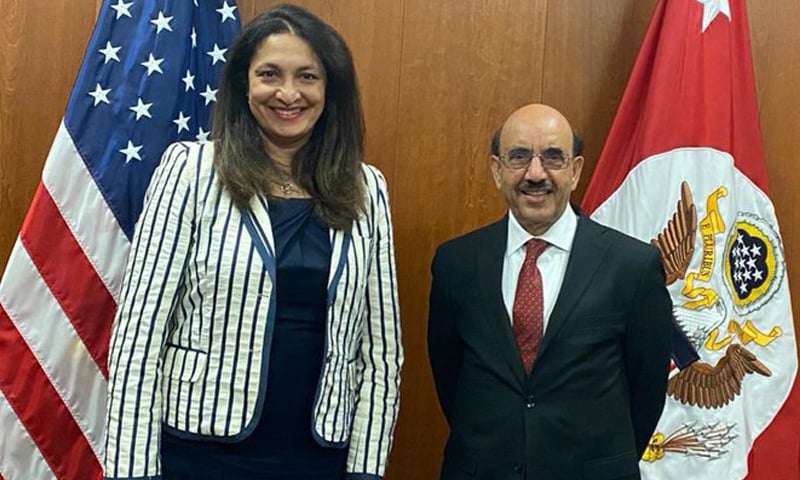
Ms Zeya, who looks after civilian security, democracy, and human rights at the State Department, expressed these views at a meeting with Pakistan’s Ambassador Masood Khan on Thursday.

She said in a tweet that she had “constructive conversation” with Ambassador Khan to “discuss human rights and Pakistan’s critical support for Afghan relocation efforts and refugees”.

An embassy statement said that both agreed to strengthen Pakistan-US relations in diverse areas through frequent exchanges on issues of mutual interest.

Responding to Ms Zeya’s tweet, Ambassador Khan said the two sides would work to promote bilateral dialogue and cooperation to forge closer ties.

Ambassador Khan also welcomed the OIC-State Department’s dialogue on 23-24 May, in Washington, to promote dialogue between the United States and OIC nations.

Under Secretary Zeya also represented the United States at the OIC-CFM Council of Foreign Ministers Conference in Islamabad in late March.

In her talks in Islamabad, she underlined the enduring ties and partnership between Pakistan and the US and commended Pakistan for offering dignity and safety to Afghan refugees for over 40 years.

At the State Department briefing, spokesperson Price said US officials have had several meetings with the representatives of the new setup since they came to power in April.

One important meeting, he said, was between Foreign Minister Bilawal Bhutto-Zardari and US Secretary of State Antony Blinken in New York last month.

“Secretary Blinken (met) his Pakistani counterpart face-to-face in his position for the first time. It was a very good, constructive discussion regarding the full range of issues, including the issue of food security,” he said. The two leaders also discussed Russia’s invasion of Ukraine and its consequences, he added.

“Pakistan is a partner of ours, and we will look to ways to advance that partnership in a manner that serves our interest and our mutual interests as well,” Mr Price said.