

The US Senate has taken a first step towards passing what has been called the most significant new gun controls in a generation.

Senators voted to speed up the passage of the bipartisan bill, meaning it could be signed into law next week.

Although significant, the proposals fall far short of what many Democrats and activists have called for in the wake of a spate of mass shootings.

The measures include tougher background checks for buyers younger than 21.

The bill calls for funding to encourage states to implement “red flag” laws to remove firearms from people considered a threat. The act also includes $15bn (£12.2bn) in federal funding for mental health programs and school security upgrades.

And it closes the so-called “boyfriend loophole” by blocking gun sales to those convicted of abusing unmarried intimate partners.

It is the first time in decades that proposed gun safety legislation has received this level of support from both Republican and Democratic party senators.

Tuesday evening’s vote passed 64 to 34 in less than two hours after the final text was circulated.

It still needs to be passed by the Democratic-controlled House of Representatives before making its way to President Joe Biden’s desk.


Senator Chris Murphy, the lead Democrat in the talks, said on the Senate floor that the bill “will become the most significant piece of anti-gun-violence legislation Congress will have passed in 30 years”.

Democratic Senate leader Chuck Schumer said in a statement: “This bipartisan gun-safety legislation is progress and will save lives. While it is not everything we want, this legislation is urgently-needed.”

His Republican counterpart, Minority Leader Mitch McConnell, described the legislation as “a common sense package” in a statement pledging his own support.

The National Rife Association (NRA) opposed the bill, saying in a statement that it “does little to truly address violent crime” and “can be abused to restrict lawful gun purchases”.

President Biden earlier this month said the proposals were “steps in the right direction” but are still not enough.

He has pushed for bigger reforms – including a ban on assault rifles, which were used in the Texas and Buffalo mass shootings – or at least an increase in the age at which they can be purchased.

The last significant federal gun control legislation was passed in 1994, banning the manufacture for civilian use of assault rifles and large capacity ammunition clips, but expired a decade later.

Watch: Thousands join gun control rallies across the US

The US has the highest rate of firearms deaths among the world’s wealthy nations. But it is also a country where many cherish gun rights that are protected by the Constitution’s Second Amendment to “keep and bear arms”.

Previous efforts lead by Democrats to strengthen US gun control laws have been hindered by Republicans.

Nearly a decade ago, attempts to tighten US gun control laws after the Sandy Hook school shooting in Connecticut – in which 20 children and six adults were killed – failed to get enough votes in Congress.

The Senate, or upper chamber of Congress, is currently split – with 50 Democrats and 50 Republicans – and legislation must have 60 votes to overcome a manoeuvre known as the filibuster – tactical delaying.

Ten of the 20 senators who support the new measures are Republicans, meaning the proposals had the numbers needed to progress.

Energy watchdog Ofgem has been accused of allowing an industry to develop on “shaky foundations” in which a series of supply companies collapsed.

All billpayers are paying about £94 more each to cover the £2.7bn cost of the failure of 28 suppliers which folded after wholesale prices soared.

The National Audit Office (NAO) said Ofgem had allowed a market to develop that was vulnerable to large shocks.

The regulator said it was already addressing the issues raised.

Meg Hillier, who chairs the Public Accounts Committee, said: “Ofgem’s approach created an energy market built on shaky foundations. As a result, many companies simply collapsed under the shock of energy price increases.

“Once again, it’s the public who has to pay for the mistakes of those charged with protecting them. It’s unacceptable.”

Encouraging competition

The result of last year’s shock was that 2.4 million customers were automatically moved to a rival company when their own supplier collapsed. Typically, according to Citizens Advice, they had to pay an extra £30 a month for the duration of their original contract, as they were shifted to a more expensive tariff.

In addition, the cost of these failures totalled £2.7bn – a tab which was spread across all billpayers in Britain, not just those of the failed companies. This is before taking into account the potentially multi-billion charge that households could face due to the collapse of Bulb Energy, which is in special administration.

The NAO said that Ofgem had decided on a “low bar” approach for allowing new domestic energy suppliers into the market to encourage competition and choice for customers after the market had been dominated by six big companies.

The regulator had then introduced tighter rules for new entrants from 2019, but not for existing suppliers until 2021.

As a result, many suppliers lacked the financial resilience to deal with the six-fold increase in wholesale prices seen last year, the NAO said.

“By allowing so many suppliers with weak finances to enter the market, and by failing to imagine that there could be a long period of volatility in energy prices, Ofgem allowed a market to develop that was vulnerable to large-scale shocks,” said Gareth Davies, head of the NAO.

“Consumers have borne the brunt of supplier failures at a time when many households are already under significant financial strain having seen their bills go up to record levels. A supplier market must be developed that truly works for consumers,” Mr Davies said.

Ofgem is making changes after a review it commissioned came to many of the same conclusions.

“We are already working hard to address all of the issues raised,” a spokesman for the regulator said. “While the once-in-a-generation global energy price shock would have resulted in market exits under any regulatory framework, we have already been clear that suppliers and Ofgem’s financial resilience regime were not robust enough.

“While no regulator can, or should, guarantee companies will not fail in the future, we will continue to take a whole-market approach to further strengthen the regulatory regime, ensuring a fair and robust market for consumers which keeps costs fair as we move away from fossils fuels and towards affordable, green, home-grown energy.”

The NAO said concerns had been raised that Ofgem’s reforms could limit new entrants and innovative ideas in the future.

A typical household gas and electricity bill – governed by the energy price cap in England, Wales and Scotland has risen sharply, and now stands at about £2,000 a year.

Analysts Cornwall Insight have predicted that the bill could hit about £3,000 a year this winter.

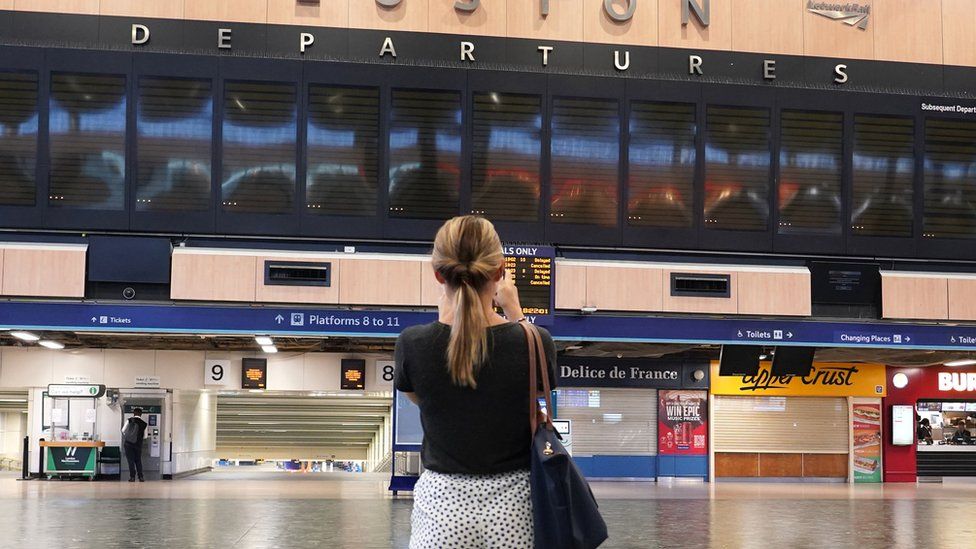
Train services in Britain will continue to be disrupted on Wednesday as talks resume in a bid to resolve a dispute over jobs, pay and conditions.

Millions of passengers were affected on Tuesday after rail workers walked out in the largest rail strike in decades.

While strikes are not being held on Wednesday, only 60% of trains are expected to be running.

The RMT union will meet Network Rail and train companies, ahead of planned strikes on Thursday and Saturday.

But Prime Minister Boris Johnson has warned passengers must be ready to “stay the course”, insisting that reforms of the rail sector are in the interests of the travelling public.


Bus stops were crowded as people sought alternative travel solutions

About 40,000 members of the Rail, Maritime and Transport (RMT) union working for Network Rail and 13 train operators walked out on Tuesday.

Half of all lines were closed and much of the country had no rail service at all, including most of Scotland and Wales, the whole of Cornwall and Dorset, and places such as Chester, Hull, Lincoln and Worcester.

RMT members on London Underground also walked out, leaving normally crammed stations deserted.

It led to travel chaos across Britain – from surging road traffic and journeys taking longer – as people found alternative modes of transport.

Disruption is set to continue on Wednesday, because the lack of overnight staff is expected to delay the first trains by up to four hours in some places, and only about 60% of normal services are due to run.

In London, there will be no Tube lines running before 08:00 BST and Transport for London has advised people to avoid using the service until mid-morning as disruption is likely to continue.

Rail workers formed picket lines outside stations on the first day of the strike on Tuesday

RMT general secretary Mick Lynch said the turnout at picket lines on Tuesday was “fantastic” and exceeded the union’s campaign.

“Our members will continue the campaign and have shown outstanding unity in the pursuit of a settlement to this dispute”, he said.

The RMT is calling for a pay rise of 7%, while employers have offered a maximum of 3%. Inflation – the rate at which prices are rising – is currently 9% but the Bank of England forecasts it will reach about 11% in the autumn.

Mr Johnson said pay rises in line with soaring inflation needed to be resisted.

Mr Lynch accused the government, which owns Network Rail, of actively preventing employers and the RMT from reaching a settlement.

Train services ended early on Tuesday as a result of the strike

The RMT has been asked by Network Rail to attend formal consultation talks next month on introducing “modern working practices”.

Network Rail official Tim Shoveller said about 1,800 jobs were expected to be cut, but the “the vast majority” would be through “voluntary severance and natural wastage”.

The changes would mean “dumping outdated working practices and introducing new technology”, he said.

Speaking at a cabinet meeting on Tuesday, the prime minister said without modernisation to the industry, train operators risked going bust and passengers faced ever-increasing prices that could lead to them abandoning rail travel.

Meanwhile, the government is planning to introduce a new law this week to make it legal for employers to bring in agency staff to replace striking workers – but it will not impact the planned rail strikes on Thursday and Saturday.

Some Asda shoppers are setting £30 limits at checkouts and petrol pumps, the supermarket’s chairman has said

Customers are putting less in their baskets, switching to budget ranges and are worried about the future, said Lord Stuart Rose.

“What we’re seeing is a massive change in behaviour,” he told the BBC.

It comes after food and fuel costs soared in the UK. Inflation – the rate at which prices rise – reached a 40-year high of 9% in April.

Lord Rose said he saw the inflation rise coming last year like a “train coming through a tunnel with a big flashing light on the top”. Now it’s time to “fasten our seatbelts”, he said.

“People are trading back. They are worried about spending,” he said. “They’ve got a limit that they’ve set out, too. They say £30 is one limit… and if they get to more than £30 then that’s it, stop. It’s the same with petrol.”

Lord Rose said the country was facing some very tough times and urged the government to do more to help low income households.

But the Treasury said it understood people were struggling with rising prices and it was making cost of living payments of £1,200 to those on the lowest incomes.

Lord Rose also addressed government concerns that supermarkets were not passing on March’s 5p per litre cut in fuel duty, insisting Asda price changes were “done the same day”.

Asda customers are trading down to budget ranges, the supermarket’s chairman says

The retail veteran has some 50 years of industry experience under his belt. He remembers the runaway inflation of the 1970s and said this bout of rising prices has come as a very nasty surprise for consumers.

“I’m of the generation that remembers what it was like last time. And once [inflation] gets hold, it’s quite pernicious,” he said.

“And it takes a long time to eradicate… We’re in danger of being in a place that it’s very difficult to extricate ourselves from.

“What’s rather sad is that the country, the government, perhaps the Bank of England didn’t see inflation coming quickly. They’ve now recognised that.”


Asda has been tracking disposable income since the financial crisis in 2008 and is all too aware of the squeeze on consumers.

Its latest data shows households had, on average, £44 less a week in discretionary income in May compared with a year ago – a fall of nearly 18%. This is the amount of money left over after taxes and essential bills have been deducted and it is the third month in a row where disposable incomes have dropped to record levels.

Budget range

Asda has launched a new budget range called Just Essentials

Like other supermarkets, Asda is having to grapple with its own soaring costs and decide how much of this to absorb and how much to pass on to shoppers.

All the big grocers are in a battle to keep prices as low as possible on the most popular everyday items because they know customers will vote with their feet and shop around.

The UK’s third biggest grocer has expanded its cut price groceries with a new range, Just Essentials, covering some 300 products.

It has also launched Dropped and Locked, an initiative to lower prices on 100 items and keep them at the same price for the rest of the year.

“We’re doing everything we can. We’ve invested nearly £100m in the last month or so making sure customers get essentials at very, very attractive prices to try and help them,” said Lord Rose.

But will it be enough? Asda has recently been performing less well than its rivals.

Lord Rose said he was not too worried about market share in the short and medium term.

“It goes up a bit, and down a bit, you’ll see the monthly changes and that’s always been the case in retail… We will do what we need to do to look after our customers,” he said.

“Secondly, because we’ve had a change of ownership – my colleagues and I only took over the business a year ago – we’re doing things which we think will affect the long term of the business which will give customers a better Asda.”

‘More support’

The Asda chairman and former M&S boss said he did not want to predict where food prices will get to by the end of the year but would like to see more government support for those most in need.

“I would urge them to do more for those people at the bottom end of the earnings income scale,” he said. He suggested a VAT reduction or another reduction in fuel tax would be “helpful”.

He acknowledged the government now has a difficult balancing act between tackling rising prices without scuppering economic growth. But he knows what he would do.

“I would say the most important priority in the short term is to kill inflation, because once inflation gets embedded, it’s very, very hard to kill. If it means we have to slow the economy down for a while, and it looks as if we are heading for a recession, then so be it.”

A government spokesperson said its £37bn support package meant it would deliver a tax cut in July to save the typical employee more than £330 a year.

It said people on Universal Credit would keep £1,000 more of what they earn and a 5p cut on fuel duty would save a typical family £100.

Dollar hits record Rs212 as IMF deal delay weighs heavy on rupee

According to the Forex Association of Pakistan (FAP), the rupee depreciated by over Rs2 to reach an all-time low of Rs212 against the dollar from Monday’s close of Rs209.96. Yesterday, the greenback appreciated by a sharp Rs1.21 — a trend persisting for over a week now.

According to Mettis Global — a web-based financial data and analytics portal — the rupee has incurred a colossal loss of Rs6.4 during five consecutive sessions last week.

Komal Mansoor, head of research at Tresmark, told Dawn.com that it seemed as if the country was now completely relying on an IMF bailout.

“There is some support for the rupee around the current 211 level, but we see a gradual depreciation of rupee on a daily basis till such time that the IMF staff-level agreement is signed,” she said.

The IMF loan facility, meanwhile, has been stalled since early April as negotiations with the international money lender remain inconclusive, with the lender earlier expressing reservations over fuel and energy subsidies introduced by the previous PTI government and now over targets set by the new government for the upcoming fiscal year.

Pakistan had signed a 39-month, $6bn Extended Fund Facility with the IMF in July 2019, but the Fund stopped the disbursement of about $3bn when the previous government reneged on its commitments and announced fuel and energy subsidies.

Yesterday, Finance Minister Miftah Ismail expressed hope that an agreement with the IMF for the revival of the Extended Fund Facility (EFF) would be reached “within one or two days”.

Before his optimism, a Dawn report, quoting diplomatic sources, said the United States has agreed to help Pakistan negotiate a deal with the IMF.

Earlier, media reports had claimed that Islamabad was “seeking Washington’s support” for renewing its Extended Fund Facility (EFF) with the IMF. As the largest shareholder, the US has considerable influence over the IMF’s decision-making.

Depleting foreign exchange reserves ‘putting pressure’

FAP chairman Malik Bostan blamed the rapidly depleting foreign exchange reserves for “putting pressure” on the rupee.

“After a long time, foreign exchange reserves have fallen to single digits, which has worried the market,” he said.

According to SBP, Pakistan’s reserves have fallen by another $234 million to close just below $15 billion in all. The central bank’s share in these reserves is just under $9 billion.

Secondly, Bostan added, demand for the dollar is high because of the upcoming Haj season. “Over 400,000 Pakistanis are going for Haj this year and are buying dollars. This is adversely impacting the local currency.”

Rumors of stopping LCs

Earlier, a Dawn report said that the currency market was gripped by uncertainty and rumours that banks have stopped opening letters of credit (LCs)

Such a situation was, however, denied by the central bank. “State Bank has not stopped banks from making import payments. Even today, roughly about $200m import payments have been executed,” SBP Chief Spokesman Abid Qamar said.

Meanwhile, the SBP has required prior approval before the opening of LCs or registration of contracts for certain types of imports like cars (CKD), cellphones and certain types of machinery. But these instructions were issued on May 20 and not today, he said.

On May 20, the SBP issued a circular after the decision of the federal government to ban imports of luxury and non-essential goods. The decision meant to consume fewer dollars while saving the economy from imported inflation. So far, the country’s import bill has already crossed $70 billion in the outgoing year.

Israel is set to hold a fifth general election in under four years, after its fractured coalition government concluded it could not survive.

In a major political development, Prime Minister Naftali Bennett will switch places with Alternate Prime Minister Yair Lapid under an existing deal.

An election could take place in late October, commentators say.

The former prime minister and current opposition leader, Benjamin Netanyahu, has vowed to return to office.

Monday’s announcement comes after weeks of speculation that the coalition – the most diverse in Israel’s history – was on the brink of collapse.

It risked losing an important vote next week after a member of Mr Bennett’s own right-wing Yamina party quit the coalition, leaving it a minority in the 120-seat Knesset (parliament).

Mr Bennett said he had made the “right decision” in the interests of Israel’s security, as dissolving the Knesset extended temporary laws which were put in jeopardy by the vote.

The coalition had been teetering for weeks. Last week, Yamina MK Nir Orbach resigned from it, saying the government had failed in its main mission “of lifting [Israelis’] spirits” – a move which left it with only 59 seats. Others had also threatened to rebel.

The announcement on Monday night caught members of the government by surprise. The Times of Israel quoted sources as saying neither the defence nor interior ministers knew about the decision.

The bill to dissolve the Knesset will go to a vote next week. If it passes, as expected, Mr Bennett will make way for centrist Yair Lapid to become interim prime minister.

The two men formed the coalition just over a year ago after a series of inconclusive elections, ousting Mr Netanyahu, Israel’s longest-serving leader.

The coalition was stitched together from eight parties from across the political spectrum, united only by the desire to make it impossible for Mr Netanyahu to form a government.

Mr Netanyahu, who is currently standing trial on corruption charges which he denies, said it was “great news for millions of Israeli citizens”.

“This government is going home,” he said, adding that he would form “a wide, national government” headed by his Likud party.

Last week, the results of an Israel Channel 12 TV poll indicated that a bloc led by Mr Netanyahu would win most seats in a fresh election, though still two short of a majority.

Imports from China’s Xinjiang region are due to be banned in the US from Tuesday as new rules come into force.

Under the regulations, firms will have to prove imports from the region are not produced using forced labour.

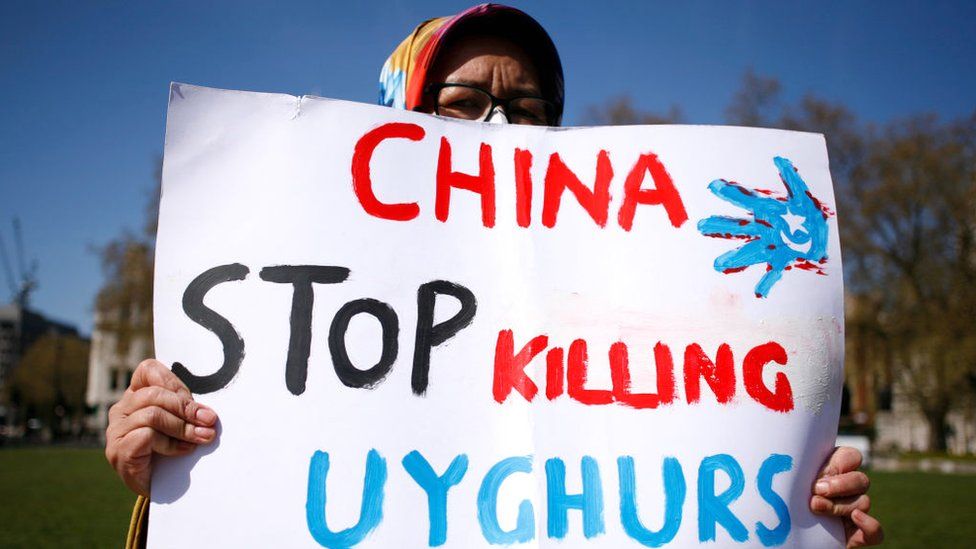
US officials have said members of the minority Uyghur community in the region, who are predominantly Muslim, have been detained and made to work.

China has repeatedly rejected accusations that it is holding Uyghurs in internment camps in Xinjiang.

Several imports from the resource-rich region, including cotton and tomatoes, have already been banned from the US.

The restrictions will be extended to all imports under the Uyghur Forced Labor Prevention Act (UFLPA), which is scheduled to take effect on Tuesday.

In a statement late last week, US lawmakers said the law sends “a clear message that we will no longer remain complicit in the Chinese Communist Party’s use of slave labour and egregious crimes against humanity”.

“Congress stands ready to work with President Biden and his administration to ensure this historic law is fully and rigorously implemented,” US Republican Senator Marco Rubio, Democrat Senator Jeff Merkley and two other lawmakers said.


According to the US Congress, China has detained more than a million Uyghurs and other Muslim minorities in Xinjiang since April 2017.

It believes tens of thousands of detainees have worked “at a fraction of minimum wage or without any compensation” in Xinjiang and other provinces “under the guise of poverty alleviation and industrial aid programmes”.

It said China also “interferes with audits and traditional due diligence efforts to vet goods and supply chains in Xinjiang… including by intimidating potential witnesses and concealing relevant information”.

China has denied the use of forced labour and said the camps in Xinjiang were “re-education” facilities used to combat terrorism.

Chinese foreign ministry spokesperson Wang Wenbin recently called forced labour accusations “an out-and-out preposterous lie concocted by certain external forces”.

But leaked files and first-hand accounts from inside the camps, which were obtained by the BBC, have detailed an organised system of mass rape, sexual abuse and torture of ethnic minorities.

Human rights groups have also accused the Chinese government of gradually stripping away the religious and other freedoms of Uyghurs through mass surveillance, detention, indoctrination and even forced sterilisation.

What does it mean for brands?

Scott Nova, executive director of the independent Workers Rights Consortium in Washington DC, said the UFLPA “will likely substantially reduce the practice of forced labour in Xinjiang” by “eliminating a large part of the market” for its goods.

“A crucial question is whether brands selling goods in the US will try to take advantage of the weaker protections in other consumer markets by directing goods with content from Xinjiang to those markets,” Mr Nova said.

“Our coalition will be working to identify and publicly expose any brands and retailers that engage in this practice,” he added.

Laura Murphy, a human rights professor at Sheffield Hallam University in the UK, said the European Union (EU) should impose a similar import ban on goods from Xinjiang.

“I think that citizens of the EU would be shocked to know that a ban on products known to be made with forced labour does not already exist,” Prof Murphy said.

“But the EU also needs to be a leader in passing mandatory human rights due diligence. Both these tools are necessary to ensure that companies address the forced labour and other abuses in their supply chains,” she added.

Japanese retailers Uniqlo and Muji are among brands that have been scrutinised over materials from Xinjiang.

In January last year, the US blocked a shipment of Uniqlo men’s shirts over concerns that it violated a ban on cotton products from the region.

Responding to a query from the BBC last week, a Uniqlo spokesperson did not state whether or not the brand uses cotton from Xinjiang.

“We continue to work with [US officials] to implement measures for the smooth importation of our products, and are awaiting new guidelines scheduled for release on 21 June,” the spokesperson said.

Meanwhile, Japanese retailer Muji has been criticised for launching a collection of Oxford shirts “made of organic cotton delicately and wholly handpicked in Xinjiang” in 2019.

A spokesperson at Ryohin Keikaku, which operates the Muji brand, told the BBC it was not currently exporting products from Xinjiang to the US. However, the company declined to comment on whether it was selling products from Xinjiang in other countries.

“In our business activities, we comply with the laws and regulations of each country and region, and we are taking all necessary steps to respect human rights and labour standards,” the spokesperson said.

Early last year, the administration of former US President Donald Trump announced a ban on cotton and tomato products from Xinjiang.

The wider-reaching UFLPA was approved by the Senate last July, and Congress in December. It was subsequently signed into law by current US President Joe Biden.

From Tuesday, US Customs and Border Protection officials will stop all shipments from Xinjiang that arrive at American ports.

Cargo will be stopped from entering the country unless the importer can “prove by clear and convincing evidence that the goods were not produced with forced labour,” the US Department of Homeland Security said.

US, Morocco launch vast military exercise

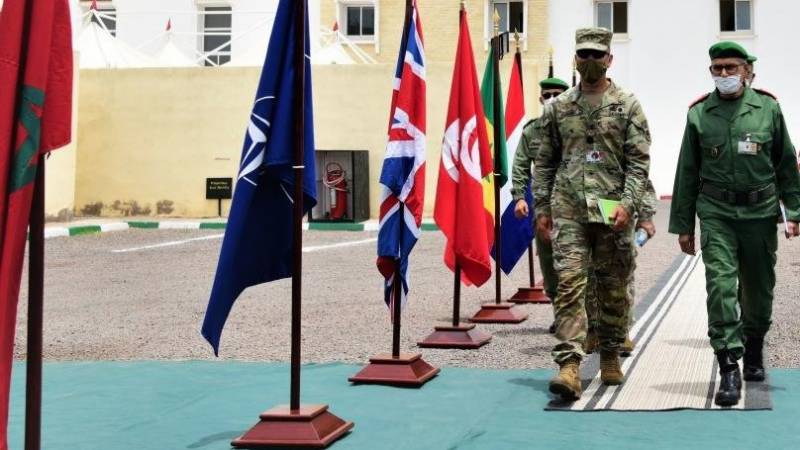
The United States and Morocco on Monday launched the vast annual “African Lion” military exercise, amid heightened tensions between the North African kingdom and neighbouring Algeria.

The exercise, which began in the southern Moroccan region of Agadir and lasts the rest of the month, involves some 7,500 personnel from 10 nations such as Brazil, France and the United Kingdom.

It will include observers from NATO and for the first time, officials from Israel.

Some manoeuvres will take place in Tunisia, Senegal and Ghana, US Africa Command said in a statement.

The “exercise bolsters interoperability among partner nations and supports US military strategic readiness to respond to crises and contingencies in Africa and around the world”, it added.

The Moroccan military‘s second-in-command, General Belkhir El Farouk, said Monday the country needed to tackle “security challenges”.

The kingdom will host land, sea and air phases, a paratrooper landing and a weapons of mass destruction response exercise.

Most will take place in Kenitra, near Rabat, but others will be near further south near the Algerian border, according to the Moroccan military.

There will also be a paratrooper landing and an artillery exercise in the desert, near the edge of the disputed Western Sahara and the Sahrawi refugee camps of Tindouf where the Algerian-backed Polisario independence movement is based.

The exercise comes amid heightened tensions over the Western Sahara since US president Donald Trump recognised Moroccan sovereignty over the territory in 2020 in return for Rabat re-establishing ties with Israel.

Algeria responded months later by breaking ties with Morocco, citing “hostile acts” and slamming its neighbour’s security cooperation with the “Zionist entity” (Israel).

This month Algiers also scrapped a long-standing treaty with Madrid after the Spanish government broke with decades of neutrality to back a Moroccan plan for autonomy in the desert territory.

Morocco considers it an integral part of the kingdom, while the Polisario has long demanded an independence referendum there.

The former Spanish colony boasts hundreds of kilometres of coastline with rich Atlantic fishing waters, plentiful phosphate resources and a key highway to West African markets.

Assam: India floods destroy millions of homes and dreams

That is how Ronju Chowdhary described the scene outside her house on Saturday. She lives in Udiana, a remote village in the north-eastern Indian state of Assam, which has been hit by severe floods.

It had been raining incessantly, she remembers. The water rose so quickly that the streets were completely submerged within hours. When the water entered their home, she says the family huddled together in darkness trying to keep themselves safe.

Two days on, the family is still marooned in their house – now resembling a lonely island – amid a sea of water.

“We are surrounded by flood water from all sides. There’s hardly any water to drink. Food is running short too. And now I hear that the water levels are further rising,” Ms Chowdhary says. “What will happen to us?”

Udiana village is submerged under water

Unprecedented rainfall and flooding has left behind a trail of destruction in Assam, submerging villages, destroying crops, and wrecking homes. Authorities say that 32 of its 35 districts have been affected, killing at least 45 people and displacing more than 4.7 million over the last week.

Heavy rains have also lashed neighbouring Meghalaya state, where 18 people have died over the last week. In Assam, the government has opened 1,425 relief camps for the displaced, but authorities say their job has been complicated by the sheer intensity of the disaster. Even the rescue camps are in a dismal state.

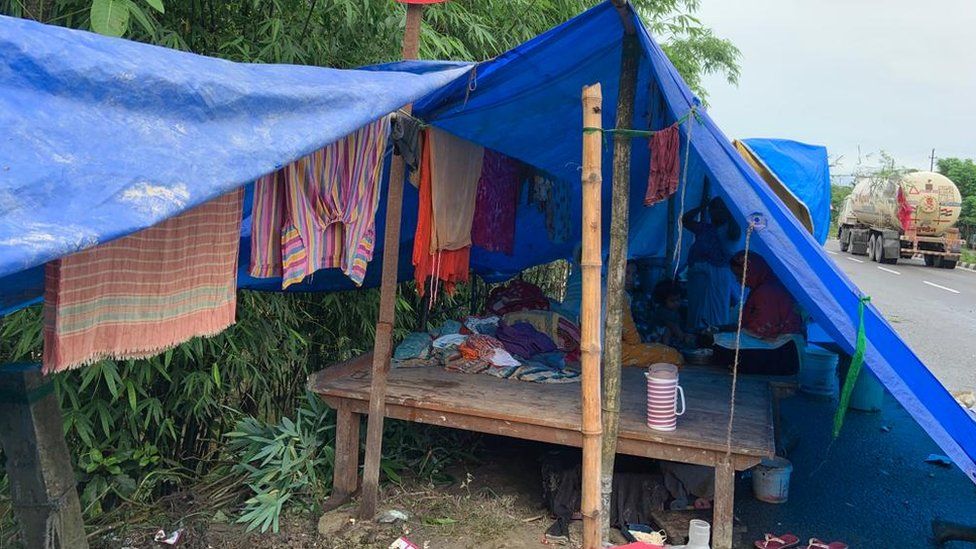
“There is no drinking water in the camp. My son has a fever but I am unable to take him to the doctor,” says Husna Begum, also a resident of Udiana. When water reached her home on Wednesday, the 28-year-old swam through the torrent in search of help. She is now sheltering in a rickety plastic tent with her two children.

“I have not seen something like this before. I’ve never seen such huge floods in my life,” she says.

Husna Begum is sheltering in a plastic tent after her house was submerged

Floods routinely wreak havoc on the lives and livelihoods of millions living near the fertile riverbanks of the mighty Brahmaputra river, often called the lifeline of Assam. But experts say that factors like climate change, unchecked construction activities and rapid industrialisation have increased the frequency of extreme weather events.

This is the second time this year that Assam is grappling with such fierce floods – at least 39 people were killed in May. The state has already recorded rainfall 109% above average levels this month, according to the weather department. And the Brahmaputra is flowing above the danger mark at many places.

Residents have been forced to vacate their homes

Residents and authorities the BBC spoke to describe the latest deluge as one of “biblical proportions” – one that has altered the social and economical fabric of the state.

“The situation is particularly alarming this time. Apart from the team of the National Disaster Response Force (NDRF), we have also deployed the army to aid the rescue operations,” says Javir Rahul Suresh, a sub-divisional officer in Rangiya city.

“At this point, our priority is to save lives.”

Officials and residents say this is one of the worst floods in Assam in years

Entire settlements have been engulfed by rushing waters, almost resembling a huge river that had formed overnight.

In Guwahati, the main economic centre of Assam, neighbourhoods have been reduced to rubble. Lush fields where rice and paddy normally grew have turned into vast swamps of mud and debris.

Back in Udiana, there are no schools, hospitals, temples or mosques in sight – just water. People travel by boats made of banana leaves and bamboo sticks. Others just swim through the brown, green brackish waters despondently, their eyes lighting up at the sight of rescuers, whose bright orange uniforms are visible from a distance.

The damage is particularly alarming in Kamrup Rural district, where hundreds of people are still reportedly trapped in their houses.

Siraj Ali, 64, says that when the water swept into his village and destroyed everything, he was scared for his life. Yet he stayed on, in a house which is now partly submerged under water, to guard his belongings and “a life-time of memories”.

He said he sent his children to a roadside shelter camp, while he waited for help to reach him. But no one has come so far.

“I am surrounded by water but I have no water to drink. I don’t have food. I have been starving for three days. What to do and where do I go?” he asks, his eyes welling up with tears.

Siraj Ali refused to leave his home even though it was submerged under flood waters

Mr Ali now finds solace in the company of his neighbour Mohammad Rubul Ali, a daily-wage worker, who also decided to stay back to protect his house – a small hut that he painstakingly built.

“Every purchase was like a milestone for me – the cycle, the bed and the chairs. But now nothing is left. The flood took everything away from me,” Mr Rubul says.

Authorities admit that they have been unable to provide drinking water and food to every flood victim.

“It is still a challenge for us to reach some areas which have been completely cut off. Our road network reaching there has been completely ruined in the water,” Mr Suresh says.

Experts say that while climate change has complicated the state’s longstanding efforts to improve its response to flooding, there are several other factors at play.

Rubul Ali, who also refused to leave his house, is Mr Siraj’s neighbour

“There is no doubt that the flood situation this time is very serious and the frequency of rains is increasing significantly,” says Jayashree Rout, an environmental science professor at Assam University. “But before linking it entirely to climate change, we need to take into account human-related factors like deforestation.”

Prof Rout says there’s an urgent need to stop the felling of big trees, especially near rivers as the roots of these trees have a lot of capacity to hold water.

But people like Ms Chowdhary have no time to analyse the reasons.

On Saturday, as the sun dripped over the cloudy horizon in Udiana and dusk crept over the sky, she sat outside her half-submerged house, visibly worried.

“Till now, no one has given us anything in the name of relief,” she says. “Is anyone even coming?”

French President Emmanuel Macron will meet political opponents on Tuesday after his coalition failed to win a majority in parliamentary elections.

Mr Macron is now under pressure to secure support from rivals to fulfil his government’s reform agenda.

But neither Marine Le Pen’s far-right nor Jean-Luc Mélenchon’s left-green alliance are keen to work with him.

Minority governments are a rarity in France, and Mr Macron’s Ensemble alliance is 44 seats shy of a majority.

This means he will need to find support from mainstream MPs from both the left and right side of politics to help build a working majority.

Party representatives will visit the Élysée Palace separately for the high-level talks on Tuesday and Wednesday.

Analysts say the president may be eyeing a deal with the right-wing Republicans, and the party confirmed that its leader, Christian Jacob, would attend the talks.

Ms Le Pen will take part but Mr Mélenchon will not, the AFP news agency reports.

Socialist Party leader Olivier Faure and Communist Party boss Fabien Roussel, members of the Nupes left-wing alliance, will also meet Mr Macron.


France’s centrist government is desperately trying to avoid political paralysis after losing its majority, with some commentators warning of France becoming ungovernable.

Mr Macron will also have to replace three ministers who lost their seats in Sunday’s vote, and Prime Minister Elisabeth Borne’s future looks increasingly under threat.

The election on Sunday saw a low-turnout, with an abstention rate of 53%.

1px transparent line

President Macron has laid out a series of plans to tackle the spiralling cost of living, including food vouchers and enhanced benefits. Another big reform is gradually raising the retirement age from 62 to 65, which has proved unpopular with much of the electorate.

The aim is to “build solutions to serve the French” at a time when there is no “alternative majority” to that of Macron’s ruling alliance, a presidential official, who asked not to be named, told AFP.

Opponents from the right and left aim to resist the president’s programme of reforms, although Ms Le Pen’s National Rally has said it may back measures to alleviate the cost of living crisis if their own proposals are adopted.