

The government is preparing to repeal a legal ban that prevents agency staff filling in for striking workers.

Transport Secretary Grant Shapps told the Sunday Telegraph a potential change in legislation could allow companies to hire temporary workers to cover some roles and prevent disruption.

Any intervention would not affect the rail strikes across Britain this month.

But Mr Shapps said changes could be brought in quickly to minimise future action in rail or other sectors.

A war of words between rail unions and ministers has been escalating since the RMT union announced three days of strikes, after talks about pay, terms and conditions, and redundancies fell through.

Mr Shapps said should the action continue then “further measures certainly would come in during this particular dispute, if it can’t be resolved”.

“We will be looking at the full suite of modernisation that’s required,” he told the Telegraph. “The country must not continue to be held to ransom.”

The transport secretary said any change could involve secondary legislation, which can be signed off by ministers “very fast”.

Meanwhile, writing in the Sun on Sunday, Mr Shapps warned rail workers who plan to strike this month that they will not be able to work overtime on subsequent days to top up pay they will lose as a result of taking part in the action. It is is understood this is because rail companies may decide to run restricted timetables after the strike days.Transport Secretary Grant Shapps said the country “must not continue to be held to ransom”

Mr Shapps’ comments come less than a month after rail unions reacted with fury to a government threat to make strike action illegal unless a minimum number of train staff remained working during a walkout.

In response, RMT general secretary Mick Lynch said “any attempt” by Mr Shapps to “make effective strike action illegal on the railways will be met with the fiercest resistance from RMT and the wider trade union movement”.

More than 40,000 RMT members working for Network Rail and 13 train operating companies across Britain will strike on 21, 23 and 25 June.

In a separate dispute over pensions and job losses, the RMT’s London Underground members will also strike on 21 June.

The RMT is calling it the biggest dispute for over three decades and put the industrial action down to the “inability of the rail employers to come to a negotiated settlement”.

Train and tram drivers, part of the Aslef union, are also set to strike in three locations this month.
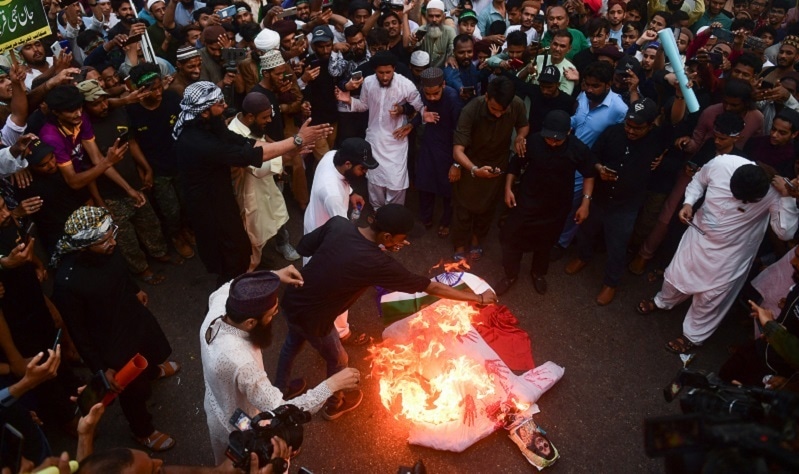
Huge protests in Asia over Indian politicians’ remarks against Holy Prophet

Anger has engulfed the Islamic world since last week, when a spokeswoman for Prime Minister Narendra Modi’s ruling party made a disrespectful comment on the Holy Prophet on a TV debate show.

Around 20 countries have since called in their Indian ambassadors and the party has gone into damage control, suspending the official from its ranks and insisting it respected all religions.

People hold posters during a protest demanding the arrest of suspended Bharatiya Janata Party (BJP) spokeswoman Nupur Sharma and expelled BJP leader Naveen Jindal, for their comments on the Prophet, outside a mosque in Mumbai on Friday. — Reuters

Friday saw the biggest street rallies yet in response to the furore, with police estimating more than 100,000 people mobilised across Bangladesh after midday prayers.

“We gather here today to protest the insult of our Prophet by Indian government officials,” said Amanullah Aman, a protester in the capital Dhaka.

Muslims participate in a protest demanding the arrest of Bharatiya Janata Party (BJP) member Nupur Sharma for her comments on the Prophet in Kolkata, India on Friday. — Reuters

“We want death penalties for them. Crowds in the city chanted slogans denouncing Modi and warning enemies of the Muslim faith to “be careful”.

In Pakistan, Tehreek-e-Labbaik Pakistan (TLP) held a march in its stronghold of Lahore after Friday prayers.

Around 5,000 supporters of the TLP — a previously banned group — gathered to protest in the city centre calling on the government to take stronger action against India over the comments.

Demonstrators carry an effigy of India’s Bharatiya Janata Party former spokeswoman Nupur Sharma during a protest over her remarks on the Prophet in Karachi on Friday. — AFP

“The Prophet of Islam is our red line. Be it India… or anyone else, they should know that defenders of Islam will not remain silent,” said school teacher Irfan Rizvi.

‘Must apologise’

Members of India’s 200 million-strong Muslim minority community staged demonstrations in several cities, with a large crowd gathered on the steps of the 17th-century Jama Masjid mosque in New Delhi.

Protestors clash with police during a protest demanding the arrest of Bharatiya Janata Party (BJP) member Nupur Sharma for her comments on the Prophet in Prayagraj, India on Friday. — Reuters

Elsewhere in the capital, social media footage showed students of the prestigious Jamia Millia Islamia university burning an effigy of Nupur Sharma — the Bharatiya Janata Party spokeswoman whose comments set off the furore.

Authorities in Indian-occupied Kashmir cut the restive territory’s internet connections, restricted prayer congregations at mosques and imposed a curfew on Friday.

A spontaneous shutdown saw businesses close across Srinagar, the region’s major city, with protesters calling for retribution against “disrespect” to the Prophet.

People raise their hands and chant slogans against the blasphemous comments on the Prophet by the members of the Indian Bharatiya Janata Party, during a protest in Karachi on Friday. — Reuters

In Indonesia, the world’s largest Muslim-majority country, about 50 protesters staged a rally in front of the Indian embassy in Jakarta.

“The Indian government must apologise to Muslims and they must take strict action against the politicians who made the remarks,” protest coordinator Ali Hasan told AFP.

The row follows anger across the Muslim world in 2020 after French President Emmanuel Macron defended the right of a satirical magazine to publish caricatures of the Prophet.

Bangladesh’s religious parties’ activists and supporters hold placards as they shout anti-India slogans during a demonstration in Dhaka on Friday. — AFP

French teacher Samuel Paty was beheaded in October 2020 by a Chechen refugee after showing the cartoons to his class in a lesson on free speech.

Flights halted from Damascus airport after Israeli strikes

Since civil war broke out in Syria in 2011, Israel has carried out hundreds of air strikes against its neighbour, targeting government troops as well as allied Iran-backed forces and fighters from Lebanon’s Hezbollah, but rarely have such attacks caused major flight disruptions.

The Syrian Observatory for Human Rights war monitor said the latest strike carried out before dawn on Friday hit three arms depots near Dama­scus airport belonging to Hezbollah, as well as other Iran-backed groups.

Syria’s transport ministry later announced the “suspension of incoming and outgoing flights through Damascus airport” as a result of technical disruptions.

“The resumption of flights shall be declared once the installations and equipment are fixed to ensure the safety and security of the operational traffic,” it said.

An airport employee said the Israeli strikes had “affected” the facility.

“We had to postpone all flights for 48 hours and some flights have been rerouted through Aleppo airport,” the employee said.

An official at an Arab airline said an airport landing strip had been hit during the Israeli assault — a development the pro-government newspaper Al Watan also reported.

The official said there had been no departures or arrivals from the airport since the strikes.

The Syrian Observatory for Human Rights said the damaged runway was the only one still operational after an Israeli strike last year put another one out of service.

Last year’s strikes had targeted weapon shipments and arms depots operated by Iran-backed groups, said the Observatory, a Britain-based monitor that relies on a wide network of sources inside Syria.

The airport is located in a region south of Damascus where Iran-backed groups, including Hezbollah, regularly operate.

The vicinity of the facility is a favourite target for Israel, which has launched 15 aerial attacks on Syria this year alone and regularly accuses Iran of using Damascus airport to send weapons shipments to its allies.

Arms depots

The Observatory said the runway hit in the attack had already been in poor condition before the raids.

Syrian state media had reported the Israeli strikes on southern Damascus, saying a volley of missiles were fired from the occupied Golan Heights before daybreak.

Syrian air defences intercepted most of the missiles, but those that reached their target left one civilian wounded and caused material damage.

While Israel rarely comments on individual strikes, it has acknowledged carrying out hundreds of them.

Pakistan urges UN not to be silent

Foreign Minister Bilawal Bhutto-Zardari called UN General Assembly President Abdulla Shahid on Friday and apprised him of the derogatory remarks made by two senior officials of India’s ruling party BJP against the Holy Prophet (peace be upon him).

Noting that such willful and deliberate provocation had deeply hurt the sentiments of billions of Muslims around the world, the foreign minister urged the UNGA president to “take cognizance of this abhorrent development amidst growing hate speech and rising Islamophobia in India,” said a statement issued in New York.

Referring to the muted response of the Indian leadership on the incident, he reminded the UNGA president that “silence could be taken as complicity, and could lead to further incitement to violence, communal discord and hate incidents”. The statement said the UNGA president underscored the impo­r­tant role of the General Assem­bly and the need for the membership to work together on these issues.

Prices in the US rose faster than expected last month, as rising energy and food costs pushed inflation to the highest rate since 1981.

The annual inflation rate rose to 8.6% in May, the Labor Department said, after easing in April.

The rising cost of living has been squeezing households and putting pressure on policymakers to bring the issue under control.

The US central bank has been raising interest rates since March.

Analysts had hoped that the moves were starting to work to cool economic activity, easing the price pressures. But the conflict between Russia and Ukraine, which has driven up the price of oil and commodities like wheat as it disrupts exports from the two countries, has made tackling the problem more difficult.

Food prices were up more than 10% last month compared to May 2021, while energy surged more than 34%.

But Friday’s report showed the increases continue to spread throughout the economy, pushing the cost of everything from airline tickets and clothing to medical services higher.

“So much for the idea that inflation has peaked. Consumer prices blew past expectations – and not in a good way with the 8.6% annual increase the fastest in more than 40 years,” said Greg McBride, chief financial analyst at Bankrate.com.

“Worse the increases were nearly ubiquitous. Just no place to hide.”

The US has been grappling with rising prices since last year, when an unexpectedly strong economic rebound from the shock of the pandemic – driven by large doses of US government spending, including direct cheques to households – overwhelmed supplies, prompting companies to raise prices.

Now the war in Ukraine has spread the problem around the world, with Covid-related shutdowns in China this spring contributing.

As the rising costs hit household purchasing power and prompt a pullback in spending, officials are warning that growth in many countries is at risk of a sharp downturn.

“The war in Ukraine, lockdowns in China, supply-chain disruptions, and the risk of stagflation are hammering growth. For many countries, recession will be hard to avoid,” World Bank President David Malpass said this week.

The average petrol price in the US is approaching $5 a gallon

US stock markets fell in the wake of the inflation reports, with all three major indexes dropping more than 2%. The falls added to weeks of declines in US shares, as investors become nervous about the path for the economy.

“Even if inflation peaks soon, it’s unlikely to decelerate quickly.” said Richard Flynn, managing director of Charles Schwab UK. “High prices may put pressure on consumer spending into the medium term.

“Add ongoing supply-chain problems and the economic impact of Russia’s invasion of Ukraine to the threat of inflation, and it’s easy to see why fears of a downturn have risen swiftly.”

For now, the US labour market has continued to add jobs, a sign that growth is continuing.

But wages have not kept pace as prices climb. The rising cost of living has especially hit lower income households, for whom basics like food and energy make up large portions of spending.

Polls show a majority of Americans see inflation as the top problem facing the country. Consumer sentiment has plunged and US President Joe Biden’s approval ratings have sunk as Republicans criticise him over the issue.

Over the month, prices gained 1%, driven by the rising cost of petrol, which has hit new records in the US, approaching an average of nearly $5 a gallon.

In hearings in Washington this week, US Treasury Secretary Janet Yellen said bringing down prices was the “number one priority”.

In a statement, Mr Biden said “we must do more – and quickly – to get prices down here in the United States”.

“I’m doing everything in my power to blunt Putin’s price hike, and bring down the cost of oil and food,” the president later pledged at a speech at the Port of Los Angeles in California.

Roberto Perli, head of global policy research at Piper Sandler investment bank, said he expected prices to come under control as America’s central bank, the Federal Reserve, increases interest rates. But he warned that raising borrowing costs will hurt economic growth.

“For now, the US economy is very healthy and you see it reflected in the fact that there is such a strong demand for pretty much everything, goods and services. But the Fed has to take care of the problem,” he said.

“The result will be not now but in the quarters ahead a significant slowdown in the US economy, induced in large part by the Fed.”

After more than a decade spent trying to avoid extradition from the UK, Julian Assange is running out of time and options.

But with the election of a new government in his native Australia last month, his supporters hope he has a new, powerful ally.

Prime Minister Anthony Albanese has previously spoken against Mr Assange’s incarceration, and the activist’s family are counting on him to put pressure on the UK as the deadline for a critical deportation decision looms.

The Wikileaks founder is wanted in the US over classified documents leaked in 2010 and 2011, which it says broke the law and endangered lives.

But Mr Assange’s supporters say the reports exposed US wrongdoing in the Iraq and Afghanistan wars and were in the public interest.

After a long legal battle in the UK, the courts in April referred the US extradition request to the Home Secretary for her final decision.

Priti Patel has until 19 June – exactly 10 years since Mr Assange was last free – to make it.

“At this point, until Priti Patel signs off, it is entirely political. And so it’s open to a political solution,” says Mr Assange’s brother, Gabriel Shipton.

So what – if anything – can Australia do?

Mr Albanese – a signatory to the Bring Julian Assange Home Campaign petition – last year said the 50-year-old should be freed.

“Enough is enough,” he said at a party room meeting.

“I don’t have sympathy for many of his actions but essentially I can’t see what is served by keeping him incarcerated.”

Anthony Albanese has previously spoken in support of Mr Assange’s release

But since taking office Mr Albanese has been coy on what action his government will take on the matter.

When asked about Mr Assange at a press conference last week, he said “not all foreign affairs is best done with the loud hailer”.

The comment has buoyed Mr Assange’s family, with Mr Shipton saying it represents a huge shift from the position of previous governments.

“[They] have always said ‘Julian is receiving consular assistance’ and said things like ‘this as a matter of for the UK courts and the government cannot interfere’.”

“[They] have become complicit in Julian’s persecution and imprisonment by sitting on their hands.”

He says the family is finally confident Australia is having conversations “behind closed doors”, which they hope could be pivotal.

Gabriel Shipton (right) has advocated for Mr Assange’s release alongside his father John Shipton

Donald Rothwell, a professor of international law, agrees the Albanese government’s election presents a “reset” opportunity and says any intervention could have sway.

Though there has been little transparency, Australia’s previous government seemingly did not seek to raise the matter at a high level, he says.

It’s a particularly sensitive problem as it involves two of Australia’s closest allies and – as the previous government often pointed out – it is a legal matter.

“To degree, they’re right,” says Prof Rothwell, from Australian National University.

“That doesn’t mean to say that – at this very pointy end – the Australian government is not able to start to make political representations.”

Mr Albanese is seen as likely to quietly appeal to both the UK and US through diplomatic channels.

“There was some speculation that the Biden presidency could see the government take a different view on Assange,” Prof Rothwell says.

“There’s really been no indication. But it needs to be understood that the power to halt this matter clearly rests with President Biden. The US could end it tomorrow.”

UK precedent to deny request

In 2000 the UK decided that former Chilean dictator Augusto Pinochet should not be extradited to Spain to face charges over human rights violations on health grounds.

So regardless of any Australian pressure “there is a significant precedent in another very, very high profile matter,” Prof Rothwell says.

And in 2012, the UK refused a US extradition request for British computer hacker Gary McKinnon, judging it to be “incompatible with his human rights”.

“He had similar depression and Asperger’s syndrome as Julian and Theresa May rejected that extradition because the care that he needed he would not be able to get in the US prison system,” Mr Shipton says.

Protestors across the world have called for the UK Home Secretary to deny the extradition request

But the expectation of Mr Assange’s legal team is that Ms Patel will sign off on the extradition order anyway, he adds.

Mr Assange is still able to appeal to the High Court and raise his case at the European Court of Human Rights.

In 2012 Mr Assange sought asylum in the Ecuadorian embassy in London, fearing US prosecution.

But after seven years confined to the embassy, he was removed and arrested in 2019 after Ecuador withdrew his asylum status – citing alleged bad behaviour.

He has since been held in London’s Belmarsh Prison, where his health has deteriorated. His legal team argues he will die if he’s sent to the US.


In January 2021, a judge sided with Mr Assange’s team, ruling he could not be extradited because there was no guarantee that American authorities could look after him.

The High Court then reversed that decision last December, saying that the US had since provided sufficient assurances that Mr Assange could be safely cared for.

Watch: The background to Julian Assange’s extradition case

Mr Assange faces a possible jail term of up to 175 years in the US, his lawyers have said.

However the US government told the High Court the sentence was more likely to be between four and six years – and it would even consider sending him to an Australian jail.

‘Threat to democracy’

Mr Shipton argues much is at stake – including global press freedoms.

Mr Assange’s supporters say he is a publisher and a journalist and his extradition would have a chilling effect.

“People should be able to expose war crimes, they should be able to publish about government corruption or torture.

“Julian’s prosecution means that… journalists can’t do their job, and that’s a threat to democracy.”

Speaking about his brother, he adds: “This endless Snakes and Ladders legal situation takes its toll on him. It’s punishment by process.

Fire crews have been called out to tackle a blaze at a secondary school in the Borders.

Flames and smoke were seen coming from the roof of the canteen end of the Hawick High building just after 14:45.

The school is closed for the day due to the town’s annual common riding celebrations.

The Scottish Fire and Rescue Service described it as an ongoing incident. Crews from Selkirk and Hawick are trying to stop the flames spreading.

A spokesperson said: “Operations control mobilised two appliances and firefighters are presently working to contain and extinguish the fire. There are no casualties.”

Scotland’s airports have distanced themselves from the chaos at English airports in recent weeks which saw thousands of people queuing for hours before some missed their flights.

But could Scots passengers be facing delays when the summer holiday season kicks in later this month?

Why are flights being disrupted?

The Covid pandemic led to thousands of workers being laid off when international travel was halted.

Airports and airlines are suffering staff shortages as they struggle to recruit replacements.

For example, in June 2020 Swissport halved its 8,500-strong UK workforce of baggage handlers and security personnel. The company has since rehired thousands of people but 1,200 of them still don’t have security clearance.

Since Covid restrictions were fully lifted in March, demand has bounced back quicker than predicted.

A queue of passengers at Glasgow Airport

Scotland’s airports were warning as late as January this year that it could be 2026 before passenger numbers recovered to pre-pandemic levels.

But terminals are already seeing huge footfall and holiday giant Tui said it expected summer bookings to “almost reach” 2019 levels.

Senior figures here in Scotland have told me they usually kick off the summer recruitment campaign in November but due to coronavirus travel rules chopping and changing, the process was delayed and prolonged.

Another factor, according to Ryanair boss Michael O’Leary, could be fewer European workers to fill gaps as a result of Brexit changes.

What are airports doing to tackle the problem?

Glasgow Airport told me it has been a “significant challenge” responding to the boom in air travel as it clambers to bring in workers.

Before coronavirus, the UK airline industry employed about 140,000 people – but since then thousands of jobs have been cut, including about 2,000 at Glasgow Airport alone.

An indication of the desperation to recruit is that some jobs within Scotland’s airports come with a £500 joining bonus.

Edinburgh Airport has been holding a series of recruitment fairs to entice workers but the industry is competing with big bucks in other sectors which are seen as more attractive.

Will my flight be cancelled?

Mike Dodgson and his family were at the gate when their flight was cancelled

Cancellations are very seldom planned very much in advance.

It is a live system, which adds to the fury from passengers on the receiving end of bad news as they stand inside the airport terminal.

Airlines say “the vast majority” of flights are operating as scheduled but Tui, Wizzair, EasyJet and British Airways are among those who have been forced to cancel some services.

They blame “operational difficulties” which have seen some left high and dry as they are about to board.

Sources explained the reasons could include the knock-on impact of wider delays in the system – for example, a plane not being in the correct place or staff working longer the day before.

Another illustration could include flight attendants arriving for their shift but as the duration of a delay grows, the longer the day becomes for the crew and, in turn, it becomes unsafe to reasonably fly the aircraft to its destination and back.

Mike Dodgson and his family faced a chaotic scene at Glasgow Airport recently when their Tui flight to Turkey was cancelled as they arrived at the gate with their passports in hand.

The dad-of-two described his anger when airport staff were forced to break the news.

He told BBC Scotland: “There was a Tui plane docked next to us but half an hour later, staff came over the tannoy to say that the flight was cancelled.

“There was a big reaction because everyone had been waiting all day. We asked when the next flight was but they told us the entire holiday was cancelled.

“They initially said it was staffing issues. There were no staff to conduct the flight.

“After a lot of shock and talks with the poor airport staff who had to take the brunt of everyone’s questions, we were told to go to baggage claim and then told ‘on your way’.”

Tui has apologised to Mike and issued a full refund.

When should I get to the airport?

Large queues formed at Glasgow Airport on Tuesday morning

Scotland’s airports have been clear that people should not arrive early after large queues formed in recent weeks.

Bosses told me some panicked passengers were arriving five hours before their flight was due to take off, which meant the staff rotated on for the peak period were out of kilter.

As a general rule you should be at the airport two hours before your flight for a domestic UK flight, three hours before for European flights and four hours for long-haul flights.

Will airports be busier when the school holidays start?

It would be a shock if they weren’t.

It is less than two weeks before Scotland’s schools begin to break up for summer.

One advantage of the summer break is that the travel peak is not limited to a single week, as happens at half-term, so delays may not be as bad.

The airports are pleading with people to not arrive earlier in a bid to avoid unnecessary crowds.

Europe’s largest airline association, Airlines for Europe, expects the problems in the UK and Europe to persist “for a good chunk of the summer season”, reported the Financial Times.

Edinburgh Airport say they will have a full complement of accredited staff ready to go by the end of this month as the summer stampede ramps up.

A flight to take asylum seekers from the UK to Rwanda next Tuesday has been allowed to go ahead by the High Court.

Campaigners failed in an initial legal bid to halt the removals to the east African country, but have confirmed they will take the case to the Court of Appeal on Monday.

Under the policy, some of those entering the UK illegally will be flown to Rwanda to apply for asylum there.

About 31 people have been told they may be on the first flight.

There will be a full judicial review, where the High Court will hear a challenge to the policy as a whole, before the end of July, it heard.

In his decision, the judge Mr Justice Swift accepted there was a “material public interest” in Home Secretary Priti Patel being able to carry out her policies.

Ms Patel praised his judgement and said the government would go ahead with its plans, while Prime Minister Boris Johnson described the ruling as “welcome news”.

However, campaigners who brought the case expressed concern for the welfare of people set to be “forcibly deported”.

It comes as the Times newspaper reports the Prince of Wales has been privately critical of the government’s policy – quoting a source saying he thinks the approach is “appalling”.

Prince Charles is to represent the Queen in Kigali, the Rwandan capital, at a Commonwealth summit later this month. His office reiterated he remains “politically neutral”.

The government hopes the scheme will discourage asylum seekers from crossing the English Channel, by making it clear many cases will now be dealt with by Rwanda.

More than 10,000 people have made the dangerous sea journey so far this year.

While their application is considered by Rwanda those affected will be given accommodation and support and, if successful, will be able to remain there with up to five years’ access to education and support.

Those who fail in their asylum bids in Rwanda will be offered the chance to apply for visas under other immigration routes if they wish to remain in the country, but could still face deportation.

Campaigners had sought to block the flight from leaving, as well as individual people being placed on it.

An excerpt of the document given to some asylum seekers by the Home Office

The case was brought by lawyers representing asylum seekers set to be deported, alongside the Public and Commercial Services union (PCS) – which represents more than 80% of UK Border Force staff – and migration charities Care4Calais and Detention Action.

Their lawyers raised concerns about shortcomings in the Rwanda asylum system and the possibility that people could be sent on to countries where they would be persecuted – a process known as refoulement.

Home Office lawyers had told the court the plan must not be stopped by legal challenges because it was in the public interest, and also urged the judge to reject challenges on behalf of individual asylum seekers.

At the hearing, the UN’s refugee body, the UNHCR, also intervened to distance itself from the policy amid claims the Home Office has misrepresented its position on the scheme.

Lawyers for the UNHCR also said it had warned the Home Office twice that its arrangement with Rwanda was unlawful.

‘Not conspicuously strong’

In his judgement, Mr Justice Swift ruled against a temporary block on the deportation flights before the full hearing on the policy in July.

He said he did not consider there was any evidence there would be “ill-treatment, refoulement” or anything that violated their rights under article three of the UK’s Human Rights Act.

Article three protects people from torture, inhuman or degrading treatment or punishment, and deportation or extradition to a country where there is a real risk they will face torture or inhuman or degrading treatment.

Mr Justice Swift said part of the case to block the initial flights focused on the argument that Ms Patel’s “decision to treat Rwanda as a safe country is either irrational or based on insufficient investigation”.

He said this argument, along with other parts of the case, would be heard with evidence at the full judicial review – to be held across two days before the end of July.

But Mr Justice Swift noted that, while the campaigners had enough evidence for a review, their claim was “not conspicuously strong”.

He also denied interim relief to two people who face removal on Tuesday, one from Syria and another from Iraq, who are still set to be on the plane to Rwanda.

“I accept that the fact of removal to Rwanda will be onerous,” he added.

However, the judge granted the campaigners and migrants the right to appeal against his decision and said the Court of Appeal would be able to hear their case on Monday.

Following the judgement, Ms Patel said the government would “continue to deliver on progressing” the plan.

She said: “People will continue to try and prevent their relocation through legal challenges and last-minute claims, but we will not be deterred in breaking the deadly people smuggling trade and ultimately saving lives.

“Rwanda is a safe country and has previously been recognised for providing a safe haven for refugees – we will continue preparations for the first flight to Rwanda, alongside the range of other measures intended to reduce small boat crossings.”

Mr Johnson tweeted: “We cannot allow people traffickers to put lives at risk and our world leading partnership will help break the business model of these ruthless criminals.”

James Wilson, deputy director of campaign group Detention Action, said it was disappointed, but added there were “some positives” from the case – noting that six of the eight original claimants had their removal orders withdrawn by the Home Office in advance of the judgement.

Clare Moseley, founder of Care4Calais, said the charity was “deeply concerned for the welfare of people who may be forcibly deported to Rwanda, a fate that could profoundly harm their mental health and future”.

The PCS union has called for urgent talks with Ms Patel to discuss the removal policy following the ruling.

Aamir Liaquat to be laid to rest in Karachi today

Abdullah Shah Ghazi graveyard today

KARACHI: Famous TV personality and PTI MNA Aamir Liaquat Hussain will be laid to rest at the Abdullah Shah Ghazi graveyard after his funeral prayers today (Friday), Hussain’s ex-wife Syeda Bushra Iqbal confirmed.

The 50-year-old televangelist passed away on Thursday. The news of his untimely death sent shock waves across the country.

Taking to Instagram, Bushra announced that the deceased’s funeral prayers will be offered at 2pm today after Friday prayers and he will be buried in the premises of Abdullah Shah Ghazi. She said that the deceased will be taken to his final resting place with respect and honour, clarifying that her children Ahmed Aamir and Dua-e-Aamir have refused to allow the autopsy of their father.

Hussain had revealed in one of his recent video statements that he has booked a grave in the graveyard of Abdullah Shah Ghazi’s shrine. His parents, politician Sheikh Liaquat Hussain and columnist Mahmooda Sultana, are also buried at the same spot and he will be laid to rest beside them.

Aamir Liaquat’s house sealed for investigation

Hussain’s house was sealed by the police as the police launched investigations into the motives behind his sudden death. Soon after his death, the police said that his family refused to allow the doctors to carry out an autopsy and had asked for some time to make a decision regarding that.

Earlier on Thursday, the PTI leader was found unconscious at his home in Karachi’s Khudad Colony and shifted to a private hospital in critical condition.

Hussain reportedly felt chest discomfort last night but refused to go to the hospital. His employee, Javed, said a scream was heard from Hussain’s room today morning.

His domestic staff broke down his room’s door when they did not receive any reply from him. Later, the doctors said that Hussain was dead when he was brought to the hospital.