
New legislation to change post-Brexit trade arrangements will not break international law, the Northern Ireland secretary has said.

Brandon Lewis said he was confident the changes would be lawful.

The UK government is due to publish legislation on Monday that would allow ministers to override parts of the Northern Ireland Protocol.

The protocol keeps Northern Ireland inside the EU’s single market for goods.

It prevents a hard border with the Republic of Ireland but means checks on some goods arriving from other parts of the UK.

Critics of the move, including the Irish government, have said any unilateral action could breach international law.

However Mr Lewis said that when people see the legislation “they’ll see it’s focused on fixing the problems with the implementation of the protocol”.

“Doing so is not only within international law but works for people across the United Kingdom and respects the EU single market,” he told BBC News NI’s Sunday Politics programme.

Earlier, Mr Lewis told the Sunday Morning programme the UK government would also set out its legal position when introducing the legislation.

He said the legal position would “make sure people see it is within international law”.

On Saturday, BBC News NI economic editor John Campbell wrote that representatives from the food industry in Northern Ireland warned that scrapping the protocol could damage businesses.

The Northern Ireland Food and Drink Association (NIFDA) told BBC News NI the protocol was working for the majority of its members.

But Mr Lewis said businesses did not want to see “uncertainty and instability” and some industries, including hospitality, had been “consistently clear that parts of the protocol are causing issues”.

He added: “When people see what we’re proposing tomorrow, it is sensible solutions to the very issues that have been detrimental to businesses.”

What is the Northern Ireland Protocol?

The trade deal governs how goods enter Northern Ireland from the rest of the UK and was agreed by the UK government and the European Union following the Brexit vote in 2019.

It was designed to prevent a hard border on the island of Ireland when the UK left the European Union.

The protocol led to the creation of new goods checks at Northern Ireland sea ports on some products from Great Britain, effectively creating a new trade border in the Irish Sea.

Unionist parties, including the Democratic Unionist Party (DUP), argue that this has led to extra costs and unnecessary delays, as well as undermining the union between Northern Ireland and the rest of the UK.

What could be in the new legislation?

On Sunday, Irish newspaper the Business Post reported that officials from the UK’s Department for Environment Food and Rural Affairs (Defra) have written to agri-food businesses setting out what the changes will mean.

The letter reportedly said ministers would remove all customs processes for goods moving within the United Kingdom and enable the frictionless movement of agri-food goods staying within the UK.

It also indicated that businesses in Northern Ireland could have the ability to choose whether to follow UK or EU regulations, depending on who they are trading with.

When asked on the Sunday Politics programme about the possibility of moving to a dual-regulatory system, Mr Lewis said the UK government wants a system “where products that are moving from Great Britain to Northern Ireland to be consumed or used within the UK can do so freely and flexibly”.

The new law may allow for firms to choose whether goods follow UK or EU regulations, depending on who they are trading with

“That means giving businesses in Northern Ireland options and the ability to trade both ways as part of the United Kingdom, but have that free ability to trade with the (EU) single market.

“We think we’ve got a proposal that’s very sensible and does that and can give confidence to the EU that there is no risk to the single market.”

Any legislation would have to be approved by Parliament, a process which could take months. The legislation could also face challenges by both rebel MPs from within the Conservative Party – after the recent revolt against Prime Minister Boris Johnson’s leadership – and in the House of Lords.

The EU has previously acknowledged issues with the protocols and, last October, put forward its own proposals which it said would cut paperwork and checks on goods entering Northern Ireland from Great Britain.

However, the UK rejected these plans saying they would make things worse.

Will it solve the Stormont crisis?

A row over the impact of the protocol has created a block on forming a devolved government in Northern Ireland, with the DUP stopping the assembly from sitting or a new executive being formed since Sinn Féin emerged as the largest party in May’s election.

The DUP, which has the second highest number of Stormont seats, has refused to support the election of a new speaker or first and deputy first minister until there is “action” on the protocol.

Asked whether Monday’s legislation could tempt the party to return to power-sharing, Mr Lewis said he hoped the DUP would see it “resolves the issues they’ve been concerned about”.

“If the DUP are true to what they have said and the reason they withdrew around wanting to see positive progress on fixing the problems of the protocol, this legislation will do that,” he added.

But DUP MP Sammy Wilson said it was too early to make a final judgement on the legislation.

“It was supposed to be published on Thursday, it wasn’t because there were still arguments within the cabinet and the Conservative Party on what should be contained in the legislation,” he said.

“We have seen and have been told bits and pieces of what is there but since it has been a changing feast all week, until we see the final draft, then it’s impossible for me to judge on.”

During the past week, DUP leader Sir Jeffrey Donaldson defended his party’s saying that “there is not cross-community support for the protocol”.

Sinn Féin has said any move by the UK government to change the protocol would be “unacceptable to the wider public and majority of MLAs (Northern Ireland Assembly members) who support the protocol”.

Speaking to Sky News on Sunday, Sinn Féin leader Mary-Lou McDonald said that the UK legislation would break international law and cause “huge, huge damage” to the Northern Irish and Irish economies.

On Wednesday, the Taoiseach (Irish prime minister) said unilateral action on the protocol would mark a “historic low”.

Speaking at the European Parliament, Michéal Martin said it was “perfectly reasonable” to want to make improvements to the protocol but warned that any attempt to do so outside the agreed joint mechanisms would damage the rule of law.
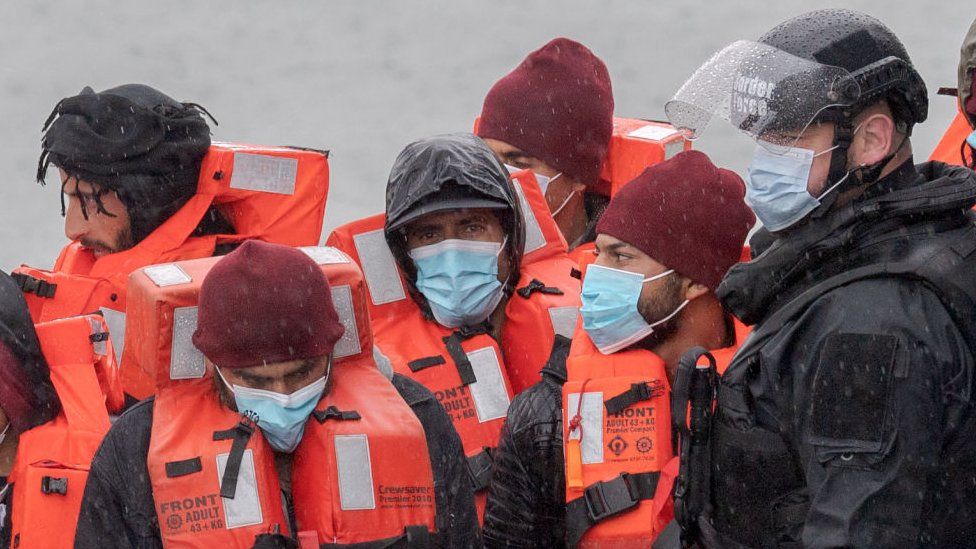
The Court of Appeal is set to decide later whether to allow the first Home Office flight to depart to Rwanda with asylum seekers.

Campaigners and migrants last week failed to win an injunction against the government policy in the High Court.

But it is thought the number facing removal to Rwanda’s capital Kigali on Tuesday has fallen to single figures.

The UK says sending some asylum seekers who arrive illegally to Rwanda will undermine smuggling gangs.

The appeal has been brought by Public and Commercial Services Union (PCS), who represent 80% of Border Force staff, along with the charities Care4Calais and Detention Action.


A separate case is also due to be heard in the High Court on Monday, after another refugee charity, Asylum Aid, applied for an urgent interim injunction against the flights to the east African nation.

A Home Office source has told the BBC that of the original 37 people scheduled to fly to Rwanda on Tuesday, individual legal challenges relating to modern slavery and human rights claims have reduced that number to single figures.

BBC home editor Mark Easton says it is expected that could be “whittled down to zero” before the plane is due to take off.

The Rwanda policy has been criticised by charities, religious leaders, opposition parties – and reportedly by the Prince of Wales who is understood to have privately described it as “appalling”.

Rwanda’s high commissioner to the UK Johnston Busingye told the Daily Telegraph his country would be a “safe haven” for migrants.

Home Secretary Priti Patel says the “vast majority” of those who take routes deemed “illegal” – such as unauthorised boats and stowing away in lorries – will be considered for relocation to Rwanda.

But it is understood that those prioritised under the scheme will be adults, with officials insisting families arriving in the UK will not be split up.

As of Friday up to 130 people had been notified they could be removed.

At the High Court on Friday, Mr Justice Swift said there was a “material public interest” in the home secretary being able to carry out her policies. He said he did not consider there was evidence asylum seekers would be ill treated in Rwanda.

He said there would be a full judicial review, where the High Court will hear a challenge to the government’s plan, before the end of July.

A former British soldier has been killed fighting for the Ukrainian armed forces, his family has said.

Jordan Gatley, who left the British army in March and travelled to Ukraine, was described as “a hero” by his father Dean in a tribute on social media.

He died in the battle for the eastern city of Severodonetsk, which has seen intense fighting in recent days.

The Foreign Office has said it is “supporting the family of a British man who has died in Ukraine”.

Mr Gatley’s father wrote in a Facebook post that his son had been helping train local forces. He added that Jordan was fatally shot on the front line while defending the city and they were informed of his death on Friday.

He had gone to Ukraine to help “after careful consideration”, he said.


According to the Facebook post, the family “had several messages from his team out there telling us of his wealth of knowledge, his skills as a soldier and his love of his job”.

“His team say they all loved him, as did we, and he made a massive difference to many people’s lives, not only soldiering, but also by training the Ukrainian forces,” the statement continued.

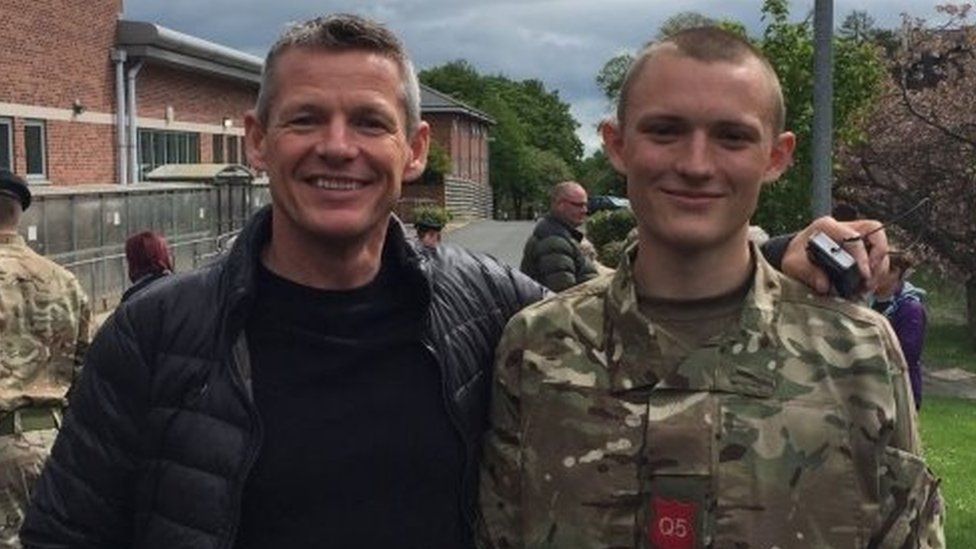
Dean Gatley posted a picture of him with his son in British army uniform

“Jordan and his team were so proud of the work they were doing and he often told me that the missions they were going on were dangerous, but necessary.

“He loved his job and we are so proud of him,” Mr Gatley wrote, adding: “He truly was a hero and will forever be in our hearts.”

Mykhailo Podolyak, an adviser to Ukrainian President Volodymyr Zelensky, tweeted that Jordan Gatley was a “true hero”.

“We will always remember his contribution to the protection of Ukraine and the free world,” Mr Podolyak wrote.

The BBC understands Mr Gatley served in the British army as a rifleman with the Edinburgh-based third battalion of The Rifles and was discharged from the forces in March before travelling to Ukraine.

There has been fierce street fighting in Severodonetsk with heavy artillery said to be causing huge casualties for both Russian and Ukrainian forces.

The region’s governor Serhiy Haidai has told Ukrainian TV that Russian shelling has caused a huge fire at a chemical plant in the city. Up to 800 civilians are hiding in underground bomb shelters at the plant, Ukrainian officials have estimated.

Fighting around Severodonetsk has lasted for more than three months, as Russia shifted its focus from trying to take the capital Kyiv to capturing the Luhansk and the Donetsk regions of eastern Ukraine – a mostly industrial area known as Donbas.

Seizing Severodonetsk and its twin city of Lysychansk would move Russia closer to its goal as it would give them control over Luhansk.

Mr Gatley is the second Briton to be killed in the conflict after the death of Scott Sibley in April.

Mr Sibley was described as a “friend like no other”.

A post on the Logistics Support Squadron Facebook page described him as a “former serving soldier” of the squadron and said he had “showed Commando spirit until the end”.

The Foreign Office advises against all travel to Ukraine and the Ministry of Defence has said that Britons who go to join the fighting following the Russian invasion may be committing a criminal offence and would be liable to prosecution.

In March, the head of the British armed forces said that Britons should not go to Ukraine to fight and should find other ways to help.

Police in India’s north-eastern state of Nagaland have charged 30 soldiers over the killing of civilians in a botched military operation last year.

The police said the soldiers resorted to “indiscriminate and disproportionate firing” when they shot at miners, mistaking them for militants.

Six miners were killed in the firing last December near the Myanmar border.

The shootings in the Mon district was the deadliest spell of violence in years in Nagaland, which has long been roiled by an insurgency led by local militant groups.

The Indian army has since apologised for the killings and ordered its own investigation.

But protesters in the state have been also pressing for the government to repeal the Armed Forces Special Powers Act (AFSPA), a controversial federal law that gives the army sweeping powers, including protection from prosecution for soldiers who mistakenly kill civilians.


North Korea appoints veteran diplomat as first woman FM

Choe, who formerly served as the North’s vice foreign minister, was tapped to lead the foreign ministry at a ruling party meeting overseen by leader Kim Jong Un, the state media KCNA reported.

She replaces Ri Son Gwon, a hardline former military official who previously led talks with the South.

A career diplomat who speaks fluent English, Choe served as a close aide to Kim during nuclear talks with the United States and accompanied the North Korean leader to summits with then US president Donald Trump.

She held a rare question and answer session with reporters on the night the two leaders’ summit in Hanoi collapsed without a deal in February 2019, blaming Washington for the failed talks.

“I think the United States has missed a golden opportunity with its rejection of our proposals,” she said.

Diplomacy between Pyongyang and Washington have since stalled, with the Kim regime in recent months not responding to the United States’ repeated offers to return to negotiations.

The nuclear-armed North has meanwhile carried out a blitz of sanctions-busting weapons tests this year, including firing an intercontinental ballistic missile at full range for the first time since 2017.

US and South Korean officials have also warned that Kim’s regime is preparing to carry out what would be its seventh nuclear test — a move that Deputy Secretary of State Wendy Sherman warned would provoke a “swift and forceful” response.

Under US sanctions, oil producers Iran and Venezuela sign 20-year cooperation plan

The inking of the agreement “shows the determination of the high-level officials of the two countries for development of relations in different fields,” Iranian President Ebrahim Raisi said.

Maduro, speaking at a joint news conference in Tehran, said the coope­ration covered the energy and financial sectors as well as plan to “work together on defence projects”.

Alongside the likes of Russia, China, Cuba and Turkey, Iran is one of Venezuela’s main allies. And like Venezuela it is subject to tough US sanctions.

Resistance will work and will force the enemy to retreat, says Iranian president

“Venezuela has passed hard years but the determination of the people, the officials and the president of the country was that they should resist the sanctions,” Raisi said during the news conference.

“This is a good sign that proves to everyone that resistance will work and will force the enemy to retreat,” the Iranian president added.

In addition to the 20-year accord inked by the two countries’ foreign ministers, Iran and Venezuela signed documents on cooperation in the political, cultural, tourism, economic, oil and petrochemical fields, state news agency IRNA said.

“We have important projects of cooperation between Iran and Venezuela in the fields of energy, petrochemical, oil, gas and refineries,” Maduro said.

Direct flights From July 18, direct flights would operate between Caracas and Tehran in order to promote tourism and the union between our countries, Maduro said, adding that Venezuela was open to receive tourists from Iran.

Iran’s president said direct flights would pave the way for enhanced trade and economic relations as well as bringing the two nations closer together.

The two presidents took part via videoconference in a ceremony marking the delivery of the second of four Iranian-built oil tankers to Venezuela, IRNA reported.

Ties between the two oil producers were strong under the late Venezuelan socialist leader Hugo Chavez and have been further bolstered under his successor Maduro.

In May, Iran’s Oil Minister Javad Owji met Maduro during an official visit to Venezuela, which sits on the world’s largest proven crude reserves. Owji also held talks with his Venezuelan counterpart Tareck El Aissami on how best to cope with US economic sanctions.

The oil minister’s trip to Venezuela came just weeks after a surprise visit by US officials following the sharp rise in world oil prices triggered by Russia’s invasion of Ukraine in February.

China has warned the US that any attempt to make Taiwan independent from China will trigger military action by Beijing’s forces.

Chinese Defence Minister Wei Fenghe met his US counterpart Lloyd Austin on the sidelines of an Asian security summit in Singapore.

Splitting Taiwan from China would leave the Chinese military with no choice but to “fight at any cost”, Mr Wei said.

Mr Austin later called Chinese military activity “provocative, destabilising”.

He said there were record numbers of Chinese aircraft flying near the island on a near-daily basis, which “undermine peace and stability in the region”.

China views self-ruled Taiwan as an integral part of China’s territory, a stance that prompted Mr Wei to condemn US arms sales to Taiwan.

A spokesman quoted him as saying: “If anyone dares to split Taiwan from China, the Chinese People’s Liberation Army (PLA) will have no choice but fight at any cost and crush any attempt of ‘Taiwan independence’ and safeguard national sovereignty and territorial integrity.”

Mr Austin said the US was committed to maintaining the status quo – recognising Beijing as the sole government of China and opposing Taiwanese independence.

He insisted there must be no attempt to resolve tensions through force.

US Defence Secretary Lloyd Austin (left) had his first face-to-face meeting with China’s Wei Fenghe

It was the first meeting of the US and Chinese defence chiefs and lasted nearly an hour, at the Shangri-La Dialogue security summit.

Mr Wei said the talks “went smoothly”, and both sides described them as cordial.

Mr Austin spoke of the importance of maintaining fully open lines of communications with China’s military, to avoid any misunderstanding.

In late May Taiwan said it had deployed fighter jets to warn off 30 warplanes sent by China into its air defence zone. The incident marked the biggest Chinese incursion since January.

The incident involved 22 Taiwanese fighters, as well as electronic warfare, early warning and anti-submarine aircraft, Taiwan’s defence ministry said.

China and Taiwan: The basics

  • Why do China and Taiwan have poor relations? China and Taiwan were divided during a civil war in the 1940s, but Beijing insists the island will be reclaimed at some point, by force if necessary
  • How is Taiwan governed? The island has its own constitution, democratically elected leaders, and about 300,000 active troops in its armed forces
  • Who recognises Taiwan? Only a few countries recognise Taiwan. Most recognise the Chinese government in Beijing instead. The US has no official ties with Taiwan but does have a law which requires it to provide the island with the means to defend itself.

Tens of thousands of protesters have rallied across the US to call for stricter gun laws in the wake of two mass shootings.

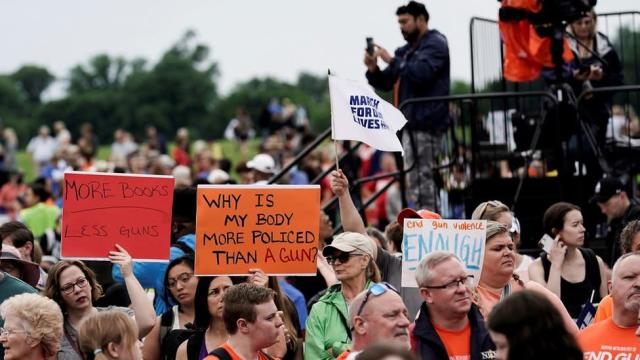
Those taking part at the hundreds of marches carried slogans like “I want freedom from getting shot”.

US President Joe Biden backed the protests, calling on Congress to “pass common sense gun safety legislation”.

Despite this the chances of legal change are likely to be quashed by Republicans.

Nineteen children and two adults were killed in the 24 May shooting at Robb Elementary in Uvalde, Texas.

That attack, and another days earlier in Buffalo, New York, in which 10 people were killed, has led to renewed calls for action on gun control in the US.

On Saturday, gun safety group March For Our Lives – founded by survivors of the 2018 Parkland school shooting in Florida – said some 450 rallies would be held across the country, including Washington DC, New York, Los Angeles and Chicago.

The group said it would not let politicians “sit back” as people continue to die.

March For Our Lives (MFOL) said political leaders’ inaction was killing Americans.

“We will no longer allow you to sit back while people continue to die,” Trevon Bosley, a MFOL board member, said in a statement.

Speaking to protesters in Washington DC, one of the survivors of the Parkland shooting, David Hogg, said the killings of children in Uvalde “should fill us with rage and demands for change, not endless debate, but demands for change, now.”

Garnell Whitfield, whose 86-year-old mother was killed in the racially-motivated shooting in Buffalo, New York on 14 May, told crowds in Washington: “We are here to demand justice.

“We are here to stand with those who are bold enough to demand sensible gun legislation.”

Among other policies, MFOL has called for an assault weapons ban, universal background checks for those trying to purchase guns and a national licensing system, which would register gun owners.

The theme of this rally is: This time it will be different – and that’s what the thousands of protesters here in Washington DC are chanting.

Teenagers Calvin Chrisfield and Ani Arzoumanian have travelled from Maryland. They tell me that members of their school sports teams have had to take shelter from gun attacks while at games. They are more hopeful than optimistic about change, but say addressing gun violence is the “biggest push” of their generation “because we’re the ones dying”.

Hafiza Kazi is holding a sign that says: “My Muslim uncle gets more background checks than a gun.”

She was born on the day of the mass shooting at Columbine high school. Her friend Annie DiGuglielmo believes there is new momentum now: She says she’s seen some Republicans who’ve previously been against gun control change their mind.

And Lindsey Erin is a primary school teacher who is adamant that teachers should not be armed, as advocated by some Republicans.

“Children hug you, they grab things on your shirt… it’s a recipe for absolute disaster.”

The first MFOL protest was held days after the Marjory Stoneman Douglas high school shooting in Parkland, Florida, in 2018, in which 14 students and three adults were killed. Organisers say it was the largest gun safety rally in one day in US history, and thousands of students across the country left their classrooms to join the demonstrations.

President Biden, a Democrat who this month urged Congress to ban assault weapons, expand background checks and implement other gun control measures, said he supported Saturday’s protests.

“Today, young people around the country once again march with @AMarch4OurLives to call on Congress to pass common sense gun safety legislation, supported by the majority of Americans and gun owners,” he tweeted.

“I join them by repeating my call to Congress: do something.”

Tens of thousands of people attended rallies across the US on Saturday
In Washington DC, protesters held slogans “Act! Fear has no place in our schools” and “Not one more”
In New York, demonstrators gathered at the city’s famous Brooklyn Bridge

In recent weeks, a bipartisan group of Senate negotiators have vowed to hammer out a gun control deal, though they have yet to reach an agreement.

Their effort is focused on relatively modest changes, such as incentivising states to pass “red flag” laws that allow authorities to keep guns from individuals deemed a danger to others.

This week the US House of Representatives voted through a series of measures regulating the sale of guns.

But Republican opposition in the Senate means the bill has little chance of entering law.

A return to Covid restrictions is not currently needed as infection rates rise in Scotland, a leading public health expert has said.

Office for National Statistics (ONS) data released on Friday estimated that about one person in 40 had the virus.

Professor Linda Bauld said there was no need for the “old days of restrictions and panic” with the current variant.

The rise was mostly in adults in their 30s and 40s but there was no evidence vaccines had stopped working, she said.

The latest ONS figures showed an increase from one case in every 50 people in Scotland the previous week.


They also showed small increases in cases in England and Northern Ireland last week, although the virus continues to be less prevalent there than in Scotland.

It is estimated that one in 70 people has the virus in England, compared to one in 65 in Northern Ireland and one in 75 in Wales.

Prof Bauld, a public health expert from the University of Edinburgh, told BBC Radio’s Good Moring Scotland programme the message was “be alert but certainly don’t panic”.

“There is absolutely no evidence that our vaccines have stopped working. We know that they confer good protection and [with] some parts of our immune response that’s a longer-term level of protection,” she said.

“So we’re not going back to the old days of restrictions and panic with this variant we have now. But we do need to be aware that we might be heading into another few weeks where it’s more common for people to become infected with this virus.”

Prof Bauld said the current rise in cases was highest in people in mid-life or their 30s and 40s, and added: “If we see infections in that group, it might spread into others.”

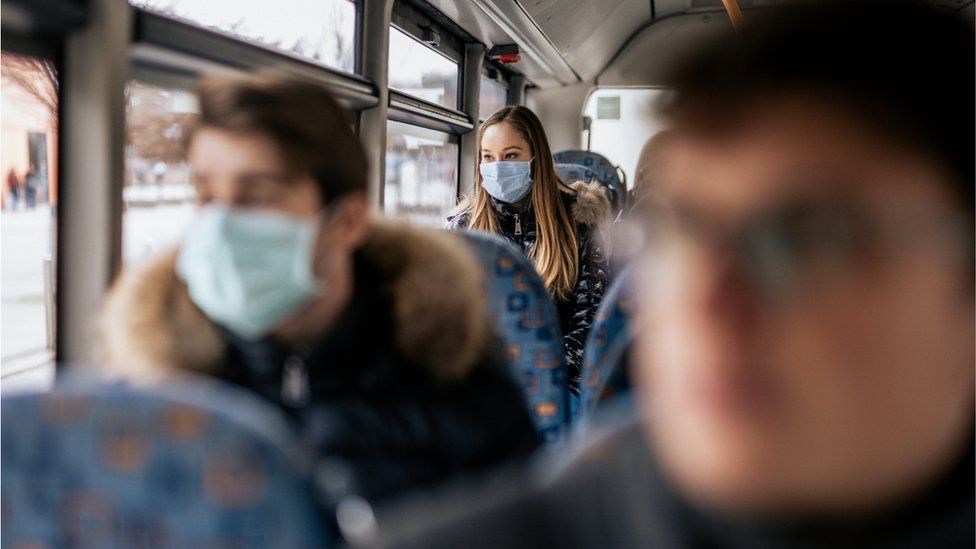
A significant increase could lead to “much stronger advice about wearing face coverings” in busy public places such as buses and trains, she added.

Omicron BA.1 caused a surge in infections across the UK in December and early January, while BA.4 and BA.5 are newer variants that were recently classified by the UK Health Security Agency as “variants of concern”.

Analysis has found both of the newer variants are likely to have a “growth advantage” over other strains.

Professor Jason Leitch said Scotland had to “hold our nerve” with the new variant

National clinical director Professor Jason Leitch told BBC Scotland the new variant was a “cousin of Omicron” and was “reacting to people in exactly the same way”.

“The disease is the same – it is mild in vaccinated individuals in the main, but it is getting better at transmission. So every time we add a new number to it, it seems to be better at transmission.”

He said Scotland had to “hold our nerve” with the new variant.

“We monitor and survey how many people have this virus and we deal with those who are severely ill and protect those who are at high risk… and we keep getting vaccinated,” Prof Leitch said

“People are a little bit fed up with repeated vaccination, but in the early stages of a disease that is often what you have to do because the vaccine will build up immunity over time.”

He said there were now 600 people in hospital with Covid, well down on earlier levels, and 20 people died last week.

‘Bad for the economy and workplaces’

Jillian Evans, head of health intelligence at NHS Grampian, told BBC Scotland there was a risk that people who had not had a booster jab for many months “may not be as protected as they could be”.

She said it was “right for people to be concerned about this and we should be vigilant”.

“The most important thing, when you start to see infection numbers rise, is to be prepared for that. Getting up to date with your vaccination is probably the best thing you can do right now,” she said.

“Rising infections means that more people will become ill. Some of them will hopefully just shrug it off after a number of days. Many won’t and many people are suffering much longer now with long Covid.”

Ms Evans added: “That’s bad for individual health, but it’s also bad for the economy and workplaces with constant disruption.

“We should be concerned about this and be vigilant. There are individual actions we can take and mask-wearing in crowded situations indoors is one of them.”

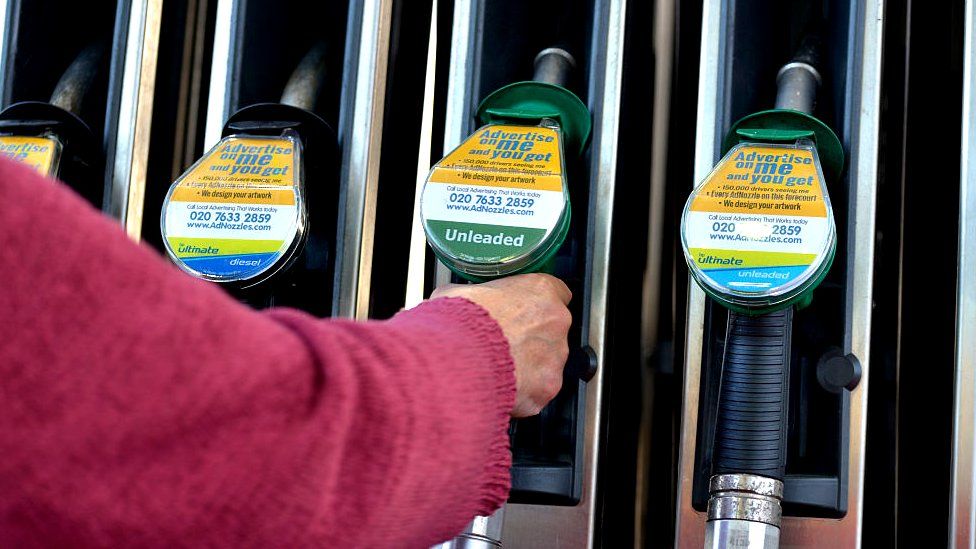
Rising petrol prices have led to an increase in fuel thefts from petrol station forecourts, according to new figures from industry experts.

Petrol prices hit record highs last week, with the cost of filling a typical family car passing £100.

Forecourt Eye, which works with 1,000 garages in the UK, said there was a 39% increase in non-payments since January.

These included motorists driving off without paying or claiming to have forgotten their wallet.

Nick Fisher, CEO of the digital debt recovery company that traces and track non-payers, said: “This is not a good thing for anyone as more theft is going on.”

He said forecourt theft had been rising month on month since Christmas, with a 19.5% spike in January and February, which he linked to the rising cost of fuel.

This was followed by another rise of 4.5% in March, 8% in April and a further 7% in May.

The soaring price of fuel is down to supply issues caused by the Russian invasion of Ukraine, and a weak exchange rate between the US dollar and the UK’s sterling.

Mr Fisher said: “At the moment, we’re seeing a spike of people claiming to forget their wallets. Some people are trying to get away with it.

“Then there are people who fill up, they go buy a coffee and don’t pay for the fuel. And then there’s the others who put in £30 [of fuel] and just drive off.”


The British Oil Security Syndicate (BOSS) is a non-profit organisation that campaigns to reduce fuel crime on UK forecourts.

It said that in the first week of June, incidents of unpaid fuel increased by 22% compared to May.

Claire Nichol, its executive director, said there is “no doubt” that there is a link between rising fuel prices and increased incidents of forecourt fuel crime.

“Motorists claiming to have no means of payment account for 70% of incidents which re-emphasises a shift away from drive-off incidents,” she added.

The AA’s Luke Bosdet said some people are stealing fuel out of desperation while others are organised and doing it to profit.

He explained: “The thief is someone who relies on their car, motorbike or scooter to get to or go about their work but their finances have been broken by the cost of living crisis. Stealing fuel then becomes an act of desperation.

“And then you have the organised thieves who see the high price of an essential item as highly lucrative and easily sold on.

“They will have their preferred method of stealing the fuel, whether that’s putting an extra tank on the back seat and then taking the fuel from forecourts, or taking jerry cans and cutting fuel lines on cars to drain tanks in the street.

The latter will know which cars are easiest to steal from and target those.”