

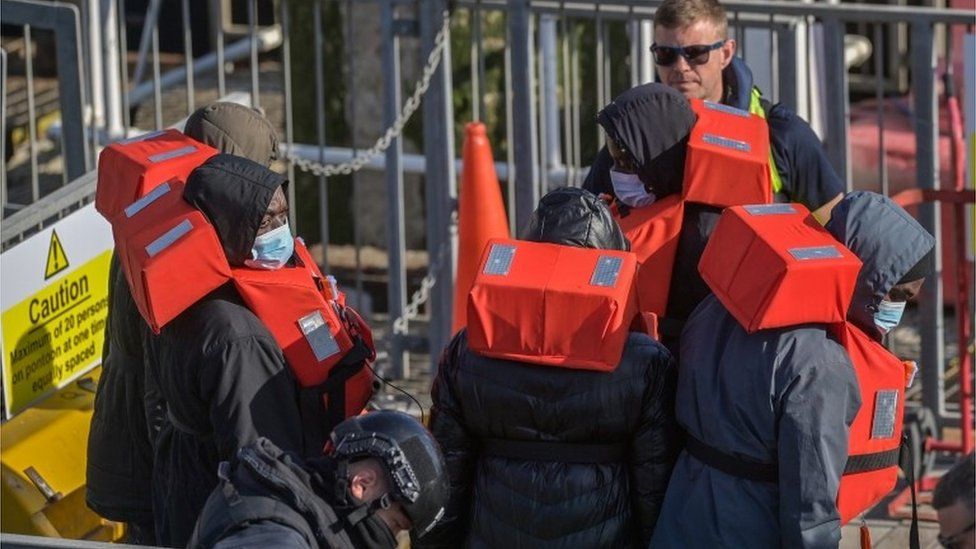
Fifty migrants have been told they will be the first to be sent to Rwanda in east Africa as part of the government’s controversial resettlement policy.

In an interview with the Daily Mail, Boris Johnson revealed the figure, saying he expected a lot of legal opposition but insisted the government would “dig in for the fight”.

Under a new deal, people judged to have entered the UK illegally now face being flown to Rwanda for resettlement.

The policy has been widely criticised.

Among its critics are more than 160 charities, the Archbishop of Canterbury, opposition parties and senior Conservative Party backbenchers, including former Prime Minister Theresa May.

Together they have raised questions about the ethics, legality, cost and efficacy of the policy.


Aid agencies have reported several asylum seekers in the UK going into hiding because of fears they would be sent to Rwanda.

The threat of removal has also prompted some to self-harm, with one attempting suicide, the Red Cross and the Refugee Council said.

Small boat crossings have continued, however. The latest available government figures show 792 migrants arrived in small boats in the week from 2 to 8 May.

Earlier this week, the Home Office said it planned to start informing the first migrants whom it wanted to remove to Rwanda. Among them would be people who had crossed the Channel, the department said.

In his interview, Mr Johnson said 50 “notices of intent” have now been issued. This marks the first stage of the process.

Those people will have between seven and 14 days to lodge objections.

It is widely expected there will be legal challenges to the plans. Home Secretary Priti Patel has said that would mean the process would “take time” but insisted she would not be deterred.

‘Huge flowchart’

Mr Johnson told the Mail: “There’s going to be a lot of legal opposition from the types of firms that for a long time have been taking taxpayers’ money to mount these sort of cases, and to thwart the will of the people, the will of Parliament. We’re ready for that.

“We will dig in for the fight and we will make it work,” he added. “We’ve got a huge flowchart of things we have to do to deal with it, with the Leftie lawyers.”

The new policy follows a drastic rise in the number of small boat crossings across the English Channel, with more than 6,000 people crossing so far this year.

Home Office figures suggest 28,526 people made the crossing in 2021, up from 8,466 the year before.The government says the new scheme will be a major blow to people smugglers and will stop people dying on dangerous routes to the UK.

Ms Patel insists the critics of the policy have “no answers” themselves to the problem of dangerous small boat crossings.

The government is to delay a ban on multi-buy deals for junk food and pre-watershed TV advertising as families struggle with the cost of living.

The Department of Health said the plans will be deferred for a year while officials assess the impact on household finances.

It said curbs on junk food placement in stores would still go ahead in October.

But health campaigners have accused the PM of “playing politics” with children’s health.

The Department of Health and Social Care (DHSC) said the planned ban on “buy one get one free” (Bogof) deals for food and drinks high in fat, salt or sugar (HFSS) as well as free refills for soft drinks, would be put on hold for 12 months, until October 2023.

Plans to restrict TV advertising of junk foods before the 21:00 GMT watershed and paid-for online adverts are also being paused for a year and will not come into force until January 2024, the department added.

Laws requiring large restaurants, cafes and takeaways to list calories on their menus came into force last month.

Public health minister Maggie Throup insisted that the government remained committed to tackling the issue of childhood obesity.

“Pausing restrictions on deals like ‘buy one get one free’ will allow us to understand its impact on consumers in light of an unprecedented global economic situation,” she added.


However, health campaigners have criticised delays to the plans, and accused Boris Johnson’s government of failing to tackle childhood obesity.

Prof Graham MacGregor, a cardiologist at Queen Mary University of London and chairman of Action on Sugar, said the delays contradicted the government’s “levelling up” agenda.

“Boris Johnson could have left a legacy of being the first prime minister to address obesity in a meaningful way, particularly in restricting advertising and promotion of unhealthy food which were his flagship policies,” he said.

“Instead, he has given in to his own MPs, and an aggressive food industry, who, ironically, were starting to comply with these new policies.”

Media caption,

The costs of the NHS dealing with obesity in the UK are “vast” and it was time to “get a grip on it”, says the PM.

Meanwhile, Barbara Crowther, of the Children’s Food Campaign, said ministers should be urgently curbing multi-buy offers instead of “delaying and dithering”.

“Obesity is spiking and millions of families can’t afford to put proper food on the table. Multi-buy offers make people spend more on junk, and less on healthy food,” she said.

“This delay threatens the UK target to halve childhood obesity by 2030. Boris is playing politics with our children’s health.”

Labour’s shadow health minister Andrew Gwynne said: “Instead of cutting childhood obesity, preventing ill-health and easing pressure on the NHS, this chaotic government is performing another U-turn.”

But industry body the Food and Drink Federation (FDF) argues that it “makes sense” to delay restrictions on multi-buy deals as families and manufacturers struggle with “high inflation”.

Kate Halliwell, the FDF’s chief scientific officer, also welcomed the delay to the advertising ban, saying it would give the industry time to prepare for a change in the law.

When the government unveiled the planned curbs, some of the UK’s biggest food companies, including Britvic, Kellogg’s and Mars, criticised them as “disproportionate” and lacking evidence.

Last month, Kellogg’s said it would take the government to court over the curbs preventing some cereals from being placed in key locations in stores due to their high sugar content.

PTI condemns ‘move’ to resume India trade, recognise Israel

During a meeting held at PTI chairman Imran Khan’s Bani Gala residence, the party discussed devising a strategy to counter the government’s alleged move vis-a-vis resuming trade with India without resolving the Kashmir dispute and recognising the Jewish state.

The meeting also condemned the government for withdrawing security of former prime minister Imran Khan and providing the Rangers for the security of PML-N leader Maryam Nawaz despite her being a convict.

The meeting, chaired by Mr Khan, slammed the Federal Investigation Agency (FIA) for its decision to withdraw cases against Prime Minister Shehbaz Sharif and Punjab Chief Minister Hamza Shehbaz.

Amid PTI-ECP tension, Qureshi meets chief election commissioner

Referring to posts on various social media platforms, he said a delegation, which also had a Pakistani national, had recently travelled to Israel. He said people of Pakistan would never accept any attempt to establish ties with Israel or recognise it.

“Security has been withdrawn from former prime minister Imran Khan and has been provided to a convicted personality Maryam Nawaz,” he regretted.

According to a statement issued by the PTI, members of the Cheena group during a meeting with Imran Khan informed him that the party’s dissident members of the Punjab Assembly were facing severe reaction from the masses.

Separately, a day after the PTI announced filing a reference seeking removal of the chief election commissioner, the party’s vice chairman Shah Mahmood Qureshi held a detailed one-on-one meeting with the CEC.

He told reporters after the meeting that lasted over an hour and a half, he said the election commission and political parties had an “unbreakable relationship”.

Mr Qureshi said he met the CEC to present the PTI’ point of view. “To understand the legal complexities and take guidance from him was necessary for me,” he said.

Mr Qureshi said he took up two cases with the CEC, including the one regarding horse trading case against Yousuf Raza Gilani.

Mr Qureshi said if the government announced the date for elections as well as the date on which the assembly will be dissolved, then his party could consider holding talks with the government on electoral reforms to ensure free and transparent polls.

He said they had already offered cooperation on electoral reforms and are also ready to cooperate with the new government on the matter.

UN launches probe into Russian abuses in Ukraine

Concerned by extrajudicial executions, civilian casualties, the use of torture and abuses against children, the council voted 33-2 to create an investigation into alleged violations, with a view to holding the perpetrators to account.

China and Eritrea voted against the resolution, while 12 countries including India, Pakistan and Cuba abstained. Russia branded the extraordinary meeting of the UN’s top rights body a politicised stunt and refused to attend.

Telling the council that an 11-year-old boy, now traumatised, had been raped in front of his mother, Ukraine’s Deputy Foreign Minister Emine Dzhaparova said Russian President Vladimir Putin’s forces were inflicting “pure evil”.


Russia was committing “the most gruesome human rights violations on the European continent in decades”, she said, speaking from Kyiv. “These have been 10 weeks of sheer horror to the people of my country.

“Torture and enforced disappearances, sexual and gender-based violence; the list of Russia’s crimes is endless.

“Only the world standing strong in solidarity with the Ukrainian people can defeat this pure evil.”

Russia invaded Ukraine on Feb 24, triggering global condemnation and increasing international isolation for Moscow.

The UN’s top rights body voted on March 4 to trigger a commission of inquiry (COI) — the highest-possible level of investigation — into alleged Russian violations during the war.

The suburb of Bucha, north of Kyiv, became synonymous with allegations of Russian war crimes when dozens of bodies in civilian clothing were found there in early April, some with their hands tied, after Moscow’s troops pulled back. Other allegations have come to light elsewhere in the country.

Thursday’s resolution asked the COI to prioritise an investigation “to address the events in the areas of Kyiv, Chernihiv, Kharkiv and Sumy regions in late February and March… with a view to holding those responsible to account”.

The resolution asks the COI to brief the council about its progress at the September regular session, and to include the complete findings in its report to the March 2023 session.

The resolution also urges Moscow to give humanitarians unhindered access to people transferred to Russia or Russian-held territory — and provide a comprehensive list of their names and whereabouts.

Russia was among the 47 Human Rights Council members until the UN General Assembly in New York voted on April 7 to suspend it from the body. Russia then immediately withdrew from the council. Thursday’s session was the first meeting of the body since then.

Now an ordinary observer, Russia was called to give its version of events but its chair was vacant.

Russian ambassador Gennady Gatilov said his country would not participate in a “political rout to demonise Russia” and branded the council biased.

“It is doubtful that the participants of this stunt will call for a real, instead of a showcase, investigation of the tragedy in Bucha,” he said in a Twitter video.

Sri Lanka appoints new PM to replace president’s brother

The new premier, Ranil Wickremesinghe, has already served in the office five times — but it remains to be seen whether he will be able to get any legislation through parliament.

The 73-year-old will be tasked with navigating Sri Lanka through the worst downturn in its history as an independent nation, with months of shortages and blackouts inflaming public anger.

“We want to return the nation to a position where our people will once again have three meals a day,” Wickremesinghe said after his appointment. “Our youth must have a future.”

In a bid to win over opposition lawmakers demanding he quit, President Gotabaya Rajapaksa, 72, had pledged to give up most of his executive powers and pave the way for a new cabinet.

Mahinda Rajapaksa, the president’s brother, resigned as prime minister on Monday after his supporters attacked anti-government demonstrators who had been protesting peacefully for weeks.

This marked a turning point and unleashed several days of chaos and violence in which at least nine people were killed and over 200 injured, with dozens of Rajapaksa loyalist homes set on fire.

On Thursday, a court banned Mahinda, his politician son Namal, and more than a dozen allies from leaving the country after ordering an investigation into the violence.

“Congratulations to the newly appointed Prime Minister,” Mahinda tweeted from the Trincomalee naval base on the country’s east coast, where he took refuge after fleeing the capital Colombo.

“I wish you all the best as you navigate these troubled times.” Security forces patrolling in armoured personnel carriers with orders to shoot looters on sight have largely restored order.

A curfew was lifted on Thursday morning — only to be reimposed after a six-hour break allowing Sri Lanka’s 22 million people to stock up on essentials.

Sri Lankans have suffered months of severe shortages of food, fuel and medicine — as well as long power cuts — after the country burnt through foreign currency reserves needed to pay for vital imports.

The central bank chief warned that the economy would “collapse beyond redemption” unless a new government was urgently appointed.

Wickremesinghe is seen as a pro-West free-market reformist, potentially making bailout negotiations with the International Monetary Fund and others smoother.

With many from Rajapaksa’s party having defected in recent months, no group in the 225-member assembly has an absolute majority, making parliamentary approval of the unity government’s legislation potentially tricky. Wickremesinghe insisted he had enough support to govern when speaking to reporters after his appointment.

But it remains to be seen whether a new cabinet will be enough to calm public anger if Rajapaksa continues to resist calls for his resignation.

Time not right for talks with India, says FO

FO spokesman Asim Iftikhar, in response to questions on ties with India at the weekly briefing, said: “In diplomacy you never shut the doors.”

He said that there was a national consensus on this issue and successive governments had pursued the same policy of seeking peaceful settlement of disputes with India. The questions were asked in the context of overtures by the new government and the appointment of a trade minister in Delhi.

PM Sharif and his Indian counterpart had exchanged messages after the former was elected as the prime minister to succeed Mr Imran Khan.

The spokesman, while answe­ring a question, noted that notwithstanding Pakis­tan’s desire for diplomatic resolution of disputes, “the environment for a fruitful, constructive dialogue is not there”.

OIC rights body condemns India’s ‘wicked’ delimitation exercise in occupied Kashmir

Last week, New Delhi issued a new list of redrawn political constituencies for India-occupied Kashmir, giving greater representation to the Muslim-majority region’s Hindu areas and paving the way for fresh elections.

In 2019, Prime Minister Narendra Modi’s government broke up the India-occupied territory into two federal territories as part of a move to tighten its grip over the region. The occupied region originally comprised the mainly Muslim Kashmir Valley, the Hindu-dominated Jammu region, and the remote Buddhist enclave of Ladakh.

However, earlier this month, the Indian government said a delimitation commission had finalised 90 assembly constituencies for occupied Kashmir, excluding Ladakh, with 43 seats for Jammu and 47 for Kashmir. Earlier, Jammu had 37 seats and the Kashmir valley 46.

The delimitation commission claimed it had been difficult to accommodate competing claims from various sides, citing in a statement the region’s “peculiar geo-cultural landscape”.

In a statement issued today, the OIC’s human rights body termed India’s move a violation of international human rights and humanitarian laws.

“IPHRC accordingly supports the unanimous rejection of the Kashmiri political leadership of these illegal measures, which are continuum of the host of other ‘Hindutva’ inspired illegal steps taken by the Indian occupation regime in IOJK in the aftermath of the 5th August 2019,” it said.

The statement recalled that Kashmir’s political leadership had always rejected and boycotted electoral politics in the occupied region and, subsequently, condemned India’s attempt to redraw electoral constituencies there.

OIC called the act “a nefarious attempt to alter the electoral demographics and dynamics in a manner that could influence sham electoral results to install puppet regimes of its choice”.

“These wicked measures are aimed at converting the indigenous Muslim population into minority within their homeland and obstruct the exercise of their inalienable right to self-determination,” it said, adding that the measures were in violation of several human rights treaties of the Fourth Geneva Convention, which prohibited any change in the demographics of occupied areas.

It further called on the UN and international community to play their due role to pressurise India to abide by the relevant UNSC and OIC resolutions to refrain from any administrative and legislative actions, which tantamount to altering the geographic and demographic status of occupied Kashmir, restore all fundamental freedoms of Kashmiris and repeal all discriminatory laws and allow people of Kashmir to exercise their inalienable right to self-determination through a free and fair plebiscite, as provided in the relevant UN Security Council and OIC resolutions.

Previously, the Pakistan Foreign Office (FO) had said that it had handed over a demarche to the Indian Charge d’Affaires, conveying the Government of Pakistan’s categorical rejection of the report of the so-called ‘Delimitation Commission’, which was aimed at disenfranchising and disempowering the Muslim majority population of Indian Illegally Occupied Jammu and Kashmir (IIOJK).

The FO had called on India to refrain from bringing about any illegal demographic changes in the occupied territory, stop forthwith its oppression in the IIOJK, and let the Kashmiri people determine their own future through a free and fair plebiscite under the UN auspices.

Hundreds have been forced to evacuate from their homes due to a swift-moving wildfire in southern California that has torched some 20 mansions so far.

The Coastal fire in Orange County, south of Los Angeles, has grown to 199 acres since it began on Wednesday.

Meanwhile, the largest wildfire in the US has burned around 170 homes in New Mexico, and continues to threaten communities and businesses.

Fire season is off to an early start, partly due to a decades-long drought.

The Coastal fire is not contained, officials said in an update on Thursday, although the winds that have fuelled the blaze are forecast to die down later.

Around 900 homes were still under mandatory evacuation order in the hills around the city of Laguna Beach by Thursday morning.

“We will repopulate when it is safe to do so,” Orange County Sheriff’s Department Captain Virgil Asuncion said in a morning news conference.

More than 500 firefighters have been deployed to fight the blaze. A spokesman said one firefighter was injured and has been taken to hospital.

Aircrafts were seen dumping fire retardant around the neighbourhoods of Laguna Niguel and Coronado Pointe, where the multi-million dollar mansions had burned overnight.

Officials say that hot embers travelling ahead of the main fire are what set many of the homes ablaze. Some homes not touched by embers were spared.

Local man Phil Charlton told the Orange County Register newspaper that he understands the danger of fires while living in “the best place in the world”.

“You see a fire like this and it goes through the brown brush and green brush,” he said, adding: “People who live in brown canyons can’t complain about fire.”

Tim Wheaton told Reuters the evacuation orders created traffic congestion in the hilly region. He described seeing “people crying and hugging one another and cars full of, I assume, their most precious items from their homes”.

The cause of the fire is still under investigation. Southern California Edison, the utility company that provides electricity to much of southern California, said that there was “circuit activity occurring close in time to the reported time of the fire”.

Utility companies in California are required by law to disclose if their equipment could have been involved in wildfires.

Several previous wildfires, including the largest in the state’s history, have been traced back to California’s Pacific Gas and Electric, which paid a multi-billion dollar settlement in 2019.

Across the western US and Canada, firefighters are gearing up for a particularly fierce wildfire season. Experts say a lack of winter moisture, combined with warmer temperatures, is causing vegetation to dry out earlier each spring, making it more susceptible to fire.

The US Forest Service says that the concept of a “fire season” is now antiquated, since climate change has led to the possibility of wildfires being sparked throughout the entire “fire year”.


“Fires in the winter months are becoming part of the norm,” the agency said in a report last summer.

The New Mexico blaze, dubbed the Calf Canyon/Hermits Peak fire, has already burned over 250,000 acres.

And in central Colorado, mandatory evacuation orders were issued for residents of Colorado Springs amid reports that grass fires had hit a local trailer park community.

Climate change increases the risk of the hot, dry weather that is likely to fuel wildfires.

The world has already warmed by about 1.2C since the industrial era began and temperatures will keep rising unless governments around the world make steep cuts to emissions.

Hundreds of Australians have been told to evacuate their homes as Queensland faces another flooding emergency.

More than a dozen warnings were issued on Friday, telling residents in several regions to prepare their homes and evacuate if needed.

One person died in flooding in the state’s north earlier this week.

The storm system has now moved south towards Queensland’s heavily populated southeast, which includes Brisbane.

In February, Queensland was devastated by floods that killed 13 people and inundated more than 20,000 homes. Another nine people were killed in floods in neighbouring New South Wales.

Major flooding was forecast for several rivers on Friday. Residents in Gympie, north of the state capital, were warned to expect flooding for the second time in recent months.

In the February disaster, 800 homes and businesses in the town were affected when the river peaked at 23m.

Mayor Glen Hartwig said they were anxious to see how high the local Mary River would rise this time. If it reaches a peak of 15m, businesses – but not homes – will be affected.

“At 16m, it’s snorkels or nothing,” he told the ABC.

Floods also inundated some towns on Friday in the Lockyer Valley, west of Brisbane, and cut off a major highway.

About 300 homes in the region were expected to be affected, after 68 were inundated in February.

“It is soul destroying – it’s absolutely crushing,” Lockyer Valley Mayor Tanya Milligan told the ABC.

A warning siren sounded in the town of Grantham on Friday, with residents in low-lying areas urged to move to higher ground.

In 2011, the town was devastated by a major flooding event that killed 12 people and was likened to an “inland tsunami”.

The main street of Laidley, in the Lockyer Valley, has been flooded

The Bureau of Meteorology has warned further heavy rainfall on Friday could also lead to life-threatening flash floods and potential landslides. The system will begin easing over the weekend.

Australians will vote in a federal election on 21 May in which climate change is a key issue.


In recent years the country has suffered severe drought, historic bushfires and mass bleaching events on the Great Barrier Reef.

North Korea has confirmed its first death from Covid-19, with state media adding that tens of thousands more are experiencing fever symptoms.

Six people died after suffering a fever with one testing positive for Omicron, state media reported on Friday.

It said 187,000 people with a fever were being “isolated and treated”.

While experts believe the virus has been present in the country for some time, the authorities only announced the first cases on Thursday.

They said there had been an outbreak of the Omicron variant in the capital, Pyongyang, and announced lockdown measures. They did not give precise case numbers.

But in an update on Friday, the official KCNA news agency reported that the outbreak extended beyond the capital. “A fever whose cause couldn’t be identified spread explosively nationwide from late April,” it said.

Around 350,000 people had shown signs of that fever, it added, without specifying how many had tested positive for Covid.

An image released by state media showed officials – all wearing face masks – meeting Kim Jong-un to discuss Covid-19

Analysts suggest the latest figures from state media, including the acknowledgement that the unspecified fever had spread nationwide, may indicate the country is experiencing an outbreak unlike any it has seen so far.

Its population of 25 million is vulnerable due to the lack of a vaccination programme and poor healthcare, experts say.


North Korea rejected offers from the international community to supply millions of AstraZeneca and Chinese-made jabs last year. Instead, it claimed it had controlled Covid by sealing its borders early in January 2020.

The country shares land borders with South Korea and China, which have both battled outbreaks. China is now struggling to contain an Omicron wave with lockdowns in its biggest cities.

On Friday, KCNA reported that the North Korean leader Kim Jong-un had visited a healthcare centre and “learned about the nationwide spread of Covid-19”.

It described the situation as an “immediate public health crisis”.

These numbers give us the first indication that the virus has spread rapidly around the country, far beyond the capital Pyongyang.

This puts the entire population of 25 million at risk. No-one is vaccinated, many are malnourished, and the health care system is poor.

But the virus itself may not present the biggest danger. The lockdown could have devastating consequences for people.

Food and medicine are already in short supply, thanks to efforts by authorities to keep the virus out – they’ve sealed the country’s borders for more than two years, cutting off virtually all trade.

We don’t know yet how aggressive these lockdowns will be, and whether people will be confined to their homes.

Kim Jong-un wants some work to continue. But it is very possible that the markets, where many earn a living, will be closed. It will also be more difficult for people to move around the country. This in turn will make it even harder for them to get hold of the food and supplies they need to survive.

By publishing these figures today, some say North Korea is showing it might finally be willing to accept outside help.

At a meeting outlining new Covid rules on Thursday, Mr Kim was seen wearing a face mask on television for what was believed to be the first time.

He ordered “maximum emergency” virus controls, which appeared to include orders for local lockdowns and gathering restrictions in workplaces.

There are fears a major outbreak could make it even more difficult for essential supplies to enter the country, worsening food shortages and a faltering economy.

South Korea has said it offered humanitarian aid after Thursday’s announcement, but Pyongyang is yet to respond.

Despite North Korea’s earlier claims that it had “shining success” in keeping out Covid, there have been signs throughout the pandemic of its possible presence in the country, including unconfirmed reports of cases and workers wearing hazmat suits.