
Ten people have been killed in a shooting in New York state that is being investigated as a racially-motivated hate crime.

An 18-year-old man wearing military gear was arrested after a stand-off at the scene in the city of Buffalo.

The suspect entered a busy supermarket on Saturday afternoon before opening fire. He used a camera to stream the attack online, police said.

US President Joe Biden condemned what he called an “abhorrent” attack.

“We are investigating this incident as both a hate crime and a case of racially-motivated violent extremism,” Stephen Belongia, the agent in charge of the FBI’s Buffalo office, told a news conference.

The suspect is believed to have driven for several hours to reach the predominantly black area of the city. Thirteen people were shot in total and the majority of the victims were black, Buffalo Police Commissioner Joseph Gramaglia said.

Speaking to CBS, a police source alleged that the man had shouted racial slurs during the shooting.

“He exited his vehicle. He was very heavily armed. He had tactical gear. He had a tactical helmet on. He had a camera that he was live-streaming what he was doing,” Mr Gramaglia told reporters.

He said the suspect surrendered his weapon after a tense stand-off and was taken into custody.

The three wounded victims – who all worked at the supermarket – have not sustained life-threatening injuries.

A retired police officer who was working as a security guard tried to shoot the suspect but was among those killed, police said.

The man has since been charged in court with first-degree murder, and Erie County District Attorney John Flynn said further charges may still be brought.

The 18-year-old suspect surrendered his weapon after a stand-off with local police officers

“This is the worst nightmare that any community can face and we are hurting, we are seething right now,” Buffalo Mayor Byron Brown told reporters.

“We cannot let this hateful person divide our community or our country,” he added.

Grady Lewis, who witnessed the attack from across the street, told local media that he saw the man open fire. “I saw the guy go in, army-style, bent over, just shooting at people,” he said.

Shonnell Harris, who was working in the shop during the attack, told Buffalo News that she heard more than 70 shots as she ran to escape the building through a backdoor.

“The store was full. It was the weekend,” she said. “It feels like a nightmare.”

Describing the aftermath of the attack, one police officer told Buffalo News: “It’s like walking onto a horror movie, but everything is real. It is Armageddon-like”.

Later on Saturday, New York Governor Kathy Hochul said the suspect was a “white supremacist who has engaged in an act of terrorism”.

This was “a military style execution targeting people who simply wanted to buy groceries in a neighbourhood store,” she said while visiting Buffalo.

In a statement, US President Joe Biden said he and the First Lady were praying for the victims and their families.

“A racially-motivated hate crime is abhorrent to the very fabric of this nation,” he said. “We must do everything in our power to end hate-fuelled domestic terrorism.”

The government has vetoed a proposal for the House of Lords to temporarily relocate to a building opposite Parliament – and told peers to move outside London instead.

The House of Lords could be forced to leave Parliament while extensive restoration works are carried out.

Peers wanted to use the Queen Elizabeth II Centre in Westminster – minutes away from Parliament.

But Levelling Up Secretary Michael Gove has said he will not support the plans.

His department owns the freehold and the body which runs the QEII Centre – a large conference and exhibition space with views of Big Ben and Westminster Abbey.

In a letter seen by the BBC, Mr Gove said he “cannot endorse” a plan for peers to “decamp to a temporary home a mere 200 yards from the Palace of Westminster”.

Mr Gove suggested they looked at alternative buildings in the north of England, the Midlands, the South West, Scotland or Wales.

Cities across the UK would welcome the peers, says Michael Gove

He told the Lord Speaker Lord McFall: “It is clear to me that the House of Lords moving elsewhere, even for a temporary period, would be widely welcomed.

“I know cities and towns across the UK would be pleased to extend their hospitality to peers,” he added.

The restoration of Parliament will cost billions – but the price will go up considerably if MPs or peers stay put in the building.

The Lords had begun working on plans for a relocation to the QEII.

Any plan will be subject to a final vote by Parliament.

The idea of moving the Upper Chamber out of London first emerged in January 2020.

Downing Street said it would demonstrate its commitment to levelling up to spread decision-making outside London.

York was considered as an option – but several leading peers said it was impractical to separate the Lords from the Commons.

The then Lord Speaker, Lord Fowler, said it was “gesture politics” while Commons Speaker Sir Lindsay Hoyle said the idea was “great PR” but questioned how it would work.

By the summer of that year, the relocation of peers to York was effectively axed.

Boris Johnson is to tell Northern Ireland’s leaders that any move to change post-Brexit trade rules must also restore power-sharing at Stormont.

The prime minister is visiting Northern Ireland on Monday amid a political crisis sparked by tensions over the Northern Ireland Protocol.

Following the 5 May election, the anti-protocol Democratic Unionist Party has refused to engage with the assembly.

A new administration cannot be formed without them.

A spokesperson for No 10 said Mr Johnson would hold private meetings with the parties and the UK government would “play its part to ensure political stability”.

The prime minister is expected to say there is “no substitute for strong local leadership”.

He will urge members of the Stormont assembly to “get back to work to deal with the bread-and-butter issues”.

But the prime minister will also tell political leaders that “there will be a necessity to act” on the protocol if the EU does not change its position.

Sinn Fein’s President Mary Lou McDonald and vice president Michelle O’Neill say the protocol is going nowhere

Mr Johnson’s visit coincides with increased speculation that the UK government is poised to introduce legislation to strip away parts of the Northern Ireland Protocol.

The protocol, a part of the UK-EU Brexit deal which keeps Northern Ireland aligned with the EU single market for goods, puts a trade border in the Irish Sea between Great Britain and Northern Ireland.

It was designed to ensure free trade could continue across the Irish land border, but it has been opposed by unionist politicians.

The DUP has argued the protocol has eroded the foundations devolution has been built upon and undermined Northern Ireland’s position in the UK.

The UK and EU’s shared objective should be for a reformed protocol to enjoy the broadest possible cross-community support when it faces a consent vote at Stormont in 2024, the PM will also say.


The Northern Ireland Assembly election on 5 May cemented a majority for politicians who accept the protocol, including the new largest party, the republican party Sinn Féin.

The DUP’s move to block the election of a speaker on Friday means the Northern Ireland Assembly cannot function.

The party said its actions sent a clear message about its opposition to the protocol.

Its leader Sir Jeffrey Donaldson said the prime minister must “outline what he intends to do”.

Sir Jeffrey Donaldson says his party will not support the election of a speaker until there is action taken over the protocol

On Saturday, Sinn Féin leader Mary Lou McDonald accused the prime minister of being “in cahoots” with the DUP.

Ms McDonald said the protocol was going nowhere and both she and would-be first minister Michelle O’Neill would be telling Mr Johnson so on Monday.

“The DUP have not simply called a halt to the formation of an executive, they have equally attempted to place a veto on the operation of the assembly,” she said.

“The British government have assisted the DUP in these blocking tactics.”

By refusing to support the election of a speaker, the DUP – previously the largest party in Stormont and holder of the post of first minister – has blocked a government from forming.

Without a speaker, there can be no debates in the assembly, no committees can be held, and the actions of ministers, currently acting in a caretaker capacity, cannot be scrutinised.

Will not rest till perpetrators of KU suicide attack given exemplary punishment: Bilawal

Addressing a condolence reference in Islamabad, he said the country was shocked and saddened at the terrible loss.

“We fully condemn this cowardly act and we will never forgive the enemies of Pakistan-China all-weather strategic partnership. We will also not allow anyone to harm our iron-clad friendship. The sacrifice of both Chinese and Pakistanis in nurturing our bonds of brotherhood will not be in vain.”

Bilawal pledged that authorities would do everything in their capacity to provide maximum security and ensure the safety of the Chinese in Pakistan. “You are our guests and we are determined to ensure your safety and comfort in our country.

“To the families of those who perished, our entire nation grieves with you. While we cannot bring back the departed, we will not rest until we have given exemplary punishment to the perpetrators of this heinous act,” he vowed.

The foreign minister said that Pakistan-China ties were time-tested and the countries would face every challenge together and emerge stronger.

The suicide attack at Karachi University had been carried out using the rights of the Baloch as an “excuse”, he said.

“I know that every Pakistani is proud of our hospitality and gives importance to caring for friends. Not only do we know this [but] we’re also known for this internationally. Neither a Sindhi Pakistani nor a Baloch Pakistani can ever tolerate the terrorism that is directed at our guests.”

In the last decade, Pakistanis saw that citizens were targeted using religion, he said, iterating that Baloch rights were used as an “excuse” for carrying out the terror attack at the university.

“These people left their homes to come here and educate our people. This attack happened not only on those individuals but on Pakistan-China friendship as well. Now, it is the responsibility of every Pakistani to proceed on this issue as if it was an attack on our own brothers and sisters.

“Together, we have to ensure that we do not tolerate such terror attacks. We will ensure that the families of these people and our public get justice.”

The country would succeed in its fight against terrorism and show the world that those who believed that they could attack Pakistan-China friendship would not succeed, he pledged.

On April 26, a woman, later identified as Shari Baloch, detonated herself as a van carrying staff members was about to enter the Confucius Institute at the Karachi University.

A spokesperson for the university had identified three of the deceased as Chinese nationals — Confucius Institute Director Huang Guiping, Ding Mupeng and Chen Sai. The fourth victim was the van’s driver, Khalid.

Another four people were injured in the attack.

The banned Baloch Liberation Army (BLA) had claimed responsibility.

The Karachi University attack was the third terrorist attack on Chinese citizens on Pakistani soil in a year.

President Dr Arif Alvi and Prime Minister Shehbaz Sharif had separately visited the Chinese embassy later and assured officials that Pakistan would leave “no stone unturned” to ensure the safety of Chinese nationals and bring the elements involved in the incident to justice.

UN terms temperature rise ‘main worry’ for South Asia

The pre-monsoon period in South Asia is usually marked with excessively high temperatures, especially in May, but early heatwaves like this signal complex, compounding and cascading risks, says the UN Economic and Social Commission for Asia and the Pacific (UN-ESCAP).

Pakistan was in the grip of a heatwave on Friday, with parts of the nation previously scalded by temperatures of nearly 50 degrees Celsius as officials warned of acute water shortages and a health threat.

Scientists believe that early heatwaves are consequent of persisting north-south low pressure patterns that form over India during winters when a La Niña phenomenon occurs in the equatorial Pacific Ocean.

Major cities record temperatures in excess of 40 degrees, Jacobabad touches 50

In its sixth assessment report, the Intergovernmental Panel on Climate Change (IPCC), in its sixth assessment report, highlights that heatwaves and humid heat stress in South Asia are set to be more intense and frequent this century.

A recent study highlights that India is the most impacted country with largest heat exposure to country’s labour productivity. It loses labour productivity of more than 100 billion hours per year while the global sum is 220 billion.

Sizzling temperatures

“It’s like fire burning all around,” labourer Shafi Mohammad told AFP. He hails from a village on the outskirts of Jacobabad, which experienced 49.5 degrees Celsius on Friday, according to the Pakistan Meteorological Department (PMD).

Nationwide, the PMD alerted that temperatures were between 6oC and 9oC above normal, with Islamabad, Karachi, Lahore and Peshawar recording temperatures around 40oC on Friday.

“This year we have jumped from winter right into summer,” said PMD chief forecaster Zaheer Ahmad Babar.

Pakistan has endured heightened heatwaves since 2015, he said. “The intensity is increasing, and the duration is increasing, and the frequency is increasing,” he told AFP.

Erdogan opposes Finland, Sweden’s entry into Nato

Though Turkey has officially supported Nato enlargement since it joined the US-led alliance 70 years ago, its opposition could pose a problem for Sweden and Finland given new members need unanimous agreement.

Turkey has repeatedly slammed Sweden and other Western European countries for its handling of organisations deemed terrorist by Ankara, including the Kurdish militant groups PKK and YPG, and the followers of US-based Islamic cleric Fethullah Gulen. Ankara says Gulenists carried out a coup attempt in 2016. Gulen and his supporters deny the accusation.

Finland’s plan to apply for Nato membership, announced Thursday, and the expectation that Sweden will follow, would bring about the expansion of the Western military alliance that Russian President Vladimir Putin aimed to prevent by launching the invasion of Ukraine.

“We are following the developments regarding Sweden and Finland, but we don’t hold positive views,” Erdogan told reporters in Istanbul, adding it had been a mistake for Nato to accept Greece as a member in the past.

“As Turkey, we don’t want to repeat similar mistakes. Furthermore, Scandinavian countries are guesthouses for terrorist organisations,” Erdogan said, without giving details. “They are even members of the parliament in some countries. It is not possible for us to be in favour,” he added.

In response, Finnish Foreign Minister Pekka Haavisto urged patience and called for a step-by-step approach in response to Turkish resistance. He also said he was due to meet his Turkish counterpart in Berlin on Saturday.

Meanwhile, Sweden said it remained confident it could secure unanimous backing for any Nato application it could submit.

Nato Secretary-General Jens Stoltenberg had said the Finns would be “warmly welcomed” and promised a “smooth and swift” accession process, which is also backed by Washington.

Aaron Stein, research director at the Foreign Policy Research Institute, said on Twitter with respect to Turkish opposition: “Turkish national security elites view Finland and Sweden as semi-hostile, given the presence of PKK and Gulenists. It’s gonna take arm twisting to get sign-off.” Nato states that membership is open to any “European state in a position to further the principles of this Treaty and to contribute to the security of the North Atlantic area”.

Finland and Sweden are already Nato’s closest partners, sitting in on many meetings, getting regularly briefed on the situation in Ukraine and taking part in regular military drills with Nato allies. Much of their military equipment is inter-operable with Nato allies.

Sri Lankan opposition, protesters push anti-govt campaign despite new PM

President Gotabaya Rajapaksa appointed five-time prime minister Ranil Wickremesinghe to his sixth term late on Thursday, but opposition comments signalled it was not likely to resolve the political and economic disarray in the strategic Indian Ocean island nation.

A week of violent clashes between protesters and government supporters across the country has left nine people dead and more than 300 wounded. The president’s elder brother, Mahinda Rajapaksa, quit as prime minister on Monday as violence spiralled and is in hiding in a military base.

The rest of the cabinet quit earlier.

“It is clear the (new) prime minister is remote controlled by the president,” said Eran Wickramaratne, a parliamentarian and senior member of the main opposition party, the Samagi Jana Balawegaya. “This country wants the Rajapaksas to go home. We are committed to that goal.” Protesters who have camped out at a site near the prime minister’s office for over a month also rejected the appointment.

“We will stop this struggle when our people get justice,” said Chamalage Shivakumar, one of the hundreds of people at the “Gota Go Home” protest site, named after the president.

“Whoever they appoint as prime minister, we will not stop this struggle until people get relief.” Wickremesinghe, 73, is the only lawmaker from his United National Party in parliament and will be reliant on rival political parties to form a coalition government. An alliance led by the Rajapaksas holds about 100 of parliament’s 225 seats, while the opposition has 58 seats. The rest are independent.

On Friday, Wickremesinghe held talks with foreign envoys representing India, Japan, the United States and China, his office said.

“Discussed continued cooperation for economic recovery and stability in Sri Lanka through democratic processes,” the Indian High Commission in Colombo said in a tweet.

New Delhi is battling China for influence in Sri Lanka, which lies on key shipping lanes between Asia and Europe and is home to major infrastructure projects financed by both countries.

The prime minister also held an emergency meeting with officials from the energy ministry regarding chronic fuel shortages that have blighted the island for months.

Protesters said the appointment of Wickremesinghe will do little to ease the anger against the president, who they say is ultimately responsible for the worst economic crisis to hit the nation since it became independent from Britain in 1948.

Buffeted hard by the pandemic, rising oil prices and populist tax cuts by the Rajapaksa brothers, Sri Lanka is critically low on foreign exchange.

Rampant inflation and fuel shortages brought thousands on to the streets in a month of protests that had remained predominantly peaceful until this week.

Hindu’s killing sparks clashes in held Kashmir

Clashes are frequent in the occupied territory, but the police operation was the first in the Muslim-majority region against the local Hindu population, known as Pandits.

According to police, two gunmen shot and killed Rahul Bhat, a government employee, on Thursday inside an office complex in Budgam where he worked. Later police put the blame on Kashmiri fighters resisting Indian rule in the valley.

The protesters on Friday shouted slogans against the Bharatiya Janata Party, led by Prime Minister Narendra Modi, and demanded Bhat’s killers be brought to justice.

“If this kind of killing can happen inside a government office, what security is Modi’s government talking about for us?” one angry protester said.

Police were deployed when the demonstrators poured onto a main road and attempted to march towards the airport.

Small groups of Hindus also staged protests at three other locations in occupied Kashmir on Thursday night.

Many political leaders, including Muslims, issued statements condemning the “barbaric” killing of Bhat.

Tens of thousands of Hindu families fled the valley in the early 1990s when Kashmiris took up arms against Indian rule.

Most of them still live outside their homeland, scattered across Indian cities.

Bhat lived in a protected rehabilitation settlement for thousands of Pandits given government jobs in recent years under a plan to help resettle some of those who fled.

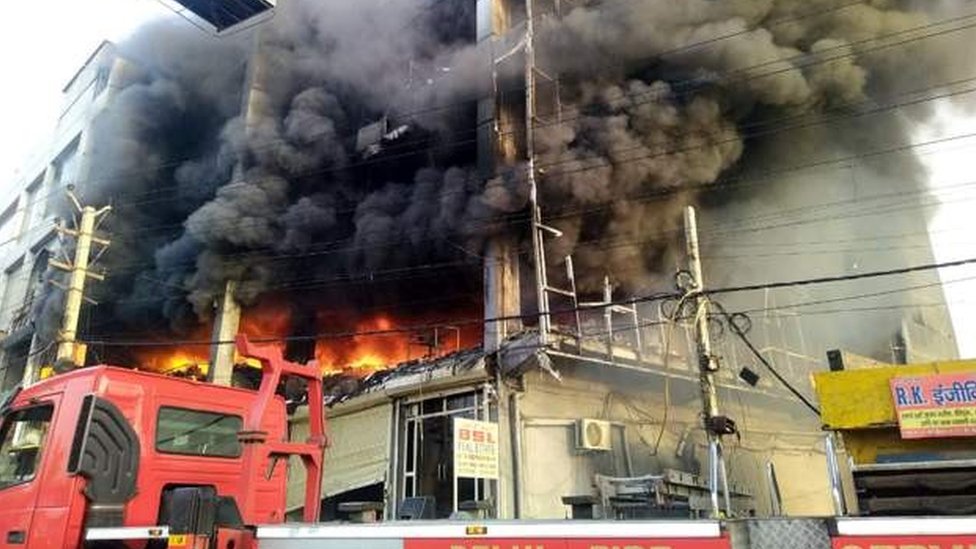
Fire has swept through a four-storey office building in Delhi, killing at least 27 people and injuring at least 12, emergency services say.

More than 70 people were in the building when the fire started and police broke windows and used ropes to rescue people.

Some 20 fire engines were used to put out the blaze near Mundka metro station in the west of India’s capital.

A short circuit is thought to have started the fire.

Indian media report that two arrests have been made.

Offering his condolences over the loss of lives, Prime Minister Narendra Modi promised 200,000 rupees (£2,118; $2,580) to next-of-kin in compensation for each death.

After the fire was extinguished, a rescue operation continued. “It will take time given the vastness of the area,” Sunil Choudhary, deputy chief fire officer, was quoted as saying by Times of India.

Most of the bodies were reportedly found on the second.

Local official Jogi Ram Jain, said preliminary reports suggested a short circuit had caused the fire and that the building did not have proper fire safety certification.

“We have initiated an inquiry and if any municipal officials are found to be at fault, strict action will be taken,” he was quoted as saying by the Hindustan Times.

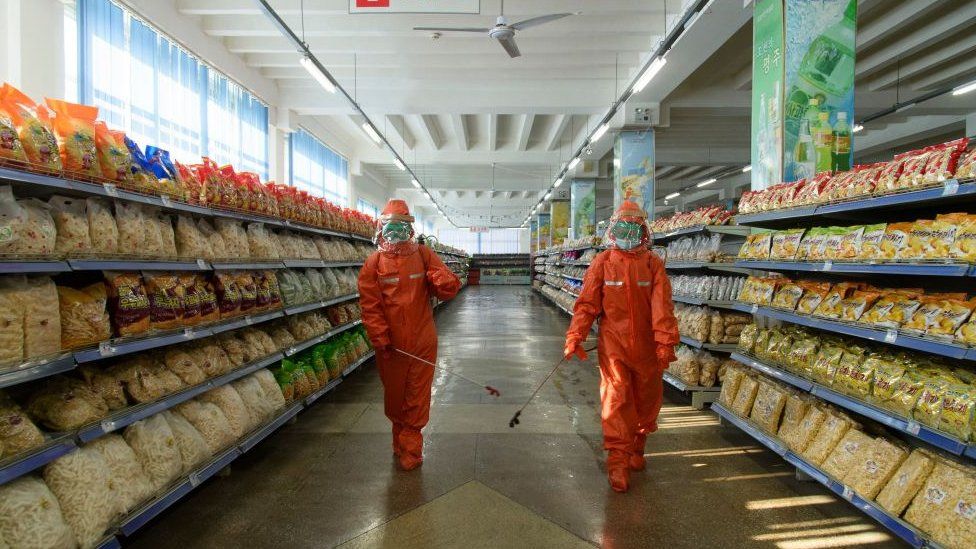
North Korea’s rapidly spreading Covid-19 outbreak is a “great disaster” for the country, its leader Kim Jong-un has said, according to state media.

Mr Kim called for an all-out battle to tackle the spread of the virus during an emergency meeting on Saturday.

It comes after officials announced the first confirmed cases on Thursday – although experts believe the virus has likely been circulating for some time.

There are fears a major outbreak could have dire consequences in North Korea.

Its population of 25 million is vulnerable due to the lack of a vaccination programme and poor healthcare system.

And on Saturday, state media reported that there had been half a million cases of unexplained fever in recent weeks. The country has limited testing capabilities so most Covid cases are not confirmed.

That figure marked a major increase on the numbers given on both Friday and Thursday, potentially providing some indication of the scale of North Korea’s outbreak.

“The spread of the malignant epidemic is [the greatest] turmoil to fall on our country since the founding,” the official KCNA news agency quoted Mr Kim as saying.

He blamed the crisis on bureaucratic and medical incompetence, and suggested lessons could be learnt from the response of countries like neighbouring China.

State media reports that 27 people have died since April after suffering a fever.

The reports do not say whether they tested positive for Covid, apart from one death in the capital Pyongyang which was confirmed to be a case of the Omicron variant.


The unprecedented admission on Thursday marked the end of two years of North Korean claims to be free of Covid.

The secretive country rejected offers from the international community to supply millions of AstraZeneca and Chinese-made jabs last year. Instead, it claimed it had controlled Covid by sealing its borders early in January 2020.

It shares land borders with South Korea and China, which have both battled outbreaks. China is now struggling to contain an Omicron wave with lockdowns in its biggest cities.

At a meeting outlining new Covid rules on Thursday, Mr Kim was seen wearing a face mask on television for what was believed to be the first time.

He ordered “maximum emergency” virus controls, which appeared to include orders for local lockdowns and gathering restrictions in workplaces.

South Korea has said it offered humanitarian aid after Thursday’s announcement, but Pyongyang is yet to respond.