
BRUSSELS: The United States will send new weapon systems to Ukraine, Washington’s top diplomat said on Thursday after Nato foreign ministers agreed to accelerate arms deliveries in response to Russia’s invasion.

Urged by Ukrainian Foreign Minister Dmytro Kuleba to end bureaucracy-driven delays, US Secretary of State Antony Blinken said the United States and 30 other countries were sending weapons to Ukraine and that that process would intensify.

“We’re not going to let anything stand in the way of getting Ukrainians what they need, and what we believe, to be effective,” Blinken said.

He spoke of “new systems” that have so far not been provided by Nato allies, but declined to go into details. Nato diplomats said that meant, in part, helping Ukraine transition from its Soviet-era arsenal to more modern weapons.

Blinken said the United States had already agreed to send Kyiv anti-aircraft systems, shoulder-held anti-tank weapons and armoured vehicles.

Asking for planes, land-based anti-ship missiles, armoured vehicles and air defence systems, Kuleba made his plea to a special session at Nato headquarters.

He addressed his counterparts from Nato’s 30 members plus the European Union, Finland, Sweden, Japan, New Zealand and Australia, urging Germany in particular to speed up deliveries, saying procedures were taking too long in Berlin.

“I think the deal that Ukraine is offering is fair. You give us weapons, we sacrifice our lives, and the war is contained in Ukraine,” Kuleba said.

After six weeks of a war that Moscow describes as a “special military operation”, Ukraine says Russia continues to shell eastern cities following its forces’ withdrawal from around Kyiv.

Kuleba also reiterated a demand that the EU stop buying Russian oil and gas, as the bloc promised a fifth round of sanctions against Moscow by Friday.

“We will continue to insist on a full oil and gas embargo,” Kuleba said.

Outrage over killings of civilians in the Ukrainian town of Bucha near Kyiv — where Russia denies any wrongdoing and says evidence was fabricated — appears to have galvanised Western support.

EU foreign policy chief Josep Borrell said a fifth package of sanctions, including a ban on coal, would be agreed on Thursday or Friday, while EU lawmakers voted in a non-binding resolution for “an immediate full embargo” on Russian energy imports.

But Blinken, while saying he had a strong sense that Europeans were committed to ending their dependency on Russian energy, also conceded that that could not be as quick as “flipping a light switch.” The bloc’s high level of dependency on Russian oil and particularly gas makes a broader energy embargo — which would cut off a significant source of revenue for Moscow’s war — unlikely for the time being.

First private mission readies for launch to International Space Station

The partnership has been hailed by Nasa, which sees it as a key step in its goal to commercialise the region of space known as “low Earth orbit,” leaving the agency to focus on more ambitious endeavours deeper into the cosmos.

Takeoff is set for 11:17am (1517 GMT) from the Kennedy Space Centre in Florida on a SpaceX rocket.

Commanding the Axiom-1 mission will be former Nasa astronaut Michael Lopez-Alegria, a dual citizen of the United States and Spain.

He is joined by three paying crewmates: American real estate investor Larry Connor, Canadian businessman Mark Pathy, and Israeli former fighter pilot and entrepreneur Eytan Stibbe.

The widely reported price for tickets — which includes eight days on the outpost — is $55 million.

But unlike the recent, attention-grabbing suborbital flights carried out by Blue Origin and Virgin Galactic, Axiom says its mission shouldn’t be considered tourism.

On board the ISS, which orbits 400 kilometres above sea level, the quartet will carry out scientific research projects, including on aging in space, experiments with stem cells, and a technology demonstration of a self-assembling spacecraft.

“The distinction is that our guys aren’t going up there and floating around for eight days taking pictures and looking out of the cupola,” Derek Hassmann, operations director of Axiom Space, told reporters at a pre-launch briefing.

“I mean we have a very intensive and research-oriented timeline plan for them.”

In addition, crewmember Stibbe plans to carry out a tribute to his friend Ilan Ramon, Israel’s first astronaut, who died in the 2003 Space Shuttle Columbia disaster when the spaceship disintegrated upon reentry.

Surviving pages from Ramon’s space diary, as well as mementos from his children, will be brought to the station by Stibbe.

The Axiom crew will live and work alongside the station’s regular crew: currently three Americans and a German on the US side, and three Russians on the Russian side.

The company has partnered for a total of four missions with SpaceX, and Nasa has already approved in principle the second, Ax-2.

Axiom sees the voyages as the first steps of a grander goal: to build its own private space station. The first module is due to launch in September 2024, president and CEO Michael Suffredini said.

The plan is for it to initially be attached to the ISS, before eventually flying autonomously when the latter retires and is deorbited sometime after 2030.

Pakistani Prime Minister Imran Khan could face removal from office this weekend, after the country’s top court ruled his move to block a no-confidence vote was unconstitutional.

Last Sunday, Mr Khan’s ruling party blocked a no-confidence vote which he was widely expected to lose.

His government then dissolved parliament and called a snap election.

Furious opposition members launched an appeal with the Supreme Court to decide the legality of the blocked vote.

The Supreme Court said in a ruling late on Thursday that the vote should go ahead.

In response to this, Mr Khan announced that he had called a cabinet meeting and would address the nation on Friday evening.

“My message to the nation is that I have always fought for Pakistan and will continue to fight till the last ball,” he wrote in a Twitter post.

What was the reaction to the ruling?

News of the court’s decision was met with cheers of jubilation on Thursday night by dozens of opposition members, who were gathered outside the court.

The leader of the opposition in the National Assembly, Shehbaz Sharif, told local news outlets that the court had “definitely fulfilled the people’s expectations”.

But furious supporters of Mr Khan chanted anti-American slogans in reply, as police in riot gear separated the two sides.

Opposition supporters celebrated outside the Supreme Court after the court ruled the blocked vote as unconstitutional

The Supreme Court has now ordered parliament to reconvene on Saturday to proceed with the vote, which is expected to go against Mr Khan.

It is unclear what other options Mr Khan can exercise to avoid that outcome, unless he and his MPs decide to submit resignation en masse in an attempt to avoid the humiliation of a defeat, says BBC Urdu reporter Abid Hussain.

He says the united opposition, buoyed by the unanimous verdict, has declared it a win for Pakistan’s democracy, even though there have been rumours that they had quiet support from country’s powerful military.

In the event Mr Khan is ousted from power, the opposition parties are expected to appoint a new prime minister who can hold power until August 2023, when a new election is scheduled to be held.


How did events unfold?

In the days leading up to the vote, Mr Khan claimed without evidence that the political opposition was in a conspiracy with the US to remove him because of his friendly relations with Russia and China. Washington has strongly denied his claim.

On Sunday, opposition lawmakers tabled the no-confidence motion to parliament.

But parliament’s deputy speaker Qasim Suri – who also comes from Mr Khan’s political party – blocked the vote on grounds of this “foreign interference”, effectively foiling any attempt to oust Mr Khan from power.

On Thursday, the Supreme Court found that the move to block the vote was illegal, saying it was “contrary to the constitution and the law and had no legal effect”.

The court also ruled that Mr Khan’s decision to dissolve parliament was invalid. A dissolution of parliament would have mandated snap general elections to be held within 90 days, which Pakistan’s electoral commission had declared as not possible.

What do we know about Imran Khan?

Mr Khan, a former star cricketer turned politician, swept into office in 2018 on a platform to tackle corruption and cronyism.

While he still has many supporters, he has lost some popular favour amid a rise in living costs, ballooning foreign debt and other scandals.

Analysts also say that Mr Khan may have lost support from the military, a crucial backer of any Pakistan leader.

The Supreme Court’s decision marks another chapter of political turmoil in Pakistan. None of the nation’s prime ministers have ever served out a full five-year term, due to various political scandals and power plays by the military in the past decades.

Military coups and removals of democratically-elected leaders have left Pakistan under direct military rule for 33 of the 75 years it has been an independent nation. However the current military leadership claims it is not involved in recent political developments.

Australia has sent off the first three of 20 armoured military trucks it’s gifting to Ukraine, following a request from Ukrainian President Zelensky last week.

The heavily fortified Bushmaster vehicles will be used to transport soldiers and civilians in the war zone – they won’t be used for offensive attacks.

Zelensky delivered a video address to Australia’s parliament last week – the 20th nation he spoke to – thanking the country for its steadfast support so far.

Australia has committed over A$190m (£108m; $142m) in military and humanitarian aid and enacted several sanctions on Russian individuals and oil imports.

“Mr President, the people of Australia stand with Ukraine in your fight for survival,” said Prime Minister Scott Morrison in response to Zelensky last week.

The Australian leader has repeatedly declared that liberal democracies must band together to defend freedom and “the right to live free of coercion, intimidation and the brute fist of force”.

He said Australia honoured Zelensky as a “lion of democracy”.

New York’s top lawyer has asked a state judge to hold Donald Trump in contempt of court, for allegedly failing to turn over files for an investigation into his business practices.

Attorney General Letitia James requested he be fined $10,000 (£7,650) per day until he complies.

A judge previously ordered Mr Trump to provide the files as part of Ms James’s probe into the Trump Organization.

The former president’s lawyer called the motion “frivolous”.

The New York attorney general opened a civil inquiry in 2019 into claims that – before he took office – Mr Trump had inflated the value of his assets to banks when seeking loans.

Mr Trump and his family have denied wrongdoing and the former president has called the inquiry a “witch hunt”.

In February, a judge ruled that Mr Trump, his son Donald Trump Jr, 44, and daughter Ivanka Trump, 40, must answer questions under oath in the New York investigation into their business practices.

They appealed the order to appear but did not object to a separate part of the ruling that the former president comply with a subpoena “seeking documents and information”. Those were meant to be produced by 31 March.

In court documents filed on Thursday, the New York attorney general said Mr Trump has not produced the requested documents and has raised objections “based on grounds such as overbreadth, burden, and lack of particularity”.

“The judge’s order was crystal clear: Donald J Trump must comply with our subpoena and turn over relevant documents to my office,” Ms James said in a statement.

Ms James has repeatedly blamed Mr Trump for creating unnecessary delays in the legal process.

Mr Trump’s lawyer, Alina Habba, said in a statement sent to Reuters that: “We are prepared to adamantly oppose the frivolous and baseless motion filed by the attorney general’s office.

“Our client has consistently complied with the many discovery requests served by the attorney general’s office over the years.”

The civil case is separate to a Manhattan criminal investigation into the Trump Organization’s practices.

Planning permission for a national Holocaust memorial outside Parliament has been quashed by the High Court.

Campaigners successfully challenged the government after it overturned a decision by Westminster Council to refuse permission for the monument.

The London Historic Parks and Gardens Trust described the process to approve permission as “flawed”.

The charity, which launched the case, argued the project was the “right idea, wrong place”.

It opposed the UK Holocaust Memorial and Learning Centre being built in Victoria Tower Gardens, a small triangular Grade II-listed green space next to Westminster Abbey and the Palace of Westminster.

The trust’s lawyer, Richard Drabble QC, argued it did not comply with a 1900 legal act affecting park land, which contains “a prohibition on using Victoria Tower Gardens as anything other than a garden open to the public”.

The monument was set to include 23 bronze fins and an underground learning centre.

Former Prime Minister David Cameron announced plans for the memorial in 2016 but disagreements over its meaning, public safety and potential harm to parkland have followed the project.

In a ruling issued on Friday, Mrs Justice Thornton said the case against the planning permission decision succeeded in relation to 1900 legal act.

The judge said the act “imposes an enduring obligation” to retain land “as a public garden and integral part of the existing Victoria Tower Gardens”.

“Accordingly, the appropriate remedy is to quash the decision, so as to enable further consideration of the implications of the London County Council (Improvements) Act 1900 for the proposed scheme,” she concluded.

At a hearing in February, the trust argued there was an “unlawful” approach taken to considering other sites for the memorial.

It also highlighted the possible impact the development could have on the heritage setting, including the Buxton Memorial commemorating the abolition of slavery.

The controversial Cambo oil field off Shetland could now be developed after the owner of the field was bought by another energy firm.

Siccar Point Energy – which put the project on hold when Shell pulled out – has now been acquired by Ithaca Energy in a $1.5bn (£1.125bn) deal.

The new company has pledged to develop Cambo and the nearby Rosebank field.

Campaigners have criticised plans to develop Cambo, warning exploiting it would exacerbate climate change.

Ithaca’s chief executive Alan Bruce said Cambo and Rosebank were “two of the largest undeveloped and most strategically important discoveries” in UK waters.

Developing them, Mr Bruce added, was a “huge opportunity to not only help secure the UK’s energy future for at least another quarter of a century, but also to create thousands of direct and indirect jobs in the process.”

A spokeswoman for Shell, which still owns a 30% stake in Cambo, told the BBC that it had nothing to add to its statement in December when the oil giant said it had “concluded the economic case for investment in this project is not strong enough at this time, as well as having the potential for delays.”

The Cambo oil field is thought to contain 800 million barrels of oil, but its development has not yet received final approval from UK government regulators.

Scotland’s first minister has also said the project should not get the green light because of concern over climate change.

Cambo has been a key target for environmental lobbyists

The Scottish government said that unlimited extraction of fossil fuels was not consistent with its climate obligations.

A spokesman added: “We have consistently called on the UK government to urgently re-assess all approved oil licenses where drilling has not yet commenced against our climate commitments.

“New oil and gas fields do not present a timely solution to improving our energy security in the coming years. Even once operational, the extracted fossil fuels will still be affected by the same global market forces which have contributed to the current energy price crisis.”

The UK government has been approached for comment.

In December Siccar Point Energy, the project’s majority stakeholder, said it was pausing the Cambo project one week after its partner Shell pulled out.

Shell had a 30% stake in the field but said the economic case for investment in the North Atlantic project was “not strong enough”.

Siccar Point Energy said it would continue talks with the UK government over the future of the field.

Energy strategy

On Wednesday the UK government released its energy strategy, which covered plans to boost UK energy independence and tackle rising prices.

The plans included a new licensing round for oil and gas projects in the North Sea – something the Scottish government dismissed, saying it was not a long-term solution to energy concerns.

The UK government said its commitment to more North Sea projects recognised “the importance of these fuels to the transition and to energy security”, adding that producing gas in the UK had a lower carbon footprint than that imported from abroad.

But its climate advisers last month said UK-produced gas would be sold internationally and would barely reduce the consumer price.

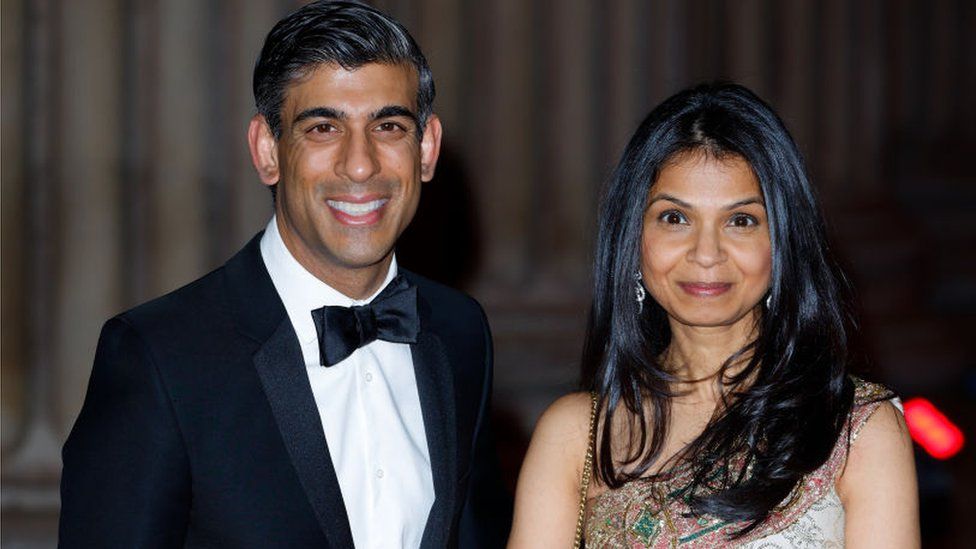
Rishi Sunak has defended his wife’s tax affairs, calling reports on her non-domicile status “unpleasant smears”.

Akshata Murty opted to claim non-dom status, meaning she does not have to pay UK tax on her overseas income.

Critics estimate she would have avoided about £4.5m in UK tax last year.

The non-dom scheme is legal but Labour says it would be “breathtaking hypocrisy” if the chancellor’s wife had reduced her tax bill as he raised taxes for millions of workers.

Responding to the chancellor’s claims that Labour was unfairly smearing his wife, a Labour source told the BBC: “The chancellor would do better to look a little closer to home.

“It’s clear that No 10 are the ones briefing against Rishi Sunak and after his failure to tackle the cost of living crisis you can understand why.”

In an interview with the Sun newspaper, Mr Sunak said he believed he was the victim of a campaign to discredit him, saying: “To smear my wife to get at me is awful.”

But No 10 has rejected newspaper reports that its staff are leaking damaging material about the chancellor to the media, calling the allegations “categorically untrue” and “baseless”.

Ms Murty, an Indian citizen, owns a 0.9% stake in Infosys, the software giant founded by her billionaire father. Her stake fluctuates in value but is estimated to be worth more than £500m.

She receives annual dividend payments on the shares, which last year were reported to be worth £11.6m .

On Thursday, it emerged that Ms Murty pays £30,000 a year to maintain her non-domicile status, meaning she does not pay tax in the UK on her overseas earnings.

It is not known whether she pays tax on her Infosys dividend payments in India or in another jurisdiction.

Under the rules, people can be granted non-dom status if they live in the UK but intend to return home.

This is the government form people use to apply for non-dom status

Mr Sunak insisted his wife had not broken any rules in his Sun interview.

“Every single penny she earns in the UK she pays UK taxes on… and every penny that she earns internationally, for example in India, she would pay the full taxes on that,” he said.

He said it was unfair to attack his wife when she was a “private citizen”, adding: “I’m an elected politician. So I know what I signed up for.”

Mr Sunak said his wife was domiciled in India and would eventually return there to care for her parents as they got older.

Labour has written to the chancellor to ask if his wife paid all foreign tax in India or in a tax haven such as the Cayman Islands. The party has also asked the chancellor if he benefits from his wife’s tax arrangements.

The Liberal Democrats have urged Mr Sunak to ban the partners of ministers from claiming non-dom status, calling it a “loophole”.

A non-dom is a UK resident who declares their permanent home, or domicile, outside of the UK.

A domicile is usually the country his or her father considered his permanent home when they were born, or it may be the place overseas where somebody has moved to with no intention of returning.

For proof to the tax authority, non-doms have to provide evidence about their background, lifestyle and future intentions, such as where they own property or intend to be buried.

Those who have the status must still pay UK tax on UK earnings but do not need to pay UK tax on foreign income. They can give up their non-dom status at any time by stating on a tax return that they intend to live in the UK and wish to be considered British for tax purposes.

Ms Murty has chosen to be domiciled in India via her father, the billionaire Narayana Murty, which means she doesn’t need to pay taxes in the UK on dividends she receives from her stake in his company.

The fee for non-dom status rises to £60,000 a year when a person has been in the UK for at least 12 of the previous 14 years.

And anyone living in the UK for 15 years automatically loses the status.

Ms Murty, who married Mr Sunak in 2009, has declined to say when her non-dom status began.

“India does not allow its citizens to hold the citizenship of another country simultaneously,” Ms Murty’s spokeswoman said. “So, according to British law, Ms Murty is treated as non-domiciled for UK tax purposes.

But tax experts have questioned Ms Murty’s statement, suggesting UK non-dom status is a “choice” and something people can give up if they want to.

Pakistani universities that are among the best in the world

At least 17 Pakistani universities have been featured in the list of the best global universities for 2022 published by US News.

According to these rankings, Quaid-e-Azam University (QAU) has been ranked 461 in the World Ranking 2022. Aga Khan University and COMSATS University Islamabad follow QAU.

Following are the top 10 universities from Pakistan that made it to the list with their global ranks:

1. Quaid-i-Azam University 461

2. Aga Khan University 473

3. COMSATS University Islamabad 495

4. National University of Sciences and Technology 922

5. University of Peshawar 933

6. University of Agriculture Faisalabad 954

7. Government College (GC) University Faisalabad 1,149

8. University of Punjab 1,242

9. Bahauddin Zakariya University 1,368

10. University of Engineering and Technology (UET) Lahore 1,458

The Vice-Chancellor of QAU Prof Dr Muhammad Ali Shah has congratulated the faculty, students, staff, and alumni on the official website of the university.

US slaps sanctions on Putin’s daughters, top banks

WASHINGTON: The White House on Wednesday announced sanctions targeting Russia’s top public and private banks and two daughters of Vladimir Putin, adding pressure on the country’s economy and its elite over the invasion of Ukraine.

The new sanctions targeted Maria Vorontsova and Katerina Tikhonova, two adult daughters of Putin’s with his former wife Lyudmila Shkrebneva.

Also hit with new sanctions were the wife and daughter of Russian Foreign Minister Sergei Lavrov and members of Russia’s Security Council, including former president and prime minister Dmitry Medvedev and Prime Minister Mikhail Mishustin.

“These individuals have enriched themselves at the expense of the Russian people. Some of them are responsible for providing the support necessary to underpin Putin’s war on Ukraine,” the White House said in a statement.

“We believe that many of Putin’s assets are hidden with family members, and that’s why we’re targeting them,” a senior US official told reporters, referring to the two daughters.

The White House also declared “full blocking” sanctions on Russia’s largest public and private financial institutions, Sberbank and Alfa Bank, and said all new US investment in Russia was now prohibited.

And it said that new sanctions would be announced on Thursday on key Russian state enterprises, aiming to hamper their ability to trade and move money through the global financial system.

President Joe Biden tied the escalation of sanctions directly to the evidence that has mounted that Russian forces deliberately murdered civilians in Bucha, a town outside Kyiv.

“I made clear that Russia would pay a severe and immediate price for its atrocities in Bucha,” Biden tweeted.

Energy transactions protected

The new sanctions were being coordinated with US allies in Europe and elsewhere, aiming to further damage the Russian economy in order to pressure Putin to stop the war.

“Today, in alignment with G7 allies and partners, we are intensifying the most severe sanctions ever levied on a major economy,” the official said on grounds of anonymity.

The sanctions on the two banks broadened an earlier measure that blocked certain capital transactions with them. Now any asset the bank has that is or comes under US jurisdiction will be frozen, and people and companies under US jurisdiction are banned from doing business with them.

This could have a significant impact on Sberbank, which holds nearly one-third of the assets in the Russian banking industry.

However, the US sanctions continued to avoid Russia’s energy sector, which still reaps millions of dollars daily from European customers for its natural gas. Energy-related transactions at the two banks will still be permitted, the White House said.