

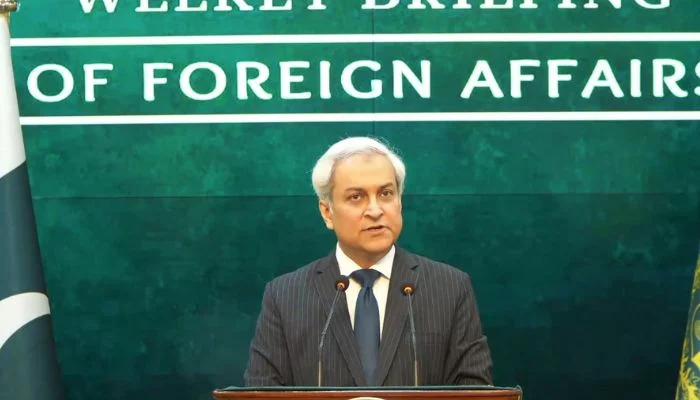
ISLAMABAD: Foreign Office spokesperson Tahir Hussain Andrabi said on Thursday that Pakistan would encourage the United States and Iran to stop violence and resume talks under the Islamabad Memorandum of Understanding (MoU) — it helped mediate last month.
“While the implementation of the MoU is facing challenges, Pakistan will continue to encourage all sides to end violence and resume technical-level talks in accordance with the MoU,” Andrabi said during a weekly press briefing in Islamabad.
Expressing deep concern over the renewed tensions between Iran and the United States, the FO spokesperson noted that Pakistan was closely monitoring the evolving regional situation and believes that negotiations remain the best way to address disputes.
Rejecting the impression that Pakistan has stepped away from peace efforts, the spokesperson said that Islamabad’s mediation efforts are continuing.
“We express the hope for an early normalisation of the situation in the Strait of Hormuz and underscore the importance of ensuring the continued safety, security and freedom of maritime navigation,” he added.
The US and Iran signed the “Islamabad Memorandum of Understanding” on June 17, largely mediated by Pakistan. The US has this week been striking Iran, drawing retaliatory Iranian attacks on US interest in the Gulf as they battle over the strategic Hormuz shipping route. That sent global oil prices soaring and led to concerns of spikes in inflation even in nations far from the conflict.
“While the implementation of the MoU is facing challenges, Pakistan will continue to encourage all sides to end violence and resume technical-level talks in accordance with the MoU,” Tahir Andrabi, Pakistan´s foreign office spokesman, told reporters in Islamabad.
The key oil and gas artery, which Iran insists it controls, is central to the rekindled fighting that has entered its sixth day despite a preliminary deal in June aiming to end the war.
“Pakistan recognises the urgent need to address the impact of the current situation on global energy supplies and other economic commodities including trade and food security,” Andrabi said.
Andrabi said that the conflicts serve no one’s interests and hoped that all sides would remain committed to the peaceful resolution of differences.
Pakistan continues humanitarian support for Afghanistan
Separately, Andrabi said that Pakistan continues to support international efforts to address the humanitarian crisis in Afghanistan and will keep facilitating the delivery of humanitarian assistance by the United Nations and partner organisations.
The spokesperson said around 45 trucks carrying humanitarian aid for Afghanistan have already been dispatched through Pakistan. He reiterated that Islamabad’s position on providing a humanitarian corridor for Afghanistan remains consistent and clear.
However, the spokesperson said that relations with Afghanistan have not yet improved, adding that meaningful progress would not be possible until the Afghan government stops supporting terrorism against Pakistan.
Andrabi said the Afghan government must provide assurances that its territory will not be used for terrorist activities against Pakistan. He added that normal progress in bilateral relations cannot take place until Pakistan’s concerns regarding terrorism are addressed.
‘India sponsoring terrorism in Balochistan’
Condemning the recent terrorist attacks in Balochistan and the killing of civilians, the spokesperson said that India has openly supported terrorism in the province, saying New Delhi’s actions and statements reflect a pattern of backing such activities.
Andrabi said that reactions from Indian media regarding the killing of Pakistani citizens, including expressions of celebration, exposed what he described as India’s double standards.
He added that India’s response to terrorism incidents in Balochistan itself reveals its position on the issue.
The spokesperson said Pakistan condemned terrorism in the strongest possible terms and emphasised that attacks against civilians cannot be justified under any circumstances.