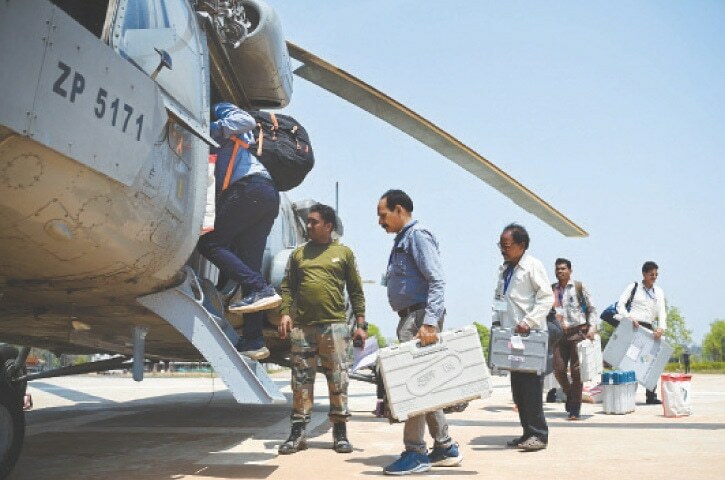

India begins voting in gigantic election as Modi seeks historic third term

The vote pits Modi’s Bharatiya Janata Party (BJP) against an alliance of two dozen opposition parties which is challenging him with promises of increased affirmative action, more handouts and what they say is the need to save democratic institutions from Modi’s dictatorial rule.

The gigantic exercise involving almost one billion voters will be spread over seven phases across the world’s most populous country at the peak of summer. It ends on June 1 and votes will be counted on June 4.

On Friday, in the largest of the seven phases, 166 million voters in 102 constituencies across 21 states and territories will vote, including in Tamil Nadu in the south, Arunachal Pradesh on the Himalayan frontier with China, and the most populous Uttar Pradesh in the north.

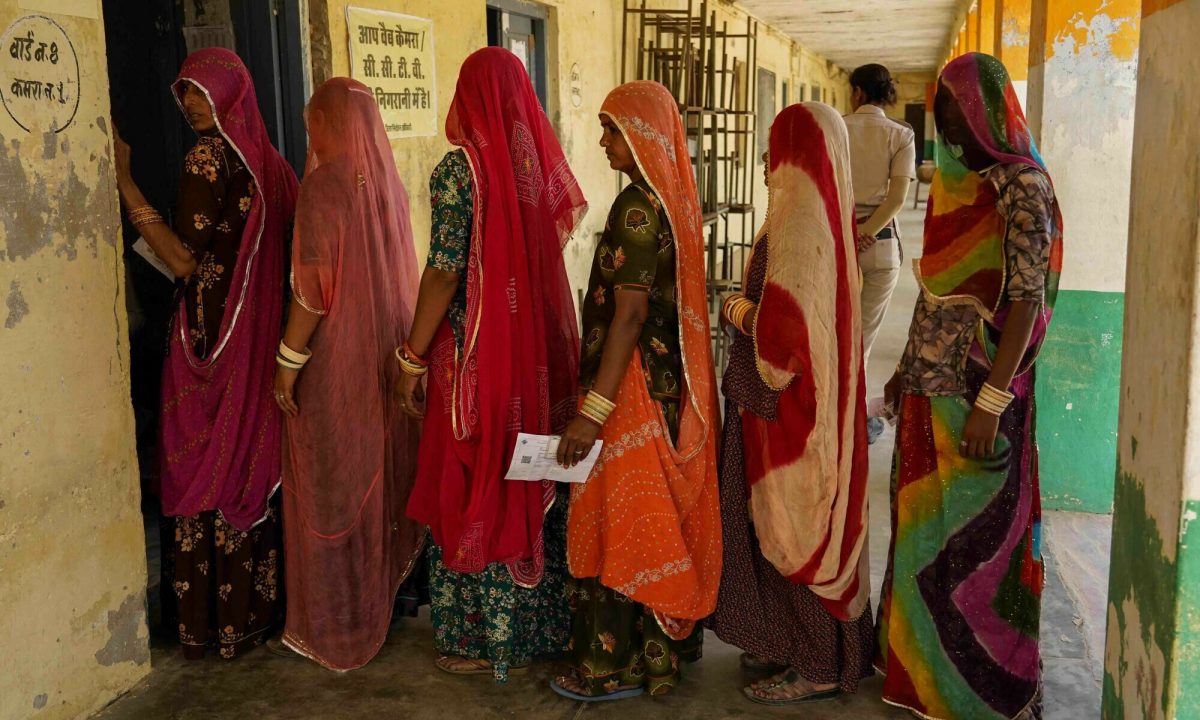
Voters began lining up outside polling stations much before they opened at 7:00am (0130 GMT) amid tight security, including senior citizens who needed help to reach the booths.

“Modi will come back to power, because apart from the religious push, his other work, including on safety and security is good,” said Abdul Sattar, 32, a Muslim voter in Uttar Pradesh’s Kairana, about 100km from Delhi.

Mohammed Shabbir, a 60-year-old driver and father of eight, said unemployment was the main issue for him as none of his children have regular jobs.

Hindu nationalism is not an issue in this election, “because even the Hindus are affected by a lack of jobs”, he said.

Surveys suggest BJP will easily win a majority even though voters have serious concerns about unemployment, inflation and rural distress in the world’s fastest growing major economy, with the spotlight being on whether BJP can improve on its 2019 victory and by how much.


“In the next five years, we will take our nation into the top three economies of the world, launch a final and decisive assault against poverty, open up newer avenues of growth […] unveil the next generation of reforms, and take a number of pro-people decisions and actions,” Modi wrote in the BJPs election manifesto.

The manifesto and the theme of the BJP campaign is titled “Modi Ki Guarantee” or Modis guarantee to fulfill promises made to voters, underlining the unusual leader-centric, presidential-style pitch in a parliamentary system.

“I urge all those voting […] to exercise their franchise in record numbers,” Modi posted on X, minutes before polling began.

“I particularly call upon the young and first time voters to vote in large numbers. After all, every vote counts and every voice matters,” he said.


Opposition weak, fragmented

If he wins, Modi will be only the second Indian prime minister to be elected three times in a row, after post-independence leader Jawaharlal Nehru.

Modi says that his first two terms were appetisers and the main course will be served in the third term. BJP hoardings across towns and cities highlight a range of achievements in his two terms, including India’s historic landing on the moons south pole and fighting corruption to woo voters.


Hindu nationalism is a key theme. Modi’s government and BJP are accused by critics of discriminating against or targeting India’s 200 million minority Muslims to please their hardline Hindu base — charges both deny. Sporadic violence between Hindus and Muslims continues to break out.

The opposition INDIA alliance says the election is an ideological battle being fought to stop the BJP from ending the constitutional and democratic system.

Rahul Gandhi, leader of the main opposition Congress party, said the BJP always seeks to divert attention from major issues such as unemployment and price rise.

“Sometimes the PM goes underwater in the ocean and sometimes he is on a seaplane but does not talk about issues,” Gandhi said, referring to Modi’s widely publicised engagements in recent months.

While the alliance has struggled to forge unity and field common candidates against the BJP, it has accused the government of denying it a level playing field by arresting opposition leaders in corruption cases and making huge tax demands ahead of the vote — charges the government denies.

Chandrachur Singh, who teaches politics at Delhi’s Hindu College, said the BJP has a clear edge but also faces real challenges.

“It’s not an election where there are no issues,” he said. “There are issues which could have led to anti-incumbency. But that is something which is not being channelised or harnessed by a fragmented, divided, weak opposition,” he said.

“That is what is causing some kind of disillusionment among voters and allowing BJP to surge ahead.”
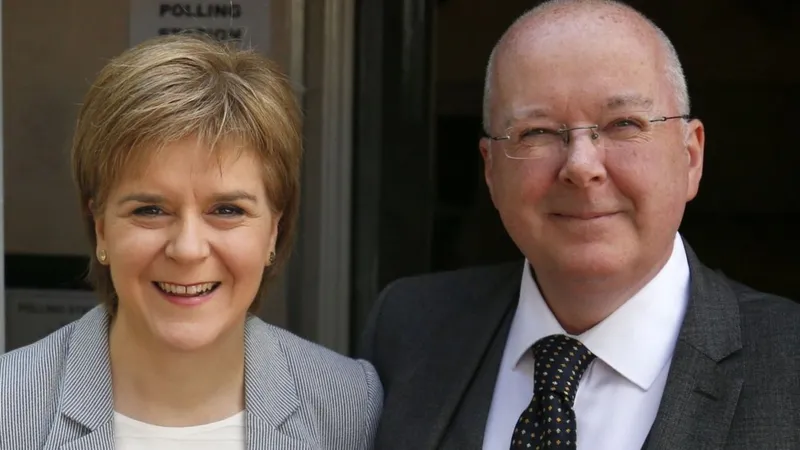
Peter Murrell was a constant in the hierarchy of the Scottish National Party for more than two decades.

He became chief executive as the sun was setting on the last century and as the dawn was rising on the new chapter of devolution.

During the 59-year-old’s tenure the party grew in confidence and became an indomitable election winning machine.

But in the public’s eye he would be remembered for something else – being married to Scotland’s first minister.

It was on a summer’s day in 2010 when Nicola Sturgeon married her long-term partner Peter at a ceremony in Glasgow.

He had already been SNP chief for 11 years and she was deputy first minister in charge of the health brief for the Scottish government, led by Alex Salmond.

Power couple

Politics played its part in bringing these two together. According to a biography of Ms Sturgeon by David Torrance, they first met in 1988 at an SNP youth weekend and became a couple in 2003.

They never had children but Ms Sturgeon later revealed the painful experience of suffering a miscarriage when she was 40, shortly before the 2011 Scottish parliamentary election campaign.

“Sometimes… having a baby just doesn’t happen – no matter how much we might want it to,” she said.

The powerful couple would be seen together at party conferences, outside polling stations and at official events such as the Queen’s Jubilee concert. But while relaxed in each other’s company, they were not gushy hand-holders who lingered before a gathered media.

On occasions when asked about her husband – notably during her appearance on ITV’s Loose Women – Ms Sturgeon was quick to credit Mr Murrell for his cooking skills.

She has also given insight into how he has supported her political leadership. Ms Sturgeon told the Sunday Times: “One of the things I value is that he’s happy with me having the public role… He’s not one of those guys who would feel threatened by it. He doesn’t have that sort of ego, he’s very self-assured.”

Mr Murrell has similarly spoken of his respect for his wife’s intellect, saying: “She’s very, very sharp and on top of whatever the issue of the day is. That spark is always there. We are constantly having conversations that I’m amazed by.”

In the spotlight

It clearly suited the FM’s husband to be in the background but he, and his role as chief executive, came under scrutiny during the inquiry into the Scottish government’s handling of complaints against former first minister Alex Salmond.

At the Holyrood Inquiry in 2020, Mr Murrell denied plotting against Mr Salmond. But opposition MSPs believed that Mr Murrell contradicted himself, and Ms Sturgeon, over some of the details he gave in evidence.

He was pressed repeatedly about whether the meetings between Ms Sturgeon and Mr Salmond were SNP business, as the first minister had insisted, or government business – which would need to be officially recorded.

PA Media
Under Nicola Sturgeon and Peter Murrell the SNP was an election winning machine

Mr Murrell was back in the media spotlight in December 2022 when it was confirmed he had given a loan of £107,620 to the SNP to help it out with “cash flow” issues.

The SNP had repaid about half of the money by October of that year and the party’s official line was that the loan was a “personal contribution made by the chief executive to assist with cash flow after the Holyrood election”.

These questions were difficult ones for Ms Sturgeon and she had to awkwardly bat away media probes about what she knew of her husband’s financial situation – “that is for him,” she said at an FM’s update at the beginning of last year.

Despite this discomfort, she continued to lead the country and he continued to be in charge of the party machine.

But then Ms Sturgeon announced her decision to resign. Some commentators said it would be inevitable that Mr Murrell would also have to go but his departure has happened before his wife’s.

Pressure mounted on him when two of the three candidates vying to be new party leader and first minister publicly questioned the contest they were taking part in.

Row over member numbers

From the outset, contender Ash Regan said Mr Murrell’s position as SNP chief executive was a “clear conflict of interest”.

And this theme would not go away with another candidate, Kate Forbes, questioning the integrity of the electoral process.

What led the chief executive to go was linked to a row about party membership and who would be voting in this election.

One point of pride for Mr Murrell had been his campaign to increase followers after the failed Scottish independence referendum of 2014 and the coronation of his wife as leader and first minister.

The SNP went from a membership of less than 25,000 in 2013 to more than 125,000 by December 2019.

But that figure had fallen back to 72,000 by March 2023 and the party only reluctantly confirmed this when media and opposition pressure, plus questions from all three candidates, became too much.

The power couple who helped shaped Scottish politics in the first two decades of this century are no more.

Security forces kill seven terrorists trying to infiltrate Pak-Afghan border in North Waziristan

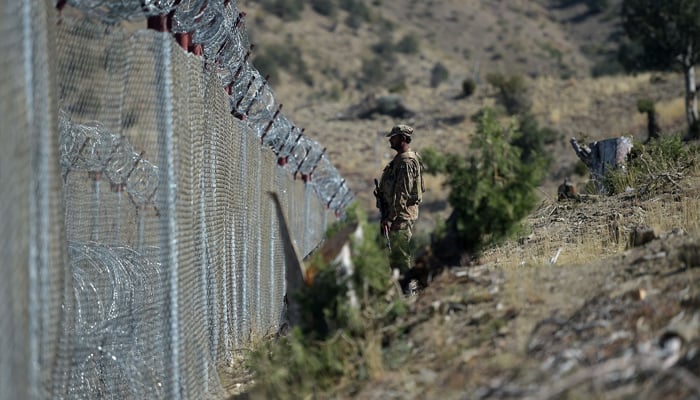
Security forces have killed seven terrorists trying to infiltrate the Pakistan-Afghanistan border in Khyber-Pakhtunkhwa’s North Waziristan district, the military’s media wing said on Wednesday.

In a statement, the Inter-Services Public Relations (ISPR), said the security forces on April 16 (Tuesday) detected a movement of a group of seven terrorists near the Pakistan-Afghanistan border in Spinkai area of Ghulam Khan in the tribal district.

“The infiltrators were surrounded, effectively engaged and after an intense fire exchange, all seven territories were sent to hell,” it added.

A large quantity of weapons, ammunition, and explosives was also recovered from the killed terrorists, the statement added.

The statement highlighted that Pakistan has consistently been asking the Taliban-led interim Afghan government to ensure effective border management on their side of the border.

The military urged the interim rulers to fulfill their obligations and deny the use of Afghan soil by terrorists for perpetuating acts of terrorism against Pakistan.

“Security forces of Pakistan are determined and remain committed to securing its borders and eliminating the menace of terrorism from the country,” read the ISPR’s statement.

Pakistan has time and again urged the Afghan authorities to take meaningful action against terrorists using the neighbouring country’s soil to launch attacks inside Pakistan.

Last month, Pakistan carried out an intelligence-based anti-terrorist operation inside Afghanistan on, whose prime target was the terrorists belonging to Hafiz Gul Bahadur Group along with Tehreek-i-Taliban Pakistan (TTP).

Hafiz Gul Bahadur Group had earlier claimed responsibility for the terrorist attack.

“This group is responsible for multiple terrorist attacks inside Pakistan, resulting in death of hundreds of civilians and law-enforcement officials. The latest attack took place on 16 March 2024 at a security post in Mir Ali in North Waziristan and claimed the lives of seven Pakistani soldiers,” said the Ministry of Foreign Affairs on March 18 after over 13 hours after the operation.

A day earlier, Pakistan Army’s top commanders were briefed on how terrorist groups operating from Afghanistan pose a threat to regional and global security, besides acting as proxies against Pakistan and its economic interests, especially the China-Pakistan Economic Corridor (CPEC).

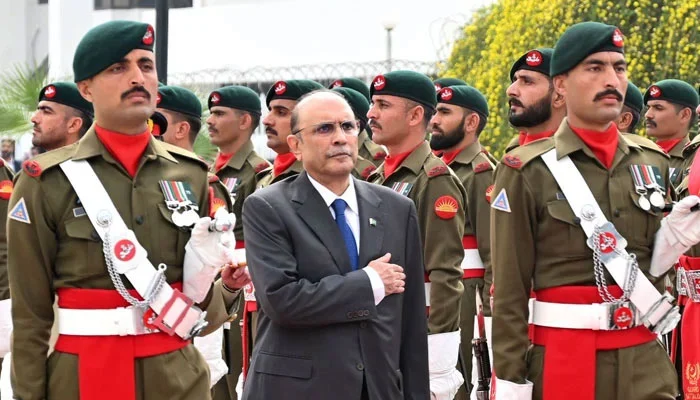
President Zardari set to address Parliament today

ISLAMABAD: President Asif Ali Zardari is set to address the joint session of parliament to kick off the parliamentary year after the February 8 general elections.

The session, convened by the president under the powers provisioned in Articles 54 (1) and 56 (3) of the Constitution, will commence at 4pm. This will be President Zardari’s seventh address as he has previously addressed the joint session of the parliament six times before during his previous tenure as the country’s head of state from 2008 to 2013.

Additionally, the president has also summoned NA session on Friday (tomorrow) at 10:30 am in exercise of the powers conferred to him under Article 54 (1) of the Constitution.

Earlier, the joint session was convened on April 16 but was rescheduled for today.

It should be noted that this will be the first joint session following the start of the new parliamentary year in the country after both the upper and lower House members were elected.

Despite elections taking place on February 8 and former president Arif Alvi still in office, he was unable to summon a joint session as elections in the Senate were yet to be conducted.

Previously, Alvi had summoned a joint session of the parliament on October 6, 2022 — months after a coalition government led by Prime Minister Shehbaz Sharif was governing the centre.

However, the then-president had called the session to mark the beginning of the last parliamentary year of the then-National Assembly in 2022.

Today’s session is likely to feature a strong reaction from the opposition benches, having a significant number of Pakistan Tehreek-e-Insaf-backed Sunni Ittehad Council (SIC) members, who have recorded strong protests in the previous sessions as well.

Meanwhile, the National Assembly Secretariat has invited the chief justice of Pakistan, governors and chief ministers of all the provinces, including Azad Jammu and Kashmir and Gilgit-Baltistan.

Furthermore, several senior officials and officeholders including the Pakistan Army’s chairman joint chiefs of staff committee (CJCSC), the three services chiefs, speakers, deputy speakers of all provincial assemblies, legislative assembly of Azad Jammu and Kashmir and Gilgit-Baltistan have also been invited to attend the joint session.

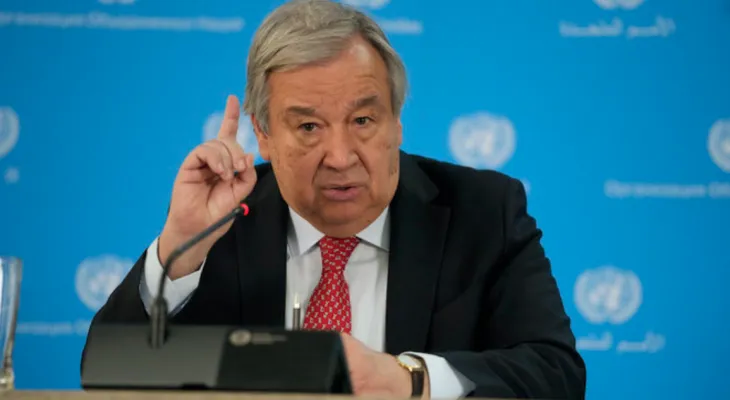
UN chief calls for ‘urgent steps’ towards South Sudan election

All political parties in South Sudan should take “urgent steps” to allow for long-delayed elections to be held late this year, UN Secretary-General Antonio Guterres wrote in a report published Wednesday.

South Sudan has not held an election since it gained independence from Sudan in 2011, and the nation is plagued by chronic violence, poverty and natural disasters.

“It is my view that the parties must commit to take urgent steps to achieve a ‘critical mass’ of implementation necessary for a peaceful conduct of free, fair and credible elections,” Guterres wrote in the report.

Plans for elections have been hobbled by relentless feuding between President Salva Kiir and his arch-nemesis, Vice President Riek Machar.

Forces loyal to the two rivals fought a bloody civil war between 2013 and 2018 that left around 400,000 people dead and millions displaced.

A peace deal was agreed in 2018 that laid out a “transition” period to pave the way for general elections.

International observers remain skeptical that the new timeline culminating in December elections will be maintained, as Kiir and Machar have yet to reach a consensus on staging the elections, or even which offices would be up for grabs.

After an assessment of the situation, the UN Mission in South Sudan (UNMISS) concluded that “stakeholders remained in urgent need of technical, legal and operational expertise and assistance for elections to be conducted in December 2024 or after,” Guterres wrote.

“Essential election tasks and preconditions continued to remain behind schedule,” he added, noting that holding national, state and local elections on the same day “would be challenging.”

The country’s national elections commission announced last week that voter registration would begin in June.

But Guterres noted the delays in not only registration but a national census, the writing of a national constitution and ways of repatriating the displaced.

“South Sudanese leaders have also acknowledged that the widespread subnational violence poses challenges to the conduct of elections,” he wrote.

In March, the UN Security Council only extended the mandate of UN peacekeepers in South Sudan by a month, and was awaiting the publication of this report to reassess that mandate. A vote on the issue is expected later this month.

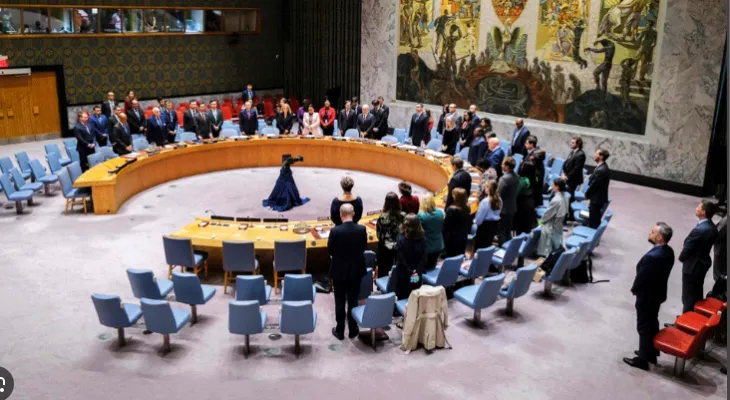
Uncertainty surrounds UN Palestinian membership vote

The Security Council vote on the Palestinians’ bid to become a full member state of the United Nations is expected to occur Thursday or Friday, diplomats said, as discussions continued.

Several diplomatic sources had told AFP earlier that the vote would take place on Thursday, but the situation has since changed with some member states asking for a Friday vote.

No firm decision had been taken as of late Wednesday, according to several diplomatic sources.

“It’s still in the air,” Slovenian Ambassador to the UN Samuel Zbogar told journalists.

“The vote is tomorrow at 3:00 o’clock. I’m sure. If you don’t believe me, you will see it tomorrow,” said Palestinian envoy Riyad Mansour.

Malta’s diplomatic mission, which holds the presidency of the Security Council in April, has yet to confirm a schedule.

Whatever the date, the Palestinian initiative appears doomed to fail due to opposition from the United States.

The Palestinians, who have had observer status at the world body since 2012, have lobbied for years to gain full membership, which would amount to recognition of Palestinian statehood.

Any request to become a UN member state must first pass through the Security Council — where Israel’s ally the United States wields a veto — and then be endorsed by the General Assembly.

In light of Israel’s offensive in Gaza following Hamas’s unprecedented October 7 attack, Palestinians revived a 2011 UN membership application last week, prompting the Security Council to launch a formal review process.

Israel reserves ‘right to protect itself’

Israel’s Prime Minister Benjamin Netanyahu said his country reserved the right to protect itself after Iran’s unprecedented attack, and that it alone would decide how to do so.

Iran launched more than 300 drones and missiles at Israel over the weekend in an attack that caused little damage after most of the projectiles were intercepted.

The Israeli military has vowed to respond, prompting a diplomatic flurry aimed at calming the Middle East.

Israel’s allies in Washington and Brussels have pledged to ramp up sanctions against Iran, while British Foreign Secretary David Cameron and his German counterpart Annalena Baerbock became the first Western envoys to visit Israel since the attack.

Netanyahu told the visiting ministers that Israel “will reserve the right to protect itself,” his office said.

The pair offered “all kinds of suggestions and advice” during a meeting, Netanyahu said. “However, I would also like to clarify: we will make our decisions ourselves.”

For his part, Cameron said “we’re very anxious to avoid escalation and to say to our friends in Israel: It’s a time to think with head as well as heart.”

Baerbock emphasised that “the region must not slide into a situation whose outcome is completely unpredictable.”

Tehran has vowed to hit back if its arch-foe Israel responds to the Saturday attack, which itself was launched after a deadly strike on Iran’s Damascus consulate building earlier this month that was widely blamed on Israel.

Citing three unnamed Israeli sources, ABC News reported on Thursday that “Israel prepared for and then aborted retaliatory strikes against Iran on at least two nights this past week.”

Among the range of possible reactions considered by the Israeli war cabinet were options to attack Iranian proxies elsewhere in the region or to conduct a cyberattack, the sources told ABC.

Meanwhile, the war in Gaza that has sent regional tensions soaring continued unabated with efforts at a truce appearing to flounder, as key mediator Qatar said it was re-evaluating its role in the stalling negotiations.

– Iran sanctions push –

Iran’s President Ebrahim Raisi warned after the attack of “a fierce and severe response” to any retaliation, and on Wednesday his country celebrated its annual Army Day with a parade featuring various attack drones and long-range missiles.

Also on Wednesday, Tehran-backed Hezbollah wounded 14 soldiers, six seriously, in a strike on northern Israel, the Israeli army said.

This was the third day in a row the Lebanese militant group had wounded people in Israel, amid near-daily cross-border fire since the start of the Israel-Hamas war.

Later, Israel hit targets in eastern Lebanon, far from the border, a Hezbollah source told AFP.

Israel’s top ally the United States has made clear it won’t join any attack on Iran, vowing instead to level more sanctions against the country’s missile and drone programme, its Islamic Revolutionary Guard Corps and the Iranian defence ministry.

Nevertheless, on Wednesday US Republicans unveiled a bill that would provide $26 billion of military aid to Israel which appeared to have White House backing.

EU foreign policy chief Josep Borrell said Brussels was also working to expand sanctions against Iran, including its supply of drones and other weapons to Russia and to proxy groups around the Middle East.

French President Emmanuel Macron said the EU and its allies had a “duty… to expand these sanctions”, while Baerbock said Berlin backed further sanctions.

Cameron also urged the G7 to adopt new “coordinated sanctions against Iran,” ahead of a meeting with counterparts from the Western-led grouping in Italy.

– Deadly strikes in Gaza –

The Israel-Iran tensions have threatened to overshadow the Gaza war, even as deadly bombardment and combat raged in the besieged territory.

Talks toward a truce and hostage release deal have stalled, said Qatari Prime Minister Sheikh Mohammed bin Abdulrahman Al-Thani, despite months of effort also involving US and Egyptian officials.

He later said that his country was undertaking “a complete re-evaluation of its role because there has been damage to Qatar”, which does not have diplomatic relations with Israel.

The Israeli military said Wednesday its aircraft had “struck over 40 terror targets throughout the Gaza Strip” over the past day.

When one strike hit the southernmost city of Rafah, where 1.5 million Palestinians are sheltering, Jamalat Ramidan said she “woke up to the sounds of girls shouting ‘mama, mama, mama’.”

As she fled the carnage alongside the children, they stumbled over “body parts and corpses scattered all over the place,” Ramidan told AFP.

The war was triggered by an unprecedented attack on Israel by Hamas on October 7 that resulted in the deaths of 1,170 people, mostly civilians, according to an AFP tally based on Israeli official figures.

The militants also took about 250 hostages, of whom Israel estimates 129 remain in Gaza, including 34 who are presumed dead.

Israel’s devastating retaliatory offensive has killed at least 33,899 people in Gaza, mostly women and children, according to the health ministry in the Hamas-run territory.

– Aid sent by sea –

Israel has faced growing global opposition to the relentless fighting in Gaza, which the United Nations and aid agencies have warned has pushed the north of the territory to the brink of famine.

But Netanyahu rejected any claims about famine on Wednesday, saying Israel is doing “above and beyond” what is needed “on the humanitarian issue,” his office said.

The Israeli army said that eight trucks of food aid from the World Food Programme that arrived via Ashdod port in Israel had entered Gaza through an Israeli land crossing.

It is the first time UN aid has travelled through the sea port since Israel said it would open it earlier this month following international pressure.

Meanwhile, the UN Security Council was preparing to vote Thursday on an Algeria-drafted resolution for full United Nations membership for a Palestinian state, diplomatic sources said.

However, the veto-wielding United States has repeatedly expressed opposition to the move.

Indian polls from Friday to decide future of its democracy

NEW DELHI: India begins its crucial national elections on Friday amid hopes and fears for its troubled democracy.

Prime Minister Narendra Modi, the most right-wing leader to head the country, is hoping to win a third consecutive term, the first time since Jawaharlal Nehru, while his rejuvenated rivals say he could lose.

Mr Modi says he is confident of getting more than 400 seats in the 18th Lok Sabha, a brute majority of in the 545-seat lower house, a feat achieved only once by Rajiv Gandhi.

The Bharatiya Janata Party hopes to increase its tally from 303 to 370, the rest coming from other members of the ruling National Democratic Alliance (NDA). It is widely feared that Mr Modi would seek to use the majority to change the constitution to align with his idea of Hindu Rashtra.

Opposition sees an opening for itself in PM’s northern stronghold; Modi says he is confident of getting more than 400 seats in Lok Sabha

Mr Modi’s hitherto fractious rivals comprising regional parties plus the Congress, recently cobbled the India National Development Inclusive Alliance (INDIA) bloc. They are pitching for the removal of the NDA from power for its “whimsical policies, narcissistic hegemony, communal avowal as well as violence against the minorities and the fear factor against any dissent”.

Ground reports say there is no Modi wave evident in any part of the country, but these are early days. The biggest chunk of seats will be in the fray on Friday, covering 102 races in 21 states. The remaining six phases of the polls, including the last leg on June 1, will make these the longest elections in memory. Security is cited as the reason, and it would involve the deployment of 3.4 lakh paramilitary forces in rotation.

West Bengal, where the Bharatiya Janata Party is hoping to expand from the 18 of 42 seats it won last time, would see polls in all seven phases. A maximum of 92,000 security personnel are likely to be deployed there.

The BJP had just two seats in the state in 2014.

The NDA is banking largely on the so-called Modi magic together with the Ram Mandir and the abrogation of Article 370 in Jammu and Kashmir. Every BJP leader is reinforcing Hindutva, which otherises the Muslims. The BJP’s manifesto is personalised as ‘Modi ki Guarantee’, with the programmes of a decade-long rule listed. The Congress’s promise of ten forms of justice has fresh appeal: “We promise you greater freedom, faster growth, more equitable development and justice for all.”

The rub however is in the numbers. Mr Modi’s 39 per cent votes got him 55 per cent seats in 2019. In so doing, he obviously won by dividing the 61 per cent votes cast for non-BJP parties.

The opposition sees in this a chance, which requires it to unite where it matters. The question is where would Mr Modi find the extra 67 opposition seats while not losing any of his to account for the BJP’s goal of hitting 370 without allies.

The opposition sees an opening for itself in Mr Modi’s northern stronghold. Much has changed since 2019 when he won all seven seats in Delhi, all 10 in Haryana, all 25 in Rajasthan, 25 of 48 in Maharashtra, 27 of 29 in Madhya Pradesh, all 26 in Gujarat, 62 of 80 in Uttar Pradesh, 22 of 40 in Bihar, all five in Uttarakhand and all four in Himachal Pradesh.

That adds up to 213 seats for the BJP from the northern stronghold. Elsewhere, the BJP picked up 25 out of 28 in Karnataka, eight of 21 in Odisha and four from 17 in Telangana. The BJP won two seats from 25 in Andhra Pradesh. It’s saturated in the north and in the absence of a divisive issue clicking, the chances are it could only go down from there.

In Karnataka, Telangana and Himachal Pradesh the Congress has taken power since the last elections. The BJP might improve its tally in Andhra Pradesh where it has cobbled an alliance with the Telugu Desam. Wild guesses have been made, however. Rahul Gandhi says the Modi alliance could be restricted to 180, nearly a hundred short of a majority.

Shiv Sena’s Uadhav Thackeray on whose strength the BJP won handsomely in Maharashtra feels, not without a tinge of bitterness that the BJP would get just 45 seats. And the Trinamool Congress of West Bengal says it would get twice the number of seats than the BJP in the state, which should worry Mr Modi’s supporters.

After the Muzaffarnagar communal polarisation of 2014 and Pulwama-Balakot nationalist fervour fuelled his campaign in 2019, the Modi souffle has so far failed to rise again.

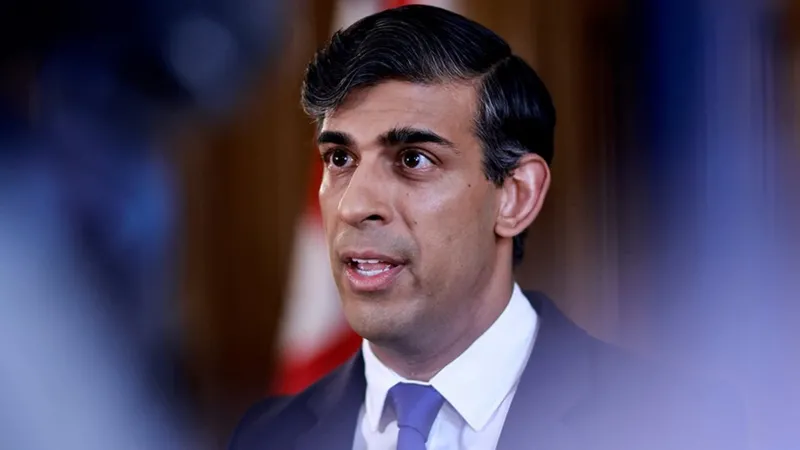
Unless the opinion polls shift and shift quite a bit, Rishi Sunak knows his time left as prime minister might be running out.

But he is the instigator of a smoking plan with substantial, cross-party political support, which looks set to herald a sizeable social change.

And that cross-party support suggests it’s an idea with greater political longevity than he might have, because Labour wouldn’t scrap it if they win the election.

In other words, whatever happens, it is what some in politics call a legacy.

As I wrote here when Mr Sunak first set out his plans last autumn – in what he described at the time as “the biggest public health intervention in a generation” – this is a government seeking to nudge, or elbow, a societal shift along: the near end of smoking.

On Tuesday, Health Secretary Victoria Atkins said she hopes creating a smoke free generation will “spare thousands of young people from addiction and early death as well as saving billions of pounds for our NHS”.

What was once mainstream is already marginal. Now the attempt to near-eradicate it, over time.

This isn’t the end of this discussion: what we have seen so far are the early parliamentary stages. There is more to come before it becomes law.

So that is the big picture, potential social change stuff. What about the politics?

Nearly 60 Conservative MPs voted against Mr Sunak’s idea.

Yes, they had a free vote – they weren’t told how to vote – but they defied him nonetheless. The cabinet minister Kemi Badenoch among them.

Another 100-ish abstained. The cabinet minister Penny Mordaunt among them.

A source close to Ms Mordaunt told me that she abstained because “she was not a supporter of the bill. She has many objections to it. The practicality of it. The implementation and enforcement of it. But being a serving cabinet minister she thought voting against it would look more confrontational and posturing than abstaining would have been.”

Who could that possibly be a dig at? Ah, Kemi Badenoch.

And what do Ms Mordaunt and Ms Badenoch have in common? A splash of ambition.

They are both talked up by some as future Conservative leaders.

When you look at the numbers, nearly half of Conservative MPs couldn’t bring themselves to endorse one of their leader’s flagship ideas of the last six months.

Which tells you something about the fractious nature of the Conservative parliamentary party, although not a lot that wasn’t pretty clear to the regular observer already.

Labour are already gleefully talking up that it is a good job they backed the idea or Mr Sunak would have lost.

And they are also publicly pondering what those opponents might do once the chance arises to change the ideas, to bolt on amendments.

But then again they would be defeated if those in favour keep backing the plan as it is.

When governments manage to latch on to a plan which goes with the grain of where a society is already heading, the might of the law can shove it along profoundly and, probably, permanently.

US assures support to Pakistan in managing ‘daunting debt burden’

WASHINGTON: As Pakistan seeks to clinch a fresh International Monetary Fund (IMF) bailout package, the United States on Wednesday vowed its support to Islamabad in its efforts to manage the country’s “daunting debt burden”.

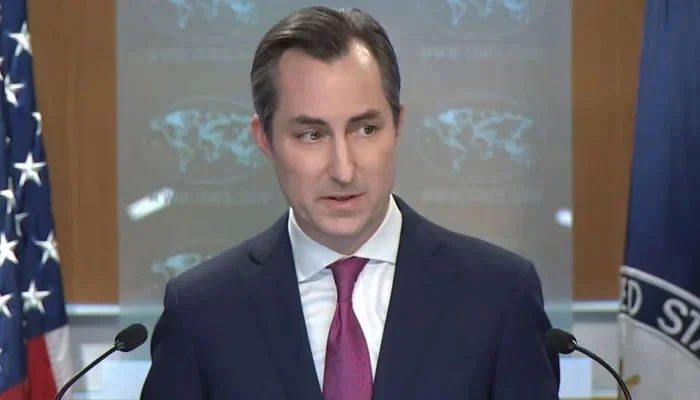
“Pakistan has made progress to stabilise its economy, and we support its efforts to manage its daunting debt burden. We encourage the government to prioritise and expand economic reforms to address its economic challenges,” said State Department spokesperson Matthew Miller, when asked if the US would support Pakistan in challenging times.

Miller also said that US support for Pakistan’s economic success was unwavering and it will continue to engage with the South Asian nation through technical agreements as well as through trade and investment ties, all of which are priorities of bilateral relationship between the two nations.

He also welcomed the staff-level agreement between the global lender and Pakistan on the second and final review under the $3 billion Stand-By Arrangement, which, if cleared by the global lender’s board, will release about $1.1 billion to the struggling South Asian nation.

Finance Minister Muhammad Aurangzeb is currently in the US to hold meetings with the IMF for a new bailout package and attend the World Bank meetings.

Sources told The News that Pakistan decided to make a request for augmenting the Extended Fund Facility (EFF) through climate finance, so there was a possibility for securing $6 to $8 billion SBA.

Ahead of his visit, IMF chief Kristalina Georgieva said Pakistan was successfully completing its existing programme with the IMF and its economy was performing somewhat better.

“There is a commitment to continue on this path, and the country is turning to the fund for potentially having a follow-up programme,” she said.

In meeting with army chief, Saudi FM emphasises ‘strategic nature of bilateral ties’

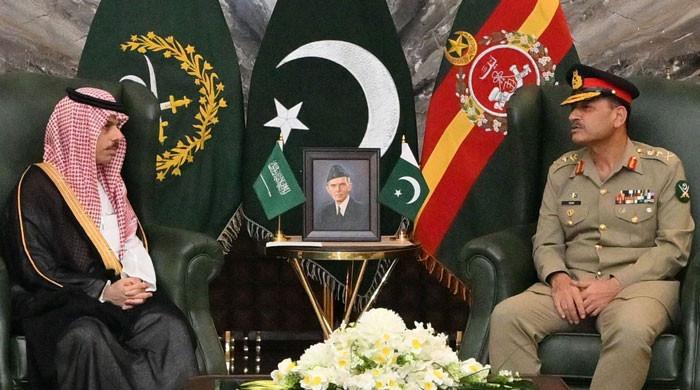
Emphasising on exploring multiple avenues for continued reinforcement of bilateral ties, Saudi Arabia’s Foreign Minister Prince Faisal Bin Farhan Al Saud has underscored the enduring and strategic nature of the relationship between Riyadh and Islamabad.

According to a statement issued by the Inter-Services Public Relations (ISPR), the visiting dignitary made the remarks during a meeting with Chief of Army Staff (COAS) General Syed Asim Munir on Tuesday.

“Discussions centered on mutual interests and policies to further bolster bilateral cooperation across various sectors,” said the military’s media wing.

In response, the COAS conveyed appreciation for the Saudi delegation’s visit and affirmed the traditional bond of fraternity between Pakistan and Saudi Arabia.

The ISPR further said that the army chief underscored the reverence and affection that the people of Pakistan hold for their Saudi brethren.

COAS Gen Munir reiterated full support for the delegation and conveyed his best wishes for mutually beneficial outcomes from the interaction for both states.

The Saudi delegation is currently visiting Pakistan on the direction of the Saudi Crown Prince Mohammed Bin Salman. The two-day visit comes soon after PM Shehbaz visited Saudi Arabia, during which the Kingdom had doubled down on its pledge to speed up the initial phase of their $5 billion investment in Pakistan.

Earlier today, the Saudi FM met with his Pakistani counterpart Ishaq Dar, Prime Minister Shehbaz Sharif, and President Asif Ali Zardari.

During his meeting with the Saudi delegation, PM Shehbaz said that Islamabad and Riyadh needed to work closely to expedite the first phase of Saudi investments under the new arrangement.

The PM expressed his deep appreciation for the leadership of KSA and conveyed his sincerest wishes to the Custodian of the Two Holy Mosques King Salman bin Abdul Aziz Al Saud and the crown prince.

The prime minister also underscored the significance accorded by Pakistan to its longstanding fraternal, economic, and strategic relations with Saudi Arabia. He said both countries had always stood together at all times.

He also informed the delegation about the Special Investment Facilitation Council (SIFC) and its initiatives to promote investment in Pakistan.

The PM also highlighted the key role of COAS General Munir and the cooperation of all institutions for the promotion of investment in the country through SIFC.