

China launches first Hangor-class submarine built for Pakistan

In a major development for Pakistan’s armed forces, the launching ceremony of the first Hangor-class submarine to be built for the Pakistan Navy by China was held on Friday.

The ceremony, held at Wuchang Shipbuilding Industry Group’s (WSIG) Shuangliu Base, was attended by Chief of the Naval Staff (CNS) Admiral Naveed Ashraf.

The development comes as part of the agreement between Islamabad and Beijing wherein the latter had agreed to provide the former with eight state-of-the-art advanced submarines.

Out of the total eight vessels, four are to be built by WSIG, whereas the remaining four are being built at KS&EW under the Transfer of Technology (ToT) agreement.

The submarines, having advanced stealth features, are to be fitted with state-of-the-art weapons and sensors to operate under a multi-threat environment and can engage targets at stand-off ranges.

Speaking at the occasion as the event’s chief guest, CNS Ashraf emphasised the importance of maritime security under the prevailing geo-strategic environment and the navy’s resolve to ensure regional peace and stability.

The navy chief also underscored that the Hangor-class S/M Project will “add a new dimension to the ever-tested Pak-China friendship and shows strong military cooperation between two countries”.

Friday’s launch ceremony comes after Pakistan commenced the manufacturing of the 6th Hangor-class submarine by KS&EW in February earlier this year.

It is pertinent to know that Pakistan enjoys close military ties with China with their bilateral relations provisioning various arms imports by Islamabad from Beijing.

Last year, the PN inducted two newly built Chinese Type 054 A/P frigates.

Both countries had inked the contract for four multi-role frigates back in 2018. The first and second ships PNS TUGHRIL and PNS TAIMUR joined the PN fleet in 2022.
Govt extends stay of registered Afghan refugees until June 30

The government has extended the validity of the Afghan refugees’ Proof of Registration Cards (PoRs) that expired on April 1, 2024, to June 30, 2024, to facilitate those who have yet not left Pakistan voluntarily as it presses ahead with its push to boot out illegal foreigners, a statement said on Friday.

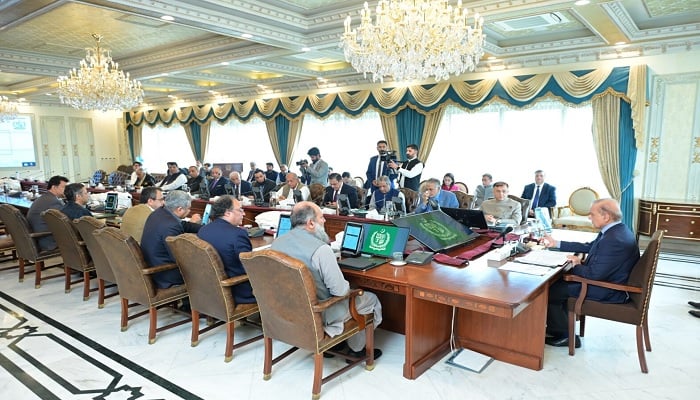
A decision to this effect was taken in the federal cabinet meeting held at the PM House under the chairmanship of Prime Minister Shehbaz Sharif.

The cabinet was told that this extension would enable the PoR cardholders to have access to schools, bank accounts, and other facilities during their stay in Pakistan.

It must be noted that these PoR cardholders will be forcibly sent back to their country in the third phase of the programme of repatriation of illegal foreign nationals living in Pakistan for ages.

Pakistan has expelled over half a million undocumented refugees in the repatriation programme’s first phase from November 1 till date. The second phase was aimed at driving out refugees holding Afghan Citizen Cards (ACC).

The ACCs were provided by the Pakistan government to Afghan refugees in 2017, after processing and registering them with Pakistan’s National Database and Regulation Authority (NADRA).

On the advice of the Ministry of Law and Justice, the federal cabinet approved the establishment of an additional special court in Makran Division to deal with anti-narcotics cases in Balochistan province.

The jurisdiction of this special court will be extended to the districts of Panjgur, Kech, Gwadar, Hub and Lasbela. The cabinet also directed the authorities to appoint the best judge in the special court and ensure effective prosecution.

Moreover, during the meeting, the Federal Secretary for the Interior briefed the cabinet on the progress of the Federal Investigation Agency’s (FIA) operations.

The Secretary of Aviation, filled in the meeting on the recent measures taken to improve the facilities at Pakistan’s airports, particularly Lahore and Karachi. The meeting was informed that the service counters at the airports had been increased and the facilities were being upgraded.

The meeting was told that the advertisements inviting expressions of interest were published in national and international newspapers on April 2, with the last date being May 3, and so far several companies had expressed keen interest in PIA.

The meeting also gave the go-ahead to the appointments of four ex-officio members of the Institute of Cost and Management Accountants (ICMA) and approved the decisions taken by the Cabinet Committee on Legislative Cases on April 18, 2024.

Erdogan expects new NATO chief to address Turkey’s terror concerns

President Recep Tayyip Erdogan said he expected NATO’s next secretary-general to prioritize Turkey’s terror-related concerns, as he met Friday with the leading candidate for the position.

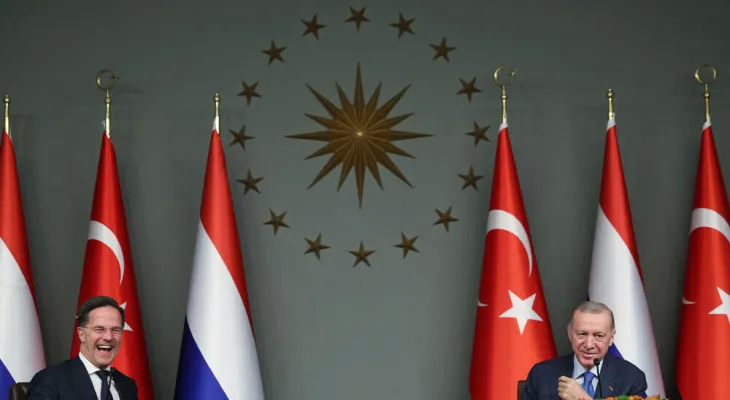
Erdogan said the fight against terror was one of the leading topics during his discussions with outgoing Dutch Prime Minister Mark Rutte, who was in Istanbul to rally Turkey’s support for his candidacy.

“We told him that following the alliance spirit, no terror organization, especially the PKK and its affiliates should be tolerated,” Erdogan told reporters, alongside Rutte.

The PKK, listed as a terror group by Turkey and its Western allies, has waged a decades-long insurgency for greater autonomy for the Kurdish minority in the southeast of the country.

In addition, Erdogan said it is “imperative for the new secretary general to make intense efforts to remove sanctions, restrictions, and obstacles in defense industry area among the allies”.

Romania’s President Klaus Iohannis is also a candidate for the NATO post, and Erdogan said he conveyed Turkey’s requests to him during a phone call last week.

Erdogan did not reveal Turkey’s choice between the two men, but said the decision would be based on “reason”, even as he smilingly wished Rutte success on his “new journey”.

Rutte is the frontrunner to replace Norwegian Jens Stoltenberg at the helm of the alliance after the United States, Britain, and Germany expressed their support for his candidacy.

Hungary, however, said the country would not support Rutte, who has previously voiced concern about receding democratic standards under Prime Minister Viktor Orban.

Rutte is also facing skepticism over the Netherland’s failure to hit NATO’s defense spending targets over the past decade.

Columbia varsity faces complaint after arresting protesters

Palestine Legal, an organisation that seeks to protect the rights of people in the US to speak out on behalf of Palestinians, urged the Education Department to probe the school’s actions, which it alleges were discriminatory against those who are pro-Palestinian.

Columbia University declined to comment.

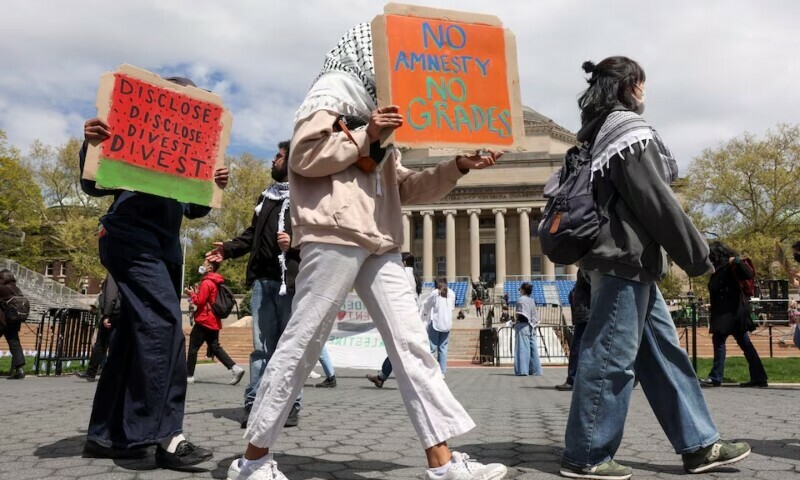
Last week, the university tried to shut down campus demonstrations by force when Columbia President Minouche Shafik took the unusual move of inviting New York City police to enter the campus, drawing the ire of many human rights groups, students and faculty. More than 100 people were arrested, reminiscent of the demonstrations against the Vietnam war at Columbia more than 50 years ago.

Protests have since continued at Columbia and spread to other US campuses where hundreds have been arrested in the last week.

The Gaza crisis has caused intense discourse across the United States, Israel’s most important ally.

Advocacy groups note a rise in hate and bias against Jews, Arabs and Palestinians.

Alarming US incidents include the fatal October stabbing of a six-year-old Palestinian American in Illinois, the November shooting of three students of Palestinian descent in Vermont and the February stabbing of a Palestinian American man in Texas.

Education Secretary Miguel Cardona said on Thursday he was following reports of allegations of antisemitism on college campuses. Earlier this month, a former Cornell University student pleaded guilty to posting online threats, including of death and violence, against Jewish students on campus.

Gaza protests against Israel reach Europe

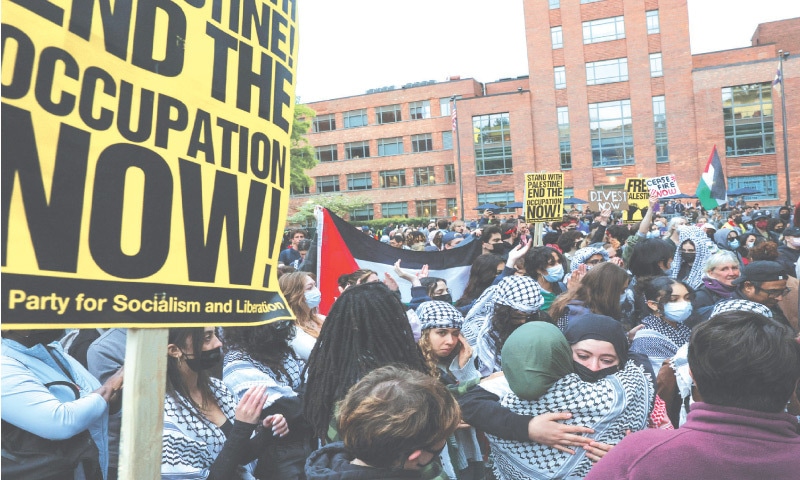
Protesters in Paris blocked an entrance to elite university Sciences Po on Friday, refusing to back down after a tent “occupation” was broken up by police a day earlier.

Activists at University College London were planning a rally in the name of a “global student movement for Palestine”, taking inspiration from protests at New York’s Columbia University.

Tensions flared in front of Paris’ prestigious Scie­nces Po University over the Israeli war on Gaza on Friday as pro-Israeli protesters came to challenge pro-Palestinian students occupying the building. Police moved in to keep the two groups apart.

Demonstrations on campus start taking lead from widening US protests

Pro-Palestinian students wore the black-and-white keffiyeh head scarf that has become an emblem of solidarity with Gaza.

They demanded the ins­titution condemn Israel’s actions in Gaza, in a protest that echoed similar demonstrations on US campuses.

“When we see what is happening in the United States, and now in Australia, we’re really hoping it will catch on here in France, the academic world has a role to play,” said 22-year-old Hicham, a master’s student in human rights and humanitarian studies at Sciences Po.

“We hope that will spread to all universities and beyond … we won’t give in until the genocide in Gaza ends,” said 20-year old Zoe, a master’s student in public administration at Sciences Po.

Later in the day, pro-Israel protesters, some wrapped in Israeli or French flags, walked to the building in protest.

Renewed clashes between police and students opposed to Israel’s war in Gaza broke out on US campuses on Thursday, raising questions about forceful methods being used to shut down protests that have intensified since mass arrests at Columbia University last week.

Israel has killed at least 34,305 Palestinians, most of them women and children, in its assault on Gaza.

Pro-Palestine camp at Germany’s parliament

In Germany’s capital Berlin, police on Friday began clearing a pro-Palestinian camp set up in front of the German parliament by activists demanding the government to stop arms exports to Israel and end the criminalisation of the Palestinian solidarity movement gaining momentum in US and other Western countries.

Police dismantled tents, forcibly removed protesters and blocked the surrounding area to stop others arriving at the camp.

The Berlin camp ‘Bese­tzung Gegen Besatzung’ — ‘Occupy Against Occu­pation’ — began on April 8, coinciding with the start of International Court of Justice hearings in Nicaragua’s case aga­inst Germany for providing military aid to Israel.

“The idea was to draw attention to that and … to the German comp­licity and active enabling of the Israeli genocide in Gaza,” the camp organiser, Jara Nassar, said.

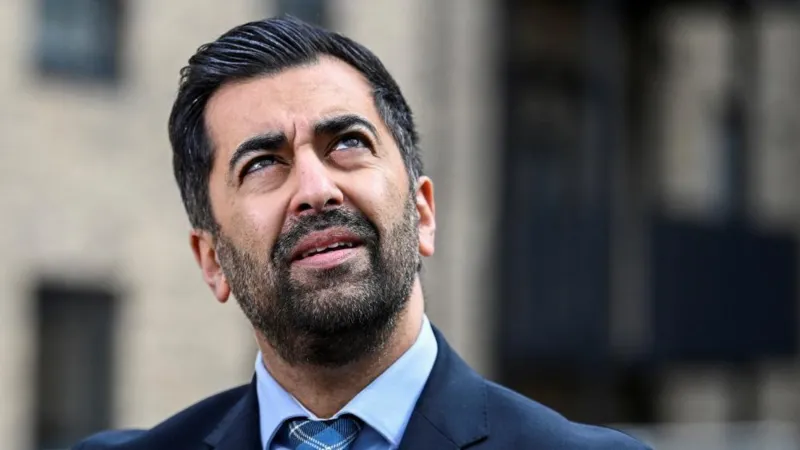
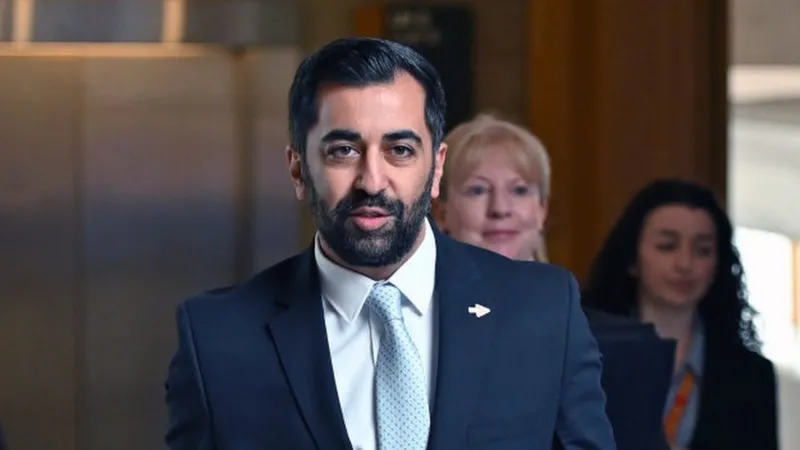
Scotland’s First Minister, Humza Yousaf, is spending the weekend fighting for his political life.

The SNP leader is expected to make a series of policy announcements in the coming days as he tries to shore up support.

BBC News has been told he will set out plans to create jobs, tackle climate change and improve public services.

Mr Yousaf could face two no-confidence votes next week – one in himself, the other in his government.

The crisis was brought on by his decision to end a governing deal with the Scottish Greens known as the Bute House agreement.

Mr Yousaf said he was determined to focus on “the priorities of the people.”

Yousaf will not resign as Scotland’s first minister

Humza Yousaf: Who is Scotland’s under-threat first minister?

The first minister has previously faced criticism from within his own party about the impact on the SNP and the country of the Greens’ approach to economic and social policy.

Mr Yousaf knows that, and his attempt to regain control of a narrative in danger of spiralling away from him began on Friday in Dundee.

He was due to have been in Glasgow, making a speech about “the labour market in an independent Scotland.”

Instead Mr Yousaf was striding around a building site, trying to look purposeful in a hard hat and high-visibility vest.

Humza Yousaf visited a building site in Dundee on Friday morning

He announced an extra £80m for affordable housing over the next two years, just five months after his Finance Secretary Shona Robison had set out plans for a £205m cut.

“You ask the people about housing and it’s one of the top issues that comes up on the doorstep,” the first minister told me.

Right now though, it is not people on the doorstep he needs to convince. It is opposition politicians in the Scottish Parliament.

There are 63 Scottish National Party MSPs at Holyrood. There are 65 opposition MSPs.

If every opposition member voted against Mr Yousaf in a personal vote of confidence he would lose and, while not legally bound to resign, the political pressure to do so would be immense.

If Mr Yousaf could persuade any or all of the seven-strong Green cohort to change their minds about opposing him, he might survive.

The Scottish Greens have been hugely critical of Humza Yousaf for ending their power-sharing deal

Another option is for him to win the support of Ash Regan, his former SNP leadership rival, who jumped ship to Alex Salmond’s Alba Party in October.

Ms Regan has been setting out the price for her support – and it has been rising.

At first she called for competent government, a renewed focus on independence, and action to protect “the dignity, safety and rights of women and children,” a reference to the gender debate which lies at the heart of many of Mr Yousaf’s troubles.

Then, Ms Regan added to the list, action to preserve the future of the Grangemouth refinery on the Firth of Forth.

Mr Yousaf is writing to the Holyrood leaders of all the parties, offering meetings to discuss how “to make minority government work.”

Asked about Alba’s apparent desire to see Scotland implement the recommendations of the Cass review of English gender healthcare, Mr Yousaf called the document “thoughtful” and “considered,” but continued to insist that responding to its clinical recommendations was a matter for clinicians.

Speaking to BBC News, Ms Regan appeared to hint that that would not be enough.

She also revealed that she not had a single conversation with Mr Yousaf since he defeated her in the leadership contest last spring.

Ms Regan said: “Some of the things he said about me when I left to go to a different political party last year probably shows that it’s always wise to have that sort of level of professional courtesy to people that you work with.”

Ash Regan says she not spoken to Humza Yousaf in a over year

Mr Yousaf had described his erstwhile rival’s departure from the SNP as “not a particularly great loss.”

So what of the Greens?

Speaking to BBC Radio Scotland, the Central Scotland Green MSP Gillian Mackay defended the power-sharing deal which was originally struck under Nicola Sturgeon in 2021.

“What the first minister is essentially saying to us is ‘you’re dumped, but can we still be friends?'” she said.

“I’m actually quite upset,” said Ms Mackay, apparently in tears, adding: “We don’t want to be in this position, but it’s the first minister that’s put us here.”

From Mr Yousaf, there was a glimpse of something close to regret about all that emotion, when he told me he empathised with the Green co-leaders Patrick Harvie and Lorna Slater whom he had ejected from his government, costing them their ministerial jobs.

He had not “meant to upset them,” he told me, adding that he understood why they were so angry.

Would his letter to them contain an apology?

Mr Yousaf wouldn’t say.

Either way, back channels between the SNP and opposition parties are already open.

The wheeling and dealing is under way.

It won’t be made any easier by continued attacks on the Greens from some elements of the SNP including the backbencher Fergus Ewing, who was disciplined by his party last year after repeatedly criticising their policies.

After the Bute House agreement collapsed, he described it as “a Faustian pact which would have delivered us to the gates of electoral hell.”

Mr Ewing’s denunciation of the Greens highlights a challenge for Mr Yousaf.

How does he win over the likes of Mr Ewing, Ms Regan, and the former SNP finance secretary Kate Forbes whom he only narrowly defeated to become leader, while also reaching out to the left wing of his party, and to the Greens?

To put it more bluntly: after a week of turmoil, how can he survive for long even if he narrowly wins a confidence vote?

The answer, according to another senior source close to Mr Yousaf, is brutal — “he can’t.”

Rahul Gandhi in the fray as India begins voting in 2nd phase of giant election

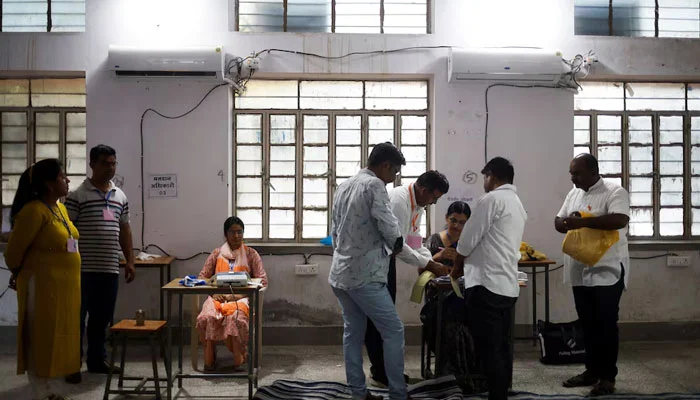
Almost one billion people are eligible to vote in the seven-phase general elections that began on April 19 and concludes on June 1, with votes set to be counted on June 4.

Prime Minister Narendra Modi is seeking a record-equalling third straight term on the back of his economic record, welfare measures, national pride, Hindu nationalism and personal popularity. Surveys suggest he will easily win a comfortable majority.

His challengers have formed an alliance of more than two dozen parties and are promising greater affirmative action, more handouts and an end to what they call Modi’s autocratic rule.

Friday’s polling will be held for 88 of the total 543 seats in the lower house of parliament with 160 million people eligible to vote. It will be spread across 13 states and federal territories in the world’s most populous country.

More than half of those 88 seats are in the southern states of Kerala and Karnataka and the northwestern state of Rajasthan.

The campaign has changed tack since the first phase and become heated as Modi and the main opposition Congress party have faced off on communal issues with Modi accusing Congress of favouring minority Muslims, aiming to dilute affirmative action and planning to impose inheritance tax.

“Congress, which used to make noise in the name of the Constitution, has now been badly exposed for its hidden agenda,” Modi posted on X late on Thursday.

Congress has denied the charges and said Modi is distracting voters from real issues such as unemployment, price rise and rural distress and fears losing.

Rahul Gandhi in the fray

“We spoke to you, we heard what was on your mind and drafted a revolutionary manifesto,” Congress leader Rahul Gandhi said in a video message on the eve of the vote. “This has been drafted by the Congress party but it is your voice.”

Gandhi, former Congress president and the face of the party, is among the 1,200 candidates in the fray on Friday.

He is seeking re-election from Wayanad in Kerala and faces Annie Raja of the Communist Party of India (CPI) and BJP’s K Surendran, among others, in the Left Front-ruled state.

In 2019, Gandhi defeated the CPI candidate by more than 400,000 votes, the highest margin in Kerala, although he lost his second seat to BJP in the family bastion of Amethi in north India. India allows a candidate to contest from more than one seat but they can retain only one if they win from more.

Congress slumped to a historic low when it was swept out of power by BJP in 2014 and won its second-lowest number of 52 seats in 2019, with Kerala contributing the highest of 15.

The party is also expected to do better in Karnataka where it won just one of 28 seats in 2019 but gained strength and defeated BJP in state elections last year.

It is still seen to be struggling nationally as bickering within the opposition alliance it leads and graft cases against some leaders have hobbled its challenge to Modi.

The Election Commission and political parties have been worried about voter turnout due to the summer heat and wedding season in some parts of the country with turnout falling to around 65% in the first phase from nearly 70% in 2019.

The poll panel has increased appeals for voter participation since, asking them to “vote with responsibility and pride”.

Parties to get standing committees’ chairmanship as per parliamentary strength

ISLAMABAD: The opposition and treasury benches Thursday reached an understanding that the parliamentary parties would get chairmanships of standing committees according to their numerical strength in the National Assembly.

This was decided during a meeting of chief whips of all the parties presided by National Assembly Speaker Sardar Ayaz Sadiq. Nevertheless, the NA speaker will make a final decision regarding this understanding next week as the opposition has sought time for consultations on choosing committees for chairmanship.

Shazia Marri, Malik Amir Dogar, Mujahid Khan, Naveed Qamar, Aijaz Jakhrani, Khalid Hussain Magsi, Gul Asfar Khan, Noor Alam Khan, Zain Hussain Qureshi, Aminul Haq, Dr Tariq Fazal Chaudhry, Hafeezuddin, and Moin Aamir were among those present during the meeting.

Sources claimed that a decision was made to assign the head of the Public Accounts Committee (PAC) to the opposition and the treasury benches would be given the parliamentary committee on Kashmir. To lead the PAC, the opposition leader would select a member from among its members.

Additionally, the Pakistan Muslim League-Nawaz (PML-N) would chair 13 standing committees, the Pakistan Peoples Party (PPP) and the independents backed by the Pakistan Tehreek e Insaf (PTI) would chair eight of the standing committees each, Muttahida Qaumi Movement-Pakistan (MQM-P) would chair two, and Istehkam-e-Pakistan (IPP) and Pakistan Muslim League-Quaid (PML-Q) would chair one apiece. The chairmanships of the standing committees would not go to the smaller parliamentary parties.

The sources said the MQM-P decided to reapproach the PML-N to seek chairmanship of three bodies instead of two.

The forum also decided the NA rules for proceedings and settled upon allocation of days for the motion of thanks on presidential speech, budget session and calendar for the parliamentary year. It was resolved at the meeting that the business advisory body would be named by the opposition and the government. The NA is scheduled to meet on April 29, Monday.

The meeting decided that the motion of thanks would be discussed in the session, which would begin on May 13, 2024. Five days would be given for discussion, and each sitting would last for five hours. Members would get 10 minutes each to speak, but the parliamentary leaders would be given more time.

A member of the opposition and a member of the government would speak on a motion of thanks on the first two days. From the third day, two members of the government and one of the opposition benches would be given permission to speak.

Sources said the government and the opposition also reached an understanding for the budget session, which would likely be held from June 6 to 28. The assembly session would be held on Saturday as well, and there would be a six-day break for Eidul Adha. There would be no question hour during the budget session, and winding up of general discussion on budget would be held on June 21, and discussion on the charged expenditure would be held on June 22, cut motions would be taken up from June 24 to 25, consideration and passage of finance bill would be on June 26, and supplementary grants would be taken up on June 27.

CM Maryam ‘entitled’ to wear uniform, Punjab Police issue clarification

LAHORE: After controversy against Punjab Chief Minister Maryam Nawaz wearing the Punjab Police uniform intensified, the provincial police department Friday issued a statement clarifying that she is indeed “entitled to wear the police uniform” as per the Punjab Police Dress Regulations.

CM Maryam, a day earlier, inspected a passing-out parade of lady constables and traffic assistants at the Police Training College, Chung, while wearing a police uniform.

This move by the chief minister not only garnered appreciation but also led to criticism from people.

The CM, first female to lead a provincial government, donned the uniform that fit her like a glove. Carrying the police baton, the chief minister inspected the parade atop a jeep amid inspiring tunes of the police band.

Taking to X, formerly Twitter, the police wrote: “This has been widely celebrated by the police personnel, who view it as a commendable show of solidarity. The Central Police Office has received hundreds of messages in which police personnel have lauded this step.”

The law enforcement department further stated that the female police officers are, in fact, celebrating the event, adding that they have also shared various pictures of CM Maryam sporting the uniform.

Punjab Police also shared a notification issued on January 30, 2024, allowing the provincial governor and chief minister to wear the uniform on formal occasions such as parades, while addressing police darbars, visiting police establishments, or any such occasion as specified, for encouraging police personnel and troops.

The department then went on to reveal about its commitment to further improve the law and order situation and to continue the counter-terrorism efforts across the country, as directed by the chief minister in a subsequent meeting held at the Police Training College Chung, Lahore.

Meanwhile, a citizen named Waqar Ali has filed a plea against CM Maryam for wearing the uniform in a Lahore court, insisting that a person cannot wear the uniform of an institution.

The petitioner, therefore, requested the court to register a case against the Punjab chief minister.

The court asked the petitioner to submit the report of the police station’s front desk and adjourned the hearing till April 29.

It should be noted that among her many critics, opposition leader in the National Assembly, Omar Ayub Khan, also criticised CM Maryam for wearing the police uniform to inspect the passing-out parade.

Terming Maryam donning a police uniform a non-serious act, he said the country was being made a laughing stock through such childish acts.

Can Humza Yousaf survive as Scotland’s first minister?

His handling of a deal with the Scottish Green Party, which he inherited from his predecessor Nicola Sturgeon, is the source of much of his trouble.

The pact, known as the Bute House Agreement, was born in the first minister’s official residence in Edinburgh in 2021 amidst promises of a new politics of co-operation and collaboration.

On a bright, cold Thursday in April, it ended where it began when Mr Yousaf summoned his two Green ministers to an early morning meeting in Bute House.

Voices were not actually raised but, I was told by someone in the room, the discussion was “pretty robust.”

Minutes later, Lorna Slater and Patrick Harvie emerged, scowling in the sunshine.


They headed to the Scottish Parliament and promptly laid into Mr Yousaf in harsh and personal terms, accusing him of betrayal, cowardice, and weakness.

Meanwhile, back inside the grand Edinburgh townhouse, the SNP leader was facing the media – and the music – in front of a gilt-edged mirror.

Mr Yousaf smiled as he batted away questions about the Greens’ onslaught.

“This is leadership,” he told us, adding: “This is the ability to say we are taking control as a party and indeed as a government.”

The SNP leader appeared buoyant. So did his team. There was a feeling that, in ditching their partners, Team Yousaf had lightened the load.

Not so fast.

By teatime, faces among some senior Scottish government figures were glum as it became clear that the Greens were going to respond not just with words but with deeds.

Mr Harvie and Ms Slater confirmed that they would vote against Mr Yousaf in a confidence motion at Holyrood, accusing him of caving in to right-wing elements in the SNP.

The Scottish Greens were particularly annoyed about the heat they took when the Scottish government decided to abandon a target to reduce by 75% emissions of planet-warming gases by 2030.

But they were also angry about the shifting sands of social policy.

Together those issues had prompted the leadership to seek a vote of members on the Bute House Agreement in around four weeks’ time.

Responding to Mr Yousaf’s decision to ditch them before they had a chance to ditch him, both Ms Slater and Mr Harvie repeatedly referred to the “progressive agenda” which they claimed the first minister had abandoned.

“If you look at some of the policies that the SNP’s right-wing like to criticise us for, they were in the SNP’s own manifesto,” said Mr Harvie.

Among those policies, he added, was “transgender people’s rights.”

And that most contentious of issues may yet determine Mr Yousaf’s political fate.

For the person who is likely to hold the casting vote when MSPs vote on his future is none other than his former SNP leadership rival, Ash Regan, who resigned as a minister in Ms Sturgeon’s government in protest at attempts to make it easier to legally change gender.

Ms Regan, who is now a member of Alex Salmond’s Alba Party, was sipping lemonade at the parliamentary bar as the drama unfolded, smiling from ear to ear.

She had not yet, she insisted when I asked her, made up her mind about how to vote.

When she defected to Alba last October, Mr Yousaf said she was “not a particularly great loss,” a quote he may yet come to regret.

But what price will Ms Regan want to extract for her support?

A clue might be found in an interaction on social media on Thursday night with the writer JK Rowling.

Both women have campaigned against the SNP’s gender policies.

On X, Ms Regan thanked the author for her “incredible strength and support.”

“Thanks for standing firm for girls and women in Scotland, Ash,” the Harry Potter author replied.

Speaking to BBC Radio 4, Ms Regan confirmed that she had written to the first minister to ask about “how he will defend the rights of women and children,” as well as seeking detail about how Mr Yousaf planned to advance the cause of independence and make “a return to competent government.”

One Alba Party source told me that they wanted to see the full implementation in Scotland of the recommendations of the Cass Review of English gender healthcare.

“My vote will depend on really what Humza comes up with in response to my letter,” she added.

Ms Regan, said the Alba Party leader Alex Salmond, was now the most powerful politician in the Scottish Parliament.