

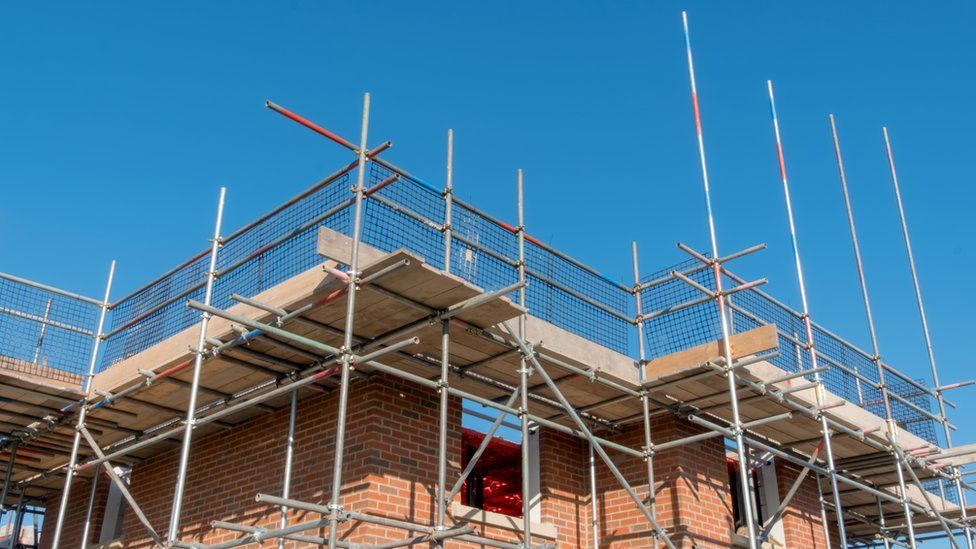
People will be given the right to vote on proposed extensions to properties in their area, as part of planning reforms aimed at giving communities more say.

But the new Levelling Up and Regeneration Bill, published on Wednesday, scraps controversial proposals to make it harder to block development, after a Tory backlash.

Conservative MPs feared the plans cost them votes in crucial by-elections.

A source said Levelling Up Secretary Michael Gove had listened to concerns.

It is understood a proposal for a zonal system will be dropped – which would would have seen certain areas earmarked for housing growth and some development applications automatically approved.

Ministers are also expected to confirm that legally-binding housing targets are being scrapped.

Instead, Mr Gove will promise communities control over what is happening in their area, with measures such as “street votes” allowing them to decide whether new extensions and other developments can go ahead,


Housing is a key challenge for the government, which pledged to build 300,000 houses a year by the mid-2020s. Sources say that target remains.

Making it easier to approve developments was a key part of its initial strategy after Boris Johnson won the general election in 2019.

The original plan would have seen local councils in England having to classify all land in their area as either “protected”, for “renewal”, or for “growth”.

Councils would then have had to look favourably on developments in “renewal” areas, whilst in “growth” zones, applications conforming to pre-agreed local plans would automatically gain initial approval.

Ministers also wanted to introduce binding local quotas.

But the plans sparked a significant Tory backlash – with some in the party saying the policy had contributed to by-election losses in former Conservative heartlands.

Those fears would only have been exacerbated by last week’s local elections results.

Design codes and levy

The government believes its new plans will give communities more of an opportunity to shape what happens in their area – and stronger grounds to resist unwanted developments.

Under Mr Gove’s plans, communities will be able to hold votes on whether planning permission should be granted for extensions to existing homes on their street.

But Labour MP Clive Betts, chair of the levelling up, housing and communities select committee, called the move a “gimmick”. He told the BBC it was “never going to be possible” for communities to “decide absolutely everything” about urban planning in their area.

Mr Betts said the process of building new housing should be simplified, with locals involved in decisions about where homes might be placed much earlier than at the planning permission stage.

Ministers are planning design codes, which would see local communities set rules about the layout of new developments and materials which could be used.

And they hope a new infrastructure levy – to be determined locally – will increase funds for projects such as schools, hospitals and roads by basing the sum on the value of the property when it is sold, rather than when it gets planning permission.

The planning system will also be digitised, making plans more accessible online.

Ministers want to modernise the system, which often sees notices on lamp posts to alert people to local proposals.

PM Shehbaz orders immediate restoration of NCOC after first case of Omicron sub-variant detected

The NCOC was formed in March 2020 by the PTI government to oversee its response to the coronavirus pandemic. The forum provided the overall direction to provincial authorities on how to contain outbreaks and its data-driven approach kept the nation updated on daily cases, deaths, recoveries, and number of vaccinations. It was dissolved by the PTI last month after Covid cases in the country subsided.

Read moreInside the NCOC — An eyewitness account

According to a statement issued by the Prime Minister’s House, the premier took notice of the new variant of Omicron and its growing cases. “He has also sought a report from the National Institute of Health (NIH) over the current Covid-19 situation,” it said.

The development comes a day after the NIH — which has been looking after Covid-related matters since the NCOC was formally shut down last month — revealed that the first case of the Omicron sub-variant, BA.2.12 had been detected in the country.

A health ministry official told Dawn that the patient tested positive at the airport and later, during genome sequencing, it was confirmed that he was infected with the new variant.

“We have decided not to mention the name of the country from where the patient had travelled to Pakistan. However, the new variant has been continuously spreading in different countries. The patient is feeling well and all his contacts have been quarantined at their home,” he said.

“Although the variant is more transmissible, the good thing is that all the vaccines are effective against it. So we request the masses to get themselves vaccinated at the earliest and those who have been vaccinated, should get their booster shots,” he cautioned.

The new Omicron sub-variant is a descendant of the earlier super-contagious “stealth Omicron” and has quickly gained ground in the US.

BA.2.12.1 was responsible for 29 per cent of new US Covid-19 infections in April’s third week, according to data reported by the US Centres for Disease Control and Prevention. And it caused 58pc of reported infections in the New York region.

The variant has been detected in at least 13 other countries, but the US has the highest levels of it so far. Scientists say it spreads even faster than stealth Omicron.

The development comes as Pakistan is witnessing a decrease in the number of Covid-19 cases, which have dropped significantly during the past few weeks. According to the NIH data, 64 new cases of the virus were reported across the country in the last 24 hours and their positivity rate was 0.49 per cent. As many as 92 patients were receiving critical care.

Pakistan’s Covid response lauded

It is pertinent to mention here that the NCOC and Pakistan’s Covid-19 pandemic response has been lauded since the day the virus was first reported in the country.

Earlier in March, a report prepared by the United Nations Development Programme placed Pakistan among the countries that have done fairly well in the fight against the Covid-19 pandemic. It noted that on March 23, 2022, the cost of vaccinating 40 per cent of the population in Pakistan was 13.95pc of the country’s current health expenditure.

On March 23, the cost of vaccinating 40pc of the population in India was 8.65pc of the country’s current health expenditure and the Covid-19 risk index was 4.6, which was classified as medium.

In Pakistan, cured and/or expected vaccine supply in total doses as percentage of the population was 112.25pc. Vaccine doses received as a percentage of the population was 107.15pc.

In 2020, the World Health Organisation had also said that Pakistan was among countries from whom the international community should learn how to deal with the Covid-19 pandemic.

WHO Director General Tedros Adhanom Ghebreyesus had said Pakistan deployed the infrastructure built up over many years for polio to combat Covid-19. “Community health workers who have been trained to go door-to-door vaccinating children for polio have been utilised for surveillance, contact tracing and care.”

“There are many other examples, including Cambodia, Japan, New Zealand, the Republic of Korea, Rwanda, Senegal, Spain and Vietnam. Many of these countries have done well because they learned lessons from previous outbreaks of SARS, MERS, measles, polio, Ebola, flu and other diseases. That’s why it’s vital that we all learn lessons this pandemic is teaching us,” he had added.

Putin invokes WWII victory to spur army in Ukraine

Addressing massed ranks of service personnel on Red Square on the 77th anniversary of victory over Germany, Putin condemned what he called external threats to weaken and divide Russia, and repeated familiar arguments that he had used to justify Russia’s invasion — that Nato was creating threats right next to its borders.

He directly addressed soldiers fighting in the Donbas region of eastern Ukraine, which Russia has pledged to “liberate” from Kyiv’s control.

“You are fighting for the motherland, for its future, so that no one forgets the lessons of World War II. So that there is no place in the world for executioners, castigators and Nazis,” he said.

His speech included a minute of silence. “The death of each one of our soldiers and officers is our shared grief and an irreparable loss for their friends and relatives,” said Putin, promising that the state would look after their children and families.

He was addressing Russia on one of its most important annual holidays, when the nation honours the 27 million Soviet citizens who lost their lives in the struggle to defeat Adolf Hitler — a source of national pride and identity.

But Putin had no victory to announce in Ukraine and his 11-minute address was largely notable for what he did not say.

He did not mention Ukraine by name, and offered no indication of how long the conflict might continue. There was no reference to the battle for Mariupol, where Ukrainian defenders holed up in the ruins of the Azovstal steel works were still defying Russia’s assault.

However, in a televised meeting in his Kremlin office after the parade, Putin offered condolences to Artyom Zhoga, the father of a Russian battalion commander killed in the Donbas region, telling him: “All plans are being fulfilled. A result will be achieved — on that account there is no doubt.”

Putin has repeatedly likened the war — which he casts as a battle against dangerous “Nazi-inspired nationalists” in Ukraine — to the challenge the Soviet Union faced when Hitler invaded in 1941.

Ukrainian President Volodymyr Zelenskiy has said it is Russia that is staging a “bloody re-enactment of Nazism” in an unprovoked war of aggression.

Preceded by a stirring fanfare, Putin delivered his address after a group of eight high-stepping guards marched across the cobbles of Red Square carrying the Russian tricolour and the red Soviet hammer-and-sickle victory banner, accompanied by stirring martial music.

The fighting forces responded with booming cheers as Defence Minister Sergei Shoigu crossed the square in a black limousine, saluting units including missile, national guard and paratroop units and congratulating them on the anniversary.

Putin’s speech was followed by a parade across the vast square featuring Russia’s latest Armata and T-90M Proryv tanks, multiple-launch rocket systems and intercontinental ballistic missiles.

A planned fly-past was cancelled because of cloudy conditions.

UAE to introduce insurance for unemployed residents

Insured workers would receive some money for a limited time period if made unemployed, UAE Prime Minister and Vice President Sheikh Mohammed bin Rashid al-Maktoum, who is also the ruler of trade hub Dubai, said on Twitter, citing a cabinet decision.

“The intention is to strengthen labour market competitiveness, provide a social umbrella for workers and establish a stable working environment for all,” the statement said. The statement did not specify whether this would apply equally to citizens and non-citizen residents in the UAE.

Permission to reside in Gulf countries like the UAE, where foreigners make up 85 per cent of the population according to the IMF, has traditionally been tied to employment, and loss of job usually means the worker has to leave the country.

Gulf states Qatar, Oman, Kuwait and Saudi Arabia have provided some form of unemployment support to citizens, and Bahrain also has a form of jobless insurance for resident non-citizen workers.

As Saudi Arabia, the largest Gulf state, opens up its economy the UAE has been pushing to retain the initiative over its neighbour, introducing new visa types and social reforms to attract and retain skilled labour and their families.

The UAE switched to a Saturday-Sunday weekend this year to move closer to global markets, and in the past 18 months has overhauled laws and regulations, including de-criminalising alcohol consumption and pre-marital cohabitation.

The cabinet also announced new quota targets for the employment of Emirati citizens in the private sector — a long-standing policy known as “Emiratisation”.

It wants to see Emirati nationals representing 10pc of private sector staff in companies with more than 50 employees by 2026, with rates increasing 2pc a year until then.

US says it will increase pressure on Taliban if they don’t reverse decisions on women, girls

“We’ve addressed it directly with the Taliban,” State Department spokesperson Ned Price said in a briefing on Monday. “We have a number of tools that, if we feel these won’t be reversed, these won’t be undone, that we are prepared to move forward with.”

He did not elaborate on the possible steps or indicate how the group, which has already implemented policies curbing 20 years of gains for girls’ and women’s rights, might have a change of heart.

The Taliban on Saturday ordered women to cover their faces in public, a return to a signature policy of their past hardline rule and an escalation of restrictions that are causing anger at home and abroad.

The ideal face covering was the all-encompassing blue burqa, the group said, referring to the garment that was obligatory for women in public during the Taliban’s previous 1996-2001 rule.

The international community has made the education of girls a key demand for any future recognition of the Taliban administration, which took over the country in August as foreign forces withdrew.

Despite that, the Taliban has restricted girls and women from working and limited their travel unless accompanied by a close male relative. Most girls were also barred from going to school beyond seventh grade.

Read: ‘I may as well be dead’: Afghan women outraged by new Taliban restrictions on work

“We’ve consulted closely with our allies and partners,” Price said. “There are steps that we will continue to take to increase pressure on the Taliban to reverse some of these decisions, to make good on the promises that they have made.”

A key piece of leverage held by Washington over the group is the $7 billion in frozen Afghan central bank assets on US soil — half of which the Biden administration is seeking to free up to help the Afghan people, the administration has said.

The United States and other countries have already cut development aid and sanctioned the banking system since the group took over, pushing Afghanistan toward economic ruin.

US Special Representative for Afghanistan Tom West expressed “deep concern” over the Saturday decision in a series of tweets, while the US Ambassador to the United Nations Linda Thomas-Greenfield said it was an “unconscionable” move.

Most women in Afghanistan wear a headscarf for religious reasons but many in urban areas such as Kabul do not cover their faces.

Curfew in Sri Lanka after day of deadly unrest

Nearly 200 were also wounded Monday as prime minister Mahinda Rajapaksa resigned, but that did little to calm public anger.

He had to be rescued in a pre-dawn operation by the military Tuesday after thousands of anti-government protesters stormed his official residence in Colombo overnight, with police firing tear gas and warning shots to keep back the crowd.

“After a pre-dawn operation, the former PM and his family were evacuated to safety by the army,” a top security official told AFP. “At least 10 petrol bombs were thrown into the compound.”

The Rajapaksa clan’s hold on power has been shaken by months of blackouts and shortages in Sri Lanka, the worst economic crisis since it became independent in 1948.

President Gotabaya Rajapaksa remains in office, however, with widespread powers and command over the security forces.

After weeks of overwhelmingly peaceful anti-government demonstrations, violence broke out Monday when Mahinda Rajapaksa’s supporters — bussed into the capital from the countryside — attacked protestors with sticks and clubs.

“We were hit, the media were hit, women and children were hit,” one witness told AFP, asking not to be named.

Police fired tear gas and water cannons to disperse crowds and declared an immediate curfew in Colombo, a measure later widened to include the entire South Asian nation of 22 million people.

Authorities said the curfew will be lifted Wednesday morning, with government and private offices, as well as shops and schools, ordered to remain shut on Tuesday.

US Ambassador Julie Chung tweeted that Washington condemned “the violence against peaceful protestors” and called on the Sri Lankan “government to conduct a full investigation, including the arrest & prosecution of anyone who incited violence”.

Shot dead

Despite the curfew, anti-government protesters defied police to retaliate against government supporters for the attacks late into Monday night.

Outside Colombo, ruling party lawmaker Amarakeerthi Athukorala shot two people — killing a 27-year-old man — after being surrounded by a mob of anti-government protestors, police said.

“He then took his own life with his revolver,” a police official told AFP by telephone.

Athukorala’s bodyguard was also found dead at the scene, police said.

Another ruling party politician who was not named opened fire on protesters, killing two and wounding five in the deep south of the island, police added.

Angry crowds set alight the homes of more than a dozen pro-Rajapaksa politicians, along with some vehicles, while buses and trucks used by the government loyalists in and around Colombo were also targeted.

Several Rajapaksa homes were torched in different parts of the country, while a family museum in their ancestral village was trashed.

Doctors at the main Colombo National Hospital intervened to rescue wounded government supporters, with soldiers breaking open locked gates to ferry in the wounded.

“They may be murderers, but for us they are patients who must be treated first,” a doctor shouted at a mob blocking the entrance to the emergency unit.

Unity government

Mahinda Rajapaksa, 76, said he was resigning to pave the way for a unity government.

But it was unclear if the opposition would join any unity administration, having before refused to govern with any members of the Rajapaksa family. Under Sri Lanka’s political system, even with a new unity government, the president will have the power to appoint and fire ministers as well as judges, and enjoy immunity from prosecution.

“Unless President Rajapaksa steps down, no one — whether the masses in the streets or key political stakeholders — will be appeased,” analyst Michael Kugelman from the Wilson Center told AFP.

The protests came after the coronavirus pandemic hammered the island’s vital income from tourism and remittances, which starved the country of foreign currency needed to pay off its debt.

This forced the government to ban many imports, leading to severe shortages, inflation and lengthy power blackouts.

In April, Sri Lanka announced it was defaulting on its $51 billion foreign debt.

It is unclear what President Rajapaksa’s next move will be in the face of the protests, according to Akhil Bery of the Asia Society Policy Institute.

Aside from following his brother in resigning, he could appoint a caretaker government — before then quitting — deploy the military and police to suppress the protests, or try to wait for them to “die down naturally”, Bery told AFP.

But whatever happens, the next government will have to take “unpopular decisions” to repair the devastated economy, he said.

Any bailout from the International Monetary Fund — currently under negotiation — would mean “higher taxes and less government spending, which is a politically toxic combination”, he added.

Affluent and multi-cultural North Sydney has traditionally been a safe seat for Australia’s ruling coalition. But its leafy streets and upmarket cafes disguise its part in a bruising political contest that could decide the Australian election on 21 May.

As in other high-profile urban electorates held by the Liberal-National government, so-called teal independents (because of a campaign colour preference) are mounting a serious challenge that focuses heavily on climate action, integrity in politics and gender representation. They’re bankrolled by the Melbourne philanthropist Simon Holmes à Court and his Climate200 Group, as well as other smaller donors.

In North Sydney, the sitting MP Trent Zimmerman has acknowledged he is under pressure from Kylea Tink, a former chief executive of the Jane McGrath Foundation, a cancer charity.

Campaign posters and fliers can be hard to find in the mid-autumn sunshine, but opinions among voters aren’t.

“It is a great pity that the independents are putting up such a fight against such an exceptional member of parliament,” explained Martin, a British migrant from Birmingham. “Trent Zimmerman is a fantastic person for the community. It’s a dire situation. I truly hope that he wins.”

Down the road I meet Shamarah, who’s upset not just with her local MP, but with the prime minister, too.

“Trent [Zimmerman] really just didn’t seem to care for the community, but it’s probably more the issue with [PM Scott] Morrison,” she said. “Most of us are really tired of the fact he won’t put a corruption committee in. He really [has] a lot of hot air. Change is needed,” “They are treating us like fools.”

Independent candidates aren’t new in Australian politics. Zali Steggall, a winter Olympian, famously unseated former prime minister Tony Abbott in another neighbouring blue-chip Sydney constituency in 2019. After a nail-biting federal poll in 2010, two regional independents in New South Wales – Rob Oakeshott and Tony Windsor – were part of the glue that held together a Labor government under Julia Gillard.

Political cleanskins could have a decisive say again this time around. Blue blood could be spilt in other three high-profile contests; in the seat of Wentworth in Sydney, and in the well-heeled Melbourne electorates of Goldstein and Kooyong, where the current federal treasurer Josh Frydenberg is at risk of being the highest-profile casualty. His ousting could cause longer term damage to the Liberal Party because he is seen as a potential – and popular – leader should Scott Morrison step aside.

“If it is a very close election they may hold the balance of power,” explained Antony Green, election analyst at the Australian Broadcasting Corp. “If the government loses, it will be mainly their seats that will be lost to independents. The government is arguing these independents mustn’t get elected because of the uncertainty it would create in the creation of the next government.”

The matter of gender fairness has never been more prominent in Australian politics after a raft of allegations of sexual assault and impropriety in government and beyond. For such a skilled campaigner, Mr Morrison seems to have misread the room on such a pivotal issue. There is powerful symbolism in Goldstein, Kooyong, North Sydney and Wentworth where there are four independent women taking on four Liberal men.

“There are lots of these women, mainly, running in these seats with good Liberal credentials and connections who are campaigning on the issue of climate change believing the government is not doing enough,” he added.

For years now, more Australians have been turning away from the two major parties; the centre-right coalition of the Liberal and Nationals, who traditionally represent country areas, and the left-of-centre opposition Labor Party.

Dr Stewart Jackson, a lecturer at the University of Sydney, has observed schisms on both sides of the spectrum.

“The Liberal Party has been moving steadily to the right under first [Tony] Abbott and then Morrison and the people who would otherwise have called themselves moderates or centrists have been, if not pushed out of the party, certainly marginalised in many of the states,” he told the BBC news website.

“It mirrors what has been happening in a number of other countries where there has been a move from particularly evangelical Christians, but also the deeply conservative right, to take control of the major party of the right,” he said.

Dr Jackson said this type ideological splintering has already hurt the other side of politics.

“It’s been an issue for the Labor Party since the rise of the Democrats,” he said, referring to a centrist party set up in the late 1970s. “But then more specifically the rise of the Australian Greens, with their vote now firmly established between 10-15% depending on the state. That’s 10% of the vote that the Labor Party used to able to count on as votes for them. So, they have already had the existential battle. For the Liberal Party it is a new phenomena.”

There could also be a reckoning for the current government’s junior partner, the Nationals. It promises to improve the services and lifestyles “of the almost eight million people who live and work beyond the nation’s [major] cities” but the party, which is over 100 years old, is now facing independent challenges of its own in its traditional heartland.

“It is really important to mention the regional independents. They know their communities really well and they might even be a higher prospect of being elected than the ones that are getting the high-profile coverage,” said Dr Andrea Carson, an associate professor in Politics, Media and Philosophy at La Trobe University. “We could see the largest cross-bench Australia has ever seen in [the] lower house.”

Some conservatives appear rattled as election day approaches. The teal independents have been dismissed as “a phoney group of green-left activists who want to trick people into voting for them”, according to Sky News Australia host Chris Smith. He didn’t hold back, adding that they “may even hold the balance of power and run this country into the sewer because of their useless and obsessive attempts to save the planet”.

But Dr Carson believes this election could help Australia finally shake off years of inertia on global warming because of divisions that have plagued Labor and the centre-right coalition.

“One of the things that has been really noticeable [during this campaign] is how little conversation the two major parties have committed at this stage to action on climate change,” she said.

In a country that relies heavily on coal for its electricity, policies to address rising temperatures have been toxic for both sides of politics, despite repeated warning from scientists of more severe droughts, bushfires and floods in Australia.

“The broader electorate wants action, which is why these independents might do well at this election because they are one of the few that are prepared to put it front and centre and talk about it,” explained Dr Carson.

North Sydney may have rich Liberal traditions, but one of its former MPs Ted Mack was the first of the modern independents in the 1990s. Voters will now decide if history will be repeated.

Angry mobs in Sri Lanka have burned down several homes belonging to the ruling Rajapaksas and MPs, after they were attacked by government supporters.

The violence capped a day of unrest that saw PM Mahinda Rajapaksa quit amid mass protests at his government’s handling of the economic crisis.

But it failed to calm demonstrators, who attempted to storm his official residence while he was still inside.

Seven people have died and more than 190 have been injured since Monday.

An island-wide curfew has been extended to Wednesday morning as authorities seek to quell the violence. Many protesters are still calling for President Gotabaya Rajapaksa, brother of Mahinda, to leave office.

Since last month Sri Lanka has been gripped by escalating demonstrations over soaring prices and power cuts.


On Monday, government supporters clashed violently with protesters in the capital Colombo outside Mahinda Rajapaksa’s Temple Trees residence, and then at the main protest site at Galle Face Green.

Police and riot squads were deployed, and tear gas and water cannons were fired at government supporters after they breached police lines and attacked protesters using sticks and poles.

Angry demonstrators retaliated, attacking government supporters and targeting ruling party MPs, including one who shot two people after a mob swarmed his car and then killed himself, according to Sri Lankan police.

As the night went on, mobs of protesters across the country torched houses belonging to the Rajapaksas, various ministers and MPs. This included a house turned into a controversial museum by the Rajapaksas in the family’s ancestral village in Hambantota in southern Sri Lanka.

Footage posted on social media showed homes enveloped in flames as people cheered.

Areas near the president’s official residence were also set ablaze, according to reports. A municipal lawmaker died in hospital after an attack on his house.

Following Mahinda Rajapaksa’s resignation, protesters attempted to breach the inner compound of Temple Trees where he was staying along with several loyalists, and set fire to a bus outside the home. Police fired shots in the air and tear gas in an attempt to disperse them.

Mr Rajapaksa was flown out of Colombo to an undisclosed location on Tuesday morning.

Elsewhere in Colombo, tensions remained high. Men armed with sticks and rods had established road blocks on the routes leading to and from the airport, and police and security forces – usually a common sight in the area – were nowhere to be seen, reports the BBC’s Anbarasan Ethirajan.

Vehicles were set alight outside Mahinda Rajapaksa’s official residence

Sri Lanka is facing its worst economic crisis since gaining independence from Britain in 1948, and people are furious because the cost of living has become unaffordable.

The country’s foreign currency reserves have virtually run dry, and people can no longer afford essential items including food, medicines and fuel.

The government has requested emergency financial help. It blames the Covid pandemic, which all but killed off Sri Lanka’s tourist trade – one of its biggest foreign currency earners.

But many experts say economic mismanagement is also to blame.

Ferdinand “Bongbong” Marcos Jr, son of a former Philippines’ dictator, is headed for a landslide win in the country’s presidential race, according to partial and preliminary results.

The 64-year-old senator has so far won 56% of the vote, compared to 28% for rival Leni Robredo.

Mr Marcos’ victory would return his family to power 36 years after they were ousted by a popular revolution.

Critics allege his campaign was fuelled by misinformation, which he denies.

Turnout on voting day was high and previous elections in the country have largely been ruled to be fair. Isolated incidents of violence – including the shooting of three people near a polling station – were not reflected widely across the country, officials said.

But the BBC’s Howard Johnson in Manila says there are lingering questions about broken machines at polling stations and videos allegedly showing vote buying.

Opinion polls in the run-up to the election put Mr Marcos Jr ahead of his nearest rival, Ms Robredo, by dozens of percentage points.

Critics say this was the result of Mr Marcos Jr consistently painting his father’s rule as a “golden age” for the Philippines, whitewashing a period of rampant corruption and widespread poverty.

His father, Ferdinand Marcos, who became president in 1965, imposed martial law in 1972 and presided over a brutal regime which saw thousands of dissenters and critics jailed and killed.

Mr Marcos Sr, who died in 1989, and his wife Imelda stole an estimated $10bn (£8.1bn) from the Philippines’ coffers, becoming infamous examples of public graft.

There was a social media campaign to rebrand the old Marcos era, not as the period of martial law with its terrible human rights abuses, corruption and near-economic collapse, but as a golden age of crime-free prosperity.

This began at least a decade ago, with hundreds of deceptively-edited videos being uploaded to YouTube, which were then reposted on sympathetic Facebook pages.

These have persuaded millions of Filipinos that the vilification of the Marcoses after their downfall was unfair, that the stories of unrivalled greed were untrue.

And then there are the myths, widely believed in poorer parts of the Philippines, that the Marcoses do indeed hold vast wealth in offshore accounts or hidden stashes of gold bullion, but that these are being kept to benefit the Filipino people once they are restored to power.

But the pro-Marcos disinformation campaign also benefited from widespread public disappointment with the failure of the post-1986 administrations to bring significant improvements to the lives of poorer Filipinos.

Bongbong Marcos successfully portrayed himself as the candidate for change, like his predecessor Rodrigo Duterte, promising happiness and unity to a country weary of the years of political polarisation and pandemic hardship and hungry for a better story.

Presentational white space

The younger Mr Marcos is not a newcomer to politics, having served in various elected positions over the years. He lost the 2016 vice-presidential election to Ms Robredo – a result he fiercely contested.

In the run-up to this election, critics say his campaign didn’t detail his plans or policies, and that he avoided debates where he might face independent questioning.

He held lavish rallies featuring pop music, comedy and dancing, where attendees were given freebies like wristbands and T-shirts.

Ferdinand “Bongbong” Marcos Jr at his last campaign rally

Ms Robredo, who ran for president on the promise of a clean and effective government, also drew huge crowds at her “pink revolution” rallies.

The rival campaigns turned this into one of the Philippines’ most watched elections. Both candidates tried to woo those below the age of 30, who account for nearly half of the registered voters.

Mr Marcos Jr is set to inherit a country whose economy appears to be recovering from the pandemic better than expected.

But challenges, from high inflation to the aftermath of a brutal anti-drug campaign President Rodrigo Duterte, remain.

Mr Duterte, a hugely popular strongman-style leader, oversaw a notorious war on drugs that led to police killing thousands without trial, according to human rights groups.

His daughter, Sara Duterte, who ran for vice-president alongside Mr Marcos Jr, is leading by a wide margin of votes, partial results show.

The election was not just for the presidential positions, but also for senators, the lower house and regional officials across the entire archipelago.

The official count of all votes may take days.

Labour says it has evidence that staff continued working after eating a takeaway at an event being investigated as a potential lockdown breach.

A party source says “documentary evidence” shows Sir Keir Starmer’s team were working until 01:00 BST.

Durham police are investigating reports of a gathering where the Labour leader ate a curry and drank a beer at an MP’s office during an election visit.

Sir Keir has pledged to resign if he is fined over the allegations.

The Labour Party is confident it can prove that the gathering in April last year was permitted under rules that allowed work events, saying that those attending were working late on the campaign for the Hartlepool by-election.

The Guardian said the party has compiled time-stamped logs from WhatsApp chats, documents and video edits which show work continued after the takeaway food was delivered.

A party source said: “We have been totally clear that no rules were broken. We will provide documentary evidence that people were working before and after stopping to have food.”


In a statement on Monday, Sir Keir repeatedly said no laws had been broken, as he tried to contrast his position with that of Boris Johnson, who refused to resign after being fined by the Metropolitan Police over his birthday celebration at No 10 Downing Street in June 2020.

Having repeatedly called for the prime minister and Chancellor Rishi Sunak to quit after it was found they had broken the law, the Labour leader has come under increasing pressure to make his own position clear, with the Conservatives accusing him of “rank double standards”.

When asked if the Labour leader had now assumed a position of moral authority over the government, Policing Minister Kit Malthouse said: “I don’t particularly.”

Mr Malthouse refused to say whether Sir Keir ​should resign if he was fined, saying “that’s a matter for him” and Durham police should be given “the space and time to do their job”.

Labour’s deputy leader Angela Rayner, who was also present at the meal, said she too would resign if she was fined.

But Culture minister Chris Philp accused Sir Keir of “attempting to pressure the police into clearing him” by announcing that a fine would mean the end of his leadership.

Mr Philp said it was “deeply inappropriate”.

Durham police announced on Friday that it was launching an inquiry into the Labour event, having previously said it did not believe any offence had been committed.

It is thought the investigation could last up to eight weeks.

Watch: Footage shows Sir Keir Starmer drinking beer with colleagues in Durham on 30 April 2021

A video of the gathering on 30 April 2021, which took place in the constituency office of City of Durham MP May Foy, shows Sir Keir drinking a bottle of beer while colleagues in the background are eating.

Under the Covid laws in England at the time, indoor gatherings were banned – but there was an exception for “work purposes”.

Sir Keir said in his statement that “no laws were broken” and he “simply had something to eat while working late in the evening”.

He suggested even his critics did not really believe the allegation against him, but were simply trying “to get the public to believe all politicians are the same”.

“I’m here to say they are not – I believe in honour, integrity and the principle that those who make the laws should follow them,” he added.

“If the police decide to issue me with a fixed-penalty notice, I would of course do the right thing and step down.”

The Labour leader faced questions about whether he had left himself a loophole if police suggest he may have broken Covid rules, but do not issue a fine.

Durham Police previously came to a similar conclusion when they investigated the PM’s former adviser Dominic Cummings for driving to Barnard Castle during the first Covid lockdown.

Sir Keir said: “The penalty for a Covid breach is a fixed penalty notice, that’s a matter of law, and I’ve set out what the position is in relation to that.”
