The Metropolitan Police confirmed a man was in custody over allegations dating back to between 2002 and 2009.
The Conservative Party said he had been asked by the chief whip not to attend Parliament while an investigation is ongoing.
The man also faces allegations of an abuse of position of trust and misconduct in a public office.
A Met Police spokesman would not confirm the identity of the man or if he was an MP, but published a statement, saying: “In January 2020, the Met received a report relating to alleged sexual offences having been committed between 2002 and 2009.
“The offences are alleged to have occurred in London.”
He added: “A man… was arrested on suspicion of indecent assault, sexual assault, rape, abuse of position of trust and misconduct in public office.”
The Conservative Whips office, which is responsible for party discipline, confirmed they had asked the MP to stay away from Parliament amid the investigation.
The office’s spokesperson said: “The Chief Whip has asked that the MP concerned does not attend the Parliamentary Estate while an investigation is ongoing. Until the conclusion of the investigation we will not be commenting further.”
The Met said the investigation was ongoing and being led by officers from the Central Specialist Crime unit.
The judge at the court in Varanasi — Hinduism’s holiest city and the site of the historic Gyanvapi mosque — ruled that Muslim gatherings there should be limited to 20 people, lawyer H. S. Jain said.
The court ordered the survey of the mosque after five women — represented by Jain — sought permission to perform Hindu rituals in one part of it, saying a Hindu temple once stood on the site.
The Gyanvapi mosque, located in the constituency of Prime Minister Narendra Modi, is one of several mosques in northern Uttar Pradesh that Hindu hardliners believe — in common with some other religious sites — was built on top of demolished Hindu temples.
Police said the court order would help maintain law and order at a time when hardline Hindu groups tied to Modi’s Bharatiya Janata Party (BJP) had stepped up demands to excavate inside some mosques and to permit searches in the Taj Mahal mausoleum.
Leaders of India’s 200 million Muslims view such moves as attempts to undermine their rights to free worship and religious expression, with the BJP’s tacit agreement.
Uttar Pradesh deputy chief minister Keshav Prasad Maurya, a BJP member, told Reuters‘ local TV partner ANI that the government welcomed the court order “and we will implement it”.
In 2019, the Supreme Court allowed Hindus to build a temple at the site of the disputed 16th century Babri mosque that was demolished by Hindu crowds in 1992 who believed it was built where Hindu Lord Ram was born.
The incident led to religious riots that killed nearly 2,000 people, mostly Muslims, across India.
The baby boys, Yussef and Yassin, were “conjoined in several organs”, and some 24 doctors were involved in the operation to separate them, the official Saudi Press Agency (SPA) said.
Yemen has been wracked by a brutal seven-year conflict pitting the Saudi-backed government against Iran-backed Houthi rebels, whose seizure of the capital Sanaa in 2014 prompted a Saudi-led military coalition to intervene.
More than 150,000 people have died in the violence and the country’s health system has been devastated, in what the United Nations describes as the world’s worst humanitarian crisis.
Saudi Arabia’s state-run King Salman Humanitarian Aid and Relief Centre (KSRelief) regularly touts its humanitarian assistance to Yemen as evidence of Riyadh’s commitment to alleviating the suffering there.
The centre’s doctors carried out the “four-phase surgery” separating Yussef and Yassin, describing it as “among the most complicated” they had performed, the SPA said.
Last July Saudi doctors separated a Yemeni baby from her parasitic twin, saying at the time it was their 50th successful operation on conjoined twins.
Shortly before 1.30pm, parishioners were attending a banquet following a morning service at Geneva Presbyterian Church when the gunman began his rampage, authorities said.
There were 30 to 40 people inside the building in Laguna Woods, about 45 miles (70 kilometres) southeast of Los Angeles.
The churchgoers detained the shooter and “hogtied his legs with an extension cord and confiscated at least two weapons” before officers arrived at the scene to apprehend and arrest him, Orange County Undersheriff Jeff Hallock told a press conference.
“That group of churchgoers displayed what we believe is exceptional heroism, and bravery,” Hallock said. “They undoubtedly prevented additional injuries and fatalities.” “One person is confirmed deceased at the scene,” Hallock said.
“Four others are critical and one other victim sustained minor injuries.” The victims were all of Taiwanese descent, Taipei’s foreign ministry said, adding that it had “asked our representative office to express our most sincere and deepest condolences to those killed or injured in the shooting and their families.”
According to the sheriff’s department, the victims were aged between 66 and 92.
Investigators were still searching for a motive, Hallock said, adding that the alleged gunman, who was not injured during the incident, was believed to be an Asian male in his 60s.
“The man is not believed to live in the area and investigators are working to determine his city of residence and whether he has any connections to the church or its congregants,” the sheriff’s department said in a statement.
The office of California Governor Gavin Newsom said it was working with local officials to monitor the situation.
“No one should have to fear going to their place of worship. Our thoughts are with the victims,” the office tweeted.
Democratic Congresswoman Katie Porter, who represents Orange County in Washington, called the shooting “upsetting and disturbing news, especially less than a day after a mass shooting in Buffalo.” “This should not be our new normal.”
The latest shooting comes one day after an 18-year-old white suspect shot dead 10 people and wounded three others — almost all of them Black — at a grocery store in Buffalo, New York state, in what officials are calling a “racist” rampage.
Mass shootings have become shockingly common in the United States, where past efforts at tightening the nation’s gun laws have generally fallen short in the face of the nation’s powerful firearms lobby — even after horrific massacres.
Ranil Wickremesinghe, appointed prime minister on Thursday, said in an address to the nation the country urgently needed $75 million in foreign exchange to pay for essential imports.
“At the moment, we only have petrol stocks for a single day. The next couple of months will be the most difficult ones of our lives,” he said.
“We must prepare ourselves to make some sacrifices and face the challenges of this period.” Two shipments of petrol and two of diesel using an Indian credit line could provide relief in the next few days, he added, but the country is also facing a shortage of 14 essential medicines.
The crisis led to widespread protests against President Gotabaya Rajapaksa and his family, culminating in the resignation of his elder brother Mahinda as prime minister last week after fighting between government supporters and protesters killed 9 people and wounded 300.
The president replaced him with Wickremesinghe, an opposition parliamentarian who has held the post five times previously, in a desperate bid to placate protesters.
But the protesters have said they will keep up their campaign as long as Gotabaya Rajapaksa remains president.
Foreign Minister Bilawal Bhutto-Zardari reaches New York on Tuesday (today) to attend a US-initiated UN meeting on food security and for a bilateral meeting with Secretary of State Antony Blinken.
Mr Blinken had invited Mr Bhutto-Zardari for the ministerial meeting on “Global Food Security Call to Action” that is being held on May 18.
“The meeting will bring together a regionally diverse group of countries including those most affected by food insecurity and those in a position to take action to address it. Ministers will be invited to speak on humanitarian needs and longer-term development efforts required to save lives and build resilience for the future,” a Foreign Office statement issued in Islamabad said about the conference.
Mr Bhutto-Zardari will also participate in the Open Debate of the UN Security Council on “Maintenance of International Peace and Security — Conflict and Food Security” on May 19, which is taking place during the US presidency of UNSC.
Diplomatic observers see the foreign minister’s participation in the conference on threats to global food security in the aftermath of the Russian invasion of Ukraine as a sort of departure from its position of neutrality on the conflict.
The FO said that Mr Bhutto-Zardari will, at the two meetings at UN, highlight Pakistan’s perspective and policy priorities and reiterate its commitment to continue to play a proactive role in supporting the international efforts to advance the shared objectives of a peaceful and stable world free of conflict, and poverty and hunger.
“Pakistan can still be a helpful partner,” said Michael Kugelman who heads the South Asia section of a Washington think-tank, The Wilson Center. That’s “why Washington has never opted for a divorce from Islamabad — despite their many incompatibilities,” he explained.
The so-called diplomatic cable controversy has “added unnecessary strain on US-Pakistan relations but the relationship can still be rebuilt,” said Prof Hassan Abbas, who teaches international relations at the National Defence University, Washington.
He was referring to former prime minister Imran Khan’s claim that a recent cable from the Pakistan Embassy in Washington underlines a US conspiracy to topple his government. Both the Biden and Shahbaz Sharif administrations have rejected this allegation as incorrect.
As a series of tweets by various US scholars show, Washington sees the current administrative setup in Islamabad completing its tenure and would like to help it overcome some of the problems it’s facing.
“Pakistan’s new government is going nowhere fast. It’s inherited a worsening economic crisis that it seemingly lacks the will and capacity to fix, making it more politically vulnerable every day,” Mr Kugelman wrote in one of these tweets.
“But at least for now, early elections don’t appear to be in the cards. Bruising year ahead.”
In Washington, the Sharif government’s decision to send its foreign minister to a meeting where the impact of the Russian invasion would be highlighted has been noted with interest. It is seen as indication of changing attitudes in Islamabad.
But it’s not clear if that would be enough for the Biden administration to offer a bailout package to Islamabad to prevent the much-feared economic collapse.
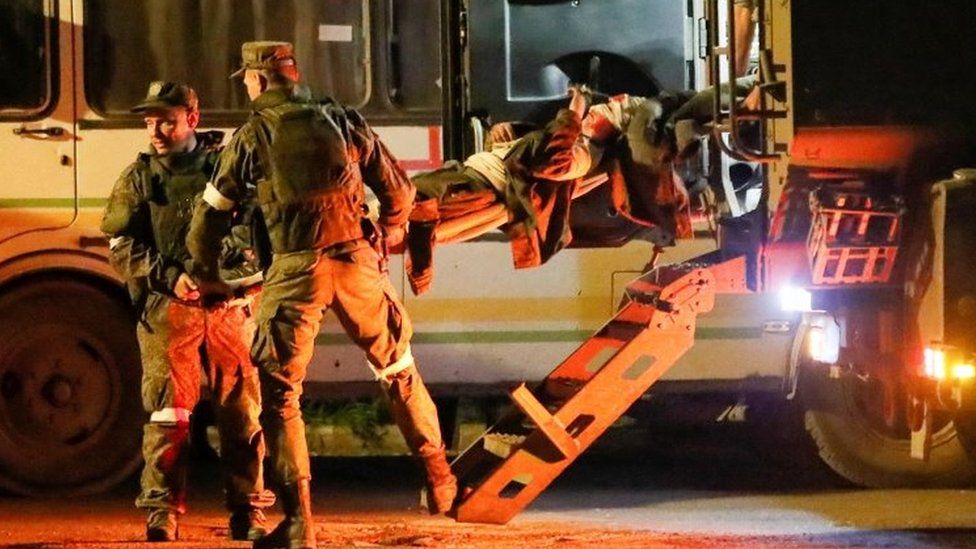
Deputy Defence Minister Hanna Maliar said 53 badly wounded soldiers were taken to the town of Novoazovsk, held by Russian-backed rebels.
She said another 211 were evacuated using a humanitarian corridor to Olenivka – another rebel-held town.
Russia earlier said a deal had been reached to evacuate the injured troops.
About a dozen buses carrying Ukrainian fighters who were holed up beneath the besieged plant were seen leaving the huge industrial site in the southern port city on Monday evening, Reuters news agency reported.
Russian state-run media outlets also posted footage of what they say were injured Ukrainian soldiers being evacuated from Azovstal.
Ms Maliar said the troops would be exchanged for captured Russian soldiers.
In his video address after midnight local time on Tuesday, Ukrainian President Volodymyr Zelensky said that Ukrainian military, intelligence and negotiating teams, as well as the Red Cross and the UN were involved in the evacuation operation.
“Ukraine needs its heroes alive,” he said.
However, he cautioned that the Ukrainian troops may not be freed immediately and warned that negotiations over their release will require “delicacy and time”.
Pictures have emerged purportedly showing injured Ukrainian soldiers arriving in Novoazovsk, a town held by Russian-backed rebels
Hundreds of Ukrainian soldiers – the Azov regiment, the National Guard, police and territorial defence units – as well as a number of civilians have been holed up at the site since advancing Russian troops encircled the southern city in early March.
The sprawling four-square mile complex is a maze of tunnels designed to survive a nuclear war.
Last month Russian President Vladimir Putin called off a planned assault on the site, citing fears of high Russian casualties.
It was not immediately clear how many people still remain in underground bunkers.
Ms Maliar said Ukraine’s military, intelligence, National Guard and Border Service were “carrying out joint efforts to save” those left behind.
She also hailed the actions of the plant’s defenders, who she said had “fully accomplished all missions assigned by the command”. But she noted that their position had become untenable after it became “impossible to unblock Azovstal by military means”.
In a message posted to Facebook on Monday night, Ukraine’s General Staff called the troops “heroes of our time” and said their efforts had helped Kyiv organise the defence of its southern flank.
“Maintaining their positions at Azovstal, they did not allow the opponent to shift the grouping of up to 17 battalion tactical groups (about 20,000 personnel) to other directions. Thereby hindered the implementation of the plan for the rapid capture of Zaporizhzhia,” military chiefs said in the post.
Meanwhile, the Azov regiment, a National Guard unit which once had strong links to the far right, appeared to confirm that its fighters had agreed in a social media post to lay down their arms.
The group’s commander, Lt Col Denis Prokopenko said his priority was saving “as many lives of personnel as possible”.
Under new measures approved by the Biden administration, restrictions on family remittances and travel to the island will be eased.
The processing of US visas for Cubans will also be speeded up.
State Department spokesman Ned Price said the move would allow Cuban citizens to pursue a life free from “government oppression”.
The loosening of sanctions will see a cap on family remittances – funds sent by migrants in the US to family members in Cuba – removed. Previously migrants were prevented from sending more than $1,000 (£811) every three months.
Donations to non-family members will also be permitted under the new plans.
But US officials emphasised that they will seek to ensure such payments don’t reach “those who perpetrate human rights abuses” by using civilian “electronic payment processors”.
They also said that no bodies will be removed from the Cuba Restricted List, a State Department register of companies linked to the communist government in Havana with whom US citizens are barred from doing business.
A Biden administration official told CBS News that more charter and commercial flights will be made available to Havana, US consular services on the island will be expanded and family reunification programmes will be relaunched.
After an easing of tensions under former President Barack Obama, Mr Trump announced a range of sanctions on the Cuban government in 2017.
His administration slashed visa processing, restricted remittances and increased hurdles for US citizens seeking to travel to Cuba for any reason other than family visits.
At the time, Mr Trump cited human rights concerns as the reason for rolling back agreements made by the Obama administration and condemned his predecessor for doing a deal with the country’s “brutal” government.
Cuba’s foreign minister welcomed the announcement and said the easing of restrictions marked “a small step in the right direction”.
But Bruno Rodriguez added that the policy does “not modify the embargo” in place since 1962 and argued that “neither the objectives nor the main instruments of the United States’ policy against Cuba, which is a failure, are changing”.
Meanwhile, a senior member of Mr Biden’s Democratic party has condemned the move.
Senator Bob Menendez, chairman of the Senate Foreign Relations Committee, denounced the lifting of restrictions, saying that the Cuban regime has continued “its ruthless persecution of countless Cubans from all walks of life”.
In a statement issued on Monday night, Mr Menendez said the easing of travel restrictions “risks sending the wrong message to the wrong people, at the wrong time and for all the wrong reasons”.
“Those who still believe that increasing travel will breed democracy in Cuba are simply in a state of denial. For decades, the world has been travelling to Cuba and nothing has changed,” he added.
Republican Senator Marco Rubio also criticised the policy and said it represented “the first steps back to the failed Obama policies on Cuba”.
The news will come as relief for thousands of Cubans who are desperate to see their families in Florida and elsewhere in the US.
The island is experiencing perhaps its most acute exodus since the Cold War, with many travelling to Nicaragua and then up via Central America to the US border with Mexico.
After 2016, the Trump Administration implemented a whole raft of new economic sanctions on the communist-run island, following the easing of the same rules by President Obama.
Combined with the economic downturn from the coronavirus pandemic and economic mismanagement by the state, the economy in Cuba has been in dire straits in recent years.
These changes amount to the White House’s first step towards some form of re-normalisation of relations with Cuba.
Recep Tayyip Erdogan said the two Scandinavian nations need not send delegations to convince Turkey, a key Nato member, of their bids.
He is angered by what he sees as their willingness to host Kurdish militants.
Earlier, Sweden said Europe was living in a dangerous new reality, referring to Russia’s invasion of Ukraine.
Russian President Vladimir Putin said the move by Finland and Sweden to join the 30-member military alliance did not threaten Moscow directly – but stressed that any expansion of military infrastructure would trigger a response from the Kremlin.
At a news conference on Monday, Mr Erdogan said Turkey opposed the Finnish and the Swedish bids to join Nato, describing Sweden as a “hatchery” for terrorist organisations.
“Neither of these countries have a clear, open attitude towards terrorist organisation. How can we trust them?” the Turkish president said.
Turkey accuses the two Nordic nations of harbouring members of the Kurdistan Workers’ Party (PKK), a group it views as a terrorist organisation, and followers of Fethullah Gulen, who Ankara accuses of orchestrating a 2016 coup attempt.
All member states must agree that a new country can join Nato, therefore Sweden and Finland require Turkey’s support in their bid to join the military alliance.
Mr Erdogan said Swedish and Finnish delegations should not bother going to Ankara, Turkey’s capital, to convince it to approve their Nato bid.
His government has also pledged to block applications from countries that have imposed sanctions on it.
Speaking in parliament in Helsinki on Monday, Finnish Foreign Minister Pekka Haavisto said he was surprised by Turkey’s stance, but added that his government was not interested in “bargaining” with Mr Erdogan.
Finland formally announced its bid to join Nato last week.
It was joined by neighbour Sweden on Saturday in a move that will end the Scandinavian country’s centuries-long military non-alignment.
“Nato will strengthen Sweden, Sweden will strengthen Nato,” Prime Minister Magdalena Andersson said at a briefing on Monday.
She said Europe was now living in a dangerous new reality, referring to Russia’s invasion of Ukraine.
“We are leaving one era behind us and entering a new one,” Ms Andersson told lawmakers during a debate in Stockholm, also on Monday.
She said a formal application could be handed within several days and would be synchronised with Finland. Nato has signalled its willingness to admit the two new members.
However, Ms Andersson stressed that Sweden did not want permanent Nato bases or nuclear weapons on its territory.
Norway, Denmark and Iceland – all Nato members – immediately said they were ready to support Sweden and Finland by all means necessary if they came under attack.
For Finland and Sweden to join Nato, all 30 existing members must say yes. But for now, one is saying no.
President Erdogan says he won’t agree to admit countries which apply sanctions on Turkey.
Sweden suspended arms sales to Turkey three years ago, following Ankara’s military intervention in Syria. And according to the official Turkish news agency, both Finland and Sweden have rejected dozens of requests to extradite Kurdish militants who Turkey describes as terrorists.
Both countries are sending delegations to Ankara to try and solve the problem, but President Erdogan says they shouldn’t bother.
He seems determined to extract a price for his precious vote.
On Sunday, the US Secretary of State, Antony Blinken, said he was confident that Finland and Sweden would both join, despite Turkish objections.
The issue is likely to dominate discussions between Mr Blinken and his Turkish opposite number in Washington on Wednesday. Having encouraged the two Nordic countries to apply, Washington won’t want to let them down at the 11th hour.
Curbs on multi-buy deals in shops and on TV adverts for junk food have been put on hold for at least a year.
Ministers said the delay would give them time to assess the impact of the plans on the cost of living crisis.
But Lord Hague said that argument was “baseless”.
Writing in the Times, he said the government was “intellectually shallow” and “politically weak” for giving in to Tory MPs who had been critical of the strategy.
“Many Tories object to the ‘nanny state’ image of anti-obesity policies and think it is ‘un-Conservative’ to pursue them,” he said.
“As a former Tory leader, I emphatically disagree with this interpretation of conservatism.
“Conservatives support freedom of choice but have always seen that it is sometimes necessary to prevent consumers being abused or misled.”
Last week, ministers announced that the planned ban on “buy one get one free” (Bogof) deals for food and drinks high in fat, salt or sugar, as well as free refills for soft drinks, would be pushed back.
Plans to restrict TV advertising of junk foods before the 21:00 GMT watershed and paid-for online adverts were also paused. They will not come into force until January 2024.
But restrictions on where stores can display food high in sugar or far will still go ahead in October.
Former cabinet minister Lord Hague said the government’s “U-turn” adds to a “long history of failed obesity strategies”.
“It means the current government’s anti-obesity drive will probably join the 14 strategies and 689 different policies over the past 30 years, according to a Cambridge University study, that have failed to deliver,” he said.
How common is obesity?
Around two in three adults in England were overweight or obese, according to an NHS health survey in 2019. Almost three in 10 are considered to be obese.
Among children aged four to five, 14% are obese, with a further 13% overweight, the another report found last year.
In children aged 10 to 11, this rose to 26% obese and 15% overweight.
These figures showed large increases on the previous year, when almost 10% of children aged four to five and 21% of children aged 10-11 were obese.
Lord Hague said those who had pressed for the dilution of the obesity strategy were “profoundly mistaken”.
“They are acquiescing in a future of higher dependence, greater costs, reduced lifestyle choice and endless pain.
“For the government to give in to them is intellectually shallow, politically weak and morally reprehensible.”
Lord Hague – who served as Conservative Party leader from 1997 to 2001 – said food companies had an “overwhelming incentive” to design products that led people down a “chemically induced addiction to foods”.
“We should be able to focus resources on those who are unavoidably ill and disabled.
“Covid hit us harder because of widespread obesity. If we fail to control diet-related diseases, on top of paying for an ageing population, there will be no possibility of lower taxes in the future,” he said.
Panorama on Obesity: Who Cares if I’m Bigger?
Eighteen months after the prime minister launched his strategy to help the nation lose weight, EastEnders actress Clair Norris, who is overweight herself, wants to know if it is working.