
A US judge has blocked plans by Joe Biden’s administration to lift a policy allowing migrants to be swiftly expelled at the Mexico border over concerns about spreading Covid.

District Judge Robert Summerhays granted an injunction to Republican state attorneys challenging the halting of checks known as Title 42.

The policy, introduced by Donald Trump in 2020, was due to expire on 23 May.

The US Department of Justice said it would appeal.

Aimed at stopping virus spread in migrant holding facilities, Title 42 was twice extended by President Biden.

More than 1.7 million people have been expelled under the policy.


On Friday, Judge Summerhays in Lafayette, Louisiana, ruled that the policy would stay in place while a lawsuit by more than 20 states played out in court.

He backed the states’ argument that the Biden administration had failed to follow procedures requiring notification and time to gather public comment on the plans to end the policy.

And the judge also said that states had made the case that they would suffer harm if the restrictions ended.

The White House said it would comply with the ruling, but would also launch an appeal.

“The authority to set public health policy nationally should rest with the Centers for Disease Control (CDC), not with a single district court,” White House Press Secretary Karine Jean-Pierre said in a statement.

Mr Biden had been under pressure from his Democratic Party to end the controversial order, with critics arguing that its public health benefits failed to outweigh harm to the rights of migrants.

Title 42 allows US authorities to expel migrants seeking asylum without being given the chance to put forward their case. Children and some families are exempt.

Though Mr Biden had pledged to reverse Trump-era immigration policies while in office, the CDC under his administration extended Title 42 in August 2021, and again in January, due to the spread of the Delta and Omicron variants, respectively.

But in April, the CDC said it was ready to rescind the policy given the current, more favourable public health outlook and after consulting with the Department of Homeland Security (DHS).

However, Republicans – and some Democrats – warned that repealing Title 42 could lead to a surge in migrants at the US-Mexico border.

Millions of Australians are heading to the polls on Saturday for the country’s first election since 2019.

It sees Prime Minister Scott Morrison go up against one of the country’s longest serving politicians, Labor Leader Anthony Albanese.

The rising cost of living and climate change have shaped up as two key issues for voters.

But the election has largely been framed as a referendum on the leaders’ characters.

Opinion polls suggest Labor will win by a narrow majority this time around. However, the polls were wildly inaccurate in the last election.


Mr Morrison, who leads the Liberal-National Coalition, is the first leader to serve a full term in office since John Howard, who won four elections before losing to Labor’s Kevin Rudd in 2007.

He has led Australia through a period dominated by natural disasters and the pandemic – which was initially hailed as a success but was later criticised for inadequate planning.

Mr Morrison has also faced various criticism – from members of his own party to the French President.

He has acknowledged he’s unpopular, admitting he can be a “bulldozer” and could have been a “more sensitive” leader.

But Mr Morrison has also defended his approach as what was needed during the pandemic.

Mr Albanese says the conservative government – which has been in power under three different leaders for almost a decade – has had enough time.

“This government has been there for almost a decade, this prime minister had four years in office, and what he’s saying is, ‘if you vote for Scott Morrison, I’ll change’.

“Well, if you want change, change the government.”

He’s promised voters “safe change” as he battles the perception he is not experienced enough to lead the country as it recovers from a tough couple of years.

Scott Morrison (L) And Anthony Albanese are this year’s main contenders

Both parties are also facing challenges from high profile independents in several key seats.

Australian election: The basics

Polls opened at 08:00 local time in eastern Australia on Saturday (23:00 on Friday GMT).

Voting is compulsory in Australia, and about 17 million people are expected to cast a ballot this time round.

They’ll elect MPs for all the seats in the House of Representatives, and just over half the seats in the Senate.

The main political contenders are the ruling Liberal-National coalition and Labor. Either party will need to win at least 76 of the 151 seats in the House of Representatives – where the prime minister sits – to form a majority government.

If they cannot do that, they must try to win support from independent MPs, or those from minor parties.

The UK’s dispute with the European Union over Northern Ireland trade risks undermining Western unity during the Ukraine war, a senior US official says.

Derek Chollet told the BBC the US hoped the row over Northern Ireland’s post-Brexit trade deal could be resolved.

He said “a big fight between the UK and the EU” was “the last thing” Washington wanted.

Vladimir Putin would “use any opportunity he can to show that our alliance is fraying”, he added.

Mr Chollet, the most senior adviser to US Secretary of State, Anthony Blinken, said: “We want to see this issue resolved and we want to see the temperature lowered and no unilateral acts.

“And it’s particularly important right now where we need to send a message of unity to the world and not undermine all the things that we’ve been so successful in working on together over the last several months and showing unity in Ukraine.”

Mr Chollet’s intervention is significant. It is rare for senior US officials to comment on the UK’s domestic affairs given the historically close relationship between the two nations.

But his comments build on recent concerns expressed by senior US politicians, including President Joe Biden and US House Speaker Nancy Pelosi, about the UK government threatening to override the Northern Ireland Protocol.

‘Bigger fish to fry’

These concerns have so far largely focused on what the US sees as the possible risks to peace in Northern Ireland.

But the senior State Department official is making a new argument, that now is not the time for the UK and the EU to be having a fight. There are bigger fish to fry over Ukraine.

The US wants its allies united, not scrapping over legacy Brexit issues.

line

The basics

  • The Northern Ireland Protocol is part of the Brexit deal: it means lorries don’t face checkpoints when they go from Northern Ireland (in the UK) to the Republic of Ireland (in the EU)
  • Instead, when goods arrive in Northern Ireland from the rest of the UK (England, Scotland and Wales), they are checked against EU rules
  • The UK and the EU chose this arrangement because the Irish border is a sensitive issue due to Northern Ireland’s troubled political history

Derek Chollet, a senior adviser to the US secretary of state, has urged the UK and the EU to cool tensions

On Thursday Ms Pelosi said she was “deeply concerned” that the UK was seeking to “unilaterally discard” Northern Ireland’s post-Brexit trade arrangements, set out in the protocol.

She said the US Congress would not support a trade agreement with the UK if its actions jeopardised the peace process in Northern Ireland.

The UK government has argued that changes to the way goods are shipped from Great Britain to Northern Ireland are needed to restore its devolved government.

A power-sharing administration cannot be formed without the Democratic Unionist Party (DUP), which has refused to join one until significant changes are made to the protocol.

The DUP says the protocol, which was agreed by the UK and the EU in December 2020, has created economic barriers between Great Britain and Northern Ireland.

On Tuesday Foreign Secretary Liz Truss said the UK government would introduce a law to change the protocol unilaterally should negotiations with the EU fail.

Ms Pelosi warned against any action that might endanger the Good Friday Agreement, the peace deal that ended decades of conflict in Northern Ireland.

In the first of several tweets, she wrote: “Ensuring there is no physical border between the Irish Republic and Northern Ireland is necessary for upholding this landmark agreement, which transformed Northern Ireland.”

‘Entirely unhelpful’

But the UK’s former Brexit minister, Lord Frost, has criticised Ms Pelosi for making what he called an “ignorant” statement about the situation in Northern Ireland.

Lord Frost, who negotiated the protocol with the EU, said there was no plan to put a physical border in place on the island of Ireland.

“Nobody’s ever suggested that. So I don’t know why she’s suggesting that in her statement,” Lord Frost told the Week in Westminster on BBC Radio 4.

US House Speaker Nancy Pelosi said she was concerned about the UK’s actions

He also denied that making changes to the arrangements would undermine the Good Friday Agreement.

“It is the protocol itself that’s undermining [the Good Friday Agreement] and people who can’t see that really shouldn’t be commenting on the situation in Northern Ireland,” said the former minister.

On Friday afternoon DUP leader Sir Jeffrey Donaldson said he thought Ms Pelosi’s contributions were “entirely unhelpful, offer no solution, offer no help and merely repeat a mantra that frankly is hopelessly out of date.”

He spoke as the Irish Taoiseach Micheál Martin met Northern Ireland’s main parties to discuss the protocol and the political crisis.

Meanwhile, a US Congress delegation flew to Brussels for a meeting with European Commission vice-president Maros Sefcovic, who has been leading negotiations with the UK.

“We’re equally committed to protecting the Good Friday (Belfast) Agreement,” he tweeted. “Joint solutions implementing the Protocol are the only way to do so.”

Civil servant Sue Gray met with Boris Johnson to discuss publishing photos as part of her report into Downing Street parties

A senior government source said the PM had told Ms Gray the decision was a matter for her, and the findings of her investigation were not discussed.

The source said it was now expected Ms Gray, who requested the meeting, would include pictures in her final report.

Labour suggested the “secret meeting” could damage confidence in the process.

Ms Gray has been looking into numerous gatherings reported to have taken place in Downing Street in 2020 and 2021, when Covid restrictions were in place.

Her full report is set to be published next week after the Metropolitan Police announced it had concluded its own investigation, which saw a total of 126 fines issued to 83 people.

Around 30 individuals, including the prime minister, have already been informed they are likely to be named by Ms Gray.

They have until Sunday evening to lodge any objections.


The BBC understands that Ms Gray requested the meeting with Mr Johnson over a month ago “to clarify her intentions” for what would happen after the completion of the police inquiry.

The senior government source said the meeting covered “practical and process issues”, including whether photos would be published.

On Friday, a Number 10 spokesperson said: “The prime minister commissioned the investigation led by Sue Gray and has been clear throughout that it should be completely independent.

“As he reiterated again today, the decision on what and when to publish rests entirely with the investigation team and he will respond in Parliament once it concludes.”

Civil servant Sue Gray has led an investigation into gatherings which took place in and around Downing Street during lockdown

In a statement, Labour’s deputy leader Angela Rayner said: “Boris Johnson must urgently explain why he held a secret meeting with Sue Gray to discuss her report despite claiming her investigation was completely independent. Public confidence in the process is already depleted, and people deserve to know the truth.

“This is a prime minister incapable of taking responsibility for the rotten culture he has created in Downing Street or of doing the decent thing.

“The Sue Gray report must be published in full and with all accompanying evidence.”

An interim version of the report, published in January, did not name individuals but criticised “failures of leadership and judgement” and said some events should not have “been allowed to take place”.

The prime minister meanwhile faces an inquiry by the Commons’ Privileges Committee about whether he knowingly lied to Parliament when he previously told MPs that no laws had been broken in Downing Street.

Under government guidelines, ministers who knowingly mislead the House of Commons are expected to resign.

FM Bilawal Bhutto defends ex-PM Imran Khan’s visit to Russia in US

Foreign Minister Bilawal Bhutto defended in the United States former prime minister Imran Khan’s visit to Russia, saying Imran Khan visited Russia as part of his foreign policy.

Former prime minister Imran Khan is repeatedly blaming the US government for his ouster. According to Imran Khan, the US voted him out through a no-trust motion because he visited Russia at the time of the Russia-Ukraine conflict and vowed to follow independent foreign policy.

During a press conference in New York, on a question related to former PM Imran Khan’s visit to Russia, Bilawal Bhutto said, “as far as the former PM’s trip to Russia [is concerned], I would absolutely defend him,” adding that, “[the] Pakistani PM conducted that trip as part of his foreign policy”.

Bilawal Bhutto said that no one knew that there would have been a Russia-Ukraine conflict.

“I believe it is very unfair to punish Pakistan for such an innocent action. Of course, Pakistan is absolutely clear as far as it comes to the principles of the UN [United Nations] of non-use of force and we stand by these principles,” he said.

The FM went on to say that Pakistan is not a part of any conflict and never wishes to be. “We will continue to emphasise the importance of peace, dialogue and diplomacy to resolve this conflict as soon as possible,” he said.

“We will certainly not take the side of any aggressor within this context,” said Bilawal, adding that Pakistan has its problems and has witnessed a decade of conflicts in Afghanistan.

Bilawal said Pakistan is now tired of this war as it has sacrificed its children, leadership, men and women. “Therefore, we think that through using tools of dialogue and diplomacy we can solve many problems”.

‘Imran Khan should play role of responsible Opposition member’

Later, while talking to the media in New York, FM Bilawal lambasted former prime minister Imran Khan over his “undemocratic and unconstitutional politics”.

“Imran Khan is not doing democratic, parliamentary and constitutional politics, however, he is heading towards politics of extremism,” said Bilawal.

He said it is Opposition’s right to protest, but Imran Khan is levelling false allegations against political rivals and institutions.

Bilawal Bhutto went on to say that if they revealed the way Imran Khan’s government was formed and ruled, he [Imran Khan] would not find a place to hide.

“Therefore, Imran Khan should play the role of a responsible Opposition member, otherwise he will have to [give] answer[s],” said Bilawal, adding that those involved in the crime of bringing Imran Khan to power will have to answer too.

PM Shehbaz’s should be given a chance: Bilawal

Showing his support to the Prime Minister Shehbaz Sharif-led government, Bilawal Bhutto said that the premier should be given a chance to solve the country’s issues.

“We need to find out the solution to issues while working together with every stakeholder and party,” he said.

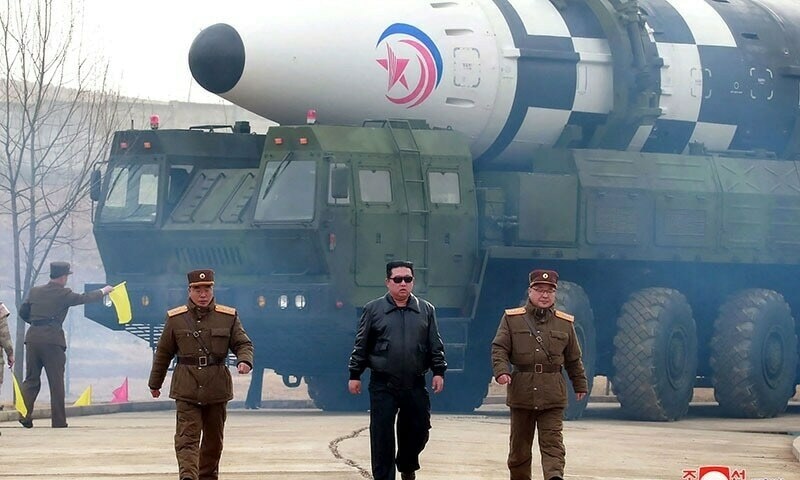
North Korea ‘ready for nuclear test’ as Biden head to Seoul

The visits to Seoul, followed by Tokyo, are being touted as proof that Washington is seeking to cement its years-long pivot to Asia, where rising Chinese commercial and military power is undercutting decades of US dominance.

However, Biden’s first trip as president to the region looks set to be overshadowed by an increasingly belligerent North Korea.

Despite a spiralling Covid outbreak, Pyongyang’s “pre­p­ar­ations for a nuclear test have been completed and they are only looking for the right time”, South Korean lawmaker Ha Tae-keung said after being briefed by Seoul’s spy agency.

US intelligence says there is a “genuine possibility” that North Korea’s Kim Jong Un could stage this “provocation” after Biden arrives in Seoul on Friday, his administration said.

This could mean “further missile tests, long-range missile tests or a nuclear test, or frankly both” around the time of Biden’s trip, National Security Advisor Jake Sullivan said.

Satellite imagery indicates North Korea is preparing to conduct what would be its seventh nuclear test — which would cap a record-breaking blitz of launches this year, including intercontinental ballistic missiles.

“North Korea will want to attract global attention by conducting a nuclear test during President Biden’s visit,” Cheong Seong-chang of the Center for North Korea Studies at the Sejong Institute said.

Biden, who will visit some of the nearly 30,000 US troops stationed in South Korea, is ready to make “adjustments” to the US military posture in the region, and Seoul’s hawkish new President Yoon Suk-yeol is eager for stronger ties.

Both Biden and Yoon have said they’re open for talks with Pyongyang but they expect to see real progress on denuclearisation — which analysts say is anathema to Kim and will stall talks.

“Biden judges that the North Korean issue can’t be resolved through impromptu meetings between the leaders as Trump did,” said Woo Jung-yeop, a researcher at the Sejong Institute.

North Korea will be watching the outcome of the Yoon-Biden meeting Saturday very closely, said Yang Moo-jin, a professor at the University of North Korean Studies.

“Depending on the result, North Korea will decide on whether it will speed up or slow down its ICBM and nuclear tests,” Yang said.

Sullivan said the security situation regarding North Korea was being “closely” coordinated with South Korea and Japan and that he had also spoken about the issue with his Chinese counterpart on Wednesday.

It is likely that Kim is still debating what to do, in particular due to this US pressure on Beijing — Kim’s sole major ally — to help rein in Pyongyang’s nuclear and ICBM tests, the Sejong Inst­itute’s Cheong said.

India’s top court has sentenced cricketer-turned-politician Navjot Singh Sidhu to one year in prison in a decades-old road rage case.

The Supreme Court ruled that Sidhu “intentionally caused hurt” to Gurnam Singh, who was 65, resulting in his death in the incident in 1988.

The former MP was acquitted of the more serious charge of manslaughter in 2018 – that still stands.

But the jail sentence is a serious setback for his political career.

Sidhu recently resigned as the Congress party’s chief in Punjab after his party was wiped out in state assembly elections.

He has limited legal options left as he can appeal against the ruling only once in the form of a curative petition.

The case timeline

Sidhu was first accused of manslaughter in 1988 when a 65-year-old man died hours after an argument with him in Patiala.

He was India’s opening batsman at the time and a rising star in his fledging international cricket career.

The case continued to be heard in a trial court. In 1999, the court acquitted Sidhu.

The state appealed against the acquittal in the high court, which convicted him for manslaughter in 2006. This forced him to resign from his parliamentary seat of Amritsar as Indian laws do not allow convicted individuals to be public representatives.

He appealed against the verdict in the Supreme Court which stayed the conviction, allowing him to retake his seat in a by-election. In 2018, the top court acquitted him in the manslaughter case, but found him guilty of “hurting the victim” and asked him to pay a fine of 1,000 rupees ($13; £10).

The victim’s family appealed against the ruling and on Thursday, the Supreme Court added a one-year sentence to the fine.

Who is Navjot Singh Sidhu?

Sidhu is one of India’s most successful Test cricketers. Known for his stylish and powerful stroke play, he thrived in particular against fast bowlers, but also held equal command over playing spin skilfully.

He scored 3,202 runs at an average of 42 in 51 Test matches. He also played 136 ODIs and scored 4,413 runs. He retired from all forms of cricket in 1999 and after four years, he joined the Bharatiya Janata Party (BJP) and became an MP. Over the years, he rose to become a prominent party leader and a star campaigner.

In the next decade, he also managed to launch a successful career as a cricket commentator and also as a TV personality on comedy shows. His witty and sharp style made him popular as a commentator.

But he became disgruntled with the BJP after reportedly not getting any important job in the government despite the party’s landslide win in the 2014 general elections.

He quit the BJP in 2016 and joined the Congress, where he rose to become the chief of its state unit in Punjab.

Sri Lanka has defaulted on its debt for the first time in its history as the country struggles with its worst financial crisis in more than 70 years.

It comes after a 30-day grace period to come up with $78m (£63m) of unpaid debt interest payments expired on Wednesday.

The governor of the South Asian nation’s central bank said the country was now in a “pre-emptive default”.

Later on Thursday, two of the world’s biggest credit rating agencies also said Sri Lanka had defaulted.

Defaults happen when governments are unable to meet some or all of their debt payments to creditors.

It can damage a country’s reputation with investors, making it harder to borrow the money it needs on international markets, which can further harm confidence in its currency and economy.

Asked on Thursday whether the country was now in default, central bank governor P Nandalal Weerasinghe said: “Our position is very clear, we said that until they come to the restructure [of our debts], we will not be able to pay. So that’s what you call pre-emptive default.

“There can be technical definitions… from their side they can consider it a default. Our position is very clear, until there is a debt


Sri Lanka is seeking to restructure debts of more than $50bn it owes to foreign creditors, to make it more manageable to repay.

The country’s economy has been hit hard by the pandemic, rising energy prices, and populist tax cuts. A chronic shortage of foreign currency and soaring inflation had led to a severe shortage of medicines, fuel and other essentials.

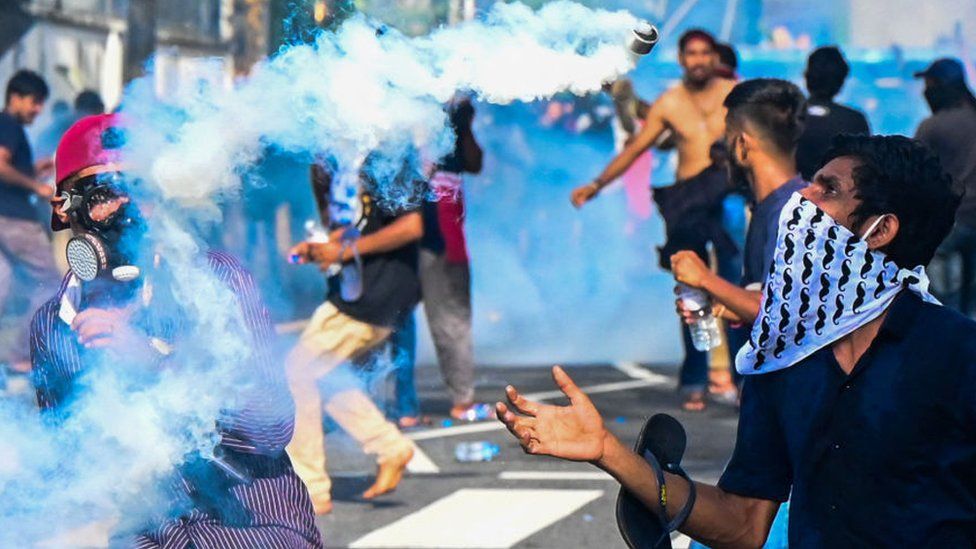
In recent weeks, there have been large, sometimes violent, protests against President Gotabaya Rajapaksa and his family due to the growing crisis.

The country has already started talks with the International Monetary Fund (IMF) over a bailout and needs to renegotiate its debt agreements with creditors.

Later on Thursday, an IMF spokesman said the current set of talks on a potential loan programmeare expected to conclude on Tuesday.

Sri Lanka’sgovernment has said previously that it needs as much as $4bn this year.

Mr Weerasinghe also warned that Sri Lanka’s already very high rate of inflation was likely to rise further.

“Inflation obviously is around 30%. It will go even [higher], headline inflation will go around 40% in the next couple of months,” he said.

He was speaking after Sri Lanka’s central bank held its two key interest rates steady following a seven percentage points rise at its last meeting.

The country’s main lending rate remained at 14.5%, while the deposit rate was kept at 13.5%.

In many ways this wasn’t a surprise. The warning sirens of a potential default were already blaring a few weeks ago.

But much more than that, on the streets of Sri Lanka, where this crisis is biting, nobody is shocked.

As petrol queues run for miles, with fuel being sold on the black market for eye-watering amounts, as lines for handouts of free bread get longer by the day, the island’s inability to pay back debts is being painfully felt.

In his first interview since taking office last week, the country’s Prime Minister Ranil Wickremesinghe told me things would get worse before they improve in Sri Lanka, but even he wasn’t able to predict just how bad.

“No-one has got all the details… so I will be like a doctor who’s opening up the patient for the first time.”

Today’s default is a depressing diagnosis for a nation facing more economic turmoil, even as talks with the IMF and other nations continue.

On Thursday, ratings agency Moody’s Investors Service said Sri Lanka had “defaulted on its international bonds for the first time”.

Moody’s said it expects the country to eventually reach an agreement over an IMF bailout.

“However, finalising the programme will likely take several months given the need for staff level agreement on both sides, followed by parliamentary approval in Sri Lanka and approval by the IMF’s executive board,” the firm added.

Also on Thursday, Fitch Ratings lowered its assessment of Sri Lanka to a “restricted default” after a grace period for payments had expired.

S&P Global Ratings did not immediately respond to a request for comment from the BBC.

Credit ratings are intended to help investors understand the level of risk they face when buying a financial instrument, in this case a country’s debt – or sovereign bond.

Last week, President Rajapaksa’s elder brother Mahinda resigned as prime minister after government supporters clashed with protesters. Nine people died and more than 300 were wounded in the violence.

that the economic crisis was “going to get worse before it gets better”.

He also pledged to ensure families would get three meals a day.

Appealing to the world for more financial help, he said “there won’t be a hunger crisis, we will find food”.

Sri Lanka: The basics

  • Sri Lanka is an island nation off southern India: It won independence from British rule in 1948. Three ethnic groups – Sinhalese, Tamil and Muslim – make up 99% of the country’s 22m population.
  • One family of brothers has dominated for years: Mahinda Rajapaksa became a hero among the majority Sinhalese in 2009 when his government defeated Tamil separatist rebels after years of bitter and bloody civil war. His brother Gotabaya, who was defence secretary at the time, is now president.
  • Now an economic crisis has led to fury on the streets: Soaring inflation has meant some foods, medication and fuel are in short supply, there are rolling blackouts and ordinary people have taken to the streets in anger with many blaming the Rajapaksa family and their government for the situation.

Across Australia household budgets are being tightly squeezed, with the cost of living soaring to an eye-watering 21 year high.

Rising prices will be a pivotal concern for voters as they head to the polls on Saturday.

Although not surging as high as in other countries at 5.1%, Australia’s inflation rate is outstripping wage growth (2.3%) meaning people have less money in their pockets every month.

In the Sydney suburb of Lakemba, 12 kilometres (seven miles) from the centre of the nation’s biggest city, almost everyone I meet is worried about the rising cost of rent, food, fuel, and other essentials.

“I am a single mum with two kids. The childcare – everything – is very expensive. (It is) stressful sometimes,” says Diana, who lives nearby.

Meanwhile, at a busy grocery shop she runs on the main street, Summer Hamze is organising deliveries. She tells me that many of her customers can barely keep up with the price rises she’s forced to pass on from her suppliers.

Climbing inflation is outpacing growth in earnings

“With the inflation, actually, we do need the government to get that under control because it is out of control,” she tells the BBC. “It is just rising and rising and rising, and people are getting really scared these days.”

Given inflation is largely being driven by market forces such as higher global shipping and energy prices, in Lakemba, opinion is divided over how much can be done by the next government.

“It is in their hands, because they know the economic factors, everything,” says one man. “So, they know how to handle the situation.”

Whereas another passer-by disagreed.

Rising petrol prices are leaving Australians with less disposable income

“Nah, I don’t think anyone can do anything,” he says. “Even if they change the government, I don’t think anything will happen because the banks will do their thing.”

Earlier this month, Australia’s Reserve Bank (RBA) increased interest rates (by 0.25% to 0.35%) for the first time in more than 11 years – the first hike in the middle of an election campaign since 2007.

Rates were held at historic lows during the Covid-19 pandemic in a bid to encourage Australians to keep spending. But as inflation surges and the economic recovery post-Covid gets underway, the RBA is applying the brakes to stop the economy overheating. It is making money more expensive to borrow.

More interest rate increases are expected in the months ahead. That’s good for savers, but it’s estimated that 300,000 Australians could default on their mortgages as repayments increase.

Key economic decisions are outsourced to independent bodies such as the RBA which sets official interest rates

So, whichever candidate wins the election at the weekend they will have to navigate choppy economic waters.

Scott Morrison, the prime minister, whose centre-right coalition has been in power for almost a decade, has slammed his main challenger, opposition candidate, Anthony Albanese, as a “loose unit” on the economy

“It is like he just unzips his head and let’s everything fall on the table. That is no way to run an economy,” thundered Mr Morrison.

In response, Labor leader Anthony Albanese said the Australian economy was “crying out for leadership and reform” but was getting neither from the current administration. Mr Albanese wants an increase to the minimum wage of at least 5.1%, to keep pace with inflation.

Almost two-thirds of Australians say reducing the cost-of-living should be the top priority for the next government, according to recent analysis.

Professor Nicholas Biddle from the Australian National University (ANU) says rising prices were “high on the minds” of many voters of various political persuasions.

“This outranks all other major policy considerations,” he says. “Interestingly, we found this was a view held by people who said they would vote for Labor, for people who said they would vote for (Scott Morrison’s) Coalition and for those who weren’t planning on voting for either party”.

Fixing Australia’s nursing home system for older people and strengthening the nation’s economy were the other top priorities among more than 3,500 voters surveyed by the ANU.

Key economic decisions have been outsourced to independent bodies (such as the RBA, which sets official interest rates), or are dictated by the demand and supply of goods and services, both in Australia and overseas.

The Australian economy may need a shot in the arm to spur the Covid bounceback further

But the national government does wield considerable influence on the fate of the economy through its tax and spending policies, for example. Massive wage subsidies and other stimulus measures during the darkest days of the pandemic did protect jobs and businesses in Australia.

However, with three-year parliamentary terms in Canberra, some academics argue that federal politicians can be distracted by almost constant electioneering and exaggerate their control over the economy.

“One of the problems Australia has is its short parliaments, which means they are almost perpetually in this cycle of gathering votes.

“If a government is always worrying about the political cycle then when do they have time to knuckle down and really get things done,” says Michelle Baddeley, a professor of economics at the University of Technology, Sydney.

“I think, yes, there is a bit of claiming more ground than they really can control,” she says. “The reality is a bit of a mixture because certainly, and Covid illustrated this pretty well, governments can do a lot in terms of spending money to generate employment in the short-term.”

Australia has a small, open economy that thrives on confidence.

And ultimately, it’s individuals that collectively power an economy, but governments with vision are able to foster enterprise, innovation, and prosperity.

“There is a lot of catching up to do in terms of growth, in terms of opportunity, and, indeed government can set the pace,” explains Peter Khoury, from the NRMA, a large motoring and transport company.

“As long as there is confidence in the economy and in the strength of the economy, Australian entrepreneurs and businesses will invest.”

“Economically speaking, Australia will come out of Covid better than most countries. So, you don’t want to miss that opportunity,” he adds.

Australians voters will soon decide who they trust to help steer their country through the recovery – and beyond – for the next three years.

Sweden and Finland have the “full, total and complete backing” of the US in their decision to apply for Nato membership, President Joe Biden says.

Both countries submitted their applications to be part of the Western defence alliance this week, marking a major shift in European geopolitics.

To join the alliance, the two nations need the support of all 30 Nato member states.

But the move by the Nordic nations has been opposed by Turkey.

Speaking alongside Swedish Prime Minister Magdalena Andersson and Finnish President Sauli Niinisto at the White House on Thursday, Mr Biden called Sweden and Finland’s applications “a watershed moment in European security”.

“New members joining Nato is not a threat to any nation,” he said. The president added that having two new members in the “high north” would “enhance the security of our allies and deepen our security co-operation across the board”.

Russia has repeatedly said it sees Nato as a threat and has warned of “consequences” if the block proceeds with its expansion plans.

War in Ukraine: More coverage


Turkey has accused both Sweden and Finland of hosting suspected militants from the Kurdistan Workers’ Party (PKK), a group it views as a terrorist organisation.

However, both Nato Secretary-General Jens Stoltenberg and British Defence Minister Ben Wallace have expressed confidence that these concerns will eventually be addressed.

Mr Biden’s comments came as the US Senate voted to approve a new $40bn (£32bn) bill to provide military and humanitarian aid to Ukraine. It is the biggest emergency aid package so far for Ukraine.

The bill – which was passed by the House of Representatives with broad bipartisan support on 10 May – was expected to be passed earlier this week, but was blocked by Kentucky Republican Rand Paul over a dispute about spending oversight.

But the Republican’s Senate leader Mitch McConnell dismissed these concerns and told reporters that Congress had a “moral responsibility” to support “a sovereign democracy’s self-defence”.

“Anyone concerned about the cost of supporting a Ukrainian victory should consider the much larger cost should Ukraine lose,” Mr McConnell said.

Last week, Defence Secretary Lloyd Austin and Secretary of State Antony Blinken urged Congress to approve the package and warned that the US military only had enough funds to send weapons to Kyiv until 19 May.

Watch: Sweden and Finland formally submit Nato applications

Ukraine’s President Volodymyr Zelensky praised the aid package as “a significant US contribution to the restoration of peace and security in Ukraine, Europe and the world”.

The package brings the total US aid delivered to Ukraine to more than $50bn, including $6bn for security assistance such as training, equipment, weapons and support.

Another $8.7bn will be allocated to replenish stocks of US equipment already sent to Ukraine.