
Former US President Donald Trump has said “it is great to be home” as he arrived in Aberdeen on a visit to his Scottish golf properties.

It is Mr Trump’s first visit to the UK since 2019 after leaving office.

He attended a ceremony to break ground on a new course at his Aberdeenshire resort, Trump International Scotland.

Mr Trump, whose mother is from the Isle of Lewis, sparked a security operation on a 2018 Scottish visit with protests in Glasgow, Edinburgh and Aberdeen.

The visit comes as Mr Trump faces court action in the United States. Earlier this month he pled not guilty to 34 counts of falsifying business records.

He is also facing a civil trial over an allegation that he raped an advice columnist in the mid-1990s. A judge has denied his legal team’s request for a mistrial.

Mr Trump, who is running for the White House again in 2024, is visiting Scotland as a private individual.

It is understood there is no requirement on the Scottish or UK governments to pay for special security.

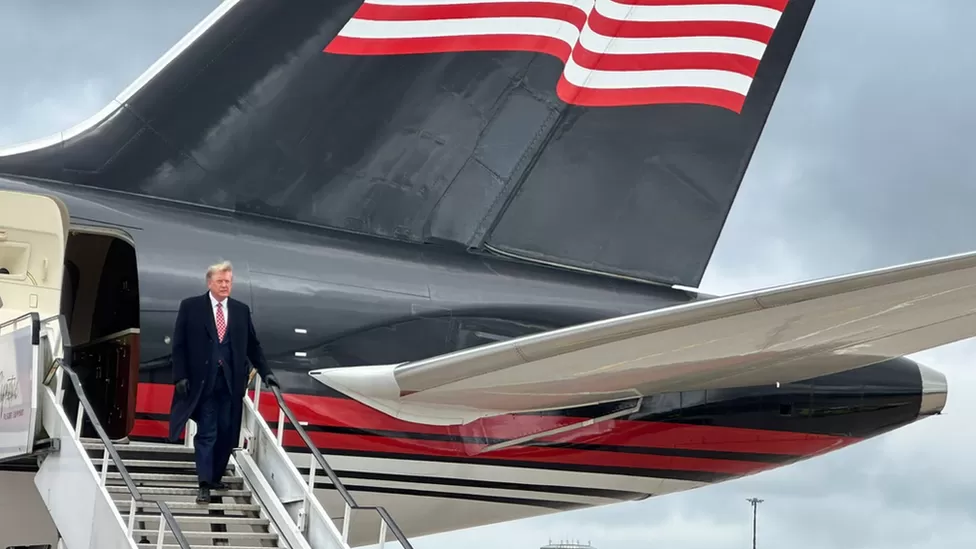
Donald Trump’s private plane landed at Aberdeen Airport
Mr Trump walked down the steps to the sound of bagpipes

The former president arrived at Aberdeen Airport at about 11:30 and was met by two pipers, a red carpet and a 10-vehicle motorcade.

He left the plane and greeted reporters as he walked to a waiting car, but did not stop to take questions.

Before getting into the vehicle, he said: “It’s great to be home, this was the home of my mother.”

His mother, Mary Anne MacLeod, was born on Lewis in the Outer Hebrides before emigrating to the US.

Mr Trump said a “spectacular” second course on the Menie Estate at Balmedie in Aberdeenshire would be dedicated to her.

Mr Trump cut the ribbon on the MacLeod course with son Eric and Sarah Malone of Trump International Scotland

The former president cut a ceremonial red ribbon to mark the beginning of work on the MacLeod course,

He said the news course would be fit to “host many great championships” in future.

He added: “My mother was an incredible woman who loved Scotland. She returned here every year and she loved the Queen.”

He added: “I love Scotland just as much.”

Mr Trump is later expected to visit the Trump Turnberry course in Ayrshire before travelling to his course in Doonbeg on Ireland’s west coast.

On Mr Trump’s last major visit to Scotland in July 2018 he spent two days at his Turnberry resort with wife Melania.

Mr Trump was heckled as he played golf there with his son Eric.

It was part of a four-day trip to the UK, during which he met then Prime Minister Theresa May and the Queen.

Donald Trump’s mother may have come from Scotland but he’s had a very difficult relationship with people and politicians in the country of her birth.

While he is now opening the second of two golf courses in Aberdeenshire, his investment there remains a fraction of the one billion pounds he originally promised.

Developing the site brought him into conflict with some of his neighbours and environmental campaigners who wanted to preserve the sand dune system and its natural habitats.

Donald Trump also clashed with the Scottish government in court in an unsuccessful attempt to block a wind farm off the Aberdeenshire coast.

His redevelopment of Turnberry in Ayrshire was more warmly received.

All Holyrood party leaders opposed his election as President in 2016 and the new First Minister Humza Yousaf suggested Trump be barred from the UK following the storming of the US Capitol building by his supporters.
PTI, PML-N leaders ‘not optimistic’ about election talks as final round on May 2

As the Pakistan Democratic Movement (PDM) and Pakistan Tehreek-e-Insaf (PTI) are all set to hold the ‘final round’ of election talks on Tuesday, leaders from both the opposition and ruling alliance cast doubt on the success of negotiations.

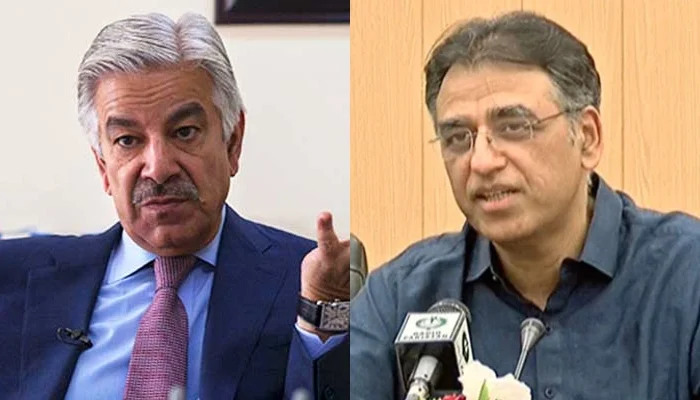
Speaking to the media in Punjab’s Sialkot on Sunday, Defence Minister Khawaja Asif raised questions over the ongoing parleys between the opposition PTI and the PDM teams to evolve consensus on holding the elections across the country simultaneously.

“What will be the result of the negotiations? They [PTI] are only making arguments,” the senior PML-N leader remarked.

Referring to the negotiation teams, the defence minister questioned: “Whether the Panchayat [council] has been set up in a legitimate way or in an illegitimate way”.

The PML-N leader said PTI chief Imran Khan had announced holding rallies in three different cities. “He should start the rallies quickly so that the negotiation process can be done away with.”

Similarly, PTI leader Asad Umar said that the PDM-led government’s intentions are not good about the negotiations.

Speaking to the media in Karachi, Umar said that the PTI was holding negotiations with the ruling PDM at the suggestion of the Supreme Court.

He also accused the ruling PDM of pushing the country towards “danger” for the sake of vested interest.

The former federal minister said the country cannot progress unless all sides agree to a unanimous accord to resolve the country’s issues.

He said that Tuesday (May 2) will be the last chance for negotiations.

Umar said that not holding elections within 90 days is a violation of the Constitution and added that the next polls after the imminent one would be held as per the new census.

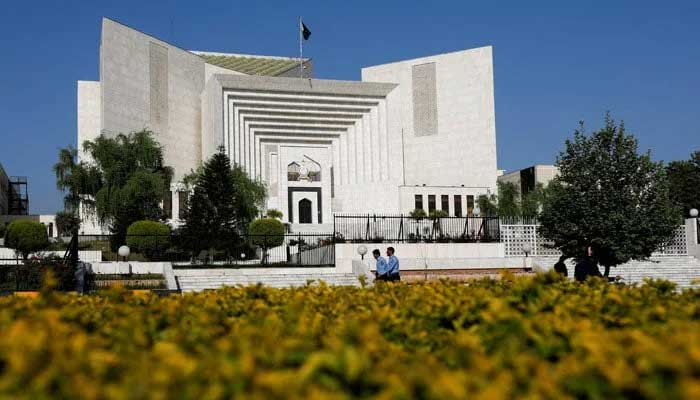
The talks are being held to end an impasse over the timing of general elections across the country, which has fuelled political tensions in the country, with the Supreme Court also urging the political forces to negotiate and find out a solution to the prevailing political turmoil.

The court had directed the political parties to decide on the election date by April 26, but no progress was made till the deadline. In the April 25 hearing, the apex court mentioned that it cannot ask parties to hold negotiations forcefully.

Earlier today, PTI Senior Vice-President Fawad Chaudhry also announced that the party will hold rallies starting from May 1 if the negotiations with the PDM-led government fail.

Taking to Twitter, Fawad said that the PTI wants the negotiations to succeed, however, it has formulated a strategy in case the talks with the ruling coalition do not bear fruit.

He said that the rallies will begin in Lahore, Islamabad and Peshawar under the leadership of Imran Khan, asking the supporters to get ready for the “major movement”.

Labour Day message: PM Shehbaz hails workers as central to economic growth

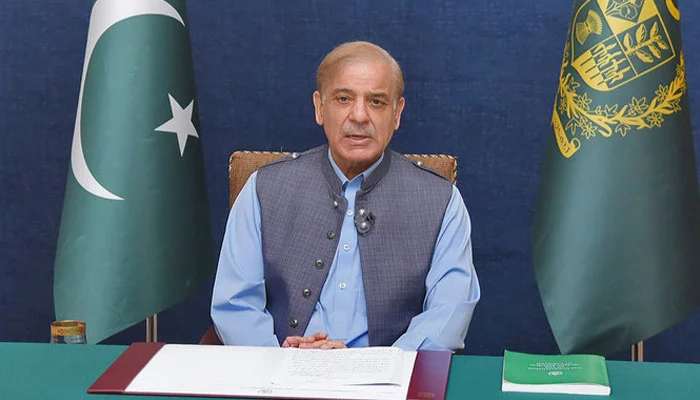
As the world marks Labour Day today (Monday), Prime Minister Shehbaz Sharif has highlighted the workers’ pivotal role in economic development, in his message on the occasion.

“The day symbolises the sanctity and dignity of labour, and at the same time, it was an acknowledgment of the importance of workers and labourers for being central to the economic growth of the country,”
a press release issued by the media wing of PM Office quoted the premier as saying.

Labour Day, also known as May Day is observed around the world on May 1 every year to express solidarity and honour the rights of the labour class. The day celebrates the work and achievements of labourers across the globe and initiate steps for the provision of job protection to them against any exploitation.

In his message on Labour Day, PM Shehbaz Sharif reaffirmed the government’s commitment to improving the working and living conditions of workers and to supplementing their welfare through the provision of better housing, education facilities and health cover for them and their families.

The present government was committed to ensuring the benefits of economic progress translated into prosperity for all sections of the population, particularly the labourers and workers, he said.

PM Shehbaz further stated that international workers’ day reminds us of the sacrifices of the workers who laid down their lives while waging a relentless struggle for their rights.

“Our great religion, Islam, emphasises the principles of social justice, equity and respect for the rights of the people. Allah Almighty and the Holy Prophet (Peace Be Upon Him) have ordered us to fulfill the rights of the workers and not be lax in the performance of this core duty,” the premier was quoted saying.

He said they found numerous inspiring examples of the dignity of labourers and respect for the rights of the working class in the life of the Holy Prophet (PBUH).

Keeping in view the high inflation rates and other economic challenges, PM Shehbaz said that the government had increased the minimum wages of workers from Rs17,500 to Rs25,000 per month.

He further stated that the government also aimed to develop automated, integrated systems for workers’ welfare institutions to ensure transparency and to curtail delays in providing relief to the labourers and workers.

Labour force is backbone of our economy: Alvi

Meanwhile, President Dr Arif Alvi said that this year the nation was celebrating Labour Day with the resolve to reaffirm commitment to the dignity of labour and pay tribute to the valiant and heroic struggle of the workers for their fundamental rights.

“The day is not only a reminder of the struggle of workers but also an acknowledgement of their contribution towards economic development. We believe that workers and employers are partners in the production process and their cooperation is essential for industrial efficiency that ultimately leads to socio-economic uplift of the country,” the president said.

He regretted that despite their contribution towards economic prosperity, labourers were facing many issues like the unsafe working environment, unfair labour practices, poor wages, lack of job security, harassment of women at the workplace, long working hours and arbitrary dismissal.

“The labour force is the backbone of our economy and it is highly essential to take steps for the protection of their rights by strictly enforcing the labour laws to discourage unfair labour practices,”

He highlighted the need to provide the “huge labour force and youth bulge” of Pakistan with modern skill sets to put the economy on fast-track development.

The president hoped that the federal and provincial governments would continue their endeavours to work for their welfare as well as to provide them with marketable skill sets.

He also urged the workers of the country to play their role in making the country economically stronger and vibrant, and employers to ensure the protection of the rights of labour and work for their welfare.

International Labour Day being observed across globe today

International Labour Day is being observed across the country on Monday as elsewhere in the world, to acknowledge and commend the invaluable contributions of the labour class.

The fundamental objective of observing the International Labour Day is to acknowledge the hard work and dedication of the working class, create awareness about their rights, and protect them from exploitation.

In this connection, rallies will be taken out by labourers’ and other organizations in various cities to highlight significance of the day.

Santiago Peña of Paraguay’s ruling conservative Colorado Party has won the presidential election, beating a centre-left challenger.

With almost all ballots counted, Mr Peña, an economist, got more than 42%, electoral officials say.

Efraín Alegre, candidate of the Concertación Nacional coalition, had nearly 28%. He later admitted defeat.

The Colorado Party has dominated the political scene in the landlocked South American nation for more than 70 years.

Sunday’s presidential poll was decided in a single round of voting.

Addressing his supporters, Mr Peña, 44, said: “Thank you for this Colorado victory, thank you for this Paraguayan victory.”

He also called for nationwide unity and consensus. Paraguay’s economy is expected to grow by more than 4% this year, but the country has relatively high levels of poverty and corruption.

“We have a lot to do, after the last years of economic stagnation, of fiscal deficit, the task that awaits us is not for a single person or for a party,” Mr Peña said.

Efraín Alegre acknowledged defeat

Meanwhile, Mr Alegre, 60, said his coalition had made significant efforts but the election results showed this was not enough.

During his campaigning, he advocated austerity measures to combat the growing fiscal deficit and pledged to tackle corruption.

He also proposed dropping his country’s long-running ties with Taiwan and instead aligning with China.

Paraguay is currently among only 14 countries who have official diplomatic relations with Taiwan.

China’s regards the island as a renegade province, which should be returned – including by force if needed – to Beijing’s control.

On Sunday, Paraguayans were also voting in parliamentary elections, with the Colorado Party securing the highest share of the vote.

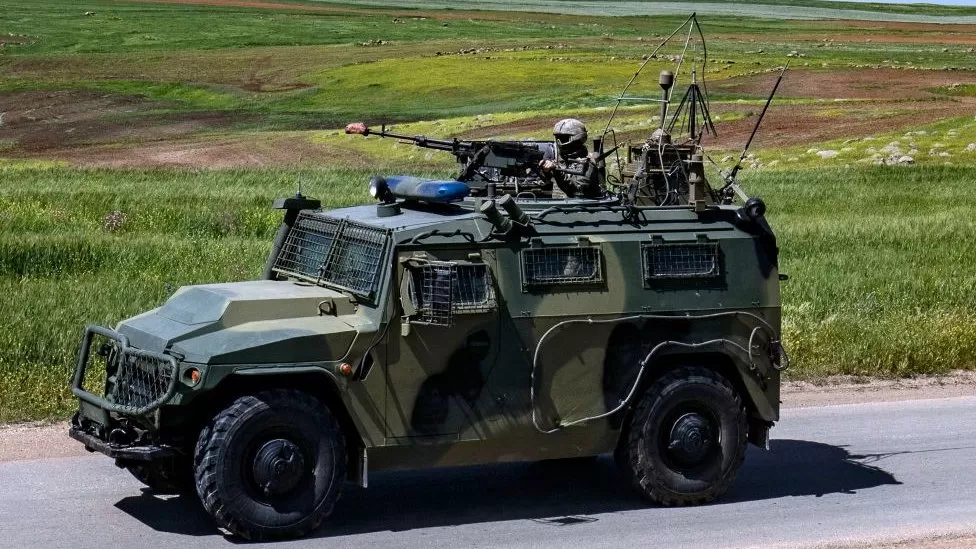
Turkish forces have killed the suspected leader of the Islamic State (IS) group in Syria, Turkey’s President Recep Tayyip Erdogan has announced.

Abu Hussein al-Qurayshi is said to have taken over the group after his predecessor was killed last autumn.

Mr Erdogan told broadcaster TRT Turk the IS leader was “neutralised” in a Turkish MIT intelligence agency operation on Saturday.

IS has so far made no comment on the reported operation.

The BBC has been unable to independently verify President Erdogan’s claim.

The MIT intelligence agency had been following Qurayshi for a “long time”, Mr Erdogan said.

“We will continue our struggle with terrorist organisations without any discrimination,” he added, providing no further details.

Syrian sources quoted by Reuters news agency said the operation took place in the northern town of Jandaris, close to the Turkish border.

Last November, the jihadist group announced the death of its leader, Abu al-Hassan al-Hashemi al-Qurayshi. The US said he was killed in an operation by the rebel Free Syrian Army in south-west Syria in mid-October 2022.

He took over the group after previous leader Abu Ibrahim al-Hashimi al-Qurayshi set off a blast killing himself and his family as US special forces rounded on his hideout after a gunfight in February 2022.

That operation “removed a major terrorist threat to the world”, US President Joe Biden said at the time.

IS once held 88,000sq km (34,000sq miles) of territory stretching from north-eastern Syria across northern Iraq and imposed its brutal rule on almost eight million people.

The group was driven from its last piece of territory in 2019, but the UN warned in July that it remained a persistent threat.

It is estimated to have between 6,000 and 10,000 fighters in Syria and Iraq, who are based mostly in rural areas and continue to carry out hit-and-run attacks, ambushes and roadside bombings.

IS regional affiliates also pose threats in other conflict zones across the world. The UN said the most vigorous and well-established networks were based in Afghanistan, Somalia and the Lake Chad basin.

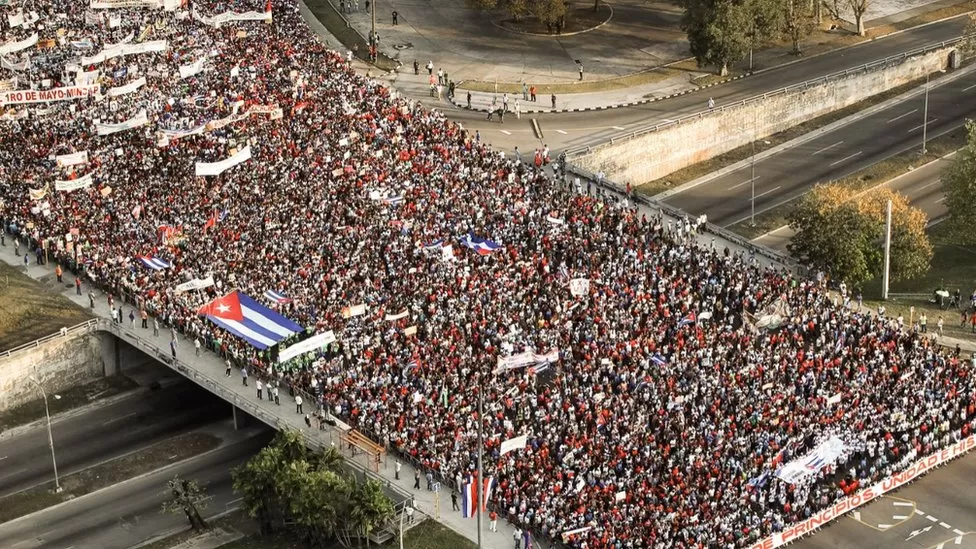
Cuba’s communist government has cancelled Monday’s traditional May Day parade because of acute fuel shortages.

Every year hundreds of thousands of people are bussed in from across the island to fill Havana’s Revolution Square on International Workers’ Day.

It is the first time since the 1959 revolution that the celebrations have been cancelled for economic reasons.

In recent weeks long queues have formed at petrol stations, with drivers often waiting for days.

Earlier this month, President Miguel Diaz-Canel said Cuba was only receiving two-thirds of the fuel it needs, adding that suppliers were failing to fulfil contractual obligations.

While Cuba has access to low-grade crude, the US-sanctioned island lacks the facilities to process it.

Deliveries of higher quality crude from Venezuela, Cuba’s largest provider of fuel, have dropped by 50% in recent years.

Analysts say Venezuela is experiencing severe problems itself and finds it increasingly difficult to subsidise its socialist ally.

The fuel shortages mean Havana drivers can end up waiting for days at petrol stations

The shortages have added to daily pressures faced by Cubans. According to Spain’s El Pais newspaper, a typical monthly salary is $150-200 (£120-160), while a litre of cooking oil costs $30.

The government insists that its state-driven socialist model is best for the country and blames the problems on longstanding US sanctions.

Cuban authorities have traditionally mobilised huge resources to ensure the success of the May Day parade, transporting workers en masse to Havana.

Before this year, the event had only ever been cancelled in 2020 and 2021, because of the Covid pandemic.

Local events are expected to go ahead instead, with people marching on foot.

Ulises Guilarte de Nacimiento, the head of the Workers’ Cuba’s main trade union said on Tuesday such acts would highlight “the obstacles to the development programmes due to the ironclad economic blockade”.

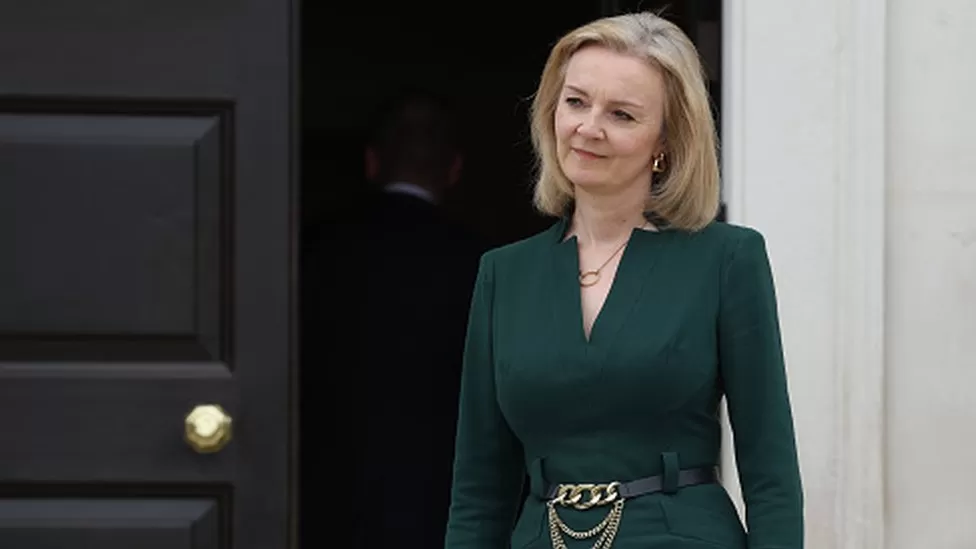
Liz Truss is contesting a government bill relating to her use of the grace-and-favour country house she had access to as foreign secretary.

The former Conservative prime minister has been asked to foot a bill of about £12,000 for costs incurred at Chevening House in Kent.

The bill covers the period last year when Ms Truss was running to be the leader of the Conservative Party.

The government said it was a matter for the Chevening Trust.

Ms Truss was foreign secretary when she used Chevening House in August 2022 as she prepared for power during the Tory leadership contest.

Conservative Party members elected Ms Truss to be leader in September last year, but her government collapsed within 45 days after her tax-cutting mini-budget spooked financial markets.

Chevening, a Grade I-listed, 115-room country house, was left to the nation by 7th Earl Stanhope following his death in 1967.

Since then, it has been up to the prime minister to decide who uses Chevening, with the foreign secretary the usual beneficiary.

The BBC has been told that Ms Truss’s Chevening bill – which was first reported by the Mail on Sunday newspaper – covers missing items, including bathrobes, which she is happy to pay to replace.

But the former prime minister is maintaining that the majority of the invoice relates to using Chevening for government business, meaning she should not be liable for most of the bill.

Those close to Ms Truss have stressed that she will account for all personal expenses incurred.

A government spokesperson said: “Costs and funding relating to Chevening House are a matter for the Chevening Trust.”

And “where appropriate”, the government said it works closely with the Chevening Trust “to ensure costs incurred are allocated accordingly”.

Liz Truss was granted access to Chevening House when she was foreign secretary

The ministerial rulebook states “where ministers host party or personal events in [official] residences it should be at their own or party expense with no cost falling to the public purse”.

A spokesman for Ms Truss said: “Liz always paid for the costs of her personal guests at Chevening.

“The latest invoice contains a mixture of costs for her personally and costs for official government business with civil servants including [Cabinet Secretary] Simon Case and senior officials from other departments who met at Chevening during the transition preparations.

“The latter constitutes the majority of the bill. It would be inappropriate for her to pay the costs for officials as it would have breached the Civil Service Code for civil servants to accept hospitality during the leadership campaign. She has therefore asked for this to be billed separately.”

Ms Truss is still an MP and has spent some of her time giving speeches about her economic philosophy since she left office, with the latest register of interests for MPs showing she received £65,000 for one speaking engagement.

Ms Truss – the shortest-serving prime minister in history – claimed her government was partly brought down by what she called “the left-wing economic establishment”.

She has ruled out running as prime minister again, but is planning to stand again as the MP for South West Norfolk at the next general election.

US Senate passes bill to form AI Task Force

WASHINGTON: The United States Senate presented a bill that would enable the creation of a task force to examine the United States’ policies on artificial intelligence, and specify how best to reduce hazards to privacy, civil freedoms and due process.

The runaway popularity of AI outlets such as ChatGPT and others, which have been used for years to create text, imagery and other content, has spread a rush around the planet to figure out if and how to control its use.

In the US, national security specialists have voiced their apprehensions concerning its use by foreign antagonists, and teachers have grumbled about it being used to fudge in exams and projects.

The job of the AI Task Force, which could contain cabinet members, will be to determine shortfalls in the regulatory supervision of AI and advise reforms if needed.

“There’s going to have to be a lot of education around this set of issues because they’re not well understood,” said Bennet, a Democrat from Colorado. “There’s going to be a lot of improvisation and iterative approaches to try to wrestle with this because AI is so new to everyone in the government.”

Under the bill, the task force would include an official from the Office of Management and Budget, the National Institute of Standards and Technology and the Office of Science and Technology Policy as well as privacy and civil liberties officers from the Departments of Justice, State, Treasury, Defense and other executive branch agencies.

Under the terms of the bill, the task force would work for 18 months, issue a final report and then shut down.

Lawyers warn of nationwide protest if SC stay on bill limiting CJP powers not vacated

QUETTA: The representatives of Bar councils from across the country have expressed their support for the Constitution and warned of countrywide protest if the Supreme Court does not annul its stay order by May 2, issued against the bill clipping the powers of the chief justice of Pakistan (CJP).

The apex court had on April 13, stayed the operation on the Supreme Court (Practice and Procedure) Act 2023. Despite the top court’s stay order, the bill was notified as an act by the federal government on April 21.

On Saturday, a lawyers’ convention was held at the Balochistan High Court under the aegis of the Balochistan Bar Council (BBC) and Pakistan Bar Council (PBC), The News reported.

The convention was attended by vice-chairmen, presidents and representatives of all the provincial bar councils, high court bar associations and district bar associations, who objected to the CJP‘s decision of not forming a larger bench to hear the polls case.

Addressing the convention, Barrister Salahuddin wondered why the CJP always sends sensitive cases to specific judges. He said the current crisis had engulfed the whole country and the judicial crisis was even greater than the issue of elections.

The lawyer said that given the current situation, the CJP should form a larger bench. There must be some reason that the top judge did not form a larger bench, he wondered.

Meanwhile, Advocate Imam Rizvi said that the top court calls upon everyone to create unity, but does not create unity in itself.

IHCBA Vice Chairman Adil Aziz observed the current government and the Supreme Court wanted to bequeath to us such judiciary in which no one will repose trust. He exhorted to revive public and lawyers’ trust in the apex court.

Meanwhile, SHCBA Vice Chairman Arif Abbasi also endorsed Aziz’s point of view, saying if a person does not want a judge to hear his case, the judge should recuse himself from hearing.

Balochistan Bar Council’s Advocate Saleem Lashari was of the view that the current crisis emerged out of the Supreme Court ruling.

“Had the apex court not trampled the Constitution, the crisis would not have emerged. The chief justice should have kept himself aloof from this matter,” he said.

The demand comes as the Supreme Court is set to resume the hearing on pleas challenging the constitutionality of the Supreme Court (Practice and Procedure) Act 2023, on May 2 (Tuesday).