
‘No comments’: US avoids remarks on Pakistan-Iran bilateral ties

As Pakistan made a major breakthrough in its ties with bordering Iran by inaugurating a cross-border marketplace, the United States refrained from commenting on the bilateral ties between the neighbouring countries.

Prime Minister Shehbaz Sharif and Iran’s President Seyed Ebrahim Raisi held a meeting on Thursday after jointly inaugurating the Mand-Pishin border sustenance market in a step aimed at boosting bilateral trade.

“We are aware of this meeting. We do not have any comment to provide on the engagement,” said a US State Department spokesperson in response to Geo News’ question regarding the development in Pakistan-Iran relations.

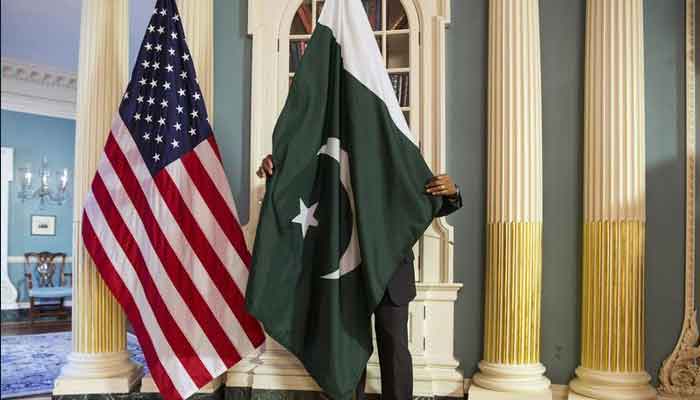
Washington, however, reiterated the importance of its ties with Islamabad, saying that ensuring Pakistan’s economic growth, energy security and environmental sustainability remained a priority for US’ bilateral relationship with Pakistan and “cornerstone” of the Green Alliance.

For the past 20 years, US has been at the forefront of investing in Pakistan, with direct foreign investments of $250 million during the last fiscal year, 2021-22, said the spokesperson.

The State Dept said that the investments by US firms were helping Pakistan to get expanded access to a cleaner, more resilient energy supply.

The spokesperson went on to say that the wind turbines, control systems and equipment of General Electric (GE), which is a US-based multinational conglomerate company, are widely used in Pakistan.

Use of these devices will increase Pakistan’s renewable energy potential, said the spokesperson.

The official further stated that it was for the first time that American technology was being installed at Mangla Power Station. Moreover, GE Hydro France was supplying eight 135 MW generation units, he added.

The spokesperson said that the same equipment could be used for other larger dams under construction, adding that US was also working for the restoration and construction of Mangla and Tarbela dams.

The inauguration of Mand-Pishin border sustenance marketplace is expected to provide a thriving platform for increasing cross-border trade, fostering economic growth, and opening up new avenues of opportunity for local businesses.

It should be noted that this is one of the six border markets which has been constructed along the Pak-Iran border.

After the inauguration, PM Shehbaz Sharif and Iranian president held a meeting to discuss bilateral ties and cooperation.

Following the “very productive and positive” meeting, the prime minister told a gathering of local elders that the two sides had decided to move forward in the areas of trade, investment, information technology, agriculture and other sectors.

The two leaders also decided to exploit the potential for cooperation in the power transmission.

He told the gathering that on his suggestion, the Iranian president also assured to move forward for enhancing cooperation in the solar energy sector.

The prime minister said that during the meeting, he also put forward suggestions regarding the China-Pakistan Economic Corridor (CPEC) and that the two sides would take measures for implementation of the decisions taken in the meeting.

Moreover, a 100MW electricity transmission line stretching from Iran to Gwadar was also inaugurated by the two dignitaries.

The prime minister said the project faced immense delay in the past but the incumbent government ensured its completion in the record time. Iranian President Raisi also took keen interest in the project, he added.

He said the matter related to the power tariff has also been settled amicably with Iranian government, he added.

“This is a great day for Pakistan-Iran friendship and will prove a milestone for the development of the two countries,” the prime minister remarked.
NAB declares PM Shehbaz Sharif ‘innocent’ in Ashiana Housing scandal

LAHORE: The National Accountability Bureau (NAB) on Saturday declared Prime Minister Shehbaz Sharif “innocent” in the Ashiana Housing case, adding that no evidence of corruption was found in the contract of the scheme.

According to a report issued by the accountability bureau, there was no loss to the national kitty nor did PM Shehbaz get any financial benefit from the project.

“It is proved beyond any doubt that the treasury didn’t suffer any loss,” the anti-graft body concluded in its report.

Moreover, it asserted: “No evidence of misuse of powers was found against Shahbaz Sharif.”

The NAB report — which is likely to spark controversy over the impartiality of the corruption watchdog — stated that no aspect of malice was proven against the prime minister in the scandal.

Furthermore, the report stated that Kamran Kayani, brother of former army chief General (retd) Ashfaq Parvez Kayani, also didn’t cause any damage to the treasury.

Moreover, the report found that Fawad Hasan Fawad — who at the time was Secretary Implementation to then-Punjab chief minister Shehbaz — took no bribe to award the contract.

The report added that PM Shehbaz had sent Ashiana case to the anti-corruption watchdog as per the law.

“The accountability court should decide on Shehbaz Sharif’s plea for acquittal according to the law,” the report concluded.

It must be noted that this is the second major NAB case against the prime minister in which he was found innocent.

Earlier this month, the anti-graft watchdog had declared Prime Minister Shehbaz, his son Hamza Shehbaz and others “innocent” in Rs7 billion references against them for assets beyond means and money laundering filed against them.

What is Ashiana Housing scandal?

When it was launched in 2011, the Ashiana-e-Iqbal Housing Scheme was touted as a low-cost housing scheme.

However, soon accusations of irregularity started to pop up as inexplicable delays in ballots and the allotment of completed units began to crop up.

After several years, in 2018, several high-profile politicians came under fire for alleged corruption and misuse of fire, leading to an inquiry by the anti-graft watchdog.

Amongst those accused was PM Shehbaz, who had allegedly misused his powers during his stint as Punjab chief minister in an inquiry pertaining to the Punjab Land Development Company (PLDC).

An inquiry conducted in 2018 claimed that Shehbaz Sharif as the chief minister of Punjab had unlawfully assumed powers of the Board of Directors of Punjab Land and Development Company (PLDC), misused his authority, and acted in connivance with Fawad and others.

Contracts awarded to M/s Ch. A Latif and Sons for the development and infrastructure of the Ashiana Iqbal Housing Project were illegally cancelled and awarded to Lahore Casa Developers (LCD), a proxy group of Paragon City Private Limited.

Moreover, it was alleged that in a meeting on October 21, 2014, the former CM unlawfully directed PLDC to entrust the project of Ashiana Iqbal Punjab to the Lahore Development Authority (LDA) — which was headed by his close aide Ahad Khan Cheema.

This decision of Sharif was considered mala fide as the PLDC was the company that was established for undertaking such housing projects.

All three of the main accused were among those arrested — and subsequently released — during the investigation in 2018.

In September last year, the accountability court — on the PM’s application — granted him a permanent exemption from appearance in the reference.

Modi ‘wants’ normal ties with Pakistan

However, he reiterated India’s oft-repeated position on the issue, saying the “onus is on Islamabad to create a conducive environment free from terrorism and hostilities”.

Pakistan has rejected the Indian stance and earlier this month told India, “Let’s not get caught up in weaponising terrorism for diplomatic point-scoring”.

Mr Modi, while speaking to Japanese publication Nikkei Asia, also mentioned the India-China standoff in eastern Ladakh, saying “Peace and tranquility in the border areas are essential for normal bilateral ties with China”.

He noted that “normalising” the ties would benefit the wider region and the world.

Speaking on India’s economy, the prime minister noted that it has been one of the world’s fastest-growing economies and stressed that the country has moved from being the 10th-largest economy in 2014 to now being the fifth-largest globally.

He added that his government’s aim was to transform India into a developed nation within the next 25 years.

On the Russia-Ukraine conflict, Mr Modi told the publication that India’s position on the Ukraine conflict “is clear and unwavering”.

“India stands on the side of peace and will remain firmly there. We are committed to supporting those who face challenges in meeting their basic needs, especially in the face of rising costs of food, fuel, and fertilisers. We maintain communication with both Russia and Ukraine,” he said.

“Cooperation and collaboration should define our times, not conflict,” he stressed.

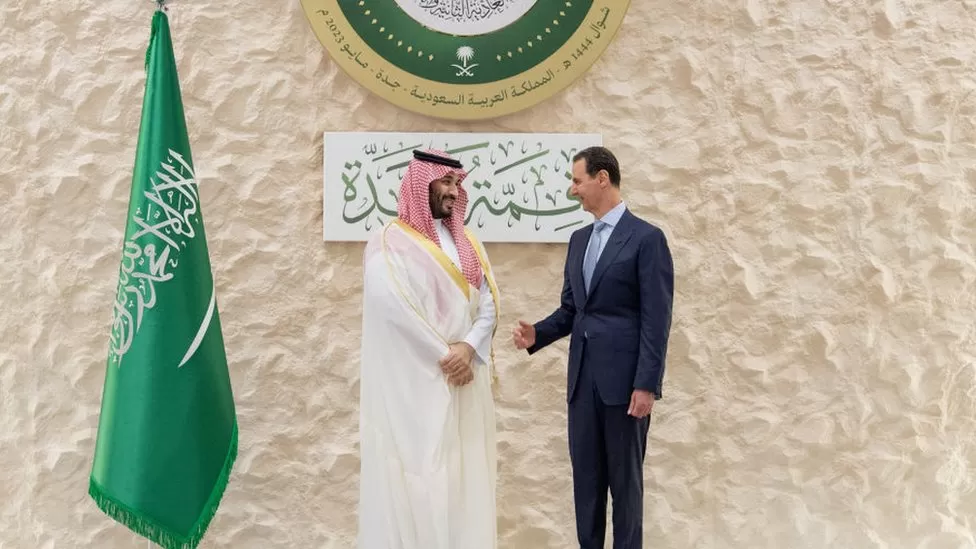
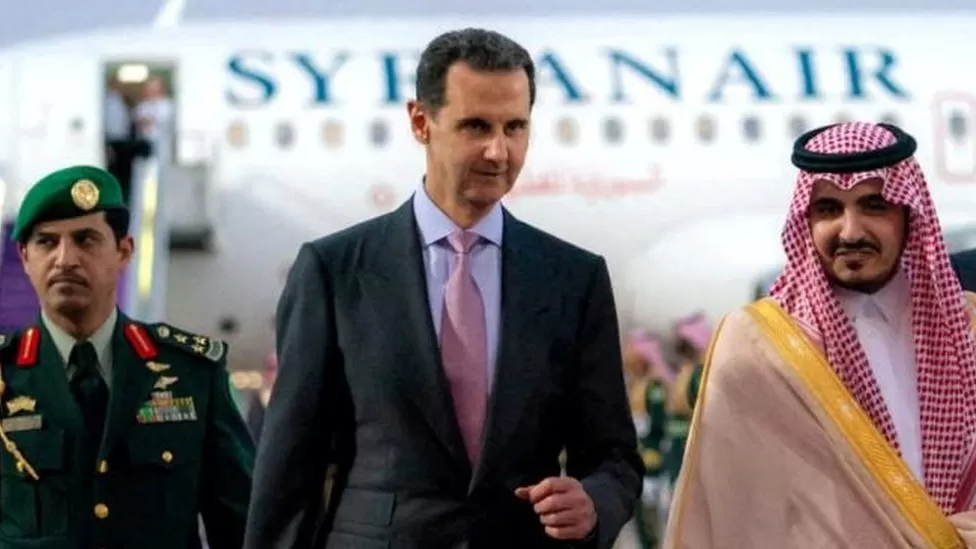
President Bashar al-Assad strode into the Arab League summit in Jeddah, relishing the clearest recognition yet that he has won his war for Syria.

He was embraced by the Saudi Crown Prince Mohammed bin Salman. A decade ago, the Saudis funded anti-Assad militias. Now the prince, known as MBS, wants to remake the Middle East, and he needs Syria onside.

In a speech, President Assad insisted that Syria would always belong to the Arab world. But other countries should not interfere with what happened inside its borders.

“It is important to leave internal affairs to the country’s people as they are best able to manage them,” he said.

By the people, President Assad meant the leader and his supporters. Between them, the princes and presidents at the summit have locked up many thousands of their opponents.

Events in Jeddah are being viewed with dismay by Syrians who blame the Assad regime for destroying their country, including all the Syrian refugees I have spoken to in Lebanon.

Lebanon, small and poor, has had to tolerate well over a million Syrians fleeing the war. That is the equivalent of a quarter of the Lebanese population – something like the UK accepting over 15 million refugees.

Now many Lebanese have had enough, making Syrians a convenient scapegoat for their own country’s chronic economic and political problems.

More than one million Syrians have fled to Lebanon, to escape 12 years of war in their home country

In the last few weeks, the army has deported around 1,500 of them back over the border at gunpoint, sometimes leaving children behind in Lebanon or forcing children out without their parents.

A refugee family speaking on condition that their identities were kept secret talked about life in a town near Beirut where a curfew has been imposed on Syrians.

The children have been thrown out of school. The turmoil in their lives is clear in their teenage daughter’s anguished artwork. Their father views the authoritarian Arab leaders embrace of Bashar al-Assad with contempt – and fear.

“The Assad regime is a dictatorship – the same as the other Arab regimes. They’re helping each other, cooperating against the people.”

In a refugee camp in Lebanon’s Bekaa Valley, Assad’s presence in Jeddah was another crushing blow. Nasser and Marwa, a couple who’ve been here since 2013, fear Assad’s return to the Arab League might be an excuse for more deportations.

Marwa said she woke up every morning thanking God she hadn’t been deported.

“Now we’re always afraid of the raids. I always imagine that they will come and take all the men and deport them.”

Nasser said he faced being drafted into the army if he went back. He escaped Syria to avoid fighting for the regime. He’s desperately worried about what would happen to his wife and their 18-month-old daughter Lillas if they are forced back.

Nasser, Lillas and Marwa live in fear of deportation back to Syria

Nasser was disgusted with the Arab League’s decision to readmit Assad’s Syria.

“After everything that he’s done, they’re hosting him. I don’t understand it, after all the killing and destruction, and the misery in Syria – it’s not acceptable.”

Syria, and the Assad regime, remain under US and European sanctions. Amnesty International, the human rights group, said that the president “turned Syria into a slaughterhouse”.

The UK government, Amnesty said, should “strenuously oppose any attempt to bolster Assad’s international standing”.

Some members of the Arab League agree. Qatar, which also funded the armed opposition in Syria, does not approve of Assad’s gradual return to Arab respectability.

But as well as the wider geopolitical plans of Saudi Arabia and the United Arab Emirates (UAE), who believe the Assad regime is a Middle Eastern reality and Syria a country they need to influence, there are other reasons for wanting to court Assad.

Jordan, as well as the Saudis, are fighting the spread of a narcotic drug called Captagon, which is made in Syria and smuggled into their countries. It is an amphetamine that was given to fighters to boost their endurance but is now widely used as a recreational drug.


The US and UK have imposed sanctions on named members of the Assad family who they say are heavily involved in the Captagon trade. Some estimates say the business is worth more than $50 billion (£40bn) a year.

Other Arab states are fighting the trade in Captagon, made in Syria and smuggled abroad

At the United Nations, which runs a huge relief operation in Syria and Lebanon, there is cautious hope Syria’s readmission to the Arab League might somehow become a circuit breaker that allows diplomatic progress.

Imran Riza, the UN’s deputy special coordinator for Lebanon, tried to find a positive.

“If what’s happening now in the region is going to help to get us to a political solution then it’s a good thing.”

But the UN does not support forced repatriation. It insists that Syrian refugees cannot return home until their country is safe and secure. That is a long way off.

President Bashar al-Assad broke his country to save his regime. There has been no justice for his victims.

But there is a lesson for ruthless, authoritarian leaders, not least his close ally, Russia’s President Vladimir Putin, whose decisive military intervention in 2015 helped the Assad regime to victory.

Wait out the storm and you can outlast your enemies.

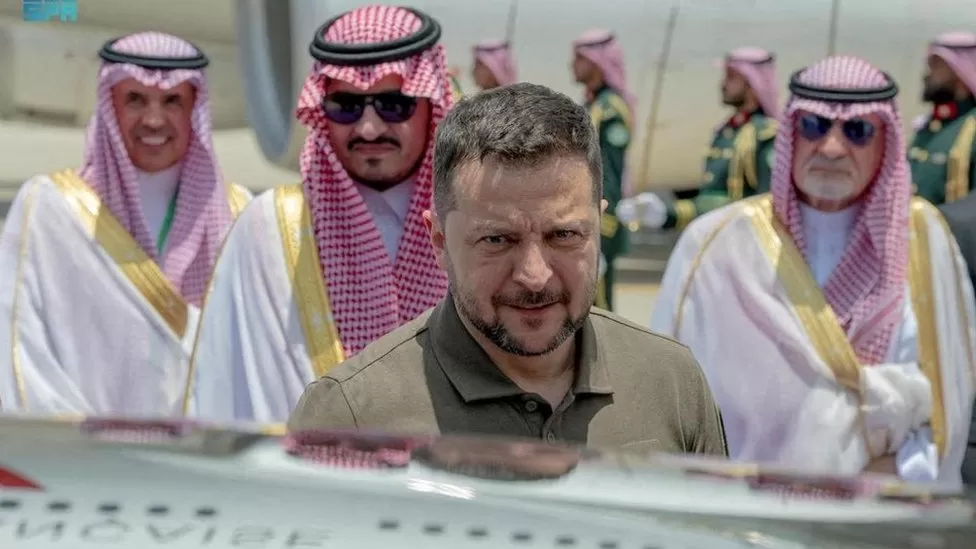
Volodymyr Zelensky has accused some Arab leaders of “turning a blind eye” to Russia’s invasion of Ukraine, ahead of his trip to the G7 in Japan.

The Ukrainian president made the comments while attending an Arab League summit in Saudi Arabia on Friday.

Of the Arab League nations, only Syria has openly supported Russia’s invasion. Others have sought to maintain good relations with Moscow.

But some states must reflect on their ties with Russia, Mr Zelensky said.

“Unfortunately, there are some in the world and here among you who turn a blind eye to those [prisoner of war] cages and illegal annexations,” said Mr Zelensky.

“I’m here so that everyone can take an honest look, no matter how hard the Russians try to influence, there must still be independence.”

Mr Zelensky also told the assembled leaders in Jeddah that his country was defending itself from colonisers and imperialists, appearing to invoke the Arab world’s own history of invasion and occupation.

Host nation Saudi Arabia has walked a delicate line on the conflict – on the one hand supporting a UN resolution calling for Russia to withdraw its troops and pledging $400m in humanitarian aid to Ukraine, while on the other hand resisting imposing sanctions on Russia, preferring to see itself as neutral on the conflict.

Saudi Crown Prince Mohammed bin Salman renewed his offer for Saudi Arabia to mediate between Moscow and Kyiv to end the fighting at the summit.

Syria meanwhile has only just been readmitted to the Arab League – its leader Bashar al-Assad told the summit there was an historic opportunity for the region to reshape itself without foreign interference.

Mr Zelensky also took aim at Iran, which is not a member of the Arab League, for supplying Shahed drones to Russia. Iran denies supplying drones for the conflict.

The Ukrainian leader will travel from Saudi Arabia to the G7 summit on Sunday, Japan confirmed on Saturday morning. Officials said he will take part in the summit’s leaders’ session and take part in a bilateral meeting with Japanese Prime Minister Fumio Kishida.

Earlier, Mr Zelensky’s office also told Ukrainian media that he would meet with US President Joe Biden “in the next few days” in Japan.

The summit kicked off on Friday with a renewed condemnation of Russia and an announcement of further sanctions.

The group of seven nations, made up of the US, UK, France, Italy, Germany, Canada and Japan, represent the world’s richest democracies. This year, eight other countries including Australia and India have also been invited.

G7 leaders slapped more sanctions on Russia on the summit’s opening day

The trip to Japan will be the furthest Mr Zelensky has travelled from Kyiv since the war began in February 2022.

In the past few days Mr Zelensky has visited Italy, Germany, France and the UK, where he nailed down promises of military support. He also continues to push allies to provide advanced fighter jets to Ukraine, but so far no country has committed to directly providing them.

Once he reaches Hiroshima he will probably try to persuade more cautious leaders to provide aid, such as Mr Kishida and Indian leader Narendra Modi.

“By showing up in person, it is a chance for him to ensure he does not come away empty-handed, and that he will head back to Kyiv his arms full with the weapons deals that he wants”, including a promise of lethal weapons from Japan, said John Kirton, director of the G7 Research Group think tank.

Though Japan has been hugely sympathetic to Ukraine, its strict military laws have meant that so far it has only given non-lethal defence equipment.


Earlier on Friday, G7 leaders were welcomed by Mr Kishida at the Hiroshima Peace Memorial Park where they laid wreaths to honour those who died in the US atomic bombing which hastened the end of World War Two.

The summit’s first day ended with a statement in which member countries pledged “new steps” to stop the war in Ukraine and promised further sanctions to “increase the costs to Russia and those who are supporting its war effort”.

They said they would “starve Russia of G7 technology, industrial equipment and services that support its war machine” and limit Russia’s revenue from energy and diamond sales.

Separately, British PM Rishi Sunak told the BBC the UK would sanction the Russian diamond industry, and would target more people and companies connected to Russian President Vladimir Putin.

In response to what it termed “anti-Russian” US sanctions, the Russian foreign ministry announced its own set of sanctions on 500 US citizens, including former US President Barack Obama.

The G7 summit, which ends on Sunday, is expected to end with a communique on the war in Ukraine.

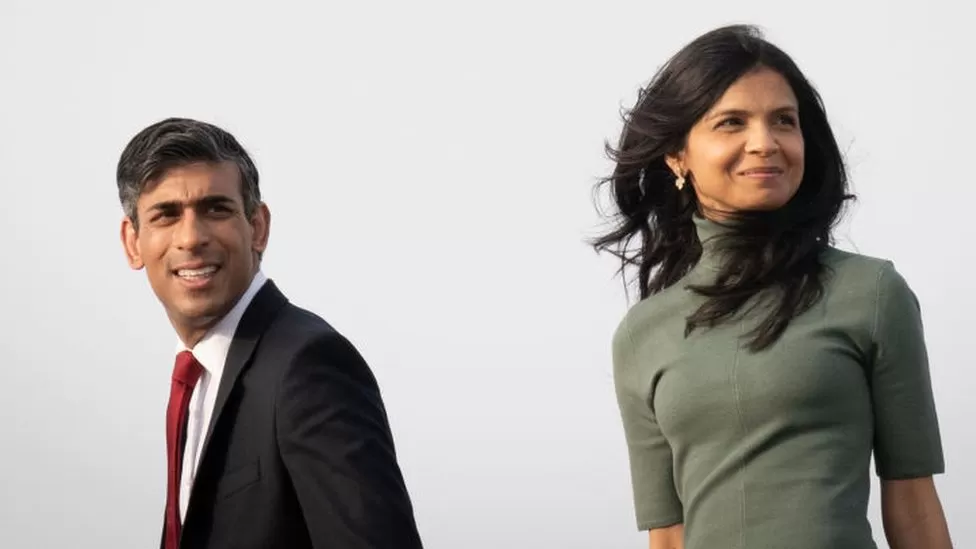
Prime Minister Rishi Sunak has said personal attacks from Labour on him and his family “don’t bother me”.

Mr Sunak told reporters the public were more interested in whether the government was improving their lives.

Labour’s attacks on the PM have become increasingly personal in recent weeks, with the party accusing him of being out of touch because of his wealth.

It has also criticised Mr Sunak’s wife, Akshata Murty, for previously benefitting from non-dom tax status.

Asked by journalists during his visit to Japan for the G7 summit whether comments about his wealth and upbringing were fair game, Mr Sunak said: “These things generally don’t worry me.

“I don’t think most people sitting at home actually are much bothered about these things either. What they care about is what am I doing for them to make their lives better.”

He added: “I think we’ve moved beyond judging people by what’s in their bank account. I think they’re interested in whether I’m going to deliver for them and their families.”

Asked whether it was hurtful when Labour leader Sir Keir Starmer talked about his family, Mr Sunak said: “These things don’t bother me.”


In recent sessions of Prime Minister’s Questions, Sir Keir has accused the prime minister of being “clueless about life outside his bubble”.

In the run-up to the local elections in England earlier this month, Labour also put out a number of adverts on Twitter attacking Mr Sunak personally.

The most controversial claimed the prime minister did not think adults convicted of child sexual assaults should go to prison.

Sir Keir defended the advert, saying it highlighted the government’s failures on crime, but there was uneasiness about the move among some in Labour.

Another advert criticised Mr Sunak for raising taxes on working people, while his family benefitted from “a tax loophole” – a reference to his wife’s non-dom status.

Last year, it emerged that Mr Sunak’s wife had non-dom status, which allows people living in the UK to avoid paying UK tax on money made abroad.

At the time Mr Sunak, who was then chancellor, described criticism of his wife as “unpleasant smears”, arguing it was unfair to attack a private citizen.

He has also previously admitted he found it “very upsetting” when his wife faced criticism over shares she owned in a tech company operating in Russia.

CM Naqvi shares proof of political party’s involvement in May 9 attacks with ECP

LAHORE: The interim government in Punjab shared solid proof including pictures, videos and messages about the involvement of a political party in the May 9 incidents with the Election Commission of Pakistan (ECP) members

They met Chief Minister Punjab Mohsin Naqvi at the CM Office on Thursday and strongly condemned the terrorist incidents, expressing complete solidarity with the Pakistan Army.

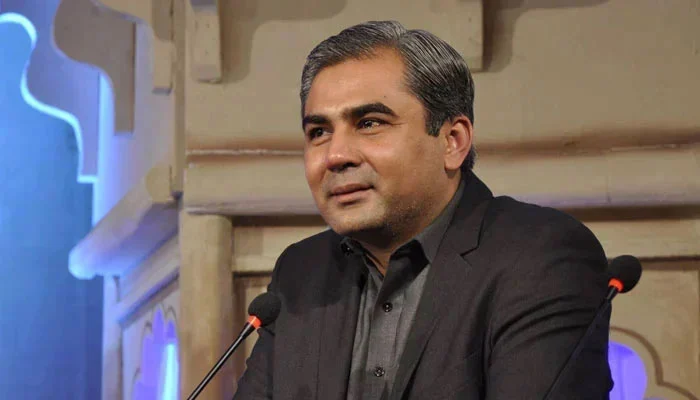
CM Mohsin Naqvi told the meeting, which was also attended by Chief Election Commissioner (CEC) Sikandar Sultan Raja, that a political party brought disgrace to the whole nation on May 9, adding that attacks on military installations were carried out under a planned strategy.

He added that the investigators were able to find proof of contact between the attackers and the political leadership at Zaman Park through geo-fencing.

The CM claimed that according to initial estimates, the country suffered Rs6 billion losses due to the May 9 attacks.

On the other hand, the CEC acknowledged that the Punjab government undertook excellent steps for the protection of the masses amid the current situation.

He said the ECP was fully satisfied with the provincial government, as it was performing its duties with honesty. The ECP wants to ensure a fair, just and peaceful general election in the country, he added.

“We are not affiliated with any political party and we have no political motives,” he reiterated.

Raja underscored that the ECP had always made decisions on merit, adding that the caretaker government was also impartial, and holding free and fair elections was also its mandate.

The CEC said the security steps for holding the general election would be reviewed again and the ECP would provide all possible assistance to the Punjab government for the elections.

He said the provincial authorities should not succumb to any pressure as the ECP was fully supporting it.

During the meeting, Inspector General of Punjab Police (IG) Dr Usman Anwar briefed the ECP officials about details of attacks at the Lahore corps commander’s house (Jinnah House) and other military installations on May 9.

‘Six more terrorists fleeing from Zaman Park arrested,’ CCPO Lahore claims

LAHORE: Lahore Capital City Police Officer (CCPO) Bilal Siddique Kamyana on Friday claimed to have arrested six more “terrorists” fleeing from Zaman Park, taking the total number of miscreants nabbed after the expiry of the deadline to 14.

The city police chief said that four of them were named in the Askari Tower attack case while the other two were involved in the ransacking of the Jinnah House.

The Punjab government had given 24 hours to Pakistan Tehreek-e-Insaf (PTI) on Wednesday to hand over terrorists or face action. However, the provincial authorities later decided to hold talks with the PTI chief before launching a search operation.

PTI-govt talks after Friday prayers

Adhering to the instructions of Punjab Caretaker Chief Minister Mohsim Naqvi, a negotiation team headed by Lahore Commissioner Muhammad Ali Randhawa will reach Zaman Park today after the Friday prayers for talks with PTI.

According to sources, the government’s team is likely to reach Zaman Park around 2pm to discuss search opertaion at PTI chief’s Lahore residence with party representatives.

The sources added that if both sides agree, 400 police personnel are likely to be part of the search team as the 24-hour deadline given to PTI by the Punjab Interim Information Minister Amir Mir to handover “30-40 terrorists hiding in Zaman Park” ended a day earlier.

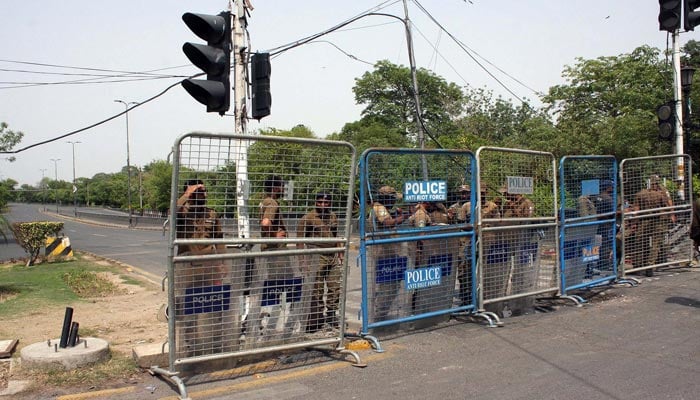
Ahead of the meeting, the road between Mall Road and Dharmapura in Lahore has been closed off by the police, while all the roads leading to Zaman Park have been cordoned off.

‘Cash prizes for those identifying accused persons’

During a meeting, held to review the law and order situation in the province, Naqvi ordered that the cases registered against the miscreants involved in May 9 violence must be pursued with full force and that the “fugitives” should be arrested as soon as possible.

The meeting took stock of the situation and took decisions to ensure peace.

The participants approved cash prizes for those identifying the accused persons involved in terrorist incidents that took place after PTI Chairman Imran Khan’s arrest last week.

The participants of the meeting also expressed concerns over the alleged facilitation of the accused involved in an attack on the Inter-services Intelligence (ISI) office in Faisalabad.

Those accused of being involved in the attack include Ali Afzal Sahi, who is reportedly a close relative of a judge, amongst others.

It was also decided that a reference would be sent against a judge for providing extraordinary facilities to terrorists, while the “illegal and unconstitutional facilitation” of those accused of the violence will also be challenged.

“Facilitation of the suspects is equivalent to murder of justice,” the meeting maintained.

‘On-camera search operation’

A day earlier, Mir had said that law enforcers will conduct a search operation at Khan’s Lahore residence after his permission and in front of cameras to apprehend “terrorists”.

“We [the interim government] have decided that instead of a head-on collision, we will send a delegation to Khan sahab under the supervision of the Lahore commissioner,” Mir told Geo News’ Shahzeb Khanzada.

Mir during the show also shared that interim CM Naqvi had conducted a meeting yesterday, in which it was decided that a delegation would take an appointment from Khan’s team and meet him after Friday prayers today.

“They will ask him [Khan] to allow them to conduct a search operation. A police party — comprising 400 personnel — will accompany the delegation as there is a reported presence of terrorists,” he said.

Khan yesterday asked law enforcers to conduct a search operation at his residence but noted that they should carry valid search warrants with them.

“If he does not permit the delegation to conduct the search, then we will decide our strategy, but for now, we will want things to be conducted in a positive manner,” the minister added.

More than 20 rivers have burst their banks in Italy, leaving 13 people dead and forcing thousands from their homes after six months’ rainfall fell in a day and a half.

More bodies were found on Thursday after almost every river flooded between Bologna and the north-east coast 115km (70 miles) away.

Some 280 landslides have taken place.

The mayor of Ravenna, a city badly affected by flooding, told the BBC it was the worst disaster in a century.

Michele de Pascale described the damage caused by the floods as catastrophic, costing people in his city and the wider region their homes, possessions and for some, their lives.

“It was a very bad 48 hours. Water and mud took over our whole village,” said Roberta Lazzarini, 71.

Her home of Botteghino di Zocca, south of Bologna, was hit by a torrent on Wednesday. Streets, houses and gardens were inundated and Roberta said she was still scared.

“I’ve never seen anything like that here. We were stuck and didn’t know what to do. I just hope it doesn’t happen again.”

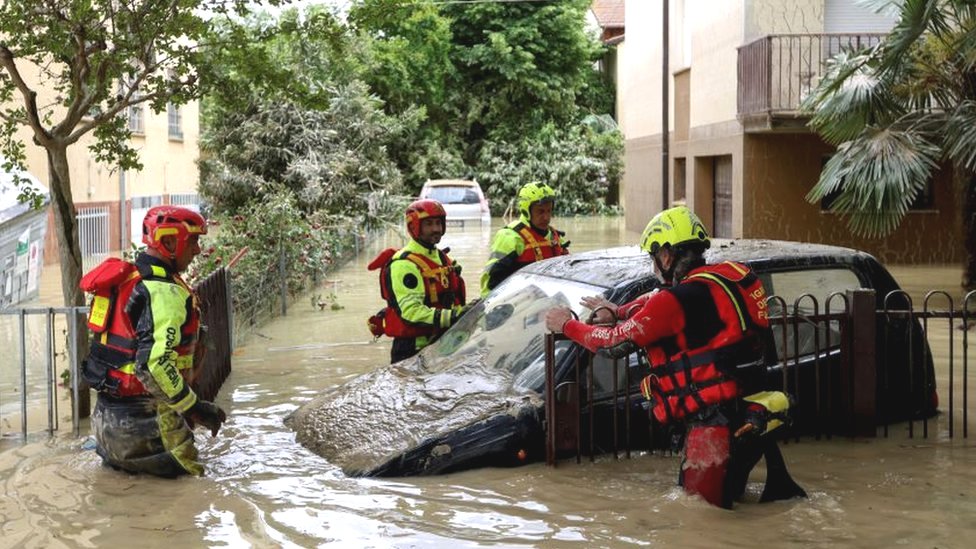
Firefighters helped residents flee their houses, including a 97-year-old woman who had to leave her bedroom in a rubber dinghy.

The historic centre of Lugo, outside Ravenna was among the cities with the worst flooding

“Our community is broken,” said Roberta’s daughter, Ines, who runs the local cafe in the central square. “We felt completely cut out, isolated, some of us were truly terrified.”

“We’ve had floods before, but it has never been this bad as far as I can remember,” said Lamieri, 74, as he removed mud from his basement, where his son stores products to sell at the souvenir shop he runs in central Bologna.

“The street turned into river. We lost all of our stuff which was stored down here. We estimate thousands of euros in damage.”

This is one of many villages and towns flooded in the province of Emilia-Romagna, not just from rivers, but overflowing canals too.

More evacuations took place west of Ravenna on Thursday and more bodies were found, including a couple in a flat in the village of Russi, which was flooded hours before.

Many are warning that Italy needs a national plan to respond to the effects of climate change.

Civil Protection Minister Nello Musumeci said tropical conditions had already reached Italy, with 20cm of rain falling in 36 hours, and in some areas up to 50cm.

“Soils that remain dry for a long time end up becoming cemented, drastically limiting their capacity to absorb water,” he said.

No regional dams had been built for 40 years, he said, and a new approach to hydraulic engineering was needed.

Prime Minister Giorgia Meloni’s government has called a crisis meeting next Tuesday.

The leader of Italy’s opposition Democratic Party told the BBC the whole political system was to blame for the disaster and politicians had not done enough to address challenges posed by climate change.

Elly Schlein, who was formerly vice-president of Emilia-Romagna, said successive governments had consistently failed to address Italy’s vulnerability to flooding and other extreme water events like droughts.

Many factors contribute to flooding, but a warming atmosphere caused by climate change makes extreme rainfall more likely. Already, the world has warmed about 1.1C since the industrial era began, and temperatures will continue to rise unless governments around the world make steep cuts to emissions.

Antonio Francesco Rizzuto, a 55-year-old lawyer who lives by the river with his wife, was forced to leave on Tuesday night and is now living at his daughter’s in a nearby village.

“It was something no-one was expecting in these proportions,” he said. “Before we left our house, the water level was getting higher by the minute. When we got back yesterday… our living room was completely submerged. We will have to throw away most of our furniture.”

1px transparent line

Stefano Bonaccini, regional president of the Emilia-Romagna region, said the damage costs ran into billions of euros.

Overnight, evacuations were ordered in towns to the west of Ravenna. Residents in Villanova were ordered to seek shelter on upper floors, a day after floodwater cascaded through the historic centre of Lugo.

Lugo was flooded again on Thursday, as was Cervi, on the coast.

Rescue operations in the small village of Massa Lombarda, about 10 km from Imola

This weekend’s Emilia-Romagna Grand Prix at Imola was called off because of the risk of the nearby Santerno river flooding. Many of the areas around the track used for parking and watching the race were deluged on Tuesday.

As well as the 23 rivers that burst their banks, the Zena stream turned into a raging torrent in Botteghino di Zocca.

Lino Lenzi, 80, was standing in what used to be his daughter’s garden, which was now overflowing with mud, his grandchildren’s toys submerged.

“I’ve lived here for 70 years and I’ve never seen anything like this,” he said, “the water is everywhere.”

Syria’s President Bashar al-Assad is to attend an Arab League summit for the first time since it was suspended from the regional body 12 years ago.

Mr Assad was shunned by many fellow leaders after his government’s violent crackdown on pro-democracy protests triggered a civil war in which half a million people have been killed.

Syria was readmitted this month after states which had backed the opposition accepted his grip on power was secure.

They include summit hosts Saudi Arabia.

The rapprochement accelerated following the devastating earthquake that hit Turkey and north-western Syria in February, when once-hostile powers decided to send humanitarian aid to Syrian government-controlled areas.

China also brokered a surprise agreement in March that saw Saudi Arabia restore diplomatic ties with its long-time regional rival Iran, which along with Russia has helped Mr Assad’s forces regain control of Syria’s biggest cities.

Large parts of the country are nevertheless still held by Turkish-backed rebels, jihadists, and Kurdish-led militia fighters supported by the United States.

Half of Syria’s pre-war population of 22 million have had to flee their homes. Some 6.8 million people are internally displaced, while another 6 million are refugees or asylum-seekers abroad.

Even before the earthquake struck an estimated 15.3 million people inside Syria were in need of some form of humanitarian assistance – an all-time high since the war began.

Syria’s civil war has left half a million people dead, devastated cities and drawn in other countries

President Assad arrived on Thursday night in the Red Sea port city of Jeddah, where this year’s Arab League summit is taking place.

At a meeting of the foreign ministers of the 22 member states on Wednesday, Arab League Secretary General Ahmed Aboul Gheit declared that he hoped that “Syria’s regaining of its seat is a precursor to the end of its conflict”.

Saudi Foreign Minister Prince Faisal bin Farhan Al Saud also welcomed Syria.

“Our world today is facing numerous challenges and difficulties that place us at a crossroads,” he said. “It is necessary for us to stand together and try harder to strengthen joint Arab action to meet them.”

But not every country was enthusiastic about Syria’s reinstatement.

Qatar’s foreign minister told a news conference in Doha that it had dropped its opposition only because it did not want to “deviate from the Arab consensus”.

The US meanwhile said it did “not believe that Syria merits readmission”.

“Our position is clear – we are not going to normalise relations with the Assad regime, and we certainly don’t support others doing that as well,” state department spokesman Vedant Patel told reporters.