Maryam says ‘PTI can now easily fit in a Qingqi’ after defections

Pakistan Muslim League Nawaz (PML-N) Senior Vice President Maryam Nawaz took a jibe at the Pakistan Tehreek-e-Insaf (PTI) saying the entire opposition party can fit in a Qingqi rickshaw following defections in the wake of May 9 violence.

“Today he himself is the president, general secretary, chief organiser and spokesperson of the party and the only candidate of his party,” she said while referring to PTI chief Imran Khan.

The ruling party leader made these remarks while addressing the PML-N’s youth convention in Punjab’s Shujabad city on Sunday.

At the rally, the PML-N stalwart was also coronated with gold tiara studded with beautiful pearls.

Unlike PTI, Maryam said the PML-N did not dismantle because “it is the people’s party and not a fake party”.

She said the PTI “which was formed after the hard work of 26 years, disintegrated in 26 minutes”.

She said the real enemy of the country was identified after May 9 tragedy which saw attacks on public and military installations in many parts of the country following the arrest of the PTI chief.

“The chapter of chaos and anarchy has ended and now the journey of progress will begin,” the PML-N leader added.

Dozens of PTI leaders including Shireen Mazari, Fawad Chaudhry, Aamir Mehmood Kiani, Ali Zaidi and other shave quit the party over May 9 mayhem while senior leaders including Asad Umar and Parvez Khattak stepped down from party positions citing the same reason.

Several PTI deserters have joined Istihkam-e-Pakistan Party (IPP) launched by sugar baron Jahangir Tareen with an aim to “set new direction in the country’s politics”.

‘Best budget’

Maryam also hailed Prime Minister Shehbaz Sharif and Finance Mnister Ishaq saying they presented the “best budget” despite difficult economic situation.

She said the PM and finance minister “saved the country” from default without the International Monetary Fund (IMF) bailout package.

“Even in difficult economic conditions, the salaries of government employees of up to grade 16 were increased by 30%,” she said.

She said the country’s economy would take off when PML-N supremo Nawaz Sharif, who has been living London since November 2019 on medical grounds, returns to the country.

Finance Minister Dar on Friday unboxed a Rs14.46 trillion budget for the fiscal year 2023-24, introducing “no new taxes” and envisaging an economic growth of 3.5% as the crisis-riven country looks to persuade the IMF to release more bailout money.

Cyclone Biparjoy live updates: India, Pakistan on high alert

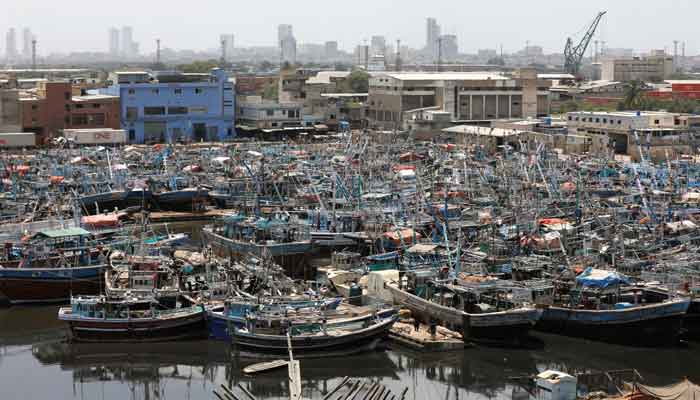
Authorities in Indian and Pakistani coastal areas were put on high alert to deal with the extremely severe cyclonic storm (ESCS) “Biparjoy” that is moving closer and likely to hit on 15th June.

The cyclone over the east-central Arabian Sea moved northwards with a speed of 05 kmph and lay centred over the same region near latitude 19.0°N and longitude 67.7°E, about 540 km west of Mumbai (India) and 660 km south of Karachi (Pakistan).

It is very likely to move nearly northward till the morning of 14th June, then move north northeastwards and cross Saurashtra and Kutch coasts between Mandvi (Gujarat) and Karachi (Pakistan) by noon of 15th June as a very severe cyclonic storm with a maximum sustained wind speed of 125-135 kmph gusting to 150 kmph.

Possible impacts on Pakistani coastal areas:

— With its probable approach to the southeast Sindh coast, widespread wind-dust/thunderstorm rain with some very heavy/extremely heavy falls accompanied with squally winds of 80-100Km/hour likely in Thatta, Sujawal, Badin, Tharparker and Umerkot districts during 13-17 June.

— Dust/thunderstorm-rain with few heavy falls and accompanied with squally winds of 60-80 Km/hour likely in Karachi, Hyderabad, Tando Muhammad Khan, Tando Allayar, Mirpurkhas districts from 13/14 June -16 June.

— Squally (high intensity) winds may cause damage to loose & vulnerable structures (Kutcha houses).

— Storm surge of 3-3.5 meters (8-12 feet) is expected at the land falling point (Keti Bandar and around).

— Fishermen are advised not to venture in the open sea till the system is over by 17 June, as the Arabian Sea conditions may get very rough/high accompanied with high tides along the coast.

Possible impacts on Indian coastal areas:

— Light to moderate rainfall at most places with heavy to very heavy rainfall at isolated places very likely over Kutch, Devbhumi Dwarka, Porbandar, Jamnagar, Rajkot, Junagarh and Morbi districts of Saurashtra and Kutch on 14th June.

— The intensity of rainfall would increase with heavy to very heavy rainfall at a few places and extremely heavy falls at isolated places very likely over Kutch, Devbhumi Dwarka and Jamnagar and heavy to very heavy rainfall at a few places over Porbandar, Rajkot, Morbi and Junagarh districts of Gujarat on 15th June.

— Isolated heavy rainfall is very likely over the remaining districts of Saurashtra and north Gujarat region on 15th June.

CM Murad Shah takes aerial view of coastal areas

KARACHI: Sindh Chief Minister Murad Ali Shah on Monday took an aerial view of Badin, Sujawal and Thatta’s coastal belt amid cyclone Biparjoy threat.

The cyclone is expected to make landfall along the Sindh’s coast on June 15. The provincial authorities have planned to evacuate at least 10,000 people and shift them to safer places.

Minister for Local Bodies Nasir Ali Shah and the chief secretary were also present with the chief minister.

Sindh to begin evacuation along coastline

As the risk of tropical cyclone Biparjoy present in the Arabian Sea escalates, the government has decided to evacuate the residential areas and other human settlements near the coast of Sindh.

Karachi to receive heavy rain

Sindh Chief Meteorologist Sardar Sarfaraz, talking to Geo News, forecast heavy rains in Karachi, Hyderabad, Nawabshah Sanghar, and Tando Mohammad Khan due to the storm.

He said rains might hit these areas on June 14 or 15, while heavy winds would blow at a speed of 70 kilometers per hour.

300-400mm rain in cyclone-hit areas

In conversation with Geo News, Sindh Chief Meteorologist Sardar Sarfaraz said that the cyclone’s direction would remain towards the northeast and hit Keti Bandar (Thatta) on June 15.

He said 300mm-400 mm of rain is expected in the areas where the storm passes. Therefore, heavy rains are expected in Thatta, Sajawal, Badin, Mirpur Khas, and surrounding areas in South East Sindh.

NDMA continuously monitoring cyclone

National Disaster Management Authority says they are continuously monitoring the cyclone and necessary instructions are being given to relevant quarters.

India Meteorological Department says Biparjoy currently lies over east-central and adjoining NE Arabian Sea about 380km SSW of Devbhumi Dwarka.

‘Nothing wrong’ with nuclear deal with West, says Khamenei

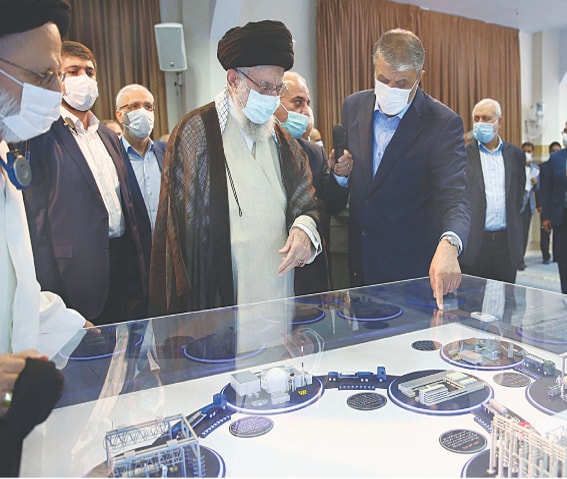
DUBAI: Iran’s supreme leader on Sunday said a deal with the West over Tehran’s nuclear work was possible if the country’s nuclear infrastructure remained intact, amid a stalemate between Tehran and Washington to revive a 2015 nuclear pact.

Months of indirect talks between Tehran and Washington to salvage the nuclear accord with six major powers have stalled since September, with both sides accusing each other of making unreasonable demands.

Ayatollah Ali Khamenei’s guarded approval comes days after both Tehran and Washington denied a report that they were nearing an interim deal under which Tehran would curb its nuclear programme in return for sanctions relief.

“There is nothing wrong with the agreement (with the West), but the infrastructure of our nuclear industry should not be touched,” Khamenei said, according to state media.

A US State Department spokesperson declined specific comment on Khamenei’s remarks, reiterating the Biden administration stance that the United States “is committed to never allowing Iran to acquire a nuclear weapon.”

“We believe diplomacy is the best way to achieve that goal on a verifiable and durable basis, but the President has also been clear that we have not removed any option from the table,” he said, alluding to the possibility of military action.

“We will not characterise the nature of an Iranian leader’s remarks,” the spokesperson added.

The 2015 agreement limited Iran’s uranium enrichment activity to make it harder for Tehran to develop nuclear arms, in return for lifting international sanctions.

Then-US President Donald Trump exited the pact in 2018 and re-imposed sanctions that have crippled Iran’s economy, leading Tehran to gradually move well beyond the deal’s nuclear restrictions and reviving US, European and Israeli fears that Iran may seek an atomic bomb.

Echoing Iran’s official stance for years, Khamenei said the Islamic Republic has never sought to build a nuclear bomb.

“Accusations about Tehran seeking nuclear weapons is a lie and they know it. We do not want nuclear arms because of our religious beliefs. Otherwise, they (the West) would not have been able to stop it,” Khamenei said.

Khamenei, who has the last say on all state matters, said the country’s nuclear authorities should continue working with the UN nuclear watchdog “under the framework of safeguards.”

However, Khamenei called on Iranian authorities not to yield to the International Atomic Energy Agency’s (IAEA) “excessive and false demands”, adding that a law passed by Iran’s hard-line parliament in 2020 had to be respected.

Under the law, Tehran would suspend IAEA inspections of its nuclear sites and step up uranium enrichment if sanctions are not lifted.

“This is a good law … which must be respected and not violated in providing access and information (to the IAEA),” Khamenei said.

Last month, the IAEA reported limited progress over disputed issues with Iran, including re-installing some monitoring equipment originally put in place under the 2015 pact that Tehran ordered removed last year.

Scotland’s First Minister Humza Yousaf is facing calls to suspend his predecessor Nicola Sturgeon from the Scottish National Party after her arrest on Sunday.

Ms Sturgeon was questioned by police and released without charge as part of an investigation into the SNP’s funding and finances.

The former party leader said she was “innocent of any wrongdoing”.

An SNP spokesman said the party was co-operating fully with the investigation.

The force has been investigating for the past two years what happened to £660,000 of donations given to the SNP by independence activists for use in a future independence referendum campaign.

SNP MP Angus MacNeil joined opposition parties in calling for Ms Sturgeon to be suspended from the party – saying “this soap-opera has gone far enough”.

“Nicola Sturgeon suspended others from the SNP for an awful lot less,” Mr MacNeil tweeted.

Scottish Conservatives chairman Craig Hoy said Mr Yousaf must “now show some leadership and suspend his predecessor from the SNP”.

Ms Sturgeon was taken into custody and questioned by detectives at a police station after she attended voluntarily shortly after 10:00 on Sunday.

Officers had up to 12 hours from the time Ms Sturgeon was arrested before they had to decide whether to charge her with a crime or release her while their enquiries continue.

She was released from custody at about 17:25 on the same day – well before the deadline expired and just over seven hours since her arrest.

Police said a report would be sent to the Crown Office and Procurator Fiscal Service.

Nicola Sturgeon arrested as part of SNP finances investigation – in 80 seconds

The former first minister published a statement on Twitter shortly after police confirmed her release.

She said: “To find myself in the situation I did today when I am certain I have committed no offence is both a shock and deeply distressing.

“I know that this ongoing investigation is difficult for people, and I am grateful that so many continue to show faith in me and appreciate that I would never do anything to harm either the SNP or the country.”

She went on: “Innocence is not just a presumption I am entitled to in law. I know beyond doubt that I am in fact innocent of any wrongdoing

It follows the arrest of her husband, former SNP chief executive Peter Murrell, on 5 April by officers who searched the couple’s home in Glasgow as part of their Operation Branchform probe.

The SNP’s headquarters in Edinburgh were searched on the same day and a luxury motorhome valued at about £110,000 was also seized by police from outside the home of Mr Murrell’s mother in Dunfermline.

Almost two weeks later, the party’s treasurer Colin Beattie was arrested.

Both men were released pending further investigations, with Mr Beattie resigning as treasurer a short time later.

The arrest of the former first minister had been widely expected as she was one of the three signatories on the SNP’s accounts alongside Mr Murrell and Mr Beattie – although there was no indication of when it was going to happen.

Pakistan wants ‘deep meaningful ties’ with Russia, says Bilawal

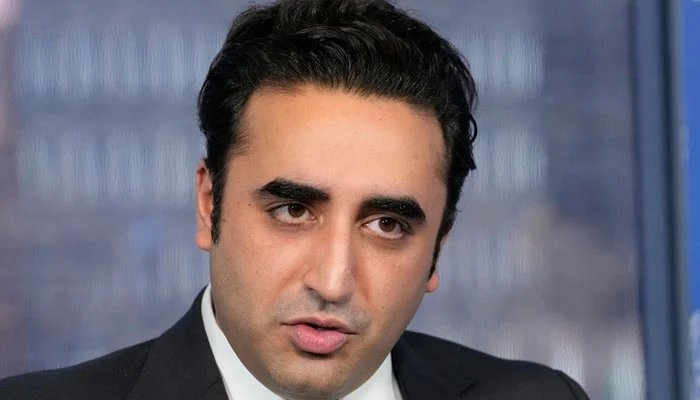
Foreign Minister Bilawal Bhutto Zardari on Saturday reiterated that the Pakistani government was committed to enhancing engagement with Russia though deep meaningful ties.

In an interview with Al-Jazeera during his recent visit to Iraq, FM Bilawal said they wanted to maintain neutrality over the Ukraine conflict.

He maintained that the floods last year that devastated large parts of Pakistan was not only significant for the country but for the entire world.

Despite many economic and political challenges faced by country, ranging from climate change to Russian-Ukraine conflicts and domestic issues, the foreign minister said that he was confident that the people of the country would come together to overcome these ordeals and build a better future.

“It had affected 33 million people, besides causing huge financial losses which had far reaching effects upon Pakistan’s economy,” he added.

To build back climate resilient Pakistan, he said, they had arranged a conference in Geneva in collaboration with the UN, adding they were making efforts to materialise about $9 to $10 billion pledges made during the conference.

Whereas, a large chunks of finances had been arranged through bilateral engagement with the world financial institutions, confirmed the foreign minister.

He said they, however, were trying to revive International Monetary Fund (IMF) programme.

About PTI chief Imran Khan’s allegations, he said that he was responsible for his downfall and history would prove it.

The foreign minister said that the country had faced dictatorships in the past and the PTI chief always supported the dictatorships. It was documented and established fact that he was brought to power through rigged elections.

He said the announcement by the military top brass that the army would not get involved in politics and would remain apolitical, had definitely upset the PTI’s supporters.

The citizens were offended on the incidents of May 9 when the PTI supporters attacked GHQ and Corps commander house, he added.

He said the elements involved in those incidents would face the legal consequences.

To a question, Bilawal said “We don’t believe the change could come by overnight”, adding the only way was through the change brought about by the democratic forces in the society.

He said change should take place through civilian and political process involving the parliament. Imran Khan had paid less attention to parliament.

“The fate of the country can’t be decided on streets but by the parliament,” he stressed while underling the need for the civilian and political leadership to strengthen the democratic role, squeezing space for others.

He said the PPP was the party that always challenged dictatorship including the last one of late Musharraf and regretted that not an attack had ever been mounted by any political party in Pakistan as done by the PTI on May 9.

The foreign minister said that he did not regret returning to Pakistan to realise the vision of his mother. “Pakistan is transitioning towards democracy. We are at the fork towards road to democracy,” he added.

To a query, he said after the fall of Kabul, the international community had many expectations from the new rulers.

“Pakistan’s position is in line with the position of the international community”, he said, adding the international community wanted Taliban rulers to to do with the women’s rights and education and that the Afghan soil should not be used for terrorist activities.

FM Bilawal further stressed that engagement of the global community with the new rulers of Afghanistan was the only solution as it was in the interest of all to have a secure and prosperous Afghanistan that was at peace with itself and with its neighbours.

The world wanted the incumbent rulers to fulfil their commitment with the international community, he said.

The foreign minister, replying to a question, said that Pakistan faced security threats from terrorist outfit TTP as different terrorist incidents occurred in Pakistan after the fall of Kabul.

He reiterated that Pakistan wanted Taliban to act against these terrorists and cited hosting of a recent meeting of Pakistan, China and Afghanistan which focused on threats of terrorism.

About ties with Iran, the foreign minister said that recently a border market was established at Iran-Balochistan border to encourage bilateral trade whereas, they were also working on electricity transmission from Iran to Balochistan.

Bilawal termed the restoration of diplomatic ties between Saudi Arabia and Iran as a ‘positive development’.

“It is a positive news not only for the two countries, but for the whole region and for us,” he said, stressing that through engagement all the issues could be resolved paving way for peace dividends.

Pak-China cooperation based on economic prosperity

The foreign minister strongly rebuffed the allegations against China’s investment in Pakistan and said that it was unfortunately a reflection of “biased attitude”.

He said all weather strategic cooperation between Pakistan and China was based upon economic prosperity.

Pakistan was engaged with China, through China Pakistan Economic Corridor (CPEC) a flagship of “One belt one road’ initiative under which China was completing different energy and road infrastructure projects, he added.

The foreign minister reiterated that they were optimistic to live up to their commitment, adding “Development is the right of all countries.”

As result of CPEC, they were optimistic to further increase their economic activity between the two countries. The economy of the two countries supplemented each other.

About his visit to Iraq, he said that it would further enhance the bilateral and economic cooperation between the two brotherly countries.

They also wanted to strengthen the security and defence cooperation and share their experiences learnt from terrorism. For the promotion of cultural and religious ties, both the countries agreed to ease visas for tourism, he added.


At least 28 killed, over 140 injured as heavy rains lash KP, Punjab

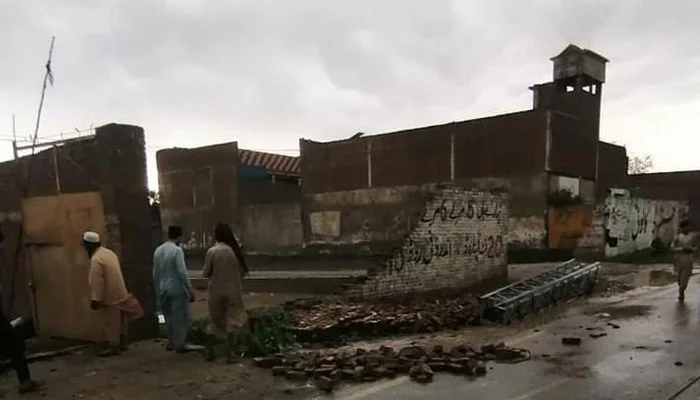
At least 28 people were killed and over 100 injured after heavy rains and thunderstorms hit several parts of Khyber Pakhtunkhwa and Punjab on Saturday.

As per the provincial disaster management authority, 25 people were killed in rain-related incidents in KP’s Bannu, Dera Ismail Khan, Karak and Lakki Marwat while 145 were injured. It added that at least 69 houses were partially damaged by the rain.

As per PDMA’s breakdown, 15 people died and 100 were injured in Bannu. It also added that 68 houses were partially damaged in the area.

Meanwhile, at least five people were killed and 42 others were wounded in the Lakki Marwat district.

Meanwhile, in Karak, four people died and one person was injured. In, Dera Ismail Khan a child died due to the rains, two people were injured and one house was partially damaged.

A Rescue 1122 official said that all stations of their Rescue 1122 in KP are on the alert to deal with any untoward incident.


He said relief activities continued as due to heavy rain, roof collapses occurred at many places in Lakki Marwat, Bannu and other parts of the province.

He disclosed that Rescue 1122’s search and rescue operations are ongoing as all the injured are being shifted to the hospital after providing medical aid on the spot.

KP caretaker Information Minister Barrister Feroze Jamal Shah, in a statement, said that a high alert had been issued in the hospitals of the affected districts.

He said the interim government was in contact with the authorities of the affected areas.

Similarly, heavy rains along with strong winds battered several parts of Punjab including Sargodha, Gujranwala, Faisalabad and other districts.

In Chan village of the Khushab district of the province, three girls died after a wall of their house collapsed due to torrential rains.

At least 10 people were injured in rain-related incidents in Gujranwala district.

Heavy rains and strong winds also disrupted electricity supply in many areas.

Heavy rain with thunderstorms was also reported from Azad Jammu and Kashmir’s (AJK) Nakyal city and its suburbs.

PM Shehbaz orders urgent measures

Prime Minister Shehbaz Sharif expressed regret over the loss of life and property in rain-related incidents in a telephonic conversation with Deputy Speaker National Assembly Zahid Akram Durrani, who hails from Bannu district.

“The people of Lakki Marwat will not be left alone in the hour of trouble,” an official statement quoted the premier as saying.

The prime minister directed the KP chief secretary and National Disaster Management Authority (NDMA) to take urgent measures to deal with any untoward situation.

Indira Gandhi assassination float in Canada draws India’s anger

LONDON: India’s foreign minister Dr Subrahmanyam Jaishankar has attacked Canada for allowing a float in a pro-Khalistan Sikh parade in the Canadian city of Brampton depicting the 1984 assassination of Indian Prime Minister Indira Gandhi by her Sikh bodyguards.

Video circulated by Sikh activists showed a float from the parade featuring Gandhi wearing a blood-stained white saree with her hands up as turban-clad Sikh men pointed guns at her. A poster behind the scene read: “Revenge”.

Jaishankar said: “It isn’t only one incident, no matter how egregious it may be. I think there is a larger underlying issue about the space which is given to separatists, to extremists, to people who advocate violence. I think it is not good for relationships, not good for Canada.”

India’s external affairs minister argued the incident shows Ottawa’s lax approach to extremism.

He said: “We are at a loss to understand, other than the requirements of vote-buying politics, why anyone would do this.”

Canada’s high commissioner to India also condemned the incident at the parade by Sikh activists in Brampton.

Gandhi was assassinated in 1984 by two Sikh bodyguards after she allowed the storming of the holiest Golden Temple Amritsar, killing thousands of Sikhs who demanded the creation of Khalistan.

India’s condemnation came within days after Prime Minister Justin Trudeau’s national security adviser said India was among the top sources of foreign interference in Canada, directly naming India for exerting improper influence in Canada.

Jaishankar said he found it hypocritical that Canada would call out India for interference.

“If anybody has a complaint, we have a complaint about Canada; the space that they’re giving to Khalistanis and to violent extremists,” he said.

Pro-Khalistan campaign group Sikhs For Justice (SFJ) defended the float rally in Brampton. Its General Counsel Gurpatwant Singh Pannun said the float depicted a harsh reality that Indira’s assassination was the direct outcome of her decision to attack Darbar Saheb, killing over 10,000 Sikhs.

He said: “Indira Gandhi ordered Operation Blue Star in which more than 10,000 Sikh pilgrims including women and children were massacred by the Indian army. The violence started by Indira Gandhi continues against Sikhs today. Sikhs from Canada suffered violence too. Shaheed Talwinder Singh Parmar was accused of Air India bombing and tortured to death. He was killed without a charge because there was no evidence. Mohinder Singh Khalsa from Ontario was also killed by India. India’s weapon is violence but Sikhs believe in using the weapon of the ballot through Khalistan Referendum voting.”

Canada and India openly clashed a few months ago as tens of thousands of Sikhs gathered in Brampton to take part in the Khalistan Referendum voting. India asked Canada to ban voting but the Canadian govt refused saying it cannot ban the democratic political activity of its citizens.

Canada has the highest population of Sikhs outside of Indian Punjab. Earlier this year, India summoned Canada’s high commissioner to convey concern over pro-Khalistan protesters in Canada who breached the security of India’s diplomatic mission and consulates.

Iran and Afghanistan dispute Helmand water rights as climate change deepens crisis

Iranian and Afghan Taliban forces clashed on the border two weeks ago, resulting in two deaths and several wounded as tensions surrounding water rights continue to rise between Tehran and Kabul.

Each accusing the other of firing first, Iran and Afghanistan are increasingly taking a belligerent stance on the sharing of water supplies as a rapidly changing climate exacerbates water insecurity in the region.

The dispute between the two countries mainly revolves around the Helmand River, whose turquoise waters emerge from the Hindu Kush mountains in east-central Afghanistan and flow southwest across more than half the length of the country before emptying into the Helmand swamps on the border with Iran.

Iran depends heavily on this water for farmland irrigation in the southeastern province of Sistan-Baluchistan, and has recently pointed the finger at Afghanistan for limiting the supply.

Tehran in May accused Kabul of violating a 1973 treaty that grants Iranians the right to use 22 cubic metres of water per second with the possibility of an additional four cubic metres.

Claiming that it is receiving only about 4 percent of the agreed amount, Iran issued a warning to the Taliban and demanded access to Helmand waters.

Dry lake and dust storms

“The Helmand is a river of great importance for Iran because it allows the agricultural areas of Sistan and Baluchestan to develop. And this becomes all the more important as we are in a situation where accelerating sequences of drought and reduced rainfall are putting these agricultural regions at risk,” said Jonathan Piron, a historian specialising in Iran for the Etopia research centre in Brussels.

As a country partly made up of arid and semi-arid land, Iran is increasingly threatened by recent phenomena of desertification as it experiences longer bouts of drought due to climate change.

Iran’s Sistan and Baluchestan province is now home to vast expanses of dry land as prolonged droughts have accelerated the shrinking of Lake Hamoun – fed by the Helmand River – which used to be at the heart of the world’s seventh-largest wetlands.

Around the lake, wildlife and vegetation, agriculture and livestock, as well as villages have disappeared, leaving behind a desolate landscape.

To make things worse, the region is turning into a major source of dust storms due to the drop in vegetation cover.

“These dust storms, when they arrive on dry, poor soil, scrape the land even more, raising even more dust, sand and salt, and damaging the good agricultural areas a little further away,” said Piron, who has been conducting water research in Iran for several years.

Afghanistan’s new dams

Water is also a precious commodity in Afghanistan as it is essential to crop cultivation in a country that is threatened by food insecurity.

“There is a desire on the part of the Taliban to regain control of Helmand and to promote water redistribution for their own population in order to assert their legitimacy as rulers,” said Piron.

During the past decades of war that ravaged the country, Afghanistan’s hydraulic infrastructures were neglected, which “favoured the Iranians” despite Afghans’ own water needs.

The former Afghan government accused Tehran of encouraging instability in regions surrounding Afghan dams by supporting armed groups, so that the water could continue to flow beyond the border.

Afghanistan has nevertheless decided to regain control of its hydraulic potential in recent years by speeding up the construction of hydroelectric dams and irrigation systems.

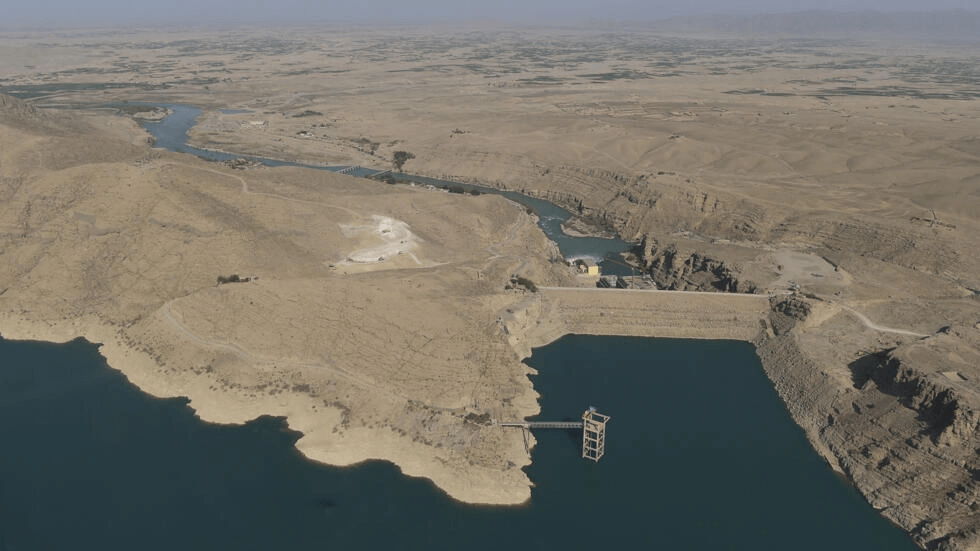
The Kamal Khan Dam, which is situated on the border with Iran, was inaugurated in March 2021 on the Helmand River after six decades of construction work.

In the meantime, the Kajaki Dam, often a bone of contention with Tehran, has also undergone major work and was recently completed.

Originally built in the 1950s, the dam was abandoned in 1979 during the Soviet invasion. It was only after the fall of the Taliban in 2001 that the US got it running again, after a major overhaul that was eventually scaled back. Later, the Afghan government took charge of new construction work in 2013 after calling in a Turkish company to the rescue.

Massive blast rips through Turkish explosives factory; at least 5 killed

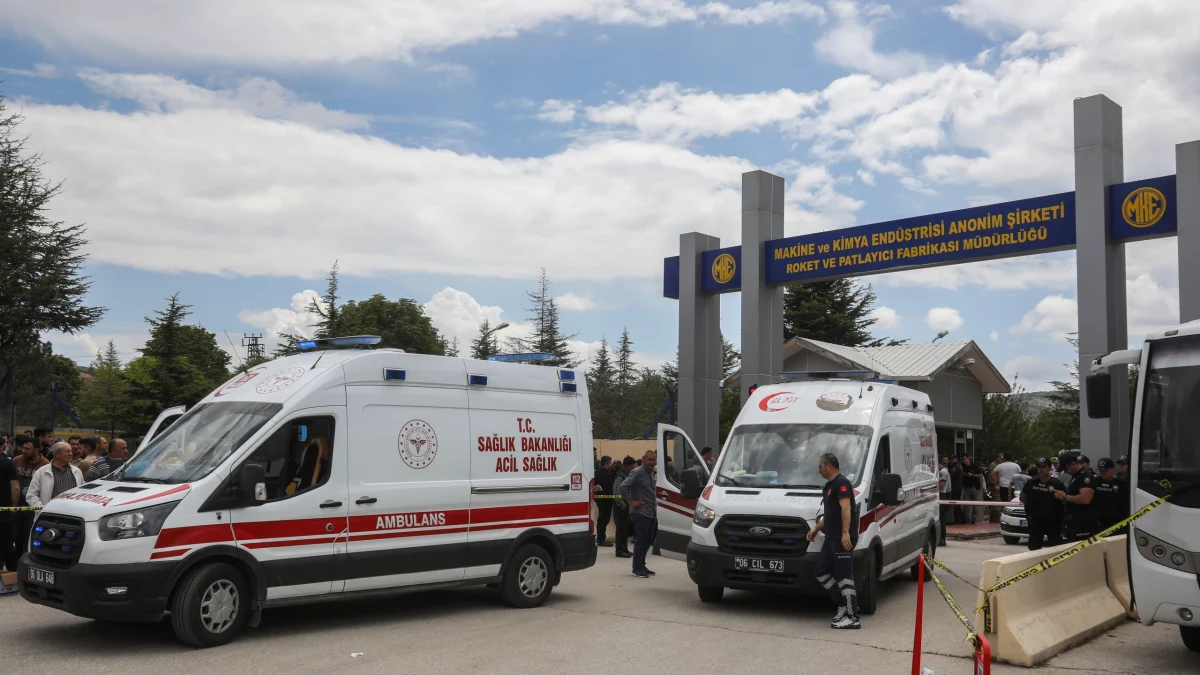
At least five people were killed and dozens injured after a huge blast at an arms and ammunition factory in Turkey, authorities reported Saturday, while ruling out any sabotage amid scanty details released by the country’s defence ministry.


The explosion occurred at a state-owned Mechanical and Chemical Industry Corporation factory in the Elmadag district, located 40 kilometres east of the Turkish capital, Ankara, on Saturday morning.


According to the BBC, the explosion caused several other injuries and broke windows in adjacent homes and businesses.

Authorities said that an accident in the factory’s explosives department was to blame for the explosion.

Meanwhile, state media stated that injured personnel had been transported to nearby hospitals, and regional governor Vahap Sahin said that no more employees or staff members were still trapped in the rubble.

However, many are reportedly in critical condition.

Sahin told reporters that the explosion was the result of a chemical reaction, according to technical staff, and that it happened at 08:45 am local time (05:45 GMT).

Alpaslan Kavaklioglu, the deputy defence minister, said in a statement that investigators had reviewed a video taken inside the structure just before the explosion and found nothing out of the norm up to the moment of the explosion.

“Our workers were carrying out their normal activities, and the explosion happened suddenly,” he added.

Pictures from the plant showed ambulances there, and it’s been reported that firefighters are putting out a number of small fires. Many family members gathered in the interim to get updates on their loved ones.

Regional prosecutors stated they were looking into what happened, and the Ministry of Defence announced that judicial and administrative investigations have begun about the incident.

Turkish Defence Minister Yasar Guler briefed newly re-elected Turkish President Recep Tayyip Erdogan about the incident, according to a statement from his office. President Erdogan expressed his sympathies to the families of the victims, according to the defence ministry.

Furthermore, the factory produces missiles for the Turkish armed forces.

US intelligence confirms China spying from Cuba for years

China has been operating a spy base in Cuba since at least 2019 as part of its global efforts to improve intelligence gathering, according to a US official from the Biden administration.

The US intelligence community has long been aware of China’s spying activities in Cuba and its broader ambitions to establish similar operations worldwide. The Biden administration has intensified its efforts to counter China’s expanding spying operations, making progress through diplomacy and other undisclosed actions.

Confirmation of the Chinese spy base came after The Wall Street Journal reported that China and Cuba had agreed to build an electronic eavesdropping station on the island. However, both the White House and Cuban officials dismissed the report as inaccurate.

US-China relations have been tense during Biden’s presidency, with conflicts arising from visits to Taiwan and the US shooting down a Chinese spy balloon that entered US airspace. Despite these tensions, the White House is eager to resume high-level communication with China.

A Biden administration official confirmed that Chinese spying from Cuba is an ongoing matter and not a recent development. China has been exploring various sites worldwide for intelligence gathering, including existing facilities in Cuba, and upgraded its spying operation on the island in 2019.

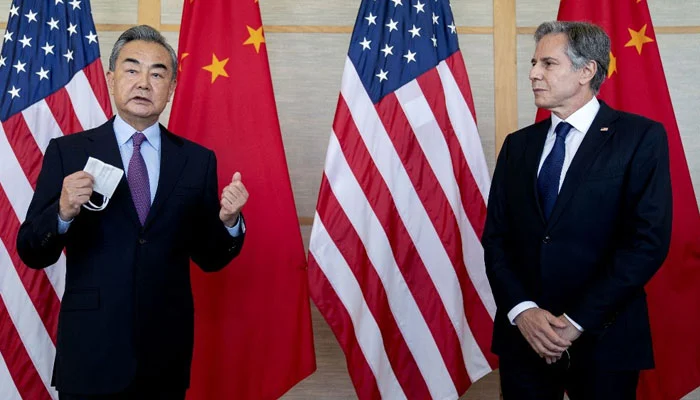
The US and China have made limited efforts to ease tensions, with Secretary of State Antony Blinken planning a trip to China and previous meetings between officials from both countries. However, China rejected a meeting request from US Defense Secretary Lloyd Austin.

China’s presence in Cuba has been documented in the intelligence record, although the Cuban government denies the existence of a Chinese spy base. The reports of a planned base in Cuba coincide with China’s broader push to expand its security presence globally.

US officials believe that their diplomatic efforts have slowed down China’s activities in Cuba, but the situation remains a concern. The rescheduled visit of Secretary of State Blinken to China is seen as a significant step, but the US official acknowledged that China’s ambitions have not been fully curtailed.

The existence of the spy base has been confirmed, despite denials from China and Cuba. Tensions between the US and China persist, and efforts to resume high-level communication are underway. The US believes its diplomatic efforts have hindered China’s activities in Cuba, but concerns remain.