Bangladesh floods wreak havoc, 48 lives lost

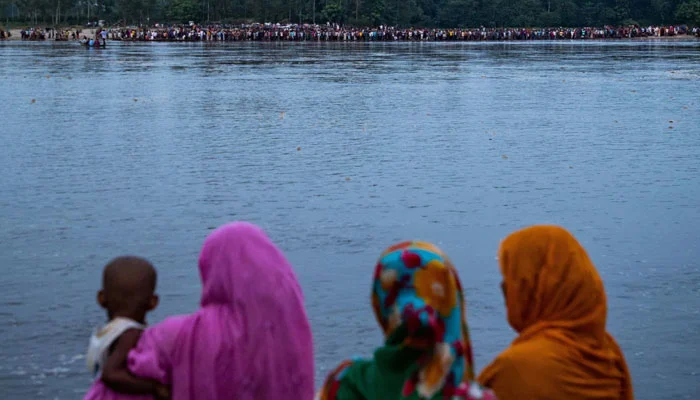
In the wake of relentless monsoon rains and subsequent flooding, the death toll in southeastern Bangladesh has risen to 48, with a number of individuals still reported missing.

Authorities confirmed on Friday that floodwaters have finally begun to recede, offering a glimmer of hope to the flood-ravaged region.

Since Monday, at least 1.2 million people across four southeastern districts – Cox’s Bazar, Chattogram, Bandarban, and Rangamati – have been severely affected by the floods, which have left thousands stranded and numerous homes destroyed. Among the casualties, two Rohingya refugees were tragically among the deceased.

In a concerted effort to provide aid and support, ten military units have joined hands with civil administration to conduct rescue and relief operations. The past four days have seen non-stop efforts to reach affected communities and deliver essential supplies.

Rakib Hasan, a senior official in Chattogram district, reported that while the waters are slowly receding, several areas remain marooned by floodwaters. He emphasised the ongoing necessity for potable water and sustenance for the affected populace. “We, with the assistance of army personnel and locals, continue the relief operation as people require potable water and food,” Hasan said.

The district of Bandarban, nestled in the hills, witnessed 10 fatalities and around 15,000 residents grappling with the aftermath of the floods. The deluge managed to destroy 3,700 homes, leaving families without shelter.

As the country’s largest man-made lake, Kaptai Lake in Rangamati district played a significant role in the flooding, causing water levels to surge. Even now, floodwaters persist in low-lying areas, exacerbating the crisis. The situation has led to the destruction of homes, crops, livestock, and fish pounds, leaving the locals in dire need.

With meteorologists predicting monsoon rains until August 15, the challenge for relief and rescue teams remains daunting.

IS attack on Syria army bus kills 26 soldiers: monitor

Despite losing their last piece of territory in Syria in 2019, IS has maintained hideouts in the vast Syrian desert from which it has carried out ambushes and hit-and-run attacks.

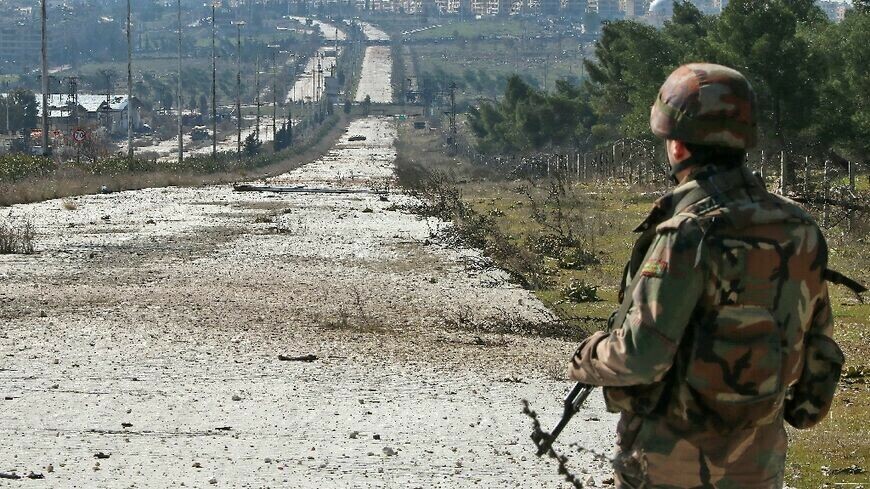
IS “members targeted a military bus” in Deir Ezzor province on Thursday, said the Syrian Observatory for Human Rights.

“The number of dead has risen to 26” soldiers, it said, revising an earlier toll of 23 and calling it the extremists’ deadliest attack on government forces this year.

The jihadists surrounded the bus and opened fire in Deir Ezzor province’s Mayadeen area, in Syria’s vast Badia desert, the Observatory added.

Eleven other soldiers were wounded, with some in critical condition, while troops previously thought to be missing were on other buses that managed to reach safe areas, said the Britain-based group which relies on a network of sources inside Syria.

The official Syrian news agency SANA said the “terrorist attack” had caused a number of military casualties, citing an unidentified army source.

Syrian government forces and their allied pro-Iranian armed groups deployed in the area were on high alert on Friday morning, the Observatory reported.

The war monitor’s Rami Abdel Rahman said IS “has recently been escalating its deadly military attacks… aiming to cause as many deaths as possible”.

By doing so, the jihadists are trying to show that IS “is still active and powerful despite the targeting of its leaders”, he told AFP.

Last week, IS announced the death of its leader Abu al-Hussein al-Husseini al-Qurashi, who it said was killed in clashes in northwestern Syria.

A spokesman for the group announced a new leader, known as Abu Hafs al-Hashimi al-Qurashi, in a recorded message on its channels on the Telegram messaging app.

Spate of IS attacks

In March 2019, IS lost the last territory it held in Syria to a Kurdish-led counteroffensive backed by a US-led coalition, but jihadist remnants continue to carry out deadly attacks.

Targets have included civilians and Kurdish-led fighters as well as government troops and allied pro-Iranian fighters.

IS members in recent weeks have increased their attacks in Syria’s north and northeast.

Thursday’s attack was the third carried out by the jihadists this month alone.

Earlier this week, 10 Syrian soldiers and pro-government fighters were killed in an IS attack in the former jihadist stronghold of Raqa province, the Observatory said.

Last week, the jihadists attacked a convoy of oil tankers guarded by the army in the Syrian desert, killing seven people including two civilians.

And last month, IS claimed responsibility for a rare bombing in Damascus that killed at least six people near the capital’s Sayyida Zeinab mausoleum, Syria’s most visited Shiite pilgrimage site.

The Sunni Muslim extremist group’s brutal rule was marked by beheadings and mass shootings.

IS has had five leaders since it lost the last remnant of the once sprawling “caliphate” it proclaimed across large swathes of Syria and neighbouring Iraq in 2014.

Four of them were killed, including the group’s first “caliph”, Abu Bakr al-Baghdadi, who died in a US raid in October 2019.

Civil war first broke out in Syria after President Bashar al-Assad’s government crushed peaceful protests in 2011. It has since drawn in foreign powers and global jihadists.

The conflict has killed more than half a million people and driven half of the country’s pre-war population from their homes, with many seeking refuge in neighbouring countries.

Maui wildfire death toll hits 67 as questions raised over warnings

The fires became the deadliest natural disaster in the state’s history, surpassing that of a tsunami that killed 61 people on the Big Island of Hawaii in 1960, a year after Hawaii joined the United States.

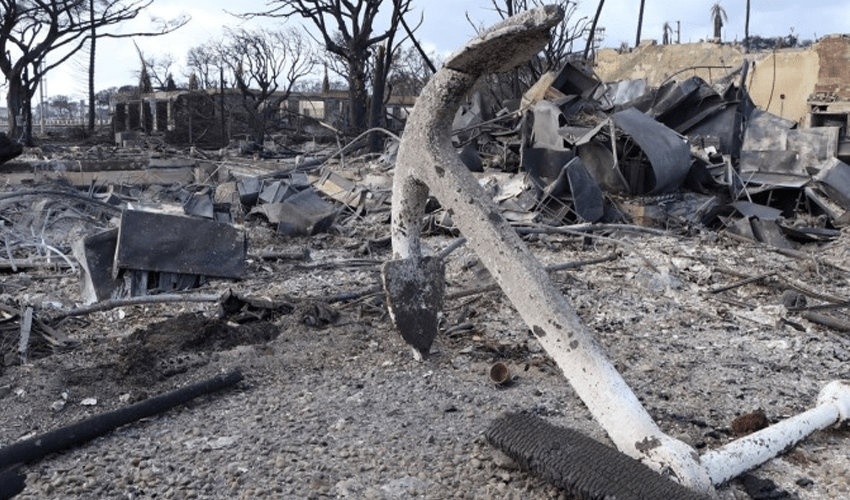
Officials have warned that search teams with cadaver dogs could still find more dead from the fire that torched 1,000 buildings and left thousands homeless, likely requiring many years and billions of dollars to rebuild.

“Nobody has entered any of these structures that have burned down and that’s where we unfortunately anticipate that the death toll will rise significantly,” U.S. Senator Brian Schatz of Hawaii told MSNBC.

He later told CNN that Lahaina resembled a bombed-out war zone where the heat melted engine blocks.

The Lahaina fire that spread from the brush to town was still burning but 85% contained, Maui County said in a statement. Two other wildfires on the island were 80% and 50% contained.

Three days after the disaster, it remained unclear whether some residents had received any warning before the fire engulfed their homes.

The island includes emergency sirens intended to warn of natural disasters and other threats, but they did not appear to have sounded during the fire.

“I authorized a comprehensive review this morning to make sure that we know exactly what happened and when,” Hawaii Governor Josh Green told CNN, referring the warning sirens.

Officials have not offered a detailed picture of precisely what notifications were sent out, and whether they were done via text message, email or phone calls.

Green described multiple, simultaneous challenges, with telecommunications down and firefighters concentrating on other major wildfires when the greatest threat to Lahaina arose.

In any event, he said, “We will do all that we can to find out how to protect our people more going forward.”

Maui County Fire Chief Bradford Ventura said at a Thursday press conference that the fire’s speed made it “nearly impossible” for frontline responders to communicate with the emergency management officials who would typically provide real-time evacuation orders.

“They were basically self-evacuating with fairly little notice,” he said, referring to residents of the neighborhood where the fire initially struck.

County Mayor Richard Bissen told NBC’s “Today” show on Friday that he did not know whether sirens went off but said the fire moved extraordinarily quickly.

“I think this was an impossible situation,” he said.

The disaster began unfolding just after midnight on Tuesday when a brush fire was reported in the town of Kula, roughly 35 miles (56 km) from Lahaina. About five hours later that morning, power was knocked out in Lahaina, according to residents.

In updates posted on Facebook that morning, Maui County said the Kula fire had consumed hundreds of acres of pastureland, but that a small three-acre (1.2-hecatre) brush fire that cropped up in Lahaina had been contained.

By that afternoon, however, the situation had turned more dire. At around 3:30 p.m., according to the county’s updates, the Lahaina fire suddenly flared up. Some residents began evacuating while people, including hotel guests, on the town’s west side were instructed to shelter in place.

In the ensuing hours, the county posted a series of evacuation orders on Facebook as the fire spread through the town.

Some witnesses said they had little advance notice, describing their terror when the blaze consumed Lahaina in what seemed a matter of minutes. Several people were forced to leap into the Pacific Ocean to save themselves.

The Lahaina evacuation was complicated by its coastal location next to hills, meaning there were only two ways out, at best, said Andrew Rumbach, a specialist in climate and communities at the Urban Institute in Washington.

“This is the nightmare scenario,” said Rumbach, a former urban planning professor at the University of Hawaii. “A fast-moving fire in a densely populated place with difficult communications, and not a lot of good options in terms of evacuations.”

More rail strikes over pay and conditions will take place on Saturday 26 August and Saturday 2 September, the RMT union has announced.

About 20,000 members working for 14 train operating companies are expected to take part.

RMT general secretary Mick Lynch said that its members would “continue fighting”.

But the Rail Delivery Group (RDG) said the union was “once again targeting customers” on the railways.

The government called the move “disappointing” and said the RMT leadership was “cynically targeting” travellers.

The announcement means rail passengers can expect disruption on the last Bank Holiday weekend of the summer in August.

It marks the latest step in a long-running dispute which has caused months of upheaval on the railways for passengers.

The 14 train firms affected are:

  • Avanti West Coast
  • c2c
  • Chiltern Railways
  • Cross Country Trains
  • East Midlands Railway
  • Great Western Railway
  • Greater Anglia
  • LNER
  • Northern Trains
  • South Eastern
  • South Western Railway
  • Transpennine Express
  • West Midlands Trains and GTR (including Gatwick Express)

Progress in the RMT’s dispute with the 14 train operating companies has effectively been at a standstill since April, after it rejected the latest proposals from the RDG.

Mr Lynch said the mood among RMT members “remains solid and determined” in the national dispute, which is over pay, job security and working conditions.

The union said it had been left with “little choice but to take further action”, insisting it had seen no improved offer from the RDG, which represents train operating companies.

Plans to close hundreds of ticket offices in England have also angered its members, the union has said.

But a spokesperson for the RDG, said: “With further strike action, the RMT are once again targeting customers looking to enjoy various sporting events, festivals and the end of the summer holidays, disrupting their plans and forcing more cars onto the road.”

The RDG said it had made three offers to the union, including job security guarantees. The headline pay rise would be a backdated pay rise of 5% for last year, followed by 4% this year. But some workers could see pay rise by as much as 13% over the two years, the RDG claims.

The group said the RMT had blocked potential deals “without a convincing explanation”.

It added that it remained “open to talks” and continues to urge the union to put the offer to members in a vote.

A Department for Transport spokesperson said: “The RMT leadership’s decision to call more strikes and cynically target the travelling public over the Bank Holiday weekend is disappointing.”The government has facilitated fair and reasonable pay offers. However, union bosses are opting to prolong this dispute by blocking their members from having a vote on these offers – we continue to urge that members are given their say, and disruption is brought to an end”, they added.

Interim PM: Govt, opposition keep cards close to their chest as first round of talks end

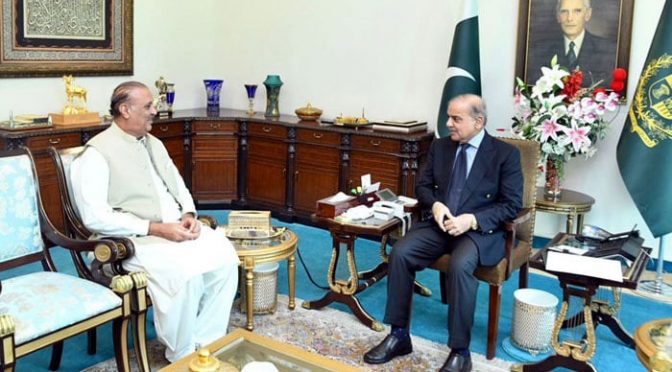
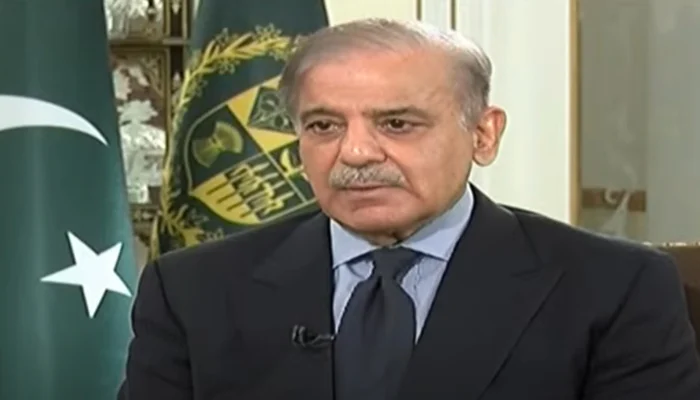
ISLAMABAD: After the first round of consultations on a caretaker prime minister, Opposition Leader in the National Assembly Raja Riaz and Prime Minister Shehbaz Sharif have failed to agree on a name and are yet to reveal the identities of the people in the run for the post.

Talking to the media after his consultation on Thursday, Riaz said that the conversation surrounding the interim prime minister was held in a cordial manner.

“It has been decided that another round of consultation will be held tomorrow (Friday). Till a name is not finalised no name will be revealed,” said the NA opposition leader, an indication that both sides are keeping cards close to their chest. However, Riaz did confirm that he had shared the names of his candidates with the premier, hoping that things will clear out tomorrow.

“The prime minister and I have to hold consultations. I told the PM that I will consider his [interim PM] names and he should consider the names suggested by him [Riaz],” said Riaz. He added that PM Shehbaz was unaware of the names suggested by him.

The opposition leader also said that he is confident that PM Shehbaz and he would develop a consensus on a single candidate for the interim premier’s slot.

Further deliberations to be held tomorrow: PM Office

On the other hand, the PM Office in a statement confirmed that further deliberations between Riaz and Shehbaz will be held tomorrow (Friday).

The consultation between the premier and opposition leader was due after the dissolution of the 15th NA of Pakistan last night, with President Arif Alvi’s approval of the summary sent by PM Shehbaz.

“The president dissolved the National Assembly on the advice of the prime minister under Article 58-1 of the Constitution,” read an official statement issued by the President’s Office on X, formerly known as Twitter, late Wednesday.

PM Shehbaz had formally invited Riaz for the meeting for consultation in a letter.

In his letter, the premier said that the president has dissolved the National Assembly under Article 58(1) of the Constitution and that he is ready to fulfil his constitutional responsibility for the appointment of the caretaker prime minister.

A process to appoint a caretaker prime minister will be conducted under Article 224-A of the Constitution, which will usher in an interim government to oversee an election.

Three names have been proposed, including two nominations — former diplomat Jalil Abbas Jilani and former chief justice of Pakistan Tassaduq Hussain Jilani — sent by the Pakistan Peoples Party (PPP) and Sindh Governor Kamran Tessori, by Muttahida Qaumi Movement-Pakistan (MQM-P).

However, there’s no public announcement by the Pakistan Mulsim League-Nawaz (PML-N) in this regard.

Names of former finance minister Ishaq Dar, former prime minister Shahid Khaqan Abbasi and former caretaker prime minister Mohammad Mian Soomro are also under consideration.

If the prime minister and opposition leader fail to agree on the name within three days, the matter will go to the parliamentary committee for the appointment of a caretaker PM.

As per the law, the premier and the opposition leader will send their respective preferences for the coveted post to the parliamentary committee.

The parliamentary committee will have to finalise the name of the caretaker prime minister within three days and if it too failed to reach a consensus on the name, then the Election Commission of Pakistan (ECP) will pick the caretaker prime minister within two days from the names proposed by the opposition and the government.

By law, elections should be held within 90 days of parliament’s dissolution, but the outgoing government has already warned they are likely to be delayed.

After the Council of Common Interests (CCI) approved new census results, ECP is required to carry out fresh delimitation — an exercise that will likely take three to four months.

Nawaz Sharif will return to Pakistan next month: PM

In a major development as the nation is heading towards general elections, Prime Minister Shehbaz Sharif said on Thursday that Pakistan Muslim League-Nawaz (PML-N) supremo Nawaz Sharif would return to the country next month and face the law.

In an interview with Geo News’ Capital Talk programme host Hamid Mir, the outgoing premier said he would travel to London to meet his elder brother Nawaz as soon as the caretaker government took charge.


“Nawaz Sharif will come back to Pakistan next month and will face the law and lead the election campaign,” the incumbent prime minister said without giving the exact date of Nawaz’s homecoming who has been in self-imposed exile in London since November 2019 owing to health reasons.

Nawaz went to London in November 2019 for medical treatment after he was convicted by an accountability court in graft cases and he has been living there since then.

In 2016, Nawaz stepped down as the prime minister after the Supreme Court disqualified him for life for concealing assets.

Later, the PML-N supremo was convicted in the Al-Azizia and the Aveinfeild Apartment references filed by the National Accountability Bureau (NAB) which emerged in the aftermath of the Panama Papers leak.

His appeals against the conviction are currently pending in the relevant courts.

“He [Nawaz] will neither wear a hat nor a bucket,” PM Shehbaz said in today’s interview while taking a thinly veiled jibe at Pakistan Tehreek-e-Insaf (PTI) chief Imran Khan who dons a bulletproof helmet while appearing for court hearings.

Shehbaz, who is also the PML-N president, hoped that his party will win the next general elections and he will work as an activist of the party under the Nawaz-led government.

His statement comes as the process to appoint caretaker setup formally kicked off with the dissolution of the National Assembly prematurely a day earlier on August 9.

The Pakistan Democratic Movement (PDM), the multi-party alliance, decided to dissolve the assembly three days ahead of its constitutional completion to allow the Election Commission of Pakistan (ECP) to hold general elections in the country within 90 days instead of 60 days stipulated time period if legislature completes its term.

However, the general elections in the country are likely to be delayed as the Council of Common Interests (CCI) approved the 2023 census, requiring the Election Commission of Pakistan (ECP) to carry out fresh delimitation — an exercise likely to take three to four months.

Caretaker PM

Speaking about his meeting with NA Opposition Leader Raja Riaz to deliberate on the interim PM name, the PM said: “It is hoped that the name of caretaker prime minister will be agreed upon before three days.”

Under the Constitution, the PM and the opposition leader have three days to finalise the caretaker PM name. In the first round of consultation earlier today, they failed to reach a consensus on the interim PM name.

“It has been decided that another round of consultation will be held tomorrow (Friday). Till a name is not finalised no name will be revealed,” said the NA opposition leader following the meeting.

His statement indicated that both sides are keeping cards close to their chest. However, Riaz did confirm that he had shared the names of his candidates with the premier, hoping that things will clear out tomorrow.

“I will meet [NA opposition leader] again tomorrow to hold consultation on the name of caretaker prime minister,” the PM added.

PM Shehbaz said he will also consult his brother Nawaz regarding the appointment of caretaker prime minister.

Amid concerns that polls might be delayed, PM Shehbaz said general elections should be held as soon as possible, adding that the ECP is responsible for holding elections in the country, not the caretaker setup.

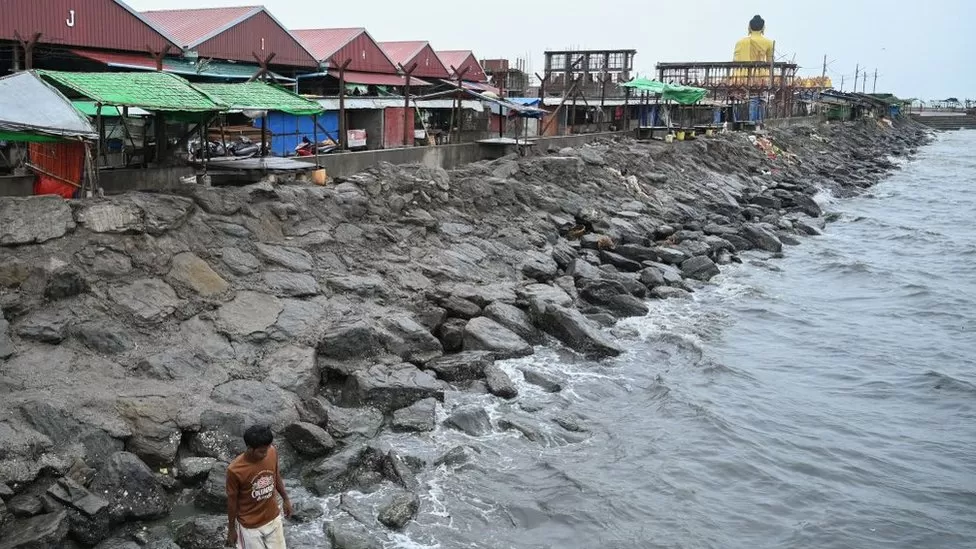
Rohingya: At least 23 dead, 30 missing after boat sinks

Thirty others are still missing, while eight people are reported to have survived the mishap.

The survivors said they were trying to reach Malaysia when their boat carrying more than 50 passengers foundered and was abandoned by its crew on Sunday.

Every year thousands of Rohingyas attempt the perilous sea journey to Malaysia or Indonesia.

They are escaping persecution in Myanmar and overcrowded refugee camps in Bangladesh. Those who died this week include 13 women 10 men, all Rohingya Muslims, a rescue team told BBC Burmese.

The Muslim Rohingyas are an ethnic minority in predominantly Buddhist Myanmar. Many of them fled to Bangladesh in 2017 to escape a campaign of genocide launched by the Burmese military. Those remaining in Myanmar too have been trying to flee since the military coup in 2021.

Survivors of the boat sinking this week recall being struck by a large wave near Rakhine’s capital, Sittwe.

They say the smugglers, who had been paid around $4,000 (£3,153) per person for the journey to Malaysia, then abandoned the boat. The bodies of the victims have been picked up by other boats, or washed up on the beach.

The long journey across the Andaman Sea in overcrowded fishing boats is always dangerous, but especially at this time of the year, at the peak of the monsoon storm season.

Most Rohingyas attempt to cross between the months of October and May.

They are willing to take the risk – and often sell their only assets, such as land, to fund the trip – because of the unrelentingly grim conditions in which they are forced to live, either as refugees in appallingly crowded camps over the border in Bangladesh, or subjected to discrimination and restrictions on their movement in Myanmar.

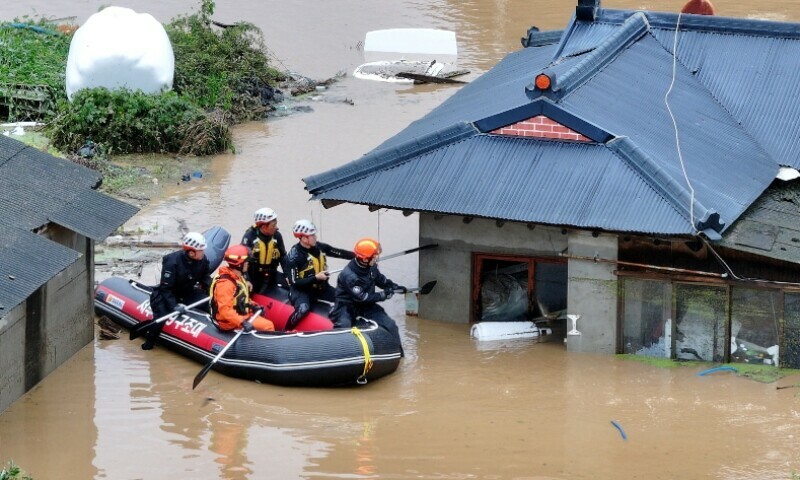
Tropical storm triggers floods, evacuations in South Korea

Downgraded from a typhoon to a tropical storm, Khanun made landfall on the southeast coast, and was heading towards the South Korean capital Seoul.

Khanun could also strike North Korea’s capital, Pyongyang, early on Friday and state media there reported that the military and the ruling party had been ordered to prepare flood-mitigation measures and salvage crops.

Schools closed, over 14,000 people evacuated from flood-hit areas

In South Korea, some 350 flights and 450 train routes were cancelled, and more than 14,000 people were moved to safety, the interior ministry said.

One person was missing in the south-eastern city of Daegu after falling into the river in a wheelchair, the ministry said, adding it was looking into the death of another person in the same city.

The storm brought up to 60 mm (2.4 inches) of rain per hour in some east coast towns, and maximum wind speeds of 126 kilometres per hour in the port city of Busan, the weather agency said.

Khanun losing a little speed as it moved northwards at 23 kph toward the greater Seoul area.“I’m worried that people living in lowlands or making a living by farming and fishing would suffer,” said Kim Wi-jeong, a 33-year-old office worker living in the capital.

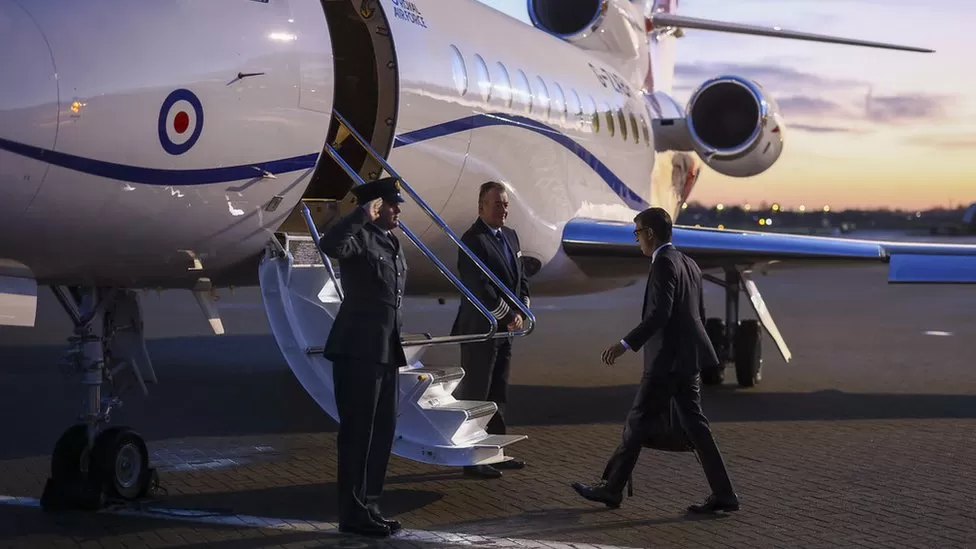
Rishi Sunak has used RAF jets and helicopters for domestic flights more frequently than the UK’s previous three prime ministers

Ministry of Defence data show he took almost one such flight a week during his first seven months in office.

The prime minister has been accused of hypocrisy for flying short journeys domestically, given his pledges to curb planet-warming carbon emissions.

But Mr Sunak has said air travel was the “most effective use of my time”.

In response to Freedom of Information requests, the BBC was told the number of domestic flights on Command Support Air Transport aircraft broken down by prime minister between July 2016 and April 2023.

The RAF division – known as 32 Squadron – operates two Dassault Falcon 900LX jets and a helicopter to transport the PM and other ministers domestically.

In total, Mr Sunak boarded 23 domestic flights on these aircraft in 187 days, which is one every eight days on average.

Two caveats to bear in mind are the brevity of Ms Truss’s time in Downing Street, and the limitations on Mr Johnson’s travel during the Covid-19 pandemic.

The BBC initially requested data on the number of flights each UK prime minister since Tony Blair had taken using a military aircraft to travel domestically. But the MoD rejected the request on cost grounds and advised asking for data on those flights since Mrs May.

The prime minister sometimes has access to an RAF Voyager plane for overseas trips, and the government also charters private flights on aircraft operated by Titan Airways.

Separately, Mr Sunak has accepted more than £70,000 worth of private jet and helicopter travel to Conservative Party events from political donors this year.

High politics

Mr Sunak’s use of flights for UK engagements has come under intense scrutiny, with critics questioning why he had not used the train instead of RAF aircraft for relatively short trips to Newquay, Dover and Leeds this year.

Last month, Mr Sunak said those who say “no one should take a plane” in their approach to climate change were “completely, and utterly wrong”.

Labour said the PM was “developing an expensive habit of swanning around on private jets courtesy of the taxpayer”.

The party’s deputy leader, Angela Rayner, suggested Mr Sunak had breached the ministerial code, which states he is supposed to use scheduled flights, unless “it is essential to travel by air”.

1px transparent line

In his speech at the COP27 climate summit last year, Mr Sunak said it was “morally right to honour” the UK’s promise to reduce carbon emissions.

The UK has set a legally binding target of achieving net-zero carbon emissions by 2050, as part of the global effort to avert the worst effects of climate change.

Flights produce greenhouse gases – mainly carbon dioxide (CO2) – from burning fuel, and these emissions contribute to global warming.

Emissions per kilometre travelled from domestic flights are significantly worse than any other form of transport, and private jets typically produce more CO2 than commercial flights.

But carbon emissions vary considerably depending on the size of the plane, how efficient its engines are, and how many passengers it carries.

In 2019, before the pandemic struck, international and domestic UK aviation accounted for 8% of the UK’s total greenhouse gas emissions.

PM’s priorities

Anna Hughes, whose Flight Free UK campaign urges people to fly less for the sake of the climate, said Mr Sunak’s transport choices were “frustrating”.

She said if leaders demonstrated “the kind of behaviour that we all need to adopt to avert the climate crisis, it communicates that it’s serious and real”.

“You can’t just say I’m the prime minister, I’m too busy and important,” she added.

1px transparent line

One former official with knowledge of ministerial travel prior to Mr Sunak’s premiership said transport choices “were based on time”, adding the train would be used “nine times out of ten”.

The former official, who did not wish to be named, said they “had access to the PM’s diary and every single minute of every day is accounted for”.

“In order to achieve a long visit, the only way was to use an aircraft,” they said.

A Downing Street spokesperson said ministers “sometimes require the use of non-commercial air travel”.

“This is a standard practice for governments around the world and this has consistently been the case under successive UK administrations of all political colours,” the spokesperson said.

“Value for money, security, and time efficiency is taken into account in all travel decisions and all flights are carbon offset.”

What’s the PM’s carbon footprint?

Although we have the number of domestic flights Mr Sunak has taken up to April this year, we don’t know the details of all those journeys, and what aircraft he used.

We did ask for that information, but the MoD said the “RAF does not retain records for air miles flown by aircraft”, and withheld data on the PM’s trips.

That means we can’t calculate the overall carbon footprint of Mr Sunak’s domestic flights during his first seven months in office.

What we can do is estimate the carbon emissions of some individual flights, using information in the public domain.

For example, on 19 January, the prime minister flew from RAF Northolt in west London to Blackpool Airport on a Dassault Falcon 900LX.

1px transparent line

A number of aviation websites say the Falcon has a fuel consumption of about 260 gallons per hour. The flight from London to Blackpool took 41 minutes, which means approximately 178 gallons, or 805 litres, of fuel was consumed.

Based on the government’s fuel-to-emissions conversation rates, the flight would have produced about two tonnes of CO2.

Falcon jets typically have 12 seats. So if we assume the plane was full for the Blackpool trip, two tonnes of CO2 would be 166 kg per person.

To put that into context, the International Energy Agency estimated that the global average energy-related carbon footprint was about 4.7 tonnes of CO2 per person in 2021.

In contrast to Mr Sunak’s flight, a train journey from London Euston to Blackpool North would produce 14.31kg of CO2 per passenger, according to a LNER carbon calculator..

The Trainline website says it takes an average of three hours and 43 minutes to travel from London Euston to Blackpool by train.

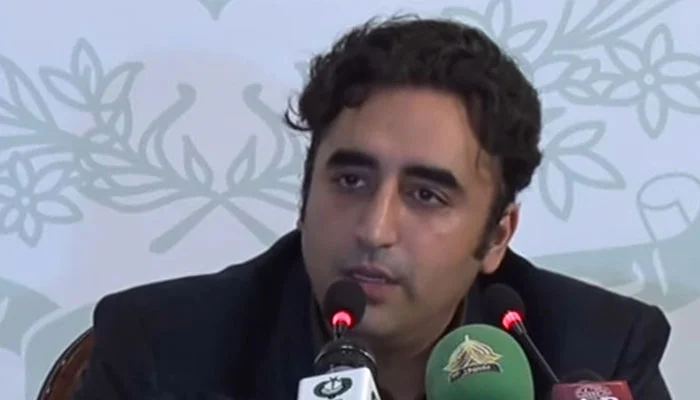
Modi on path to become ‘Butcher of Kashmir’ after committing Gujarat massacre: Bilawal

Lashing out at Indian Prime Minister Narendra Modi for grave human rights violations, atrocities and annexation of Indian Illegally Occupied Jammu and Kashmir (IIOJK) by revoking its special status in 2019, Foreign Minister Bilawal Bhutto-Zardari on Wednesday said that the “Butcher of Gujarat” will become a slaughterman of the disputed territory.

Addressing a presser to highlight the achievement of the Ministry of Foreign Affairs during his tenure, Bilawal reiterated that Pakistan’s stance over its relations with India was very clear and consistent; unless it revoked its illegal and unilateral acts of 2019 over occupied Jammu and Kashmir, there was no space to meaningful engagement, APP reported.

India had not only violated international laws and the United Nations Security Council resolutions but also the bilateral agreements between the two countries, he added.

“There is no space left for Pakistan to meaningfully engage with India,” the foreign minister added.

Bilawal said he had already maintained during the previous government’s tenure that they should not expect anything good from Modi, who was a “butcher of Gujarat” and was quite different from Vajpayee and Manmohan Singh.

SCO summit

Kashmir issue had been a consistent component of the foreign policy, he said and enumerated Pakistan’s efforts to address issues of Islamophobia and desecration of the Holy Quran, leading to the adoption of a resolution by the UN Human Rights Council.

To a quarry, the foreign minister said he went to Goa to attend Shanghai Cooperation Organisation (SCO) meeting despite serious reservations and carrying head money, to present Pakistan’s stance and tried to utilise the space available for the pronounce Pakistan’s interests.

He said due to his participation in SCO where he presented Pakistan’s stance clearly, India went on the back foot and held the SCO heads of states summit virtually.

About sending Pakistan national team to contest the ICC Cricket World Cup in India, he said contrary to India’s indulgence in immature acts, Pakistan always maintained that there should be a difference between politics and sports, adding that they still had security concerns as the security of the national team could not be compromised; and they had conveyed such to the ICC and India.

Pakistan was not interested in the bloc politics and did not want to be part of any polar world because they wanted to serve their 224 million population, he said, adding that if they were drawn into others’ interests, then they would be distracted.

Uptick in terror incidents

Responding to a question about Afghanistan, the foreign minister said that certain opinions were being formed across the world on the basis of ground realities.

If they wanted diplomatic recognition, the Afghan interim government would have to address the international concerns, but if they continued with their statements, it would create complications and the Afghan people would continue to suffer, he added.

The foreign minister said that after the fall of Kabul, there was a sharp spike in terrorist incidents in Pakistan and stressed that cooperation and engagement between the two countries was necessary to tackle the issue.

He said Pakistan remained engaged with the Afghan leadership. About women’s education issue, he said, Pakistan had a very open and clear stance.

Terming the fight against terrorism as their own fight, the foreign minister said that Pakistan had been the largest country in the world affected by the curse of terrorism.

He said that they wanted to save the next generations and would not allow the enemies of the religion, country and people to cause any further harm.

The foreign minister also expressed strong opposition to the previous government’s policy over the terrorists hiding in Afghanistan.

The foreign minister expressed the satisfaction that at the diplomatic front, they moved ahead with ‘damage control’ during the last 16 months.

He regretted that the PTI’s government had caused damage to the country’s relations with world capitals and strongly disagreed with the gesture of the former prime minister waving a letter sent by the EU in public.

Ukraine conflict

About the Russia-Ukraine conflict, he said that Pakistan wanted a peaceful resolution of the issue.

He said they did not want to see the relationship with Russia through the prism of the ongoing issue, as they wanted to collectively unlock the immense potential between the two countries. They prayed that diplomacy and peace would prevail, he added.

The foreign minister said Pakistan was committed to the Pakistan-Iran gas pipeline for the mutual benefit of the people of the two countries.

Earlier, the foreign minister highlighted the achievements of his ministry on the diplomatic fronts and global fora with increased outreach and extensive engagements with the international community.

He said Pakistan engaged with the US, Europe and the UK through bilateral and multilateral meetings.

Removal from FATF’s grey list and hosting of the Geneva conference were some of the conspicuous achievements for f Pakistan, he added.

Visa facilitation and cooperation in science and technology resulted in the opening of doors for Pakistanis seeking jobs abroad, he said, adding they had corrected the diplomatic course.

The foreign minister said that during his tenure in office, they never compromised on the core issue of Kashmir and effectively advocated for the oppressed people of Kashmir at all fora.

The foreign minister thanked the UN Secretary-General for his efforts to support Pakistan during last year’s floods.

He said that they would provide 2 million climate-resilient houses to the flood-affected people in Sindh, adding that a huge number of educational institutions and roads network were also affected by that natural calamity.