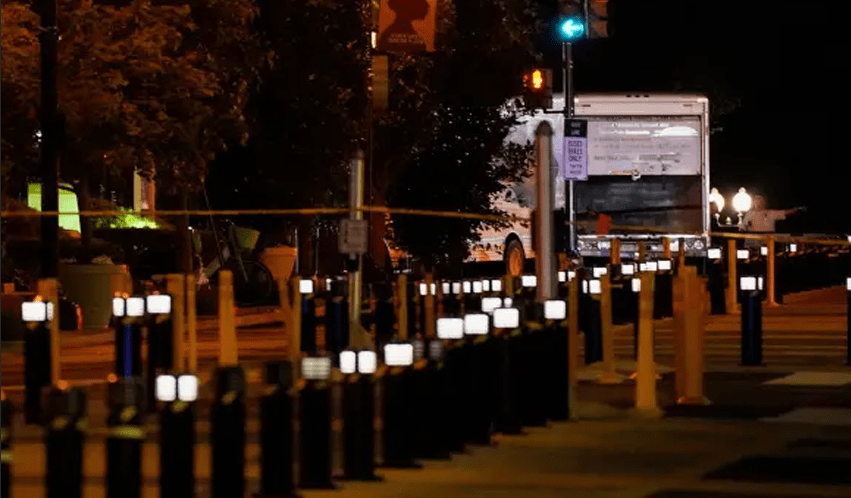
Truck crashes into barriers near White House, driver detained

The driver of the truck has been apprehended, as confirmed by a spokesperson from the US Secret Service.

The crash occurred late in the evening, prompting an immediate response from law enforcement authorities.

“There were no injuries to any Secret Service or White House personnel and the cause and manner of the crash remain under investigation,” said Anthony Guglielmi, chief of communications for the US Secret Service, via Twitter.


As a precautionary measure, several roads and pedestrian walkways in the area were temporarily closed.

According to reports, people present at the nearby Hay Adams hotel were evacuated following the incident. The situation caused a temporary disruption in the vicinity, with heightened security measures put in place as authorities assessed the situation.

Reportedly, after the initial crash, the driver struck the barriers near the White House grounds for a second time.

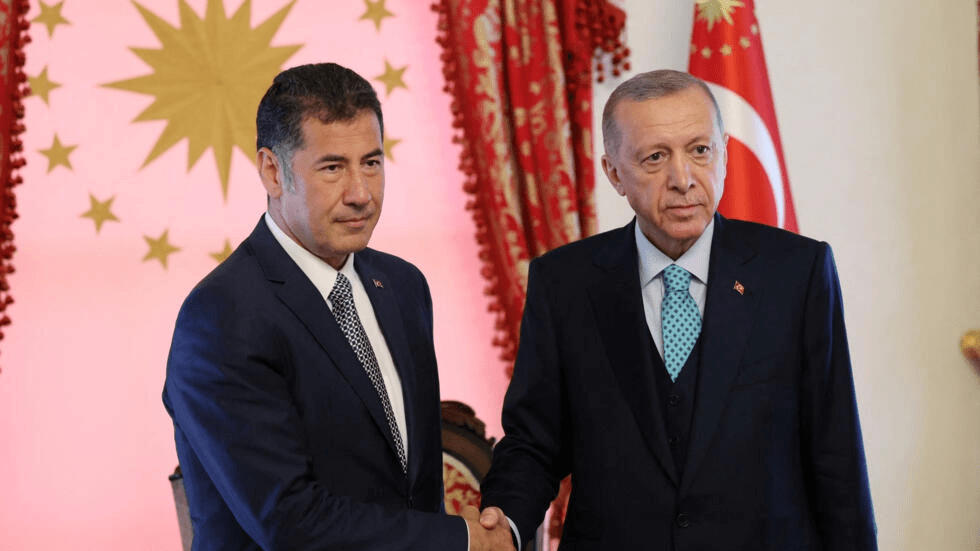
Turkiye’s third-place finisher endorses Erdogan

Sinan Ogan’s 5.2 per cent of the vote in the May 14 general election deprived Erdogan of an outright victory for the first time in his 20-year rule.

He met the Turkish leader on Friday and held separate negotiations with allies of opposition leader Kemal Kilicdaroglu.

“We will support the People’s Alliance candidate, Recep Tayyip Erdogan, in the second round of the elections on May 28,” he told reporters in nationally televised remarks.

“I invite voters who backed us in the first round to support Mr Erdogan in the second round.”

Ogan portrays himself as an ardent supporter of a brand of Turkish nationalism espoused by the post-Ottoman republic’s creator Mustafa Kemal Ataturk.

He has demanded the immediate expulsion of millions of migrants and sought a firm stance on “terrorists” — a euphemism for Kurdish groups fighting for broader autonomy in Turkiye’s southeast.

The 54-year-old also tried to stop the opposition from discussing constitutional changes that could dilute language stressing the importance of Turkishness at the expense of other ethnicities.

‘Terrorism and refugees’

Analysts question how much weight Ogan’s endorsement carries with his voters.

His tiny party has only been around for a few months and most of his support appears to be disaffected with both Turkiye’s Islamic-rooted leader and his 74-year-old secular rival.

But it undermines Kilicdaroglu’s urgent efforts to expand his appeal among more nationalist voters in the runup to the second round.

“Ogan’s newfound reputation as a kingmaker is an exaggeration.. Ogan’s backing for Erdogan is no guarantee that his voters from the first round will follow in lockstep,” Hamish Kinnear of the Verisk Maplecroft consultancy told AFP.

“Assuming Erdogan’s first round voters remain on side, only a small portion of Ogan’s voters need to go with Erdogan to push the president into his third decade in power.”

Kilicdaroglu ran a more inclusive campaign that focused on Turkiye’s raging economic crisis and Erdogan’s crackdown on civil liberties during his second decade of rule.


But he struck a decidedly more nationalist tone in his first post-election appearance last week.

The former civil servant pledged to send “all the refugees home” when he comes to power and accused Erdogan of failing to “protect the borders and honour of our country”.

Erdogan had signalled that he did not intend to make any concession to Ogan to secure his support.

Kilicdaroglu sounded defiant in a tweet posted moments after Ogan’s announcement.


He accused unnamed forces of “selling out this beautiful country” and signalled his intention to continue pursuing the nationalist vote.

“We are coming to save this country from terrorism and refugees,” Kilicdaroglu wrote. “This is a referendum. No one can fool anyone anymore. “

G20 meet begins in held Kashmir amid boycott

MUZAFFARABAD / SRINAGAR: In sheer violation of international laws and United Nations Security Council resolutions, a G20 meeting got under way in India-held Kashmir on Monday with at least three member countries boycotting it while several western states preferring to send their India-based diplomats instead of allowing del­egates from their respe­ctive capitals to the event in the disputed region.

G20 member China, which is locked in a military standoff with India along their mostly un-demarcated border in the Ladakh region, refused to attend the tourism working group meeting, and no government delegations are expected from Turkiye or Saudi Arabia.

Beijing also stayed away from earlier G20 mee­tings in Ladakh and in Arunachal Pradesh, which it says are part of Tibet.

Last week, the UN special rapporteur on minority issues, Fernand de Varennes, said New Delhi was seeking to use the G20 meeting to “portray an international seal of approval” on a situation that “should be decried and condemned”.

India rejected the rapporteur’s comments and Pakistan denounced Ind­ian “arrogance” for violating international law by holding the huddle in the disputed territory where, according to the UN resolutions, a plebiscite must be held giving the Kashmiri people the right to self-determination.

In Muzaffarabad, Foreign Minister Bilawal Bhutto-Zardari said that holding a G20 meeting in occupied Srinagar was a sheer violation of the UN resolutions on Kashmir.

Addressing a special session of the AJK Legislative Assembly, he said India was deviously trying to convince the world that occupied Jammu and Kashmir was its undisputed part.

“But history remembers that it was India that took the Jammu and Kashmir dispute to the Security Council as a dispute yet to be resolved. There, the disputed status of Jammu and Kashmir was internationally recognised, and it was decided that the final disposition of the state shall be made through a free and impartial plebiscite under the UN auspices,” he recalled.

By holding a G20 meeting in the disputed territory under tight security, India wants to show “normalcy and peace” are returning to the region after New Delhi revoked its limited autonomy in 2019 and took direct control, imposing an extended lockdown. Since then Indian authorities have criminalised dissent, curbed media freedoms and limited public protests in a drastic curtailment of civil liberties.

Both China and Pakistan have condemned holding the event in the disputed territory.

Since the lockdown, the decade-old uprising has largely been crushed — although young Kashmiri men continue to take up arms against Indian occupation — and the annual death toll, once in the thousands, has been on a downward trend, with 253 fatalities last year.

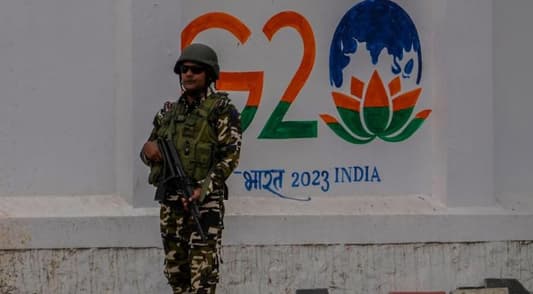
Police said last week that security had been beefed up to avoid any chance of attack during the three-day event, and on Monday soldiers and armoured vehicles were deployed at multiple locations in Srinagar, capital of India-held Kashmir.

Hundreds have been detained in police stations and thousands, including shopkeepers, have rece­ived calls from officials warning against any “signs of protest or trouble”, a senior official told AFP on condition of anonymity.

Attempt to hoodwink assailed

Foreign Minister Bhutto-Zardari lambasted India for likening the legitimate struggle for right to self-determination of Kashmiri people with terrorism to hoodwink the international community, but said the diatribe against Kashmiris and Pakistan would never help New Delhi evade the long overdue just solution to the festering issue in accordance with the UNSC resolutions and aspirations of the Kashmiris.

“India is trying to use the terrorism bogeyman to mask the indigenous Kashmiri struggle for the legitimate right to self-determination. It uses the same bogey to blame Pakistan and justify its brutal repression of the Kashmiri people, in what is a complete travesty of justice,” he said, in his address to a special session of the AJK Legislative Assembly.

“There is a clear distinction between terrorism and a people’s genuine quest for freedom. Terrorism cannot be and should not be used as an excuse to deny the Kashmiri people their fundamental rights and their fundamental freedoms,” he added.

Mr Bhutto-Zardari’s address coincided with the G20 meeting in occupied Srinagar.

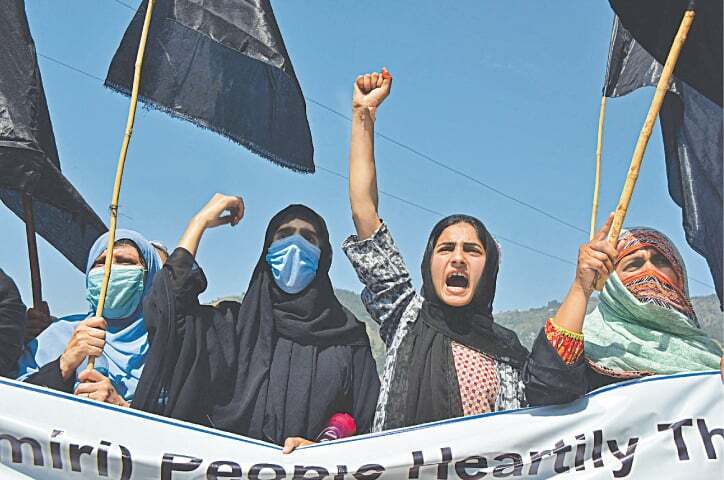
People in AJK expressed their disapproval of the event by staging rallies and demonstrations and observing symbolic strikes.

The foreign minister emphasised that the Kashmir dispute was the unfinished agenda of the partition of the Sub-continent, when the rights and aspirations of the Kashmiri people were trampled upon by machinations and intrigue.

He regretted that the Kashmiri people had been denied their inalienable right despite the lapse of more than seven decades.

“Today, I ask the world if a country can be allowed to renege on its solemn commitments to the United Nations, break its own promises and blatantly violate international law just because they want to?”

Taking strong exception to India’s August 5, 2019, move, he said it had opened a new chapter of oppression to accomplish Delhi’s nefarious plan to convert Kashmiris into a dispossessed and disempowered minority in their own land.

“Pakistan rejects these unilateral and illegal steps outright. How can the world be a silent bystander when a large country usurps the rights guaranteed by the Security Council, and instead uses brute force to suppress those rights?” he asked. “India is misusing its position as chair of the G20,” he said.

While paying tribute to the valiant Kashmiri people, he reassured them of Pakistan’s unstinted moral, diplomatic and political support till they achieved their legitimate rights.

Men, women attend rallies

Earlier, hundreds of men, women and schoolchildren paraded through the streets in different parts of the liberated territory to condemn the holding of G20 huddle in Srinagar.

A big rally was held in Muzaffarabad under the aegis of an organisation of post-1989 migrants from occupied Kashmir, with its participants carrying black flags and banners inscribed with slogans against the G20 meeting.

One banner was full of praise for China for its categorical boycott of the Srinagar meeting.

Sixty-year-old Malka Jan, who had migrated to AJK in 1992, said she was yearning for a just settlement of Kashmir issue so that she could return to her native area.

“Instead of participating in meetings under the aegis of oppressor India, world powers should take concrete steps to establish peace and justice in our motherland by granting us our right to self-determination,” she said.


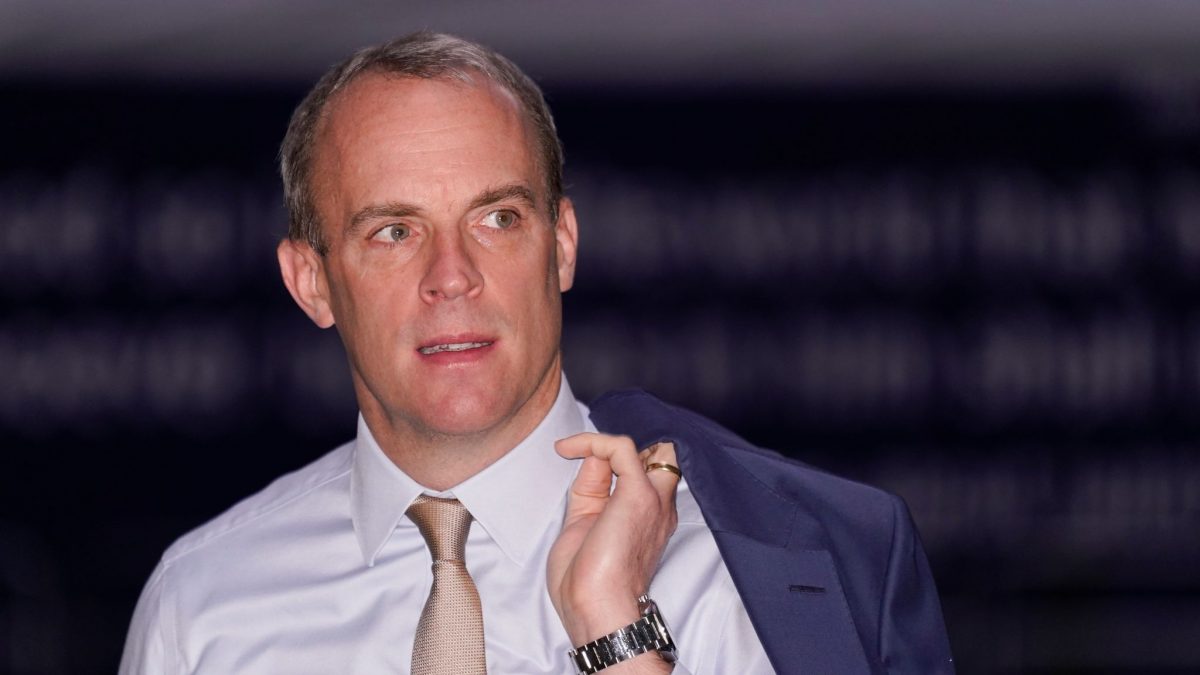
Former deputy prime minister Dominic Raab will stand down as an MP at the next election.

His decision, first reported in The Telegraph, comes a month after he resigned as a minister when a bullying inquiry found he had acted in an “intimidating” way towards officials.

The paper quotes Mr Raab as saying he is concerned about “the pressure the job has placed on my young family”.

Mr Raab and his wife have two sons, aged 10 and eight.

Since becoming an MP in 2010, Mr Raab has served in many ministerial roles.

In 2018 then-prime minister Theresa May appointed him as Brexit secretary, a job he quit less than six months later.

Boris Johnson picked him to be his foreign secretary and first secretary of state – the latter role meant he was left in charge of running the country when Mr Johnson was hospitalised with Covid in April 2020.

Mr Raab has also been a close ally of Rishi Sunak, supporting him in last summer’s Conservative leadership race.

Mr Sunak rewarded his loyalty when he became prime minister, making Mr Raab both his justice secretary and deputy prime minister.


Mr Raab confirmed to BBC News that he would not seek re-election as the MP for Esher and Walton, which he has represented since 2010 and won with a majority of 2,743 votes in 2019.

In a letter from Mr Raab to his constituency, seen by the Telegraph, the MP said it had been a “huge honour to represent the Conservatives since 2010 in this wonderful constituency”.

His departure from Parliament means the Conservatives will have to find a new candidate for the Surrey constituency – which is a key election target for the Liberal Democrats.

Mr Raab joins a growing number of senior Conservatives deciding not to stand in the next general election, expected in 2024.

Former ministers including Sajid Javid and George Eustice have also announced their intention to leave the House of Commons.

Mr Raab was at the centre of months of speculation when bullying allegations from civil servants led to an inquiry into the MP’s conduct.

The report – conducted by senior lawyer Adam Tolley KC – concluded Mr Raab had engaged in an “abuse or misuse of power” as foreign secretary.

The findings prompted Mr Raab to step down, but in his resignation letter he noted that the inquiry “dismissed all but two of the claims levelled against me”.

He also said the inquiry was “flawed and sets a dangerous precedent” and would “encourage spurious complaints against ministers, and have a chilling effect on those driving change on behalf of your government – and ultimately the British people”.

Responding to his decision to quit as an MP, fellow Conservative Angela Richardson tweeted: “His constituents will miss his dedication. I am happy for his young family though. This job is tough enough on family life as a simple backbencher, let alone being in Cabinet.”

Miscreants involved in attacks on army installations to face military court, others ATC: PM Shehbaz

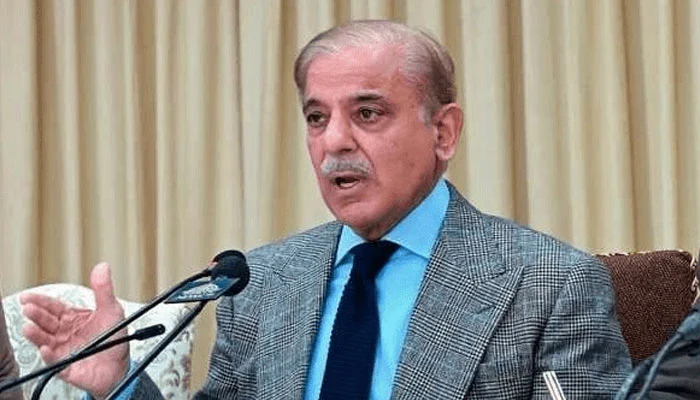
Prime Minister Shehbaz Sharif on Sunday announced that miscreants involved in attacks on army installations and civil properties during the May 9 violent protests will be tried in military courts and anti-terrorism courts (ATCs), respectively.

The violent protests were triggered almost across the country after Pakistan Tehreek-e-Insaf (PTI) Chairman Imran Khan’s arrest in £190 million Al-Qadir Trust case on May 9 which led to the deaths of at least 10 people and injured several others, prompting the authorities to arrest thousands of PTI workers.

During the protests, the miscreants attacked the civil and military installations including – Corps Commander’s House (Jinnah House) in Lahore Cantt and the General Headquarters (GHQ) in Rawalpindi.

The military called May 9 “Black Day” and has decided to try the protesters under the Army Act, with Chief of Army Staff General Asim Munir saying that the legal process in this regard has already begun.

Chairing a meeting on the law and order situation in Lahore today, PM Shehbaz said everyone who is involved in the incidents of May 9 will be dealt with iron hand.

He added that the day will always be remembered as a “black day” in the history of Pakistan. He went on to say that the rioters “turned into enemies of the country” and carried out the attack on the GHQ.

He said that the miscreants also burned Jinnah House and public properties on the same day. PM Shehbaz said that those who are involved in attacking the military installations will also be brought to book.

Berating Khan, the incumbent prime minister said: “May 9 was the darkest day in the history of Pakistan when PTI Chairman Imran Khan Niazi led miscreants torched Quaid’s (Corps Commander’s) House in Lahore like the terrorists had set on fire Quaid’s Residency in Ziarat during 2013.”

He added that the PTI chief and his followers stoked terrorism and violence that amounted to anti-state acts.

They caused damage to such a huge extent that even the enemies of Pakistan could not do it in the last 75 years, he added. “Such agonising incidents will continue to haunt the nation.”

Seeking progress on the legal proceedings against the culprits, he reiterated that during previous meetings, it was decided that anyone involved in the incidents of planning, instigating, sloganeering and vandalism would not escape the iron claws of law.

‘Attack on GHQ included in India’s objectives’

Earlier today, Federal Minister for Defence Khawaja Asif said that the attack on the GHQ during the May 9 violent protests was included in India’s anti-Pakistan objectives.

“Pakistan’s existence was attacked on May 9. A person [Imran Khan] made this attack just for the sake of his power,” Asif said while addressing Pakistan Muslim League-Nawaz’s (PML-N) rally taken out to express solidarity with the armed forces, in Sialkot.

He regretted how the families and heirs of the martyred would have felt when a group of vandals attacked the sacred monuments. “I never doubt anyone’s loyalty but I doubt the intentions of those who led the attacks on May 9.”

Moreover, Minister for Planning, Development, and Special Initiatives Ahsan Iqbal deemed the May 9 vandalism on military installations by the PTI workers as “9/11-type” attacks on the national interests of the country.

In an exclusive interview with APP today, the federal minister lamented over the regrettable act by the party’s workers who barged into and destroyed several symbols of Pakistan’s pride including the Jinnah House, Yadgar-e-Shuhada, fighter jets of the famous 1965 war and the Chagai mountain model.

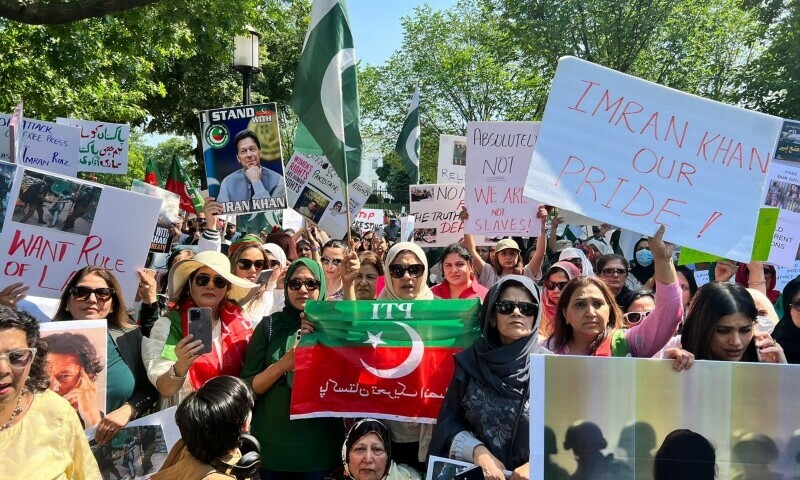
Hundreds of PTI supporters protest outside White House

In an interview to CNN’s Fareed Zakaria, Mr Khan complained that “there’s no rule of law” in Pakistan, saying that over 10,000 PTI workers had been arrested.

Arriving in two buses from Virginia, PTI workers were heard singing patriotic songs and chanting slogans, expressing their determination to continue struggling for democracy in Pakistan.


One song offered encouragement to despondent supporters, worried over the crackdown on party workers: “Don’t worry, good days will return.”

Buses also brought PTI supporters from other areas in and around Washington, indicating the party’s increased popularity among the Pakistani-American community since Imran Khan’s arrest.

At the White House, “Pakistan Zindahbad” and “Imran Khan Zindahbad” were the most dominant slogans. Unlike previous protests, no anti-military slogans were raised.

“The country is ours, so is the army,” said Johnny Bashir, a local PTI leader. “We are against a handful of generals.”

In his interview to Fareed Zakaria, Mr Khan complained that police had surrounded his home in Lahore, searching every visitor.

“One evening … I opened my house for the media” to show that there were no terrorists inside, as the government claimed.

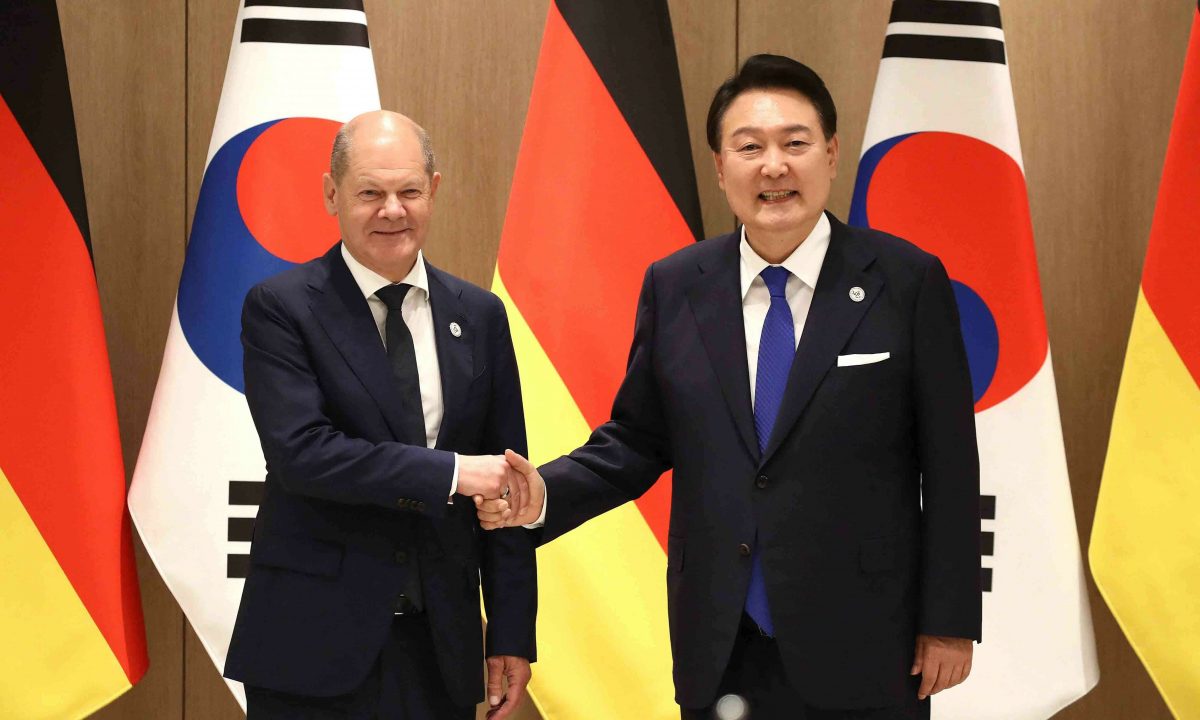
Scholz visits Korean DMZ, calls North’s missile tests ‘dangerous’

The military information agreement will help “smoothly operate the defence industry supply chain”, amid global economic and political instability, Yoon told a briefing.

South Korea, which recently pursued a similar information-sharing pact with Canada, has moved to expand its defence industry amid rising demand driven by the war in Ukraine and other global tensions, but has so far refused to provide weapons to Kyiv.

Yoon said respect for freedom as a universal value was “very vital” in the face of authoritarianism challenging democracy, unstable global supply chains and the war.

“From now, I expect South Korea and Germany will further expand reciprocal and future-oriented cooperation and strengthen the solidarity for peace and prosperity of Europe and Asia,” Yoon said in opening remarks at the meeting with Scholz. The two leaders also discussed deepening cooperation in production of semiconductors, among other areas.

Scholz, who is visiting South Korea after attending the Group of Seven (G7) summit in Hiroshima, Japan, called North Korea’s missile tests a sign of a “still dangerous situation” on the Korean peninsula.

“This is a threat to peace and security in this region,” he said at a military base after a visit to the Demilitarised Zone (DMZ) separating the Koreas. Germany’s history as a divided nation had been overcome, he said, but division persists on the Korean peninsula. Both Scholz and Yoon left Japan on Sunday after joining the G7 summit. South Korea was invited as an observer.

G7 leaders signalled they would not back down from supporting Ukraine, and outlined a shared approach towards China, looking to “de-risk, not decouple” economic engagement with a country regarded as the factory of the world.

Yoon, who met Ukrainian President Volodymyr Zelenskiy for the first time on the sidelines of the G7, said he was planning to provide mine-removing equipment and ambulances.

India is holding a key G20 tourism meeting in Kashmir amid heightened security and opposition from China.

The working group meeting is being held in Srinagar, the summer capital of the federally administrated territory, from Monday to Wednesday.

This is the biggest international event organised in the region since India scrapped its special status in 2019.

Over 60 delegates from G20 member countries are expected to attend the event.

China, however, has said it will not attend, citing its firm opposition “to holding any kind of G20 meetings in disputed territory”. The BBC has emailed India’s foreign ministry for its response to China’s statement.

Both India and Pakistan claim Kashmir in full, but control only parts of it. The nuclear-armed neighbours have already fought two wars and a limited conflict over the region.

In April, Pakistan, which is not a G20 member, had criticised India’s decision to hold the meetings in Kashmir, calling it an “irresponsible” move.

India, however said, that it was “natural” to hold G20 events and meetings in “Jammu and Kashmir and Ladakh, which are an integral and inalienable part” of the country.

In 2019, India had divided the Muslim-majority state of Jammu and Kashmir to create two federally administrated territories – Jammu and Kashmir, and Ladakh. Ladakh is a disputed frontier region along the Line of Actual Control (LAC) between India and China, and both countries claim parts of it.

In the days leading up to the G20 event, India had conducted several security drills in Kashmir. The region has seen an armed insurgency against India since 1989 – India accuses Pakistan of fomenting the unrest by backing separatist militants, a charge denied by Islamabad.

Some opposition leaders have criticised the elaborate security arrangements ahead of the G20 meet

The region has witnessed increased attacks by suspected militants this year and security officers have told the media that they are taking steps to prevent any threats designed to derail the meet.

Elite security forces – including marine commandos, National Security Guards, Border Security Force and police forces – have been deployed in Kashmir to provide ground-to-air security cover, according to reports.

Security has also been boosted around the Dal Lake and the Sher-e-Kashmir International Convention Centre (SKICC) in Srinagar, which is the venue for the meeting.

Several schools in Srinagar have also been closed, some for as long as nine days, according to reports. Military bunkers, a common sight in Kashmir, have been covered with G20 banners to hide them from view.

Local opposition leaders, including former Jammu and Kashmir chief minister Mehbooba Mufti, have criticised the elaborate security arrangements and accused the federal government of making life even more difficult for ordinary people. In a press conference, Ms Mufti compared the restrictions in Kashmir ahead of G20 to that of the notorious US military prison, Guantanamo Bay. The Jammu and Kashmir administration has not responded to this yet.

Last week, Fernand de Varennes, the UN’s special rapporteur on minority issues, had issued a statement saying that the G20 was “unwittingly providing a veneer of support to a facade of normalcy” when human rights violations, political persecution and illegal arrests were escalating in Kashmir. The statement was criticised by India’s permanent mission at the UN on Twitter.

India has said it will showcase the cultural heritage of Kashmir and promote its tourism potential during the meeting. Delegates will be taken on sightseeing tours and there will be discussions on strategies to promote “film tourism”, according to an official statement.

The G20, which includes the world’s 19 wealthiest nations plus the European Union, accounts for 85% of global economic output and two-thirds of its population.

India currently holds the presidency – which rotates annually between members – and is set to host the G20 summit in Delhi in September.

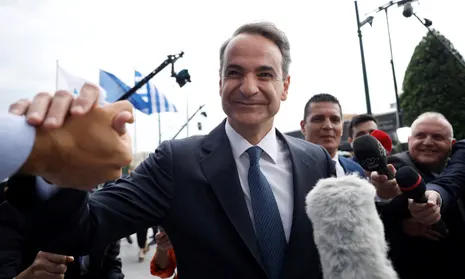
Greece’s conservative prime minister Kyriakos Mitsotakis has won national elections, hailing his party’s big victory as a “political earthquake”.

His centre-right New Democracy party were heading for almost 41% of the vote, five seats short of a majority.

His centre-left rival Alexis Tsipras congratulated him, with his Syriza party set for a poor result of 20%.

Mr Mitsotakis said the result showed that Greeks had given his party a mandate for a four-year government.

“The people wanted the choice of a Greece run by a majority government and by New Democracy without the help of others,” he said in a victory speech.

Hours earlier party supporters in Athens cheered as an exit poll indicated the unexpected scale of New Democracy’s victory. As results emerged, it was clear that pre-election polls had underestimated the 20-point margin between the two main parties.

Mr Mitsotakis’s party won 146 seats, five seats short of the 151 required for a majority. An interior ministry vote map showed all but one of Greece’s electoral districts coloured in New Democracy blue.

The prime minister’s remarks were taken as indication that he would not look to share power with another party but go for a second election in late June, when the winning party picks up bonus seats.

Greek President Katerina Sakellaropoulou will offer him a mandate to form a coalition, which he is likely to refuse. She will then pass it to the next two parties, and if that fails she will arrange a caretaker government until new elections.

The result was an immense setback for Syriza leader Alexis Tsipras, who described his party’s performance as “extremely negative”. He came to power in 2015 campaigning against the austerity of international bailouts, but ultimately agreed to creditors’ demands.

The centre-right has governed Greece for the past four years, and can boast that the country’s growth last year was close to 6%.

Mr Mitsotakis’s pitch to the nation was that only he could be trusted to steer the Greek economy forward and consolidate recent growth. Greeks appear to have responded positively – more than expected.

Giorgos Adamopoulos, 47, voted for New Democracy a few hundred metres from the Acropolis in Athens.

Greece deserved a better form of politics, he told the BBC, but he backed Mr Mitsotakis because he was impressed with his record after four years as prime minister.

Panayiotis, 47

1px transparent line

Four years ago winning 41% of the vote would have been enough to secure a majority in Greece’s 300-seat parliament.

Now it requires more than 45%, because the winning party is no longer entitled to a 50-seat bonus in the first round, making a re-run more likely.

Mr Mitsotakis will have his eye on the extra seats he would be entitled to if he won the second election. An outright majority would give him four years in power with a cabinet of his choice.

If he were to seek coalition talks, then Syriza’s socialist rival Pasok would be a potential partner, as one of the election’s big winners with 11.5% of the vote.

But that would prove tricky as Pasok leader Nikos Androulakis was the target of a wiretap scandal last year.

It led to the resignations of a nephew of Mr Mitsotakis, who was working as the prime minister’s chief of staff, and also of the head of Greek intelligence.

Mr Androulakis believes the prime minister was aware he was one of the dozens of people targeted with illegal spyware.

1px transparent line

Mr Mitsotakis comes from one of Greece’s most powerful political dynasties.

His father Konstantinos Mitsotakis was himself prime minister in the early 1990s; his sister Dora Bakoyannis was foreign minister and her son Kostas Bakoyannis is the current mayor of Athens.

In the end a rail tragedy in February that overshadowed the election campaign played no obvious role in the result.

Fifty-seven people died in the disaster, many of them students. Opposition parties highlighted the tragedy as a symptom of a dysfunctional state pared down to the bone after years of economic crisis and under-investment.

Greeks have the right to vote from the age of 17, and an initial analysis of voting by Greek TV suggested that 31.5% of voters aged 17-24 backed ND, almost three points higher than Syriza.

First-time voters Chrysanthi and Vaggelis, both 18, voted for Syriza because their generation wanted “something new, something different”.

Rishi Sunak is to consult his ethics adviser later about Suella Braverman’s handling of a speeding offence.

The home secretary sought advice via civil servants and an aide about arranging a private speed awareness course while attorney general in 2022.

A government source has denied her actions broke the ministerial code.

Labour leader Sir Keir Starmer said the prime minister should order his adviser, Sir Laurie Magnus, to investigate whether rules were broken.

Speaking to BBC Breakfast, Sir Keir said it looked like “inappropriate action took place” from the home secretary that “needs to be fully investigated”.

“The usual consequence of breaking the ministerial code is that you’ll go,” he added.

Labour’s deputy leader Angela Rayner also called on the prime minister to “show some backbone” and order Sir Laurie to “get to the bottom of this episode”.

Mr Sunak, who has been in Japan for the G7 summit, will speak to his ethics adviser on his return. Sir Laurie cannot begin an investigation into a minister until the prime minister gives it the go-ahead.

The Liberal Democrats are also calling for an investigation and said Mr Sunak needed to make a statement in Parliament about the claims.

Meanwhile, Mrs Braverman is due in the Commons on Monday afternoon for Home Office questions.

She was caught speeding last summer, and faced three points on her licence and a fine, or a course as part of a group.

The home secretary is under scrutiny, not over the speeding offence itself, but over whether she acted properly in trying to arrange a one-to-one awareness course.

A government source told the BBC the senior minister had been “concerned” about her insurance premiums, and favoured doing a course.

She asked civil servants about arranging a course for just her, citing security concerns about doing one as part of a group, but was told it was not a matter for the civil service.

Mrs Braverman then asked a special adviser to try to arrange a private course.

When the course provider told her there was no option to do this – and after she was reappointed home secretary in Mr Sunak’s government – she opted to pay the fine and accept the points because she was “very busy” and did not have the time to do a course, the BBC has been told.

The same government source refused to say whether Mrs Braverman’s motivation to do the course in private was to reduce the chances of her being recognised by members of the public.

The ministerial code sets standards of conduct expected of ministers, including that they must uphold the political impartiality of the civil service.

Speaking to the Westminster Hour on BBC Radio 4, former senior civil servant Sir Philip Rycroft said Mrs Braverman’s reported actions appeared to be a “real lapse of judgement”.

“Obviously, there’s still investigations to be done and so on but the code is very clear. Ministers must ensure that no conflict arises or appears to arise between their public duties and their private interests.

“Even asking a question of a civil servant as to how she might go on one of these courses puts them in an impossible position.”

Mr Sunak apparently did not know anything about the story the until it was first reported in the Sunday Times. and he declined to say whether he would be ordering an investigation, when asked at the G7 summit.

Speaking at a news conference, he also declined to say he backed Mrs Braverman – but a Downing Street source later said that “of course” he did.

“I don’t know the full details of what has happened, nor have I spoken to the home secretary,” Mr Sunak said.

“But I understand she has expressed regret for speeding, accepted the penalty and paid the fine.”

Media caption,

“Did you have any questions about the summit?” Rishi Sunak asks the BBC’s Chris Mason

After serving as attorney general between February 2020 and September 2022, Mrs Braverman was promoted to home secretary under Liz Truss.

She resigned on October 19 after sending an official document from a personal email to a backbench MP – describing it as a “technical infringement of the rules”. But she was reappointed to the same role by Mr Sunak six days later following the collapse of the Truss government.

A source close to the home secretary said: “Mrs Braverman accepted three points for a speeding offence which took place last summer.

“The Cabinet Office was made aware of the situation as requested by Mrs Braverman. She was not and is not disqualified from driving.”

A Cabinet Office spokesman said: “It would not be appropriate to comment on the existence or content of advice between government departments.”