Climate change will fuel humanitarian crisis in 2023: study

The agency, based in New York and led by former UK politician David Miliband, flagged that the number of people in humanitarian need has skyrocketed in the last decade, approaching 339.2 million versus the 81 million seen in 2014.

Climate change is among the key factors accelerating humanitarian emergencies, the IRC noted, despite the fact that the 20 countries on its emergency watchlist — like Haiti and Afghanistan — contribute just 2 per cent to global CO2 emissions.


“2022 has shown that the role of climate change in accelerating the global humanitarian crisis is undeniable,” the report noted.

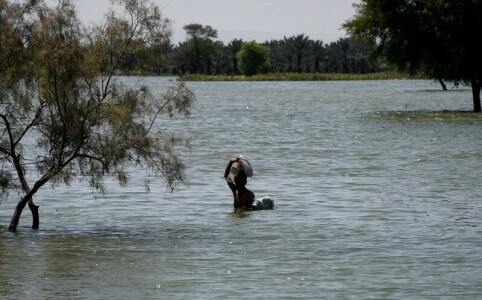
It pointed to record-long periods of rains, which has “brought catastrophic food insecurity to Somalia and Ethiopia,” and killed thousands in Pakistan.

The IRC also flagged to need to more “proactively invest in climate change prevention and mitigation.”

Meanwhile, food insecurity is already rife due to growing conflict as well as the economic crisis sparked by Russia’s invasion of Ukraine and the coronavirus pandemic, it said.


In addition, the gap between humanitarian needs and its financing has grown to a global deficit of $27 billion as of November 2022.

“Donors are failing to respond proportionately,” the report said.

“The result is that communities affected by the crisis are unable to access the services they need to survive, recover and rebuild.”

The study — titled “Emergency Watchlist 2023 “ — also highlighted that the number of people forced to flee their homes has risen to more than 100 million today, up from 60 million in 2014, with Venezuela among the biggest drivers.

“SOS. I am dying, I have very little time left,” wrote Georgian ex-president Mikheil Saakashvili in a hand-written note to the French president.

Saakashvili, 54, has been in a Georgian jail for more than a year, convicted of abuse of power while in office.

A court in Tbilisi is due to consider whether to suspend his sentence or release him on humanitarian grounds to let him have medical treatment abroad.

He hopes the international community will press Georgia to release him.

Last seen in public at a court hearing in April, the former president has reportedly suffered significant weight loss and is unable to move without assistance. He is expected to attend Wednesday’s court hearing in the capital remotely.

Following two hunger strikes against his imprisonment, Saakashvili was transferred to the private Vivamedi Clinic in Tbilisi in May 2022 and has been confined to a room there.

Empathy, an organisation supporting victims of torture in Georgia, alleged on 1 December that he had been diagnosed with illnesses “incompatible with imprisonment” and that Georgian and foreign medical experts had found evidence of heavy-metal poisoning.

Hair samples revealed high levels of mercury.

But the Georgian government denies Saakashvilli’s life is in danger.

“We will not allow anyone, no matter who they are, to put themselves above the law,” Prime Minister Irakli Garibashvili told local media on 7 December.

“I heard a lot that Saakashvilli is depressed and does not like the environment. Which prisoner likes the prison environment?” he said.

Mikheil Saakashvili/Facebook
I am sick, but tomorrow I want to attend the court that decides my life or death. thank you everyone!
1px transparent line

The former president has inflamed tensions in Georgia between his supporters and those who want him punished for crimes committed in office.

Mikheil Saakashvilli rose to power after Georgia’s so-called Rose Revolution in 2003 and was credited with introducing major reforms and helping to steer the country towards a more Western system of democracy. But in his final years in office, he was accused of turning increasingly authoritarian.

He led the country until his party’s defeat in elections in 2012, then later left Georgia to avoid facing prosecution.

Saakashvili was tried in absentia and sentenced to six years in 2018 for abuses of power. There are additional criminal cases against the former president, including illegally crossing the state border last September, after he smuggled himself back into Georgia.

But his supporters believe his prosecution is a transparent political vendetta.

Saakashvilli had a very public falling-out with Georgia’s powerful oligarch Bidzina Ivanishvili, who made his fortune in Russia.

Mr Ivanishvili founded the governing party, Georgian Dream, and is widely believed to maintain influence in politics.

The opposition United National Movement, founded by Saakashvili, has accused the current administration of being pro-Kremlin for failing to openly criticise Russia since its invasion of Ukraine.

Georgia’s government argues its approach to its northern neighbour is pragmatic and accuses the opposition of seeking to entangle Georgia in Russia’s war.

Saakashvili describes himself as a prisoner of President Vladimir Putin.

“All my life I fought for freedom and reforms in Georgia and Ukraine against Russia’s imperialist policy. Putin considers me one of his main enemies,” Saakashvili wrote in his note to the French president.

Saakashvili was detained in October 2021 when he made a surprise return to Georgia

The Russian leader infamously threatened to hang Saakashvili “by his balls” during the 2008 Russia-Georgia war over the Georgian region of South Ossetia, which is now occupied by Russia.

Eduard Saakashvili warned journalists at the European Parliament this week that his father’s health was in decline and that he was growing weaker: “A person who used to be energetic, ambitious, charismatic, restless is slowly fading away.

“Add that to the medical reports and we see a dire picture… from mistreatment and inadequate care… We cannot allow my father Mikheil Saakashvili to die in prison.”

He called on the Georgian government to allow his father to receive treatment abroad.

Earlier, the US ambassador to Georgia, Kelly Degnan, said the government of Georgia was responsible for meeting Saakashvili’s medical needs and ensuring his rights.

When asked about his responsibility for the former president’s well-being, Prime Minister Garibashvili said it was in the hands of God.

“Our lives are given to God, so I can’t really be responsible for anyone’s life,” he said.

Strikes are picking up pace in the run-up to Christmas as workers squeezed by rising costs fight for higher pay.

Rail workers will walk out for a second day, while Royal Mail employees and driving examiners are also striking.

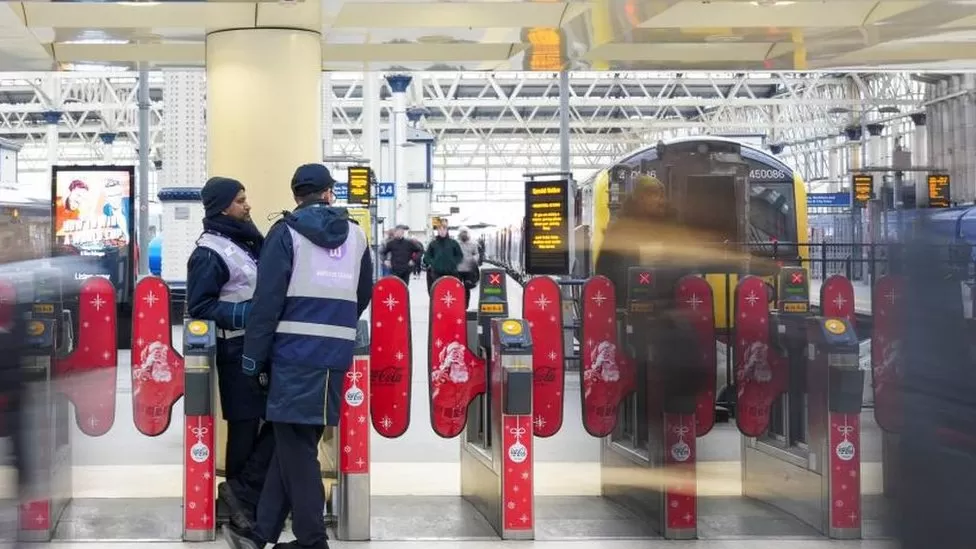
Tuesday’s walkout by rail staff left services running at about a fifth of capacity, on a day when snow, ice and fog hampered road and air travel.

Around half of rail lines will be shut again on Wednesday, with no services at all in most of Scotland and Wales.

The first-ever nationwide strike by nurses is also expected to go ahead this week.

And on Friday, rail workers, buses, baggage handlers, highway workers and driving examiners will walk out.

The government’s emergency Cobra committee will hold its second meeting of the week later to discuss how to minimise the impact of the wave of industrial action.

Industrial action by 115,000 members of the Communication Workers Union (CWU) coincides with the busiest time of year for Royal Mail when people and businesses are sending Christmas cards and presents.

Some parcel companies claim the Royal Mail strike is having a knock-on effect, and forcing them to delay next-day deliveries as people and firms seek alternative ways to send their post.

DPD Group said: “We are experiencing short delays to our next-day delivery service in a small number of locations, as a result of the industrial action at the Royal Mail, which has had a huge knock-on effect across the entire industry.”

Evri, the delivery company formerly known as Hermes, said that severe weather, Royal Mail strikes and staff shortages are causing “some localised delays”.

While Yodel also said that deliveries are taking longer to some areas but did not specify why.

As well as holding strikes this week, Royal Mail workers will also take industrial action on 23 December and Christmas Eve.

The dispute has been going on since the summer and like all the industrial action across rail, the NHS, teachers, border staff and driving instructors, pay is a key issue.

Workers are seeking wage rises as the cost of living soars. The rate at which prices are rising, known as inflation, is running at more than 11% which is the fastest pace for more than 40 years.

This is largely due to food and energy prices going up.

‘Making life hard’

One small business in Brighton which relies on Royal Mail to get its products to customers said the strikes in the run-up to Christmas were “frustrating”.

Lucy Bryant, who runs her artist’s studio, Haus of Lucy, says she supports the strikers as “everyone has a right to fair pay”.

However, she relies “so heavily on the post” to get products from suppliers and to send her art to customers that she says the Royal Mail strikes “have made my life very hard this Christmas season”.

“I’ve got the frustration of my customers to deal with,” when artworks don’t arrive on time in the run-up to Christmas, she says. “It’s frustrating for them, and it’s frustrating for me.”

Lucy Bryant supports the strikes, but says they have it more difficult to get her art to customers

Some artworks are getting through, and some aren’t. “There’s almost no logic to what is getting through,” she says.

Lucy had to re-order prints that didn’t arrive at a cost to the business “that is quite a big hit for me to take,” she says.

“I’m not Banksy – yet,” she adds.

Lucy says using other postal service providers “is a bit of a wild west”, but if strikes continue, she may be forced to find alternatives to Royal Mail, which is a service she trusts.

On Wednesday, the Office for National Statistics will announce the inflation figure for November. In October, that rate was 11.1%.

On Tuesday, figures from the ONS revealed that the gap between wage growth in the public and private sector is near a record high.

The average pay rise for workers in the private sector was 6.9% between August and October. That compares to wage growth of just 2.7% for public sector employees.

Royal Mail workers voice their anger over pay and conditions

A spokesman for Royal Mail said the company had made a “best and final pay offer worth up to 9% over 18 months”.

“Instead of working with us to agree on changes required to fund that offer and get pay into our posties’ pockets, the CWU has announced plans to ballot in the New Year for further strike action.”

But a spokesman for the CWU said that Royal Mail has offered workers a 3% pay rise this year, 3% next year as well as an additional 2% if employees agree to “the absolute destruction” of terms and conditions.

Along with the rail industrial action on Tuesday and Wednesday, there will also be train strikes on Friday and Saturday.

This is part of a long-running dispute between unions, rail firms, the government and Network Rail over pay, job cuts and changes to terms and conditions.

Employees are being squeezed by the rising cost of living, and want pay deals that reflect this.

But the rail industry was hit by a drop-off in passenger numbers during the Covid pandemic, and it’s under pressure to save money. Bosses say reforms need to be agreed, to afford pay increases and modernise the railway.

Network Rail wants to cut 1,900 jobs as part of changes to the way its maintenance teams work – although it insists most of this could be achieved by people leaving voluntarily.

The RMT disagrees with some of the changes and wants a guarantee of no compulsory job losses.

PM Shehbaz lauds OIC ‘principled stance’ on Jammu and Kashmir

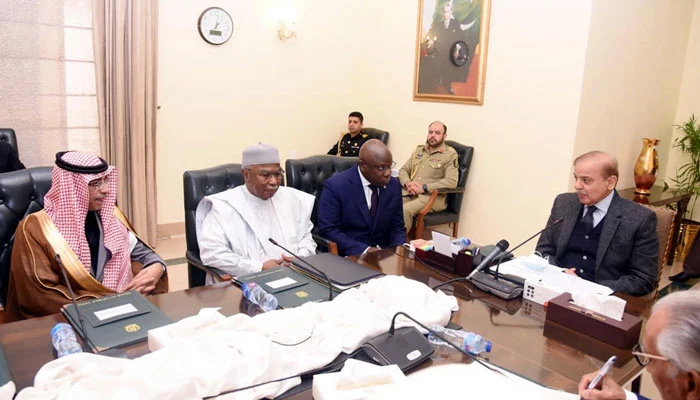
ISLAMABAD: Prime Minister Shehbaz Sharif on Monday appreciated the Organisation of Islamic Cooperation’s (OIC) “principled stance” on the Jammu and Kashmir issue.

In his meeting with OIC Secretary General Hissein Brahim Taha, the prime minister lauded the organisation for its consistent support for the resolution of the longstanding dispute.

He mentioned the support of OIC is in accordance with the relevant United Nations Security Council (UNSC) resolutions and the aspirations of the Kashmiri people.

The OIC secretary-general is in Pakistan on his maiden visit after assuming office in November 2021.

The prime minister highlighted the grim human rights and humanitarian situation in Indian Illegally Occupied Jammu and Kashmir (IIOJK).

Welcoming the secretary general’s historic visit to Azad Kashmir and Line of Control (LoC), PM Shehbaz underscored that his visit would send a strong message of support from the OIC to the Kashmiri people in their just struggle for the right of self-determination.

PM renews support to Palestinian people

The prime minister also renewed the unwavering support of the people and the Pakistani government to the Palestinian people and their cause. He reiterated that any solution to the Palestine issue must be based on the pre-1967 border with Al-Quds Al-Sharif as its capital.

Recognising that the OIC has stepped up its engagement with Afghanistan since the extraordinary session of the OIC Council of Foreign Ministers (CFM) in Islamabad in December 2021, he encouraged the secretary general to accelerate efforts for addressing and alleviating the humanitarian challenges faced by the people of Afghanistan.

The prime minister also reiterated the need to counter the rising anti-Muslim hatred and attempts to denigrate the sanctity of the Holy Prophet Muhammad (Peace Be Upon Him).

He expressed concern over intensifying the Islamophobia campaign, particularly in the region, where anti-Muslim and anti-Islam agenda was being pursued as an instrument of state policy.

The secretary-general reiterated the OIC’s full support for the resolution of the Jammu and Kashmir dispute, in accordance with the relevant UNSC resolutions.

He also offered his condolences over the loss of lives and livelihoods caused by the recent climate-induced floods in Pakistan.

PM Shehbaz’s son Suleman secures 14-day protective bail from IHC

The Islamabad High Court (IHC) on Tuesday granted 14 days of protective bail to Prime Minister Shehbaz Sharif’s son Suleman Shehbaz while directing him to appear before the relevant trial court hearing a money laundering case against him.

Suleman landed in Pakistan on Sunday after spending over four years of self-exile in the United Kingdom, following IHC’s directive to surrender before the court by December 13.

The court had denied protective bail to the premier’s son, citing his absence, but barred the authorities from arresting him from the airport on his arrival to Pakistan.

Suleman appears before IHC

Suleman appeared before the IHC at the outset of the hearing of his plea for protective bail.

During the hearing, IHC Chief Justice Aamer Farooq asked Suleman’s counsel about the court his client has to appear in.

At this, Amjad Pervez, Suleman’s lawyer, told the IHC CJ that his client has to appear before the central special judge in Lahore.

Justice Farooq, after learning this, granted protective bail to the PM’s son and directed him to appear before the relevant court within 14 days.

In his petition before the IHC, Suleman contended that he left Pakistan in 2018 and the case was registered against him in 2020. He also shared that the Federal Investigation Agency (FIA) had not issued a call-up notice to him, adding that he was declared a proclaimed offender by the court without any action.

‘Imran Khan’s time to be accountable here’

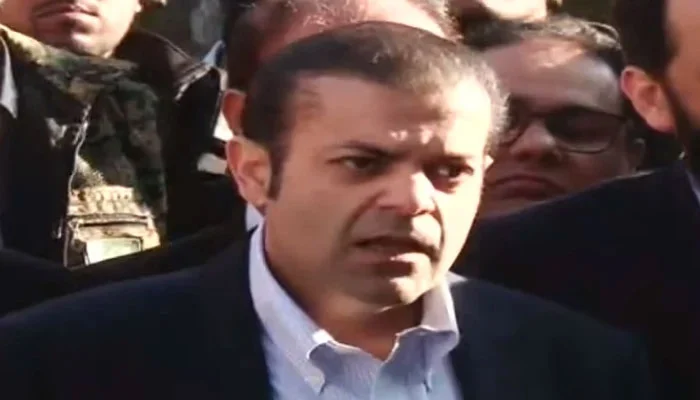
Speaking to the media outside IHC, Suleman slammed Pakistan Tehreek-e-Insaf (PTI) Chairman Imran Khan and said that his time of accountability is here.

“The time of accountability is here, we will not spare him. We will not give him any space now and he will be punished,” said Suleman.

Asked about Farah Gogi, a friend of Imran Khan’s wife who allegedly sold the Toshakhana watches gifted to Khan, Suleman wondered why she flee Pakistan.

“You are crying that Farah Gogi is not a public office holder. I was not a public office holder either,” said Suleman. He added that the PTI chairman, while he was in power, did not even think about women and arrested them.

“You had the power, you could have proved the cases,” said Suleman.

The PM’s son also slammed former National Accountability Bureau (NAB) chairman Javed Iqbal, saying that he was a “black stain” on the accountability system.

‘Entire world saw Imran Khan’s tamasha last month’

Suleman further stated that the entire world saw the “tamasha” [show] by PTI Chairman Khan last month.

He said that the PTI leadership criticises every institution which provides relief to the PML-N leaders. He said that a case was registered in Britain at the behest of the Pakistani government in Khan’s tenure, and its trial continued for 18 months.

“The [UK] National Crime Agency (NCA) found no evidence of money laundering against Shehbaz Sharif,” Suleman said, while asking what the PTI leadership would say about the British agency now.

The PM’s son also asked the PTI chief to show the transaction of the money he got from selling the watches gifted by the Saudi crown prince.

Moving on to the defamation case that PM Shehbaz Sharif won in a UK court, Suleman said that PTI leader Shahzad Akbar was the one to bring David Rose — who wrote the defamatory article in the British publication Daily Mail — to NAB’s cell.

He said that the story was published in England’s newspaper after a “false briefing” at NAB’s cell.

“Shahzad Akbar himself is on the run from Pakistan. He played with Pakistan,” Suleman said.

Suleman’s exile

Suleman flew to London from Pakistan ahead of the 2018 general elections when the National Accountability Bureau (NAB) registered several cases against him.

He was also named in several cases along with his father, the current prime minister, his brother Hamza Shahbaz, and other Sharif family members.

The Assets Recovery Unit (ARU), headed by then-prime minister Imran Khan’s former accountability aide Shahzad Akbar, had Suleman investigated in London in Shahbaz’s money-laundering and misuse of public office cases by the UK’s National Crime Agency (NCA).

However, he was given a clean chit after two years of investigation by the UK’s top anti-corruption sleuths.

Suleman has claimed that he was forced to leave Pakistan after fake and manipulated cases were registered against him and his family in order to facilitate a new political order.

He said that nobody goes into exile, leaving their homeland behind, out of their free will and it’s only under unfair circumstances that he was left with no choice but to “leave Pakistan for safety.”

“There was no chance of any justice at that time when a whole system was put in place to bring in the hybrid system, displacing us as a family and as a political party. The whole system was based on injustice and this system relied on lies, manipulations and victimisation. The whole system was geared to target us using fake cases and using the state machinery.”

He said in a statement from Madinah: “These cases were the worst example of political witch-hunt and political victimisation. There was no truth and not a scintilla of evidence of corruption in the cases cooked up by the National Accountability Bureau under former NAB chairman Javed Iqbal and the Assets Recovery Unit.”


European Parliament acts on lawmaker accused in Qatar graft probe

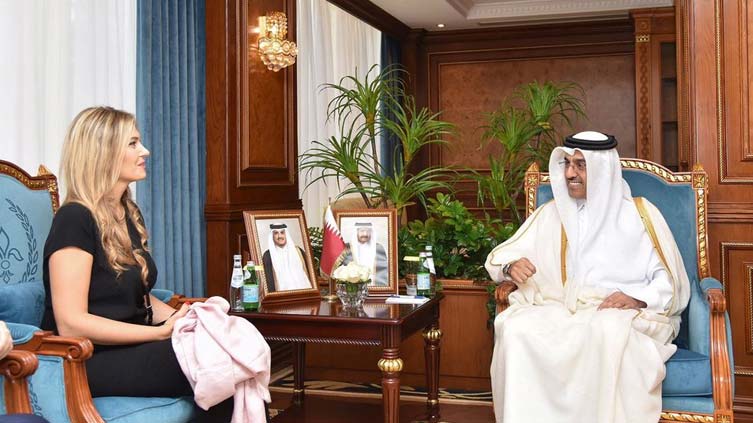
BRUSSELS (Reuters) – The European Parliament moved on Monday to strip one of its members of her role as vice president after she and others faced criminal charges over allegations Qatar lavished them with cash and gifts to influence decision-making.

Greece on Monday froze the assets of a key suspect in the case, Eva Kaili, one of 14 vice presidents of the parliament and among four people arrested and charged in Belgium at the weekend, a source with knowledge of the matter said.

Kaili’s office did not respond to a request for a comment. Qatar has denied any wrongdoing.

Belgian prosecutors searched 19 homes and the offices of the parliament from Friday to Monday, seizing computers, mobile phones and several hundred thousands of euros at the home of one suspect, in a flat belonging to an EU lawmaker and in a suitcase in a Brussels hotel room.

The four unnamed suspects have been charged with “participation in a criminal organisation, money laundering and corruption”, prosecutors said.

The scandal is particularly awkward for the parliament, which has seen itself as a moral compass in Brussels, issuing resolutions critical of human rights abuses across the globe and taking EU governments to task. Germany said it jeopardised the credibility of Europe.

Some European diplomats had told Reuters last month that pressure to maintain good ties with Qatar was increasing as the continent headed towards a winter of energy shortages because of the Russian invasion of Ukraine.

The European Parliament suspended Kaili from her duties on Saturday. On Monday, as EU lawmakers convened in Strasbourg, the chamber’s president Roberta Metsola said she was launching a procedure to end her role as vice president.

The Greek socialist PASOK party is expelling her from its ranks.

Belgian prosecutors said they had suspected for more than four months that a Gulf state was trying to buy influence in Brussels.

A source with knowledge of the case said the state was Qatar. A Qatari official denied at the weekend accusations of possible misconduct.

The European Parliament had been due to vote this week on a proposal to extend visa-free travel to the EU for Kuwait, Qatar, Oman and Ecuador, but this has now been shelved.

The investigation comes as World Cup host Qatar is in the global spotlight, amid criticism of its human rights record, including its treatment of migrant workers.

In a speech in the European Parliament on Nov. 21, at the start of the month-long soccer tournament, Kaili lashed out at Qatar’s detractors and hailed the energy-rich Gulf State as “a frontrunner in labour rights”.

CREDIT CARD
According to a source familiar with the case, the other accused are Italian citizens — former EU lawmaker Pier Antonio Panzeri, Kaili’s partner Francesco Giorgi, who is a parliamentary assistant, and Niccolo Figa-Talamanca, secretary-general of a human rights campaign group.

Another Italian, general secretary of the International Trade Union Confederation Luca Visentini, was released under conditions, meaning he is still under suspicion, the source said.

There were no replies to calls and emails made by Reuters to their respective offices or homes in Belgium.

Belgium also submitted European arrest warrants for Panzeri’s wife and daughter in Italy, according to extracts seen by Reuters.

It said Panzeri was suspected of receiving payments from Qatar and Morocco to influence people working at the European Parliament and that his wife Maria Colleoni and adult daughter Silvia were aware of the activities.

It says they took part in the transport of gifts and Panzeri and his wife had use of a credit card of a third person they called the “geant” (giant). The person was not identified.

Nicola Colli, a lawyer of the Panzeri family, said the wife and daughter were under house arrest and a court would decide next week whether to hand them over to Belgian authorities.

There was no immediate reaction to a request for comment from the Moroccan government.

German foreign minister Annalena Baerbock, meeting EU counterparts in Brussels, called the incident “unbelievable”.

“This is about the credibility of Europe,” she told reporters.

European Commission president Ursula von der Leyen described the allegations as of “utmost concern” and highlighted a Commission proposal for the creation of an independent ethics body for all EU institutions.

“It is a question of confidence of the people in our institutions,” she said.

India says its forces have clashed with Chinese troops in a disputed area along the border, the first such flare-up in more than a year.

The nations had been working to de-escalate tensions since a major clash killed at least 24 troops in 2020.

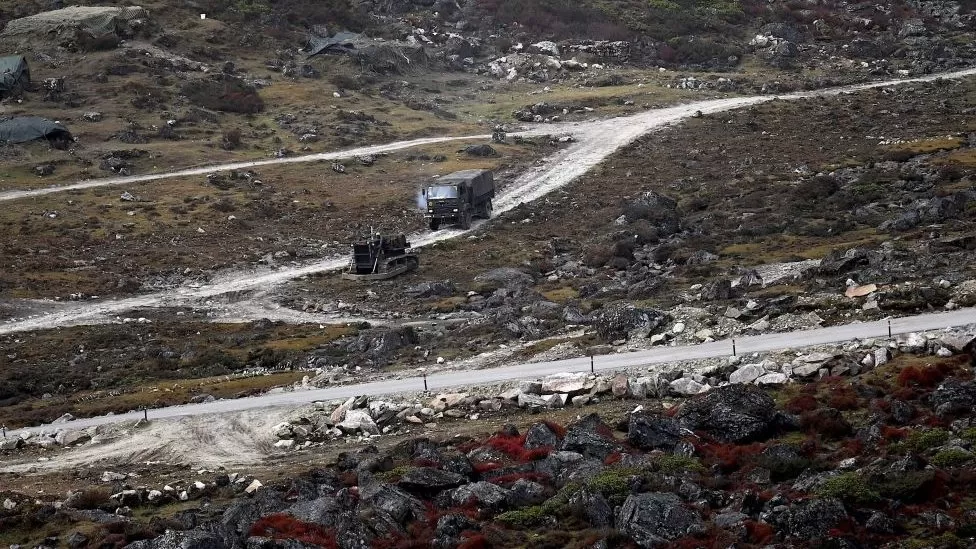
But on Monday, the Indian army said there had been a clash in the Tawang sector of Arunachal Pradesh state last Friday, the eastern tip of India.

Both sides were involved with a few soldiers suffering minor injuries.

China is yet to comment on the stand off. But Reuters reported an Indian army source saying at least six Indian troops were injured.

“Both sides immediately disengaged from the area,” the Indian army said.

It added that commanders from both sides had held a meeting immediately after “to restore peace and tranquility”.


China and India share a disputed 3,440km (2,100 mile) long de facto border – called the Line of Actual Control, or LAC – which is poorly demarcated. The presence of rivers, lakes and snowcaps means the line can shift. The soldiers on either side – representing two of the world’s largest armies – come face to face at many points.

Tensions sometimes escalate into skirmishes. However both sides have been trying to de-escalate since a major battle in June 2020 in the Galwan Valley in the Ladakh region much further to the west – where 20 Indian soldiers and at least four Chinese soldiers died.

That battle – fought with sticks and clubs, not guns – was the first fatal confrontation between the two sides in the the area for 45 years.

Another face-off in January 2021 left troops on both sides injured. It took place along the border between China and India’s Sikkim state, which is sandwiched between Bhutan and Nepal.

In September both countries agreed to disengage from at a disputed area along a remote western Himalayan border area, with both sides beginning troop withdrawals.

Anti-government protesters blocked roads and stormed the international airport in Peru’s second city Arequipa as deadly unrest intensified on Monday.

Supporters of leftist former President Pedro Castillo took to the streets in anger at his impeachment and arrest.

Dina Boluarte, his successor and former deputy, proposed bringing general elections forward by two years to April 2024 in response to the protests.

But Mr Castillo called Ms Boluarte’s plans a “dirty game”.

At least seven people have now died in clashes with the security forces since protests erupted over the impeachment of Mr Castillo last Wednesday.

He was accused of corruption and detained for attempting to dissolve the opposition-controlled Congress, just hours before it was due to vote on his impeachment.

In a handwritten letter that he tweeted on Monday, he called Ms Boluarte a “usurper”, and said he had been “kidnapped” and humiliated.

There were running battles in the streets of the capital

Supporters of Mr Castillo argue that Ms Boluarte was not elected by the people. They are demanding that Peru hold new elections, with some also calling for Congress to be shut down and Mr Castillo released.

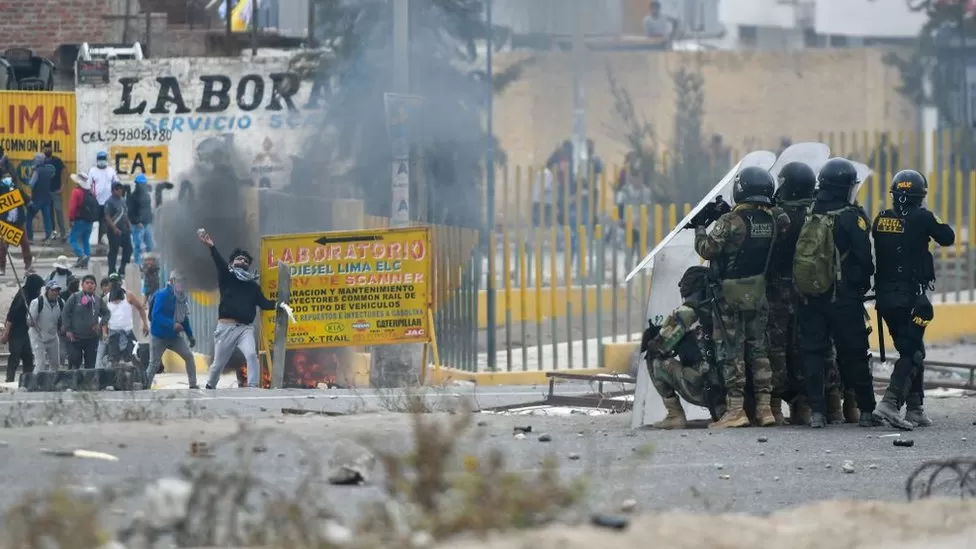
Protesters blocked roads and set fire to vehicles on Monday, and an estimated 2,000 stormed the airport in the southern city of Arequipa, blocking the runway and forcing flights to be suspended for several hours. Police finally dispersed them with tear gas.

In a televised address to the nation earlier in the day, Ms Boluarte – the first woman to lead Peru – said she would submit a bill to Congress to hold elections in April 2024, instead of April 2026.

Ms Boluarte said she would also propose constitutional reforms to achieve “a more efficient, transparent and participatory system of government”, but did not go into detail about those reforms.

The move represents an about-turn. Ms Boluarte, who was sworn in as president on Wednesday, said on taking office that she would serve out the remainder of Mr Castillo’s five-year term in office in full.

The city of Arequipa saw serious clashes on Monday

Last week a court ordered that Mr Castillo be held in preliminary detention for seven days while an investigation is carried out into whether he should be charged with rebellion.

How Ms Boluarte deals with the protests is seen as a key test for her presidency and whether she will be able to hold on to power until April 2024.

Peru’s politics have suffered from instability for years, with the legislature and executive almost constantly at loggerheads.

Ms Boluarte is the sixth president to hold power in as many years.

Six people, including two police officers, have been shot dead after a suspected ambush at a remote Australian property.

Police said they had been searching for a missing person in Wieambilla – 270km (168 miles) west of Brisbane, Queensland – when they were fired upon.

After a lengthy siege, three suspects were fatally shot by police. A motive remains unclear, authorities said.

Prime Minister Anthony Albanese called it a “heartbreaking day” for Australia.

Four police officers – who are armed in Australia – initially went to the property on Monday afternoon local time, after a request from New South Wales police.

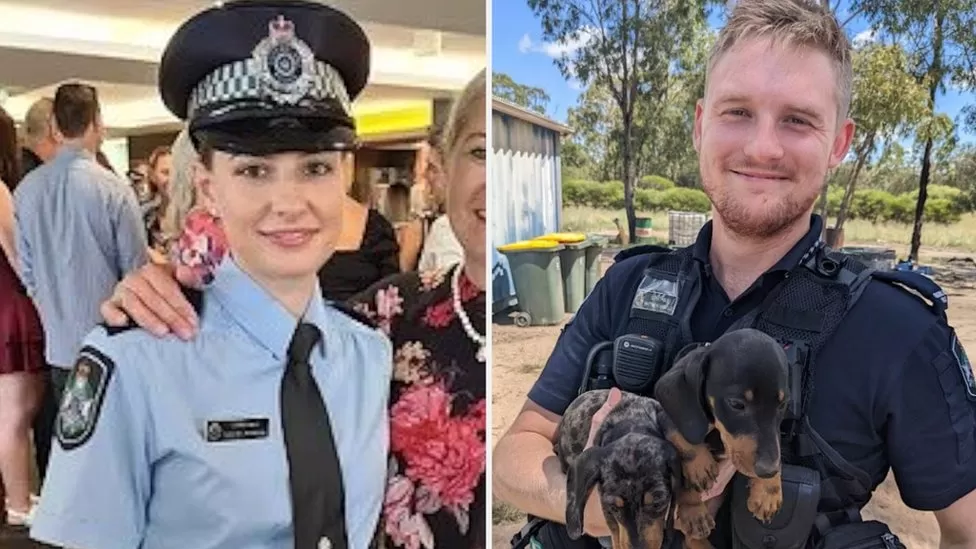
Constables Matthew Arnold, 26, and Rachel McCrow, 29, were shot dead as they approached the property. Another officer suffered a “bullet graze” and the fourth escaped without physical injury, police said.

A neighbour, 58-year-old Alan Dare, was killed by the suspects after going to the property to investigate.

The siege involved “many weapons” and continued for hours, before the suspects – two men and a woman – were shot by specially trained officers, authorities said.

One was identified as Nathaniel Train, 46, a former school principal and the missing person police had been sent to check on.

The others were his brother Gareth Train, 47, and Gareth’s wife Stacey Train, 45, who co-owned the property.

Queensland Police Commissioner Katarina Carroll described the attack as an “unimaginable tragedy” and the force’s largest loss of life in a single incident in many years.

“Those officers did not stand a chance. The fact that two got out alive is a miracle,” she said after visiting the scene on Tuesday.

The uninjured officer – a rookie sworn in only weeks ago – managed to find cover and call for help.

The suspects had then tried to draw her out by lighting a fire, said Queensland Police Union president Ian Leavers.

“She did not know whether she was going to be shot, or [if] she was going to burnt alive,” he told the Australian Broadcasting Corporation (ABC).

“I do know she was sending messages to loved ones, saying she was at a point where she thought it was her time. What was going through her mind, one cannot comprehend.”

Specialist police later arrived and took over the operation.

The remote property where the incident unfolded

Mr Arnold and Ms McCrow were relatively new to the police force but were much loved, said Ms Carroll.

“Both under 30 years of age. Both had wonderful careers and lives ahead of them,” the visibly emotional commissioner told reporters.

Ms Carroll said she couldn’t comment on a possible motive or say if police were lured to the property, citing the ongoing investigation.

Several media outlets reported that Gareth Train appeared to have contributed often to online forums which promoted conspiracy theories. In posts he had expressed a distrust of police and wrongly claimed the country’s deadliest mass shooting was a government ploy to disarm Australians, The Guardian reported.

Australia introduced some of the world’s strictest gun regulations after 35 people were killed in a massacre by a lone gunman at Port Arthur, Tasmania, in 1996.

Since then, there have been only three mass shootings – defined in Australia as those resulting in at least four deaths, excluding perpetrators.

Mr Albanese said Monday’s shooting was devastating “for everyone who loved these Australians” and “our hearts go out to those in the grip of terrible grief”.

He noted it would be a “rough day indeed” for all police officers and their families. “This is not a price that anyone who puts on the uniform should ever pay,” he said.

Local MP David Littleproud said it had left his community “numb”.

“[These] are small country towns where this sort of thing just doesn’t happen,” he told the ABC.

The deaths will be investigated by the coroner and the police response will be examined by the force’s ethical standards command, in line with standard practice.

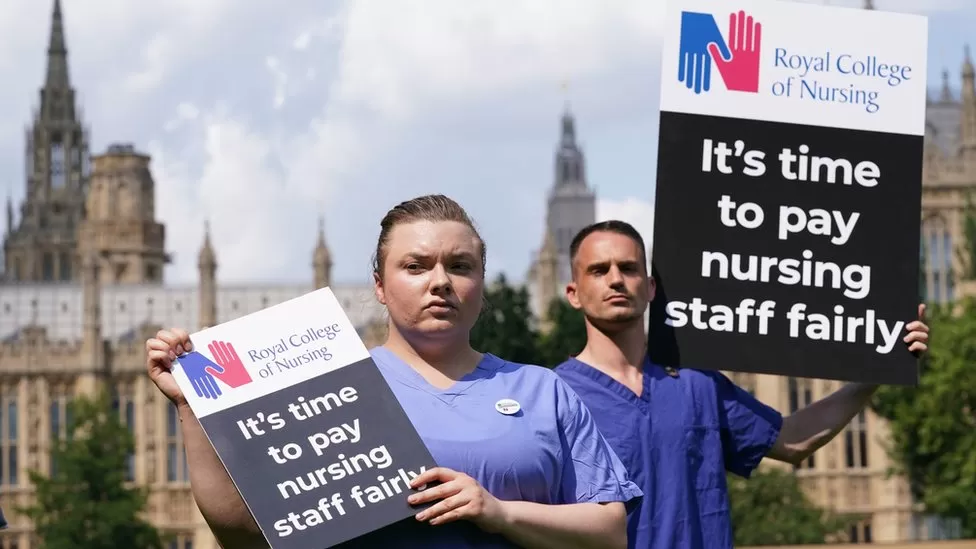
Talks to avert strike action by nurses have failed, with the union accusing the health secretary of “belligerence”.

The head of the Royal College of Nursing (RCN), Pat Cullen, said strikes in England, Wales and Northern Ireland would now go ahead on Thursday, after Steve Barclay refused to discuss pay.

The government said it would continue to engage on non-pay related issues.

The union is calling for a pay rise of 19.2% but ministers say this is unaffordable.

The Department of Health said Mr Barclay had “again listened to the RCN’s position on pay and reiterated the government has agreed to the recommendations of the independent pay review body”.

A spokesperson said the health secretary had told Ms Cullen that any further pay increase would mean taking money away from frontline services and tackling the post-Covid backlog.

Ms Cullen said she was “extremely disappointed at the belligerence shown” in a meeting with the health secretary earlier.

She said pay was “fundamental” to the dispute and not discussing it was “nothing short of being disrespectful to our profession”.

Ms Cullen had said she was “optimistic” ahead of the meeting but “they closed their books and walked away from the nursing profession this afternoon”.

“We haven’t come out with one single brown penny,” she added.

The union leader has previously said the strikes could be paused if the health secretary “seriously” negotiated over pay.

The RCN has also failed to reach an agreement with the Welsh government, which said it could not make an increased pay offer without additional funding from the UK government or risking a reduction in services.

More walkouts are planned for 20 December.

RCN members in Northern Ireland are also part of the strike action. Health sector workers from Unison, Nipsa and GMB in Northern Ireland have already been striking this week over pay and conditions.

The union is calling for a pay rise of 5% above the RPI inflation rate, which in October was 14.2%, but no UK nation has offered close to that.

The RCN says its pay demands follow years of squeezes on nurses’ salaries, which have not kept up with the rising cost of living.

Shadow health secretary Wes Streeting said a Labour government would not be able to afford such a rise but added that it “would be willing to meet and negotiate” to avoid a strike.

He accused ministers of a “stubborn refusal to engage” and of blaming NHS staff for the challenges “that are the direct fault and responsibility of 12 years of Conservative mismanagement”.

Meanwhile, in Scotland, members of two major NHS unions, Unite and Unison, have voted to accept an improved pay offer, averaging 7.5%.

However, ballots of GMB, Chartered Society of Physiotherapy and RCN members in Scotland are ongoing.

Watch: Labour would not give nurses a 19% pay rise

The country is facing a wave of strikes this month, including from paramedics, rail workers, and Border Force staff.

Unions are calling for bigger pay increases to help their members cope with rising prices, but the government has warned this could make inflation worse.

Earlier, ministers and civil servants held an emergency Cobra meeting to discuss contingency plans for the upcoming industrial action, including using the military to cover Border Force staff.

Armed forces will also be sent to hospital trusts to familiarise themselves with vehicles ahead of an ambulance worker strike in England and Wales on 21 and 28 December.

Downing Street has warned there will still be “serious disruption”.

Cabinet Office minister Oliver Dowden, who chaired the meeting, urged unions to call off the strikes.

He said ministers were “straining every sinew” to minimise the risks from walkouts but it would never be able to eliminate them.