
UN official lauds Pakistan’s counter-terrorism, peace efforts

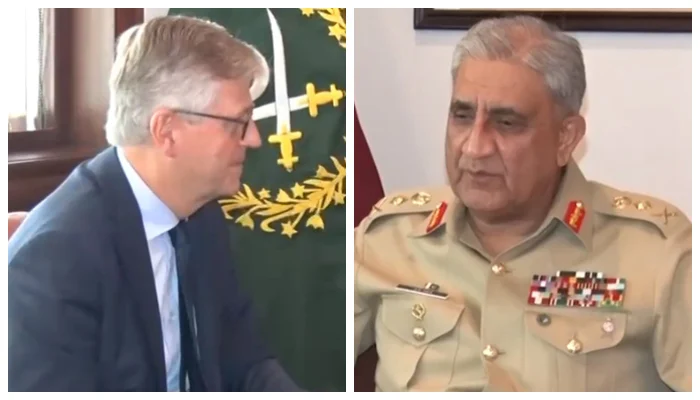
RAWALPINDI: UN Under-Secretary-General Department of Peacekeeping Operations Jean Pierre Lacroix Wednesday called on Chief of Army Staff (COAS) General Qamar Javed Bajwa.

During the meeting at the General Headquarters in Rawalpindi, matters of mutual interest and the overall regional security situation were discussed.

The army chief appreciated the role of the office of the under-secretary in promoting UN core values and their response during crises.

The UN dignitary acknowledged Pakistan’s contribution to UN peacekeeping missions and extraordinary achievements in counter-terrorism.

He expressed grief over the devastation caused by floods in Pakistan due to climate change and offered sincere condolence to the families of the victims.

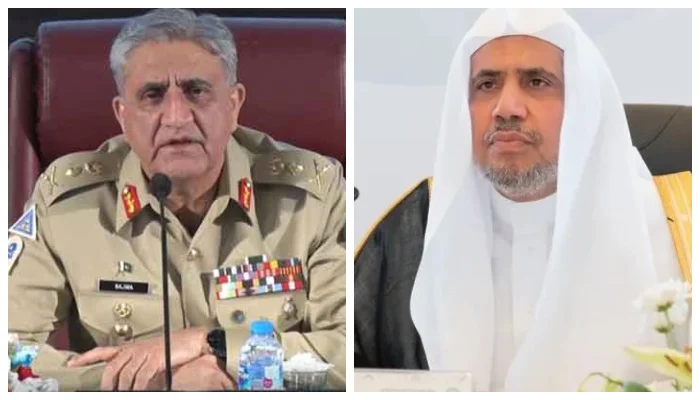
A day earlier, COAS Gen Bajwa met Secretary-General of the Muslim World League and President of the Organisation of Muslim Scholars (Saudi Arabia) Sheikh Dr Mohammad bin Abdulkarim Al-Issa.

The two sides resolved to continue playing their part for peace and stability and betterment of the Muslim Ummah.

During the meeting, matters of mutual interest, bilateral security cooperation, and regional peace and stability came under discussion.

The secretary-general said Pakistan has a significant place in the Muslim world, and it is playing a vital role in peace and stability in the region.

In response, the army chief said the relations between Pakistan and Saudi Arabia are based on bonds of brotherhood and mutual trust.

Moreover, British High Commissioner to Pakistan Dr Christian Turner also called on the army chief at the GHQ, the military’s media wing said.

According to ISPR, during the meeting, matters of mutual interest and regional security situation, including bilateral cooperation in various fields were discussed.

The COAS said that Pakistan values UK’s balanced role in regional affairs and the country looks forward to enhancing mutually beneficial relationships based on common interests.

The visiting dignitary expressed his grief over the devastation caused by floods in Pakistan and offered sincere condolence to the families of the victims.

The dignitary appreciated Pakistan’s efforts for regional stability and also pledged to play his rule enhancing cooperation with Pakistan at all levels.
 

PM Shehbaz, Azerbaijan president agree to boost ties in trade, energy sectors

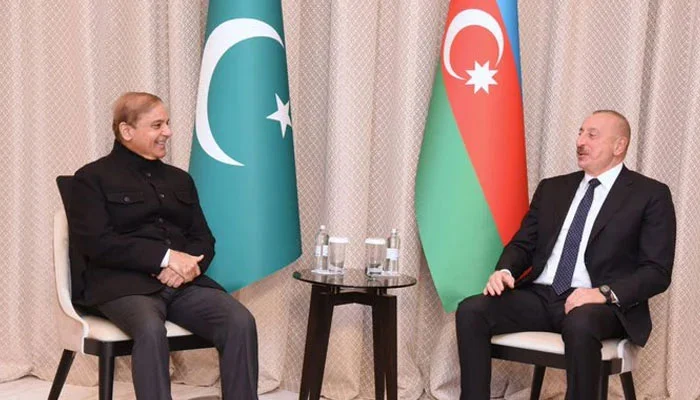
Prime Minister Muhammad Shehbaz Sharif discussed the need to further enhance cooperation and bilateral ties with Azerbaijan.

PM Shehbaz met with Azerbaijan President Ilham Aliyev on the sidelines of the Sixth Summit of Conference for Interaction and Confidence Building Measures in Asia (CICA) on 12th October 2022 in Astana, Kazakhstan.

The two leaders agreed to boost relations in the areas of trade, investment, education, information technology, security, agriculture, connectivity and energy.

The Prime Minister also briefed President Aliyev on his government’s efforts to rehabilitate the millions of flood-affected people in Pakistan and restore their livelihoods damaged by the unprecedented climate change-induced natural disaster.

The Prime Minister underscored that damage to standing crops and the inability to cultivate in the coming sowing season had exacerbated the threat of food shortage in the country. The import of urea was crucial for averting this danger and revitalizing the agricultural sector of the country.

President Aliyev assured him of Azerbaijan’s full support in this context. Regional and global issues of common interest were also discussed at the meeting.

Prime Minister Sharif appreciated Azerbaijan’s steadfast position on Jammu and Kashmir and its valuable role as a member of the OIC Contact Group on Jammu and Kashmir. He reaffirmed Pakistan’s principled support to Azerbaijan on former Nagorno-Karabagh and appreciated President Ilham Aliyev’s efforts for bringing long-term and sustainable peace in the South Caucasus.

Both leaders renewed their commitment to intensify and deepen bilateral engagement in diverse areas of mutually beneficial cooperation. They also reviewed the progress of various ongoing initiatives for promoting connectivity, trade and investment.

Prime Minister underlined the need for fostering close cooperation between the two countries in the field of energy, which is a high-priority area for his government.

PM Shehbaz has nominated the Minister of State for Petroleum as the focal person for bilateral energy cooperation between Azerbaijan and Pakistan who visited Baku last month.

Both leaders agreed to fast-track discussions on energy collaboration between the two countries through robust engagement.

Prime Minister Shehbaz Sharif proposed leadership-level consultations in Islamabad aimed at advancing regional connectivity which was received positively. This was the second interaction between the two leaders in the wake of their last meeting on the sidelines of SCO in September 2022 in Samarkand, Uzbekistan and afforded a productive opportunity for catalyzing multifaceted economic engagement between Pakistan and Azerbaijan in keeping with the great tradition of amity and cooperation.

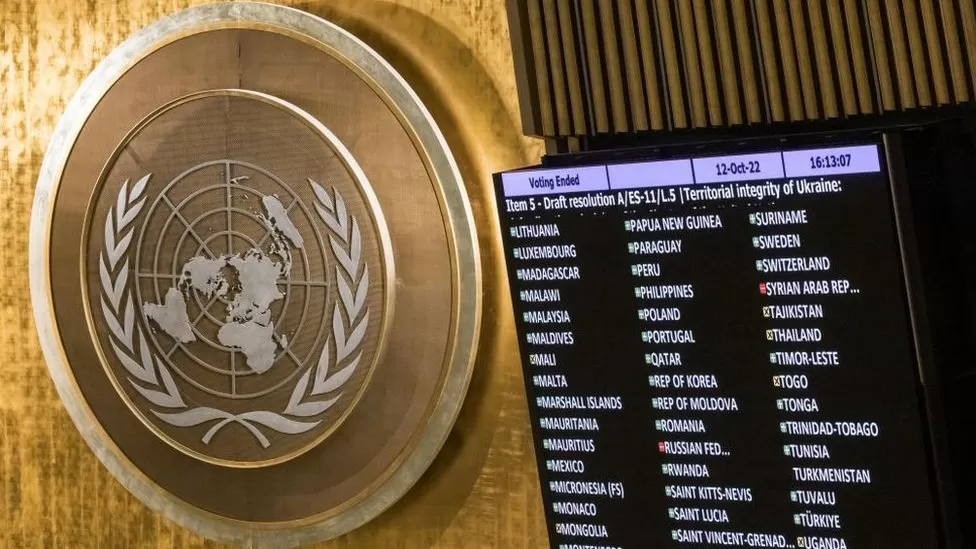
The United Nations General Assembly has voted overwhelmingly to condemn Russia’s attempts to annex four regions of Ukraine.

The resolution was supported by 143 countries, while 35 states – including China and India – abstained.

As well as Russia, four countries rejected the vote, namely Belarus, North Korea, Syria and Nicaragua.

Although symbolic, it was the highest number of votes against Russia since the invasion.

Last week, in a grand ceremony in the Kremlin, President Vladimir Putin signed documents to make the eastern Ukrainian regions of Luhansk, Donetsk, Zaporizhzhia and Kherson part of Russia.

The agreements were signed with the Moscow-installed leaders of the four regions, and came after self-proclaimed referendums in the areas that were denounced as a “sham” by the West.

The resolution calls on the international community not to recognise any of Russia’s annexation claim and demands its “immediate reversal”. It welcomes and “expresses its strong support” for efforts to de-escalate the conflict through negotiation.

Ukraine’s President Volodymyr Zelensky said he was grateful to the countries that supported it.

“The world had its say – [Russia’s] attempts at annexation is worthless and will never be recognised by free nations,” he tweeted, adding that Ukraine would “return all its lands”.

US President Joe Biden said the vote sent a “clear message” to Moscow.

“The stakes of this conflict are clear to all, and the world has sent a clear message in response – Russia cannot erase a sovereign state from the map,” he said.

Dame Barbara Woodward, Britain’s ambassador to the UN, said Russia had failed on the battlefield and at the UN, adding that countries had united to defend the world body’s charter.

“Russia has isolated itself, but Russia alone can stop the suffering. The time to end the war is now,” she said.

The General Assembly vote was triggered after Russia used its veto power to prevent action at the Security Council – the body in charge of maintaining international peace and security. As permanent members, China, the United States, France and the United Kingdom also hold vetoes on the council.

There have been calls for Russia to be stripped of its veto power after the Ukraine invasion.

Ukraine’s Nato-led allies have announced deliveries of advanced air defence weapons to Kyiv, after a spate of Russian missile strikes.

The weaponry promised by the UK, Canada, France and the Netherlands includes missiles and radars. The US earlier made a similar pledge. One high-tech system from Germany is already in Ukraine.

The pledges come as Ukraine’s allies from 50 countries meet at Nato headquarters in Brussels.

Kyiv hailed the summit as “historic”.

Hours later Russian shelling hit the southern city of Mykolaiv on Thursday morning, officials said.

The city’s mayor Oleksandr Senkevich said the city was “massively shelled” at around 01:00 local time (23:00 GMT).

“A five-storey residential building was hit, the upper two floors were completely destroyed, the rest – under rubble. Rescuers are working on the site,” he said.

It has been a particularly intense week in Ukraine – on Monday and Tuesday, it saw some of its heaviest Russian bombardment in months when more than 100 missiles were launched, hitting energy infrastructure and other non-military targets including a children’s playground.

At least 19 people were killed on the first day of the strikes, which included hitting central Kyiv.

Russian President Vladimir Putin says the missile strikes were retaliation for an attack on a key bridge linking Russia and Crimea – Ukraine’s southern peninsula annexed by Moscow in 2014.

Russia says Saturday’s blast was organised by Ukraine’s intelligence agency – a claim rubbished by Kyiv.


The UK will donate air defence missiles, as well as hundreds of aerial drones to support Ukraine’s information gathering and logistics capabilities. It will also provide 18 howitzer artillery guns in addition to the 64 already delivered.

“Russia’s latest indiscriminate strikes on civilian areas in Ukraine warrant further support to those seeking to defend their nation,” said Defence Secretary Ben Wallace.

“These weapons will help Ukraine defend its skies from attacks and strengthen their overall missile defence.”

Speaking after the Brussels meeting on Wednesday, US Defence Secretary Lloyd Austin said “we’re going to do everything we can to make sure that they [Ukrainians] they have what’s required to be effective”.

French President Emmanuel Macron said Paris would supply air defence systems to Ukraine.

In an interview to France 2 television, he did not specify which systems would be sent. But he did say their main function would be to protect the population from drones.

The Netherlands said it would deliver €15m (£13m; $14.5m) worth of air defence missiles.

Dutch Defence Minister Kajsa Ollongren said the Russian attacks “can only be met with unrelenting support for Ukraine and its people”.

Canada pledged to provide more than C$47m ($34m; £31m) worth of military aid, including satellite communications and drone cameras.

The UK is expected to announce its weapons deliveries shortly.

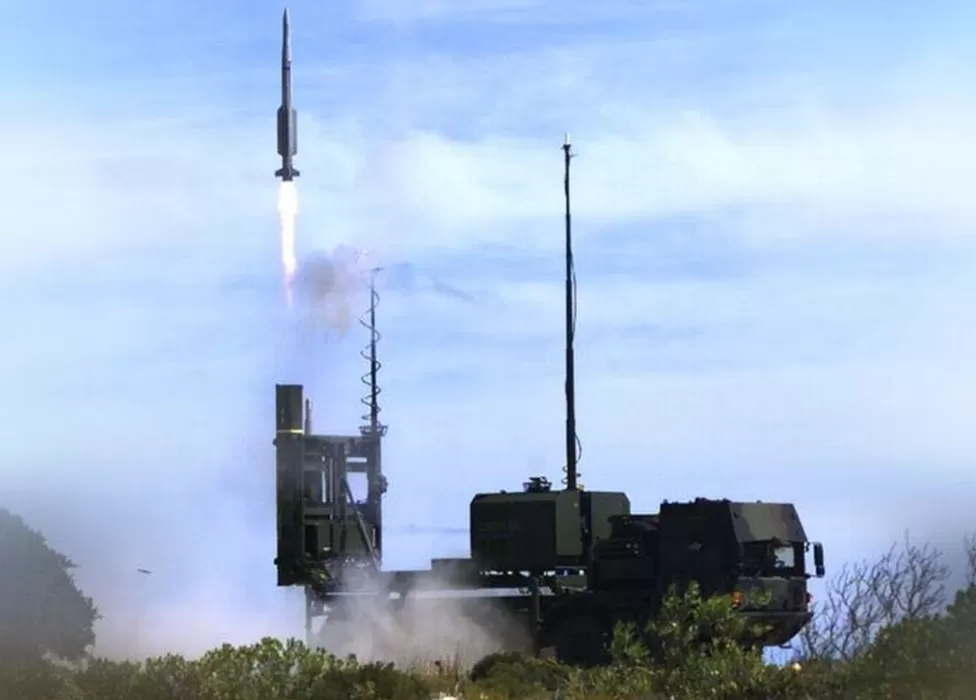
Meanwhile, Ukraine’s military announced earlier on Wednesday that the first of several “state-of-the-art IRIS-T SLM has been delivered from Germany to Ukraine”. It said the air defence system would help protect the country “against terror”.

President Zelensky has for months been asking Ukraine’s allies to provide air defence systems to create an “air shield” for Ukraine.

In his video address late on Wednesday, the Ukrainian leader said: “The more audacious and cruel Russian terror becomes, the more obvious it is to the world that helping Ukraine to protect the sky is one of the most important humanitarian tasks for Europe of our time.”

“I believe that we will cope with this task,” he added.

Russia has repeatedly warned Ukraine’s allies against supplying advanced weaponry to Kyiv, stressing this would make them participants of the war that Mr Putin began on 24 February.

The West has accused Moscow of nuclear sabre-rattling, following a string of Russian military defeats on the battlefield.

Royal Mail workers are holding the first of 19 strikes in a long-running dispute over pay and conditions.

The Communication Workers Union (CWU) said 115,000 members across the UK would walk out in a 24-hour strike on Thursday, starting at 04:00 BST.

General Secretary Dave Ward said workers faced the “biggest ever assault” on jobs, terms and conditions “in the history of Royal Mail”.

Royal Mail said further strikes would “weaken” its financial position.

The planned 19 days of industrial action include Black Friday week and Cyber Monday, as well as 13, 20, and 25 October, and 28 November.

Letters will not be delivered and some parcels will be delayed, the Royal Mail has warned.

This is the sixth strike for postal workers, and comes after a summer of unrest which saw rail workers and criminal barristers walk out amid disputes with their employers.

The CWU has accused Royal Mail of planning structural change. This would effectively see employees in secure, well-paid jobs turned into a “casualised, financially-precarious workforce overnight”, said the union.

It said plans by the postal service include cutting workers’ sick pay, delaying arrival of post by three hours and inferior terms for new employees.

General Secretary Mr Ward said the changes could lead to the “destruction of the special relationship that postal workers and the public have in every community in the UK”.

He described the plans as an “asset-stripping business plan” that will lead to the break-up of the company.

Royal Mail workers mounted picket lines at previous strikes over the summer

Royal Mail said it would do what it could to keep services running, but the strike was likely to cause disruption.

No letters will be delivered during strike days, said Royal Mail, but as many special delivery and Tracked24 parcels as possible would be delivered.

It also said it would prioritise the delivery of Covid-19 test kits and medical prescriptions.

A Royal Mail spokesperson said: “Royal Mail is losing £1m a day and must change faster in response to changing customer demands.”

Industrial action will threaten the job security of postal workers, said Royal Mail, calling on the leaders of CWU to cancel the walk-out and accept invitations for talks.

Royal Mail apologised for any delays to customers, adding: “We are doing all we can to minimise any delays and keep people, businesses and the country connected.”

The government may have to rethink its tax-cutting plans to reassure financial markets and stabilise the economy, some senior Conservative MPs have said.

The warnings came ahead of a bruising appearance for the prime minister at a meeting of Tory backbenchers.

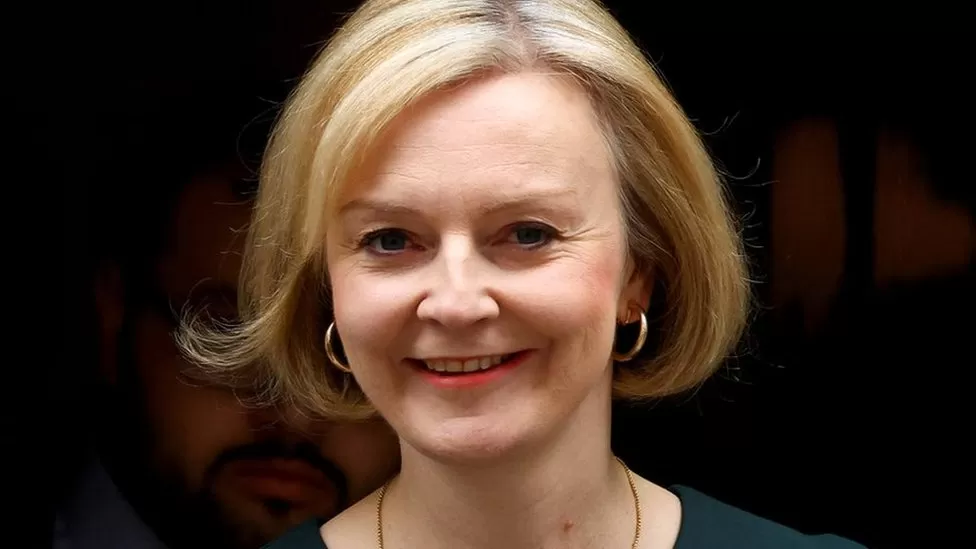
One loyal minister told the BBC: “We are completely in a dreadful place. There is no way out – maybe Liz Truss will find a way, but I cannot see it.”

Ms Truss has repeatedly defended the proposed tax cuts outlined last month.

The chancellor’s mini-budget on 23 September, which included £45bn of tax cuts funded by borrowing, sparked turmoil on financial markets and prompted the Bank of England to intervene to protect pension funds.

Kwasi Kwarteng is due to set out how he will fund the package and reduce debt on 31 October.

Ms Truss has denied she is planning public spending cuts, saying the government would instead focus on reducing debt “by making sure we spend public money well”.

However, Mel Stride, a prominent backer of Ms Truss’ leadership rival Rishi Sunak, suggested the government would need to show a “clear change of tack” to restore credibility with the financial markets.

“Given the clear government position expressed today on protecting public spending there is an emerging question. Whether any plan that does not now include at least some element of further row back on the tax package can actually satisfy the markets,” he said.

Earlier, he told the Commons he believed it was “quite possible” the chancellor would have to further row back on the tax cuts announced in his mini-budget.

Asked to confirm whether this possibility was still on the table, Treasury Minister Chris Philp replied: “There are not any plans to reverse any of the tax measures announced in the growth plan.”

The prime minister insists cancelling a rise in corporation tax from 19% to 25% due in April and other tax cuts will help boost growth.

She also believes stepping back from what she describes as the highest tax burden in 70 years would allow the public to keep more of the money they earn at a time of global high prices.

Tory MP Kevin Hollinrake, who was also a Sunak supporter, said it would be better for the chancellor to U-turn on aspects of his mini-budget rather than cause more market turmoil.

“I think it’s better to have looked at this more carefully in the context of what’s happened over the last few weeks and say ‘I think we’ve got some of this wrong and these tax cuts need to be introduced over time’,” he told BBC Radio 4’s World at One programme.

He suggested reversing the government’s decision to scrap the planned hike in corporation tax was one potential option.

Mr Hollinrake said the markets would want to see something “tangible”, adding: “It’s got to be either moderate some of those tax cuts or cut spending to give the government credibility.”

Meanwhile, former deputy prime minister Damian Green said an obvious way to reduce debt while ruling out public spending cuts would be to defer some tax cuts.

He told BBC Radio 4’s PM programme the reversal of some parts of the mini-budget was being discussed openly by Tory MPs.

Former Conservative minister David Davis suggested overturning some of the tax cuts would “buy some time” and persuade Tory critics to “come in behind them”.

He told ITV’s Peston the mini-budget was a “maxi-shambles” but he did not think there would be moves to replace the prime minister in the next few months as the party would have “zero chance” of winning an election if it was in a “civil war”.

The government has already U-turned on its plan to scrap the top rate of income tax, following market turmoil and vocal opposition from some Tories.

However, this only made up £2bn of the tax cuts announced by the chancellor.

Liz Truss says she “absolutely” rules out making cuts to public spending.

On Wednesday evening, Ms Truss faced sharp criticism from some of her own MPs during a meeting of the 1922 committee of backbenchers.

Sources in the room told the BBC that Robert Halfon had accused Ms Truss of “trashing blue collar conservatism”.

He told her the party’s record over the past 10 years had included things like boosting apprenticeships and the living wage, whereas she had cut tax for millionaires and wanted to cut affordable housing and benefits.

MPs who were present said he got a cheer, while Ms Truss looked “shocked” and said he could come to speak to her.

They said another Tory MP, James Cartlidge, also criticised the government’s mini-budget, saying the communication had been poor and she had not prepared the markets.

Both MPs supported Mr Sunak during the Tory leadership election.

The BBC’s Nick Watt said he encountered a “wall of derision and unease” about the prime minister outside the room.

The loyal minister also told him: “It’s like Black Wednesday in 1992, when interest rates shot up, we lost economic credibility, and it took us 15 years to get it back.”

However, leaving the meeting the prime minister said it had been “very good”.

One MP who supported Ms Truss in the leadership race said the PM acknowledged during the meeting that she could have laid the ground better for her recent policies.

During the initial election rounds most MPs did not back Ms Truss to become one of the final two in the contest. She won based on a final vote among party members.

Sri Lanka cabinet approves downgrade to ‘low income country’

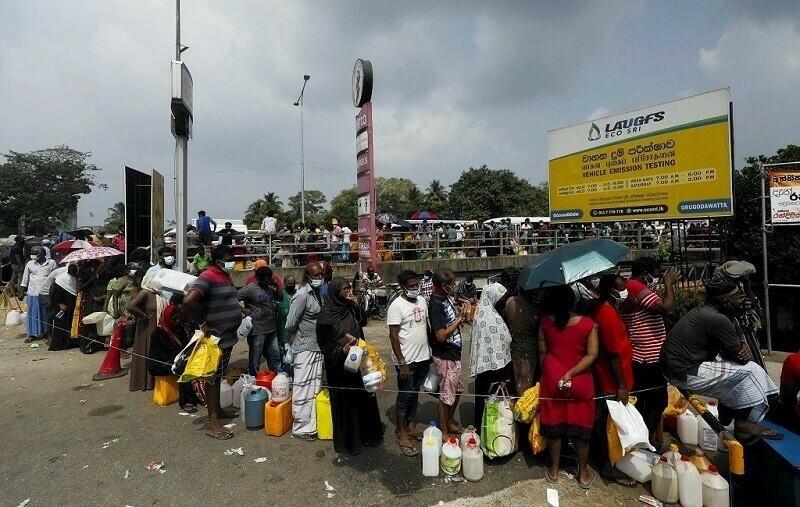
Sri Lanka’s economy is in a deep slump, shrinking at an annual 8.4 per cent in the June quarter in one of the steepest quarterly declines.

Per capita GDP was $3,815 in 2021, which had placed it in the lower-middle economy category, according to the World Bank.

The cabinet had decided to downgrade the island to “low income” on the World Bank list, said cabinet spokesman Bandula Gunawardane.

“Given the serious financial crisis Sri Lanka is facing representatives of international organisations had informed us that if Sri Lanka was categorised as a low income country access to funding would be easier,” Gunawardane said.

The South Asian island of 22 million people is battling its worst economic crisis since independence in 1948, brought about by Covid-19 battering its tourism-reliant economy and slashing remittances from workers overseas, rising oil prices, populist tax cuts and a seven-month ban on the import of chemical fertilisers last year that devastated agriculture.

The crisis has led to an acute dollar shortage to pay for imports of food, fuel and medicine, a plunge in the rupee and runaway inflation.

The Central Bank of Sri Lanka, which held policy rates steady last week, is predicting an 8.7pc gross domestic product contraction for 2022.

The World Bank did not immediately respond to a request for comment.

Now you can follow Dawn Business on TwitterLinkedInInstagram and Facebook for insights on business, finance and tech from Pakistan and across the world.

Pakistan, Saudi Arabia to continue to play role in Ummah’s betterment

RAWALPINDI: Pakistan and Saudi Arabia Tuesday resolved to continue playing their part for peace and stability and betterment of the Muslim Ummah, the Inter-Services Public Relations (ISPR) said.

The development, according to the military’s media wing, came during a meeting between Chief of Army Staff (COAS) General Qamar Javed Bajwa and Secretary-General of the Muslim World League and President of the Organisation of Muslim Scholars (Saudi Arabia) Sheikh Dr Mohammad bin Abdulkarim Al-Issa.

During the meeting at the General Headquarters in Rawalpindi, matters of mutual interest, bilateral security cooperation, and regional peace and stability came under discussion.

The secretary-general said Pakistan has a significant place in the Muslim world, and it is playing a vital role in peace and stability in the region.

In response, the army chief said the relations between Pakistan and Saudi Arabia are based on bonds of brotherhood and mutual trust.

Moreover, British High Commissioner to Pakistan Dr Christian Turner also called on the army chief at the GHQ, the military’s media wing said.

According to ISPR, during the meeting, matters of mutual interest and regional security situation, including bilateral cooperation in various fields were discussed.

The COAS said that Pakistan values UK’s balanced role in regional affairs and the country looks forward to enhancing mutually beneficial relationships based on common interests.

The visiting dignitary expressed his grief over the devastation caused by floods in Pakistan and offered sincere condolence to the families of the victims.

The dignitary appreciated Pakistan’s efforts for regional stability and also pledged to play his rule enhancing cooperation with Pakistan at all levels.
Civil govt main ‘interlocutor’ in Washington-Islamabad ties: State Dept

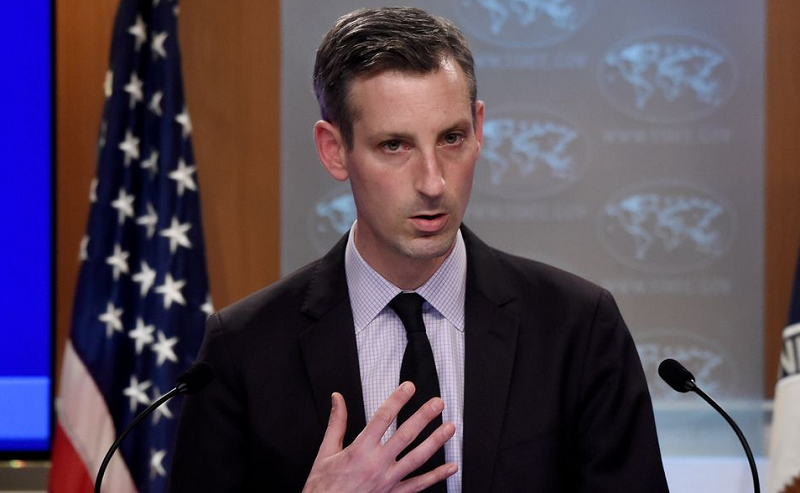
At a news briefing in Washington, spokesperson Ned Price also dismissed rumors about misappropriation of flood relief funds, saying that the US closely monitors the aids it sends to a disaster-hit region.

Responding to a question, he said that Deputy Secretary Sherman “did have the opportunity” to meet Gen Bajwa in Washington last week.

“We value our long-standing cooperation with Pakistan. There are a number of areas where our interests are aligned,” he said, adding that Afghanistan and the security challenges that confront the region “are always there when we have high-level meetings with our Pakistani counterparts”.

The US and Pakistan, he said, “have a number of shared interests … there are security interests, there are economic interests, there are people-to-people ties and connections as well.”

Refraining from mentioning which of these interests were discussed in the Bajwa-Sherman meeting, he said that “Pakistan has a civilian government that is democratically elected and that’s our (principal) interlocutor.”

Responding to a question on rumours of misappropriation of relief funds, Mr Price said: “This is something we take very seriously, not only in Pakistan but anywhere around the world where American taxpayer dollars are implicated and where there is an urgent humanitarian interest at stake, which is clearly the case in terms of response to the flooding in Pakistan.”

The US government, he said, sends inspection teams to such areas to monitor the situation and has done so in Pakistan too where one such team visited 10 flood-affected areas in Balochistan last month.

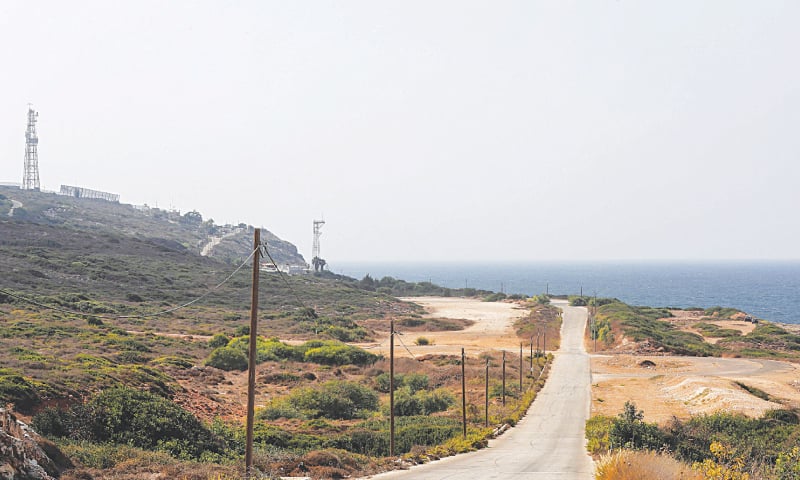
Lebanon, Israel clinch maritime border deal for energy exploration

The deal would mark a significant compromise between states with a history of war and hostility, opening the way for offshore energy exploration and easing a source of recent tensions.

“This is a historic achievement that will strengthen Israel’s security, inject billions into Israel’s economy, and ensure the stability of our northern border,” Lapid said in a statement.

In Lebanon, President Michel Aoun said the terms of the final US proposal were satisfactory and he hoped the deal would be announced as soon as possible.

The agreement is meant to resolve a territorial dispute in the eastern Mediterranean Sea in an area where Lebanon aims to explore for natural gas. Israel is already producing natural gas at fields nearby.

It sets a border between Lebanese and Israeli waters for the first time and also establishes a mechanism for both countries to get royalties from an offshore gas field that straddles the boundary.

Lebanese negotiator Elias Bou Saab said the latest draft “takes into consideration all of Lebanon’s requirements and we believe that the other side should feel the same”. It was also endorsed by the heavily armed, Iran-backed Lebanese group Hezbollah.

A senior Lebanese government official and an official close to Hezbollah said the group had agreed to the terms of the deal and considered negotiations “over”.

TotalEnergies to launch gas search

In a related development, Lebanon on Tuesday asked French energy giant TotalEnergies to kickstart gas exploration off its shores.

Lebanon’s caretaker prime minister Najib Mikati met a visiting delegation from TotalEnergies — which was awarded an exploration licence in 2018.

“During the meeting, Mikati called on representatives of TotalEnergies to immediately begin taking operational steps to drill in Lebanese waters,” his office said in a statement.