
Election officials have warned about a clash with next year’s local elections on 4 May if a bank holiday is added to the coronation weekend.

The coronation of King Charles III will be on Saturday 6 May.

But there are concerns that if Friday 5 May becomes a bank holiday, that will fall on the day planned for counting votes from local elections in England.

The Association of Electoral Administrators has asked the government for clarification.

Peter Stanyon, the organisation’s chief executive, said a bank holiday switched to 5 May would “directly affect the election timetable”.

This would include difficulties for election staffing, including volunteers, if the day set aside for counting votes was turned into a bank holiday.

“A lot of the staff involved in the elections will also be involved in the ceremonial events alongside the coronation,” he said.

“It makes it more difficult,” said Mr Stanyon, calling for early information from the government – and suggesting a bank holiday on Monday 8 May would be less problematic.

Counting will take place on the eve of the coronation

But the government department responsible for bank holidays – the Department for Business, Energy and Industrial Strategy – said on Friday no decision had been made: “Plans are being considered carefully and we will update in due course.”

Earlier this week, Downing Street said about an extra bank holiday: “All options remain on the table.”

The date of a monarch’s coronation is “generally determined by the Cabinet and the Royal Household”, according to the House of Commons library. The coronation to be held in Westminster Abbey is a state occasion funded by the government.

The choice of 6 May places King Charles’s coronation in the same week as local government elections, which will be the first big electoral test for Liz Truss’s government since she became prime minister.

These are also expected to be the first elections where voters will have to show photo ID.

Election administrators expect this new requirement to be another challenge for staff working on elections – but their particular concern is about an extra bank holiday on the eve of the coronation, such as moving the existing one from 1 May.

This happened for the VE commemorative weekend in May 2020, with the bank holiday being moved to the Friday to create a long weekend.

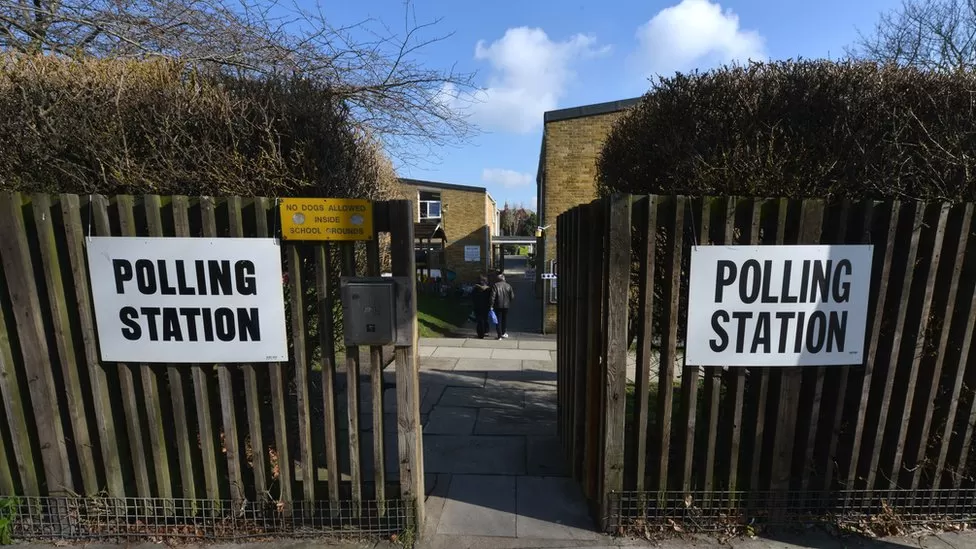
The polling booths on 4 May will see votes for a range of council elections in England, including unitary authorities, metropolitan boroughs, district councils and parish councils.

Local elections are seen as more intensive to administer than general elections, with many more seats to be decided, multi-member ballots and large numbers of candidates.

A spokeswoman for the Electoral Commission said they were “working to understand the impact of the timing of the coronation on the May elections. We await further detail on any potential changes to the bank holiday”.
Liz Truss is facing a backlash from Conservative MPs after firing her chancellor and announcing a second U-turn on a major economic policy.

One former minister told the BBC, “we cannot go on like this indefinitely”.

Another Tory MP said the party was in a “state of despair” after the PM’s Downing Street news conference.

Truss supporter Christopher Chope said “time will tell” if she had done enough to secure her position, calling those plotting to remove her “hyenas”.

Sir Christopher said: “We can’t possibly force another prime minister out of office, we’ve just got to calm down and try to give the prime minister our support.”

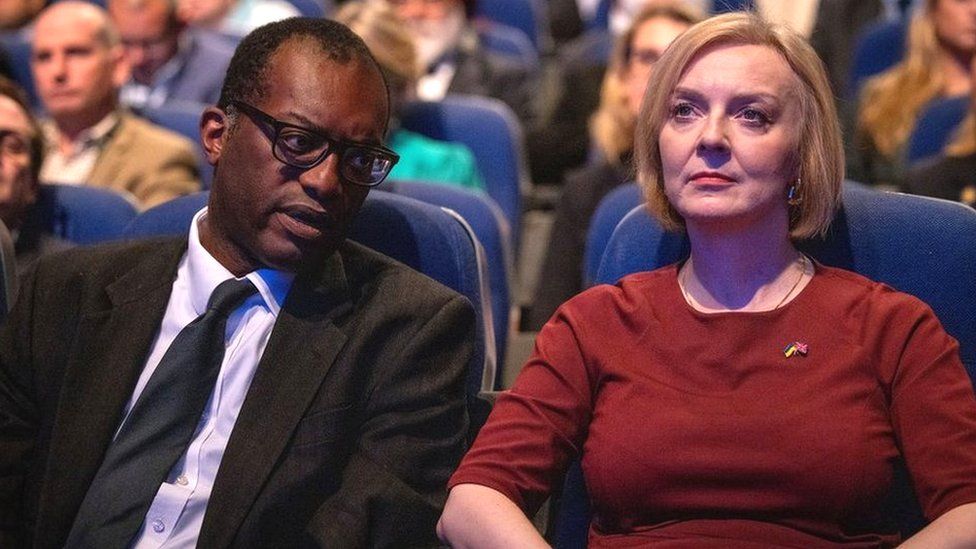
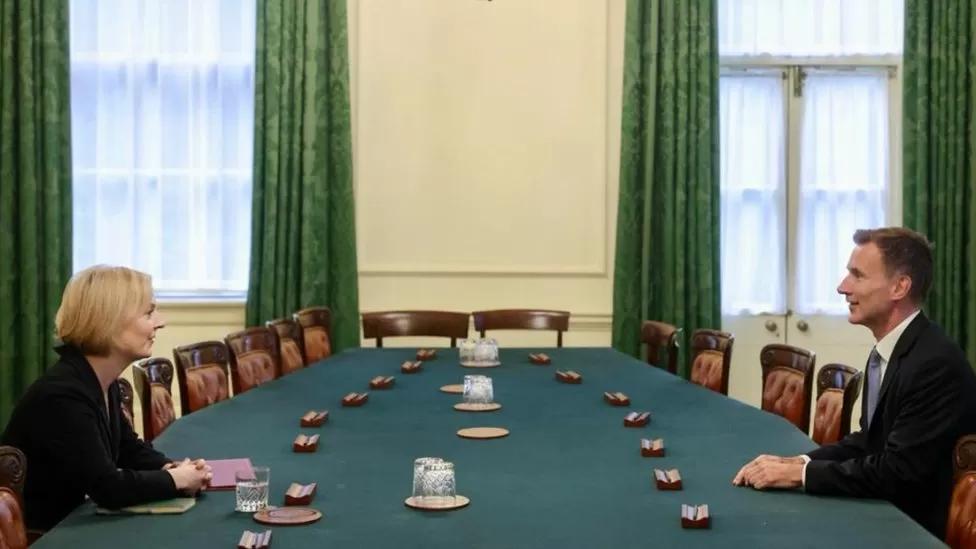
In an attempt to end turmoil on the financial markets, Ms Truss sacked her chancellor and close ally, Kwasi Kwarteng, replacing him with former foreign secretary Jeremy Hunt. She then reversed a key policy to scrap a planned rise in corporation tax from 19% to 25%.

It is the second major U-turn on September’s mini-budget after Ms Truss cancelled her plan to scrap the top rate of income tax earlier this month.

At a brief news conference in Downing Street on Friday, the PM dismissed calls for her resignation, saying she was determined to see her promises through.


Commenting on the corporation tax U-turn, Sir Christopher added it was “going to be damaging to the prospects for growth” and was “totally inconsistent” with what Ms Truss said during her leadership campaign.

Conservative MP for Coalville, Andrew Bridgen, said he thought there would “be a challenge to Truss in the next few weeks”.

Mr Bridgen, who backed Rishi Sunak to be leader, said: “Dissatisfaction is so high in the parliamentary party.

“Removing Kwasi Kwarteng when he implemented the policies she asked him to do won’t engender loyalty to her.”

Former Conservative leader William Hague meanwhile said her premiership was “hanging by a thread”.

On a day of fast-moving political developments:

  • Mr Kwarteng cut short a visit to the US to hold talks with the prime minister
  • By early Friday afternoon, Mr Kwarteng had been sacked as chancellor
  • In a letter to the PM, Mr Kwarteng said Ms Truss’s economic vision was “right” for the country
  • Responding, Ms Truss said she was “deeply sorry” to lose him and thanked him for putting “the national interest first” by standing down
  • Government borrowing costs rose and the pound’s value fell after the PM’s latest U-turn
  • Some economists warned that the latest developments might not be enough to restore the UK’s credibility
  • Scotland’s First Minister Nicola Sturgeon called for a general election, saying Ms Truss is “unfit to hold the office of prime minister”

Privately many Conservative MPs admit they have gone through despondency and into despair over the past 24 hours.

By going back on her promise to cut taxes she has now alienated some of those who backed her in the leadership contest for her “bold” approach.

It is not hard to find Tory MPs who think her time is up.

One former backer told the BBC Ms Truss had “appointed her successor,” by bringing in Jeremy Hunt as chancellor. “Sadly I think that hastened her demise,” the Conservative MP said.

Another MP called Ms Truss’s news conference “a mega-disaster”. They said: “She will have to resign – she is worse than Corbyn.”

Mr Kwarteng cut short a US trip to hold talks with the prime minister in Downing Street, where he was asked to resign

Ms Truss insisted she would stay on as prime minister to get the economy growing.

“I’m absolutely determined to see through what I promised – to deliver a higher growth, more prosperous United Kingdom to see us through the storm we face,” she said.

The eight-minute news conference came after a dramatic day in which the prime minister fired Mr Kwarteng after he returned early from a US summit.

But as we witnessed with Boris Johnson, if a prime minister wants to cling to power, it can be difficult to remove them.

It took the mass resignation of dozens of ministers to persuade him to resign.

Members of Ms Truss’s cabinet are not in open revolt. Many allies have been tweeting support for her and Mr Hunt.

Former chancellor Nadhim Zahawi tweeted: “It’s time to get Britain moving. We are determined to grow the economy, eliminate the Covid backlog and protect people from Putin’s energy warfare.”

In a tweet, Deputy Prime Minister Therese Coffey – a close ally of Ms Truss – said the prime minister was “right to act now to ensure our country’s economic stability”.

And Business and Energy Secretary Jacob Rees-Mogg tweeted: “As a government, we must now get on and deliver the pro-growth reforms that will lay the foundations for our future prosperity.”

Appearing on BBC Radio 4’s Any Questions programme, Welsh Secretary Sir Robert Buckland also warned: “I think if we start with gay abandon, throwing another prime minister to the wolves, we’re going to be faced with more delay, more debate, more instability.”

The prime minister said she and Jeremy Hunt shared the same vision for the country

The Liberal Democrats and the SNP have called for a general election, while shadow chancellor Rachel Reeves said a new government led by Labour is “what this country needs”.

But Ms Truss has ruled out a general election until 2024 and with the government’s large majority in Parliament the opposition would find it very difficult to trigger one.

On 23 September, Mr Kwarteng unveiled a so-called mini-budget to deliver the prime minister’s vision, announcing the biggest package of tax cuts in decades.

But the mini-budget spooked financial markets and sparked a revolt among Tory MPs, who urged the prime minister to drop parts of her economic plan to shore up the UK’s finances.

Many in the parliamentary Conservative party think they have to avoid another drawn-out leadership contest where Tory members have the final say.

Firstly, it requires others to put their personal ambitions to one side for the greater good. It also requires discipline – something that has been in short supply in Conservative ranks since the turbulent days of Theresa May’s premiership.

The idea cropping up most is a joint ticket with former chancellor Rishi Sunak and Penny Mordaunt. But after 12 years in power, under four different leaders, there are many old scores to settle in the Tory Party.

Several of Mr Johnson’s supporters would do anything to stop Mr Sunak from taking over.

One told the BBC such a move would lead to a split in the party and he would stand himself to prevent a coronation. He said: “The only unity we’d end up with is the unity of the grave. The question is do we jump in now or step back.”

It is possible the appointment of her new chancellor has bought some time but a leader with diminishing authority will struggle to bring this fractious party together.

India axes rule on voting rights in occupied Kashmir after political parties’ outcry

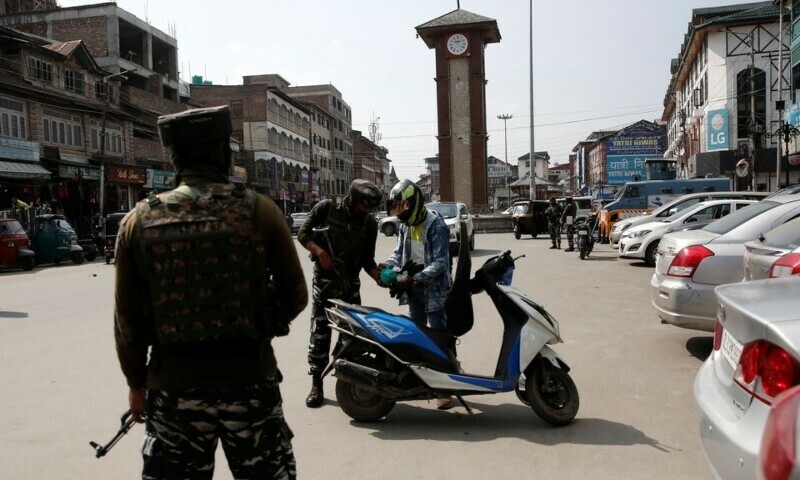
In 2019, India stripped the region of its remaining measure of autonomy, reorganising Jammu and Kashmir state into two federally-controlled territories and changing the constitution to let non-Kashmiris vote and own land there.

The rule scrapped on Thursday had been introduced just two days earlier in one district of 20 in the region.

It had allowed Indians who have lived in IIOJK for a year or more to register as voters, replacing a rule that limited the franchise only to those who had lived there in 1947 — the year that India gained independence — or their descendants.

The measure of October 11 “is withdrawn and to be treated as void”, an electoral officer in the Jammu region, Avny Lavasa, told Reuters, without giving a reason for the withdrawal.

IIOJK last voted in 2019 in national elections, a few months before it was stripped of its autonomy.

New voters

In August, the government said it expected to add 2.5 million voters to IIOJK’s rolls, which would swell the electorate by more than a third from 7.6 million now.

Kashmiris fear that any rule changes which add new voters would allow Prime Minister Narendra Modi’s Hindu nationalist Bharatiya Janata Party (BJP) to alter the region’s makeup, stamping out a decades-long independence movement.

The BJP says its policies aim to benefit ordinary Kashmiris, but the region’s political parties do not see the measure in the same light.

“The BJP’s attempts to create religious and regional divisions between Jammu and Kashmir must be thwarted,” former chief minister Mehbooba Mufti, who is president of the J&K Peoples Democratic Party, wrote on Twitter on Wednesday.


Authorities are revising voter lists in all 20 electoral districts of IIOJK. India’s home minister Amit Shah said last week that elections would be held following the publication of the revised lists.

UNGA resolution fruit of ‘diplomatic terror’: Russia

The General Assembly had, on Wednesday, approved the resolution with 143 in favor and five against, but 35 nations abstained, including China, India, South Africa and Pakistan despite a major US diplomatic effort to seek clearer condemnation of Moscow.

The vote, US President Joe Biden said, sent a “clear message” to Moscow.

“The stakes of this conflict are clear to all and the world has sent a clear message in response: Russia cannot erase a sovereign state from the map,” a White House statement quoted him as saying.

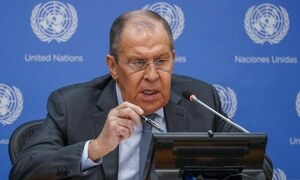
But Russian Foreign Minister Sergei Lavrov hit back on Thursday, terming the resolution “anti-Russian” saying that it had been achieved using “diplomatic terror”, the TASS news agency reported.

The resolution “condemns the organization by the Russian Federation of so-called referendums within the internationally recognized borders of Ukraine” and “the attempted illegal annexation” announced last month of four regions by President Vladimir Putin.

International condemnation

The US had put special effort into seeking to persuade South Africa and especially India, a growing US partner that has a historically close relationship with Russia and also abstained in the Security Council, where it holds a non-permanent seat.

The vote was largely the same – with a net two more votes against Russia – as when the General Assembly in March condemned the initial invasion of Ukraine.

Bangladesh, Iraq and Senegal – which abstained in March – on Wednesday voted to condemn Russia.

Eritrea, one of the world’s most closed states, moved from a “no” to an abstention, while Nicaragua, under growing international pressure over human rights, switched from abstaining to voting “no” alongside only Russia, Belarus, North Korea and Syria.

‘Willing to engage with India,’ PM Shehbaz says at CICA moot

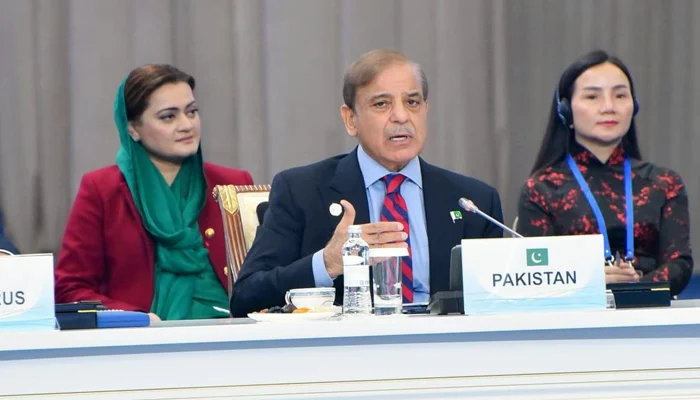
ASTANA: Prime Minister Shehbaz Sharif said on Thursday that he strongly favoured peaceful dialogue in resolving conflicts with other countries, including neighbouring India, in a bid to achieve prosperity of the nations and the region.

Addressing the 6th summit of the Conference on Interaction and Confidence Building Measures in Asia (CICA) in Kazakhstan’s capital Astana, he said Pakistan desired peaceful relations with all its neighbours, including India.

“We are willing to engage with India for the sake of prosperity and development as both sides of the border can not afford to deal with massive challenges of poverty and unemployment amid meagre resources,” he said.

The prime minister’s speech focused on peace among nations to hit the goal of prosperity as he addressed the leaders of the multinational forum, gathered to discuss cooperation towards promoting peace, security and stability in Asia.

PM Sharif stressed that the people deserved the resources to be diverted to their education and health.

“I want to leave behind a legacy of peace and progress for the prosperity of the coming generations of our region,” he said.

“Pakistan’s first priority at the moment is to revive rapid and equitable economy.”

He, however, said the “onus remains on India to take a necessary step to engage towards the result-oriented solutions.”

The premier highlighted India’s unabated atrocities in Jammu and Kashmir for the last seven decades, where he said, that the Kashmiris faced continued denial of their right to self-determination.

He urged other countries to take notice of India’s “bullet over ballot” policy as it blatantly quashed the United Nations Security Council’s resolution on holding a plebiscite in Kashmir.

“India has become a threat to its minorities, neighbours and the entire region,” he said.

Sharif said Pakistan was “absolutely ready and willing for a discussion with Indian counterparts to promote trade and investment provided they showed the sincerity of purpose”.

On Afghanistan, he said the four decades of conflict not only took a heavy toll on the country but also upon its neighbouring Pakistan.

Pakistan, he said, suffered immense damage to its peace and security with serious consequences borne in the shape of 80,000 casualties and billions of dollars in financial losses.

The prime minister expressed satisfaction that after immense sacrifices, Pakistan had now become able to control extremism and terrorism on its soil besides managing to host four million Afghan refugees.

“Prosperous and stable Afghanistan is not only in the interest of Pakistan but also for the international community,” he said.

He called for pooling resources among the regional countries to address the common challenges in the interest of peace and progress.

“If we team our resources, Asia can stand with pride and achievement,” he said. “Through constructive dialogue, we can build mutual trust”.

He mentioned Pakistan’s location offering a natural bridge among various economies of the region.

In this regard, he highlighted the multi-billion dollar project of China Pakistan Economic Corridor (CPEC), which had transformed the economic and connectivity landscape of the region.

He also invited the CICA member states to consider benefiting from the trade, investment and business opportunities offered by Pakistan.

On recent floods in Pakistan, the prime minister pointed out that the country was bearing the brunt of climate change despite its less than one percent carbon omissions.

He thanked the countries that stepped forward in extending assistance to Pakistan to carry out the relief and rehabilitation activities in the flood-affected areas.

He also termed as encouraging the upscale $816 million flash appeal by the United Nations launched to meet the daunting challenge of heavy losses incurred by flash floods.

The prime minister expressed confidence that Pakistan was “determined and committed” to emerge stronger after the flood disaster.

“Pakistan, with the support of its people and the friendly countries, will come out of this problem,” he said.

The prime minister in his speech deliberated upon the Palestine dispute, stressing a peaceful way of its resolution for ensuring peace in the Middle East and the region.

He also elaborated on the significance of CICA as a unique forum for promoting interaction, understanding, and collaboration among the countries across Asia.

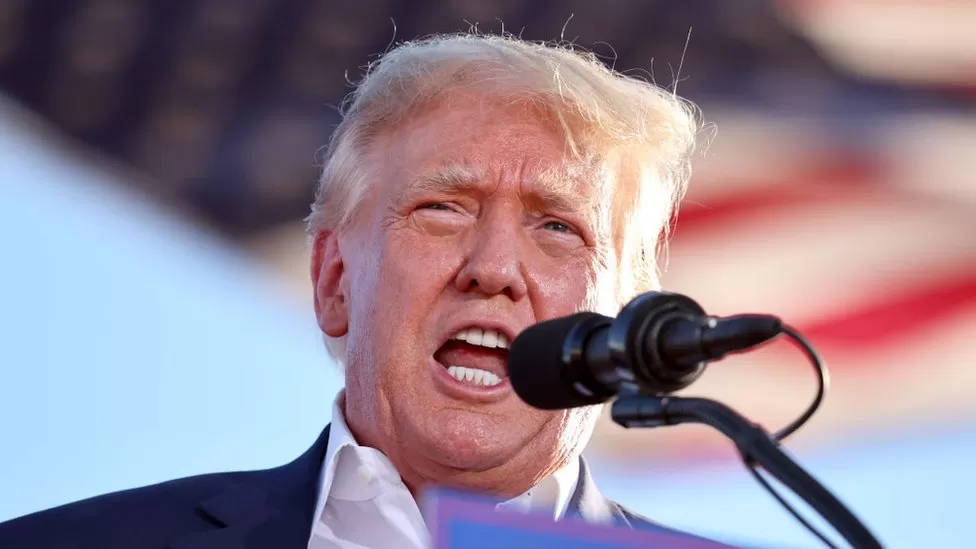
The US congressional committee investigating last year’s Capitol riot is issuing a legal summons for former President Donald Trump to testify.

“He is required to answer for his actions,” said Representative Bennie Thompson, a Mississippi Democrat.

If Mr Trump does not comply with the summons, known as a subpoena, he could face criminal charges and imprisonment.

The select committee is looking into Trump supporters’ storming of Congress on 6 January 2021.

The panel’s seven Democrats and two Republicans voted 9-0 in favour on Thursday of issuing the subpoena for the former Republican president to provide documents and testimony under oath in connection with the Capitol riot.

The subpoena is expected to be issued in the coming days, and include a deadline for when Mr Trump must comply.


Representative Liz Cheney, the committee’s vice-chairwoman and a Wyoming Republican, said: “We are obligated to seek answers directly from the man who set this all in motion. And every American is entitled to those answers.”

New footage shows Speaker Pelosi during Jan 6 attack

The surprise move came during the investigation’s ninth and possibly final public hearing for the investigation into last year’s raid on Congress.

At Thursday’s session the committee said it would focus on Mr Trump’s “state of mind” as he refused to admit defeat to Joe Biden in the presidential election of November 2020.

Mr Trump – who has lambasted the inquiry as a ruse designed to distract US voters from the “disaster” of Democratic governance – is widely expected to refuse to testify and fight the subpoena.

His former political strategist, Steve Bannon, also flouted a similar legal summons from the select committee to testify, and he was found guilty in July of criminal contempt of Congress.

On Thursday, Mr Trump – who has been hinting he may run for president in 2024 – questioned on his Truth Social platform why the committee did not ask him months ago to testify.

“Why did they wait until the very end, the final moments of their last meeting?” he posted. “Because the Committee is a total ‘BUST’ that has only served to further divide our Country which, by the way, is doing very badly – A laughing stock all over the World?”

During Thursday’s hearing, the committee showed never-before-seen footage of Congress being evacuated as the building was breached, and lawmakers being moved to secure shelters.

Democratic Speaker of the House Nancy Pelosi, whose daughter filmed the video, is seen expressing shock when told that lawmakers in another part of the building were being told to wear gas masks.

She and other lawmakers in the clip desperately call military officials and the governors of nearby states in a plea for more resources to fight back the mob.

Mike Pence, Mr Trump’s vice-president, is heard on the phone speaking to Mrs Pelosi about how long it will be before lawmakers can return to the floor to resume voting on Mr Biden’s confirmation.

The committee also heard evidence that Mr Trump was aware he had lost, but encouraged the conspiracy theory about a stolen election anyway.

White House communications aide Alyssa Farah said in videotaped testimony that about a week after the election the president was watching the news when he said to her: “Can you believe I lost to this effing guy?”

The panel has spent more than a year interviewing over 1,000 witnesses, including Mr Trump’s children, his top aides and top military and police officials.

Under the committee’s rules, its lawmakers must produce a report of their findings. It is expected to be released in December.

Ms Cheney and the only other Republican on the panel, Adam Kinzinger of Illinois, have become pariahs in their party amid conservative backlash to their participation in the inquiry.

She lost a primary election this summer for her Wyoming seat, and Mr Kinzinger has decided not to run in next month’s US midterm elections.

More than 850 people have been charged with participating in the riot at Congress.

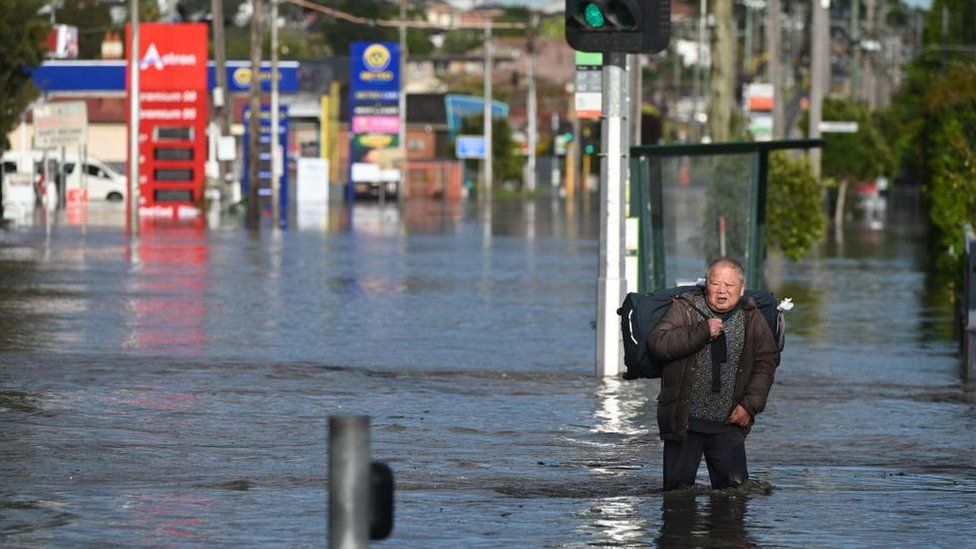
Communities in three Australian states have been ordered to evacuate as torrential rain brings major flooding.

Parts of the country have received more than three times their average October rainfall in just 24 hours.

At least 500 homes have been flooded, one person has died and another is missing as the disaster unfolds.

Widespread flooding across Australia – driven by a La Niña weather pattern – has killed more than 20 people this year.

Victoria – Australia’s second most populous state – has been worst hit this week. Several communities have been ordered to evacuate, including some in the state capital Melbourne.

Premier Daniel Andrews said the number of inundated homes was “absolutely certain to grow”, calling it one of the state’s worst flood events in decades.

“This has only just started, and it’s going to be with us for a while,” he told the Australian Broadcasting Corporation.


Floods have swamped roads, forced school closures and cut power to 3,000 houses and businesses.

More rain is forecast in the coming weeks, placing strain on already swollen rivers and saturated ground.

The town of Seymour north of Melbourne has received 155mm in 24 hours – three times its average October rainfall, or about a quarter of the average amount London receives in a year.

In Tasmania, several rivers have flooded after up to 400mm of rain fell in some areas in a day. It is unclear how many homes and business have been affected there.

In New South Wales, about 600 people were told to evacuate from the town of Forbes, where about 250 properties and business were expected to flood.

One man died in the state’s west earlier this week after his car became submerged in floodwaters.

Rescuers have also been searching for a 63-year-old man thought to have been swept away in similar circumstances on Tuesday.

Experts say recent flooding in Australia has been worsened by climate change and a La Niña weather phenomenon. In Australia, a La Niña increases the likelihood of rain, cyclones and cooler daytime temperatures.

King Charles has reopened Glasgow’s Burrell Collection almost four decades after the Queen first opened it.

The internationally renowned museum and gallery reopened to the public in March after a six-year £68.25m refurbishment.

It houses 9,000 objects from the personal collection of shipping merchant Sir William Burrell, which were gifted to the city of Glasgow.

The King toured the gallery in Pollok Country Park and met local school and nursery children outside.

Senior museum manager Jane Rowlands showed King Charles the highlights of the collection, including Auguste Rodin’s The Thinker.

His mother Queen Elizabeth first opened The Burrell, which was purpose-built for the vast collection of art and antiquities from around the world, on 21 October 1983.


Sir William devoted more than 75 years to amassing the collection with his wife Constance and insisted his gifts to the industrial city should be housed where people could appreciate the art in a countryside setting.

The King’s first official engagement in Glasgow since acceding the throne came two days after he attended a reception in Ballater with Camilla, the Queen Consort, to thank the community there for its support following the death of the Queen.

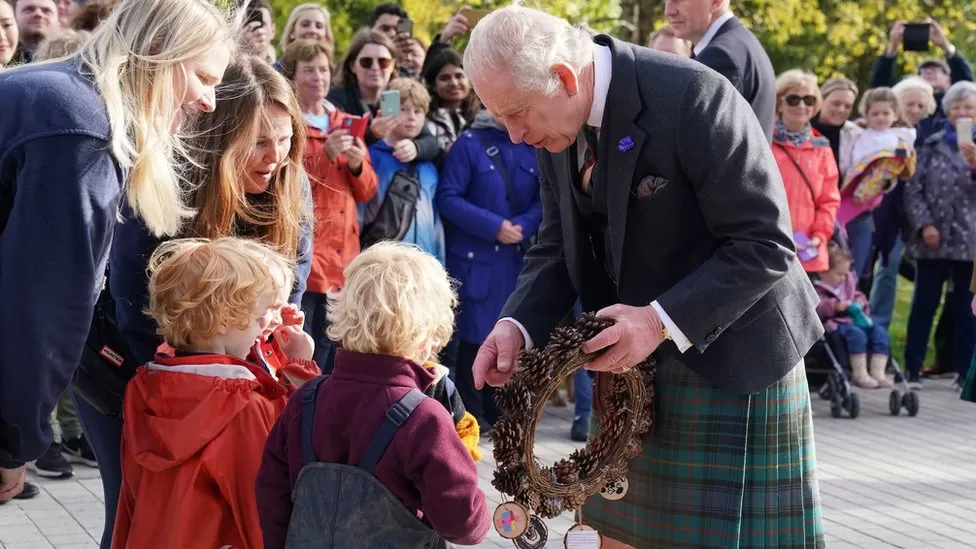
Dressed in Royal Stewart Hunting Tartan, he looked delighted as he was presented with an autumnal wreath by local nursery children.

Inside the museum, the King was shown a statue of The Luohan which portrays a Buddhist monk. Both his late mother and grandmother have previously been photographed beside it.

Following a viewing of the museum’s collection of stained-glass windows and elaborate tapestries, the King was escorted into a open foyer where he met with volunteers and those involved with the museum’s refurbishment.

The King was then invited to unveil a plaque by the chair of Glasgow Life, Annette Christie, who called it a “momentous occasion” for Glasgow.

Children from an outdoor nursery handed the King a wreath made of pine cones
Senior museum manager Jane Rowlands explained the history of the Figure of a Luohan during the tour
King Charles contemplated Auguste Rodin’s The Thinker, one of the world’s most recognisable sculptures
The Burrell Collection was purpose-built to incorporate carved stone work in the structure
Stained glass windows are among the 9,000 artworks donated as part of the collection
This 13th Century casket commemorating the death of St Thomas Becket caught the King’s eye
Pipers were at The Burrell Collection to mark the occasion and greet the monarch
King Charles met local dignitaries who had gathered at the museum in Pollok Country Park for the royal visit
Schoolchildren were among those to get a chance to meet the King on his first visit to the city since he became monarch
King Charles meets schoolchildren during his visit to Pollok park in Glasgow
Thirty-nine years after the Queen opened the iconic building, a new plaque was unveiled to mark the royal visit from her son King Charles

Chancellor Kwasi Kwarteng has cut short his visit to the US for urgent talks in Downing Street, with a U-turn over the mini-budget on the table.

Prime Minister Liz Truss is facing calls to change her economic plans to reassure markets and her party.

Mr Kwarteng is expected to arrive back on Friday for discussions with the prime minister and Conservative MPs.

He had been in Washington DC for a meeting of global finance ministers.

Speaking about the change in his travel plans, a source close to Mr Kwarteng said he “really wants to engage not only with government colleagues, but also MPs” over the financial plans.

The source said “fiscal responsibility is absolutely core to what we’re trying to do”.

No 11 dismissed a comparison to the Greek financial crisis of 2011, when its finance minister was hauled back from an international meeting to meet the country’s prime minister.

It said that was a debt crisis “on a completely different scale to anything that’s happening in our markets”.

The Bank of England is poised to withdraw its post mini-budget emergency support later – as many Tory MPs think a U-turn on some of the tax-cutting package is inevitable.


“It’s checkmate, we’re screwed,” one Tory MP remarked.

“There is no question in my mind, they’ll have to junk loads of this stuff and U-turn,” another said.

If the government does announce changes to its plans it is not clear when this might happen.

The chancellor began his journey back to the UK a day earlier than planned

On Thursday, he said he was “not going anywhere” – and when asked if he and Ms Truss would still be in their jobs this time next month, he said: “Absolutely, 100%.”

As it stands, Mr Kwarteng is set to spell out how he will pay for the government’s £43bn package of tax cuts and get the UK’s national debt falling in a statement on 31 October, alongside an independent economic forecast.

The government has already U-turned on its plan to scrap the top rate of income tax, but this only made up £2bn of the tax cuts announced by the chancellor last month.

Some Tory MPs think the government’s tax-cutting plans should be reversed, while others believe the help with energy bills should be more targeted.

Other scenarios being discussed by Tory MPs include the chancellor resigning or the prime minister being ousted.

However, there is little agreement on what should happen next or who should replace Ms Truss if she is removed.

According to the Times, senior Conservatives are holding talks about replacing Ms Truss with a joint ticket of Rishi Sunak and Penny Mordaunt, who both ran for the leadership this summer.

Unlike the summer leadership contest, MPs would propose just one person to succeed the PM, with the other individual taking a senior cabinet role, the paper reported.

Watch: I am not going anywhere – Kwasi Kwarteng speaking earlier

Among the possible U-turns, there has been speculation the government could reverse its plan for corporation tax.

Ms Truss has pledged to scrap a planned rise to the tax, which was set to increase from 19% to 25% in 2023.

When asked about the positive market response to the speculation of a U-turn on corporation tax, Mr Kwarteng told the Daily Telegraph: “Let’s see.”

However, he added that he still thought ensuring “competitive” tax rates for businesses was a “great idea”.

Former Home Secretary Priti Patel, meanwhile, told Sky News the market would now “dictate” the prime minister’s decision on corporation tax “primarily because we want to see stability”.


Senior Tories are continuing to call for the government to change course.

Alicia Kearns, the new chairwoman of the Commons Foreign Affairs Committee, said the government had to “adapt” during a “crisis”.

Asked if the government’s tax cuts should be reversed, she told the BBC: “There are some that are worth keeping, there are some that are not, but do I want to see mass borrowing at this point? I don’t think that’s reassuring.”

Former minister Johnny Mercer called for a “course correction” from No 10, describing the impact of rising mortgage rates on people who want to buy a home as “unconscionable” and “politically unsurvivable”.

“Get on and do it – we all know it’s coming. It’s not a game for folks down here,” he said of his Plymouth Moor View constituency.

Scottish Conservative leader Douglas Ross called on the prime minister and chancellor to “get a grip” on the economy.

“There have been mistakes, they’ve got to work this out to settle the markets, to settle the economy and to get things back up and running again,” he told the BBC One’s Question Time.

Asked whether he believed Ms Truss could win the next general election, he replied: “Yes.”

But other Tory MPs expressed support for the prime minister and said she must not reverse her plans.

Sir Christopher Chope, a Truss backer, told the BBC Two’s Newsnight: “If we were to increase corporation tax having said that we’re not going to, that would be totally inconsistent with the prime minister’s policy of promoting growth, growth and growth.”

He added that a U-turn would be a “complete betrayal of that she believed in” and he believed it would not happen.

Wales Office Minister David Davies said the government had to be “flexible” in what he described as an economic “storm”.

However, he said Mr Kwarteng should remain chancellor and refused to accept recent market turmoil was due to a “mistake” by the government.

Kremlin expects Erdogan to offer Kyiv mediation

“The Turks are offering their mediation. If any talks take place, then most likely they will be on their territory: in Istanbul or Ankara,” Kremlin foreign policy adviser Yuri Ushakov told reporters in Moscow.

“Erdogan will probably propose something officially” during talks with Putin in the Kazakh capital Astana on Thursday, the foreign policy adviser added.

Nato member Turkiye, which has stayed neutral throughout the conflict in Ukraine, has good relations with its two Black Sea neighbours — Russia and Ukraine — and has refrained from joining Western sanctions on Moscow.

“Turkiye on principle does not join the illegal sanctions of the West. And this position of Turkiye gives an additional impetus for the expansion of trade and economic cooperation,” the official said.

Turkiye has twice hosted talks between Moscow and Kyiv, including a March in-person meeting of Russia’s Foreign Minister Sergei Lavrov and his Ukrainian counterpart Dmytro Kuleba, the first high-level talks to take place after Moscow sent troops into Ukraine.

However, peace negotiations have since stalled and Ukraine’s President Volod­ymyr Zelensky said he would not hold any talks with Putin after the Kremlin recently annexed four territories.