

Celebrations marking the Queen’s 70 years on the throne have continued with church services, picnics and a carnival parade.

The service of “celebration and thanksgiving” at Glasgow Cathedral was one of several across Scotland which reflected on the work of the monarch.

In the gardens beneath Edinburgh Castle, live music and a carnival parade entertained the crowds.

They had been invited to bring a picnic to the jubilee party.

And they were able to watch a live broadcast of the Platinum Jubilee Pageant, live from London.

Perth also played host to a colourful parade, celebrating world music, dance and culture.

The service in Glasgow was the fourth jubilee celebration held for the Queen at the city’s cathedral during her 70-year reign, according to the order of service.

It says: “We have been privileged to receive Her Majesty on the occasions of her silver, golden and diamond Jubilee, and although we cannot welcome her in person on this equally momentous occasion, her Platinum Jubilee, we can feel confident she is with us in spirt.”

The Queen attended a service of thanksgiving at Glasgow Cathedral to mark her Diamond Jubilee in 2012

The order of service continues: “Jubilee is not an everyday occurrence but a special occasion which does not happen every year, or even every 10, and today we celebrate the extraordinary reign and devotion Her Majesty has had over us and to us.”

At the beginning of the service, the congregation – which included Health Secretary Humza Yousaf – joined three cheers for the monarch.

In his sermon, the Rev Dr Ian Greenshields, the Moderator of the General Assembly of the Church of Scotland, described the Queen’s life as “an example of humble, self-denying service to God and her country”.

“And it’s this that we offer thanksgiving for today and this life that we honour in this ancient place of worship,” he added.

Performers from Edinburgh Festival Carnival entertained the crowds in Princes Street Gardens in Edinburgh

In Edinburgh, West Princes Street Gardens hosted a jubilee picnic, and a special Edinburgh Festival Carnival parade.

The band of HM Royal Marines Scotland and the local Love Music Community Choir performed before the pageant near Buckingham Palace was shown on big screens.

Among those picnicking in the gardens was Johnny Bacigalupo and his family.

“We’re here to celebrate the Platinum Jubilee… it’s an excuse for a party, an excuse to enjoy yourself, and celebrate what makes us all feel British,” he said.

Vicky Appleyard said she was there with family from all over the world.

“I was not born here but I’m truly British, I’m proud British now, but I was born in Argentina and this is the best thing ever.

“We needed this – we definitely needed a party. We’ve been two years indoors. Look at us, we’re from everywhere. That’s what the Queen does – she brings us together.”

The Band of HM Royal Marines Scotland played in Princes Street Gardens

Edinburgh’s Lord Provost Robert Aldridge told BBC Scotland it was great to be having a party in the festival capital in the sunshine.

“It’s really important to celebrate a woman who has devoted 70 years of her life to faultless duty,” he added.

“She’s a fantastic role model for anyone involved in public life and we’re really proud to be able to host a party here today.”

Paddington Bear

It follows a series of events across the UK over the four-day holiday weekend, including the Platinum Party at the Palace on Saturday night.

Huge crowds watched the show outside Buckingham Palace, during which the Prince of Wales paid tribute to his “mummy”.

And they saw the Queen feature in a secretly pre-recorded comic sketch featuring Paddington Bear.

Nicola Sturgeon and her husband Peter Murrell were among those watching the Platinum Party at the Palace on Saturday

It follows a series of jubilee-themed events in Scotland on Saturday, including a re-enactment of the 1953 coronation by Brownies, Guides, Cubs and Scouts in Kelso.

There was a flotilla of about 20 boats which took part in A Parade of Sail in Edinburgh.

And at Balmoral in Aberdeenshire there was a gathering of 70 corgis – the Queen’s favourite dog – on the lawn outside the castle.

Meanwhile a group of republicans, including SNP MP Tommy Sheppard, took part in rally on Edinburgh’s Calton Hill.
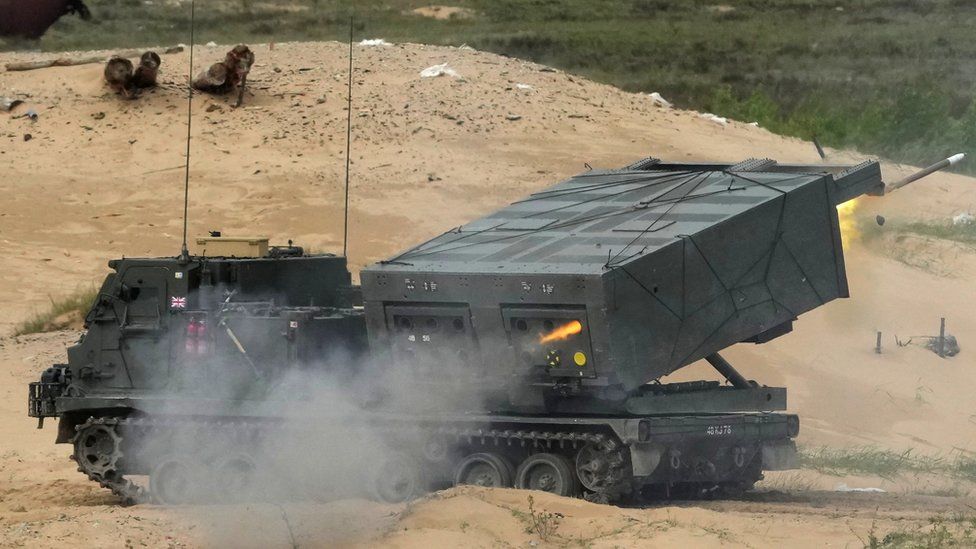
The UK is sending its first long-range missiles to Ukraine, the defence secretary has said, despite a threat from Russia to the West.

Ben Wallace said the M270 multiple-launch rocket system will help Ukraine defend itself against Russia.

The UK government has not confirmed how many weapons will be sent, but the BBC understands it will be three initially.

The decision was co-ordinated with the US, which announced last week it was also supplying a rocket system.

The move by the US has already angered Moscow and on Sunday Russian President Vladimir Putin threatened to expand the list of targets Russia will attack in Ukraine if Western countries send long-range weapons to Kyiv.


The UK government said the Ukrainian military will be trained in how to use the launchers in the UK in the coming weeks.

Announcing the move, Mr Wallace said the UK was taking a leading role in supplying Ukrainian troops with the “vital weapons they need to defend their country from unprovoked invasion”.

He said: “As Russia’s tactics change, so must our support to Ukraine.

“These highly capable multiple-launch rocket systems will enable our Ukrainian friends to better protect themselves against the brutal use of long-range artillery, which Putin’s forces have used indiscriminately to flatten cities.”

Britain and America have led the way in supplying weapons to Ukraine, but giving it advanced long range rockets marks a significant shift, said the BBC’s defence correspondent Jonathan Beale.

It is also a recognition that Ukraine is struggling to compete against Russia’s vast artillery arsenal, he added.

The UK’s multiple launch rocket system can fire 12 surface-to-surface missiles within a minute and can strike targets within 50 miles (80km) with pinpoint accuracy – far further than the artillery Ukraine currently possesses.

It is similar to the system the US is sending, the M142 High Mobility Artillery Rocket System (HIMARS).

Last week Washington said it would supply four HIMARS multiple rocket launchers to Ukraine – following receipt of guarantees they would be used for defensive purposes only and not to strike targets inside Russia.

In an interview on Russian state TV on Sunday, Mr Putin said: “In general, all this fuss about additional arms supplies, in my opinion, has only one goal – to drag out the armed conflict as long as possible.”

The Russian leader said what the US was supplying was “nothing new”.

But he warned against sending missiles with longer ranges: “If they are supplied, we will draw appropriate conclusions from this and use our weapons, of which we have enough, to strike at those targets that we are not striking yet.”

The warning came as explosions shook parts of Kyiv on Sunday in the first assault on the capital city for weeks, while fierce fighting for control of key towns and cities in the eastern Donbas region continues.

Russia refocused its military efforts on the Donbas at the end of March after pulling back from the Kyiv region.

Some of the fiercest fighting is currently in the eastern city of Severodonetsk. Capturing the city would deliver the Luhansk region to Russian forces and their local separatist allies, who also control much of neighbouring Donetsk. The two regions form the heavily industrial Donbas.

On Sunday, Ukraine’s president, Volodymyr Zelensky, said he had visited front-line troops in the eastern Donbas region to the city of Lysychansk and the town of Soledar.

Britain and the US have are among the leading nations giving arms to support Ukraine since Russia invaded in February.

The UK has also delivered more than 5,000 next generation light anti-tank weapons – known as Nlaw – which analysts believe have been critical to Ukraine driving back Russian ground assaults since the war began.

Other weapon systems delivered by the government include short-range Brimstone 1 missiles, Mastiff armoured vehicles and Starstreak missile air defence systems – with the overall military support to Ukraine costing £750m so far, the government said.

Several other countries have pledged to send advanced weapons to Ukraine. Germany has promised to send its most modern air defence system – the Iris-T – to enable Ukraine to shield an entire city from Russian air attacks.

Support for war crimes investigation

Meanwhile, a specialist team of lawyers and police officers will be offered to assist the chief prosecutor investigating alleged Russian war crimes in Ukraine, the Justice Secretary Dominic Raab announced on Monday.

The offer will include a Metropolitan Police officer stationed in the International Criminal Court in The Hague, in the Netherlands – who will provide the ICC’s prosecutor Karim Khan with greater access to British police and military expertise.

On top of this, seven lawyers experienced in international criminal law will be offered to help uncover evidence of war crimes committed in Ukraine and prosecute those responsible.

The ICC has already begun an investigation that may target senior Russian officials thought to be responsible for war crimes, crimes against humanity or genocide.


Atrocities and mass graves have been reported in towns and cities around Ukraine previously occupied by Russian forces – who withdrew from around the Kyiv and other areas they previously occupied to focus their offensive in the east.

Civilian massacres have been discovered in places like Bucha, a town near the Ukrainian capital, with people found dead in the street, having been allegedly bound, gagged and executed by retreating Russian soldiers.

Ukraine has so far reported 15,000 suspected war crimes, including Ukrainian women alleging being raped by Russian troops.

Some 600 suspects have been identified and 80 prosecutions have begun, with one tank commander already sentenced to life in prison in May, after being found guilty by a Kyiv court of shooting a 62-year-old civilian in the back.

MPs will return to Westminster on Monday, amid continuing speculation about a possible vote of confidence in Boris Johnson’s leadership.

Some Tory MPs have told the BBC such a ballot could be triggered this week, as the prime minister continues to face calls to resign over lockdown parties.

On Sunday ministers publicly backed the PM to win a vote, should one be called.

Business minister Paul Scully told Channel 4 that a vote “may well” happen – but Mr Johnson “will face it down”.

Transport Secretary Grant Shapps also told the BBC the prime minister would not lose a confidence vote among his own MPs.

In the 10 days since MPs returned to their constituencies for the half term break, speculation has swirled about whether Mr Johnson will face an internal electoral battle to save his premiership.

For a confidence ballot to be triggered, 54 Tory MPs must formally put in a letter to Sir Graham Brady, the chairman of the 1922 Committee of backbench MPs, asking for one.

So far 28 Conservative MPs have publicly called on Boris Johnson to step down. But some Conservative MPs have privately told the BBC they believe the threshold for triggering a vote could happen in the coming week.

On Sunday, both Mr Shapps and Mr Scully shrugged off crowds booing the PM at the Jubilee thanksgiving service, with Mr Shapps saying politicians didn’t expect to be “popular all the time”.

Mr Scully told Channel 4’s The Andrew Neil Show politicians had been “booed through time immemorial”.

He added: “We may well have a vote of confidence. If it does happen, the prime minister, I know, will face it down.

“But whatever happens, we’ve got to get back to governing, to tackle the things that people want us to do on a day-to-day basis, not continuing… to look back at two years previous.”

“I begin to wonder if the Tory party has a death wish.” So says a senior supporter of Boris Johnson.

“Either we get rid of him or the electorate will get rid of us,” says a Conservative MP who wants him out.

After four days of bunting, union flags, Paddington Bear and Jason Donovan, yes – that is the sound of the clunk and clatter of politics returning.

Resuming again, a festival of guesswork to rival any fete or pageant, all focused on the prime minister’s future.

I am struck by a couple of things:

Firstly, speaking to Mr Johnson’s greatest supporters, his biggest critics, and those somewhere in between, there is a collective gloom within the Conservative Party. A feeling they are in a spot it will be hard to get out of in one piece.

And secondly, very few within the Conservative parliamentary party would be remotely surprised if a vote of confidence happens this week.

But that doesn’t mean one definitely will.

On top of the internal machinations of his own backbench MPs seeking his removal, Mr Johnson also faces two upcoming electoral tests on 23 June – with by-elections being held in seats vacated by former Tory MPs in controversial circumstances.

The first is in the marginal West Yorkshire constituency of Wakefield to replace Imran Ahmad Khan, who was jailed for sexually assaulting a teenage boy.

The second is in the safe-seat of Tiverton and Honiton in Devon, after Neil Parish stood down after admitting to twice watching pornography in the House of Commons.

Ahead of these votes, this week Mr Johnson is expected to make a speech on housing policy in an attempt to focus attention on his government’s agenda.

How does a confidence vote work?

Under Conservative Party rules, for a leadership ballot to take place 15% of the parliamentary party – currently 54 MPs – must write letters to the chair of the backbench 1922 Committee saying they no longer support the PM.

It is not known how many MPs have submitted one so far to the current chairman, Sir Graham Brady.

This is because he is notoriously discreet about what the tally of letters is at any given time.

If a vote is called, a majority of Tory MPs must vote against their leader for them to be removed, which would mean in the current Parliament the rebellious MPs would need to get 180 votes in total to succeed in removing Mr Johnson.

A Conservative leader who survives a confidence vote is safe from any further challenge for a year.

Pressure on Mr Johnson to resign has been increasing since allegations emerged of parties taking place inside Downing Street while coronavirus restrictions were still in place.

Last month, an investigation published by senior civil servant Sue Gray revealed widespread Covid rule-breaking had taken place, with staff throwing up, getting into altercations and being rude to security staff at parties.

Ms Gray’s report followed a months-long Metropolitan Police investigation which ended in 126 fines being issued to Downing Street staff, including to the PM and Chancellor Rishi Sunak for attending a birthday party in No 10 for Mr Johnson’s birthday.

The prime minister is also facing a parliamentary investigation over whether he misled MPs when he told the House of Commons that no parties took place and Covid rules were followed at all times in Downing Street.

Mr Scully said he did not believe that his leader had “wilfully misled parliament”, but did express frustration over “the way that we as a government have handled this issue.”

He said: “It should have been actually dealt with before Christmas. That was one of the things I regret, that it has stretched out for so long.”

Saudi Arabia on Saturday welcomed its first batch of Haj pilgrims since before the coronavirus pandemic, which prompted authorities to sharply restrict the annual ritual.

The group from Indonesia landed in the city of Madina and was set to travel south to the holy city of Makkah in the coming weeks to prepare for the Haj next month, state media reported.

“Today we received the first group of this year’s pilgrims from Indonesia, and the flights will continue from Malaysia and India,” Mohammed al-Bijawi of the country’s Haj Ministry told the state-run Al-Ekhbariya channel.

“Today we are happy to receive the guests of God from outside the kingdom, after a two-year interruption due to the pandemic,” he added, describing Saudi Arabia as “fully prepared” to accommodate them.

Usually one of the world’s largest religious gatherings, about 2.5 million people participated in 2019.

But after the onset of the pandemic in 2020, Saudi authorities announced they would only let 1,000 pilgrims take part.

The following year, they increased the total to 60,000 fully vaccinated Saudi citizens and residents chosen through a lottery.

In pictures: Pilgrims mark second Haj overshadowed by Covid-19

Barring overseas pilgrims caused deep disappointment among Muslims worldwide, who typically save for years to take part.

In April, the kingdom announced it would permit one million Muslims from inside and outside the country to participate in this year’s Haj, which will take place in July.

Hosting the Haj is a matter of prestige for Saudi rulers, as the custodianship of Islam’s holiest sites is the most powerful source of their political legitimacy.

Before the pandemic, Muslim pilgrimages were major revenue earners for the kingdom, bringing in about $12 billion annually.

This year’s pilgrimage will be limited to vaccinated Muslims under age 65, the Haj Ministry has said.

Those coming from outside Saudi Arabia, who must apply for Haj visas, are required to submit a negative Covid-19 PCR result from a test taken within 72 hours of travel.

Hong Kong detains multiple people as world marks Tiananmen anniversary

As night fell, candles appeared in the windows of several foreign countries’ missions to Hong Kong — in defiance of a warning not to do so — and on various street corners around the city.

Discussion of the events of 1989, when China set troops and tanks on peaceful protestors, is all but forbidden on the mainland.

Semi-autonomous Hong Kong had been the one place in China where large-scale remembrance was still tolerated — until two years ago when Beijing imposed a national security law to snuff out dissent after widespread pro-democracy protests in 2019.

Authorities had warned the public that “participating in an unauthorised assembly” on Saturday risked a maximum penalty of five years’ imprisonment.

They also closed large parts of Victoria Park, once the site of packed annual candlelight vigils that were attended by tens of thousands on the anniversary.

The park and nearby Causeway Bay shopping district — one of the city’s busiest neighbourhoods — were heavily policed all day.

People were stopped and searched for carrying flowers, wearing black and, in one case, carrying a toy tank box.

Reporters saw at least half a dozen people being taken away by police, mostly in the evening, including activist Yu Wai-pan from the League of Social Democrats (LSD) party.

LSD said Yu was later released without charge, while fellow member Lau Shan-ching was arrested for wearing a shirt with a portrait of late Chinese democracy activist Li Wangyang wearing a mask that read “mourn June 4”. “For 33 years it has always been peaceful, but today it’s like (police) are facing a big enemy,” Chan Po-ying, head of the LSD, said.

Security was heightened in the Chinese capital Beijing on Saturday, with officer numbers bulked up, and ID checks and facial recognition devices set up on roads leading to Tiananmen Square.

China has gone to exhaustive lengths to erase the crackdown from collective memory, omitting it from history textbooks and scrubbing references to it from the Chinese internet and social media platforms.

A similar approach is now beginning to be applied to Hong Kong, as authorities remould the city in the mainland’s image.

Since last September, the Victoria Park vigil’s organisers have been arrested and charged with subversion, their June 4 museum has been closed, statues have been removed and memorial church services cancelled. Commemoration events in Macau were also cancelled this year.

On Saturday, multiple Western consulates general in Hong Kong posted Tiananmen tributes on social media, despite local media reports that they had been warned by the city’s Chinese foreign ministry office to refrain from doing so.

The European Union’s office confirmed that they had received a call. At dusk, both the US Consulate General and the EU office’s windows were illuminated by the flickering light of candles.

Sri Lanka in diplomatic spat over confiscated Russian plane

The Airbus A330 was seized at the Bandaranaike International Airport on Thursday, the same day it arrived from Moscow, after a directive from a court in the capital Colombo.

Flight SU289 was about to return to the Russian capital with 191 passengers and 13 crew aboard.

Sri Lanka’s top envoy was summoned to the Russian foreign ministry on Friday to receive a “resolute protest” over the detention, Russian state news agency TASS reported.

But Airport and Aviation Services, which runs Bandaranaike airport, said in a statement the dispute was “purely of a commercial nature” and should not be subject to state involvement.

The plane was stopped on the orders of Colombo Commercial Court in response to a commercial dispute filing by Celestial Aviation Trading 10 Limited of Ireland.

The case is to be heard on Wednesday.

The aircraft is parked at Bandaranaike International Airport, north of Colombo, and its passengers have been booked into hotels.

Aeroflot suspended all international flights in March following tough Western sanctions over Moscow’s invasion of Ukraine, but resumed operations to Colombo in the following month.

Russia’s civil aviation body had recommended airlines operating rental planes registered in foreign countries cease international flights to avoid their seizure.

It remains unclear whether the detention of flight SU289 was related to those sanctions.

China to launch next crewed mission today to build space station

A Long March-2F rocket carrying the Shenzhou-14 spacecraft is set to blast off from Jiuquan Satellite Launch Centre in the northwestern province of Gansu at 10:44am local time (0244 GMT) on Sunday, a China Manned Space Agency official told a news conference on Saturday.

Mission commander Chen Dong will be accompanied by Liu Yang and Cai Xuzhe aboard Shenzhou, meaning “Divine Vessel” in Chinese. “All preparations for the launch are basically ready,” said Lin Xiqiang, an agency official.

Shenzhou-14 will be the third of four crewed missions — and the seventh of a total of 11 missions — needed to complete the space station by the end of the year.

China began constructing its three-module space station in April 2021 with the launch of Tianhe — the first and biggest of the station’s three modules.

Tianhe, slightly larger than a metro bus, will form the living quarters of visiting astronauts once the T-shaped space station is completed.

Following Shenzhou-14, the remaining two modules — the laboratory cabins Wentian and Mengtian — will be launched in July and October, respectively.

Wentian will feature a robotic arm, an airlock cabin for trips outside of the station, and living quarters for an additional three astronauts during crew rotations. The Shenzhou-14 crew will help with the setup of Wentian and Mengtian and conduct functionality tests on both modules.

Biden’s visit delayed as efforts to normalise Saudi, Israel ties continue

Speculations about the visit started in mid-May and several US media outlets reported last week that Mr Biden might visit the two Middle Eastern countries as early as late June.

On Friday, President Biden acknowledged that he plans to visit Saudi Arabia soon but indicated that the trip might not take place in June.

“I have been engaged in trying to work with how we can bring more stability and peace to the Middle East,” he said on Friday. “There is a possibility that I would … meet both the Israelis and some Arab countries at the time, including, I expect, Saudi Arabia.”

But he also said that he had “no direct plans at the moment” and was looking at various possibilities. When journalists contacted the White House for clarification, they were told the visit might happen in July, not June as speculated. It would be Biden’s first trip to the region since he came to office in January last year.

The trip would include a summit in Saudi Arabia with the leaders of nine Arab countries, followed by visits to Israel and the Palestinian Authority.

US media outlets reported that Biden would also meet Crown Prince Mohammed bin Salman when he visits the kingdom. The reports speculated that larger political and strategic interests would persuade Biden to meet the prince despite his concerns about his alleged involvement in the murder of a Washington Post columnist Jamal Khashoggi.

Earlier this week, Saudi Arabia and other oil-producing states agreed to boost their output by 648,000 barrels per day in July and to a similar increase in August. But Washington wants a greater increase to ease the impact of its sanctions on Russian oil, imposed after Moscow invaded Ukraine.

The United States and Israeli media reported that Israel has also been talking to Washington about how to establish diplomatic relations with Saudi Arabia.

Saudi Arabia continues to publicly proclaim its commitment to the Palestinian cause and insists that it will not normalise its relations with Israel until this issue is resolved.

Ukraine’s foreign minister has hit out at French President Emmanuel Macron after he said it was vital that Russia was not humiliated over its invasion.

Mr Macron said it was crucial President Vladimir Putin had a way out of what he called a “fundamental error”.

But Dmytro Kuleba said allies should “better focus on how to put Russia in its place” as it “humiliates itself”.

Mr Macron has repeatedly spoken to Mr Putin by phone in an effort to broker a ceasefire and negotiations.

The French attempts to maintain a dialogue with the Kremlin leader contrast with the US and UK positions.

Foreign minister Kuleba said in a tweet that “calls to avoid humiliation of Russia can only humiliate France and every other country that would call for it”.

Kyiv says Russia must not get territorial concessions from Ukraine, as the Russian invasion has been condemned internationally as brutal aggression.

Earlier, Mr Macron told French regional media that Russia’s leader had “isolated himself”.

“I think, and I told him, that he made a historic and fundamental error for his people, for himself and for history,” he said.

“Isolating oneself is one thing, but being able to get out of it is a difficult path,” he added.

Italy’s Prime Minister Mario Draghi has aligned himself with Mr Macron, suggesting Europe wants “some credible negotiations”.

Fierce fighting in Severodonetsk

The eastern city of Severodonetsk remains the epicentre of fighting in Ukraine, with Ukrainian forces fiercely resisting Russian tanks, infantry and intense artillery barrages.

Capturing the city would deliver the Luhansk region to Russian forces and their local separatist allies, who also control much of neighbouring Donetsk region.

In Soledar, not far from Severodonetsk, a woman sits in her wrecked apartment after a missile strike

The region’s Ukrainian governor Serhiy Haidai said his forces had reclaimed about a fifth of Severodonetsk and could hold on.

“As soon as we have enough Western long-range weapons, we will push their artillery away from our positions. And then, believe me, the Russian infantry, they will just run,” he said.

The US plans to give Kyiv’s forces precision rocket systems, so that they can hit Russian positions from a longer range. The UK will also send them a number of large multiple-rocket batteries.

Facing Severodonetsk across the Siverskyi Donets river lies Lysychansk. Both cities are strategically important for Russia: Severodonetsk has the giant Azot chemical plant, which produces nitrogen-based fertilisers, and Lysychansk has Ukraine’s second biggest oil refinery.

The fighting has now left most of Severodonetsk in ruins, but thousands of civilians are still sheltering in basements there.

Governor Haidai said Russian forces were blowing up bridges on the river to prevent Ukraine bringing in military reinforcements and delivering aid to civilians.

In other developments:

  • The Russian military said it had shot down a Ukrainian military transport plane carrying weapons near the Black Sea port of Odesa
  • Russia continued heavy shelling of Mykolaiv, a key port city on the approaches to Odesa – the BBC’s Laura Bicker met shaken but determined civilians there
  • A major fire engulfed a wooden church at the Sviatohirsk Lavra Monastery in Donetsk region; Ukraine blamed Russian shelling, which Russia denied, instead blaming it on retreating Ukrainian troops.

At least 16 people have been killed and hundreds reported injured in an explosion at a depot in a south-eastern town in Bangladesh, officials say.

The explosion happened after firefighters were called to put out a fire at a container storage facility in the town of Sitakunda.

Twenty of the injured are in critical condition with burns covering 60% to 90% of their bodies, a doctor at a hospital treating the injured told AFP.

The cause of the fire remains unknown.

Some of the containers at the depot are believed to have stored chemicals, local media report.

The blast reportedly shattered the windows of several buildings nearby and was felt from areas as far as 4km (2.4 miles) away, according to local news outlet Prothomalo.

The town is only 40km (25 miles) from the country’s second-largest city, Chittagong, and one of the city’s hospitals has been inundated with victims. The injured include depot workers as well as fire-fighters and police, according to local media.

Several hours after the blast, fire-fighters were still attempting to extinguish the fire on Sunday morning.

About 600 people worked at the depot, the facility’s director, Mujibur Rahman, told AFP.

Fires are common in Bangladesh. Last year, at least 39 people were killed after a ferry caught fire in the south of the country. And earlier that same year, at least 52 people died in a factory fire in Rupganj near the capital, Dhaka.

Three workers were also killed in 2020 after an oil tank exploded in another container storage depot in Patenga, not far from Chittagong.