
Aid groups push to feed Yemen’s hungry millions during ceasefire

“The benefits of the first weeks of truce are already significant,” said Erin Hutchinson, Yemen Director for the Norwegian Refugee Council. The group has been able to give aid to 12,000 people in one district of Hajjah province that has not been reached for more than three years.

More than seven years of conflict in Yemen have devastated the economy, displaced millions and pushed food prices out of the reach of many. Spiking global grain and commodity prices are adding further strain.

“Tens of millions of people in Yemen are living hand-to-mouth,” said Richard Ragan of the World Food Programme (WFP), which is trying to feed half of Yemen’s 30 million people in one of its largest ever programmes.

Stunted and weakened by severe malnourishment, one-year-old Jiad Jalal’s skin is dry and wrinkled over his protruding skull, limbs and stomach. Living in a makeshift displacement camp in Khadish, Hajjah, one of Yemen’s poorest regions, Jalal is one of 2.2 million children under five — including 538,000 severely malnourished — who will suffer acute malnutrition this year, according to pre-ceasefire UN estimates.

“We eat only what we can get from aid agencies. Wheat, beans and such items. If we don’t receive food, then some days we eat and other days we go hungry,” said his grandmother Zahra Ahmed.

UN concerned as clashes erupt again at Al Aqsa mosque

“We are deeply concerned by the escalating violence in the occupied Palestinian territory and Israel over the past month,” said Ravina Shamdasani, spokeswoman for the UN Office of the High Commissioner for Human Rights.

Friday’s new clashes between Israeli police and Palestinian protesters at the Al Aqsa mosque compound come after a month of deadly violence, as the Jewish festival of Passover overlaps with the holy Muslim fasting month of Ramazan.

The violence has sparked international fears of a major escalation, a year after similar unrest led to an 11-day war.

“The use of force by Israeli police resulting in widespread injuries among worshippers and staff in and around the Al-Aqsa mosque compound must be promptly, impartially, independently and transparently investigated,” she said.

“Those responsible for any violations should be held to account, and policies and procedures on the use of force reviewed with a view to avoid any further violations.” She said the conduct of Israeli security forces on April 15, captured in numerous videos, “raises serious concerns that the use of force was widespread, unnecessary and indiscriminate”, Shamdasani added.

Noting how the tension in Jerusalem had impacted on other areas, the spokeswoman said Israel’s intensified military operations in the West Bank, especially in Jenin, and the use of firearms by Palestinian militants, “place Palestinian residents at high risk”.

She said the weeks of violence included “the most serious attacks in Israel in many years”, with 12 Israelis and two foreign nationals “killed by attackers in incidents in Beersheba, Bnei Brak, Hadera and Tel Aviv”.

3 soldiers martyred in N. Waziristan during gun battle with terrorists from Afghanistan: ISPR

According to a statement issued by the Inter-Services Public Relations (ISPR), terrorists opened fire on Pakistani troops from across the Afghan border and the latter “responded in a befitting manner”.

“As per credible intelligence reports, due to fire of own troops, terrorists suffered heavy casualties,” the ISPR said, adding that three soldiers embraced martyrdom after fighting gallantly.

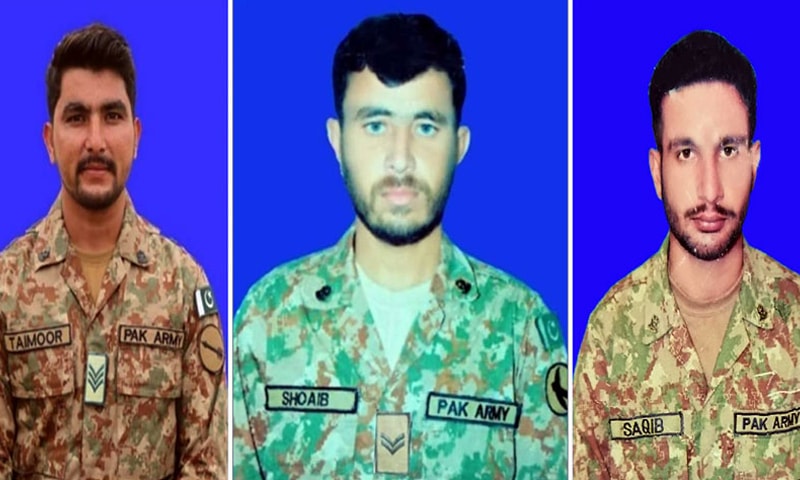
The martyred soldiers have been identified as 30-year-old Havaldar Taimoor, a resident of Jhelum; 38-year-old Naik Shoaib, a resident of Attock; and 24-year-old Sepoy Saqib Nawaz, a resident of Sialkot.

“Pakistan strongly condemns the use of Afghan soil by terrorists for activities against Pakistan and expects that [the] Afghan government will not allow conduct of such activities in [the] future,” the ISPR said, adding that the Pakistan Army “is determined to defend Pakistan’s borders against the menace of terrorism and such sacrifices of our brave men further strengthen our resolve”.

Earlier on April 14, eight soldiers were martyred in two terrorist attacks in North Waziristan.

In one incident, seven soldiers were martyred when terrorists had ambushed a vehicle of security forces in Datakhel tehsil of the North Waziristan district by terrorists operating from Afghanistan, according to the Foreign Office.

Separately, another soldier was martyred during a clash between security forces and terrorists in the district’s Isham area.

Last month, four soldiers had embraced martyrdom in North Waziristan’s Hassan Khel area during an exchange of fire with terrorists who attempted to infiltrate into Pakistan from Afghanistan on the night between March 23 and March 24.

In the last few days, incidents along Pak-Afghan border had significantly increased, in which Pakistani security forces were being targeted from across the border.

Last week, the Foreign Office had urged the Afghan government to secure the Pak-Afghan border region and take stern actions against the individuals involved in terrorist activities in Pakistan, in the interest of peace and progress of the two brotherly countries.

The FO, in the statement, had recalled that Pakistan had repeatedly requested the Afghan government over the last few months to secure the Pak-Afghan border region. “Terrorists are using Afghan soil with impunity to carry out activities inside Pakistan.”

US discourages India from ‘relying on Russia’ for defence needs

The senior official made the statement in response to a question from a journalist regarding India’s ties with Russia amid the ongoing Russia-Ukraine war.

In a press briefing on Friday, Kirby said that US had been “very clear with India and other countries that we don’t want to see them rely on Russia for defence needs”.

“At the same time, we also value the defence partnership that we have with India. And as was evidenced a week ago, we’re looking at ways to improve that going forward. That’s going to continue because it matters and it’s important,” he added.

Kirby also said that India was a provider of security in the region and “we value that”.

Earlier, US had warned India against warming up to Russia. Daleep Singh, Washington’s chief sanctions strategist, was quoted by local media in a visit to Delhi as saying that India could not rely on Russia if there was another clash.

US President Joe Biden, last month, had said that India was an exception among Washington’s allies with its “shaky” response to the Russian invasion of Ukraine after it abstained from a United Nations vote condemning the invasion .

India and Russia are working on a rupee-ruble mechanism to facilitate trade and get around Western sanctions on Russian banks, according to media reports.

Russia has written to India’s defence ministry requesting clearance of payments worth $1.3 billion that have been halted since last month, according to the local Economic Times newspaper.

Johnson signs new deals with India

Kirby’s remarks on Friday come two days after Britain Prime Minister Borris Johnson, on his first visit to India, agreed to step up defence and business cooperation between the two countries.

According to Reuters, the UK premier discussed with his Indian counterpart Narendra Modi ways to boost security ties with India, which buys more than half of its military hardware from Russia.

Johnson also said Britain was creating an India-specific open general export license to slash delivery times for defence items. Only the European Union and the United States currently have such licences.

India’s foreign secretary, however, said Johnson did not put pressure on Modi over New Delhi’s position on Russia’s invasion of Ukraine. “Prime Minister Johnson shared his perspective on it, Prime Minister Modi shared ours – which is that the Russia-Ukraine war should end immediately,” Harsh Vardhan Shringla told reporters.

“There was no pressure of any kind.”

Six people have been killed in a blast at a seaside restaurant in Somalia’s capital Mogadishu, an ambulance service official said.

The Pescatore Seafood Restaurant, which opened recently in the south of the city, was frequented by security and government officials.

Video uploaded to social media shows smoke billowing from the scene of the attack.

Militant Islamist group al-Shabaab claimed responsibility for the blast.

The group’s military operations spokesperson told the Reuters news agency they were targeting “security officers and politicians of the apostate government”.

Al-Shabab, which is allied to al-Qaeda, frequently carries out attacks in Mogadishu as part of its war against the government.

Abdikadir Abdirahman, director of Aamin Ambulance Service, said that they had “carried six dead civilians and seven others injured”.

A number of high profile people – including the Somali police commissioner – are reported to have been at the venue at the time, but there is no indication they were among the injured.

Police officer Mohamed Ali told the AFP news agency that the police commissioner was safe along with “several legislators who stayed there”.

This attack comes amid a surge in violence in recent weeks as politicians have struggled through a much-delayed process to select a new parliament. Lawmakers were finally sworn in last week, paving the way for them to choose a new leader.

On 24 March, a female member of the Somali federal parliament was among more than 30 people who were killed in two suicide bombings in Beledweyne town, in central Somalia.

And on 18 April, seven people were injured in a mortar attack on Somalia’s parliament.

The two candidates fighting for the French presidency have launched bitter attacks on each other in a final bid to win over millions of undecided voters before Sunday’s election.

Centrist Emmanuel Macron is aiming to become the first sitting president to win a second term for 20 years.

He said Marine Le Pen’s far right was fuelled by unhappiness and risked a society of hate and fracture.

It was proof of his weakness, she said, that he used old insults of extremism.

The opinion polls give the sitting president the edge in the second round run-off, but Ms Le Pen’s far right party has never been this close to power which is why the stakes are so high.

‘Macron or France’

The number one issue in this election has been the spiralling cost of living, from energy bills and food shopping to the price of filling up a car. It was identified very early on by the Le Pen team, who have promised a government of national unity to attack the high cost of living, as well as a referendum on immigration and a ban on wearing headscarves in public.

Her simple message to voters has been: “It’s Macron or France”.

Mr Macron also kept his message brief: “This election is a form of referendum, on secularism and on Europe.” He argues Ms Le Pen’s idea of a “Europe of nations” would mean an end to the EU.

He invoked the UK’s vote to leave the EU and the presidency of Donald Trump in a TV appeal to voters. “There are millions of people who, a few hours before Brexit, decided what was the point in going to vote. Millions did the same in 2016 with Trump. The next day they woke up with a hangover,” he said.

Marine Le Pen’s message was that the choice was either Macron or France

Accusing him of insulting both her and those who voted for her, Ms Le Pen said France had endured five years of chaos and could rediscover civil peace and respect. “We won’t find it with the same man and the same type of rule,” she said.

‘I’m going to vote blank’

The biggest issue for both candidates is the large number of voters who are set to cast blank ballots or not even vote at all. The polls suggest turnout could be the lowest since 1969.

“I’m going to vote blank because it’s my national duty to cast my vote, but I still want to show my unhappiness with the system,” Edrisi, a voter in a southern suburb of Paris, told me.

The dissatisfaction with Mr Macron’s brand of centrism and with mainstream politics was laid bare in the first round, when well over half the electorate backed the far right or far left.

More than one in five voters backed far-left candidate Jean-Luc Mélenchon, who came third, narrowly behind Marine Le Pen.

Many in France have not forgotten the gilets jaunes or yellow-vest protests over fuel costs and rising prices that erupted 18 months after Mr Macron came to power. Ms Le Pen has exploited claims that he is a president for the rich.

The final polls suggest the sitting president will win between 53% and 57% of the vote, so there are big question marks over who those 7.7 million Mélenchon voters will back. According to an Ipsos poll on Friday, 48% of people who voted for him in the first round support neither candidate in the final round.

‘Between cholera and the plague’

While one in three of those far-left voters will back Mr Macron, there are a sizeable number who dislike him so much they would rather vote for the far right.


Mélenchon voter in Arras
1px transparent line

Campaigning ended at midnight French time (22:00 GMT) on Friday, and the two teams are now required by law to halt electioneering until voting ends on Sunday evening.

As the sun went down in Paris, one of the rising stars of Mr Macron’s party joined party activists in handing out leaflets in a last-ditch appeal for votes.

Agriculture Minister Julien Denormandie said the government was acutely aware that a disaffected public needed to be brought closer to mainstream politics: “Maybe it will be one of the major issues of a new Macron period, if he’s re-elected. Everyone in politics has to consider the way we make and enact policy. And if people don’t feel their lives are getting better, then they won’t see the use of politics and they won’t vote.”

It has been an unusual election from the start, overshadowed first by the Covid pandemic and then the Russian invasion of Ukraine, which meant Mr Macron only engaged with voters eight days before the first round.

Even though 12 candidates took part in that initial race, only three performed well. The two mainstream parties that traditionally ran France until the meteoric rise of Emmanuel Macron in 2017 attracted little over two million votes between them.

Agriculture Minister Julien Denormandie said people had to see their lives improve because of politics

The campaign did eventually burst into life on Wednesday night, when the two final candidates sparred for almost three hours on live TV, with the moderators barely getting involved.

And it continued right until the final moments of Friday, with the head of Ms Le Pen’s National Rally party, Jordan Bardella, promising to save public money and return it to the French people.

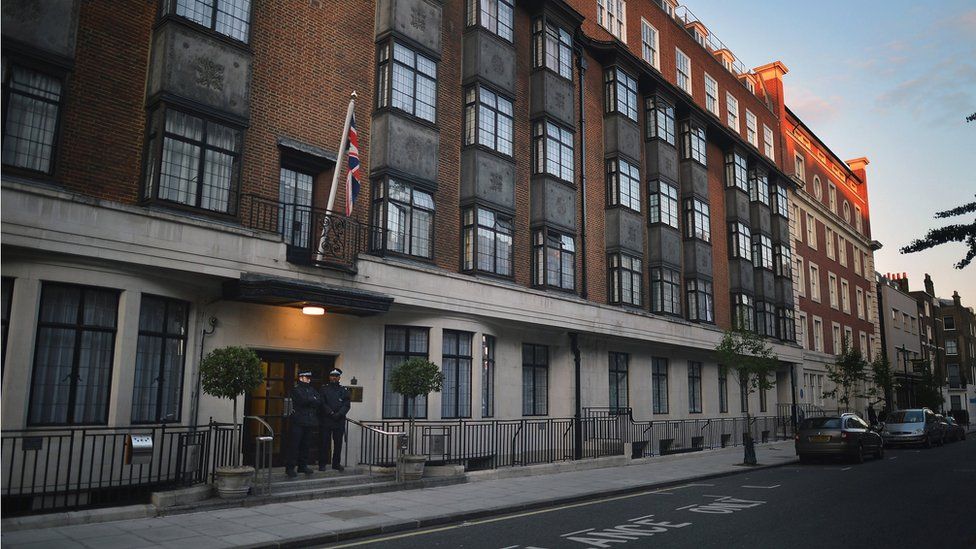
A Russian oligarch’s charity, which donated to a private hospital used by the Queen and the Royal Family, has had its bank accounts frozen.

The Charity Commission has launched an inquiry into charities connected to Viateschlav Kantor, a billionaire sanctioned by the UK over Ukraine.

Dr Kantor donated £9m to King Edward VII’s Hospital in London.

One of Prince Charles’s charities, The Prince’s Foundation, had also been promised £3m.

The Russian-born billionaire had been made a “life governor” of the private hospital in Marylebone, of which the Queen is patron.

But Dr Kantor has stepped down from that role and as a trustee of the hospital, which is known for its links to royalty.

Assets frozen

The Edward VII recently opened the “Kantor Medical Centre”, a new wing built with Dr Kantor’s support, but in the wake of the sanctions, his name has been removed.


Donations were paid through the Kantor Charitable Foundation, whose bank accounts have now been frozen by the charity regulator.

The King Edward VII’s private hospital is used by members of the Royal Family

A King Edward VII’s Hospital spokesman said: “In the light of the difficult position [Dr Kantor] now finds himself in, he has decided to step back completely from all charitable activity in the UK.”

The spokesman said the action was “out of respect for the important and valuable work of the many charities he has supported” and that Dr Kantor had agreed that his name would no longer be attached to these projects.

Charles’s charity

Dr Kantor’s charity also made donations to The Prince’s Foundation, an education and training charity set up by the Prince of Wales.

Charity records show £600,000 was paid to the foundation over two years, as part of a pledge for £3m, intended to be paid in stages until 2028.

Dr Kantor’s charity remains listed as a patron of the foundation.

The Prince’s Foundation says it won’t comment on individual donations, but it is understood that donors would have been subject to a process of due diligence, based on what was known at the time.

Among other causes supported by the sanctioned oligarch are the Thrombosis Research Institute, the Royal Society of Medicine, the Anna Freud Centre and the Royal Opera House.

The Charity Commission inquiry will decide whether charities linked to Dr Kantor – which also include the Kantor Foundation and the World Holocaust Forum Foundation – can continue to operate.

“We are committed to protecting the integrity of the charitable sector and are clear that an individual sanctioned in the UK cannot act as a trustee,” said Tim Hopkins, Charity Commission assistant director.

Earlier this month Dr Kantor was added to the list of oligarchs facing UK government sanctions over the Russian invasion of Ukraine.

Dr Kantor was described by the UK government as the “largest shareholder of fertiliser company Acron, with vital strategic significance for the Russian government”.

Foreign Secretary Liz Truss said when announcing the further sanctions: “We are showing the Russian elite that they cannot wash their hands of the atrocities committed on Putin’s orders.”

A 2020 report on Russian influence, by Parliament’s Intelligence and Security Committee, had warned of UK charities being “willing beneficiaries of Russian money” and enabling a “reputation-laundering process”.

More than a quarter of households in Scotland have yet to complete the national census, new figures reveal.

Two million households filled in their survey responses, but an estimated 700,000 have still to submit them.

Census letters were sent to 2.7million homes, representing 5.5million people

National Records of Scotland, which manages the 10-year survey, said anyone who failed to submit a response by 1 May could face prosecution – with a possible fine of up to £1,000.

In 2011, the last time the census took place, 95% of households replied.

But with a week to go until the deadline, the response rate is sitting at 74%.

Sunday 20 March was Scotland’s official Census Day. Householders were asked to answer questions for every person in the property relating to that day.

National Records of Scotland (NRS) said the information helps the government plan and fund services like transport, education and healthcare.

Households had the option to complete their census online, or to request a paper questionnaire and post it back.

NRS previously issued an appeal on 5 April, when more than a million households had still to complete a census.


The census gives an insight into jobs, relationships and the ethnic make-up of Scotland

Reminder letters were sent to every household in the country and field staff visited door-to-door.

Only about 300,000 further responses have been received since.

Scotland’s constitution secretary, Angus Robertson MSP, said it was essential for every household to complete the census as it was a “legal responsibility”.

He said: “I would ask everyone who has not submitted their census return to do so now. The information gathered is vital in shaping important services.

“We know that there are people who have begun the census online but haven’t completed it, and that others have requested a paper copy but haven’t yet returned it.

Covid pandemic

NRS chief executive, Paul Lowe, added: “Thank you to the two million households who have already submitted their response.

“For anyone that still hasn’t, help and support to complete your census is available on our website via our free helpline.

“Paper forms are still available on request for those who need them.”

A census has been taken every 10 years in Scotland since 1801, apart from in 1941 during the Second World War, and in 2021 due to the Covid pandemic.

Topics included household relationships, health, type of accommodation, age, and employment.

New questions in this year’s census included the use of British Sign Language, passports held, sexual orientation and trangender status.

England, Wales and Northern Ireland held their survey in March 2021. Anyone who has moved from another part of the United Kingdom to Scotland still has to complete the form.

The main Arran ferry is out of action again, putting Calmac’s ageing fleet in the spotlight. Is Scotland’s west coast ferry network fit for purpose?

Most islands in the west of Scotland rely on services from state-owned Caledonian MacBrayne, which operates 34 vessels – the largest fleet in the UK.

But the fleet has a problem – the pace of renewal has been slow and the ageing boats are developing more faults, leading to delays and cancellations.

How old is the CalMac ferry fleet?

The average age of the CalMac ferries is almost 24 years and many of the large boats are even older.

Of the 10 largest ferries, four are more than 30 years old and the MV Isle of Arran is 39.

The MV Caledonian Isles, which is 29 years old, is out of service until early May with engine failure. This is causing major problems for Arran, CalMac’s busiest ferry route, just when businesses were hoping to see some kind of bounce-back after Covid.

On Thursday, there were also technical issues with the MV Clansman’s bow thruster, used for manoeuvring, with the MV Isle of Mull operating the service instead. The same boat was recently found to have widespread deck corrosion.

Even the newer ships have had breakdowns – CalMac’s biggest ship MV Loch Seaforth, built in 2014, was out of action for weeks last year due to engine damage, with knock-on effects hitting many other services.

An investigation found a failure to replace piston screws during scheduled maintenance may have been to blame.

CalMac says its maintenance budget has risen by 67% over the past five years, with a projected spend of £34.2m in 2022.

A spokeswoman for CalMac added: “A long-term strategy to replace vessels and improve port infrastructure would improve the capacity we can offer to meet demand and increase resilience.

“Significant investments are being progressed by the Scottish government and its partners.”

Why have the ferries not been replaced?


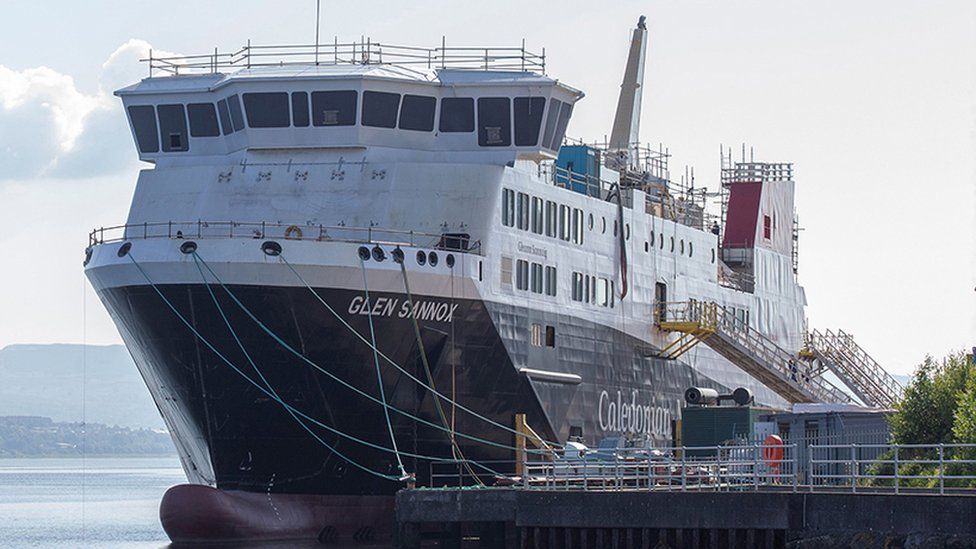
The Glen Sannox’s construction at Ferguson’s shipyard has been troubled

The Scottish government’s Transport Scotland agency has long known it needs to renew the CalMac fleet – but those ambitions have foundered, in part at least, due to the Ferguson ferry fiasco.

Back in 2012, a ferries plan included a programme of vessel replacement.

Two years later tenders went out for two new large ships – one for the Arran route and the other destined for the “Uig triangle”, serving Skye, North Uist and Harris.

More than seven years later those ships, Glen Sannox and the as yet un-named hull 802, are still under construction at the now-nationalised Ferguson shipyard in Port Glasgow.

The cost to the public purse has risen to 2.5 times the original £97m budget – and the first ship won’t be handed over to CalMac until the spring of 2023 at the earliest, nearly five years late.


An impression of one of new ferries being built for the Islay route

A £105m order for the next two big ships – for the Islay route – has now been signed with a Turkish shipyard and, if all goes to plan, they should be delivered in 2024/2025.

The new ships will replace 37-year-old MV Hebridean Isles and allow the 11-year-old MV Finlaggan, to be redeployed.

Next on the shopping list is a replacement for 33-year-old MV Lord of the Isles, which operates between Mallaig and South Uist – but that’s at an early stage and a new ship could be several years away.

A replacement programme for seven smaller vessels has begun, and is currently at the “concept design” phase.

Last year the Scottish government promised £580m of investment in Scotland’s ferry network over the next five years – about half of it for new ships – but some claim, given the scale of the problem, that’s nowhere near enough.

What are the ferries of the future?


Privately-run Pentland Ferries has successfully used catamarans to and from Orkney for years

While few dispute the need for new ferries, there is far less consensus on what type of vessels should be purchased.

CalMac and CMAL, another government agency which owns the ships and harbours, have a reputation for choosing a certain type of vessel – large, sophisticated mono-hulled ships with capacity for the crew to sleep on board.

Some island communities have suggested they would be better served by a greater number of smaller vessels, and that shore-based crews could boost their economies.

Others have urged CMAL to consider using catamarans, arguing they require smaller engines yet can carry similar numbers of vehicles at a substantially lower cost.

Privately-run Pentland Ferries has successfully used such ships to and from Orkney for years, and has recently replaced MV Pentalina with a new catamaran.

The Mull and Iona Ferry Committee has urged Transport Scotland to buy MV Pentalina. This has been rejected, although leasing the ship as a temporary measure remains a possibility.

CMAL’s argument is that it needs to build long-lifespan “quality” ships, interchangeable between routes and capable of withstanding often harsh conditions. Having ship-based crews, it says, provides more robust staffing.

And it insists it remains on the lookout for suitable second hand boats. One such vessel, a medium-sized Norwegian ferry now renamed MV Loch Frisa, is due to enter service on the Craignure to Oban route in June.

What about climate change?


In Denmark, fully-electric ferries are already sailing but only on relatively short routes

One of the dilemmas facing Scotland’s ferry network is that it needs to commit to new ships now that could be in service for decades – yet it is still unclear which future technology will win out.

In Denmark, fully-electric ferries are already sailing but only on relatively short routes. A Norwegian ferry operator has taken delivery of a boat powered by liquid hydrogen – but this is still prototype technology.

The troubled ships being still being built at Port Glasgow were meant to be “green ferries”, using dual-fuel diesel and liquified natural gas (LNG) engines.

But those “green” claims are questionable – LNG is still a fossil fuel, and it has to be imported from Qatar before being driven hundreds of miles from Kent to Scotland.

For the new Islay ferries, CMAL has ditched LNG in favour of mainly diesel ships with “fuel efficient hulls” and some electric power options while manoeuvring in port.

Why are the ferries so full?


Islands like Iona are seeing visitor numbers pick up again

The introduction of heavily-subsidised road equivalent tariffs – aligning fares with the cost of road travel – has increased ferry traffic over the past decade, with 5.7m passengers and nearly 1.5m vehicles being carried in 2019 before the pandemic.

The past two years have seen a significant drop in numbers due to Covid restrictions but the ferry network is once again struggling to cope.

The boost in numbers is good news for the islands in many ways but locals often complain of trouble getting a booking.

Residents on Mull have urged Transport Minister Jenny Gilruth to consider a system used for the Danish island of Samso where are proportion of spaces are held back for locals, based on evidence of demand.

A new ferries plan is being promised by the Scottish government by the end of this year. Ministers are also currently considering Project Neptune – a review by consultants looking at the roles of Transport Scotland, CalMac and CMAL – to try to make the system work better.

But like the metaphor about the time it takes to turn a tanker around, the problems facing CalMac’s fleet are going to take a long time to fix.

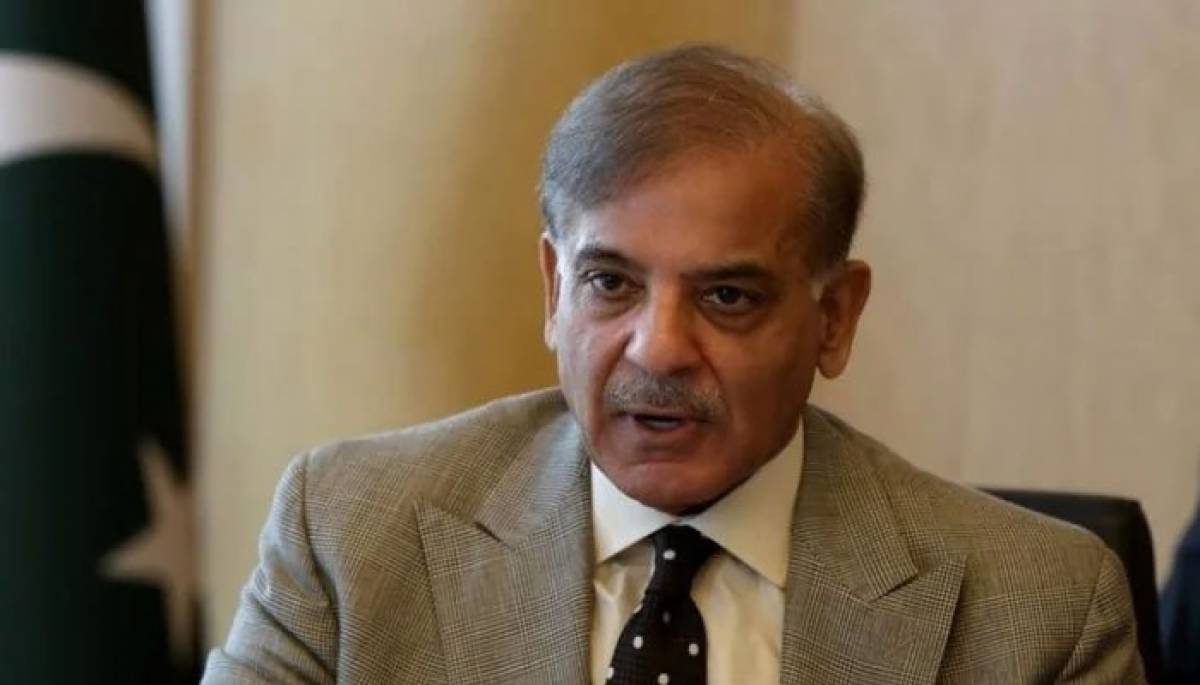
PM Shehbaz Sharif chairs NSC meeting to discuss ‘threat letter’: sources

ISLAMABAD: The National Security Committee (NSC) meeting on Friday started with Prime Minister Shehbaz Sharif in the chair to discuss the alleged ‘threat letter’, sources told Geo News Friday.

The meeting is being attended by the the services chiefs and federal ministers.

Sources privy to the matter said that former Pakistani ambassador to Washington Dr Asad Majeed Khan will brief the NSC today over his diplomatic cable that carried the alleged threat sent to the PTI government last month by US officials.

The Pakistani diplomat, sources said, has reached Islamabad and will attend the NSC meeting convened by Prime Minister Shehbaz Sharif at PM Office to discuss the “threat letter”.

Former premier Imran Khan, who was voted out through a no-confidence motion, brandished a “threat letter” on March 27 at a public gathering before his ouster claiming that his government had been threatened by the US and the Opposition was involved in the conspiracy.

The PTI has claimed that the Imran Khan government was toppled because of the independent foreign policy and most recently due to the PM’s Russian visit.


Not only this, DG ISPR Major General Babar Iftikhar had also rejected the perception of a foreign conspiracy behind the no-trust motion.

Addressing a press conference on April 14, the military spokesperson had clarified that the word “conspiracy” was not used in the statement issued after a meeting of the NSC last month.

The military’s spokesperson had said he cannot discuss what was discussed in the meeting, but noted that the word “conspiracy” was not used.

The NSC meeting was called on March 31 by former prime minister Imran Khan to discuss the matter. All the services chiefs and DG ISI had also attended the huddle.

PM Shehbaz, soon after taking becoming the prime minister, had also said that the government will summon a meeting of the Parliament’s National Security Committee where the military leadership will brief the lawmakers.