
The transport secretary has said energy will not be rationed in the UK, despite pressure on supplies globally.

Grant Shapps ruled this out after Labour’s shadow business secretary suggested ministers might need to prepare for rationing.

Some European countries have moved towards rationing as energy costs rise and supplies tighten.

Mr Shapps told the BBC the energy strategy would be announced later this week.

Plans to expand nuclear and wind power are expected to form part of the strategy, which has been delayed amid cost concerns.

When pressed on whether he can completely rule out energy rationing, he told the BBC’s Sunday Morning programme: “Yes, I can. It’s not the route that we want to go down.”

He was responding to Labour’s shadow business secretary Jonathan Reynolds who told the programme: “The government should be preparing, not necessarily in public for that situation.”

But Mr Reynolds later told Times Radio the UK should be not be rationing energy right now.

Wind power debate

As Mr Shapps ruled out rationing, he said wind farms were an “immense invisible national resource” that could be exploited more and that it was better to build significant wind power offshore.

While he said there may be occasions where onshore wind farms made sense, he added: “I don’t think we want to cover every inch of land in onshore wind farms.”

In turn offshore wind “performs better because it tends to be windier” and can be built “much, much bigger”, he said.

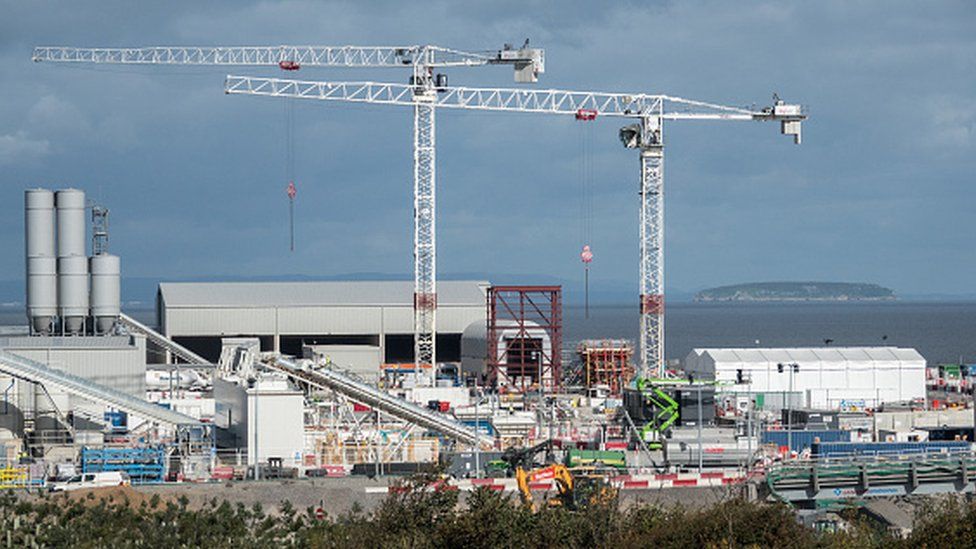
The government is looking to increase the amount of energy generated by nuclear power

He made the comments after he told Sky News that he did not favour “a vast increase in onshore wind farms”, calling them an “eyesore for communities”.

Sources have told the BBC onshore wind will feature in the government’s energy strategy, despite some opposition within the cabinet.
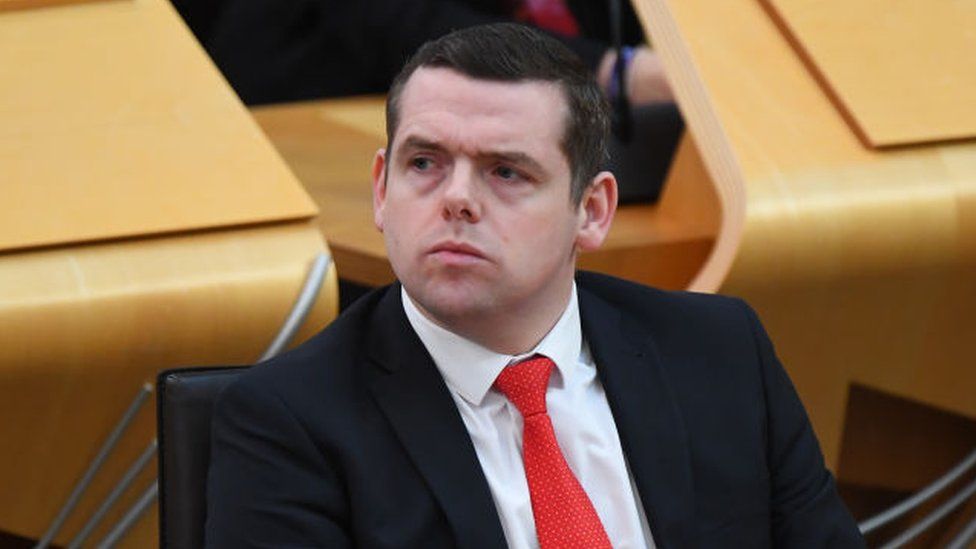
Scottish Conservative leader Douglas Ross is isolating after testing positive for Covid-19.

The MP and MSP said he had to cancel this week’s campaign events for the upcoming local elections.

Several members of the government cabinet including Deputy First Minister John Swinney are also in isolation, although Holyrood is in recess.

Infection rates remain high, with one in 12 people in Scotland estimated to have had the virus last week.

This prompted First Minister Nicola Sturgeon to delay the lifting of face mask rules for shops and public transport until 18 April, although some changes for places of worship went ahead on Monday.

Mr Ross had urged Ms Sturgeon to “leave it up to people and businesses to decide what is best for them, based on public health advice”.

On Monday, he confirmed he had tested positive for the virus, and said he was “looking forward to getting back out on the campaign trail soon”.

Police have issued fines to some people who attended an event in Downing Street on the eve of Prince Philip’s funeral, sources have told the Us

The gathering on 16 April 2021 was a leaving party for the former No 10 director of communications James Slack.

Prime Minister Boris Johnson did not attend the event and has so far not been issued with a fine.

The Metropolitan Police’s investigation of 12 events held across government began in January.

It was launched after an internal inquiry by senior civil servant Sue Gray passed information to the force.

Sources have confirmed to the BBC fixed penalty notices had been sent by email in recent days, as part of the first batch of 20 fines issued by police.

The BBC has seen the content of the emails. They say the police believe there are reasonable grounds that an offence was committed in contravention of Covid regulations.

The identity of recipients will not be revealed by the police unless they challenge the fine in court.

Two parties were held by Downing Street staff at No 10, the night before Prince Philip’s funeral. Mr Johnson was not at either of them, but has apologised.

One of the events was a leaving party for the PM’s then director of communications Mr Slack, who has also apologised.

Critics contrasted the behaviour of No 10 staff with pictures of the Queen sitting alone at her husband’s funeral, held under Covid restrictions.

Meanwhile, Monday’s Daily Telegraph claims the former director of ethics in the cabinet office, Helen MacNamara, was fined in connection with a leaving party the year before – in June 2020.

At various stages during the pandemic, the government imposed legally enforceable rules – including restrictions on social gatherings – to stop Covid from spreading.

The rules had been eased in England on 12 April 2021, but working from home continued to be recommended and socialising indoors with people from other households was not allowed. Meeting others outdoors was limited to groups of six people or two households.

The Met Police investigation, called Operation Hillman, is examining 12 gatherings on eight dates to see if Covid regulations were broken.

The prime minister is known to have attended at least three of the gatherings:


The police probe was launched after a separate inquiry was undertaken by senior civil servant Sue Gray.

In her separate, initial report, Ms Gray criticised “failures of leadership and judgement” over the gatherings, between May 2020 and April 2021.

An updated version of her report will be published in full, once the police have finished theirs, the prime minister has said.

Of the 16 gatherings listed in her initial findings, the police are looking at 12.

Labour leader Sir Keir Starmer has called for senior people who have been fined to be named.

On Sunday night, Conservative MP Steve Brine told the BBC there should be more transparency in the fines process.

He said it otherwise risked becoming a distraction from upcoming local elections, telling Radio 4’s Westminster Hour: “They should just be honest about who’s been tipped off with what and put it all out there and say, you know what, we got this wrong, or this person’s got this fine.”

Despite tensions, US wants Pakistan to play its role in Afghanistan

On March 31, both Pakistan and the United States participated in yet another meeting of the so-called Extended Troika for Afghan­istan, which also includes Russia and China.

All four countries sent their special envoys for Afghanistan to the ancient Chinese city of Tunxi which also hosted the foreign ministers of China, Russia, Pakistan, Iran, Tajikistan, Turkmenistan and Uzbekistan for another meeting.

After the troika meeting, a spokesperson for the Chinese Ministry for Foreign Affairs, Wang Wenbin, noted that “China, the US, Russia and Pakistan are all countries with significant influence on the Afghan issue,” a key point that also echoed at a US State Department’s latest news briefing.

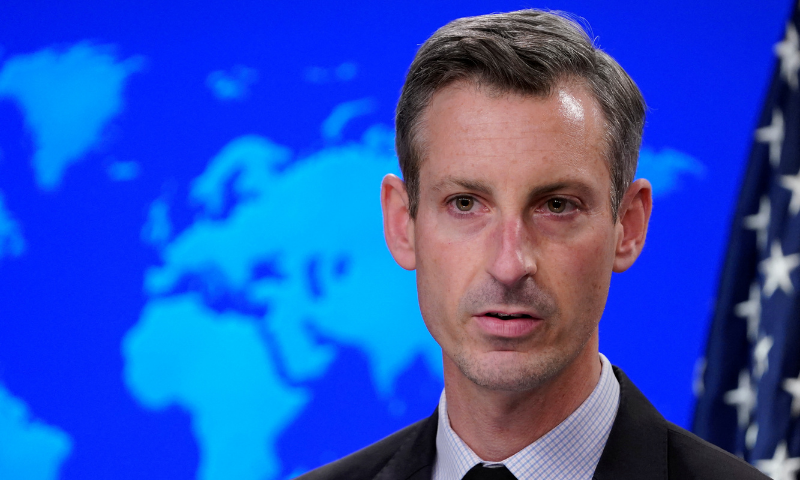
“These are countries that have a good degree of leverage with the Taliban, and the ‘Extended Troika’ has, in the past, been a constructive forum, and it is critical that the international community remain united in its approach to Afghanistan,” State Department spokesperson Ned Price said.

“It is especially critical with countries that have a good deal of leverage with the Taliban. The United States would be included in that, Russia would be included in that, the People’s Republic of China would be included in that, and Pakistan would be included in that.”

The US official said that it was “incumbent on all of these countries to use that leverage to push the Taliban in the right direction.”

Mr Price said that US interests in Afghanistan “are aligned with the members of the troika,” that includes Pakistan, which has the longest border with Afghanistan and policy makers in Washington believe that Islamabad still has enough leverage on the Taliban to influence their policymaking.

Mr Price also explained how the members of this Extended Troika should use their influence, highlighting two key issues that Washington has been pushing for since August last year when the Taliban captured Kabul: “Seeing girls return to secondary schools and encouraging inclusive governance.”

“We want to see to it that those are messages the Taliban received not only from us, not only from our European partners, with whom we’re coordinating closely on Afghan­istan and engagement with the Taliban, but also from a broader collection of countries, and certainly those countries that do have a good deal of leverage,” Mr Price added.

Acknowledging Pakistan’s role in Afghanistan indicates that Washington still wants to engage with Islamabad on issues where Pakistan can be a useful facilitator.

But diplomatic observers in the US capital no longer see a desire in Washington to revive once-close partnership with the South Asian nation.

Pakistan-US relations have been tense since 2011, when Americans found and took out Osama bin Laden in Abbottabad without informing Islamabad. But the discovery of an alleged letter, explicitly expressing US displeasure with the policies of the PTI government has further eroded the US desire to rebuild ties with Pakistan.

Although the alleged letter, which Wash­ing­ton says it never wrote or sent, says that the relationship could be restored if the PTI government is removed, diplomatic observers do not see that happening anytime soon.

Paris: Macron holds first rally as French election race tightens

The centrist Macron threw his hat into the election ring at the last moment and has been distracted by the war in Ukraine, conducting diplomacy from the Elysee while Le Pen paces the country to discuss basic issues, including purchasing power.

With the first round of elections on April 10 — followed by a run-off on April 24 — polls have shown Le Pen comfortably in second place in the initial stage and narrowing the gap on Macron for round two.

Macron’s rally at the indoor La Defense Arena stadium — a vast venue that usually hosts top-level rugby and rock concerts — represents a pivotal chance for the president to regain momentum.

“Of course Marine Le Pen can win,” Macron’s former prime minister Edouard Philippe warned in an interview with the Le Parisien daily posted online Thursday.

Philippe, who is backing Macron, added that “if she wins, believe me, things will be seriously different for the country… Her programme is dangerous.”

The latest Elabe poll published on Wednesday showed Le Pen winning 47.5 percent of the vote in a second-round run-off against Macron, who was projected to garner 52.5 percent, a smaller margin than in the same poll last week.

Le Pen, who lost to Macron in the 2017 polls run-off, has sought to moderate her image in the last half decade in a process helped by the emergence of Eric Zemmour as a fellow candidate in the far-right.

While Zemmour risks taking votes from Le Pen in the first round, his more radical stances in immigration and Islam have helped her project a more mainstream image.

“We feel it on the ground, there is a great dynamic, a hope that is emerging as the campaign nears it end,” she said on a visit to eastern France.

“What people said was the automatic re-election of Emmanuel Macron turned out to be fake news. It is perfectly possible to defeat Emmanuel Macron and radically change the politics of this country,” she added.

But the first round risks being a disaster for The Republicans — the traditional right-wing party that was the political home of ex-presidents such as Nicolas Sarkozy and Jacques Chirac.

Their candidate Valerie Pecresse is projected by most polls to be vying with Zemmour for fourth place after failing to find momentum in the campaign.

Her big chance to ignite her bid will be at a rally in southern Paris. But the Le Parisien daily reported that Sarkozy — whose support is still coveted by the right despite criminal convictions — would be staying away in a major snub to her campaign.

The Socialist candidate, Paris mayor Anne Hidalgo, is struggling to reach beyond low single figures while the Greens hopeful Yannick Jadot has failed to put the environment at the centre stage of the campaign.

The left’s main hope is the far-left candidate Jean-Luc Melenchon who most polls project coming in third place but believes he has a chance of making a run-off.

Melenchon, one of the most explosive orators in French politics, will address an open air meeting in

Place de Capitole in centre of the southern French city of Toulouse on Sunday.

NEW DELHI: India and Nepal restored passenger rail services between them on Saturday, as Kathmandu is increasingly wooed by China.

Nepal has traditionally done a balancing act between New Delhi and Beijing, but analysts believe Indian influence over Kathmandu has been dwindling as China pours heavy investment into the landlocked Himalayan country.

But Nepalese prime minister Sher Bahadur Deuba made India his first foreign destination since he returned to power last year.

As part of a three-day visit, he met his Indian counterpart Narendra Modi on Saturday and they virtually flagged off a passenger train connecting the eastern Indian state of Bihar with Nepal.

It is the first such rail link between the neighbours since services were halted for upgrades in 2014.

Both leaders agreed to prioritise trade and cross-border connectivity initiatives, Modi said.

“Such schemes will make a wonderful contribution for smooth, hassle-free exchange of people between the two countries,” he said.

The two countries also finalised agreements on the supply of petroleum products and released a joint vision statement on power sector cooperation.

Deuba’s journey south comes just days after Chinese foreign minister Wang Yi visited Nepal and India.

US helping China with cockpit recorder of jetliner that crashed

The China Eastern jetliner was flying between the cities of Kunming and Guangzhou on March 21 when it nosedived into a mountainside, disintegrating on impact and killing all 132 people on board.

The cause of the disaster, China’s deadliest plane crash in more than 30 years, is not yet known.

“NTSB investigators are assisting the Civil Aviation Administration of China with the download of the cockpit voice recorder from China Eastern Flight 5735 in our lab in Washington,” spokesman Peter Knudson said in an email. He declined to give any details of this work.

The other black box from the plane, the flight data recorder, has also been found, and it too could help solve the mystery of what went wrong. This recorder contains crucial information such as the speed of the aircraft, its altitude and heading. It was found March 23 and sent to Beijing for analysis.

While parts of this recorder were seriously damaged, the data storage unit appears relatively intact, Zhu Tao, director of safety at the Civil Aviation Administration of China (CAAC), told reporters last weekend.

The aircraft went down near Wuzhou in southern China after losing contact with air traffic control.

Tracking website FlightRadar24 showed the jet sharply dropped from an altitude of 29,100 to 7,850 feet (about 8,900 to 2,400 metres) in just over a minute. After a brief upswing, it dropped again to 3,225 feet, the tracker said. There is no data for the flight after 2:22pm.

The cockpit voice recorder will likely provide investigators with details of communications between the flight’s three pilots, which is one more than is normally required on board the Boeing plane.

Earlier on Friday, the NTSB said a team of three investigators had left for China to assist in the crash probe. The NTSB said “investigators will limit interactions with those outside of investigation similar to safety protocols at Beijing Olympics, which will allow them to begin work immediately without a quarantine.”

The team includes the US accredited representative Sathya Silva, who is an NTSB senior aviation accident investigator. An NTSB spokesman said the US team was traveling on a commercial flight. It was not clear if the team will travel to the crash site in China and for how the long team will be in China but it could be several weeks.

The NTSB also said a small team from Boeing is also traveling China to assist in the investigation.

CAAC News, a publication under the Chinese aviation regulator, said on Saturday that the NTSB group of seven investigators and technical advisers had arrived in China. Under an international agreement, the NTSB has the right to participate since the plane was designed and built in the United States.

On Thursday, Chinese state media said the cause of the crash must be determined as soon as possible, following a meeting of China’s highest decision-making body helmed by President Xi Jinping.

Information about the crash must be released in an open, timely and transparent manner, state media said in a report on the meeting of the seven-person Standing Committee of the Communist Party’s politburo, China’s top leadership.

Politicians react to PM Imran Khan’s ‘surprise’

Following the “surprise” by the PTI-led government, the Opposition parties leaders rejected the move, intending to challenge the matter in the Supreme Court.

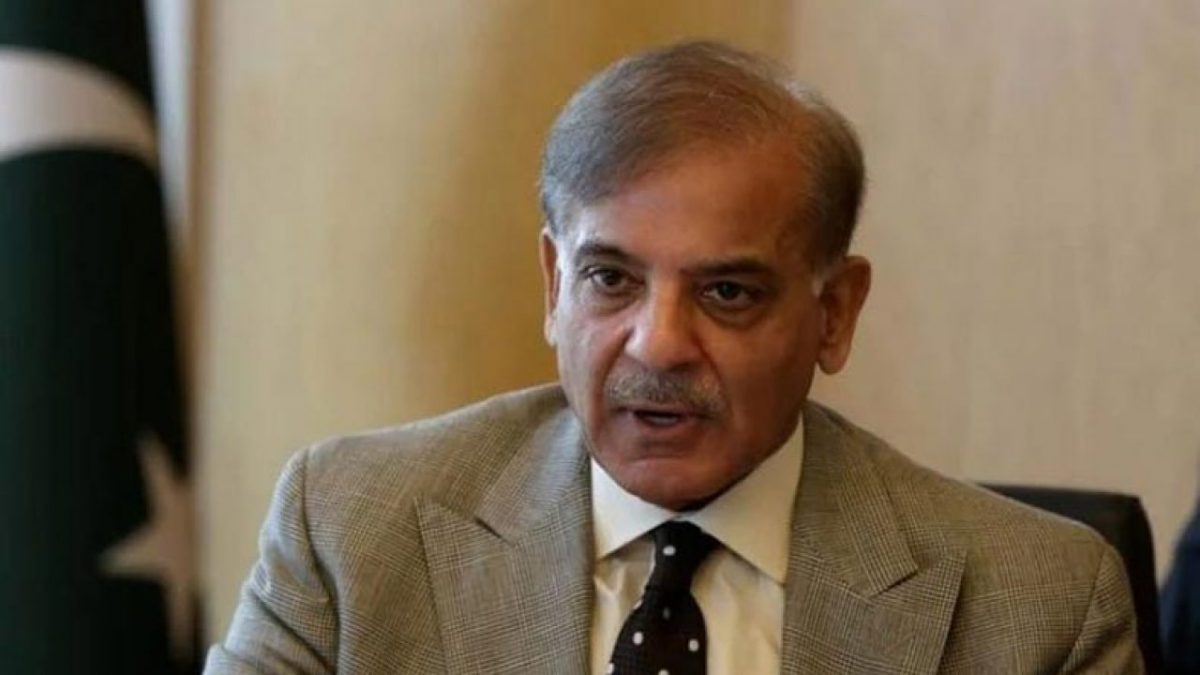
Reacting to the development, Leader of the Opposition in the NA Shahbaz Sharif declared PM Imran Khan a “traitor of democracy.”

He said that Article 5 that the government used to declare the no-trust motion “unconstitutional” says that the Constitution should be followed under any circumstances.

“Imran Niazi and his supporters openly violated the Constitution but they will be caught under Article 6 of the Constitution,” Shahbaz said.

Article 6 of the Constitution will apply to PM Imran Khan and the NA speaker, he added.

“Currently, there is no government in the country, instead it is occupied by a group of violators of the Constitution.”

Shahbaz went on to say that it was proved in the House that “Imran Niazi” lost.

“Imran Niazi has pushed the country in anarchy but the Chief Justice of Pakistan can save the country from going into crisis.”

He said that the Opposition will fulfill its Constitutional obligation to protect the country from Constitutional violation by taking the matter to the Supreme Court.

He hoped that the apex court will ensure the rule of law.

‘Constitutional manipulation’

Sharing his take on the situation, PPP Chairman Bilawal Bhutto-Zardari said that the joint Opposition has complete numbers not only that they had the majority.

“The ruling given by the deputy speaker is “unconstitutional” and has manipulated the laws of the Constitution,” he said, adding that according to the Constitution of Pakistan voting is to be held today.

Bilawal said that the punishment for breaking the Constitution is clear.

The politician said that the joint Opposition has decide to stage a sit-in in the National Assembly till our constitutional right is not given.

He said that the Opposition will go to the Supreme Court right now seeking a vote of no-confidence today.

“Prime minister cannot dissolve the assembly after the no-trust motion is submitted against them […] has to face the no-confidence.”

Meanwhile, members of the PM Imran Khan-led government also poured in some reactions.

Special Assistant to Prime Minister on Political Communication Shahbaz Gill said that the elections will be held through electronic voting machines (EVMs).

“Overseas Pakistanis will now be able to cast their vote in the election,” he said, adding that elections will not be held without the EVMs.

Congratulating the nation, he said that now the people will decide whether they support traitors or the captain.

Moreover, PTI leader Fayazul Hassan Chohan said that the entire country is celebrating at the moment.

“Decisions of honor and disgrace are made in the heavens,” Chauhan said.

He further stated that those who left the party at night came back to us in the morning.

“The disgruntled Jahangir Tareen group members will also return by April 6.

He said that the PTI government wants good links with United States, India, and European Union but doesn’t want to do anything by selling the country’s honour.

‘Treason case’ should be first registered against PM Imran Khan, says Shahbaz Sharif

ISLAMABAD: Hitting out at PM Imran Khan over his televised question and answer session with the nation, Opposition Leader in the National Assembly Shahbaz Sharif said that a “treason case” should be first registered against the premier.

“Treason case should be first registered against Imran Khan by not ending his [2014] sit-in Imran Khan harmed the nation’s pride,” said Shahbaz Sharif in a press conference immediately after PM’s address.

The PML-N president said that if politicians get involved in “treason and patriotism” then the matter will get out of hand. He added that if PM Imran Khan goes against the constitution and the law, then they will take their course.

Shahbaz’s statement on treason comes as PM Imran alleges that the no-confidence motion moved against him is a “foreign conspiracy”

“Imran Khan, instead of admitting defeat, is busy dividing the nation. He is refusing to follow the constitutional and legal path,” said Shahbaz. He claimed that the premier was directly taking on the Constitution

“He is inciting his supporters to sabotage the decision that will be taken in Parliament tomorrow,” said Shahbaz on PM Imran’s call for protests tomorrow ahead of the vote on the no-confidence motion.

The Opposition leader said that MNAs have the right to enter Parliament, adding that incitement to violence will be accounted for after being defeated in the no-confidence motion.

“I am hoping that the police and the administration will maintain law and order in view of the Supreme Court orders,” said Shahbaz.

Shahbaz defends “beggars cannot be choosers” comments

The Opposition leader also spoke about his “beggars cannot be choosers” comment on Pakistan. Shahbaz said that it was “not the first time” that he had made such a comment.

“We have been taking loans one after another and will have to break the shackles but breaking the shackles will not be easy,” said the PML-N president.

“I don’t care about Imran Khan’s nonsense. Nation’s independence doesn’t mean anything if it isn’t economically empowered,” said Shahbaz. He added that “freedom” is not possible without self-reliance.

The Opposition leader said that, so far, Pakistan has not become “economically independent”. He gave the examples of Germany and Japan saying that they were defeated in World War 2, but they reached their peak by working hard.

CJP takes sou motu notice of constitutional crisis in country

ISLAMABAD: The Supreme Court of Pakistan on Sunday took a sou motu notice of the political situation in the country.

Chief Justice of Pakistan Umar Ata Bandial reached the top court following the demand of the Opposition leaders to review the “unconstitutional” ruling given by National Assembly Deputy Speaker Qasim Suri.

According to reports, the judicial staff has started arriving at the Supreme Court.

The joint Opposition has prepared a petition to cancel the ruling of the deputy speakers under which the National Assembly session was adjourned for an indefinite period as Suri cancelled the voting on the no-confidence motion, terming it “unconstitutional”.