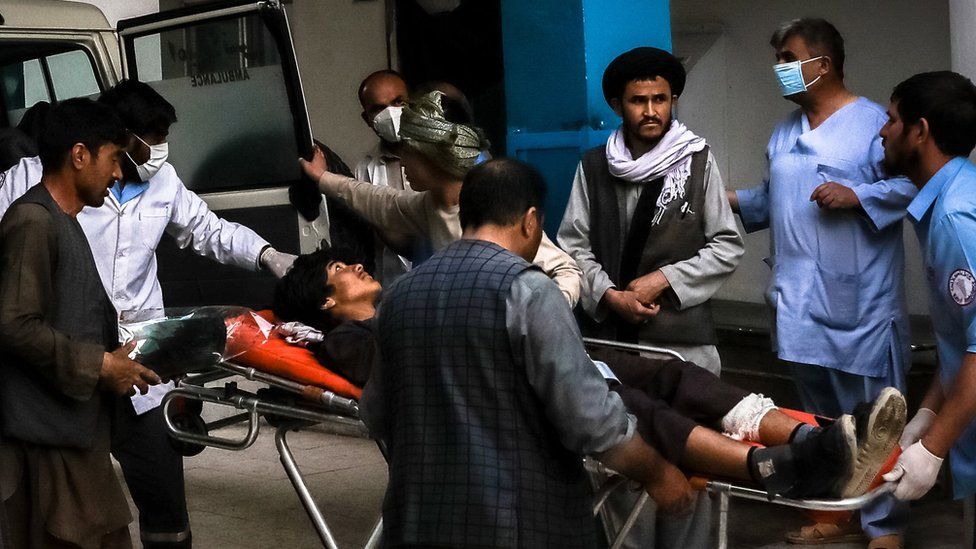
A suspected twin suicide bombing outside a boys’ school in the Afghan capital Kabul has killed at least four people and wounded many others.

The blasts happened at the Abdul Rahim Shahid high school in the Shia-dominated west of the city. The number of dead and wounded is likely to rise.

A nearby tuition centre was also targeted in a grenade attack.

There was no immediate claim of responsibility. Islamic State militants have attacked the area in the past.

Sources from Muhammad Ali Jinnah Hospital in Kabul told the BBC they had so far received four dead bodies and 19 injured people from the school attack.

Students were leaving morning classes when the blasts happened, one witness told the AFP news agency.


Photographs from the aftermath of the explosions show bloodstains on the ground alongside discarded notebooks.

The area in which the attacks took place – Dasht-e-Barchi – has frequently been the target of attacks by the local branch of the Islamic State group because of its largely Hazara Shia Muslim population.

The Taliban still face a major security challenge from Islamic State fighters

Hazaras are an ethnic and religious minority frequently targeted by Sunni militant groups, who view them as heretics.

Local sources also said a hand grenade had been thrown at a nearby tuition centre for students preparing for a university entrance exam.

After a spate of IS attacks last year following the Taliban takeover, the group’s activities had declined.

A girls’ school in the same part of the city was attacked last May (file photo)

IS has carried out a devastating campaign against Shias in Afghanistan over the last few years. Scores have been killed in bombings on targets including sports halls, cultural centres and places of education.

Last May, more than 90 students and staff were killed in an attack by IS on a girls’ school in Dasht-e-Barchi.

A federal judge in Florida has struck down the Biden administration’s mask mandate for airplanes and other forms of public transit, calling it unlawful.

US District Judge Kathryn Kimball Mizelle said the national public health agency had exceeded its legal powers in issuing the mandate.

The US transit authority said it would now no longer enforce mask wearing.

The US Centers for Disease Control and Prevention (CDC) just last week extended the mandate until 3 May.

Judge Mizelle is based in Florida, but federal judges can issue rulings that block nationwide government policies.

Her order on Monday effectively removes the masking requirement in all airports, trains, taxis and transit hubs.

White House press secretary Jen Psaki called the decision “disappointing” and noted that the CDC still recommends travellers cover their mouths and noses.

The CDC did not immediately respond to a request for comment to Monday’s ruling.

Last week US Surgeon General Vivek Murthy said the mandate had been extended into May because of rising Covid-19 cases.

The lawsuit was first brought in July 2021 by the conservative group Health Freedom Defense Fund (HFDF) and two Florida residents who said wearing masks increased their anxiety and panic attacks.

The plaintiffs argued that the CDC mandate was “arbitrary and capricious” because it gave exemptions to certain groups – like children under two years of age – but not to others.

In her ruling, Judge Mizelle, who was appointed by former President Donald Trump, found that the CDC had improperly invoked what is known as the “good cause exception”, allowing the agency to skip public notice and comment on the mandate.

“Because ‘our system does not permit agencies to act unlawfully even in pursuit of desirable ends,'” Judge Mizelle wrote, invoking another case, “the Court declares unlawful and vacates the Mask Mandate.”

Shortly after the legal decision was issued, the Transportation Security Administration – which runs US airport security – confirmed it would no longer enforce the mask mandate.

United Airlines, Delta Air Lines, Alaska Airlines and American Airlines said face coverings would no longer be required on domestic flights and certain international flights.

Since the CDC first issued a public health order in February 2021 requiring masks for travellers, more than 7,000 unruly passenger incidents have been reported – 70% of them involving masking rules, according to the Federal Aviation Administration.

The Biden administration’s Covid-19 mandates have had mixed success in the court system.

The Supreme Court in January blocked the White House from enforcing its sweeping vaccine-or-test rule for employees at large private companies.

But the Biden administration’s requirement that all federal employees be vaccinated against Covid-19 was upheld on appeal earlier this month.

Scotland’s former first minister Alex Salmond is to outline the local council election policies of his independence-backing Alba Party.

The focus of its manifesto launch in Dundee will be the cost of living crisis and how to “make life better for all households”.

More than 100 Alba candidates will stand for election on 5 May.

The party was formed ahead of last year’s Scottish Parliament election in which it did not win any seats.


Mr Salmond will set out plans to double the winter fuel payment for pensioners and explain its proposals to help households with fuel bills.

Speaking ahead of the launch, the former SNP leader said: “Scotland stands at a pivotal moment in its history.

“Council budgets are facing challenges, as never before, while one in four children live in poverty.

“Household incomes are under unprecedented financial pressure as families face a cost-of-living crisis which is squeezing household budgets to breaking point.

“One third of families are facing fuel poverty in our land of energy plenty.”

‘Real action on independence’

He continued: “The sex-based rights of women and girls are under concerted and increasing attack.

“Our manifesto will set out Alba’s specific pledges on how we can make life better for all households and for every community.

“However, the focus of this manifesto reflects three key themes: taking real action on independence as an urgent necessity; tackling the cost of living crisis; and standing up for women and girls.”

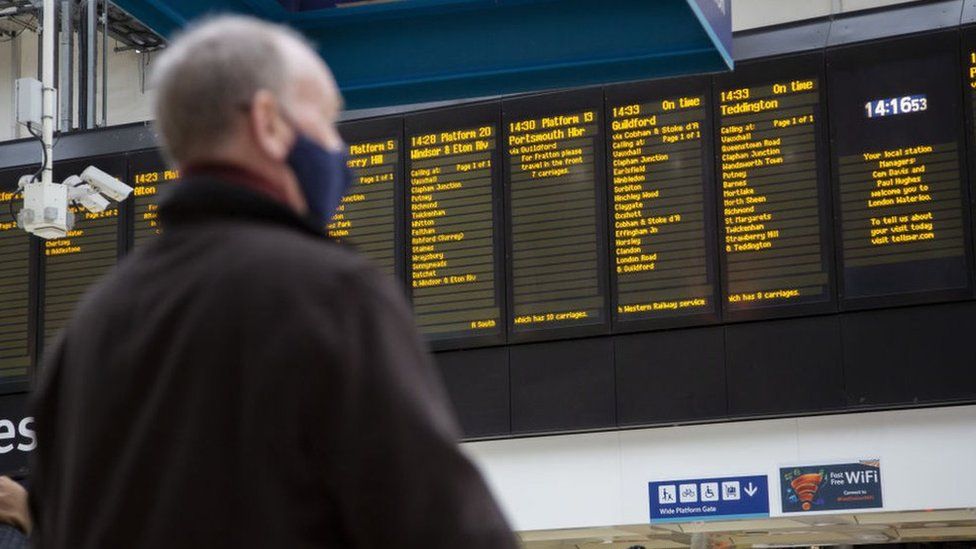
Transport campaigners have welcomed a temporary sale on train tickets across the UK, but argue that costs should be cut even further.

The government’s “Great British Rail Sale” will see off-peak prices slashed by as much as half, with cheaper travel on offer in April and May.

But the Campaign for Better Transport said wider price increases are “driving people off the railway”.

Passenger numbers on trains have not yet returned to pre-pandemic levels.

About 285 million rail passenger journeys were made in Britain in the last three months of 2021 – just 62% of the levels seen before coronavirus struck, according to the Office of Rail and Road.

Transport Secretary Grant Shapps said more than one million train tickets would be reduced this spring.

The Department for Transport (DfT) is hoping the move will help struggling households to afford trips across the UK and boost the domestic tourism industry.

It comes after the highest train fare rises for nine years came into force for rail travellers in England and Wales last month.

The sale is expected to bring some Manchester to Newcastle journeys down to a little over £10, while seats on some London to Edinburgh services will be slashed from £44 to £22.

Discounted tickets will go on sale from Tuesday, with passengers eligible to travel for less on off-peak fares between 25 April and 27 May.

Jacqueline Starr, chief executive of the Rail Delivery Group, also said: “We want everyone to be able to benefit from travelling by train because it’s more than just a journey, it’s a way to connect everyone to the people, places and things they love.”

‘Little respite for passengers’

The Campaign for Better Transport, however, said that it had been pushing for action to improve passenger levels for months.

It welcomed the move by the government, but Norman Baker, its chief executive’s adviser and former transport minister said: “It can show the Treasury that the way to increase income is to cut fares, not keep ratcheting them up and driving people off the railway.”

“This initiative, though very welcome, is but a first step,” he added, calling for an end to annual fare rises and a review of tickets and travel patterns following the rise of hybrid working during the pandemic.

DfT said reforms to the rail sector through the so-called “Williams-Shapps” plan for rail will mean that network-wide sales of tickets should be able to take place more easily in the future.

But Shadow Transport Secretary Louise Haigh said that in the meantime, the temporary move would provide little respite “to passengers who had thousands taken out of their pockets from soaring fares since 2010.”

She pointed out: “And the decision to end the sale just before half-term will mean many families face the same punishing costs over the holidays.”

Regulated fares in England and Wales increased by up to 3.8% last month.

They cover around half of fares and include season tickets on most commuter routes and it marked the steepest increase since January 2013, according to figures from industry body the Rail Delivery Group.

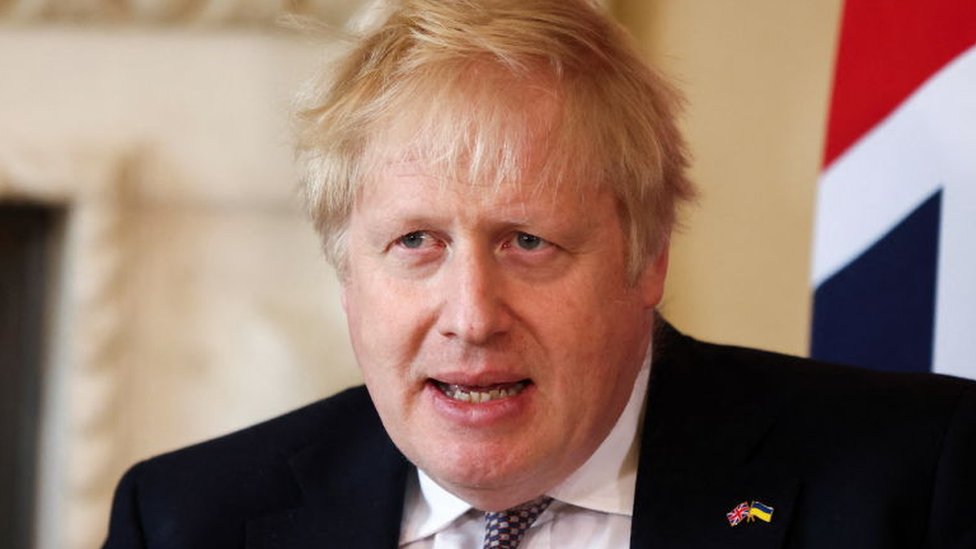
Boris Johnson is set to apologise for breaking his own lockdown laws when he makes his first statement to MPs since being fined by police.

The prime minister is expected to say he did not knowingly break the rules at a 2020 birthday party at No 10.

Opposition parties have accused him of lying to Parliament after he previously told them no rules had been broken.

Mr Johnson has vowed to “set the record straight” when he speaks to MPs at about 3.30pm.

But he is also expected to urge MPs to focus instead on issues such as rising prices and the war in Ukraine.

Speaking to ITV, Labour leader Sir Keir Starmer accused the PM of using the conflict in Ukraine as a “shield” to keep his job, adding that he finds such a tactic “pretty offensive”.

Sir Keir predicted: “He will try an try an apology, and he will immediately then go into excuses”.

Labour and the other opposition parties are exploring ways to hold the prime minister to account, such as a censure motion, effectively a slap on the wrist, or a vote of no confidence.

But shadow attorney general Emily Thornberry said a coup by Tory MPs was needed to remove the prime minister.

She told BBC Radio 4’s Today programme: “Whatever means we take, the difficulty we will always have is that, since the 2019 election, the Conservatives have an 80-seat majority when there is a vote.

“Unless Conservative MPs can look at their consciences and vote the right way, we are not going to get the sort of result that we should get.”

Commons Speaker Sir Lindsay Hoyle is expected to decide around lunchtime what vote – if any – should take place on measures against the prime minister.

Mr Johnson became the first serving UK prime minister to be sanctioned for breaking the law when, along with his wife Carrie and Chancellor Rishi Sunak, he was fined last week for attending the birthday event held for him in the Cabinet Room in June 2020.

The PM is facing accusations of lying to MPs because he initially told them Covid rules had been followed in No 10 after the first reports of parties emerged last year.

Under government rules, ministers are expected to resign for knowingly misleading MPs – and correct the record as soon as possible if they inadvertently tell Parliament something false.

Mr Johnson has since said it “did not occur” to him at the time of the gathering that it could be in contravention of Covid lockdown rules.

On Monday, Transport Secretary Grant Shapps said what happened was “wrong”, but argued Mr Johnson had not “knowingly” misled MPs.

Opposition parties strongly believe the prime minister deliberately misled parliament and are looking at various mechanisms to hold him to account.

Labour sources say options under consideration include forcing a vote on whether he misled Parliament, or referring him to a parliamentary committee to investigate.

There’s no suggestion the prime minister would lose any vote against him, but opposition parties are likely to strongly criticise any Tory MPs who may be forced to publicly defend his actions.

After fresh allegations in the Sunday Times that at a leaving drinks for his director of communications, Lee Cain, in November 2020 the prime minister poured drinks at the gathering Labour’s deputy leader Angela Rayner said – if the reports were true – then the prime minister had a “hand in instigating” at least one of the parties.

No 10 have not denied that this event took place, but have strongly denied that the prime minister instigated it.

However, there is concern among some Tory MPs that further fines or bad headlines could be yet to come.

Alongside staff leaving parties on 18 June 2020 and 16 April 2021, the June 2020 birthday event is among three so far known to have attracted fines.

Mr Johnson is known to have attended at least two further events of the 12 being investigated by police, meaning he could be fined again.

More than 70 Conservative MPs have expressed their support for the PM since he was fined, including some who have previously called for him to go.

Since Mr Johnson was fined last week, only a handful of Tory MPs have publicly said he should quit.

What has the PM told MPs about parties?

When asked whether there was a party in Downing Street on 18 December 2020, the PM told the Commons on 1 December 2021 that “all guidance was followed completely in No 10”.

After the publication of a video showing No 10 staff joking about the 18 December event, he told MPs on 8 December 2021 he had been “repeatedly assured” that “there was no party and that no Covid rules were broken”.

Later that day, he told the Commons he was “sure that whatever happened, the guidance was followed and the rules were followed at all times.”

On 12 January 2022, he apologised for attending a Downing Street garden party on 20 May 2020 but said he had “believed implicitly” it was a work event.

Pakistan urges international community to hold India accountable for targeted attacks on Muslims

Indian police had on Sunday arrested 14 people in connection with violent clashes between Hindus and Muslims during a Hindu religious procession in New Delhi. Six police officers and several others were injured on Saturday during scuffles that marred the procession at a festival in Jahangirpuri, a suburban section of New Delhi.

In recent weeks, religious clashes have broken out between the majority Hindu and minority Muslim communities during religious processions in several parts of the country.

Referring to a recent incident in Jahangirpuri, the FO pointed out that attempts to hoist the saffron flag at Delhi’s Jamia Masjid, derogatory sloganeering, playing of provocative music and the brandishing of weapons by a Hindu procession while Muslims were waiting to break their fast revealed the “gravity of the state-sanctioned hysteria and hatred in India against Muslims”.

“This incident has re-kindled the horrific memories of the Delhi pogrom of February 2020, which was aimed to discriminate, dispossess and dehumanise the Muslim community,” the FO said.

The FO also referred to the Ram Navami riots, which spread across many Indian states, saying that they spotlighted the country’s “precipitous slide … into a ‘Hindu Rashtra’”.

“Harrowing scenes of demolition of houses, businesses and shops belonging to Muslims and the vandalisation of mosques by local authorities in Madhya Pradesh and Gujarat reveal the deep penetration of Hindutva ideology into the fabric of Indian state and society.”

The statement said it was regrettable to note a rapidly increasing trend in India of using Hindu religious processions to fan communal hatred and instigate anti-Muslim violence.

“Even more alarming is the fact that the local authorities that were evidently complicit in the fear-mongering have launched a concerted campaign against the Muslims on the pretext of a crackdown against ‘alleged rioters’,” the FO added.

It said that Pakistan called upon the Indian government to transparently investigate the incidents of widespread violence and intimidation against Muslims and their places of worship and initiate demonstrable efforts to prevent the reoccurrence of such incidents.

Pakistan also called upon the international community, particularly the United Nations and relevant international human rights and humanitarian organisations to question India and hold it accountable for repeated violations of human rights in the country.

Courts work for 24 hours, CJP says after Imran Khan’s criticism

ISLAMABAD: Courts work for 24 hours, Chief Justice of Pakistan (CJP) Justice Umar Ata Bandial said Monday in response to former prime minister Imran Khan’s question on why the courts had to open at midnight on April 9 — the night he was ousted as the prime minister.

No one needs to point a finger at the courts, CJP Bandial said during the hearing on a presidential reference seeking interpretation of Article 63A of the Constitution of Pakistan.

The top judge said: “We don’t care about what is being said on social media; [we] are the protector of the Constitution”.

A five-member larger bench of the Supreme Court — headed by Justice Bandial and comprising Justice Muneeb Akhtar, Justice Aijazul Ahsan, Justice Mazhar Alam, and Justice Jamal Khan Mandokhel — had resumed hearing the reference on Monday.

During the hearing, the CJP Bandial said that the SC expects political leaders to defend judicial orders in public.

The remark came in response to former prime minister Imran Khan’s recent criticism of the courts.

The apex court was also hearing PTI Chairman and ex-premier Imran Khan’s plea seeking to declare dissident party members ineligible for life.

PTI’s lawyer Babar Awan requested the court issue notices to the respondents of the case.

At this, CJP Bandial asked Awan to present his case first, saying that the notices will be issued afterwards.

During the hearing, the Islamabad Advocate-General Niaz Ullah Khan Niazi contended that lifelong ineligibility should be awarded over defection.

He asked the court to rule early, keeping the situation in Punjab and Centre in view.

“Parliament hasn’t included lifelong disqualification in Article 63A,” Justice Mandokhel remarked, asking if Parliament deliberately avoided including the lifelong disqualification in Article 63A or by mistake.

Justice Mandokhel noted that half of the people would comply with the apex court’s order and half won’t as some of them favour lifelong disqualification and some are against it.

“Why do you want the SC to decide this when there is Parliament?” he asked.

At this, CJP Bandial remarked that his fellow judge’s stance is clear.

“Why should we announce the verdicts when 10-15 thousand people start criticising judicial orders […] why should the court take part in your political debates.”

“We expect political leaders to defend judicial orders in public,” CJP Bandial remarked, adding that protecting and ensuring the rule of law is the court’s responsibility.

In his arguments, Balochistan National Party-Mengal’s counsel Mustafa Ramday said that the president, in his reference, asked the court to rewrite the Constitution.

The government did nothing for the “audio and video” issue mentioned in the presidential reference, he added.

At this, the PTI’s lawyer said that two of their lawmakers had approached the ECP over the matter.

Ramday said that the Centre kept silent over the regime change in Balochistan, adding “you have seen whatever happened in Islamabad and Punjab.”

‘Constitution wants to end the culture of defection’

During the hearing, the CJP remarked: “It is our responsibility to uphold and protect the Constitution,” and declared that deviation from the Constitution was a violation.

The CJP said that the Constitution wants to end the culture of defection in politics. The top judge said that they have to see the results of constitutional violations and asked whether the violators of the Constitution be allowed to go unpunished or if they should be held accountable.

The advocate general Islamabad urged the top court that the defiant lawmakers should be disqualified for a lifetime.

At this, Justice Jamal Khan Mandokhel asked why you want the courts to do this when parliament is present?

Parliament did not include life disqualification in Article 63 (A), Justice Mandokhel said, and asked whether the House deliberately did this or it was a mistake?

Why should the court take part in the political discussion, asked the CJP.

He said the court expect the political leaders that they would defend their verdicts in public.

Meanwhile, the court adjourned the hearing till 1 pm tomorrow.

Earlier, at the outset of the hearing, the additional attorney-general maintained that the court was requested to adjourn the hearing till the appointment of a new attorney-general of Pakistan (AGP).

Khalid Javed Khan stepped down as the AGP on the night of former prime minister Imran Khan’s ouster through a vote of no confidence on April 9.

Responding to the AAG’s statement, CJP Bandial remarked that Khan had completed his arguments as the AGP while the political parties are yet to complete their arguments.

The new AGP can give the arguments at the end of the case if he wants, the judge added.

PML-Q to challenge Hamza Shahbaz’s election as Punjab CM

LAHORE: PML-Q has decided to challenge the election of PML-N’s Hamza Shahbaz as the Punjab chief minister.

The decision came during a meeting of the PML-Q and PTI’s parliamentary parties, with Chaudhry Parvez Elahi in the chair.

“A bogus, unconstitutional and controversial election was held on April 16,” Elahi said while addressing the meeting.

He said that the Punjab governor and advocate-general have declared the chief minister polls controversial and, therefore, it cannot be acknowledged till the situation gets clear.

“Deputy speaker Dost Mohammad Mazari held the election in the gallery, which has no constitutional value. Anyone with a megaphone can hold polls in the guests’ gallery,” he said.

“They can find a fake governor and take a fake oath the way they held a fake election,” Elahi said.

He informed the meeting that the party has summoned a meeting of constitutional experts in which the strategy to challenge the election of chief minister will be prepared.

He said that the courts were attacked in the past and now the Punjab Assembly has been ambushed.

“Whatever happened has never happened in the history of the Punjab Assembly. The police came as if they were raiding robbers,” the politician added.

He alleged that all of it was supervised by Hamza with the target to push PML-Q and PTI workers out of the assembly.

PML-N leader Hamza Shahbaz elected chief minister Punjab

Hamza was elected as chief minister Punjab on Saturday in a ruckus marred session of the Punjab Assembly.

Ahead of the vote, three PTI members of the Punjab Assembly were arrested for attacking Deputy Speaker Dost Mohammad Mazari as the party boycotted the session to elect the new chief minister.

Hamza was elected as the new chief minister with 197 votes. While his rival Pervez Elahi did not receive any votes as his party and PTI had boycotted the polls.

Hamza is the third member of his family to be elected as chief minister of Punjab. Earlier, his father Shehbaz Sharif, who is now the PM, and his uncle former prime minister Nawaz Sharif had also held the post.

PML-N’s Khawaja Asif, JUI-F chief Fazl call on govt to hold early elections

ISLAMABAD: JUI-F chief Maulana Fazlur Rehman and the ruling PML-N stalwart Khawaja Muhammad Asif have called on the coalition government for holding early elections in the country.

Addressing the National Assembly session today, PML-N’s senior leader Khawaja Muhammad Asif urged the government to hold the general elections in the country as soon as possible.

“In my personal opinion, we should go to the people as soon as possible and take a new mandate,” Asif said while speaking on the floor of the lower house.

Criticising the past government over its alleged incompetency and corruption, he said Imran Khan brought the country to the brink of bankruptcy.

Asif maintained that their coalition government is faced with the gigantic task of price hikes, and added that time and peace are required to deal with such challenges.

He said the coalition government is cognizant of the grievances of the people of Balochistan and wants to address them.

A day earlier, Maulana Fazlur Rehman had said that the maximum tenure of the new government is one year. Demanding immediate elections, Fazl said that JUI-F has its own identity and narrative within the collation government.

Addressing an event, he said the allied parties have toppled the PTI-led government, adding that now it is their responsibility to give back to the nation what they promised and struggled for.

Underscoring the need for necessary electoral reforms, the JUI-F leader said that unnecessary delay in elections is not the narrative of his party.

Beleaguered Sri Lankan President Gotabaya Rajapaksa has appointed a new cabinet despite calls for him to resign over a disastrous economic crisis.

The 17 new ministers named did not include several relatives who had previously held portfolios, although a number of stalwarts kept their seats.

He had called on the opposition to join a unity government but they refused.

The island nation is grappling with its worst economic crisis since independence from Britain in 1948.

It is caused in part by a lack of foreign currency, which has meant that Sri Lanka cannot afford to pay for imports of staple foods and fuel, leading to acute shortages and very high prices.

With power cuts lasting half a day or more, and shortages of food, medicines and fuel, public anger has soared.

Last week, Sri Lanka also said it would temporarily default on its foreign debts. A payment on some of those bond debts was due to be made on Monday, the day on which the government is to begin bailout talks with the International Monetary Fund.

The stock exchange has also been suspended for a week with effect from Monday.


Mass protests began in early April with people calling for President Rajapaksa to quit. His cabinet resigned en masse but he refused to go, despite the opposition arguing that he had lost the people’s mandate.

His appointment of a new cabinet appears to be another sign that he will not bend to protesters’ demands.

It also comes hours after some media outlets sympathetic to his government labelled peaceful protests in the capital “a beach party”, and implied that they were funded by terror organisations. The protests in Colombo’s Galle Face Green have attracted thousands of people.

When the protests broke out, Mr Rajapaksa activated a draconian emergency law and imposed a curfew to try to stop them. He also banned social media.

He later withdrew these measures when they failed to deter protesters.

Both he and his elder brother, Prime Minister Mahinda Rajapaksa, who was not among those who resigned and who keeps his post in the new cabinet, have addressed the nation in an apparent attempt to placate protesters. But calls for the president to resign have only grown louder.

The demonstrations mark a massive turnaround in popularity for Mr Rajapaksa who swept into power with a thumping majority win in 2019, promising stability and a “strong hand” to rule the country.

Critics say rank corruption and nepotism – his brothers and nephews occupied several key ministerial portfolios – are the main reasons for the situation the country has found itself in.

Opulent displays of wealth by family members have only increased anger. Significantly, there are no Rajapaksa family members in the new cabinet, apart from the prime minister.

Four ministers, including Finance Minister Ali Sabry and Foreign Minister GL Peiris, keep their posts.

All 21 positions in the cabinet are filled by men. In the previous cabinet one woman held a ministerial portfolio.