
North Korea has ‘likely more in store’ after missile test: US

SEOUL: North Korea likely has “more in store” after successfully test-firing its largest-ever intercontinental ballistic missile this week, a top US official said Friday.

Thursday’s launch was the first time Pyongyang has fired Kim Jong Un’s most powerful missiles at the full range since 2017.

It was conducted under Kim’s “direct guidance”, and ensures his country is ready for “long-standing confrontation” with the United States, state media outlet KCNA reported Friday.

“We see this as part of a pattern of testing and provocation from North Korea… we think there is likely more in store,” White House National Security Advisor Jake Sullivan told reporters travelling on board Air Force One with President Joe Biden.

The missile appears to have travelled higher and further than any previous ICBM tested by the nuclear-armed country — including one designed to strike anywhere on the US mainland.

The Group of Seven nations and the EU called North Korea’s latest launches a “blatant violation” of the country’s obligations under UN Security Council resolutions in a joint statement Friday condemning the country’s “reckless actions”.

State media photographs showed Kim, wearing his customary black leather jacket and dark sunglasses, striding across the tarmac in front of a huge missile, with other images of him cheering and celebrating the test launch with uniformed military top brass.

‘Monstermissile’

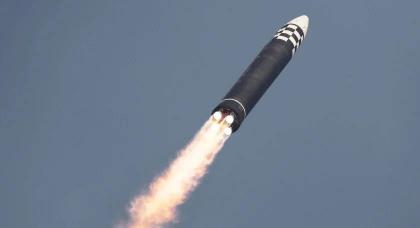
Known as the Hwasong-17, the giant ICBM was first unveiled in October 2020 and dubbed a “monster missile” by analysts.

It had never previously been successfully test-fired, and the launch prompted immediate outrage from Pyongyang’s neighbours and the United States.

“The missile, launched at Pyongyang International Airport, travelled up to a maximum altitude of 6,248.5 km and flew a distance of 1,090 km for 4,052s before accurately hitting the pre-set area in open waters” in the Sea of Japan, KCNA said.

South Korea’s military had estimated the range of the Thursday launch as 6,200 kilometres (3,900 miles) — far longer than the last ICBM, the Hwasong-15, which North Korea tested in November 2017.

The missile landed in Japan’s exclusive economic zone, prompting anger from Tokyo, but KCNA said the test had been carried out “in a vertical launch mode” to ease neighbours’ security concerns.

Following the test, Washington imposed new sanctions on entities and people in Russia and North Korea who are accused of “transferring sensitive items to North Korea’s missile program”.

The North is already under biting international sanctions for its weapons programs, and the UN Security Council will hold an emergency meeting over the launch on Friday.

‘Important progress’

The test is a clear sign North Korea has made “important qualitative progress” on its banned weapons programmes, said US-based analyst Ankit Panda.

“What’s important about this ICBM is not how far it can go, but what it can potentially carry, which is multiple warheads,” something North Korea has long coveted, he told AFP.

“The North Koreans are on the cusp of significantly increasing the threat to the United States beyond the ICBM capability demonstrated in 2017.”

Multiple warheads would help a North Korean missile evade US missile defence systems.

The North had carried out three ICBM tests prior to Thursday, the last being the Hwasong-15 in 2017.

Long-range and nuclear tests were paused when Kim and then US president Donald Trump engaged in a bout of diplomacy which collapsed in 2019. Talks have since stalled.

Thursday’s launch, one of nearly a dozen North Korean weapons tests this year, marked a dramatic return to long-range testing.

It came just days after one last week, likely also of the Hwasong-17, failed, exploding after launch.

Compensation

“This test also appears to ‘compensate’ for last week’s failed projectile launch — handsomely so,” Soo Kim, RAND Corporation Policy Analyst and former CIA analyst, told AFP.

“The regime appears quite pleased with the outcome of the test,” she added.

The country’s new ICBM launch comes at a delicate time for the region, with South Korea going through a presidential transition until May, and the US distracted by Russia’s invasion of Ukraine.

The official Rodong Sinmun newspaper carried a photograph of a haggard-looking Kim signing papers at his desk, with an image of a handwritten “I approve the test launch” scrawled over a report.

“Kim Jong Un wants to ultimately establish himself as a leader who has successfully developed both nuclear weapons and ICBMs,” Ahn Chan-il, a North Korean studies scholar, told AFP.

“He is almost desperate as without such military achievements, he really hasn’t done much,” he added, pointing to the isolated country’s Covid- and sanctions-battered economy.

The government must do more to recover taxes that went unpaid during the pandemic, a group of MPs has said.

The Public Accounts Committee said the total UK tax debt was £39bn – more than double the amount at the start of 2020.

It said HM Revenue and Customs must pursue businesses and individuals who were choosing not to pay their taxes while supporting those still struggling with the impact of the pandemic.

HMRC said it was recouping debts and would also be recruiting more staff.

After the UK first entered lockdown, HMRC paused most debt collection activity, significantly reducing the number of letters sent and in-person collections conducted.

The move, along with the wider economic impact of the pandemic, saw the number of taxpayers in debt rise from about 3.8 million in January 2020 to 6.2 million in September 2021.

The total amount owed rose from about £16bn before the pandemic to a peak of £67bn in August 2020, before falling back down to current levels.

The Public Accounts Committee’s report said HMRC had not “articulated a clear plan or set out a detailed timescale to give us confidence it can manage the challenge it now faces”.

The cross-party committee added that the longer the tax went unpaid, the greater the risk that HMRC would never be able to collect it.

It was particularly concerned about “rogue firms” that have been able to profit by exploiting measures put in place as part of the pandemic response.


The report also expressed concern that HMRC was not being proactive enough in identifying and offering support to people who had been left economically vulnerable or less able to pay their debts because of the pandemic.

Committee chairman Dame Meg Hillier MP said: “HMRC has a tricky balance to strike. Those least able to afford rising bills, including tax bills, are also the easiest collection ‘targets’.

“At the same time, HMRC’s challenges chasing down high-wealth individuals and companies who take advantage of every trick in the book to avoid and evade tax and outrun the law are well-known.

“Those tricks are just not available to ordinary people, now emerging from the misery of the pandemic into an exploding cost of living crisis. HMRC must push much harder at the doors – no matter where they are – of those who are not paying their fair share.”

In a statement, HMRC said: “We are recouping debt safely, taking into account customers’ circumstances and making repayments affordable. It’s in no-one’s interests to push viable businesses into insolvency when they can succeed given some time to repay their tax debts.”

It also said it would be recruiting almost 2,000 extra staff over the next year to support collection efforts.

The wife of a US Supreme Court judge repeatedly pressed Trump White House staff to overturn the 2020 presidential election, US media has reported.

Virginia Thomas, wife of Justice Clarence Thomas, reportedly sent 29 text messages to former adviser Mark Meadows, urging him not to concede.

Ms Thomas called Joe Biden’s victory “the greatest heist of our history”.

The texts are among 2,320 messages Mr Meadows provided to a committee investigating the US Capitol riot.

In the text messages, seen by CBS News and The Washington Post, she urged Mr Meadows, who was Donald Trump’s chief of staff, to “make a plan” in a bid to save his presidency.

“Do not concede. It takes time for the army who is gathering for his back”, she wrote on 6 November. It is unclear if Mr Meadows responded.

Ms Thomas also appeared to push QAnon conspiracy theories and urged Mr Meadows to appoint Sidney Powell, a conspiracy theorist and lawyer, to head up Mr Trump’s legal team.

“Sounds like Sidney and her team are getting inundated with evidence of fraud,” Ms Thomas wrote. “Release the Kraken and save us from the left taking America down.”

Mr Meadows told Ms Thomas that he intended to “stand firm” and said that he “will fight until there is no fight left”.

The Trump campaign later distanced itself from Ms Powell, after she made dramatic claims of voter fraud, without providing any evidence, at several media events.


Virginia Thomas – who goes by Ginni – is a prominent Republican fundraiser. She was formerly associated with the Tea Party wing of the party, a hard-line conservative movement to which Mr Meadows was also affiliated during his time in the House of Representatives.

She has been married to conservative-leaning Justice Clarence Thomas for 35 years, and has insisted her activist work has no influence on her husband’s work with the Supreme Court.

In 2010, she made headlines for asking Anita Hill to apologise for accusing Mr Thomas of harassment during his confirmation hearings in 1991.

Clarence Thomas is the longest-serving member of the US Supreme Court, having served since 1991, and is currently in hospital with “flu-like” symptoms.

He is considered extremely influential in American law, but for much of his career rarely spoke or asked questions in court until 2016 when he broke a 10-year silence.

Since the Covid pandemic began, however, Mr Thomas has become more vocal and participates in most oral arguments.

In February 2021 the Supreme Court rejected Donald Trump’s challenges to the elections result, however Mr Thomas dissented from the decision, calling it “baffling”.

The revelation of Ginni Thomas’s conspiracy-minded text messages have prompted critics on the left to call for Clarence Thomas to be impeached and removed from his lifetime seat on the Supreme Court.

They point to his lone dissent from the Supreme Court decision ordering the release of White House documents to the congressional committee investigating the 6 January Capitol attack as evidence that he was secretly protecting his wife, who was closely involved in efforts to overturn Donald Trump’s election defeat.

Mr Thomas’s defenders counter that he should not be held responsible for the activities of his spouse and, in any regard, there are no ethical rules that apply to high court justices.

The impeachment process for Supreme Court justices is the same as those for US presidents – a majority vote in the House of Representatives and two-thirds to convict and remove in the US Senate. That’s an unreachable bar given the current partisan divide of the latter chamber.

In fact, only one US Supreme Court justice has been impeached by the House in US history. Samuel Chase was accused of political bias and misdeeds in 1804. He was acquitted in the Senate by a comfortable margin.

The US and the EU have announced a major deal on liquified natural gas, in an attempt to reduce Europe’s reliance on Russian energy.

The agreement will see the US provide the EU with extra gas, equivalent to around 10% of the gas it currently gets from Russia, by the end of the year.

The bloc has already said it will cut Russian gas use in response to Russia’s invasion of Ukraine.

Russia currently supplies about 40% of the EU’s gas needs.

The new deal will involve the US and other countries supplying an extra 15 billion cubic metres of gas on top of last year’s 22 billion cubic metres.

The new total will represent around 24% of the gas currently imported from Russia.

The eventual aim is for the US and international partners to provide about 50 billion cubic metres per year to the EU.

Cutting reliance on Russia will mean generating more renewable energy and improving energy efficiency as well as increasing imports.


The deal was announced on Friday during a three-day visit by US President Joe Biden to Brussels.

Mr Biden and European Commission President Ursula von der Leyen discussed Russia’s invasion of Ukraine and offered fresh support to Kyiv.

“Putin is using Russia’s energy resources to coerce and manipulate its neighbours,” Mr Biden told reporters in Brussels. “He’s used the profits to drive his war machine.”

He said the long term benefits of the deal would outweigh the short term pain that reducing Russian gas supplies would cause.

“I know that eliminating Russian gas will have costs for Europe, but it’s not only the right thing to do from a moral standpoint, it’s going to put us on a much stronger strategic footing.”

President von der Leyen said: “We want, as Europeans, to diversify away from Russia towards suppliers that we trust that are friends and that are reliable.”

She pointed out that the target 50 billion cubic metres per year “is replacing one-third already of the Russian gas going to Europe today. So we are right on track now to diversify away from Russian gas.”

The EU gets 40% of its gas from Russia. If it’s to wean itself off that dependency, it needs to get its energy elsewhere.

The question is, where from?

Gas is already piped from Norway – but those pipelines are already operating at maximum capacity. The EU gets relatively little from the North Sea.

New supplies will have to come from further afield, in the form of LNG – gas that’s been chilled and liquified.

But there’s already intense competition for LNG supplies from countries such as Algeria and Qatar, and that’s been pushing up prices.

The 50 billion cubic metres of gas a year from the US – more than double the current quantity – would certainly be welcome.

But it still wouldn’t fill the gap if Russian supplies were removed.

There are also question marks over how much gas the US can supply, how quickly it can increase exports to the EU – and how much those shipments will cost.

The EU has been enjoying cheap gas for many years – but now it seems to have accepted that era is coming to an end.

Russia’s war with Ukraine has helped push energy prices to record highs.

Energy prices were already rising before the invasion as economies started to recover from the Covid crisis.

The Ukraine invasion prompted the EU to pledge to cut Russian gas use by two-thirds this year by hiking imports from other countries and boosting renewable energy.

The White House said that greater energy efficiency can be immediately achieved through increasing the use of smart thermostats and heat pumps.

The EU said that reductions through energy savings in homes can replace 15.5 billion cubic metres this year and that accelerating wind and solar deployment can replace 20 billion cubic metres.

The EU’s goal is to save 170 billion cubic metres by 2030 through energy efficiency and by using renewable energy.

That 170 billion on top of the planned 50 billion of additional gas from the US and other countries means Europe’s reliance on Russian gas could be replaced by 2030.

Russia sanctions

In response to Russia’s invasion of Ukraine, the US is banning all Russian oil and gas imports and the UK will phase out Russian oil imports by the end of 2022.

The EU has said it will switch to alternative supplies and make Europe independent from Russian energy “well before 2030”.

Germany has put on hold permission for the Nord Stream 2 gas pipeline from Russia to open.

Meanwhile in the UK petrol prices have hit record highs as oil and gas costs soar.

Oil jumped to $139 a barrel at one point earlier this month, the highest level for almost 14 years, while wholesale gas prices for next-day delivery more than doubled.

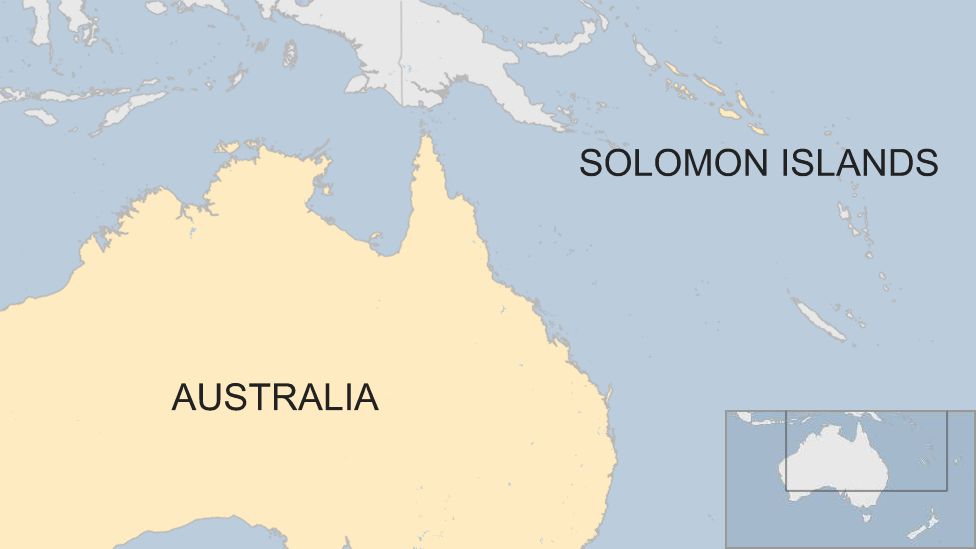
Solomon Islands has confirmed it is drafting a security deal with China – a move that’s triggered alarm in neighbouring Australia and other Western allies in the Indo-Pacific.

Leaked papers indicate a Chinese military base could potentially be set up on the island to Australia’s north.

That’s sparked concern from Australia, long the chief defence partner and biggest aid donor to the tiny island.

Both Australia and New Zealand said it had raised concerns with Honiara.

Australia’s Foreign Minister Marise Payne said she respected the Pacific island’s right to make sovereign decisions but:

“We would be particularly concerned by any actions that undermine the stability and security of our region, including the establishment of a permanent presence such as a military base.”

New Zealand said it was also concerned as the plan threatened to “destabilise the current institutions and arrangements that have long underpinned the Pacific region’s security.”

The Solomon Islands did not confirm the details of the leaked draft agreement, or if it was the finalised version.

But on Friday it said it was “expanding” security arrangements with more countries and “diversifying the country’s security partnership including with China”.

China could deploy forces

The details of the leaked plans have particularly concerned Australia, which is just 2000km (1,400 miles) south of the Solomon Islands.

The papers set out a framework which could allow Beijing to deploy forces to “protect the safety of Chinese personnel and major projects in Solomon Islands”.

The tiny Pacific nation could also “request China to send police, armed police, military personnel and other law enforcement and armed forces”, according to the document.

There is also provision for China to “make ship visits, to carry out logistical replenishment in, and have stopover and transition in Solomon Islands”.

Security analysts say the plans reveal China’s clear intention in the region for the first time.

“It shows in black and white what China is asking for and in some ways has done Australia a favour,” said Jonathan Pryke, a Pacific Islands analyst at Australia’s Lowy Institute thinktank.

“We are at the start of a long process before we would see any sort of boots on the ground or form of military presence in the Solomon Islands… but it is worrying to see just what China’s intent is,” he told the Australian Broadcasting Corporation.

On Friday, Honiara emphasised that any strategic partnership with China would include a “development dimension”. It was working to “sign off and implement” several deals with China including trade expansion and a civil aviation services agreement.

But it added it also welcomed police training and equipment offered by its “two major partners China and Australia.”

Australia has been increasingly concerned about China’s growing influence in the Indo-Pacific region, and has tried ramping up aid spending to curtail that in recent years.

In 2018, it launched the ‘Pacific Step Up’ policy to re-engage with its “Pacific family.” It also set up a multi-billion dollar infrastructure fund widely seen as a counter to China’s loans and spending in the region.

Despite this, Honiara has drawn closer to China, establishing formal diplomatic ties in 2019 and ditching its links with Taiwan.

On Friday, former Australian PM Kevin Rudd called the plan “one of the most significant security developments we have seen in decades” and a defence failure by the current Australian government in its “own territorial waters”.

Following riots on the Solomon Islands last year year, Australia sent troops to the island and re-established a previous long-term policing mission. China also offered training for the island’s police.

In February, the US said it also planned to re-open its embassy in the Solomon Islands amid concerns about China’s plans in the region.

The US, UK and Australia all signed a landmark defence treaty last year, nicknamed Aukus, to strengthen Western allies’ presence in the Indo-Pacific.

A dangerous escape on the ‘Rescue Express’ Ukraine war

The air raid alarm in the station tower has just started: no bombs are falling, but nerves are fraying. The guard tells us to shelter with the refugees in the tunnel under the platform.

There are several thousand people here, in a long queue.

We wait among the anxious and exhausted, the families calming scared children, the elderly woman wrapped in a blanket and pulling a suitcase. She looks as if she cannot possibly walk another step. But she will trudge forward when the all-clear is given. This is not a place of options. Go forward, or run the risk of the war catching up with you.

Then a horn blares. A searchlight appears down the track to the east, a looming brilliance that grows larger as it approaches. Another horn sounds, followed by a conductor’s whistle cutting through the clamour of the air raid sirens. A murmur ripples through the crowd. The all-clear is declared, and they can board a train to Poland.

After nearly a month reporting on refugees, I have taken to calling this extraordinary evacuation the “Rescue Express”. Millions of Ukrainians have taken trains from as far south as Odessa on the Black Sea, from Kharkiv close to the Russian border in the north-east, from the Donbas and from Kyiv, and numerous smaller stations in between.

It has come at great human cost: 33 railway staff have been killed. Tracks and stations have been bombed.

The head conductor on Train 91/92 between Lviv and Kyiv is Ievgen Propokenko, a 40-year veteran of the railways. He comes from Kharkiv, which is now under Russian siege, and where his daughter and son-in-law also work to keep the Rescue Express going. The railways, he explains, run in the family.

Ievgen Propokenko, head conductor on board the “Rescue Express” knows that his train could come under fire

“It is terrifying. My native city is being bombed,” says Ievgen. “I can feel it and see it, but I cannot believe it.”

He knows that his own train runs the risk of being attacked. One of the conductor’s duties is to check that train windows are covered, so its lights don’t present an obvious target for Russian aircraft.

“We can see the war in the faces of the people who come onboard. It is our job. It is what we have to do.”

Also onboard is his younger colleague, Oleksandr Shevchenko, 31, the spokesman for the railways who is heading to an awards ceremony. The Prime Minister will be handing out awards to railway staff at the station in Kyiv.

This service is heading east back towards the conflict, and has only a few passengers. Sitting in a compartment before departure I met Petro Rocharan, a 25-year-old investment banker, who has volunteered to join a battalion defending the capital. Petro is a scout. He has had just three weeks’ military training and he is frank about his feelings.

“I am rather scared honestly. I know Kyiv has been through a lot so far. Including the streets where I am going, where some of my friends are living, and I am just not sure if I am ready to see those buildings destroyed,” he explains. Petro speaks of different waves of feeling: from fear to excitement and back to fear again.

The lights of the train could make it a target in these dangerous times

The train pulls into Kyiv just after dawn, and Petro heads off in search of his battalion. New shifts of drivers, conductors and stewards start to arrive at the station. So do the buses carrying families from the embattled cities of Kharkiv, Mariupol, Kramatorsk and the suburbs of Kyiv itself.

Oleg Kryvospytska, 59, comes from Troyeschchyna in the northern suburbs of Kyiv and has brought his wife, Olena, his 29-year-old daughter Olga, and his granddaughters, aged six and 12.

But Oleg will not be travelling with them. He must stay behind and care for an elderly relative who is unable to travel.

Olena says that they will take the train to Lviv and stay for a few days before deciding where to go in Europe. “I have no words for this,” she says. “This is something terrifying that I can’t believe is happening. I’m currently taking sedatives every day to keep me calm, but even that isn’t helping.”

Oleg is a tall, strongly-built man and his wife Olena leans into him as the time approaches to board the train. They embrace, and sway gently from side to side. It is a portrait of fortitude and loss, rooted in the 30 years of their life together.

Oleg does not speak or cry. For the children’s sake, he smiles.

Even as he walks alongside the departing train and can see Olena weeping, he keeps smiling and waving. The little girls shout: “We love you, we love you.” His daughter Olga calls out: “Wait for us.”

He will. Of course. However long it takes.

The train picks up speed. The horn blares and the carriages roll west, through the suburbs, away from the front line and out into the great immensity of Europe’s second-largest country. It passes wheat fields ready for spring planting, through small and large towns, further and further from the war zone.

It is after 22:00 when the Rescue Express pulls into Lviv. Olga and Olena and the children are in the first carriage and it is dark on the platform. A conductor appears with a flash lamp and lights their way. The weary travellers gather their bags and walk towards the lights of the station.

In a day or two they will board another train, to Poland, peace and exile.

A group of 52 children from orphanages in Dnipro in Ukraine have arrived at their temporary new home in Scotland.

The children and their guardians were supposed to leave Poland on Monday, but a vital document from the Ukrainian government was not ready in time.

They will stay in the Callander area, near Stirling, before moving to Edinburgh in small family-style groups.

Steven Carr from Dnipro Kids, which arranged the evacuation, said he was “ecstatic” to get them to safety.

The Edinburgh charity, which was set up by Hibernian fans and has been supporting the orphanages for many years, enabled the children to flee Ukraine for Poland.

First Minister Nicola Sturgeon tweeted a welcome, and wrote: “I know you’d all rather be at home in Ukraine but you’ll find love, care and support here for as long as you need it.”


Dnipro Kids has arranged accommodation for the children, who range in age from one to late teens, as well as two older “sisters” and their seven legal guardians.

They will stay in a rural hostel while they acclimatise to life in Scotland, then move to Edinburgh to live within the smaller household groups they had at home in Dnipro until it is safe for them to return to Ukraine.

Mr Carr told BBC Radio Scotland’s Good Morning Scotland they were “ecstatic” to finally get the children to the “quiet and secluded” hostel where they can be together and the orphanage “mothers” can support each other.

He said: “Dnipro Kids has got a fantastic committee in place that has been working non-stop to make sure everything is in place for the kids when they arrive.

“It’s just great to finally get over the line.”

Although the charity was initially set up by Hibs fans following a UEFA cup match in Dnipro in 2005, he said it had gained “phenomenal” support since beginning the evacuation from Ukraine.

Many people have offered money, time and services, including members of the Ukrainian community in Edinburgh who are helping with language issues.

The children will continue their education with an online Ukrainian programme being used by displaced students during the conflict.

“We just take care of them, we make sure everything is in place,” Mr Carr said.

“It’s very traumatic [for the children] – I wouldn’t say they are excited to be here, hopefully that will happen over the next few days.

“I think at the moment it’s just relief they are now here, they know they are no longer in limbo, they know they can now settle down and get themselves adjusted.”

Last minute visas for ‘sisters’

Last minute visas were arranged on Wednesday for two young women who belonged to one of the orphanages after someone connected to Dnipro Kids offered to sponsor their visas.

The 19 and 21-year-olds thought they would be separated from their “brothers and sisters” and the woman they called mother.

Mr Carr said: “The UK government was brilliant at fast-tracking their visas.”

Daniel Burger, chief executive of Magen David Adom UK helped organise the Virgin flight from Warsaw to London.

He said the flight attendants made sure there was a “celebration” on the flight from Warsaw.

“The plane was full of toys and other goodies and sweets and chocolates and other goodies for them,” he said.

Sally Becker, the founder of Save a Child, was also on the flight from Warsaw on Monday.

“As it touched down they all started to clap,” she said. “The main thing is they’re here, they have sanctuary, temporary sanctuary and they’re safe.”

‘Beginning of something significant’

SNP MP Ian Blackford has been supporting Dnipro Kids deal with the applications for the children to seek sanctuary in Scotland.

He said it had taken time to get the paperwork in order because they had to address all safeguarding concerns before they could be moved to another country.

Speaking in the House of Commons on Wednesday, he thanked the Scottish and UK governments for helping make arrangements for the children.

“This is a good day for these 50 young Ukrainian orphans arrive in Scotland after delay people but let’s hope it’s the beginning of something much more significant for more young people that we can offer sanctuary to,” he said.

Home Secretary Priti Patel tweeted about their arrival: “Huge thanks to my team at the UK Home Office, the Ukraine and Poland authorities, the Scottish Government and Virgin Atlantic who worked urgently on their swift arrival.

“The care they will receive will go some way to heal their suffering.”


Up to 3,000 people fleeing the conflict in Ukraine will be offered immediate temporary accommodation in Scotland.

The Scottish government has also announced a further £15m of funding will be made available to help refugees, including £11m for local councils and £2.5m for temporary accommodation.

About 3.6 million people, mostly women, children and elderly people, have fled Ukraine since Russian army invaded last month.

Covid cases have climbed by a million in a week in the UK, data from the Office for National Statistics reveals.

Swab tests suggest about one in every 16 people is infected, as the contagious Omicron variant BA.2 continues to spread.

That’s just under 4.3 million people, up from 3.3 million the week before.

The figures for the week ending 19 March, are thought to give the most accurate reflection of what’s happening with the virus in the community.

Rates were up in England and Wales, and Scotland reached a new high.

Infections have started decreasing in Northern Ireland, however.

The rates across the nations were:

  • England: 6.4%, up from 4.9% last week – approximately one in 16 people
  • Wales: 6.4%, up from 4.1% last week – approximately one in 16 people
  • Northern Ireland: 5.9%, down from 7.1% last week – approximately one in 17 people
  • Scotland: 9%, up from 7.15% last week – approximately one in 11 people

A high number of infections means the UK can expect Covid hospitalisations to rise too, although vaccines are still helping to stop many severe cases, say experts.

According to the latest figures, there were 16,975 patients in hospital with the virus on 23 March. About half will have been admitted for something else, rather than Covid, but tested positive.

Just over 300 of them needed an intensive care bed with a ventilator to help them breathe.

England’s chief medical officer Prof Sir Chris Whitty said earlier this week that while the virus was causing pressure in the NHS, the high rates of transmission were fortunately not translating into lots of intensive care cases and deaths.

Staff absences at NHS hospitals in England due to Covid have risen by 31% on the week to 13 March.

About of 23,127 staff at hospital trusts in England – 2% of the total workforce – were absent, either because they were sick with the virus or were self-isolating.

People aged 75 and over and those who are immunosuppressed can book a spring booster jab to top up their protection against Covid.

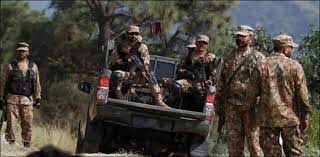
ISPR says terrorists had “attempted to infiltrate” Pakistan from Afghanistan on midnight of March 23-24 in North Waziristan district.

RAWALPINDI: Four soldiers were martyred as they foiled the plans of a group of terrorists who were attempting to enter Pakistan from Afghanistan.

According to the Inter-Services Public Relations (ISPR), the terrorists had “attempted to infiltrate” Pakistan from Afghanistan on the midnight of March 23-24 in the Hassan Khel area of North Waziristan district.

“Due to alertness and timely response of the troops, the infiltration attempt was foiled. Terrorists retaliated with fire which was reciprocated in a befitting manner,” said the ISPR statement. The terrorists, after failing to enter the country, fled away. And as per intelligence reports, they “suffered heavy casualties”.

The four soldiers who embraced martyrdom during the exchange of fire were identified as 34-year-old Lance Havaldar Wajahat Alam of Ghizer in Gilgit Baltistan, 25-year-old Sepoy Sajjid Inayat resident of Sheikhupura, 32-year-old Sepoy Maqbool Hayat, resident of Ghizer in Gilgit Baltistan, and 22-year-old Sepoy Sajjid Ali resident of Skardu.

“The Pakistan Army is determined to eliminate the menace of terrorism and such sacrifices of our brave soldiers further strengthen our resolve,” vowed the ISPR.

Russia is considering accepting Bitcoin as payment for its oil and gas exports, according to a high-ranking lawmaker.

Pavel Zavalny says “friendly” countries could be allowed to pay in the crypto-currency or in their local currencies.

Earlier this week, Russian President Vladimir Putin said that he wanted “unfriendly” countries to buy its gas with roubles.

The move is understood to be aimed at boosting the Russian currency, which has lost over 20% in value this year.

Sanctions imposed by the UK, US and the European Union, following the invasion of Ukraine, have put a strain on Russia’s rouble and raised its cost of living.

However, Russia is still the world’s biggest exporter of natural gas and the second largest supplier of oil.

Mr Zavalny, who heads Russia’s State Duma committee on energy, said on Thursday that the country has been exploring alternative ways to receive payment for energy exports.

He said China and Turkey were among “friendly” countries which were “not involved in the sanctions pressure”.

“We have been proposing to China for a long time to switch to settlements in national currencies for roubles and yuan,” said Mr Zavalny. “With Turkey, it will be lira and roubles.”

Mr Zavalny added: “You can also trade bitcoins.”

‘More risk’

Analysts said Russia may benefit from accepting the popular cryptocurrency, despite the risks.

“Russia is very quickly feeling the impact of unprecedented sanctions,” said David Broadstock, a senior research fellow at the Energy Studies Institute in Singapore. “There is a need to shore up the economy and in many ways, Bitcoin is seen as a high growth asset.”

However, he noted that the value of Bitcoin has swung by as much as 30% this year. In comparison, the dollar has traded within 5% against the euro.

“Clearly accepting Bitcoin, compared with other traditional currencies, introduces considerably more risk in the trade of natural gas,” Mr Broadstock said.

“Moreover, one of the major ‘friendly’ trade partners for Russia is China, and cryptocurrency is banned for use in China,” he added. “This clearly limits potential for payment using Bitcoin.”

There are concerns that Russian oligarchs could be using virtual currencies to avoid sanctions.

This has spurred Ukraine’s government as well as US and European politicians to ask crypto-currency platforms to ban all Russian users.

But many firms have ruled this out.

“Some ordinary Russians are using crypto as a lifeline now that their currency has collapsed,” said Brian Armstrong, chief executive of cryptocurrency firm Coinbase.

He said: “Many of them likely oppose what their country is doing, and a ban would hurt them, too.”

On Wednesday, Mr Putin’s comments on making “unfriendly” countries pay in roubles drove the currency to a three-week high.

However, many existing gas contracts are agreed upon in euros and it is unclear if Russia can change them. The EU relies on Russia for 40% of its gas.