
Plans for the UK to send some asylum seekers to Rwanda have been passed by Parliament.

The Rwanda bill was introduced to allow the scheme to go ahead after the Supreme Court ruled it was unlawful.

The government says any asylum seeker entering the UK “illegally” after 1 January 2022, from a safe country such as France, could be sent to Rwanda.

They would have their asylum claims processed there, rather in than the UK.

If successful, they could be granted refugee status and allowed to stay in the landlocked east-central African country.

If not, they could apply to settle in Rwanda on other grounds, or seek asylum in another “safe third country”.

No asylum seeker would be able to apply to return to the UK.

Ministers say the plan will deter people from arriving in the UK on small boats across the English Channel.

There is no limit on the number of asylum seekers who could be sent to Rwanda.

According to BBC home and legal correspondent Dominic Casciani, there are currently 52,000 people who could be considered.

The first flight to Rwanda was scheduled for June 2022, but was cancelled after legal challenges.

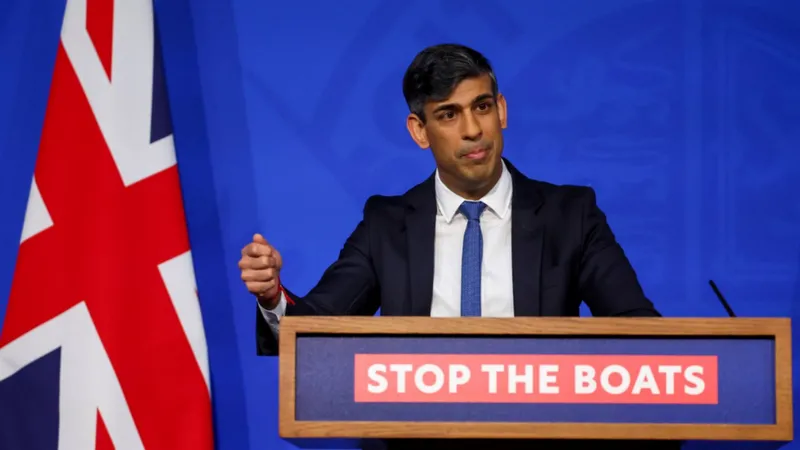
Speaking on 22 April, Prime Minister Rishi Sunak said the first flight would now leave in 10-12 weeks. This is later than the government’s previous goal of sending people in spring.

Mr Sunak did not confirm how many people would be on board, but said there would be “multiple flights a month through the summer and beyond”.

The PM also said the government had “put an airfield on standby” and had booked commercial charter planes.

Legal challenges meant the first Rwanda flight was cancelled shortly before take-off in June 2022

He said the number of detention spaces for people the government was preparing to remove had been increased to 2,200 and that “200 trained, dedicated caseworkers” were available to process cases quickly.

Mr Sunak said that 25 courtrooms and 150 judges were available to deal with any legal cases, and there were “500 highly trained individuals ready to escort illegal migrants all the way to Rwanda”, with a further 300 to be trained.


After the Supreme Court ruled that the scheme was unlawful, the government introduced a bill to make clear in UK law that Rwanda is a safe country.

The legislation – which was finally approved on 22 April after intense political wrangling – orders the courts to ignore key sections of the Human Rights Act.

It also compels the courts to disregard other British laws or international rules – such as the international Refugee Convention – which would block deportations to Rwanda.

The UK government also signed a new migration treaty with Rwanda, which Home Secretary James Cleverly said guarantees that anyone sent there would not risk being returned to their home country.

The Rwanda bill was fiercely criticised by opposition parties and by many charities representing asylum seekers.

After the bill was passed, the illegal migration minster Michael Tomlinson said a “whole range of legal challenges” is now expected.

These are likely to come both from individual asylum seekers appealing against their own deportation, and specialist expert refugee organisations.


In November 2023, the UK Supreme Court ruled unanimously that the Rwanda scheme was unlawful.

It said genuine refugees would be at risk of being returned to their home countries, where they could face harm.

This breaches the European Convention on Human Rights (ECHR), which prohibits torture and inhuman treatment. The UK is a signatory to the ECHR.

The ruling also cited concerns about Rwanda’s poor human-rights record, and its past treatment of refugees.

Judges said that in 2021, the UK government had itself criticised Rwanda over “extrajudicial killings, deaths in custody, enforced disappearances and torture”.

They also highlighted a 2018 incident, when Rwandan police opened fire on protesting refugees, killing at least 11.

However, the total payment will be at least £370m over five years, according to the National Audit Office .

If more than 300 people are sent to Rwanda, the UK would pay a one-off sum of £120m to help boost the country’s economy, with further payments of £20,000 per individual relocated.

On top of that, up to £150,000 will be paid for each person sent there, the NAO report said.

These figures would not include the cost of payments to anyone to who chooses to go to Rwanda voluntarily.

Getty Images
Home Secretary James Cleverly visited Rwanda in December 2023, after the Supreme Court ruling

Previously released official figures suggested that removing each individual to a third country would cost £63,000 more than keeping them in the UK.

The prime minister previously claimed that the Rwanda plan would “literally save us billions in the long run“, but did not explain the figures.

The UK’s asylum system costs nearly £4bn a year, including about £8m a day on hotel accommodation.

Failure to process asylum claims efficiently “has led to unacceptable costs to the taxpayer”, a report by MPs said in October 2023.
President Raisi’s visit: US hints at ‘potential risk of sanctions’ amid Pak-Iran business deals

The United States State Department Tuesday warned against the “potential risk of sanctions” in light of the business deals between Pakistan and Iran following Iranian President Seyyed Ebrahim Raisi’s official visit to Pakistan.

Without mentioning Pakistan in a statement, a State Department spokesperson said: “We advise anyone considering business deals with Iran to be aware of the potential risk of sanctions.”

The spokesperson, while commenting on Islamabad’s trade and economic ties with Washington, said US is Pakistan’s biggest export market and one of its largest investors.

“We have also been a leading investor in Pakistan for the past 20 years. Pakistan’s economic success is in both of our interest, and we look forward to continuing our partnership,” they added, stressing the significance of economic relations between both countries.

However, considering Islamabad’s closeness with Tehran amid President Raisi’s three-day visit and the bilateral agreements signed between the two nations, the spokesperson hinted towards these relations being at risk with chances of potential sanctions owing to Iran’s position in the world.

“We do not preview potential sanctions actions,” the spokesperson said and referred journalists to the Government of Pakistan for any further comment on the matter.

The State Department’s statement comes at a crucial standpoint in Pakistan’s history as it works to advance its “brotherly ties” with Iran by welcoming their president, months after their cross-border skirmishes in January.

The statement also holds significance following Iran’s standing at the global level, owing to its regional activities and recent clashes with Israel after it attacked its embassy in Damascus, killing two senior members of the Islamic Revolutionary Guard Corps.

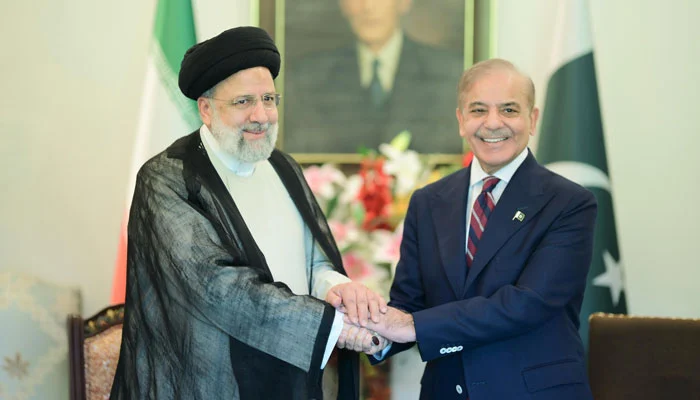
Meanwhile, both Tehran and Islamabad also signed a total of eight accords on varying subjects to enhance cooperation in the different fields including trade, science technology, agriculture, health, culture, and judicial matters with both PM Shehbaz and President Raisi witnessing the momentous occasion.

In his address during joint presser with the prime minister, the Iranian president revealed that both Pakistan and Iran have agreed to increase trade volume to $10 billion.

The signing ceremony also marked the ratification of a security cooperation agreement between the governments of both countries.

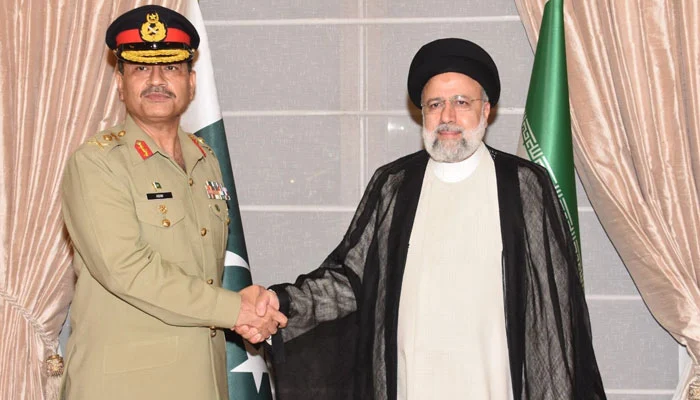
In meeting with Raisi, army chief seeks ‘improved coordination’ with Tehran against terrorists

RAWALPINDI: Chief of Army Staff (COAS) General Syed Asim Munir met with Iranian President Ebrahim Raisi, emphasising the need for “improved coordination” against the terrorists, a statement issued by the Inter-Services Public Relations (ISPR) said Tuesday.

According to the military’s media wing, COAS Munir described described the Pak-Iran border as “the border of peace and friendship,” emphasising the need for improved coordination along the border to prevent terrorists from jeopardising the longstanding brotherly relations between the two neighbouring countries.

The statement said that the discussion between the two dignitaries primarily focused on matters of mutual interest, notably regional peace, stability, and border security.

“Both sides concurred on the necessity to bolster bilateral cooperation while jointly striving for regional stability and economic prosperity,” said the ISPR statement.

President Raisi, during the meeting, emphasised that by fostering cooperation between the two armed forces, Islamabad and Tehran can attain peace and stability for both nations and the region.

The Iranian head of state arrived in Pakistan on Monday on a three-day official visit, the first by any foreign leader to Pakistan after the February 8 polls.

He is being accompanied by his spouse and a high-level delegation, comprising the foreign minister and other members of the cabinet, senior officials and a large business delegation.

Following his arrival at the Prime Minister’s House to meet with PM Shehbaz Sharif on April 22, the Iranian president received a guard of honour from the smartly turned-out contingents of the armed forces.

The premier welcomed the high-profile guest as he arrived at the venue of the formal welcome ceremony after which the national anthems of both countries were played.

In the second leg of his high-profile visit to Pakistan, Raisi will travel to Lahore.

Later, the Iranian leader will travel to Karachi where his meetings are scheduled with Governor Kamran Tessori and Chief Minister Murad Ali Shah.

Raisi will also visit Quaid’s mausoleum in Karachi and pay his respects to the founder of Pakistan.

The foreign leader would stay in Karachi and return to Tehran on Wednesday.

The provincial authorities are on high alert due to the high-profile visit and a public holiday has been declared in Karachi and Lahore today.

Taiwan hit by numerous quakes, strongest reaching 6.3 magnitude

Taiwan’s capital was hit by a series of earthquakes overnight into the early hours of Tuesday, with the Central Weather Administration saying the strongest was a magnitude-6.3 tremor originating in eastern Hualien.

The first strong quake — a magnitude 5.5 — hit on Monday at around 5:08 pm (0908 GMT), according to Central Weather Administration. It could be felt in the capital Taipei.

That was followed by a series of aftershocks and quakes, with two intense tremors hitting one after another around 2:30 am (1830 GMT) Tuesday, according to AFP reporters and witnesses in Taipei.

“I was washing my hands, and suddenly felt what I thought was vertigo,” Olivier Bonifacio, a tourist staying in Taipei’s Da’an district, told AFP.

“I stepped into my room and noticed the building was rocking and I heard the desk creak,” he said, adding that it was then he realised it was another aftershock.

The Central Weather Administration said a magnitude-6.0 quake had hit at 2:26 am, followed six minutes later by a magnitude-6.3 one.

The US Geological Survey put the first one at a magnitude-6.1, followed by a magnitude-6.0.

Through Monday, AFP reporters could feel their buildings swaying during intense quakes, while one said “glass panels of bathroom and windows were making noises” as the island shuddered.

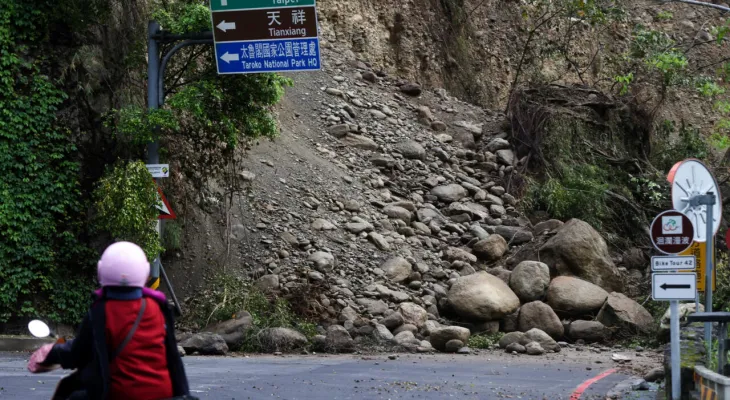
The Hualien region was the epicenter of a magnitude-7.4 quake that hit on April 3, causing landslides that blocked off roads around the mountainous region, while buildings in the main Hualien city were badly damaged.

At least 17 were killed in that quake, with the latest body found in a quarry on April 13.

Early Tuesday, Hualien’s fire department said that teams were dispatched to inspect any disaster from the new quakes.

At 2:54 am, they released a statement saying no casualties had been reported yet.

Taiwan sees frequent earthquakes as it is located at the junction of two tectonic plates.

The April 3 quake was followed by hundreds of aftershocks, which caused rockfalls around Hualien.

It was the most serious in Taiwan since 1999 when a magnitude-7.6 quake hit the island. The death toll then was far higher, with 2,400 people killed in the deadliest natural disaster in the island’s history.

Stricter building regulations — including enhanced seismic requirements in its building codes — and widespread public disaster awareness appeared to have staved off a more serious catastrophe in the April 3 quake.

Tensions flare at US universities over Gaza protests

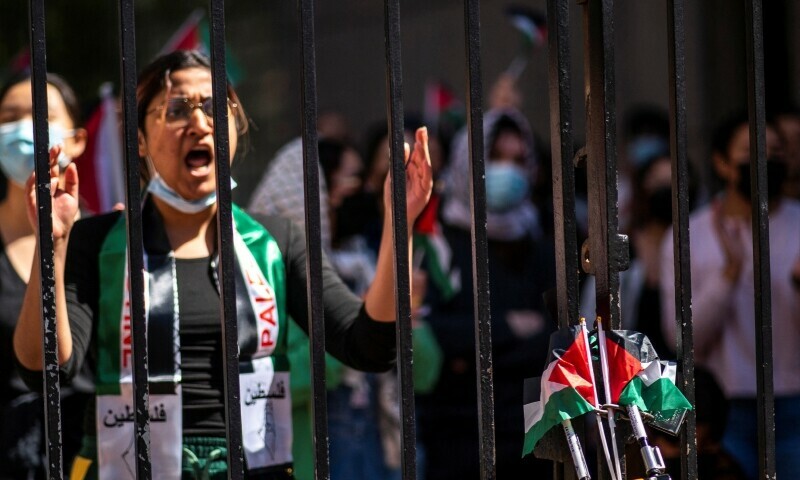
The protests, which began last week at Columbia University with a large group of demonstrators establishing a “Gaza Solidarity Encampment” on school grounds, have spread to other campuses, including Yale, MIT and others.

Some Jewish students at Columbia have reported intimidation and anti-Semitism amid the days-long protest, which is calling for the prestigious New York institution to divest from companies with ties to Israel.


Classes were moved online on Monday, with university president Nemat Shafik calling for a “reset” in an open letter to the school community.

“Over the past days, there have been too many examples of intimidating and harassing behavior on our campus,” she said.

“Anti-Semitic language, like any other language that is used to hurt and frighten people, is unacceptable and appropriate action will be taken.

“To de-escalate the rancor and give us all a chance to consider next steps, I am announcing that all classes will be held virtually on Monday,” she added.

Last week, more than 100 protesters were arrested after university authorities called the police onto the private campus Thursday, a move that seemingly escalated tensions and sparked a greater turnout over the weekend.

Mimi Elias, a social work student who was arrested, told AFP on Monday: “We are going to stay until they talk to us and listen to our demands.

“We don’t want anti-Semitism or Islamophobia. We are here for the liberation of all,” Elias said.

Joseph Howley, an associate professor of classics at Columbia, said the university had reached for the “wrong tool” by involving police, which had attracted “more radical elements that are not part of our student protests”.

“You can’t discipline and punish your way out of prejudice and community disagreement,” Howley told AFP.

Disciplinary action

As the holiday of Passover began on Monday night, social media images appeared to show pro-Palestinian Jewish students holding traditional seder meals inside the protest areas on multiple campuses, including at Columbia.

Further downtown, police began detaining protesters who had set up their own encampment at New York University at around 8:30pm, the New York Times reported, after the school called the students’ behavior “disorderly, disruptive, and antagonising”.

There were also demonstrations at MIT, the University of Michigan and Yale, where at least 47 people had been arrested on Monday after refusing requests to disperse.

“The university made the decision to arrest those individuals who would not leave the plaza with the safety and security of the entire Yale community in mind,” the Ivy League university said in a statement.

At Harvard, university officials on Monday suspended the Palestinian Solidarity Committee, the student group said on Instagram.

They were ordered to “cease all organisational activities” for the rest of the term, or risk permanent expulsion after holding an unregistered demonstration last week, student newspaper the Harvard Crimson reported, citing an email to the group.

Universities have become the focus of intense cultural debate in the United States since Hamas’ October 7 attack and Israel’s overwhelming military response, as a humanitarian crisis grips the Palestinian territory of Gaza.

US President Joe Biden on Monday said he condemned “the anti-Semitic protests”.

“I also condemn those who don’t understand what’s going on with the Palestinians,” he told reporters, without further details.

Modi accused of targeting Muslims in election speech

The world’s most populous country is constitutionally secular and its election code bans canvassing based on “communal feelings”.

Modi’s muscular Hindu-first politics is a key part of his electoral appeal and his opponents accuse him of marginalising India’s 200 million Muslim population.

The prime minister usually steers away from explicit references to religion — the word “Hindu” does not appear in his Bharatiya Janata Party’s (BJP) 76-page election manifesto.

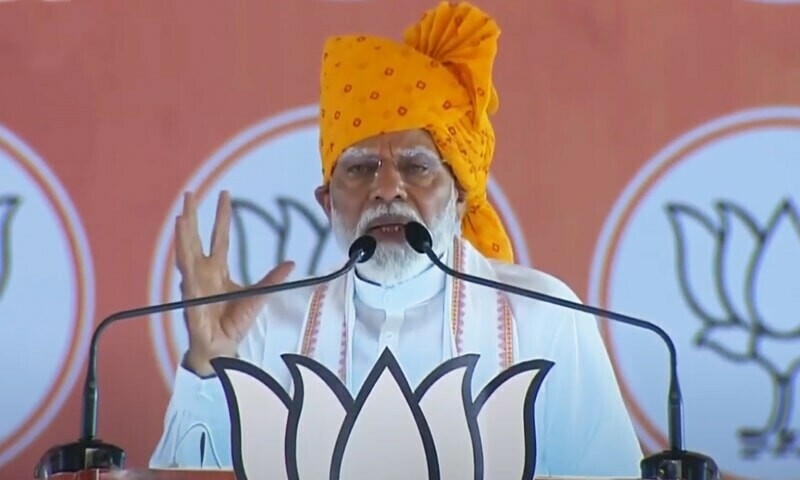
But at a weekend election rally in Rajasthan, Modi claimed a previous Congress government had said that “Muslims have the first right over the nation’s wealth”.

He said if Congress won “it will be distributed among those who have more children. It will be distributed to the infiltrators.

“Do you think your hard-earned money should be given to infiltrators? Would you accept this?”


Critics said the phrases were references to Muslims.

In its complaint to the Election Commission, the Congress party said the “divisive, objectionable and malicious” comments were targeted at “a particular religious community” and amounted to “blatant and direct violations of electoral laws”.

They were “far worse than any ever made by a sitting prime minister in the history of India”, the complaint said.

Congress party spokesperson Abhishek Manu Singhvi told reporters outside the Commission’s office: “We hope concrete action will be taken.”

Modi and the BJP are widely expected to coast to victory in India’s marathon elections, which began last Friday and with the results due on June 4.

Earlier this year, Modi presided over the inauguration of a grand temple to the deity Ram, built on the site of a centuries-old mosque razed by Hindu zealots. The BJP has frequently invoked the temple on the campaign trail.

BJP spokesperson Gaurav Bhatia told reporters on Monday that Modi was calling “a spade a spade” and his remarks resonated with what people thought.

A bill that proposes major changes to Scotland’s criminal justice system will be debated by MSPs at Holyrood later.

If passed, it would see the abolition of Scotland’s not proven verdict.

The Victims, Witnesses, and Justice Reform (Scotland) Bill would also see the number of jurors in criminal trials reduced from 15 to 12, and could also see rape cases held without a jury.

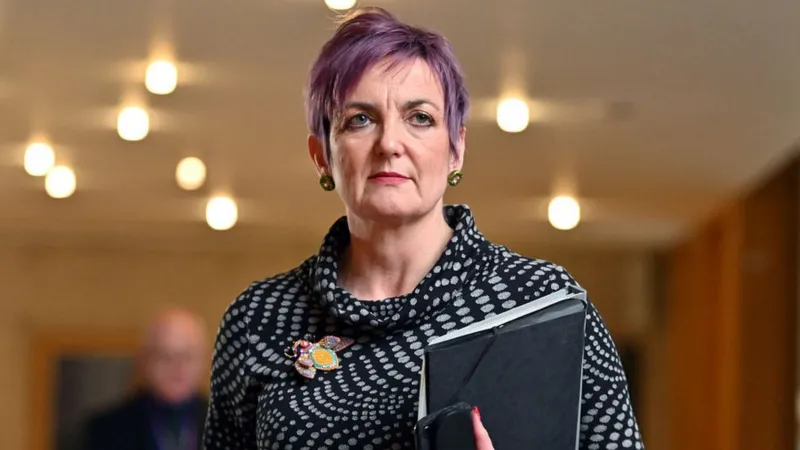
Justice secretary Angela Constance has described the bill as “landmark and historic”.

It aims to make the Scotland’s justice system better for victims of crime, but it has proved controversial.

Why is the bill controversial?

The bill is still in the early stages of the legislative process and will be debated in Holyrood for the first time.

It has already been scrutinised by the Scottish parliament’s criminal justice committee, which had split opinions on certain parts.

Committee convener Audrey Nicoll MSP said they agreed with the bill’s general principles on the basis that it is designed to improve the system for victims and witnesses, but believe further evidence, data and scrutiny is required.

The committee stated it had not heard “compelling evidence” to support some of the proposals, in particular the changes to juries.

In response, Angela Constance acknowledged the legislation would have to be amended, but added that there was a “consensus” that the bill has the potential to change the experiences of victims and witnesses, particularly in cases involving sexual offences.”

The Scottish Solicitors Bar Association said 97% of defence lawyers would boycott the trial without jury pilot if it goes ahead, while Rape Crisis Scotland said it supported the move.

The Victims, Witnesses, and Justice Reform (Scotland) Bill is a range of reforms to the Scottish justice system being considered by the Scottish Parliament.

The government says it aims to “improve the experience of victims and witnesses in the justice system”.

The bill also proposes changes to improve the fairness, clarity and transparency of the framework within which decisions in criminal cases are made.

Proposals include scrapping Scotland’s not proven verdict, smaller juries in criminal trials and stand-alone sexual offence courts.

not proven verdict is one of three verdicts that can be returned in a criminal case in Scotland. It would be removed as an option, meaning defendants could only be found guilty or not guilty.

The verdict is not available in any other part of the UK and campaigners have long been calling for it to be scrapped.

The bill also proposes a change to jury sizes. Currently, 15 people sit on a Scottish jury with a simple of majority of eight required for a conviction.

The bill proposes a smaller jury of 12 with a two thirds majority required for a guilty verdict.

A new specialist sexual offences court would also be created and a pilot project would see rape and attempted rape cases being held without a jury, with a single judge deciding whether or not the accused is guilty.

The Scottish government has not provided a full timeline for the legislation process. After the bill is debated in parliament MSPs will decide whether to take it forward.

Amendments can then be suggested by members before another debate and final vote. That process could happen as soon as this year.

While the bill makes its way through parliament, the Scottish government has already started implementing measures to improve the experiences of witnesses.

Specialist suites to help children and vulnerable adults give evidence in serious criminal trials are being established following £2m of investment.

The Evidence by Commissioner (EBC) facilities allow vulnerable witnesses to give evidence away from the courtroom which can help reduce the risk of experiencing further trauma.

Angela Constance has announced plans for two new suites which will cover the north and south Strathclyde sheriffdoms, as well as Dumfries and Galloway.

It adds to the Scottish Courts and Tribunals Service’s (SCTS) four existing suites located in Aberdeen, Edinburgh, Glasgow and Inverness.

Analysis by Jenni Davidson, BBC Scotland political reporter

The Victims, Witnesses and Justice Reform Bill sets out some of the biggest changes to the criminal justice system in Scotland in recent times.

If all that’s proposed in the draft bill gets passed, it will be a major shake-up of the way court cases work in Scotland.

For some, that’s just what’s needed. For others, it’s too big a risk.

Victims’ groups point to the distress caused by the not proven verdict and low conviction rates for sexual offences. They say something needs to change.

Lawyers have made clear their total opposition to juryless trials. They have also raised concerns about changes to verdicts and juries and how that might affect conviction rates, either up or down.

The difficulty is in predicting not just what the effect of individual changes will be, but of how all these different changes might interact with each other.

Whatever is decided, it will take effect in live court cases, with real victims and real accused, and serious consequences for both, so the stakes are very high to get this right.

Pakistan dispatches eighth tranche of humanitarian aid for Gaza

ISLAMABAD: Foreign Minister Ishaq Dar on Sunday said Pakistan has dispatched its eighth tranche of humanitarian assistance for Gaza through sea.

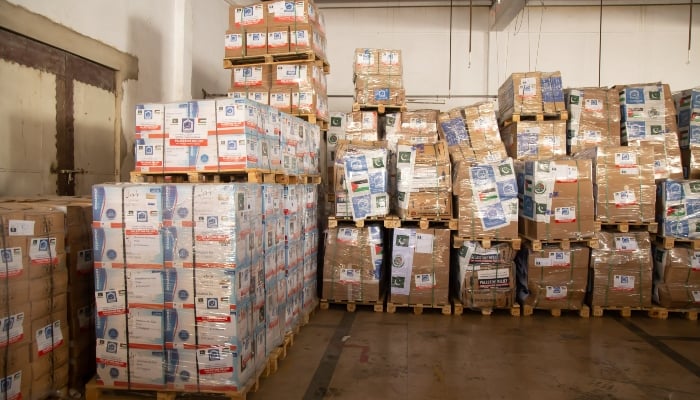
The 400 tonnes of aid consists of “winterized tents, tarpaulins, blankets, medicines and food supplies”.

In a post on X, Dar said the shipment would be received by the Pakistani Ambassador to Egypt at Port Said and handed over to the Egyptian Red Crescent for onward delivery to the people of Gaza.

“Pakistan remains committed to addressing the urgent humanitarian needs of our brothers and sisters in Gaza,” he said.

Since the conflict broke out in Palestine on October 7, 2023, Pakistan has continuously been raising voice against Israeli atrocities and dispatching aid time and again.

Pakistan on April 19 regretted the United States (US) decision to veto the draft resolution seeking Palestine’s full membership of the United Nations (UN), as well as expressed its disappointment on the UN Security Council’s inability to reach a consensus on the matter.

“Pakistan is deeply disappointed by the result of last night’s debate at the UNSC and its inability to reach a consensus and recommend Palestine’s membership to UN General Assembly,” Foreign Office spokesperson Mumtaz Zahra Baloch had said in her weekly press briefing.

“We regret the US decision to veto the draft resolution granting full membership of the UN to Palestine,” she had added.

The Security Council had blocked Palestine’s bid to become a full member of the UN due to a US veto on a widely-supported resolution that would have recommended the granting of such status.

The proposal, submitted to the 15-member Council by Algeria, received 12 votes in favour, with the US casting a negative vote and Switzerland and the United Kingdom (UK) abstaining.

The UNSC resolution had required at least nine votes in favour and no vetoes from its five permanent members — China, France, Russia, the United Kingdom and the United States — to pass.

“We believe, the time has come for admission of Palestine to the UN. This will be a step towards correcting the historic injustice suffered by Palestinians for over 75 years. It will affirm their right to self-determination,” she had remarked.

The spokesperson had said that the people of Palestine had their inherent right to live in a sovereign Palestinian state with the pre-1967 borders and Quds Al-Sharif as its capital.

To a question, she had said the upcoming summit of the Organisation of Islamic Cooperation (OIC) in Gambia would consider several proposals including those on Palestine, Jammu and Kashmir as well as Islamophobia.

The spokesperson had said that during the recent visit of a high-powered Saudi delegation to Islamabad, Foreign Minister Ishaq Dar and his Saudi counterpart Faisal bin Farhan Al Saud had also called for de-escalation, immediate ceasefire, and lifting of the siege in Gaza.

The stumbling block in the implementation of the ceasefire is the Israeli occupation authorities, she had added.

Pakistan rolls out red carpet for Iranian President Seyyed Ebrahim Raisi

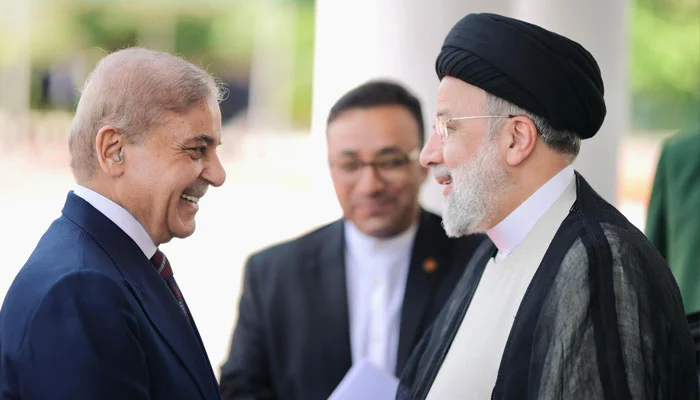
ISLAMABAD: In a major diplomatic development, Iranian President Seyyed Ebrahim Raisi has arrived in Islamabad today on a three-day official visit to Pakistan.

This is the first visit of any foreign leader to Pakistan after the February 8 polls, which will also be watched closely by the United States amid the Iran-Israel tension. However, sources told Geo News that the visit has no relation with the ongoing hostility.

Following his arrival at the Prime Minister’s House to meet with PM Shehbaz Sharif, the Iranian president received a guard of honour from the smartly turned-out contingents of the armed forces.

The premier welcomed the high-profile guest as he arrived at the venue of the formal welcome ceremony after which the national anthems of both countries were played, as the Iranian president stood at the salute dais along with PM Shehbaz.

Later, both President Raisi and the premier introduced their respective delegations to each other before proceeding for the tete-a-tete and delegation-level talks.

During the visit, President Raisi will also meet President Asif Ali Zardari, Chairman Senate Syed Yusuf Raza Gilani, Speaker National Assembly Sardar Ayaz Sadiq and Chief of Army Staff General Asim Munir.

He will also visit Lahore and Karachi and meet with the provincial leadership.

Meanwhile, speaking during a press conference in Tehran before his departure, President Raisi termed Pakistan a “brotherly Islamic country” and underscored historic relations with its government and people.

The president also highlighted that both Islamabad and Tehran have a common position on various global issues including anti-terrorism efforts as well as the violation of human rights in Palestine.

Commenting on his Islamabad trip, Raisi said his visit would see the two sides mulling over various issues including those relating to security, economy and trade.

The Iranian president, expressing the intention to increase bilateral trade to $10 billion, said that Islamabad could benefit from the Iranian market.

The Iranian president, according to Foreign Office Spokesperson Mumtaz Zahra Baloch, will be accompanied by his spouse and a high-level delegation, comprising the foreign minister and other members of the cabinet, senior officials and a large business delegation.

The two sides, during President Raisi’s visit, will have a wide-ranging agenda to further strengthen Pakistan-Iran ties and enhance cooperation in diverse fields, including trade, connectivity, energy, agriculture and people-to-people contacts.

Leaders from both sides will also discuss regional and global developments and bilateral cooperation to combat the common threat of terrorism.

The dignitary, upon his arrival at the Islamabad airport, was received by Federal Minister for Housing and Works Mian Riaz Hussain Pirzada and Pakistan’s Ambassador to Iran Mudassir Tipu.

PM Shehbaz will hold delegation-level talks with Iran’s Raisi at the PM Office after which, the FO shared, a number of memorandum of understanding (MoUs) will be signed between the two sides.

The premier will also host a luncheon in honour of the visiting dignitary.

The FO added that President Zardari will meet his Iranian counterpart at Aiwan-e-Sadr and host a dinner in his honour.

In the second leg of his high-profile visit to Pakistan, Raisi will travel to Lahore where he will meet Governor Balighur Rehman and Chief Minister Maryam Nawaz.

He is also scheduled to visit the mausoleum of Allama Iqbal.

Later, the Iranian leader will travel to Karachi where his meetings are scheduled with Governor Kamran Tessori and Chief Minister Murad Ali Shah.

Raisi will also visit Quaid’s mausoleum in Karachi and pay his respects to the founder of Pakistan.

The foreign leader would stay in Karachi and return to Tehran on Wednesday.

The provincial authorities are on high alert due to the high-profile visit and public holiday has been declared in Karachi on April 23.

US-Israel: Netanyahu vows to reject any US sanctions on army units

“I will fight it with all my strength,” the prime minister said on Sunday.

Earlier, the Axios news site said the US would target Israel’s Netzah Yehuda battalion over alleged human rights violations in the occupied West Bank.

The BBC understands any move would come under a US ban on aid to foreign units credibly implicated in violations.

When asked last week about reports that US military aid to the Israel Defense Forces’ (IDF) units could be cut over allegations of human rights abuses in the occupied West Bank, Secretary of State Antony Blinken said: “I’ve made determinations; you can expect to see them in the days ahead”.

Washington – Israel’s main ally – has never suspended aid to an IDF unit before.

The Israeli military said Netzah Yehuda was operating in accordance with international law.

“Following publications about sanctions against the battalion, the IDF is not aware of the issue,” the military is quoted as saying by Reuters news agency. “The IDF works and will continue to work to investigate any unusual event in a practical manner and according to law.”

Israel’s Defence Minister Yoav Gallant called on the US to withdraw its intention to sanction Netzah Yehuda, saying the world was watching the ties between the US and Israel more closely than ever.

“Any attempt to criticise an entire unit casts a heavy shadow on the actions of the IDF,” a statement from Mr Gallant read, adding “this is not the right path for partners and friends”.

“If anyone thinks they can impose sanctions on a unit of the IDF, I will fight it,” Mr Netanyahu said

On Saturday, Axios cited three US sources with knowledge of the issue as saying that Mr Blinken was expected to announce measures against Netzah Yehuda within days.

It said the move would be over alleged abuses in the West Bank, including one incident in which a Palestinian-American man, 80-year-old Omar Assad, died after being bound and gagged by Israeli soldiers during a search in the West Bank in January 2022.

At the time the US called for a “thorough criminal investigation and full accountability” in the case.

The IDF later said it regretted Mr Assad’s death and that the Netzah Yehuda commander would be “reprimanded”over it. It added that two soldiers would barred from serving in senior positions for two years, but would not be prosecuted. It said Mr Assad’s death had been caused by a pre-existing medical condition.

Mr Assad’s family, many of whom are based in the US, condemned the decision to close the case.

All the alleged violations took place before the 7 October Hamas attack on Israel from the Gaza Strip.

Any decision to bar an IDF unit from US military assistance would be made under the “Leahy Law”, sponsored in 1997 by then-Senator Patrick Leahy. It prevents US funding or training being used for foreign military units credibly implicated in gross human rights violations.

Last year, a group of US officials known as the “Israel-Leahy vetting forum” looked into at least a dozen allegations made against Israeli units, including the Netzah Yehuda battalion, a former senior US official told the BBC.

“We believed that in most cases, these were un-remediated – in other words, the perpetrators had not been properly held to account,” said Josh Paul, former director of the state department’s Political-Military Affairs bureau, which oversees US arms transfers.

“When we tried to advance these recommendations to the secretary [of state] we were never able to get them through the political level,” he added.

Mr Paul resigned from his position in November in protest at what he saw as a lack of accountability over weapons transfers to Israel. Asked whether the recommendations he mentioned had since reached Mr Blinken’s desk, he cited the recent media reports suggesting they had.

Formed in 1999, Netzah Yehuda is a special men-only unit where ultra-Orthodox Jews serve.

Earlier this week, the state department imposed sanctions on Israeli far-right activist Ben Zion Gopstein. It said his organisation, Lehava, had “engaged in destabilising violence affecting the West Bank”.