A Singaporean and Malaysian were arrested in 2008 on drug trafficking charges and sentenced to death two years later

SINGAPORE: A Singapore court on Wednesday rejected appeals by three men sentenced to death for drugs offences despite criticism from the United Nations and rights campaigners.

Roslan Bakar, a Singaporean, and Pausi Jefridin, from neighbouring Malaysia, were arrested in 2008 on drug trafficking charges and sentenced to death two years later.


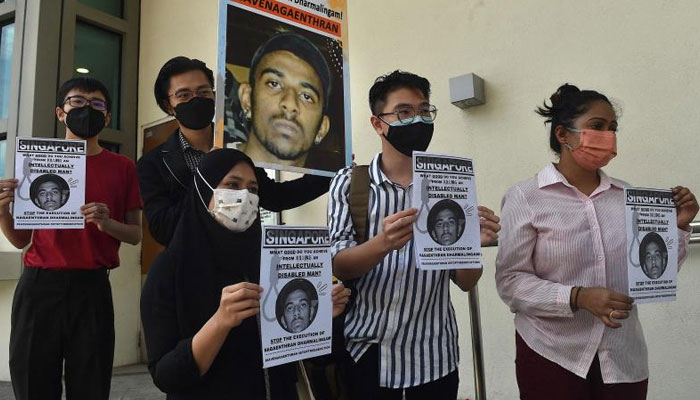
Activists hold posters against the execution of Nagaenthran Dharmalingam, sentenced to death for trafficking heroin into Singapore, outside the Singapore High Commission in Kuala Lumpur on March 9, 2022. — AFP/File

SINGAPORE: A Singapore court on Wednesday rejected appeals by three men sentenced to death for drugs offences despite criticism from the United Nations and rights campaigners.

Roslan Bakar, a Singaporean, and Pausi Jefridin, from neighbouring Malaysia, were arrested in 2008 on drug trafficking charges and sentenced to death two years later.

The appeal of Singaporean Rosman bin Abdullah was also dismissed.

The city-state has some of the world’s toughest anti-narcotics laws and insists capital punishment remains an effective deterrent against crime, despite mounting calls to soften its stance.

High Court Judge Kannan Ramesh, in dismissing the appeals, said no new arguments were raised that were different from earlier pleas that had been rejected and accused the complainants of abusing the court process.

“In this case, the dominant ‘extraneous purpose’ of the applications is the ulterior intention of delaying the imposition of the sentence of death that was passed on the plaintiffs by disrespecting the finality of the judicial process,” the judge said.

Rights activist M. Ravi, who is assisting the legal team representing the three men, said they were considering another appeal.

The UN rights office has urged Singapore to halt the executions, which would be the city’s first since November 2019, saying the death penalty is incompatible with international human rights law.

Rights group Amnesty International has labelled the planned executions “appalling” and urged Singapore to impose a moratorium on the death penalty.

Malaysian rights group Lawyers for Liberty raised concerns that Pausi has an IQ of only 67, which suggests he has an intellectual disability.

His case bears similarities to that of Malaysian Nagaenthran K. Dharmalingam, which has sparked a storm of criticism, with the European Union among those protesting against his punishment.

Sentenced to death in 2010 for trafficking a small amount of heroin into Singapore, Nagaenthran was scheduled to be hanged in November despite concerns he is mentally disabled.

In an 11th-hour plea this month, Nagaenthran’s lawyer asked the Court of Appeal for mercy and that he be examined by an independent panel of psychiatrists.

The court has yet to issue a ruling on the plea.

Earthquake jolts Japan’s northeast coast, cuts power in Tokyo

TOKYO: A strong earthquake with a magnitude of 7.3 jolted Japan’s northeast coast on Wednesday and left hundreds of thousands of residents in Tokyo without power.

The tremor, in the same region devastated by the magnitude 9 temblor 11 years ago that triggered the Fukushima nuclear disaster, occurred at a depth of 60 kilometres, 57 kilometres off the coast, the Japan Meteorological Agency (JMA) said.

It registered as high as a 6-plus on the Japanese shaking intensity scale in some areas — too strong for people to stand — and rattled buildings in the capital.

The JMA issued a tsunami warning for the region of as high as 1 metre (3.28 ft), with public broadcaster NHK reporting waves of 20 centimetres in some places.

Prime Minister Fumio Kishida told reporters his government was assessing the extent of any damage after arriving at his office following the tremor, which shook large parts of Japan.

Tokyo Electric Power Company said that around 2 million households were without power, including 700,000 in the capital, and that it was checking the condition of reactors at Fukushima and other plants, public broadcaster NHK reported.

No damage had yet been reported at those or at oil refineries on the coast, government officials said.

The radiation leak from the Fukushima Daichi nuclear power plant was the worst nuclear crisis since the explosion at the Chernobyl facility in Ukraine a quarter of a century earlier.

Authorities warned residents in Fukushima, Miyagi and Yamagata prefectures to expect aftershocks.

Sitting on the boundary of several tectonic plates, Japan experiences around a fifth of the world’s earthquakes of magnitude 6 or greater.

New Zealand has brought forward plans to reopen its borders to international travellers after a Covid lockout of more than two years.

Australians will be allowed to enter the country without needing to quarantine or isolate from 13 April.

Fully vaccinated travellers from about 60 countries on a visa-waiver list will be able to arrive from 2 May. Those nations include the UK and US.

All arrivals will have to show a negative Covid test.

New Zealand shut its borders in March 2020 as the pandemic spread. They have remained closed, except for a short-lived travel bubble with Australia.

Currently only New Zealand citizens are allowed in and out.

Prime Minister Jacinda Ardern said New Zealand was “ready to welcome the world back”.

“We have now received guidance that it is safe to significantly bring forward the next stage of border reopening work, bringing back our tourists,” she said on Wednesday.

People who already have a visa – but are from outside the visa waiver list – will be eligible to enter the country on 1 May.

While tough lockdowns and virtual isolation helped the country get a reputation as a Covid success story, transmission rates have soared recently.


Many Kiwis are struggling to grasp how their country has gone from fewer than 1,000 cases a day to more than 20,000 daily infections in just a couple of weeks. Ms Ardern had pursued an elimination strategy until October last year.

But New Zealand now has a 95% vaccination rate in the eligible population. It has recorded only 115 Covid deaths since the pandemic began.

Despite some easing of isolation requirements for Covid patients, the country remains in its highest level of restrictions with limits on gatherings and mask mandates in many settings.

Mandates have left unvaccinated people in some sectors without jobs, leading to three weeks of protests in the capital Wellington.

You may also be interested in:


Ukraine president says peace talks more “realistic”.

KYIV/LVIV: Russia and Ukraine both emphasised new-found scope for compromise on Wednesday as peace talks were set to resume three weeks into a Russian assault that has so far failed to topple the Ukrainian government.

Ukraine’s President Volodymyr Zelenskiy said the talks were becoming “more realistic”, while Russian Foreign Minister Sergei Lavrov said there was “some hope for compromise”, with neutral status for Ukraine — a major Russian demand — now on the table.

The Kremlin said the sides were discussing status for Ukraine similar to that of Austria or Sweden, members of the European Union that are outside the NATO military alliance.

Three weeks into the invasion, Russian troops have been halted at the gates of Kyiv, having taken heavy losses and failed to seize any of Ukraine’s biggest cities in a war Western officials say Moscow thought it would win within days.

Ukrainian officials have expressed hope this week that the war could end sooner than expected — even within weeks — as Moscow was coming to terms with a lack of fresh troops to keep fighting.

Talks were due to resume on Wednesday by video link for what would be a third straight day, the first time they have lasted more than a single day, which both sides have suggested means they have entered a more serious phase.

“The meetings continue, and, I am informed, the positions during the negotiations already sound more realistic. But time is still needed for the decisions to be in the interests of Ukraine,” Zelenskiy said in a video address overnight.

On Tuesday, Zelenskiy had hinted at a possible route for compromise, suggesting Ukraine would be willing to accept international security guarantees that stopped short of its longstanding hope for full admission to the NATO alliance.

Keeping Ukraine out of NATO was long one of Russia’s main demands, in the months before it launched what it calls a “special operation” to disarm and “denazify” Ukraine.

“The negotiations are not easy for obvious reasons,” Lavrov told media outlet RBC news. “But nevertheless, there is some hope of reaching a compromise.”


“Neutral status is now being seriously discussed along, of course, with security guarantees,” Lavrov said. “Now this very thing is being discussed in negotiations — there are absolutely specific formulations which in my view are close to agreement.”

Kremlin spokesman Dmitry Peskov said a demilitarised Ukraine with its own army, along the lines of Austria or Sweden, was being looked at as a potential compromise. They are the biggest of six EU countries that are outside NATO.

“This is a variant that is currently being discussed and which could really be seen a compromise,” Peskov was quoted as saying by RIA news agency.

The head of Ukraine’s negotiating team, Zelenskiy’s aide Mykhailo Podlolyak, tweeted ahead of Wednesday’s resumption of talks that Ukrainian military counteroffensives had “radically changed the parties’ dispositions”.

In an intelligence assessment released on Wednesday, Britain said Russian forces were trapped on roads, struggling to cope with Ukrainian terrain and suffering from a failure to gain control of the air.

“The tactics of the Ukrainian Armed Forces have adeptly exploited Russia’s lack of manoeuvre, frustrating the Russian advance and inflicting heavy losses on the invading forces,” it said.

Three million refugees

Europe’s biggest invasion since World War Two has destroyed some Ukrainian cities and sent more than 3 million refugees fleeing abroad.

The streets of the capital Kyiv were largely empty on Wednesday after authorities imposed a curfew overnight. Several buildings in a residential area were badly damaged after what appeared to be a Russian missile was shot down in the early hours of Wednesday, residents and emergency workers said.

There was no immediate word on casualties as a specialist rescue team searched for signs of life amid the rubble. Surrounding streets were covered with broken glass from hundreds of windows shattered in a wide area. What appeared to be a motor from the missile lay twisted on the roadside.

Still, Ukrainian forces have withstood an assault by a much larger army. Zelenskiy said Ukrainian troops had killed a fourth Russian major general in the latest fighting. Reuters was not immediately able to verify his statement.

“The occupiers were not successful today, although they threw thousands of their people into battle, in the north, in the east, in the south of our state. The enemy lost equipment, hundreds more soldiers. A lot of dead Russian conscripts, dozens of officers.”

Ukraine said about 20,000 people had managed to escape the besieged port of Mariupol in private cars, but hundreds of thousands remain trapped under relentless bombardment, many without heating, power or running water.

Deputy Prime Minister Iryna Vereshchuk said it was not clear whether the humanitarian corridor to the city would open on Wednesday. She said 400 staff and patients hostage were being held hostage at a hospital Russian forces had captured in Mariupol on Tuesday.

The prime ministers of Poland, the Czech Republic and Slovenia were due home on Wednesday after an overnight journey out of Kyiv by train. They met Zelenskiy in the Ukrainian capital on Tuesday in the first visit of its kind since the war began, a symbol of the Ukrainian administration’s success so far in withstanding the Russian assault.

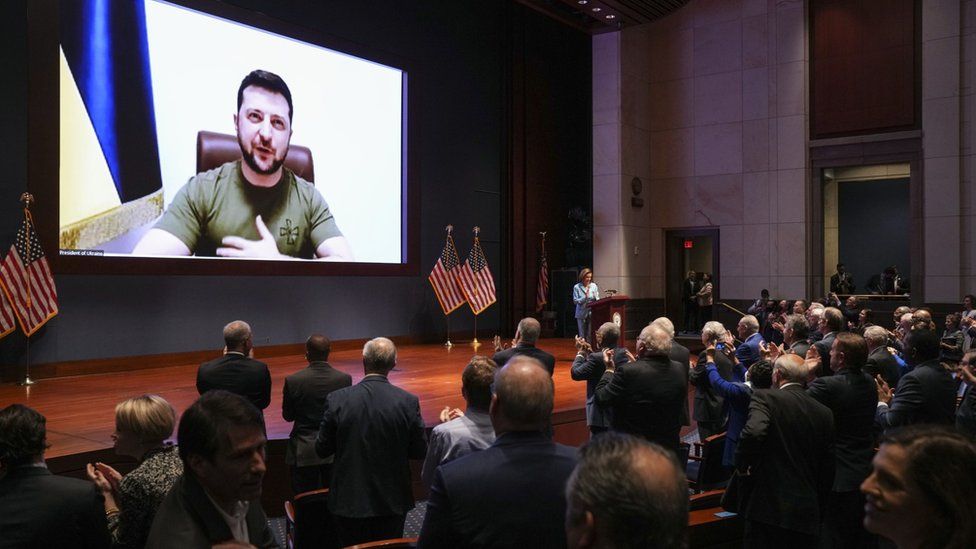
Zelenskiy was due to address the US Congress later on Wednesday by video link, having made similar appearances in parliaments across Europe. The White House said US President Joe Biden would make his first visit to Europe since the invasion next week to discuss the crisis with NATO allies.

The conflict has brought economic isolation upon Russia and the economic cost was fully exposed on Wednesday, as its sanctions-ravaged government teetered on the brink of its first international debt default since the Bolshevik revolution.

Moscow was due to pay $117 million in interest on two dollar-denominated sovereign bonds it had sold back in 2013, but it faces limits on making payments and has talked of paying in roubles, which would trigger a default. read more


Russians grieve for fallen soldiers: Ukraine War

Mikhail Orchikov was deputy commander of a motor-rifle brigade. He was killed in action in Ukraine. Armed Russian soldiers form a guard of honour.

An Orthodox priest walks around the casket reciting prayers and swinging an ornate metal vessel emitting burning incense. The pungent scent fills the chapel, mixing with the sweet cadences of the church choir. The dead soldier’s widow, head covered in a black scarf, is being comforted by relatives.

How many Russian servicemen have been killed in Ukraine? It is a criminal offence in Russia to report anything other than the official figures.

According to information released by Russia’s Defence Ministry, 498 soldiers have lost their lives in what the Kremlin calls its “special military operation”. Those are the latest figures, from 2 March. There has been no update for two weeks.

“The situation in our country isn’t simple,” the priest tells the congregation. “Everyone understands that.”

The Kremlin wants the public to believe that the Russian soldiers in Ukraine are heroes and that Russia’s offensive there is an act of self-defence.

In a recent edition of state TV’s flagship weekly news show, the anchor claimed that if Russia “hadn’t intervened now, in three years’ time Ukraine would have been in Nato… with a nuclear bomb. [Ukraine] would definitely advance on Crimea, then on southern Russia.” An alternative reality, in which Ukraine is the aggressor.

On the streets of Kostroma, many appear to believe the official Kremlin line.

That’s partly due to the power of television in shaping public opinion. But also, at moments of crisis, many Russians instinctively rally around its leader – as if they don’t want to believe that their president may have made the wrong decision.

“Nato wants to set up shop right next to us [in Ukraine] and they’ve got nuclear weapons,” Nikolai tells me. “Well done Putin. He didn’t let them.”

“Russia needs to push on till the end,” declares pensioner Nina Ivanovna.

“How much do you trust the information you’re getting on Russian TV about this?” I ask her. “I trust it. Why shouldn’t I? It’s the internet I don’t trust.”

“Why not?” I ask.

“I don’t know,” she replies.

Not everyone supports Russia’s offensive in Ukraine. In the village of Nikolskoye, I visit the home of Orthodox priest, Father Ioann Burdin. He recently delivered an anti-war sermon and voiced his criticism on the church website.

He was later detained and fined under a new law for discrediting the Russian Armed Forces.

“I believe that any bloodshed, whatever the cause and however you try to justify it, is still a sin,” Father Ioann tells me. “Blood is on the hands of the person who spilled it. If an order was given, it’s on the hands of whoever gave the order, supported it or stayed silent.”

“The worst thing of all is that hatred has appeared. It will grow deeper and deeper, because we can see that the situation [with Ukraine] isn’t ending. There is no political will to stop this. Hatred on both sides will strengthen and become a wall between our peoples for decades to come.”

At a cemetery in Kostroma, eight soldiers bear Mikhail’s coffin to the grave. A military band plays solemn music. Then a gun salute and, to the Russian national anthem, the casket is lowered into the ground.

There is a brief speech: “The loss of a son, brother, father is always a tragedy, but we are proud that he died defending our people, our children, our country.”

In Kostroma, they call Mikhail “a defender of the Fatherland”.

And yet it was Russia’s army that crossed the border into a sovereign nation and attacked Ukraine on the orders of President Putin. The Kremlin leader claims that the aim of his “special military operation” is to “demilitarise and de-Nazify” Ukraine, as if the Ukrainian government is overrun with fascists – which is simply not true.

In recent days Russian officials have barely concealed their wider objectives. The Russian Foreign Minister Sergei Lavrov has said that what’s happening in Ukraine “…is a life-and-death battle for Russia’s right to be on the political map of the world with full respect for their legitimate interests”.

In other words, this is about geopolitics, and Moscow’s determination to force Ukraine back into Russia’s sphere of influence.

That’s something the government is Ukraine is determined to prevent.

US President Joe Biden has labelled Russian leader Vladimir Putin a “war criminal” in a move likely to escalate diplomatic tensions even further.

Mr Biden delivered the remark off-the-cuff in response to a reporter’s question at the White House.

It is the first time he has used such language to condemn President Putin, and the White House later said he was “speaking from his heart”.

The Kremlin, however, said it was “unforgiveable rhetoric”.

“We believe such rhetoric to be unacceptable and unforgivable on the part of the head of a state, whose bombs have killed hundreds of thousands of people around the world,” spokesman Dmitry Peskov told Russian state news agency Tass.

The exchange in Washington happened Wednesday when a reporter asked the US president: “Mr President, after everything we have seen, are you ready to call Putin a war criminal?”

The President replied “no” before being challenged, and then changed his reply: “Did you ask me whether I would tell ….? Oh, I think he is a war criminal.”

White House Press Secretary Jen Psaki later said the president had been speaking from his heart after seeing “barbaric” images of the violence in Ukraine, rather than making any official declaration.

She noted that there was a separate legal process, run by the State Department, to determine war crimes – and that was ongoing separately.

The president’s official Twitter account posted: “Putin is inflicting appalling devastation and horror on Ukraine – bombing apartment buildings and maternity wards… these are atrocities. It is an outrage to the world.”

One by one, diplomatic bridges between the United States and Russia are being set ablaze.

Mr Biden’s statement was an odd one, albeit not out of keeping for a politician who has a history of making monumental policy shifts in seemingly off-the-cuff remarks (see, for instance, his comments on gay marriage in 2012).

After initially telling a reporter he did not think Mr Putin was a criminal, he came back and reversed himself. If there had been an internal debate at the White House over how to handle the growing calls in Congress and the press to condemn Mr Putin in this way, the president settled it in an aside, not a set-piece speech.

This, of course, will make it harder for Mr Biden and his administration to work with the Russians going forward. Every concession or negotiated agreement, on whatever topic, will invite the rejoinder: How can you associate with a criminal?

Perhaps Mr Biden, in his comments, was simply acknowledging the new reality – that the world’s political order has irrevocably shifted, and there’s no going back to the way things were.

It came after a busy day of political theatre in both the US and Russia over Ukraine.

Ukrainian President Volodymyr Zelensky earlier gave a speech by video link to the US Congress, receiving a standing ovation. Hours later, Mr Biden approved additional weapons aid for Ukraine, bringing the total US contribution to $1bn (£760m).

On the other side of the world, President Putin also gave a televised speech laden with anti-Western rhetoric.

He accused the West of trying to divide Russia with lies, and railed against those he called “traitors” inside of Russia.

“Of course they will try to bet on the so-called fifth column, on traitors – on those who earn their money here, but live over there. Live, not in the geographical sense, but in the sense of their thoughts, their slavish thinking,” Mr Putin said.

The term “fifth column” is often used for a group that tries to undermine a nation or organisation from the inside.

“Any people, and especially the Russian people, will always be able to distinguish the true patriots from the scum and the traitors, and just to spit them out like a fly that accidentally flew into their mouths,” Mr Putin said. Such a “self-purification” of society would strengthen Russia, he added.

Mr Putin also accused the West of trying to provoke civil conflict with the goal of “the destruction of Russia”.

His speech was greeted with concern by some Russia-watchers and journalists.

Tatiana Stanovaya, a political analyst, told the New York Times that Mr Putin was signalling authorities across Russia to target “all spheres of society that show any sympathy to the Western way of life”.

Mikhail Kasyanov, a former Russian Prime Minister who also worked in Mr Putin’s first government before becoming one of his fiercest critics, tweeted that Mr Putin “is intensifying his actions to destroy Russia”.

He is “essentially announcing the start of mass repressions against those who don’t agree with the regime,” Mr Kasyanov wrote. “This has happened in our history before, and not only ours.”

Ukraine’s president invoked the horror of the 2001 terror attacks on the US as he pleaded for more military aid in a historic address to the US Congress.

Volodymyr Zelensky said via video link that Ukraine was enduring a 9/11 every day as it battled Russian forces.

He again urged the US and Nato allies to enforce a no-fly zone over Ukraine, saying: “I need to protect the sky.”

US President Joe Biden is later set to sign off an extra $800m (£612m) in military aid to Ukraine.

Mr Zelensky urged the assembled US politicians to remember coming under attack in the past – at Pearl Harbor in 1941 and on 11 September 2001 – saying Ukrainians were experiencing the same thing every day.

“In your great history, you have pages that would allow you to understand the Ukrainian history. Understand us now,” he said.

He also referenced US civil rights leader Martin Luther King’s famous speech: “I have a dream, these words are known to each of you – today I can say I have a need. I need to protect the sky,” he said.

The Ukrainian leader also showed a video of missile strikes on his country’s cities and the resulting dead and wounded people.


He has repeatedly called on Nato to impose a no-fly zone over his country’s airspace, but Nato has refused.

A no-fly zone over Ukraine would mean that Nato forces would have to engage directly with any Russian planes spotted in those skies and shoot at them if necessary.

As an alternative to a no-fly zone, Mr Zelensky pleaded for air-defence systems and aircraft.

He has previously asked the US and the EU for Polish MiG-29 fighter jets, but this has been rejected by Mr Biden over fears this would pull Nato members into the war.

Addressing President Biden directly in English, President Zelensky said: “I wish you to be the leader of the world. Being the leader of the world means being the leader of peace.”

Volodymyr Zelensky again demonstrated he had a firm grasp on how to plead his nation’s case to a foreign audience in a language they could understand – both literally and figuratively.

Speaking to the British Parliament last week, the Ukrainian president referenced Winston Churchill. In his video address to Congress on Wednesday, Zelensky compared his nation’s daily aerial bombardment to Pearl Harbor and September 11.

He also mentioned the carvings of US presidents at Mount Rushmore and Martin Luther King Jr’s I Have a Dream speech – saying his nation had a “need” for more US assistance.

The American public has been transfixed by video footage of the Russian onslaught, and Zelensky used sometimes graphic images of dead and injured children and bombed cities to drive home his request to “close the skies” to Russian attacks.

Then the former actor made one final gesture of theatrical flair, ending his speech in English, framing the fight in Ukraine as a battle for the values of Europe and the world.

When the stakes are framed this way, Zelensky may hope, it will be difficult for the US and its allies to say no.

After the speech, House Speaker Nancy Pelosi tweeted that it had been a “distinct privilege” to hear from the Ukrainian president, and that the US was “unwavering in our commitment to the people of Ukraine as they courageously defend democracy”.

The $800m in funding set to be signed off later will go towards anti-armour and anti-aircraft weapons, such as Stingers and Javelins, US media report.

The funding is covered by a spending bill on humanitarian, defensive and economic assistance to Ukraine that was approved by Congress last week.

In the past year, the Biden administration has provided $1.2bn in weapons for the country, including Mi-17 helicopters, patrol boats and small arms such as grenade launchers and machine guns, the New York Times reports.

On Wednesday, attacks by Russian forces continued in cities and towns across the country:

  • in the capital Kyiv, a 12-storey residential building was hit by shelling
  • in Kharkiv, Ukraine’s second largest city, two people died when shelling hit a multi-storey apartment block, the emergency services said
  • in Zaporizhzhia, officials say missiles struck a train station and a public park
  • about 400 staff and patients remain trapped inside a hospital that has been captured by Russian forces in the besieged southern city of Mariupol. The International Committee of the Red Cross described the situation there as a “waking nightmare”

Meanwhile, Nato defence ministers are meeting in Brussels to discuss their response to the invasion.

Mr Biden is expected to travel to Brussels next week to meet Nato allies and participate in a summit of European Union leaders.

The US president will “discuss ongoing deterrence and defence efforts,” and reaffirm his country’s commitment to its Nato allies, White House press secretary Jen Psaki has said.

On Tuesday, the prime ministers of Poland, Slovenia and the Czech Republic met Mr Zelensky in the evening as a curfew began in the Ukrainian capital, Kyiv.

Afterwards, the Czech leader told Ukrainians that they were “not alone”. The group are the first Western leaders to visit Ukraine since Russia invaded last month.

Diesel prices in the UK rose by an average of more than 2p in a day as Russia’s invasion of Ukraine continues to affect global oil costs.

The fuel jumped to a record £1.76 per litre on Tuesday, up from almost £1.74 on Monday.

Petrol prices, which have also increased to record highs, rose to almost £1.65p a litre from about £1.64.

The continuing price rises come amid warnings of potential global oil supply problems.

Recent rises in the global price of oil has pushed up prices at the pumps in the UK, but there are hopes recent falls will transfer to cheaper fuel.

Simon Williams, fuel spokesman for the RAC, said drivers could save almost 4p a litre by buying their fuel at one of the big four supermarkets, where the average for petrol is 161p and 171p for diesel.

“We continue to remain hopeful that retailers will soon start to pass on recent reductions in the price of wholesale fuel to drivers when they next buy supply. That ought to lead to petrol stabilising at around 160p while diesel ought to stay where it is based on current wholesale prices,” he said.

The British Retail Consortium (BRC), whose members include major supermarkets which sell fuel, has said retailers understand the cost pressures facing motorists.

Andrew Opie, of the BRC, said they would do everything they could to offer the best value-for-money across petrol forecourts.

The International Energy Agency (IEA) said high commodity prices and sanctions against Russia for its invasion of Ukraine were “threatening to create a global oil supply shock”.

It estimated three million barrels per day of Russian oil could be taken out of the global market as a result of international sanctions.

The agency warned only Saudi Arabia and United Arab Emirates have enough spare production capacity to offset the shortfall in Russian output, which it said was the largest oil exporter in the world.

Russia continues to export oil for the time being due to deals and trades made before Moscow sent its troops into Ukraine, the IEA said. New business has all but dried up, however, because many Western countries are seeking alternative fuel supplies.

Some countries, such as the US and Canada, have banned Russian oil imports, but by contrast, the EU, which is much more reliant on Russian energy, has stopped short of a ban.

Meanwhile, the UK has said it will phase out imports of Russian oil in response to Russia’s actions by the end of the year.

Prime Minister Boris Johnson has travelled to discuss energy security and other issues in Saudi Arabia and the United Arab Emirates.

The IEA said the world was “faced with what could turn into the biggest supply crisis in decades”, with global energy markets “at a crossroads”.

It added the “implications of a potential loss of Russian oil exports to global markets” could not be understated.

“Russia’s invasion of Ukraine has brought energy security back to the forefront of political agendas as commodity prices surge to new heights. While it is still too early to know how events will unfold, the crisis may result in lasting changes to energy markets,” it said.

The price of Brent crude oil – the global benchmark for prices – hovered around $100 per barrel on Wednesday, having previously reached record highs of more than $130 a barrel in the immediate aftermath of Western countries hitting Russia with sanctions.

The UK only imports about 6% of oil from Russia, but is affected by the global shifts in price which are driven by supply and demand forces.

RAC fuel spokesman Mr Williams said UK fuel prices had increased at the fastest rate on record, with petrol rising 13p since the start of the month and diesel increasing by nearly 21p.

He said a full tank of unleaded for a family car was now almost £91 on average.

‘Drivers need a break’

UK motoring groups have said fuel prices are likely to fall as global oil prices stabilise.

Yet, there is a concern some retailers might be reluctant to lower their prices for fear of being caught out if wholesale costs jump back up again.

“The big question is how keen will retailers be to pass on those savings at the pumps as they will no doubt be extremely conscious of protecting themselves from any more rises that could suddenly materialise,” said Mr Williams.

“Drivers badly need a break from these relentless daily rises.”

The RAC has called on the chancellor to cut fuel duty or VAT in his upcoming Spring Statement.

Doctors who died during the Covid pandemic have been remembered with a sculpture unveiled in their honour.

The names of 50 doctors who died caring for patients were read at a memorial service in London organised by the British Medical Association (BMA).

More than 80% of the doctors who were remembered at the event were from ethnic minorities, the BMA said.

Its council chairman, Dr Chaand Nagpaul, said the sculpture would stand in memory of their bravery.

Sculptor Richard Tannenbaum said his stone piece of a continuous loop showed the public are “inextricably linked” with NHS workers who lost their lives caring for them.

Dr Nagpaul said: “It’s a cruel tragedy in saving the lives of tens of thousands of patients, so many doctors lost their own. Their deeds will inspire generations long after the pandemic had passed.”

He added the country owed a “debt of gratitude” to doctors from overseas who died working in the UK.

“They continued to work through the crisis, some separated from families also at risk in other parts of the world,” he said.

“The pandemic has brought into sharp focus the immeasurable and vital contribution of our multicultural workforce to our nation.”

Pamela Foley, whose husband Mr Amged El-Hawrani died in March 2020, said the service was a “crucial opportunity” to acknowledge the selflessness of health workers who died.

She said: “I also feel that this memorial allows me and my family to reclaim part of the experience we lost when we were prohibited from a traditional funeral and memorial service.”

Sculptor Richard Tannenbaum said the sculpture shows the link between the public and NHS workers

BMA president Prof Neena Modi said she understood the anger of families and welcomed the government’s decision to include in its Covid inquiry discussion of how the UK will protect its workforce in the future and maintain personal protective equipment (PPE) stocks.

She said: “Those who care, deserve to be cared for as well.”

A minute’s silence was also observed at the service – attended by family and friends of the doctors – at the BMA’s headquarters in Tavistock Square, central London.


Labour has called for a guarantee that Boris Johnson did not intervene with the security services, to ensure Evgeny Lebedev was given a peerage in 2020.

The Sunday Times claimed security services removed its warning that the Russian-born businessman posed a risk after the prime minister got involved.

Mr Johnson has denied the report.

But at Prime Minister’s Questions, Angela Rayner called for further assurances from the deputy prime minister about the PM’s actions.

Addressing Dominic Raab – who was standing in for Mr Johnson while he visits Saudi Arabia – she said: “There is no ifs or buts when it comes to the safety of the British people.

“So I ask the deputy prime minister, can he guarantee that the prime minister never asked anyone to urge the security services to revise, reconsider or withdraw their assessment of Lord Lebedev of Hampton and Siberia?”

Mr Raab called the “suggestion” she was making “sheer nonsense”, and defended the Conservatives’ record on security issues.

Lord Lebedev has denied posing a “security risk” to the UK, writing an article in the Evening Standard newspaper – which he owns – saying: “I am not some agent of Russia” and that he was “proud to be a British citizen and consider Britain my home”.

The son of billionaire Russian banker and former KGB officer Alexander Lebedev, he moved to the UK as a child, and has condemned President’s Putin’s actions in his newspaper, writing: “I plead with you to stop Russians killing their Ukrainian brothers and sisters.”


Ms Rayner, who was standing in for Labour leader Sir Keir Starmer, pointed to newspaper reports that claimed British intelligence warned against granting a peerage to Lord Lebedev on 17 March 2020.

She then claimed that despite the concerns, the prime minister visited Mr Lebedev at his home in London 48 hours later and then made the appointment in July.

“The central duty of any government is to keep the British people safe,” she said.

“There are now widespread reports that the prime minister did not accept warnings from our own intelligence services, granting a Russian oligarch – the son and business partner of a KGB spy – a seat here in this Parliament.

“It shouldn’t matter if such a warning was about a close personal friend of the prime minister, it shouldn’t matter if he gave the prime minister thousands of pounds of gifts, and it shouldn’t matter how much champagne and caviar he serves.”

Putin critics

Mr Raab said it was down to the House of Lords’ Appointment Commission to vet any prospective peers after they are nominated by the PM.

But he said peerages were given out “in recognition of what [someone’s] contribution is to society”, adding: “I should say that includes those of Russian origin who contribute brilliantly to our nation, many of whom in this country are critics of the Putin regime.”

The deputy PM also attacked Labour’s record on security, pointing to the former party leader Jeremy Corbyn and his stance on the armed forces and Nato.

“A Labour government would put at risk our security,” he said. “We are doing everything to protect it.”

Evgeny Lebedev is very well connected. He owns the Evening Standard and Independent newspapers, is friends with the prime minister and made George Osborne editor of the Evening Standard after he left government.

Lord Lebedev was in the room when Boris Johnson and Michael Gove decided to back Brexit. Mr Johnson attended his party the day after winning a majority in the general election – and there are various reports of him attending other parties hosted by the Lebedev family.

Mr Lebedev has urged an end to the war in Ukraine. Those who know him say he is more likely to chat about his favourite authors, Leo Tolstoy or Fyodor Dostoevsky, than Russian politics. He has British citizenship, owns companies here and has a keen interest in the arts.

His father Alexander, however, is a former KGB spy. He made vast amounts of money after the fall of the Soviet Union. For some time, that has raised concerns among politicians in Westminster.

The decision to grant Lord Lebedev a peerage was hugely controversial. The prime minister has faced questions about whether he intervened to ensure it happened after concerns were reportedly raised by security services. There have been calls for the Intelligence and Security committee – which has access to classified material – to investigate. Labour has also urged the House of Lords Appointments Committee to publish details of the vetting process.

But Lord Lebedev himself used his Evening Standard newspaper to hit back last week. He said he was a proud British citizen, adding: “I am not a security risk to this country, which I love. My father a long time ago was a foreign intelligence agent of the KGB, but I am not some agent of Russia.”