
Germany mulling Israeli anti-missile shield purchase

Germany is looking at buying an Israeli anti-missile shield system that could also offer protective cover for neighbouring EU states, Chancellor Olaf Scholz said Sunday.

“I can reveal to you that that is certainly among the things that we are discussing, and for good reasons,” Scholz told state television channel ARD.

The chancellor’s comments confirmed earlier statements from German parliamentary sources earlier Sunday.

“We must better protect ourselves against the Russian threat,” Andreas Schwarz of the SPD, who sits on the parliamentary budget committee, told Bild daily. “To do that, we need quickly an anti-missile shield for Germany.

“The Israeli Arrow 3 system is a good solution,” he added, referring to the long-range missile deterrence weapon.

According to Bild, the system, which costs two billion euros ($2.2 billion), could be operational from 2025.

The corresponding radar system would be installed in three sites in Germany, and their monitoring data then transmitted to a central site where soldiers would be watching for threats 24/7.

If a rocket attack is uncovered, an Arrow 3 would be sent up to intercept the missile in space, destroying it there.

The radar system is so powerful it can provide cover for Poland, Romania and the Baltic nations, said Bild.

“We can put the ‘Iron Dome’ over our neighbouring countries. We would then play a key role for the security of Europe,” said Schwarz.

Marie-Agnes Strack-Zimmermann, who chairs the parliamentary defence committee, confirmed that Berlin was mulling the purchase.

“Given the threat situation and the different weapons systems that Russia has, of course you have to look at that, so in that sense it makes sense,” she told Welt newspaper.

After years of under-investment in defence, Germany has announced a dramatic U-turn, shaken by Russia’s assault on its neighbour.

Scholz on February 27 in a landmark speech said Germany would earmark a special budget of 100 billion euros to bolster its defence capabilities.

He also said Berlin would spend more than two percent of its output a year on defence, outstripping NATO’s target of two percent which Germany has consistently failed to meet.

In Chernihiv, civilians are trapped as hospitals and schools attacked

The strikes are so frequent that Anna and her husband take turns in watching the sky. He does the nights, she does the mornings. “The attacks are extremely loud. The building and windows shake a lot,” she said. It is impossible to sleep. “Only when you’re exhausted, because your brain just turns off.”

The couple, and probably everyone else left in Chernihiv, spend most of their time hiding behind thick walls. “Thank God we have them,” Anna said. Their son, who is 12, rarely ventures outside. “He’s in panic. Many children are afraid of going out.”

Chernihiv, located on the banks of the Desna River, was one of the first targets for Russian troops who invaded Ukraine from Belarus, hoping to quickly reach the capital Kyiv, just 144km (90 miles) to the south. A month on, that has not happened, and they have now effectively surrounded the city.

Civilians are trapped with no running water, electricity and heating, and under relentless bombing and shelling. And like Mariupol, the besieged city on the Sea of Azov that has seen the worst of Russia’s brutality, very little seems to remain untouched.

Hospitals. Schools. A cinema. The stadium. Historic and residential buildings. All attacked, Anna said.

“They hit [sites] two times in a row. It’s obvious they do it on purpose,” she said. “Most of the city suburbs are completely destroyed.”

A number of residential areas in Chernihiv have been heavily damaged by Russia’s attacks

Olena, another resident, said the only thing still standing from the cinema was its façade. “It’s destroyed. Totally. I saw it with my own eyes”.

“In the suburbs, there were only private buildings. My friends say they are all totally destroyed,” Olena said. (The names of the civilians interviewed for this story have been changed to protect their identities as they remain in the city.)

Most days, Olena walks, sometimes for more than an hour, in search of drinkable water. She often has to endure long queues, as people bring bottles and buckets at distribution points organised by the city council. Supplies are running out, and each person is allowed to have only 10 litres.

Without electricity, the only way for her and others to charge their phones and power banks is when one of her neighbours lets them use his generator. Gas has also been cut, meaning there is no heating. “We don’t even talk about it,” she said, “because it’s now part of our routine”.

Vladyslav Chaus, the governor of Chernihiv state, said half of the city’s population of 280,000 had left since the start of the war. After Russia bombed a bridge on a road to the capital last week, Chernihiv had been “cut off”, he said, and residents had nowhere to go, including those requiring treatment for wounds caused by the attacks. “There is no safe way out.”

Russia was attacking the city “every 10 or 15 minutes”, Chaus said, and civilian facilities were being hit “on purpose”. “They have targeted residential buildings, schools, hospitals, kindergartens and the stadium,” he said. It is difficult to independently verify information in Chernihiv, although residents’ accounts, pictures and satellite images corroborate some of his claims.

Mariia, who remains in the city, said she believed there was no area that had not been hit. “A lot of hospitals and schools were attacked,” she said. “A school was attacked twice in a single week.”

Russia has denied targeting civilian sites in Ukraine. But its attacks on countless apartment blocks and other non-military facilities have been well documented across the country.

In a single attack on 3 March, 47 people including nine women were killed as they gathered in a small square in the city, the state government said. Human rights group Amnesty International said the attack was mostly likely a Russian air strike in which at least eight unguided aerial bombs, known as “dumb bombs”, were used.

“Amnesty International was not able to identify a legitimate military target at, or close to, the scene of the strike,” the group said. “[We believe] the majority of victims were queuing for food when the missiles struck.”

Chaus, the governor, said about 200 people had already died in Chernihiv, probably an underestimate. Some bodies were believed to remain under the rubble of collapsed buildings, he said, and “we’re still trying to collect them”.

Mariia’s family live in constant panic. “We stay in the bunker all the time,” she said. “We hear the attacks very well.”

Anna said she was in “survival mode”. “I’m just very focused. I know when there is bombing I need to get into a safer place,” she said. “I no longer have fear.”


Israel Attack: Two police officers have been shot dead in an attack in the northern Israeli city of Hadera.

Police said the gunmen were Israeli Arab citizens. They were shot dead by undercover officers.

The Islamic State (IS) group said it was behind the attack in a statement posted on social media.

One of the assailants in the latest incident tried to join IS and officials are looking for connections between the attacks, Haaretz reports.

Four other people were taken to hospital after the attack in Hadera, and two others were treated at the site of the shooting.

Police said counterterrorism officers happened to be in a restaurant near the shooting and brought the attack to an end.

“Our officers managed to neutralise the assailants and prevent a bigger terrorist attack,” national police spokesman Eli Levy told Israeli TV.

The Islamic State group’s claim of responsibility is unusual – the intelligence group SITE said it was the first time it had taken credit for an attack in Israel since 2017.

Sunday’s incident occurred as Israel hosts an historic summit with three Arab League states with which it has normalised ties, as well as Egypt and the US.

Israel’s Foreign Minister Yair Lapid said that all his counterparts at the meeting had condemned the attack. However, it was praised by the Hamas militant group which governs Gaza as a “heroic operation”.

There have been several recent attacks amid concerns that tensions are rising ahead of religious holidays.

Over the past week, US President Joe Biden has made a series of unscripted remarks that have upped the temperature of US-Russia relations to near boiling point.

However, his ad-libbed line at the end of what was billed as a “major speech” in Poland on Saturday – seemingly calling for President Vladimir Putin to be removed from power – may have landed the hardest.

In his speech to a crowd of assembled Polish government officials and dignitaries at the Royal Castle in Warsaw, the US president once again warned that the world was in the midst of an era-defining conflict between democracies and autocracies.

He pledged that Nato would defend “every inch” of its member states’ soil. He also promised continued support to Ukraine, although he noted that the US military would not engage with Russian forces there.

It was a confrontational, but measured, speech – well in line with what US officials, from Secretary of State Antony Blinken on down, have been saying for months.

Then, right before the “thank yous” and “goodbyes”, Mr Biden added of his Russian counterpart: “For God’s sake, this man cannot remain in power.”

Cue the fireworks.

“This speech – and the passages which concern Russia – is astounding, to use polite words,” Russia spokesperson Dmitry Peskov said. “He doesn’t understand that the world is not limited to the United States and most of Europe.”

And the US walk-backs.

“The president’s point was that Putin cannot be allowed to exercise power over his neighbours or the region,” a Biden administration official said on background. “He was not discussing Putin’s power in Russia, or regime change.”

The speed with which the US issued its “clarification” – later echoed by Mr Blinken – suggests the US understands the danger inherent in Mr Biden’s words.

Earlier in the day, the US president had called Mr Putin a “butcher”. Last week, he seemed to get ahead of his own administration’s diplomatic process by accusing the Russian leader of war crimes. In both cases, Mr Biden’s remarks prompted condemnations and warnings from Moscow that US-Russia diplomatic relations were being frayed to the point of breaking.

There’s a line between condemning a nation’s leader – the sometimes overheated rhetoric of diplomacy – and calling for his removal. It was a line both the Americans and the Soviets respected even at the height of the Cold War. And it is a line that Mr Biden had apparently crossed.

“Regime change” is something powerful countries are accused of imposing on weaker ones – not what one nuclear-armed nation demands of another.

By Sunday, even some US allies were attempting to distance themselves from Mr Biden’s remarks.

French President Emmanuel Macron warned that the US president was putting ceasefire negotiations between Russia and Ukraine in jeopardy.

“We want to stop the war that Russia has launched in Ukraine without escalation,” he said. “If this is what we want to do, we should not escalate things – neither with words or actions.”

In Washington, congressional leaders were also expressing concern. Idaho Republican Jim Risch, the senior Republican on the Senate foreign relations committee, called Mr Biden’s remarks a “horrendous gaffe”.

“My gosh, I wish they would keep him on script,” he said. “Any time you say or even, as he did, suggest that the policy was regime change, it’s going to cause a huge problem. This administration has done everything they can to stop escalating. There’s not a whole lot more you can do to escalate than to call for regime change.”

A history of off-the-cuff remarks

Mr Biden has a well-known propensity for making off-the-cuff remarks that can land him in difficult situations. They’ve derailed past presidential bids and occasionally frustrated Obama administration officials when he was vice-president. Those lines are not entirely accidental, however. They can reveal where Mr Biden’s heart lies, even if his head – and the heads of those around him – might prefer he hold his tongue.

That, at times, is a political strength, writes The Atlantic’s Tom Nichols, allowing Mr Biden to authentically connect with the emotions of the American people. But, in this current moment of diplomatic crisis – when poorly chosen words can lead to consequential actions – they’re also a weakness.

“It is hard to blame Biden for giving in to his famous temper after talking to the people who have suffered from Putin’s barbarism,” Mr Nichols writes. “But the words of every world leader matter right now, and none more than those of the president of the United States.”

Mr Biden may believe that US-Russia relations are damaged to the point that they will not be repaired while Mr Putin is in power. Explicitly saying so, however, could make the immediate US goal – ending the war in Ukraine while preserving the nation’s territorial integrity – more difficult.

The war in Ukraine is not going the way Mr Putin intended so far. His army is bogged down in bitter fighting and casualties are growing. His economy is straining under the weight of economic sanctions. Russia is increasingly isolated from the rest of the world.

The situation has potential to lead to the de-escalation the US and its allies are calling for – but it also could make Mr Putin more desperate. And if the Russian leader believes his power is at stake, and believes the US is not-so-secretly making that an objective of its efforts, the turn the crisis takes from here may not be one toward peace.

Global oil prices have fallen as China starts to implement a city-wide lockdown in Shanghai, an important financial and manufacturing hub.

Brent crude lost more than $5 a barrel on concerns that the move would mean that demand for oil will fall.

The Shanghai Composite stock index fell in early trade before regaining most of the losses later in the day.

The lockdown, which began on Monday, is China’s largest since the coronavirus outbreak began more than two years ago.

The futures contract for Brent crude – an international benchmark for oil prices – was down by 4.2% at $115.50.

Despite the fall, oil remains almost 80% higher than it was a year ago after the war in Ukraine helped to drive up prices.

Traders were concerned about the effectiveness of China’s zero-tolerance policy towards Covid, said Stephen Innes, managing partner at SPI Asset Management.

‘Tip of the iceberg’

Mr Innes also said in a note to investors that there were expectations of further supply chain disruptions as well as a fall in demand.

“We might be only dealing with the tip of the iceberg,” he said.

However, Dan Wang, chief economist at Hang Seng Bank China, does not expect the lockdown to have a major impact on supply chains.

Most factories continue to operate as usual, and workers are either being confined on-site or given priority for testing, the Shanghai-based economist told the BBC.

“The suburbs are controlled quite well and quite tightly,” she said. “Supply chain stability is a priority in this round.”

She added that, given the spike in Covid cases, there were expectations of more government stimulus and interest rates could be lowered “quite significantly” in the coming days.

As long as they are passed on by banks, lower interest rates make it less costly for businesses and individuals to borrow money.

Meanwhile, the Shanghai Composite stock index opened lower on Monday before rebounding to trade down by just 0.3% in Asia afternoon trade.

Until now, Chinese authorities had resisted locking down the city of almost 25 million people to avoid destabilising the world’s second largest economy.

The city will be locked down in two stages over nine days while authorities carry out Covid-19 testing.

The key financial centre has battled a new wave of infections for nearly a month, although case numbers are not high by some international standards.

It comes after lockdowns in China affected tens of millions of people across the country earlier this month, including the entire Jilin province and the technology hub of Shenzhen.


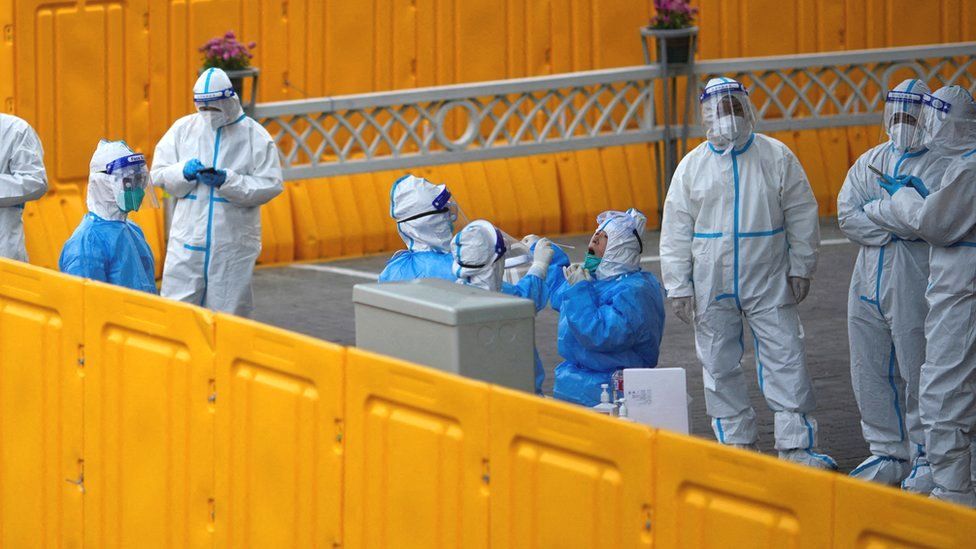
Shanghai’s public transport has been suspended and firms and factories in the city have been ordered to halt operations or work remotely.

The lockdown will take place in two stages, starting on Monday with the eastern side of Shanghai, which includes the city’s financial centre.

From Friday, the western side of Shanghai is scheduled to go into lockdown.

This staggered approach means that half of the city will be able to remain open.

Some businesses had already stopped operating in Shanghai, which has been battling a new wave of Covid infections for nearly a month.

Last week, the Shanghai Disney Resort said it would close until further notice, citing the “current pandemic situation”.

“We will continue to monitor the pandemic situation and consult local authorities, and will notify guests as soon as we have a confirmed date to resume operations,” it said.

China’s financial capital, home to almost 25m people – Shanghai is now a divided city.

Everyone east of its main river is now locked down. Another round of mass testing has started.

By the week’s end the western half of the city will be shut.

Public transport is being closed and the city sealed off. Anyone leaving needs to show a negative test.

It is all part of a huge effort to try to stop the spread of a resurgent virus that China’s leaders thought they had banished.

Anyone testing positive here is sent to hospital or forced quarantine.

As the numbers continue to rise China’s insistence on a zero-Covid strategy is being tested – but also subtly adapted.

Sooraj Kumar is back with his family in Babuapur village in the central Indian state of Uttar Pradesh.

The 26-year-old was one of the more than 18,000 Indian students studying medicine in Ukraine who were evacuated after the war began. Mr Kumar was in a medical school in Uzhhorod for the past six years and would have qualified as a doctor in three months.

Mr Kumar now stares at an uncertain future – he is unable to continue his studies or find a place in Indian colleges.

The dream of becoming a doctor for thousands of young Indians begins from small towns and villages. But aspirants have always far outnumbered the vacancies available at affordable government-run colleges. Private medical colleges are accessible to only those who can afford very high fees.

In 2021, over 1.5 million students appeared for qualifying exams to government colleges, but less than 6% managed to get admission.

According to Public Health Foundation of India, a think tank, only one out of every 11 candidates in 2014 got into medical colleges. Last year, the number had increased to one out of every 19 candidates.

‘Dismal results’

“So you have an increase in the number of people wanting to be admitted, but the seats have not risen proportionately. As a result a large number of students look for outside avenues” says president of the foundation, K Srinath Reddy.

A farmer’s son, Mr Kumar was studying to be the first doctor not just in the family, but in his entire village.

Since he could not get admission in a government college, heading to Ukraine was the next affordable option.

“I would have had to pay nearly $150,000 (£113,000) in a private Indian medical college, but in Ukraine it cost me around $30,000 for the entire six-year course. [Still] I took a huge loan and my father had to sell some of our ancestral land [to fund my studies]” Mr Kumar said.

For medical students with a foreign degree, there is one final hurdle – clearing a qualifying exam to practice in India.

“The percentage of success in these exams have been fairly dismal” says Dr Reddy. “Between 2015 and 2018, the pass percentage was only 19%. In 2019, it went up to 25% but it came down to 16% in 2020”.

He said the teaching system abroad “didn’t adequately prepare” students to Indian medical practices.

Now as students return from Ukraine, leaving their studies mid-way, there is uncertainty. “I worry, without a degree, I can’t take the qualifying examination in India. How do I even fill out my application if I don’t have a degree?” Mr Kumar laments.

It’s a reality that 22-year old medical student Swati Sagarika Sabat is still coming to terms with. She’s back home in Kendrapara city in the eastern state of Odisha, struggling to learn medicine over a Zoom class her university in Ukraine has organised.

“We are not sitting with our teachers or seeing patients. How can anyone learn how to perform a surgery online? We can’t learn without getting any practical experience,” says Ms Sabat.

Shortage of doctors

Some feel the government should allow the students from Ukraine to be accommodated in local medical colleges. The government has said it is looking into their matter.

But what is essential is improving the existing infrastructure in India so that students have more choices in the country instead of having to go abroad.

In the last seven years, the number of medical seats in Indian colleges has gone up from around 52,000 to nearly 89,000. This is a substantial rise, but still not enough. With one doctor for every 1,500 people, India desperately need more medical professionals

The government is looking to set up hospitals in districts, especially in rural areas. The upgraded district hospitals will have medical colleges attached to them.

“By using district hospitals as a training area, you are actually also creating a cultural shift. You are making them much more responsive to the needs of the community,” says Dr Reddy.

A man has died in a car crash in Houston, near Glasgow Airport.

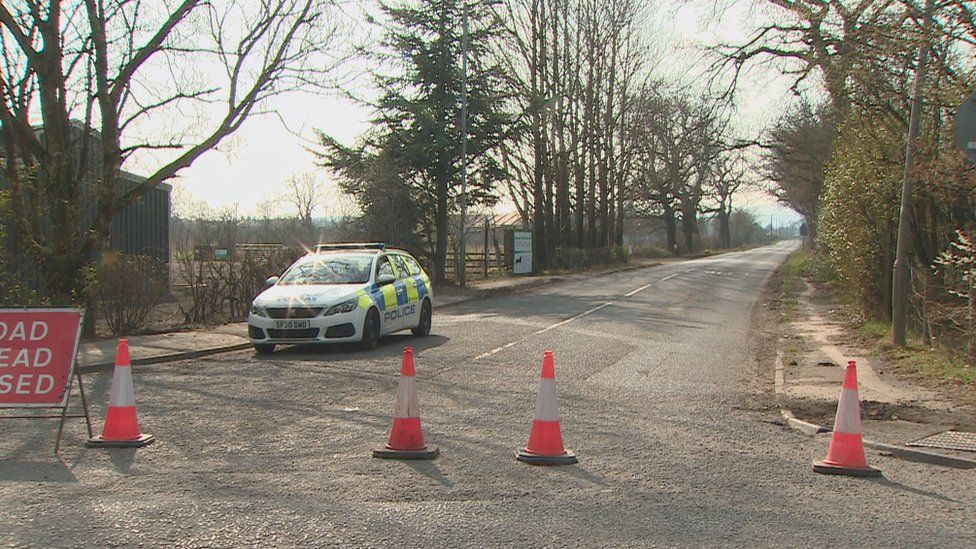
The collision, which involved one car, happened on Houston Road at about 23.50 on Saturday. Emergency services attended but the man died at the scene.

The road remains closed while officers carry out further investigations to establish the cause of the crash.

Police have appealed for information and dashcam footage.

An uninhabited Scottish island where government scientists once conducted experiments with Anthrax has been hit by a fire.

People who saw the fire on Gruinard Island from the mainland described the scene as “apocalyptic”.

They said the uninhabited island off Scotland’s north-west coast was ablaze from “one end to the other” on Saturday evening.

The island was used for germ warfare experiments during World War Two.

It was declared free of Anthrax by the Ministry of Defence in April 1990.

Kate Gearing and her daughter Nessie were at their home in Aultbea when they saw a glow in the sky, around 20:30 on Saturday.

They could smell the smoke in the air from their house which is about five miles from the island.

They got into the car to investigate, and drove along the coast until they saw the fire, which they said you couldn’t miss.

Nessie took pictures from the area around Gruinard beach.

The 25-year-old described the scene as “apocalyptic,” and said it looked like “hell fire”.

“There was a string of flames around the whole circumference of the island,” she said.


Kate said the island off the north west coast was lit up by flames from one end of the island to the other.

The most distressing thing about the scene, Kate said, was the noise of birds, which she thinks were nesting on the island.

“We could hear birds crying, screaming, and then suddenly there was silence – but the flames went on, it was awful.”

She said thankfully the island is far away enough from shore not to be a danger to the mainland.

The pair returned on Sunday, and said there were no obvious flames by the afternoon. However, there was still some smoke hanging in the air.

Kate, a retired GP, said: “The island is pretty black now. There’s just a few trees left standing, along the shoreline.”

“I’m just hoping there aren’t any anthrax spores left around anywhere,” she added.

Smoke could be seen above Gruinard Island on Sunday

The Scottish Fire and Rescue Service said the island did not fall under its remit because it is uninhabited.

Earlier this week it issued a warning that the risk of wildfires was “very high” in central, southern and north-east Scotland.

It urged people to to think twice about using naked flames outdoors.

How did Gruinard Island come to be contaminated with Anthrax?

Experts from Porton Down returned to clean up the island in 1986

Anthrax is a lethal bacteria, especially when inhaled, and it proves fatal in almost all cases, even with medical treatment.

Gruinard had long been uninhabited when, with World War Two on a knife edge, the government tasked scientists with finding a way of harnessing anthrax as a weapon – fearing the Nazis had developed a biological bomb.

They had to find a testing site that was remote, uninhabited and isolated but accessible from the mainland.

Rumours began to spread on the mainland when sheep, cows and horses began dying strange deaths.

The facts about what happened remained a mystery until the declassification of an MoD film 50 years later.

It showed sheep being put in exposure crates facing the anthrax cloud.

The film shows a small blast set off by remote control and then white powder moving on the wind. Within days all the sheep were dead.

The experiment was deemed a success and the scientists returned to Porton Down – but the anthrax remained.

In an attempt to rid the island of anthrax spores, Porton Down instructed the heather be set on fire.

It remained off limits and it was not until 24 years after the experiment that the warning signs even mentioned Anthrax.

Porton Down experts checked the soil but the anthrax spores were “surprisingly resistant to degradation”.

In 1986, Gruinard was again a hive of activity as teams of scientists, vaccinated against anthrax and dressed in protective clothing, prepared to return the island to its natural state.

They sprayed the soil with seawater and formaldehyde and it was again tested at Porton Down.

Finally, on 24 April 1990, the MoD declared Gruinard anthrax free.

Sharp rises in standing charges on standard electricity bills will see customers face very different cost increases depending on where they live.

Customers in South Scotland, Merseyside, North Wales and the South West of England will see the daily payments double from April.

Those in London and the East of England will see increases of less than 60%.

All consumer bills include a standing charge; a fixed daily payment covering the costs of supply and other levies.

The regulator Ofgem caps them for consumers on standard default tariffs in England, Wales and Scotland, although the cap varies by region.

Standing charges are not the biggest part of an energy bill, but they are set to rise by more than £71 a year on average in April.

‘Not surprised’

Jeehan Saleh and Hesham Hussain told the BBC the wide regional differences were unfair at time when energy bills are soaring.

They say they “weren’t shocked” when they learned that standing charges where they live in Garston in South Liverpool would rise by double that of other areas.

“Surprise, surprise, Liverpool again isn’t it,” said Hesham.

“It’s always us being hit the hardest,” added Jeehan. “There’s people in poorer areas where we work who are choosing between food bills and energy bills. Thankfully we’re not in that position but it’s not too far from home. You’re already feeling it in so many areas, this is just another hit.”

The standing charge has always varied depending on where you live, due to different costs to supply homes with power in rural or more remote areas.

However, research has shown that the increase this spring varies disproportionately in different parts of Britain, when comparing standard variable tariffs for electricity paid for by direct debit.

Analysts told the BBC that local distributors and suppliers are moving charges which were once part of a consumer’s unit price for energy (which now has a tight upper limit on it) over to their standing charge. They are also increasing standing charges to the maximum level for each region, which means a big jump for some places.

The average increase – of just under 20p per day – will add more than £71 a year to a standard electricity tariff. But in North Wales and Merseyside, the South West, the Midlands, South Scotland and South Wales the rise will add over £80 a year. In London less than £30 will be added.

The changes are slightly different for customers using prepayment meters.

It comes as households in England, Scotland and Wales prepare for an even bigger hit when the energy price cap – which limits what consumer pay per unit of gas and electricity – also goes up in April.

In Liverpool, David and Joan Boyle told us their energy bill was rising by £700. They are happy they will be able to manage but say they worry about other people.

Elsewhere there was more concern.

“Standing charges should be the same everywhere shouldn’t they,” said Kev Oloughlin. He was enjoying a day out in the sunshine with his son Leo. He told us they’d “normally shop around every year when bills come in, but at the moment it’s pointless”.

He added: “We’re managing alright with things but we’re conscious of having the heating and things like that on. Everyone’s got to tighten their belt at the minute haven’t they.”

The standing charge not only covers costs such network maintenance, administration fees and certain government schemes. It is also the part of your bill that will contribute to the cost of the 28 energy suppliers that have gone bust since last autumn amid a cost crunch sparked by sharply rising wholesale energy prices.

Ofgem told the BBC that the levy added to bills to pay for costs associated with energy suppliers going bust had been spread equally across the country.

It says standing charges in some regions are increasing more than others because of a reallocation of network costs, the level of which differs between distribution networks.

Unavoidable cost

The BBC contacted major suppliers British Gas, Scottish Power, EDF, EOn, Ovo/SSE, Shell, Octopus and Bulb, and almost all confirmed they now have a majority of customers on a standard default tariff, which is controlled by the Ofgem cap.

Three of the biggest suppliers, British Gas, Scottish and Ovo/SSE would not give details on their charges, calling them “commercially sensitive”.

But EOn, EDF, Shell, Octopus and Bulb confirmed they were increasing standing charges on these tariffs in line with the standard charge cap, with example prices (including VAT) from Bulb, EDF and Shell varying from 32p a day in London and 38p in the East, to around 50p in Northern Scotland and the South West.

And it is not an expense that can be avoided by shopping around. While tariffs actively chosen by customers, such as fixed rate tariffs, are not subject to the default tariff cap on standard charges, there are only a handful of such deals on the market.

Moneysupermarket told the BBC that as of 14 March, there were just five fixed tariffs available to consumers. This compares to about 96 fixed deals available at the same time in 2021.

Standing charges are certainly not the biggest part of your energy bill, and they are dwarfed by the massive increases in the unit price for the energy you use.

But in normal circumstances an extra £80 a year on your energy bill just from standing charges would not go unnoticed, especially as in some areas they are increasing by a lot more than others. So is something fishy going on?

Ofgem assures me that the extra costs for failed energy companies are being spread equally across the country.

But the Energy Networks Association say that no major network developments have happened in any areas in the last six months that would explain the regional divisions.

Local distributors and suppliers are moving charges which were once part of your unit price, which now has a tight price cap on it, and shifting them across to your standing charge. Most suppliers are upping their standing charges to the maximum level for each region, which means a big jump for some places, adding insult to the injury of a whopping energy bill.

The no-trust motion against CM Buzdar has been signed by 126 members of the Punjab Assembly

LAHORE: The joint Opposition Monday submitted a no-trust motion against Chief Minister Usman Buzdar in the Punjab Assembly.

According to the details the no-trust motion has been submitted with the Punjab Assembly secretariat. The no-confidence motion was signed by 126 MPAs, including Rana Mashood, Ramzan Siddique, Malik Ahmed and Mian Naseer.

“CM Usman Bazdar has lost the confidence of the majority of the House,” read the resolution.

It said that the chief minister is not running the affairs of Punjab as per the Constitution and he has ruined the democratic norms in the province.

The political experts were of the view that the Opposition’s move is aimed at blocking Buzdar’s plan to dissolve the assembly. It was reported on Saturday that the CM was preparing a draft to dissolve the assembly. However, the government spokesperson denied the report.

Number game in Punjab Assembly

  • PTI – 183
  • PML-N – 165
  • Pakistan Muslim League – 10
  • PPP – 7
  • Independent – 5
  • Pakistan Rah-e-Haq – 1

According to Rana Mashood, the Opposition has also filed a requisition for the Punjab Assembly session. He maintained that 119 MPAs signed the requisition to convene the PA session.

As per the Constitution, the speaker is bound to convene the session in a maximum of 14 days for voting after submission of the no-confidence motion.

Now, CM Usman Bazdar required the support of 182 out of total 371 lawmakers to thwart the no-confidence motion against him.

‘Don’t want incompetent CM’

Talking to journalists after submitting the motion, PML-N leader Rana Mashhood, while criticizing Usman Buzdar, said that they do not want an incompetent chief minister.

Lashing out at the ruling PTI, he said that the government made new records of corruption and violated the merit and did not provide any relief to the masses.

The PTI leadership will be held accountable for their corruption, he vowed. The PML-N leader said that they would expose their scams before the people and will take them to the institutions.

‘We have enough numbers’: Hasaan Khawar

Reacting to the no-confidence motion against CM Buzdar, Punjab government spokesperson Hasaan Khawar claimed that they have enough numbers to thwart the no-trust resolution.

“We will give surprise to the Opposition in Punjab,” he said.

The spokesperson hoped that the PML-Q and disgruntled Jahangir Khan Tareen’s (JKT) group will support the government on the no-trust motion. He maintained that the majority of the lawmakers are with CM Buzdar.