
Labour will call for a vote on Tuesday to introduce a windfall tax on oil and gas companies, saying it is shameful not to introduce the measure to help tackle the rising cost of living.

Shadow minister Ed Miliband told the BBC it was obscene the government had refused to bring in the policy.

A windfall tax is a one off levy on companies enjoying unexpected profits.

Business Secretary Kwasi Kwarteng said it was a bad idea that would deter firms from investing in the UK.

But a Treasury source said the option was “not off the table”.

Opposition parties have repeatedly touted the idea of a windfall tax on the record profits of oil and gas companies, saying the money raised could be used to help those struggling the most with rising living costs.

Ministers had dismissed the policy, but attitudes within government appeared to warm this week, with Chancellor Rishi Sunak threatening to introduce the measure if the firms did not invest enough in new projects.

Prime Minister Boris Johnson also said the government would have to look at the proposal if not enough investment was made.

Despite Mr Kwarteng’s comments, a Treasury source told the BBC that the chancellor remained pragmatic about the idea and he still held the same position as earlier in the week.

Labour’s shadow chancellor, Rachel Reeves, accused the cabinet of being in “complete chaos” over whether to back the tax.

Households in the UK are being hit with rising costs when it comes to fuel, energy and food, as inflation reaches a record high in the country.

Labour, the SNP and the Liberal Democrats have all proposed using a windfall tax to raise money to support the hardest hit.

A debate on the Queen’s Speech is to be held on Tuesday, and Labour will put forward an amendment to allow the Commons to vote for or against the measure.

Shadow climate change secretary – and former party leader – Mr Miliband told the BBC’s Sunday Morning programme it would give Conservatives MPs a choice, saying: “You can vote for a windfall tax or you can explain to your constituents why you are refusing to provide them the help that they need.”

He added: “I think it is obscene, frankly, that we have as a result of surging energy bills, oil and gas companies making billions of pounds in our country and the government refuses to put a windfall tax on them. It is shameful.

“The case for a windfall tax now is unanswerable… Everyday that goes by is sleepless nights for millions of people with this government refusing to help.”

‘More investment’

Mr Kwarteng said the government had already put forward £9bn of support for those struggling with their bills, including a £150 council tax rebate for rate payers.

He said it was right for the chancellor not to “take anything off the table” four months ahead of the government’s next budget.

But despite hints at a change of direction from the government, the business secretary told Sunday Morning his own view was that he did not believe in windfall taxes.

Kwarteng: I don’t believe in windfall taxes

Mr Kwarteng added: “What you are taxing is investment in jobs, you are taxing investment in wealth creation, you are taxing investment in new technologies.

“And that is what we want to see, we want to see more investment. We don’t want to see taxes that essentially act against any incentive to invest.”

The minister said also called the policy a bad idea, and an old one, saying: “I am not surprised that a Labour frontbencher is saying we should put up taxes – that’s not something that is new to me.”
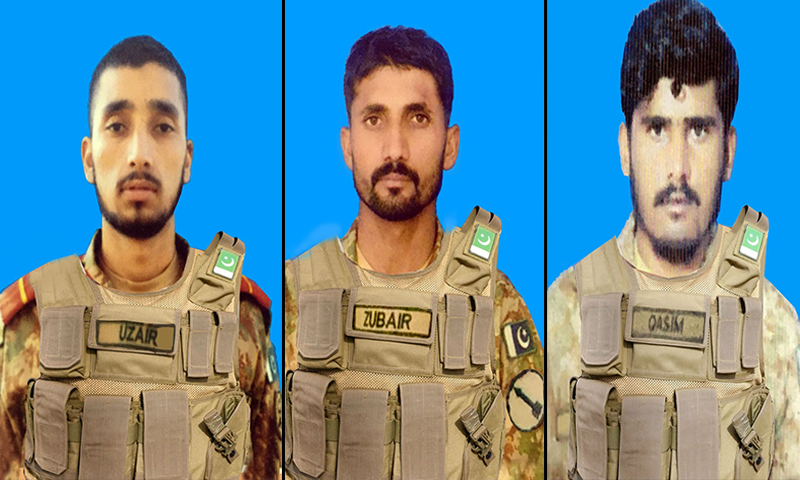
Three soldiers martyred in suicide blast in North Waziristan: ISPR

RAWALPINDI: Three security personnel were martyred in a suicide attack in North Waziristan, said Inter-Services Public Relations (ISPR) on Sunday.

According to the military’s media wing, the security personnel were martyred when a suicide bomber blew himself up in the Miran Shah area of North Waziristan.

Three children were also martyred in the explosion, said the ISPR.

The three martyred soldiers were identified as Lance Havaldar Zubair Qadir, Sepoy Asghar and Sepoy Qasim Maqsood.

Those who embraced martyrdom include Anam, 4, Ahsan, 8 and Ahmed Hassan, 11, said the ISPR.

The intelligence agencies have launched an investigation to identify the suicide bomber and trace his handler and facilitators, said the military’s media wing in a statement.

‘Cowardly acts cannot discourage us’

Condemning the suicide attack on the security forces in North Waziristan, Minister for Information and Broadcasting Marriyum Aurangzeb said that miscreants want to destabilize law and order in the country.

In a statement, she said that such cowardly acts cannot discourage us.

The information minister said that the sacrifices of security personnel for restoring law and order in the country will not go in vain. She also extended condolences to the families of the security personnel and children martyred in the blast.

Civilians flee fighting in Panjshir Valley

The Panjshir Valley is famed for being a site of resistance by Afghans against Soviet forces in the 1980s and as a base for rebels opposed to Taliban rule during the Islamists’ first stint in power in the late 1990s.

The National Resistance Front (NRF) were the last to hold out against the Taliban’s takeover of the country last year by retreating to the valley.

Headed by the son of late anti-Taliban commander Ahmad Shah Massoud, NRF forces last week announced an offensive against the Taliban — their first since the hardline Islamists seized power in August.

Both sides claim to have killed dozens of each other’s fighters in recent days.

“We could only pick up one or two items of clothing,” Lutfullah Bari said, adding he fled with dozens of families.

North Korea reports 21 new deaths as it battles Covid outbreak

Despite activating its “maximum emergency quarantine system” to slow the spread of disease through its unvaccinated population, North Korea is now reporting tens of thousands of new cases daily.

On Friday alone, “over 174,440 persons had fever, at least 81,430 were fully recovered and 21 died in the country”, the official Korean Central News Agency reported.

North Korea confirmed on Thursday that the highly contagious Omicron variant had been detected in the capital Pyongyang, with leader Kim Jong Un ordering nationwide lockdowns.

It was the North’s first official admission of Covid cases and marked the failure of a two-year coronavirus blockade maintained at great economic cost since the start of the pandemic.

From late April to May 13, more than 524,440 people have fallen sick with fever, KCNA said, with 27 deaths in total.

The report did not specify whether the new cases and deaths had tested positive for Covid-19, but experts say the country will be struggling to test and diagnose on this scale.

North Korea has said only that one of the first six deaths it announced had tested positive for Covid-19.

“It’s not a stretch to consider these ‘fever’ cases to all be Covid-19, given the North’s lack of testing capacity,” said Cheong Seong-chang of the Sejong Institute.

“The actual number of Covid cases could be higher than the fever figures due to many asymptomatic cases,” he said, adding that the pace of infection was growing “very fast”.Kim said the outbreak was causing “great upheaval” in North Korea, as he oversaw a second Politburo meeting in three days to discuss the situation.

Kim is putting himself “front and centre” of the country’s Covid response, said Leif-Eric Easley, a professor at Ewha University in Seoul.

“The language he’s used suggests the situation in North Korea is going to get worse before it gets better,” he said.

“Engagers see this rhetoric preparing the way for international assistance, but Kim may be rallying a population on the verge of further sacrifice,” he added.

The meeting of the nation’s top officials discussed medicine distribution and other ways of “minimising the losses in human lives”, KCNA said.

North Korea has a crumbling health system — one of the worst in the world — and no Covid vaccines, antiviral treatment drugs or mass testing capacity, experts say.

But the country will “actively learn” from China’s pandemic management strategy, Kim said, according to KCNA.

China, the world’s only major economy to still maintain a zero-Covid policy, is battling multiple Omicron outbreaks — with some major cities, including financial hub Shanghai, under stay-at-home orders.

North Korea has previously turned down offers of Covid vaccines from China and the World Health Organisation’s Covax scheme, but both Beijing and Seoul issued fresh offers of aid and vaccines this week.

Kim’s comments indicate North Korea “will try getting supplies from China”, said Yang Moo-jin, a professor at the University of North Korean Studies.

It also looks likely Pyongyang “will adopt a Chinese-style anti-virus response of regional lockdowns”, Yang added.

So far, Kim said, North Korea’s outbreak was not “an uncontrollable spread among regions” but transmission within areas that had been locked down, KCNA said.

Despite its Covid outbreak, new satellite imagery indicates that North Korea has resumed construction at a long-dormant nuclear reactor.

“I can’t tell you when the reactor will be ready to go, but it is about 10x larger than the existing reactor at Yongbyon,” Jeffrey Lewis of the Middlebury Institute of International Studies wrote in a Twitter thread on Saturday.

Sri Lanka eases curfew amid cabinet formation

More than a month of predominantly peaceful protests against the government turned violent this week after supporters of former Prime Minister Mahinda Rajapaksa stormed an anti-government protest camp in the commercial capital Colombo, burning tents and clashing with protesters and police.

The initial violence and reprisals against government figures also left more than 300 injured.

Hit hard by the pandemic, rising oil prices and tax cuts by the populist government, Sri Lanka is in the throes of its worst economic crisis since independence from Great Britain in 1948. Useable foreign reserves have dwindled, and rampant inflation and shortages of fuel have brought thousands onto the streets in protest.

The government lifted the curfew from 6am (0030 GMT) on Saturday until 6pm. A 24-hour curfew imposed on Monday had been lifted for a few hours on Thursday and Friday to allow purchase of essential supplies.

Rajapaksa stepped down after violence flared on Monday, leaving his younger brother Gotabaya Rajapaksa to rule on as president while Wickremesinghe, a five-time prime minister, was appointed to another term late Thursday.

He appointed four ministers from the Rajapaksas’ Sri Lanka Podujana Peramuna (SLPP), a decision unlikely to satisfy the protesters demanding the removal of the party from power.

The appointments, announced by the president’s office, include G.L. Pereis, the SLPP chairman who had held the post before resigning on Monday.


Ukraine wages counteroffensive against Russian forces in east

Russian forces have focused much of their firepower on the Donbas in a “second phase” of their invasion that was announced on April 19, after they failed to reach the capital Kyiv from the north in the early weeks of the war.

But Ukraine has been retaking territory in its northeast, driving the Russians away from the second-largest Ukrainian city of Kharkiv. Keeping up pressure on Izium and Russian supply lines will make it harder for Moscow to encircle battle-hardened Ukrainian troops on the eastern front in the Donbas.

Ukrainian President Volodymyr Zelenskiy also said complex talks were underway to find a way to evacuate a large number of wounded soldiers from a besieged steel works in the port of Mariupol in return for the release of Russian prisoners of war.

Mariupol, which has suffered the heaviest fighting in nearly three months of war, is now in Russian hands but hundreds of Ukrainian fighters are still holding out at the Azovstal steel works despite weeks of heavy Russian bombardment.

Western military analysts say Russian President Vladimir Putin and his generals failed to anticipate such fierce Ukrainian resistance when they launched the invasion on Feb 24.

As well as losing large numbers of men and much military equipment, Russia has been hit by economic sanctions. The Group of Seven leading Western economies pledged in a statement on Saturday to “further increase economic and political pressure on Russia” and to supply more weapons to Ukraine.

Commenting on the latest developments in eastern Ukraine, regional governor Oleh Sinegubov said in comments aired on social media: “The hottest spot remains the Izium direction.” “Our armed forces have switched to a counteroffensive there. The enemy is retreating on some fronts and this is the result of the character of our armed forces,” he said.

Taliban’s first annual Afghan budget foresees $501 million deficit

Announcing the first annual national budget since the Taliban took over the war-torn country in August last year, Deputy Prime Minister Abdul Salam Hanafi said the government foresaw spending of 231.4 billion Afghanis and domestic revenue of 186.7 billion.

“The revenues are collections from departments related to customs, ministries and mines,” spokesman for the Finance Ministry Ahmad Wali Haqmal said.

Since the 2001 US-led invasion of Afghanistan, successive Western-backed governments relied mostly on foreign aid.

In August 2021, foreign forces withdrew from Afghanistan, leading to the collapse of the government and a Taliban takeover.

The world is yet to officially recognise the Taliban government. The country is dealing with rising security issues and an economic meltdown, while aid agencies figure out how to help 50 million Afghans without giving the Taliban direct access to funds.

Hanafi said the budget for the current financial year, that runs to next February, had been approved by the council of ministries and confirmed by the Taliban’s supreme leader Haibatullah Akhunzada, and would use local funds only.

Development works would take up 27.9 billion Afghanis, he said, but did not provide a breakdown of spending on areas such as defence.

“We have paid attention to education, technical education, and higher education and our all focus is on how to pave the way education for everyone,” Hanafi said.

Taliban authorities are yet to allow the restarting of older girls’ education across the country after committing to a start date earlier this year.

Israeli police to probe attack on Al Jazeera journalist’s funeral

Thousands of mourners packed Jerusalem’s Old City on Friday for the burial of the 51-year-old Al Jazeera reporter. The Palestinian-American was killed two days earlier during an Israeli raid in the occupied West Bank.

Television footage showed pallbearers struggling to stop Abu Akleh’s casket from falling to the ground as baton-wielding police charged towards them, grabbing Palestinian flags.

“The Israel police commissioner in coordination with the minister of public security has instructed that an investigation be conducted into the incident,” the police said in a statement.

They had coordinated funeral arrangements with the journalist’s family but “rioters tried to sabotage the ceremony and harm the police,” it said.

“As with any operational incident, and certainly an incident in which police officers were exposed to violence by rioters and in which force was subsequently used by the police, the Israel Police will be looking into the events that ensued during the funeral,” it added.

The latest condemnation came when Spain’s foreign ministry, in a tweet, called “totally unacceptable” the scenes showing “disproportionate use of violence by the Israeli police” at the funeral.

German Foreign Minister Annalena Baerbock expressed deep shock “that the funeral ceremony could not be held in peace and dignity.” The foundation of late South African Archbishop Desmond Tutu, a Nobel Peace Prize winner, said the police “attacking pallbearers” was “chillingly reminiscent of the brutality” during funerals of anti-apartheid activists.While the two sides traded blame, the UN Security Council in a rare, unanimous statement, condemned the killing and called for “an immediate, thorough, transparent, and impartial investigation,” diplomats said.

Qatar-based Al Jazeera said Israel killed its reporter “deliberately” and “in cold blood”.

Ten people have been killed in a shooting in New York state that is being investigated as a racially-motivated hate crime.

An 18-year-old man wearing military gear was arrested after a stand-off at the scene in the city of Buffalo.

The suspect entered a busy supermarket on Saturday afternoon before opening fire. He used a camera to stream the attack online, police said.

US President Joe Biden condemned what he called an “abhorrent” attack.

“We are investigating this incident as both a hate crime and a case of racially-motivated violent extremism,” Stephen Belongia, the agent in charge of the FBI’s Buffalo office, told a news conference.

The suspect is believed to have driven for several hours to reach the predominantly black area of the city. Thirteen people were shot in total and the majority of the victims were black, Buffalo Police Commissioner Joseph Gramaglia said.

Speaking to CBS, a police source alleged that the man had shouted racial slurs during the shooting.

“He exited his vehicle. He was very heavily armed. He had tactical gear. He had a tactical helmet on. He had a camera that he was live-streaming what he was doing,” Mr Gramaglia told reporters.

He said the suspect surrendered his weapon after a tense stand-off and was taken into custody.

The three wounded victims – who all worked at the supermarket – have not sustained life-threatening injuries.

A retired police officer who was working as a security guard tried to shoot the suspect but was among those killed, police said.

The man has since been charged in court with first-degree murder, and Erie County District Attorney John Flynn said further charges may still be brought.

The 18-year-old suspect surrendered his weapon after a stand-off with local police officers

“This is the worst nightmare that any community can face and we are hurting, we are seething right now,” Buffalo Mayor Byron Brown told reporters.

“We cannot let this hateful person divide our community or our country,” he added.

Grady Lewis, who witnessed the attack from across the street, told local media that he saw the man open fire. “I saw the guy go in, army-style, bent over, just shooting at people,” he said.

Shonnell Harris, who was working in the shop during the attack, told Buffalo News that she heard more than 70 shots as she ran to escape the building through a backdoor.

“The store was full. It was the weekend,” she said. “It feels like a nightmare.”

Describing the aftermath of the attack, one police officer told Buffalo News: “It’s like walking onto a horror movie, but everything is real. It is Armageddon-like”.

Later on Saturday, New York Governor Kathy Hochul said the suspect was a “white supremacist who has engaged in an act of terrorism”.

This was “a military style execution targeting people who simply wanted to buy groceries in a neighbourhood store,” she said while visiting Buffalo.

In a statement, US President Joe Biden said he and the First Lady were praying for the victims and their families.

“A racially-motivated hate crime is abhorrent to the very fabric of this nation,” he said. “We must do everything in our power to end hate-fuelled domestic terrorism.”

The government has vetoed a proposal for the House of Lords to temporarily relocate to a building opposite Parliament – and told peers to move outside London instead.

The House of Lords could be forced to leave Parliament while extensive restoration works are carried out.

Peers wanted to use the Queen Elizabeth II Centre in Westminster – minutes away from Parliament.

But Levelling Up Secretary Michael Gove has said he will not support the plans.

His department owns the freehold and the body which runs the QEII Centre – a large conference and exhibition space with views of Big Ben and Westminster Abbey.

In a letter seen by the BBC, Mr Gove said he “cannot endorse” a plan for peers to “decamp to a temporary home a mere 200 yards from the Palace of Westminster”.

Mr Gove suggested they looked at alternative buildings in the north of England, the Midlands, the South West, Scotland or Wales.

Cities across the UK would welcome the peers, says Michael Gove

He told the Lord Speaker Lord McFall: “It is clear to me that the House of Lords moving elsewhere, even for a temporary period, would be widely welcomed.

“I know cities and towns across the UK would be pleased to extend their hospitality to peers,” he added.

The restoration of Parliament will cost billions – but the price will go up considerably if MPs or peers stay put in the building.

The Lords had begun working on plans for a relocation to the QEII.

Any plan will be subject to a final vote by Parliament.

The idea of moving the Upper Chamber out of London first emerged in January 2020.

Downing Street said it would demonstrate its commitment to levelling up to spread decision-making outside London.

York was considered as an option – but several leading peers said it was impractical to separate the Lords from the Commons.

The then Lord Speaker, Lord Fowler, said it was “gesture politics” while Commons Speaker Sir Lindsay Hoyle said the idea was “great PR” but questioned how it would work.

By the summer of that year, the relocation of peers to York was effectively axed.