G77+China summit seeks ‘new economic world order’

United Nations chief Antonio Guterres, who arrived on the island on Thursday, will join some 30 heads of state and government from Africa, Asia and Latin America at the two-day summit in Havana.

The meeting should conclude on Saturday with a statement underscoring “the right to development in an increasingly exclusive, unfair, unjust and plundering international order,” the foreign minister of host Cuba, Bruno Rodriguez, told reporters on Wednesday.

A draft of the closing statement underlines the many obstacles facing developing nations, and includes “a call for the establishment of a new economic world order,” he said.

The bloc was established by 77 countries of the global South in 1964 “to articulate and promote their collective economic interests and enhance their joint negotiating capacity,” according to the group’s website.

Today it has 134 members, among which the website lists China although the Asian giant says it is not a full member. Cuba took over the rotating presidency in January.

Guterres, who will deliver the opening address with Cuban President Miguel Diaz-Canel, has recently attended a rash of multilateral summits, including a gathering of the G20 club of major economies in India and the BRICS group that includes Russia.

The prosecutor leading the federal election meddling case against Donald Trump has asked a judge to place him under a gag order, limiting how he is able to publicly comment on the case.

Special Counsel Jack Smith’s filing says the “narrowly tailored” order would prevent harassment of witnesses.

Mr Trump hit back online, accusing Smith’s team of misconduct, writing: “they won’t allow me to SPEAK?”

He has pleaded not guilty to conspiracy to overturn the 2020 election.

The request was unsealed by District Court Judge Tanya Chutkan and was filed a week earlier. It was among a slew of older court documents from the case that were released on Friday.

Prosecutors say their proposed order – which they never refer to as a “gag order” – is “a narrow, well defined restriction” that is necessary to prevent disinformation, threats and “prejudicing” the case.

If approved, it would ban Mr Trump from making statements “regarding the identity, testimony, or credibility of prospective witnesses” and “statements about any party, witness, attorney, court personnel, or potential jurors that are disparaging and inflammatory, or intimidating”.

It does not place any restrictions on Mr Trump from quoting from public record court documents or proclaiming his innocence.

Any restriction placed on the former president’s first amendment right to freedom of speech, particularly as he runs for president in 2024, would kick off a major constitutional challenge in court.

Last week, lawyers for Mr Trump wrote to Judge Chutkan, calling her biased against Mr Trump and asking her to step aside from the case.

It is unclear when she may issue a ruling on either motion.

On Truth Social, Mr Trump’s social media platform, he wrote on Friday: “So, I’m campaigning for President against an incompetent person who has WEAPONIZED the DOJ & FBI to go after his Political Opponent, & I am not allowed to COMMENT?

“They Leak, Lie, & Sue, & they won’t allow me to SPEAK?”

Shortly afterwards, speaking at a dinner for the group Concerned Women for America in Washington DC , he said prosecutors wanted to take away his right to speak freely and openly.

“These people are sick and they want to silence me because I will never let them silence you.

“But in the end they’re not after me, they’re after you, and I just happen to be standing in their way,” Mr Trump told the group of around 300 socially conservative evangelical Christian women.

CWA president Penny Nance led the group in prayer with former President Trump after his speech

The filing refers to specific statements and online posts by Mr Trump as well as people, including Judge Chutkan, who have allegedly faced intimidation after Mr Trump criticised them.

In one comment referenced by prosecutors, Mr Trump called her “a fraud dressed up as a judge” and “a radical Obama hack”. They argue that a woman who was arrested for calling the judge and making racist death threat came as a result of Mr Trump’s criticisms.

The filing also cites attacks by Mr Trump on a Georgia election worker and his former cybersecurity aide which have allegedly resulted in harassment by his supporters


On Friday it was also revealed that Twitter had secretly delivered direct messages from Mr Trump’s account to Mr Smith’s team.

Twitter had fought the ruling, but was ultimately forced to hand over 32 direct messages. No information about the messages was released, including whether they were sent or received by Mr Trump, or were undelivered drafts.

Mr Trump, the current frontrunner for the 2024 Republican presidential nomination, faces mounting legal troubles.

He has been criminally indicted four times, including in this federal investigation into efforts to overturn the result of the 2020 presidential election.

An official in eastern Libya has denied allegations that many of those killed in devastating floods last weekend were told to stay in their homes.

Othman Abdul Jalil, a spokesperson for the Benghazi-based government, told the BBC that soldiers warned people in the city of Derna to flee.

He denied that people were told not to evacuate, but conceded some may have felt the threat was exaggerated.

Meanwhile, BBC teams in Derna say aid agencies are yet to arrive at the city.

While reporters witnessed a hive of activity in the centre of Derna – with rescuers, ambulance crews and forensic teams working to identify the dead – there was little sign of major international aid agencies.

A spokesperson for one organisation said that trying to coordinate aid operations in the country was “a nightmare”.

“Libya one week ago was already complicated,” said Tomasso Della Longa from the International Federation of Red Cross and Red Crescent Societies (IFRC).

Making the situation even more complicated is the fact that the floods have destroyed crucial infrastructure, like roads and telecommunications systems.


Death tolls that have been provided vary from around 6,000 up to 11,000. With many more thousands still missing, Derna’s mayor has warned that the total could reach 20,000.

The BBC has been told that some victims’ bodies have washed ashore more than 100km (60 miles) from Derna, after they were swept out to sea.

A spokesperson for the United Nations’ humanitarian office, Jens Laerke, told the BBC that there were still survivors and dead bodies under the rubble, and that it would be some time before they knew the true number of casualties.

“We are trying to not to have a second disaster there. It is critical to prevent a health crisis, to provide shelter, clean water and food,” he said.

More than 1,000 people have so far been buried in mass graves, according to a UN report.

The World Health Organisation (WHO) has asked disaster workers to stop doing this, because a hasty burial in mass graves can lead to long-lasting mental distress for grieving family members.

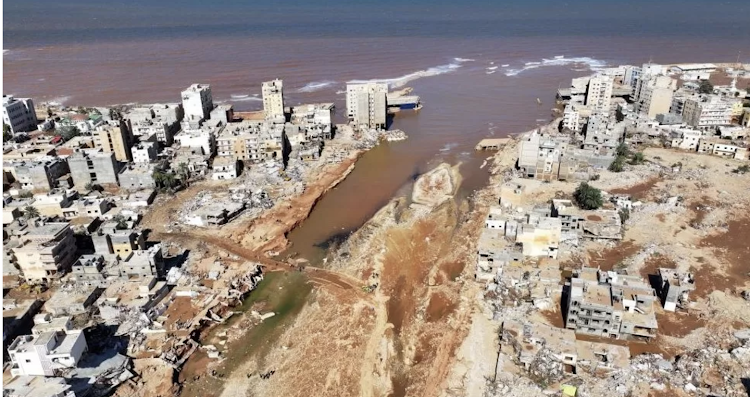
Thousands of people were killed when two dams burst in the wake of Storm Daniel on Sunday, washing whole neighbourhoods into the Mediterranean Sea.

Survivors have described terrifying escapes and people being swept away in front of their eyes.

Entire neighbourhoods were washed into the Mediterranean Sea

The country’s fragmented political situation is said to be complicating the recovery. Libya is split between two rival governments – with the UN-backed administration based in the capital Tripoli and the rival Egyptian-supported one based in Benghazi.

Questions raised over evacuation orders

There have been widespread allegations that the two dams that collapsed were not well-maintained, and there are growing calls for an urgent inquiry into how the flooding became so catastrophic.

There are also conflicting reports as to whether – and when – people were told to flee their homes. Residents have told the BBC that they received mixed messages from the two rival governments on whether they should stay or leave.

Guma El-Gamaty, a Libyan academic and head of the Taghyeer Party, said on Thursday that people in the flood zone should have been evacuated, but “on the contrary they were told to stay put and stay inside their houses and not go out”.

But Derna’s mayor told Arab news channel Al-Hadath that he “personally ordered evacuating the city three or four days before the disaster.” The BBC has not been able to verify Abdulmenam al-Ghaithi’s claims.

As the weather got worse, police and military were telling people to leave their homes for higher ground, survivors have told the BBC.

But it seemed many people did not take the threat seriously.

“A lot of them did but unfortunately, people sometimes, they said, ‘well you know, this is exaggerating, this might not be the case’,” an official from Libya’s unofficial, eastern administration told the BBC’s Newshour programme.

There are also allegations that officials took to Libyan television on Sunday night, and ordered people to stay in their homes because of the bad weather. But the same official, Othman Abdul Jalil, denied this.

It is too early to attribute with certainty the severity of this storm to rising global temperatures. However, climate change is thought to be increasing the frequency of the world’s strongest storms.

Prof Liz Stephens, an expert in climate risks and resilience at the UK’s University of Reading, said scientists were confident that climate change was super-charging the rainfall associated with such storms.

On Friday, a top UN official, Martin Griffiths, said the disaster was “a massive reminder” of climate change and the challenge it posed.

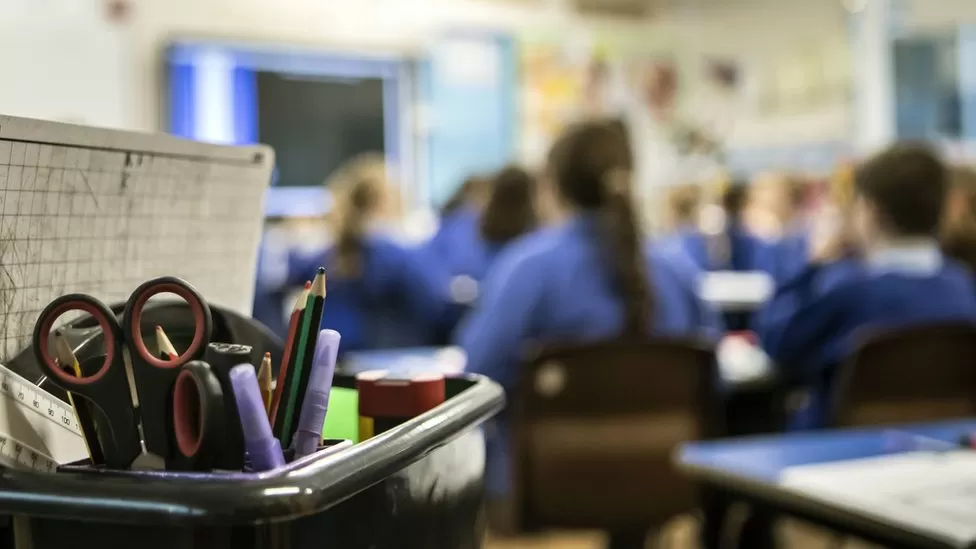
Schools across Scotland face weeks of closures and disruption after a third union rejected a new pay offer.

Unite has joined Unison and the GMB in turning down the proposal from council body Cosla. All three have warned time is running out to avert strike action.

Parent groups have raised fears school closures will have a “detrimental” effect on their children.

But on Thursday Cosla said there was no more money available for pay without cuts to jobs and services.

The latest offer from the body, which represents Scotland’s 32 councils, is a two-part plan which it said would give workers at least a £1,929 increase in annual salary by 1 January 2024.

The decision to reject this means three out of four schools could be closed by a programme of strikes beginning with a three-day walkout on 26, 27 and 28 September.

On Friday Unite general secretary Sharon Graham said: “It has taken Cosla five months to increase their offer by a measly 38 pence a week for the lowest paid council workers.

“Unite’s local government representatives rightly rejected this offer. The fight for better jobs, pay and conditions in local government goes on, and if needs be by strike action. Unite will back its members all the way.”

‘Meaningful discussions’

Unison has already said Cosla has until 20 September to “significantly improve” the offer and prevent walkouts.

GMB Scotland dismissed the latest offer as “far too little, far too late” to avoid the upcoming strikes.

First Minister Humza Yousaf said he had already provided Cosla with additional funding to help negotiation in the pay offer and hoped that this would be enough.

Calling on both sides to continue “meaningful discussions”, he said: “We’ll continue to do what we can to support those discussions but they are negotiations for Cosla and nobody… wants to see strike action and our schools closed.”

Scottish Labour Leader Anas Sarwar said the Scottish government needed to show leadership and get round the table with Cosla and the trade unions and strike a deal that is “fair for workers and fair for those that require council services.”

The three unions had to ballot each council area separately and this has led to a complex picture of who has the right to strike across the country.

‘Frustrated’ parents

Only six out of the 32 councils will be unaffected. These are the areas where the unions did not win a mandate.

They are Argyll and Bute, East Ayrshire, East Lothian, Midlothian, Scottish Borders and West Lothian.

No council has said what effects these strike days will have but the unions expect the actions to lead to widespread school closures.

Parents outside a school in Paisley spoke about the effects the industrial action could have on their childcare.

Paul Lumsden says he hopes the dispute is resolved as quickly as possible

Paul Lumsden said: “It’s obviously disruptive to the kids. I hope the staff get looked after and the outcome is resolved as quickly as possible.

“It means we have to get more childcare arranged. We’ve got childcare arrangements in place but it’s not that convenient having to chop and change to ask parents and grandparents.”

Zornista Koleva said: “It will bring some difficulty for parents like me. I think if they need to fight for better conditions they need to go for it. I definitely need to change my working days.

“I have three kids so I will need to take some time off probably. I feel a bit frustrated as it feels last minute.”

Zornista Koleva says she will need to take time off on strike days

Speaking on BBC Radio’s Good Morning Scotland programme, Leanne McGuire, of the Glasgow City Parents Group, said the latest strikes felt like “history repeating itself”.

It is the fourth year of disruption following the Covid lockdowns and teacher strikes.

She told the programme: “My concern is that we start to feel that this is the new normal in schools and it really shouldn’t be.

“Pupils should be able to get through their full school year without any disruption, regardless of what that disruption is for.”

Ms McGuire said there was a lot of sympathy for the striking workers and anger at Cosla, the councils and the Scottish government that the dispute had not been settled.

She added: “When these talks come down to the wire, that’s where families get really frustrated because we don’t know what plans to put in place.

“That’s where people start getting really frustrated about it.”

Robert Woolley, of the Highland Parent Council Partnerships, said he was worried school closures were having a detrimental effect on pupils who were forced to learn alone at home.

“I think it’s detrimental to the social aspect of life being stuck behind a screen. It’s not normal. You worry about the future of your children,” he said.

FO confirms Pakistan HC and Nawaz’s meeting in London

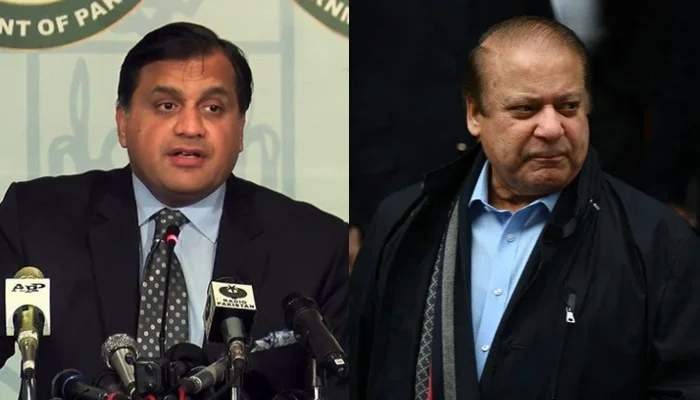
ISLAMABAD: The Foreign Office has confirmed that Pakistan’s High Commissioner (HC) to the United Kingdom Dr Muhammad Faisal met Pakistan Muslim League Nawaz (PML-N) supremo Nawaz Sharif last week in London ahead of former premier Shehbaz Sharif’s arrival in the UK’s capital.

The directives from Islamabad for the HC to meet Nawaz right after the transfer of power to the caretaker setup in the country raised many eyebrows as the meeting took place just before statements from the PML-N that the former prime minister was due back in Pakistan in mid-September.

Later, a video of HC Faisal leaving the office of Hassan Nawaz, son of Nawaz Sharif, at his Central London office also surfaced.

“Yes, the meeting took place. Mr Nawaz Sharif has been our prime minister three times, and we give all former prime ministers such courtesy,” a source affiliated with the Ministry of Foreign Affairs stated.

The FO sources said that it was a courtesy call on the former prime minister, which was a routine matter.

Meanwhile, another government source commented that the issue was complicated because technically and legally Nawaz has been convicted and is absconding in the eyes of the law.

“It is normal for Pakistan’s diplomats to meet high-profile Pakistanis, and Nawaz Sharif is certainly amongst them,” said the official.

Last week, a Sharif family source, who spoke on the condition of anonymity, said that Nawaz will leave for Pakistan from London “after a month”.

This would mean that the former prime minister is expected to return to Pakistan in the mid of this September.

The Sharif family’s lawyers and political aides had advised the PML-N supremo to come to Pakistan immediately after ending his Europe and Middle East visit which started two months ago and ended last week when Nawaz reached London. However, some within the PML-N have advised Nawaz that it’s better to arrive in mid-September.

“Nawaz Sharif’s decision to return to Pakistan after ending nearly four years of exile is final and everything is in order,” said the source who has been part of the negotiation and the arrangements.


Shehbaz Sharif calls for official inquiry into President Arif Alvi’s conduct

LONDON: Former prime minister Shehbaz Sharif has called for an official inquiry into the conduct of President Arif Alvi after his tweet plunged Pakistan into a constitutional crisis.


Speaking to the media, Shehbaz said that a transparent inquiry should be held into President Alvi’s conduct “to determine facts through a transparent probe”.

Shehbaz is in London for 10 days for his medical treatment and to meet his elder brother Nawaz Sharif.


The Pakistan Muslim Legue-Nawaz (PML-N) president also said the inquiry should make it clear whether the staff of the president committed a mistake or Alvi lied. He explained that prime ministers and other office bearers are required by law to sign summaries and bills.

“As a premier, one is required to always put down signatures, the president is required to do the same by putting down his signature,” he added.


Shehbaz went on to say that the state business is not conducted through oral or informal means. He said the president either “rejects or approves a bill, he signs it, there is nothing oral”.


He said President Alvi holds the highest constitutional office of the state and an inquiry is needed to determine the truth.


Shehbaz wondered why President Alvi stayed quiet for such a long time. He asked the president to explain why he failed to do his job and only claimed to remember things at a certain time.

He also questioned why President Alvi had not followed the rules and if he had returned the bills he should have made that clear.


Hours after his removal’s request as secretary to the president, Waqar Ahmed issued a statement saying that President Alvi neither assented to the Official Secrets (Amendment) Bill, 2023, and the Pakistan Army (Amendment) Bill, 2023 nor gave a written decision for returning them to parliament for reconsideration.


In a letter sent to the president, Ahmed stated that the Pakistan Army (Amendment) Bill was received on August 2 and sent to the president on August 3.

President Alvi, he added, had the 10-day time to advise on the bill till August 11.

“The Honourable President neither assented to the Bill nor gave a written decision for returning the Bill for reconsideration by the Parliament. The said file has not been returned to the Office of Secretary to date i.e. 21.08-2023,” the letter stated.

Meanwhile, the Official Secrets (Amendment) Bill was received on August 8 and was moved to the president’s office on August 9.

“It was clearly stated in the Note that the Prime Minister’s advice was received on 08-08-2023 and time of 10 days will be completed on 17.08.2023 (Thursday),” the letter also stated.

However, the letter added that the president neither assented to the bill nor gave a written decision for returning the bill for reconsideration by parliament.

Russian strikes kill eight ‘fighters’ in Syria

Moscow’s intervention since 2015 has helped Damascus claw back much of the territory it had lost to rebel forces early in the 12-year civil war, and Russian forces have repeatedly struck the Idlib area.

Early on Monday, “Russian warplanes carried out air strikes on the western outskirts of Idlib city, targeting a military base belonging to Hayat Tahrir al-Sham (HTS)… killing at least eight fighters,” said Rami Abdel Rahman, head of the Syrian Observatory for Human Rights.

Several other fighters were wounded in the strikes, with some in critical condition, said the Britain-based monitor which relies on a wide network of sources inside Syria.

Demonstrators take to the streets again over living conditions

Militant group HTS, led by Syria’s former Al Qaeda affiliate, controls swathes of Idlib province, as well as parts of the adjacent Latakia, Hama, and Aleppo provinces.

A correspondent said the militant group cordoned off the area after the strikes, which came shortly after midnight (2100 GMT on Sunday).

HTS regularly carries out deadly attacks on soldiers and pro-government forces.

On Monday, the Syrian defence ministry said its forces had downed “three drones laden with explosives” operated by “terrorist organisations”.

The Observatory said the army shot down three reconnaissance drones in Idlib and Hama provinces.

Days of rare protests

Hundreds of demonstrators took to the streets again on Monday in Syria’s southern city of Sweida, local media and an activist reported, as dire living conditions stoke discontent in regime-held areas.

Days of rare protests have erupted in the south after the government lifted fuel subsidies last week, dealing a blow to Syrians already struggling with the heavy toll that 12 years of war have exacted on the economy.

Local news outlet Suwayda24 posted videos showing hundreds of people gathered in the city on Monday, holding banners and chanting anti-government slogans including “freedom” and “long live Syria, down with Assad”.

“We’ve had enough, the Syrian people are suffocating,” one activist in Sweida said on condition of anonymity for security reasons, adding that hundreds had gathered to protest in the city.

Soaring inflation, the rising cost of living, instability and poverty have plagued the country, pushing desperate Syrians to take to the streets, the activist said.

Security forces have not cracked down on demonstrators so far, he noted.

“My only hope is that this movement will spread to other provinces and that our voices will be heard,” he said.

Syria’s war has killed more than half a million people and displaced millions since it broke out in 2011 following Assad’s repression of peaceful pro-democracy protests.

It spiralled into a deadly conflict that pulled in foreign powers and global militants.

Sunday saw a strike over deteriorating living conditions and price hikes across Sweida province — the heartland of the country’s Druze minority — which has been mostly spared the worst of the civil conflict.

One senior Druze religious leader has expressed support for demonstrators and chastised the government. Footage on Monday showed protesters carrying local Druze sheikhs on their shoulders.

In December, one protester and a policeman were killed when security forces cracked down on a demonstration in Sweida against deteriorating living conditions.

On Saturday, dozens demonstrated in southern Syria’s Daraa province, some raising the opposition flag and calling for Assad’s departure, according to the Syrian Observatory for Human Rights war monitor.

An activist said there were further protests on Sunday evening in the province, the cradle of Syria’s uprising. Daraa returned to regime control in 2018 under a Russia-backed ceasefire deal and has since been wracked by violence and dire living conditions.


China lodges complaint over US-Japan-S. Korea statement

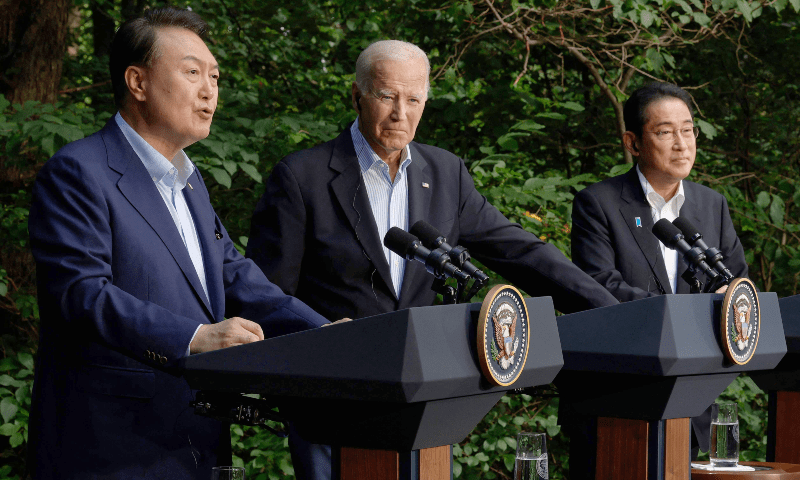
US President Joe Biden hosted the summit — described as launching a “new chapter” of close, three-way security cooperation — at the Camp David presidential retreat.

The three leaders said in a joint statement on Friday they opposed the “dangerous and aggressive behaviour” of China in maritime disputes in the East and South China Sea.

Beijing hit back on Monday, saying the leaders had “smeared and attacked China on Taiwan-related and maritime issues, grossly interfered in China’s internal affairs and deliberately sowed discord between China and its neighbours”.

Beijing says leaders interfered in internal affairs and deliberately sowed discord between its neighbours

It also expressed “strong dissatisfaction and firm opposition and has lodged solemn representations with relevant parties”, foreign ministry spokesperson Wang Wenbin said at a regular news briefing.

Camp David marks the first time the leaders of the United States, Japan and South Korea have met for a standalone summit, rather than on the sidelines of a larger event.

“If relevant countries really care about peace and stability in the Taiwan Strait, they should abide by the One-China principle, stop condoning and supporting separatists advocating for Taiwan independence and their activities, and take concrete actions to safeguard regional peace and stability,” Wang said on Monday.

“The Taiwan question is purely China’s internal affair. Solving the Taiwan question is China’s own business”, he added.

Biden praised the “political courage” of South Korean President Yoon Suk Yeol and Japanese Prime Minister Fumio Kishida in turning the page on historical animosity.

Such a summit would have been unthinkable until recently due to the legacy of Japan’s harsh 1910-1945 occupation of the Korean peninsula.

The three leaders agreed to a multi-year plan of regular exercises in all domains and made a formal “commitment to consult” during crises, with Biden saying they would open a hotline. The leaders also agreed to share real-time data on North Korea and to hold summits every year.

On Monday, Wang slammed the grouping as an example of an “attempt to revive Cold War mentality by inciting division and confrontation represented by various closed and exclusive small circles”.

Biden insisted that the Camp David summit was not targeted at China. But in the joint statement, the leaders said they “strongly (opposed) any unilateral attempts to change the status quo in the waters of the Indo-Pacific”.

Thailand’s former PM Thaksin Shinawatra has been jailed upon returning to the country after 15 years in exile.

But many believe he has struck a deal that will keep him from serving more than a short period in prison.

He arrived on Tuesday morning in a private jet, ahead of a vote for the next Thai leader – the frontrunner is from Mr Thaksin’s Pheu Thai party.

He has sentences of up to eight years outstanding from criminal cases he says were politically motivated.

Mr Thaksin, Thailand’s most successful elected leader, has long been feared by conservative royalists, who have backed military coups and contentious court cases to weaken him.

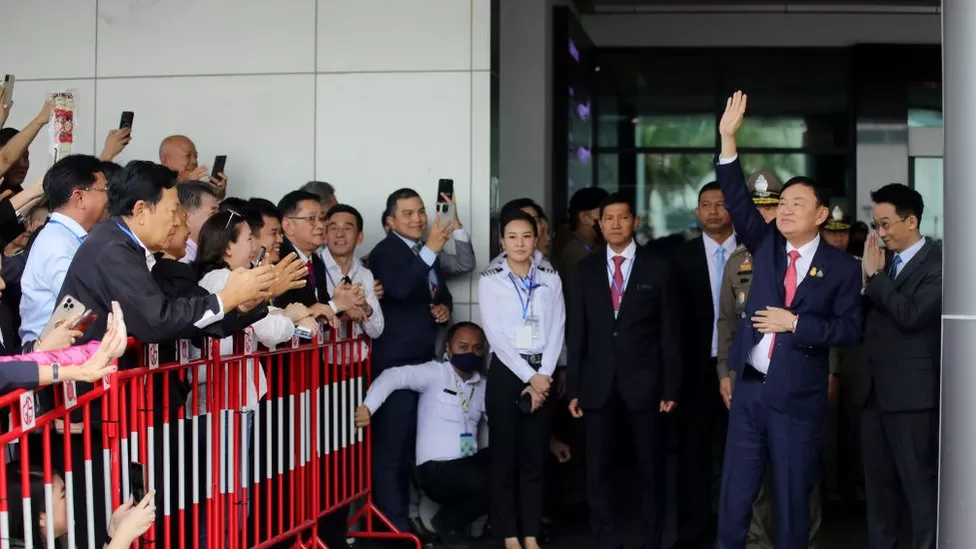
But now the brash, politically-ambitious telecoms tycoon is back – he landed in Bangkok’s main airport to cheers from hundreds of loyal supporters who had gathered overnight to see him. Flanked by his two daughters and son, he emerged briefly from the airport terminal and paid his respects to a portrait of the king and queen.

He was immediately taken to the Supreme Court where he was sentenced to eight years on the outstanding charges, and then to Bangkok Remand Prison. The department of corrections has said that he “is safe under the supervision of the staff”.

Outside the Don Mueang Airport, 63-year-old Samniang Kongpolparn had been waiting since Monday evening to see Mr Thaksin. She, like many of the other supporters, had travelled from Surin province in the northeast, the stronghold of Mr Thaksin’s party in past decades.

“He’s the best prime minister we’ve ever had. Even though I won’t get to see him today, I still wanted to come to show him support,” she said. “I’m ok with them reconciling with the pro-military government, or else we’re stuck with the senators. We don’t want that.”

Mr Thaksin greets supporters after arriving in Bangkok

Mr Thaksin’s Pheu Thai party is expected later today to join a coalition government – a byzantine process which in three months has taken Thailand full circle.

It began with the heady hopes of a new dawn led by the radical young Move Forward party, which won the most seats in the May election.

Move Forward initially formed a partnership with Pheu Thai but it’s now certain that the coalition will include almost everyone but the reformers, including two parties led by former coup-makers – a deal with its sworn enemies that Pheu Thai vowed it would not do.

Pheu Thai insists the two developments are unconnected. Few people believe that.


It is true that Pheu Thai’s hands have been tied by the unelected senate, a 250-seat constitutional landmine planted in Thailand’s political landscape by the military junta which ruled for five years after a 2014 coup.

And Pheu Thai’s bargaining position was weakened by its poorer-then-expected performance in the election, when it lost a lot of support to Move Forward and for the first time was relegated to second place.

The senators, all appointed under the junta, are allowed to join the 500 elected MPs in voting for the new prime minister. Their thinly-disguised remit is to block any party which might threaten the status quo – the nexus of monarchy, military and big business which has dominated decision-making in Thailand for decades.

Unsurprisingly they refused to back the Move Forward-led coalition with Pheu Thai, despite its commanding majority in the lower house. When it was Pheu Thai’s turn to negotiate a new coalition, its need for senate support meant it had to take in some of its former opponents.

Many of the supporters had come from the northeast, a Thaksin stronghold

However some Pheu Thai politicians argue that the party should have held out for a better deal, by refusing to be in a government with the most hard-line conservative groups. Any minority administration formed without Pheu Thai and Move Forward would quickly collapse, because the senators cannot join normal parliamentary votes on issues like the budget.

But the Pheu Thai leadership was not willing to wait; it even invited the ultra-royalist party United Thai Nation to join the coalition, whose leaders have in the past been virulently critical of the Shinawatra family and their supporters, and were instrumental in ousting the last Pheu Thai government led by Thaksin’s sister Yingluck. That these two factions will now sit together in the same government is a mark of how far Thai politics has shifted.

In the end for the ultra-royalists the perceived threat posed by Move Forward, and by a younger generation of Thais demanding a conversation about the power and wealth of the monarchy, eclipsed their long feud with the Shinawatra family.

For the Shinawatras, and Pheu Thai’s more conservative, business-minded elements, getting into government again and guaranteeing the deal to bring Thaksin back, have been bigger priorities than worrying about the party’s reputation.

But there are those, even within Pheu Thai, who are horrified by the cynical pragmatism of this deal. They are warning that the party will lose even more of its once-passionate grass-roots supporters, and lose, perhaps forever, the dominance it held over electoral politics in Thailand for two decades.

King Charles III and Queen Camilla have come to Balmoral Castle for their first summer residence in Scotland since the death of Queen Elizabeth II

The King is continuing his mother’s tradition of taking a summer holiday on Royal Deeside in Aberdeenshire.

He is expected to stay for three weeks and be there on the first anniversary of the Queen’s death on September 8.

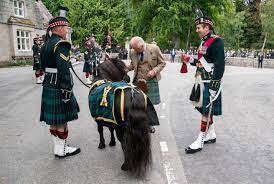
His visit began by inspecting troops from Balaklava Company, 5th Battalion of the Royal Regiment of Scotland.

The King was also introduced to the regiment’s official mascot, the Shetland pony Corporal Cruachan IV.


The inspection ceremony marks the formal welcome of the monarch to the Aberdeenshire castle.

Last August it was held privately inside the grounds for the comfort of the Queen.

She died at the castle a month later at the age of 96. She was the first monarch to die at Balmoral.

The last photograph of Queen Elizabeth II was taken at Balmoral

The 50,000 acre estate sits 50 miles to the west of Aberdeen, within the Cairngorm National Park. It has long been established as the private summer home of the Royal Family.

It was bought by Prince Albert, the husband of Queen Victoria, in 1852 and has been handed down through the generations.

The estate includes grouse moors, forestry and farmland and is home to a large population of red deer.

It is the private property of the monarch and is not part of the Crown Estate.

Queen Elizabeth II with Philip and their children at Balmoral in 1960

Queen Elizabeth II hosted numerous royal garden parties there and enjoyed watching events at the nearby Braemar Highland Games with other members of the Royal Family.

She spent her final months at Balmoral and held an audience there with Liz Truss, the 15th Prime Minister of her 70 year reign, just two days before her death.

Thousands of people lined the route as the Queen’s body was driven from Balmoral to Holyroodhouse in Edinburgh.

King Charles grew up visiting the castle every year and the estate was the inspiration for his 1980 children’s book The Old Man of Lochnagar.

He inherited the neighbouring Birkhall estate from his grandmother, the Queen Mother, upon her death in 2002.

He honeymooned there with Queen Camilla in 2005 and the couple later self-isolated at the house after testing for Covid-19 in March 2020.